
Quick answer: An abutment cost is the price of the connector that joins a dental implant body to a crown, bridge, or denture—not automatically the price of the implant or final tooth. A useful quote identifies the component, screw, material, stock or custom design, laboratory work, fitting, crown, reviews, and possible maintenance separately.
Searching for abutment cost can produce confusing answers because the word “abutment” is used for several components and because clinics do not always package implant treatment in the same way. A healing abutment that temporarily shapes the gum is different from the definitive prosthetic abutment that supports the restoration. The implant body in the jaw, the fixation screw, and the crown or bridge are also distinct parts. A headline price can therefore describe one small component, a laboratory-made unit, or an almost complete restored tooth.
This guide explains how to read an abutment cost estimate without assuming a fixed price, diagnosis, or guaranteed result. The appropriate component depends on the implant system, position, gum contour, bite, available restorative space, and planned crown or bridge. Those findings require a clinical examination and suitable records. The aim here is to help you request an itemised plan, compare like with like, and recognise costs that may sit outside an advertised figure.
What does abutment cost mean in implant dentistry?
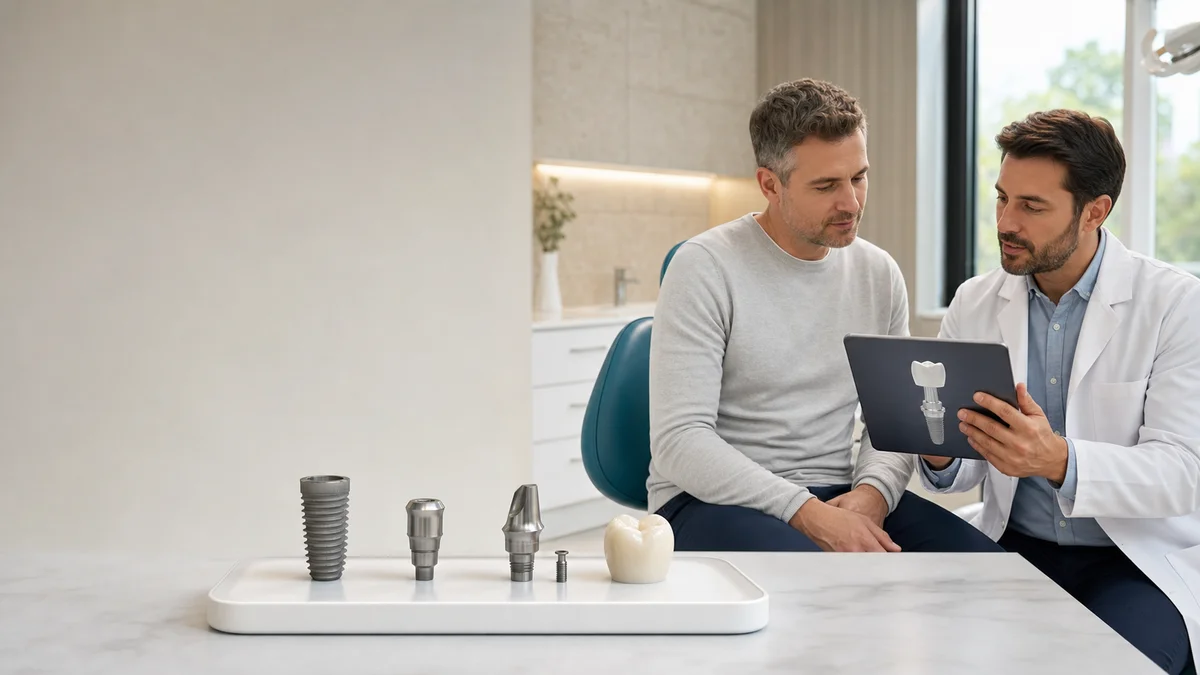
The US Food and Drug Administration describes a dental implant system as including an implant body and an implant abutment, and it may also include an abutment fixation screw. The implant body is placed in the jaw. The abutment attaches to it and passes through the gum to support an artificial tooth. A crown, bridge, or denture is then made over or onto that restorative connection. This component map matters because an abutment cost is not automatically an “implant cost” or a “crown cost.”
Several stages can use components that sound similar. A cover screw may seal the implant during submerged healing. A healing abutment can protrude through the gum while the tissue matures. A definitive abutment is selected or designed for the final restoration. A multi-unit abutment can create a restorative platform for certain multi-implant bridges. Temporary abutments may support provisional restorations. Each has a different purpose, and a quote should state exactly which one it prices.
The abutment cost may represent only a boxed component, or it may include design, manufacture, fixation screw, clinical fitting, radiographic confirmation when indicated, torqueing, and a restorative scan. Some clinics combine the definitive abutment and crown into one restorative fee. Others list every part. Neither format is inherently wrong, but the scope must be clear before two estimates can be compared.
- Implant body: the part surgically placed in bone to act as the foundation.
- Cover screw or healing component: used during a stage of tissue healing, depending on the protocol.
- Definitive abutment and fixation screw: the connection that supports the planned restoration.
- Final restoration: the visible crown, bridge, overdenture, or full-arch prosthesis.
- Clinical and laboratory services: examination, records, design, manufacture, fitting, adjustment, and reviews.
Ask the provider to point to each charged item on a diagram or written plan. That simple request prevents a low abutment cost from being mistaken for a finished tooth and helps reveal whether a second healing component, a replacement screw, or additional laboratory stage is likely.
10 factors that can change abutment cost
There is no responsible universal figure because the clinical objective and manufacturing pathway vary. These ten factors explain why one abutment cost differs from another. They are a comparison framework, not a calculator for self-treatment.
- Component purpose. A simple healing abutment, definitive single-tooth abutment, multi-unit component, overdenture attachment, and temporary component do different jobs. Confirm which is being quoted.
- Stock or custom design. A prefabricated stock abutment comes in standard dimensions. A custom abutment is designed for the specific implant position, tissue contour, restorative space, and proposed crown, adding digital or laboratory work.
- Material. Titanium, zirconia, and hybrid designs using a titanium base have different indications and workflows. Material alone does not establish quality or suitability.
- Implant-system compatibility. The connection must match the implant brand, platform, and geometry. Traceable components and future availability can influence the abutment cost.
- Position and angulation. A well-positioned implant may accept a standard design. A challenging emergence, limited height, or angled restorative path may require additional planning or a custom solution.
- Restoration type. A single crown, implant bridge, overdenture, or full-arch restoration uses different components and quantities. A per-unit figure may not reflect the complete reconstruction.
- Digital or conventional records. Scan bodies, digital impressions, conventional impression components, models, design files, and verification steps use different materials and professional time.
- Dental laboratory work. Design, milling, finishing, quality checks, gingival contour development, and a possible remake are not always included in a component-only price.
- Clinical fitting. Removing a healing component, cleaning the connection, trying in the abutment, checking fit, tightening to the prescribed protocol, and adjusting the bite are professional services.
- Aftercare and contingencies. Follow-up, screw access, crown removal, component replacement, repair, or management of complications may be included for a defined period or billed separately.
Location, clinician and laboratory fees, taxes, currency, and operating costs also affect the final amount. A higher abutment cost does not prove that a component is better, and a lower one does not by itself prove that it is unsafe. What matters is whether the proposal is compatible, traceable, clinically appropriate, maintainable, and transparently priced.
Stock versus custom abutment cost
A stock abutment is manufactured in preset shapes, diameters, heights, and angles. It can be an efficient choice when the implant position, tissue level, restorative clearance, and crown design fit those options. A custom abutment is digitally or conventionally designed for the individual site. It may allow the technician and dentist to control the emergence profile, margin location, angulation, or crown support more specifically. That extra design and manufacturing work can make the custom abutment cost different.
“Custom” does not automatically mean “clinically superior.” A systematic review and meta-analysis indexed in PubMed compared digitally customised and prefabricated abutments and did not find significant short-term differences across several peri-implant clinical and aesthetic outcomes in the included studies. Evidence, follow-up duration, case selection, and the proposed restoration all matter. The design should solve a clinical or restorative need rather than serve as a luxury label.
A useful abutment cost comparison asks what the custom design changes. Will it improve the path of insertion, support a cleansable contour, place the restoration margin more appropriately, manage an implant angle, or accommodate restricted space? If the answer is simply “custom is better,” ask for a case-specific explanation. Likewise, a stock component should not be chosen solely because its initial price is lower if it creates a compromised, difficult-to-clean restoration.
Custom healing abutments are another category and should not be confused with definitive abutments. Recent systematic-review evidence suggests they can provide predictable tissue results in immediate single-tooth implant situations, but it did not show that they eliminate expected tissue dimensional changes compared with standard healing components. If a custom healing device appears in the plan, ask whether its fee is separate from the definitive abutment cost.
How material choices affect abutment cost
Titanium is widely used for implant and abutment components. Zirconia and hybrid approaches may be considered in selected restorative situations, particularly when colour, tissue thickness, implant position, strength, connection design, and the planned crown are assessed together. The FDA notes that dental implant systems commonly use titanium or zirconium oxide and that recognised material and device-evaluation standards contribute to safety assessment.
The material line on an abutment cost estimate should never be read in isolation. A titanium abutment can be stock or custom. A zirconia restoration may be manufactured over a titanium base rather than connecting directly in the same way as a one-piece metal component. Design thickness, connection fit, screw access, crown material, polishing, and laboratory protocol are at least as important as the broad material name.
For an anterior tooth, gum thickness and aesthetic expectations may influence how the restorative team manages colour. For a posterior tooth, bite forces and available space may receive greater emphasis. These are tendencies, not rules. Bruxism, opposing teeth, implant angulation, hygiene access, and restoration type can change the discussion. The safest question is not “Which material has the highest abutment cost?” but “Why is this material and connection appropriate for my specific restoration?”
Ask whether the quoted material includes a genuine or compatible component, who manufactured it, whether the laboratory documentation is available, and how replacement parts could be obtained later. No material makes an implant maintenance-free or guarantees that a screw will never loosen, a crown will never chip, or surrounding tissue will never become inflamed.
A decision table for comparing abutment quotes
The table below helps organise a conversation after an examination. It does not recommend one component for every patient. Use it to see whether two abutment cost offers describe the same purpose and level of service.
| Quote category | What to confirm | When it may be discussed | Hidden-cost question |
|---|---|---|---|
| Standard healing abutment | Diameter, tissue height, implant compatibility, fitting visit | Soft-tissue healing after implant placement or exposure | Is it temporary, and is a definitive component charged later? |
| Custom healing abutment | Design method, material, tissue-shaping objective | Selected immediate or staged sites where a customised contour is planned | Does this include design and manufacture but exclude the final abutment? |
| Stock definitive abutment | Material, height, angle, margin, fixation screw, crown interface | When standard geometry suits the implant position and restoration | Are modification, scan, fitting, and crown separate? |
| Custom definitive abutment | CAD/CAM design, material, titanium base if used, laboratory record | When individual emergence, space, angle, or crown support is needed | Are design changes, remakes, and the definitive crown included? |
| Multi-unit or attachment component | Number of units, angles, prosthetic screws, cylinders, restoration type | Selected bridges, full-arch prostheses, or overdentures | Is the price per component or for the entire arch? |
One clinic may fold the scan, laboratory design, abutment, screw, and crown into a restorative package. Another may show five lines. Calculate the complete planned stage before judging the abutment cost. If a component is provisional, clarify whether it will be reused, removed, or replaced and what happens to the fee if the treatment plan changes.
What a complete itemised quote should include
A reliable estimate begins with the full implant restoration, even if you are currently investigating only the abutment cost. The dentist should explain what has already been completed, what is planned now, and what remains conditional. A person with an integrated implant body needs a different estimate from someone who still requires extraction, grafting, or implant placement.
- Consultation, medical and dental history, clinical examination, and personalised risk assessment.
- Two-dimensional radiographs and three-dimensional imaging only when clinically indicated.
- Existing implant identification, connection assessment, and retrieval of prior component records.
- Implant placement, exposure, or healing-stage services if these have not already occurred.
- Healing abutment, definitive abutment, fixation screw, scan body, impression parts, and models.
- Custom design and laboratory manufacture where applicable.
- Temporary crown, definitive crown, bridge, denture, or full-arch restoration.
- Clinical try-in, fit assessment, prescribed tightening protocol, bite adjustment, and screw-access closure.
- Defined follow-up visits, hygiene support, imaging, repair policy, and long-term maintenance.
Also ask whether medication, sedation, removal of an old restoration, screw retrieval, management of damaged internal threads, replacement of a fractured component, taxes, shipping, and emergency appointments are included. These may not apply, but their status should be clear. A written abutment cost plan should distinguish confirmed care from possible contingencies that would require further assessment and consent.
When an existing implant was placed elsewhere, bring the implant card, invoices, radiographs, and any manufacturer or model information. Guessing the connection can lead to delays, extra imaging or parts, and a higher abutment cost. The FDA advises patients to ask for the implant system’s brand and model and retain it for their records. Traceability is especially useful if maintenance is needed years later.
Does the abutment cost include the crown?
Often it does not. The abutment supports the restoration; the crown is the visible artificial tooth. A laboratory may make both within one coordinated workflow, but they remain different components. Some screw-retained restorations combine the crown and abutment interface into an assembly that the patient experiences as one piece. Cement-retained restorations use a crown cemented over an abutment. The appropriate approach depends on the implant position, screw-access location, retrievability, cement control, aesthetics, bite, and clinician judgement.
Ask whether the quoted abutment cost includes the definitive crown, crown material, shade work, temporary restoration, scan, laboratory fee, trial fitting, adjustment, and final insertion. If the crown is separate, request its current estimate at the same time. A component price is not a meaningful budget if it leaves the tooth unrestored.
Also clarify whether the fixation screw is new and included, whether an additional prosthetic screw is recommended, and how screw-access material or crown cement is billed. The FDA lists a feeling that a restoration is loose or twisting as a possible sign of abutment screw loosening. Prompt assessment matters; repeatedly tightening a loose restoration without investigating the cause is not a long-term maintenance plan.
Diagnosis, fit, and implant-system compatibility
An online abutment cost cannot confirm which connection is present or whether the implant is healthy enough to restore. The clinician assesses the implant’s position, stability, surrounding gum and bone, available space, neighbouring and opposing teeth, and the condition of the internal connection. Symptoms such as pain, swelling, bleeding, discharge, mobility, numbness, or a changed bite need clinical evaluation rather than a parts order.
Component compatibility is not only about diameter. Implant brands can have different platforms, connection shapes, screw designs, materials, and prescribed tightening protocols. The team should know what system is in place and verify that the planned abutment is intended for that connection. If a third-party compatible part is proposed, ask how compatibility, regulatory status, traceability, warranty terms, and future supply are addressed.
Fit should be checked according to the clinical situation and manufacturer’s protocol. The connection needs to be clean; the abutment should seat as planned; the screw must not be improvised; and the restoration must be designed for hygiene and a balanced bite. These professional steps help explain why an abutment cost is more than the wholesale price of a small metal or ceramic object.
Overall health and habits matter too. The FDA advises discussing health conditions and notes that smoking can impair healing. Diabetes control, periodontal history, medicines, bruxism, oral hygiene, and ability to attend maintenance can affect risk and design. This information supports individual planning; it should not be used to make a diagnosis from an online checklist.
Insurance, financing, and abutment cost
Dental benefit plans vary widely. They may treat implant surgery, an abutment, and a crown as separate services, apply annual maximums, waiting periods, frequency limits, network rules, or an alternative benefit, or exclude implants. The American Dental Association explains that PPO, DHMO, indemnity, and direct-reimbursement arrangements use different payment structures. Your personal abutment cost after benefits therefore depends on the exact plan and claim, not a general statement that insurance “covers implants.”
Request a written pretreatment estimate when available, but understand that it may not guarantee payment. Confirm the procedure descriptions, benefit-year timing, deductible, coinsurance, annual maximum, missing-tooth clause if applicable, and whether the dentist and laboratory are in network. Ask what you would owe if the plan pays less than estimated or if treatment crosses into a new benefit year.
A payment plan can spread the abutment cost but does not reduce the treatment price. Review interest, origination fees, missed-payment terms, cancellation rights, and refund arrangements before using credit. If the plan changes after examination or healing, the clinic should explain the clinical reason and financial consequence before proceeding, except where urgent care is required.
Never choose a component solely because an insurer reimburses it or because a financing offer expires. Clinical appropriateness, informed consent, compatibility, and maintainability remain the treatment team’s priorities. A second opinion can be reasonable when a proposed restoration is complex, irreversible, or difficult to understand.
Travel, records, and continuity of care
Patients sometimes compare abutment cost across countries. Currency and clinic fees may differ, but the comparison should include travel, accommodation, time away from work, extra visits, temporary components, laboratory remakes, and a possible return for adjustment. A low component quote can become less predictable if the implant system is unidentified or local replacement parts are difficult to obtain.
The CDC’s current medical-tourism guidance includes dental care and recommends planning follow-up, understanding what services are included, reviewing insurance, and obtaining complete records. Complications can occur wherever care is delivered. Before travel, agree on who will provide routine reviews and who will manage a loose screw, chipped crown, inflammation, or urgent symptoms after you return.
- Request the implant brand, model, platform, diameter, length, and placement date.
- Keep the abutment and screw reference, material, laboratory invoice, and restoration details.
- Obtain relevant radiographs or scans in a transferable format and a clinical summary in a language your local provider can use.
- Confirm the planned number and timing of visits, healing restrictions, and fit or adjustment appointments.
- Ask who pays for a replacement component, laboratory remake, added travel, or local emergency visit.
For an individual assessment, you can review Redent Clinic’s approach on the English home page and use the Redent Clinic contact page to arrange a consultation. Remote records can support initial discussion, but a definitive abutment cost and restoration plan depend on an appropriate clinical examination.
Maintenance, complications, and long-term value
No abutment or crown is guaranteed for life. The FDA lists potential implant-system problems including screw loosening, difficulty cleaning, infection, bite problems, and implant failure. A complete abutment cost discussion therefore includes what maintenance is expected and how complications are evaluated. The cheapest initial component may not be the least expensive over time if it is hard to clean, cannot be retrieved, lacks traceability, or is difficult to replace.
Daily care should follow instructions for the specific restoration. Depending on the design, the dentist or hygienist may recommend floss, interdental brushes, water irrigation, or other aids. Professional reviews can assess gum health, plaque control, the bite, screw or crown stability, and bone levels when radiographs are clinically indicated. Long-term hygiene visits and protective appliances are commonly separate from the original abutment cost.
Contact a dental professional promptly if the restoration moves, twists, clicks, feels newly high in the bite, traps food differently, or becomes painful. Increasing swelling, bleeding, discharge, a bad taste, fever, or numbness also needs assessment. Difficulty breathing or swallowing, rapidly spreading facial swelling, or uncontrolled bleeding requires urgent emergency care. Online articles cannot determine the cause or urgency for one person.
Warranty language should be read carefully. It may cover a laboratory defect for a limited period but exclude biological complications, accidental damage, bruxism, missed maintenance, or treatment by another provider. Ask whether the warranty covers the component, crown, labour, travel, and diagnostic visits. “Lifetime guarantee” marketing should never replace a balanced explanation of risk and maintenance.
Questions to ask before accepting an abutment cost quote
Take the estimate to your consultation and mark anything that is unclear. A well-documented abutment cost should withstand these practical questions:
- Is this for a healing abutment, definitive abutment, multi-unit component, or attachment?
- What implant brand, model, platform, and connection is present, and how was it verified?
- Is the component stock or custom, and what case-specific reason supports that choice?
- What is the material, manufacturer, regulatory status, and traceability record?
- Are the fixation screw, scan or impression, laboratory design, try-in, fitting, and adjustment included?
- Does the figure include the temporary or definitive crown, bridge, or denture?
- What possible findings could change the plan and the abutment cost?
- Who is responsible for follow-up, repairs, and urgent care, especially if treatment occurs abroad?
- Which maintenance visits are included, for how long, and what is billed separately?
- What records will I receive if I move or change dentists?
Clear answers should relate to your implant and proposed restoration. Be cautious if a provider cannot identify the component, dismisses health history, promises a guaranteed result, or pressures you to pay before diagnosis. Transparent consent gives you time to consider alternatives and states when a revised estimate would require approval.
Frequently asked questions about abutment cost
Is an abutment included in the implant price?
Sometimes, but not always. “Implant price” may refer only to the implant body and surgical placement, while the healing component, definitive abutment, screw, crown, and laboratory work are separate. Ask for every part and professional service in writing. Only then can you tell whether the advertised figure includes the abutment cost or the completed restoration.
Why is a custom abutment more expensive than a stock one?
A custom abutment usually includes site-specific design, digital or conventional records, manufacturing, finishing, and laboratory review. It may be selected to manage tissue contour, implant angulation, restorative space, or crown support. That does not mean every case needs one. Ask what problem the design solves and how it changes the total abutment cost.
Is the healing abutment the same as the final abutment?
No. A healing abutment is generally used while the gum tissue heals or is shaped. The definitive prosthetic abutment supports the final crown, bridge, or other restoration. Some protocols use customised healing components, but they remain distinct from the final restorative component. Confirm whether both appear in the abutment cost estimate.
Does abutment cost include the crown and screw?
It depends on the clinic’s billing format. The screw may be packaged with the abutment, while the crown, design, scan, and fitting are frequently separate. In other plans, the complete restorative stage is bundled. Request the brand, component, screw, laboratory service, crown, fitting, and review lines so the total abutment cost is unambiguous.
Can an abutment from any brand fit my implant?
No. Connections, platforms, screw dimensions, and protocols differ. The component must be intended and verified for the implant system and clinical design. Bring the implant card and records when possible. If a compatible third-party part is considered, discuss traceability, regulatory status, warranty, fit, and future availability before accepting the quoted abutment cost.
Can a loose abutment simply be tightened at home?
No. Movement can have several causes, and continued loading may damage the screw, crown, connection, or surrounding tissues. Do not use household tools or adhesive. Avoid chewing on the area and arrange prompt dental assessment. The clinician can identify the moving part, evaluate the bite and connection, and explain any repair or new abutment cost.
Will insurance pay for an implant abutment?
Coverage depends on the individual plan, codes, network, limits, waiting periods, and exclusions. Some plans separate implant placement, abutment, and crown benefits or reimburse an alternative service. Obtain a pretreatment estimate when available, but confirm that it is not a payment guarantee. Ask the insurer for your expected share of the abutment cost in writing.
How long should an implant abutment last?
There is no guaranteed lifespan. Longevity depends on component fit, restorative design, bite, material, health, hygiene, smoking, bruxism, maintenance, and unexpected events. Screws can loosen, crowns can wear or fracture, and tissues can become inflamed. Regular review helps identify changes early but cannot promise that a future abutment cost will never arise.
What records should I receive after fitting?
Request the implant and abutment manufacturer, model or reference, platform, material, screw details, laboratory record, fitting date, relevant images, invoice, and maintenance instructions. Keep the treatment summary and emergency contact route. These records help another dentist identify parts and avoid unnecessary delay or duplicate abutment cost if care is transferred.
Clinical sources and further reading
- US Food and Drug Administration: Dental Implants—What You Should Know
- US Food and Drug Administration: Endosseous Dental Implants and Abutments Guidance
- MouthHealthy by the American Dental Association: Implants
- PubMed: Digitally Customized and Prefabricated Abutments—Systematic Review and Meta-analysis
- PubMed: Custom Healing Abutments—Systematic Review and Meta-analysis
- US Centers for Disease Control and Prevention: Medical Tourism
- American Dental Association
- World Health Organization: Oral Health
Sources were checked on 1 August 2026. This educational article supports informed discussion and does not replace an examination, diagnosis, or personalised treatment plan. The content is prepared for clinical review by Dentist Esma Çevrük Çakır.