
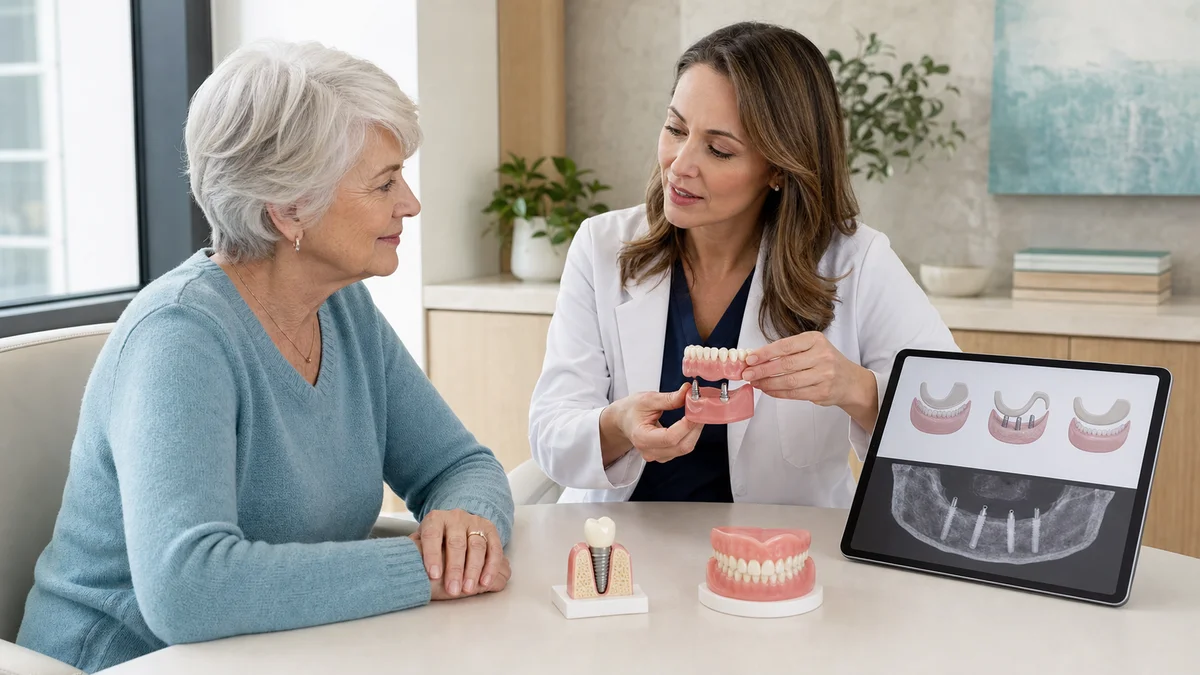
Quick answer: affordable dental implants for seniors are not defined by age, the fewest implants, or the lowest advertisement. A cost-conscious plan may preserve treatable teeth, replace only priority gaps, stabilize a denture with implants, or stage care. Compare examination, imaging, surgery, implant components, temporary and final teeth, maintenance, travel, and realistic alternatives. Medical and dental assessment is required before a reliable personal quote.
affordable dental implants for seniors should mean care that is clinically appropriate, financially understandable, maintainable at home, and supported after treatment. It should not mean using an implant where a tooth can be predictably preserved, removing healthy teeth to fit a package, or choosing a restoration that the patient cannot clean. A small headline price may omit the abutment, crown, overdenture, temporary teeth, grafting, follow-up, or repairs. A higher proposal may describe a completely different treatment.
Chronological age alone does not decide implant candidacy. Overall health, oral disease, bone and gum condition, medications, smoking, healing capacity, dexterity, cognition, caregiver support, bite, and personal priorities can matter more than the number on a birthday card. The National Institute on Aging lists implants among several ways to replace missing teeth and advises older adults to tell the dentist about medical conditions and medications. The FDA likewise emphasizes overall health, risks, implant records, hygiene, and regular review.
This guide helps seniors and families compare pathways without diagnosing a specific person or promising a result. It does not offer a universal price because a reliable total requires examination and appropriate imaging. Instead, it shows how to define value, identify exclusions, verify Medicare or other benefits, and plan for long-term care.
What affordable dental implants for seniors should mean
The word “affordable” has at least three dimensions: the initial treatment amount, the total cost over time, and the cost of keeping the result usable. A plan can look inexpensive initially but become difficult to maintain if replacement parts are unavailable, hygiene is unrealistic, or repeated travel is required. Conversely, the most complex fixed solution is not automatically the best value. affordable dental implants for seniors align the treatment objective with the least complex predictable pathway that the patient can clean, attend, and support financially.
Begin with the problem, not the product. Is one tooth missing, several teeth absent, a complete denture unstable, or an entire arch failing? Does the patient mainly want improved chewing, less movement, replacement of a visible tooth, easier hygiene, or a non-removable restoration? Each goal points to different alternatives. A single implant crown, short implant bridge, implant-retained overdenture, fixed full-arch bridge, tooth-supported bridge, partial denture, and conventional complete denture do not have the same surgery, materials, maintenance, or total.
A safe affordable dental implants for seniors discussion also respects a person’s expected care setting. Someone who performs detailed home care independently may manage a different design from a person with arthritis, reduced vision, tremor, memory change, or reliance on a caregiver. Accessibility and cleaning are not secondary concerns; they are part of whether the restoration is sustainable.
Age is not the only eligibility question
There is no ethical shortcut such as “over 65 means suitable” or “over 80 means unsuitable.” Older adults range from fully independent and medically stable to frail or medically complex. ADA information on aging and dental health notes that older patients may have multiple conditions, use several medicines, and experience physical, sensory, or cognitive changes that complicate home care and communication. affordable dental implants for seniors therefore require individualized risk assessment rather than an age-based package.
Medical history and medication review
The dental team needs an up-to-date list of prescriptions, over-the-counter medicines, supplements, allergies, diagnoses, and previous surgeries. Anticoagulants, antiplatelet medicines, antiresorptive drugs, immune-modifying therapy, diabetes medicines, and drugs that cause dry mouth may influence assessment or coordination. The patient should never stop or change a prescribed medicine solely on internet advice. When indicated, the dentist and treating physician coordinate the plan.
A quote for affordable dental implants for seniors should not conceal medical coordination under a generic “clearance” fee. Ask what information is needed, who requests it, whether additional monitoring changes the setting, and what alternatives exist if surgery is deferred. Medical complexity may affect timing, sedation, or candidacy, but it does not automatically rule out all tooth-replacement care.
Diabetes, smoking, and healing
The FDA notes that uncontrolled diabetes, local infection, and smoking can contribute to delayed healing or implant failure. Risk is not assessed by a diagnosis label alone; current control, complications, oral hygiene, and the planned procedure matter. A responsible team may recommend disease management, smoking cessation support, or periodontal treatment before surgery. A low affordable dental implants for seniors advertisement should never override the need to reduce modifiable risk.
Gum health and remaining teeth
Untreated periodontitis threatens natural teeth and can complicate implant care. Existing teeth should be assessed for restorability, periodontal support, strategic value, and hygiene. Preserving a maintainable tooth may reduce surgery and cost, while retaining a hopeless tooth can prolong infection and undermine a prosthesis. The decision belongs in a comprehensive plan rather than a sales package.
Accordingly, affordable dental implants for seniors begin with controlling disease and documenting which teeth can still be maintained.
Dexterity, vision, cognition, and caregiver support
An implant restoration must be cleanable by the patient or caregiver. Fixed full-arch bridges often require special brushes, floss-threading tools, or water irrigation in addition to professional care. A removable overdenture can be cleaned outside the mouth but must be handled, inserted, and removed correctly. affordable dental implants for seniors should match the person’s present abilities and consider how support might change.
Truly affordable dental implants for seniors remain manageable when vision, grip, memory, mobility, or caregiver arrangements change.
Preserve, replace, or stabilize: four cost-conscious pathways
No single pathway is cheapest for everyone. The most economical sound choice depends on the condition being treated and the patient’s goals. affordable dental implants for seniors can include a limited implant plan, but they can also mean avoiding unnecessary implant treatment.
| Pathway | Potential value | Main cost drivers | Maintenance questions | When to ask about it |
|---|---|---|---|---|
| Preserve and restore treatable teeth | Avoids extraction and implant surgery where prognosis is acceptable | Periodontal, endodontic, restorative, or protective care | Decay prevention, gum care, repairability | Can strategic teeth be maintained predictably? |
| Conventional partial or complete denture | No implant surgery; can restore many missing teeth | Clinical records, laboratory stages, adjustments | Fit, sore areas, reline, repair, remake | Can a well-designed non-implant prosthesis meet the goal? |
| Implant-retained removable overdenture | May improve denture retention with a removable design | Implants, attachments or bar, denture, possible grafting | Attachment wear, cleaning, reline, repair | Is movement the main problem and is removability acceptable? |
| Fixed implant crown, bridge, or full arch | Non-removable tooth replacement when clinically appropriate | Implants, abutments, temporary and final restoration, laboratory | Hygiene access, screw or material repair, professional review | Does fixed care justify its complexity and cleaning burden? |
The table is a conversation tool, not a prescription. A conventional denture may be an appropriate definitive plan for one person and an unsatisfactory compromise for another. Two implants retaining a lower overdenture may address movement in a suitable case, but no fixed implant number applies automatically to every upper or lower jaw. affordable dental implants for seniors must be designed from anatomy, prosthetic support, bite, and patient preference.
In practice, affordable dental implants for seniors compare only options that can reasonably meet the same functional and hygiene objective.
The 10 components of a complete implant quote
To compare affordable dental implants for seniors, place every proposal into the same structure. Ask which lines are included, which are conditional, and which belong to future maintenance.
Reliable affordable dental implants for seniors quotes separate surgical devices, professional procedures, prosthetic teeth, and follow-up instead of hiding them in one package label.
1. Examination and diagnostic records
A personal plan may require oral examination, periodontal charting, assessment of existing teeth and dentures, bite evaluation, and appropriate radiographs. Three-dimensional imaging may be indicated for anatomy and implant positioning, but it does not replace clinical assessment. Confirm whether consultation, radiographs, scan interpretation, photographs, and diagnostic models are part of the quote.
2. Disease control and extractions
Active gum disease, decay, infected teeth, or denture-related tissue injury may need treatment before implantation. Extractions should be justified tooth by tooth; healthy or maintainable teeth should not be removed merely to simplify a package. affordable dental implants for seniors should show the cost and timing of necessary disease control separately from implant placement.
3. Implant device and surgical placement
The implant body is a medical device placed in the jaw. The device and surgical service may be different line items. The FDA advises patients to ask for the implant brand and model and keep the information in their records. Ask how many implants are planned, why each site is needed, what device system is proposed, and whether routine surgical supplies and post-operative reviews are included.
4. Bone or soft-tissue procedures
Grafting is not required for every patient. When suggested, the site, material, timing, clinical reason, alternatives, effect on temporary teeth, and additional visits should be explained. A quote that says “graft extra” without a decision rule is difficult to compare. affordable dental implants for seniors can show a base scenario and a conditional scenario tied to a specific finding.
5. Abutments and connecting parts
The abutment connects the implant body to a crown, bridge, or denture attachment. A full-arch plan may use multi-unit components; an overdenture may use individual attachments or a bar. These parts affect laboratory space, cleaning, component availability, and repair. “Implants included” does not necessarily include every abutment, screw, housing, insert, or bar.
6. Temporary teeth
Healing may take months, and the patient needs to know what they will wear during that interval. Options may include an adjusted denture, healing denture, temporary crown, or temporary bridge. Immediate loading is conditional on clinical factors and cannot be promised to everyone. A complete affordable dental implants for seniors plan identifies the temporary appliance, adjustment visits, and fallback if immediate connection is not advisable.
7. Final crown, bridge, or overdenture
The visible teeth are a separate prosthetic phase. Material, design, laboratory stages, tooth setup, try-in, and insertion vary by restoration. A temporary acrylic full arch is not the same as a definitive bridge; an existing denture conversion is not the same as a new overdenture. The quote should identify exactly what is final and what remains temporary.
For this reason, affordable dental implants for seniors must include the definitive crown, bridge, or overdenture—not only implant placement.
8. Anesthesia or sedation
Many implant procedures can be performed with local anesthesia. Sedation or general anesthesia is not an automatic upgrade and requires medical assessment, qualified personnel, appropriate monitoring, and recovery planning. Older adults may be more sensitive to certain medicines. affordable dental implants for seniors should include only the anesthesia setting that is clinically justified and safely provided.
9. Early follow-up and hygiene instruction
Early reviews assess healing, tissue condition, bite, temporary teeth, and home care. The patient or caregiver needs a practical demonstration using tools they can handle. Ask which post-operative visits, denture adjustments, and professional hygiene services are included and which start a separate maintenance phase.
10. Repairs, relines, parts, and replacement
Implant survival is not the same as a lifetime without maintenance. Attachment inserts may wear, denture bases may need relining, screws can loosen, and restorative materials can chip or fracture. Tissue and functional needs can also change. A lifetime affordable dental implants for seniors estimate should identify service categories without pretending to predict an exact repair date.
Medicare, Medicare Advantage, Medicaid, and private benefits
Medicare.gov currently states that Original Medicare does not cover dentures and implants in most cases. It may cover certain dental services that are directly related to specified covered medical treatments, such as some care linked to organ transplant, heart valve treatment, cancer services, or dialysis. These narrow medical-service circumstances should not be described as routine implant coverage. For most elective tooth replacement, the patient may be responsible for the dental cost.
Medicare Advantage plans may offer additional dental benefits, but coverage varies by plan, network, annual limit, waiting period, prior authorization, frequency rule, and definition of covered services. Medicaid adult dental benefits vary by state. Private retiree or supplemental plans also differ. affordable dental implants for seniors should not be advertised as “Medicare approved” without a current plan-specific benefit determination.
Insurance can support affordable dental implants for seniors only to the extent that the current plan confirms the specific service and provider.
- Ask whether the examination and imaging are covered.
- Ask whether surgical placement, implant devices, abutments, and prosthetic teeth are separate benefits.
- Check annual maximums, deductibles, coinsurance, waiting periods, and replacement frequency rules.
- Confirm whether preauthorization or a predetermination is required.
- Verify the provider network and whether overseas care is excluded.
- Request the plan’s decision in writing; a clinic estimate is not a coverage guarantee.
When insurance is limited, separate the quote into covered, noncovered, conditionally covered, and patient-responsibility lines. This makes affordable dental implants for seniors easier to compare without inflating an expected reimbursement.
Legitimate ways to lower cost without lowering safety
Cost reduction should remove unnecessary complexity, not essential assessment or infection control. The following approaches may be reasonable depending on the patient’s findings:
- Preserve strategic teeth: ask whether maintainable teeth can support a simpler plan.
- Prioritize function: treat urgent disease and the most important functional gap before elective additions.
- Compare removable and fixed options: an overdenture may meet retention goals without a fixed full arch in a suitable case.
- Stage care: separate disease control, surgery, and final prosthetics when safe and financially practical.
- Ask about a current denture: conversion may be possible if fit, strength, bite, and space are acceptable.
- Use written alternatives: compare a base plan and a conditional graft or replacement plan.
- Explore community resources: HRSA-funded health centers provide dental services and adjust fees based on income, but availability of implant care must be confirmed locally.
- Consider teaching settings carefully: dental schools may offer supervised care with different eligibility, timelines, and service availability.
A clinic should never claim that a grant, charity, dental school, health center, or insurer will fund implants before that organization confirms eligibility and service availability. affordable dental implants for seniors are safer when every resource is verified directly rather than routed through a lead-generation form that requests sensitive information.
Verified community access can contribute to affordable dental implants for seniors, but it should never be represented as guaranteed implant funding.
Financing: compare the total repayment, not the monthly line
A monthly payment can hide interest, origination charges, deferred-interest terms, late fees, or a long repayment period. Before financing affordable dental implants for seniors, request the treatment total, amount financed, annual percentage rate, finance charge, number of payments, total of payments, and refund process if treatment changes. Read the lending agreement separately from clinical consent.
Financed affordable dental implants for seniors should be compared by total repayment and clinical scope, not by the smallest monthly line.
Ask how funds are released. Paying the entire prosthetic phase before implant integration may create refund questions if the plan changes. A staged payment schedule can mirror completed clinical milestones, but policies vary. Family members helping with finances should have the patient’s permission and should not be pressured to sign without time to review terms.
Maintenance is part of affordability
The least expensive restoration to insert is not affordable if the patient cannot keep it clean or reach follow-up. NIA guidance emphasizes regular dental care, disclosure of medicines and conditions, and adaptations when flossing or brushing is difficult. FDA guidance stresses implant hygiene and regular visits. affordable dental implants for seniors therefore include an achievable maintenance plan.
Maintainable affordable dental implants for seniors also include a realistic budget for hygiene, attachment wear, repairs, and professional review.
For a single implant crown, cleaning around the crown and adjacent teeth matters. For an implant-retained overdenture, the denture is removed so the attachments and tissues can be cleaned, while inserts or clips may need replacement. For a fixed full arch, the space under the prosthesis requires special access. The patient should demonstrate the routine before treatment is complete.
- Who will perform daily cleaning: patient, family member, or professional caregiver?
- Can the person see, grip, and position the recommended tools?
- Is the prosthesis removable if cognition or dexterity declines?
- How often will professional review be individualized?
- Who manages attachment wear, a loose screw, fracture, soreness, or swelling?
- Are compatible parts and the implant system record available locally?
Do not assume a fixed bridge is automatically easier because the patient cannot remove it. A non-removable design can be harder to clean. Equally, do not assume an overdenture is easy if the patient cannot grip or orient it. affordable dental implants for seniors must be usable in daily life.
Traveling abroad for implant treatment
International treatment can change professional fees, but the complete calculation includes flights, accommodation, companion travel, medications, time away, and return visits. Implant integration and tissue healing cannot be compressed to fit a ticket. A full treatment may require examination, surgery, early review, healing, impressions, try-in, delivery, and adjustment. A realistic affordable dental implants for seniors quote lists expected and contingency visits.
Older travelers should discuss mobility, medical support, travel tolerance, and medication management. Travel insurance is not the same as dental complication coverage. If an urgent problem occurs after returning home, the local dentist may need implant system details, radiographs, clinical notes, and prosthesis specifications. Confirm who pays for remote assessment, repair, replacement parts, and return travel.
For international care, affordable dental implants for seniors require portable records and a workable local response to complications.
Currency also matters. Compare quotes using the same date and ask how exchange-rate changes affect later payments. Confirm deposit, cancellation, change-of-plan, and refund terms. A lower overseas headline may still be reasonable, but it should not be called affordable dental implants for seniors until continuity and total travel burden are considered.
A 12-step checklist for comparing written plans
- Define the problem: one gap, several gaps, unstable denture, or failing full arch.
- Ask what can be preserved: request the prognosis of strategic teeth before extraction.
- State the priority: pain control, chewing, retention, appearance, hygiene, or fixed teeth.
- Review health and medicines: include physicians when coordination is indicated.
- Match the alternatives: conventional denture, overdenture, implant crown or bridge, and fixed full arch where appropriate.
- Count every component: implant bodies, surgery, abutments, screws, attachments, and prosthesis.
- Identify conditional care: extraction, graft, sedation, temporary teeth, or additional imaging.
- Map the timeline: healing, travel, try-in, final delivery, and adjustment.
- Verify benefits: use Medicare, insurer, Medicaid, or plan documents rather than a sales claim.
- Calculate repayment: compare cash total, financed total, fees, and refund terms.
- Plan maintenance: hygiene, parts, reline, repair, professional review, and caregiver support.
- Request a fallback: ask what changes if healing, implant stability, or the temporary plan differs from expectations.
This checklist turns an advertisement for affordable dental implants for seniors into a comparable clinical pathway. If two proposals differ in diagnosis, implant number, prosthesis, materials, or follow-up, their totals should not be ranked until the scope is normalized.
Using one checklist keeps affordable dental implants for seniors comparisons focused on like-for-like treatment rather than unrelated totals.
Warning signs in low-cost advertising
Affordability claims deserve extra scrutiny when they target older adults, veterans, or Medicare beneficiaries. Pause before sharing personal or financial information if an advertisement uses:
- A universal price before examination or records
- “Free implants” without written eligibility and prosthetic exclusions
- Routine “Medicare-covered implants” without plan-specific verification
- Guaranteed lifetime success or permanent complication-free teeth
- Removal of all teeth without documented prognosis and alternatives
- Same-day final teeth for every patient regardless of stability or grafting
- An unexplained brand upgrade as the only measure of quality
- A deadline or deposit pressure that prevents review or a second opinion
- Financing presented only as a monthly amount
Transparent affordable dental implants for seniors advertising should identify whether the number refers to one implant device, surgery, a crown, an arch, or the entire plan. It should not disguise temporary teeth as definitive or imply that age alone earns coverage.
Ethical affordable dental implants for seniors messaging allows time for questions, consent, and a second opinion without deposit pressure.
Planning with Redent Klinik
Before requesting a personalized plan, gather recent dental images if available, a list of missing and painful areas, previous implant and denture information, current medicines, allergies, relevant diagnoses, smoking history, and the patient’s main functional goal. Remote records can help organize questions, but they cannot confirm final candidacy or a guaranteed total.
Patients and families can review the implant-care approach on the Redent Klinik English website and share available records through the Redent Klinik contact page. A useful request for affordable dental implants for seniors asks for clinically reasonable alternatives, the complete temporary and final prosthetic scope, expected visits, maintenance, and a contingency plan.
Personalized affordable dental implants for seniors planning becomes final only after the required in-person examination and imaging.
Frequently asked questions
Are seniors too old for dental implants?
Age alone does not determine candidacy. Overall health, oral infection, bone, medications, smoking, healing, hygiene, function, and the ability to attend follow-up are assessed. Some older adults may be suitable for implants; others may be better served by a non-implant or less complex plan. Individual examination is essential.
What are the most affordable dental implants for seniors?
There is no universal cheapest implant plan. affordable dental implants for seniors may involve preserving teeth, replacing one priority tooth, using an implant-retained overdenture, or staging care. The correct comparison includes the final teeth, temporary phase, possible grafting, maintenance, and alternatives—not only the implant device.
Does Medicare pay for senior dental implants?
In most cases, Original Medicare does not cover implants or dentures. Medicare may cover certain dental services that are directly linked to specified covered medical treatments, but this is not routine implant coverage. Medicare Advantage and other plans vary. Verify the current benefit directly before treatment.
Can Medicare Advantage cover implants?
Some plans offer extra dental benefits, but covered services, networks, annual limits, waiting periods, prior authorization, and cost sharing vary. A general benefit description is not a guarantee for a specific implant, abutment, crown, or overdenture. Obtain a plan-specific written determination.
Is an implant-retained overdenture cheaper than a fixed full arch?
It may have fewer components or a different prosthetic design in some cases, but it is not automatically suitable or cheaper for every jaw. Implant number, attachments or bar, denture, grafting, maintenance, and relines affect the total. Compare clinically appropriate designs at the same scope.
Can existing dentures be used with implants?
Sometimes. The denture must have acceptable fit, bite, tooth position, strength, and space for attachment housings. A worn, cracked, thin, unstable, or poorly designed denture may require replacement. Ask for conversion and new-overdenture scenarios when both are reasonable.
Do seniors always need bone grafting?
No. Grafting depends on the specific site, bone, intended implant position, and prosthetic plan—not age alone. When recommended, ask for the clinical reason, material, timing, alternatives, and effect on the temporary teeth and total.
Can diabetes rule out implants?
A diabetes diagnosis does not answer the question by itself. Current control, complications, infection, healing risk, hygiene, and overall health matter. Uncontrolled diabetes can increase risk. The dentist may request medical coordination; the patient should not change medication without the prescribing clinician.
Should blood thinners be stopped before implant surgery?
Never stop an anticoagulant or antiplatelet medicine based on an article or non-prescribing person’s advice. The dentist reviews the medicine, procedure, bleeding and clotting risks, and coordinates with the prescribing clinician when needed. A safe plan balances both risks.
Are same-day implants cheaper?
Fewer visits do not automatically mean a lower or safer total. Immediate loading depends on implant stability, bone, bite, distribution, and additional surgery. The first teeth may be temporary. Ask what happens financially and clinically if immediate connection is not advisable.
Are dental schools or community clinics guaranteed to provide implants?
No. Dental schools and HRSA-funded health centers can improve access to dental care, but services, eligibility, fees, waiting lists, and availability of implant treatment vary. Contact the institution directly. Avoid third-party claims that promise grants or free implants without verified criteria.
What should a complete written quote contain?
It should identify diagnosis, arch, implant count and system, surgery, abutments or attachments, temporary and definitive teeth, conditional procedures, imaging, follow-up, maintenance, payment schedule, and change-of-plan policy. For travel, add expected visits, records, local aftercare, and contingency costs.
Conclusion: affordability is a clinical and lifetime calculation
affordable dental implants for seniors are not a single brand, procedure, or discount. They are the result of preserving what can be preserved, defining the functional priority, selecting the least complex suitable replacement, verifying benefits, and disclosing every surgical and prosthetic component. The plan must also remain cleanable, repairable, documented, and supported over time.
Ask for written alternatives and a fallback. Verify Medicare or insurance with the current plan. Compare cash price with total financing repayment. Include attachment wear, professional care, relines, repairs, and travel in the lifetime view. These steps make affordable dental implants for seniors easier to compare on equal clinical terms. Most importantly, do not trade necessary assessment or infection control for a headline price. Personal affordable dental implants for seniors require clinical examination and appropriate imaging before a reliable quote can be finalized.
Sources and verification notes
- American Dental Association — required professional authority reference.
- ADA: Aging and Dental Health — medical, medication, functional, sensory, and cognitive considerations in older adults.
- NIH National Institute on Aging: Taking Care of Your Teeth and Mouth — tooth replacement options, medication disclosure, hygiene, and low-cost care resources.
- National Institute of Dental and Craniofacial Research: Tooth Loss — current U.S. adult and senior tooth-loss data context.
- U.S. Food and Drug Administration: Dental Implants—What You Should Know — components, overall health, smoking, benefits, risks, records, and maintenance.
- Medicare.gov: Dental Service Coverage — current general exclusion for implants and dentures and limited medically linked circumstances.
- Centers for Medicare & Medicaid Services: Items and Services Not Covered Under Medicare — September 2025 official dental exclusion and exceptions guide.
- Health Resources and Services Administration: Get Affordable Health Care — federally supported health and dental access resources.
- HRSA: Oral Health for Adults — regular care, medicine list, insurance information, and low-cost dental resources.
- World Health Organization oral health fact sheet — prevention, disease burden, and access context.
Sources were checked on July 30, 2026. Medicare, Medicare Advantage, Medicaid, private benefits, clinic fees, financing, and community services can change. Confirm eligibility and written terms directly with the responsible organization before care.