
Choosing the right full-arch tooth replacement solution can dramatically improve your quality of life. For people who have lost most or all of their teeth, modern implant dentistry offers several advanced options that restore both function and aesthetics. One of the most frequently searched topics in implant dentistry today is all on 4 vs all on 6 dental implants. Patients who are researching full-mouth restoration often want to understand which solution offers the best durability, stability, and long-term value.
The comparison of all on 4 vs all on 6 dental implants is important because both procedures aim to achieve the same goal: replacing a complete arch of missing teeth using dental implants as a secure foundation. However, they differ in the number of implants used, structural support, long-term stability, and suitability for different bone conditions. Understanding these differences helps patients make informed decisions about their oral health and smile restoration.
Dental implants have revolutionized restorative dentistry over the past few decades. According to the American Dental Association, implant-supported restorations provide one of the most reliable and long-lasting solutions for missing teeth. The debate around all on 4 vs all on 6 dental implants typically arises when a patient requires a full arch replacement rather than individual implants for each missing tooth.
To better understand the topic of all on 4 vs all on 6 dental implants, it helps to first understand how full-arch implant systems work. Instead of placing a separate implant for every missing tooth, dentists strategically position a limited number of implants in the jawbone. These implants act as anchors that support a fixed prosthetic bridge containing multiple artificial teeth. This approach significantly reduces the number of surgical procedures while still providing a stable and natural-looking result.
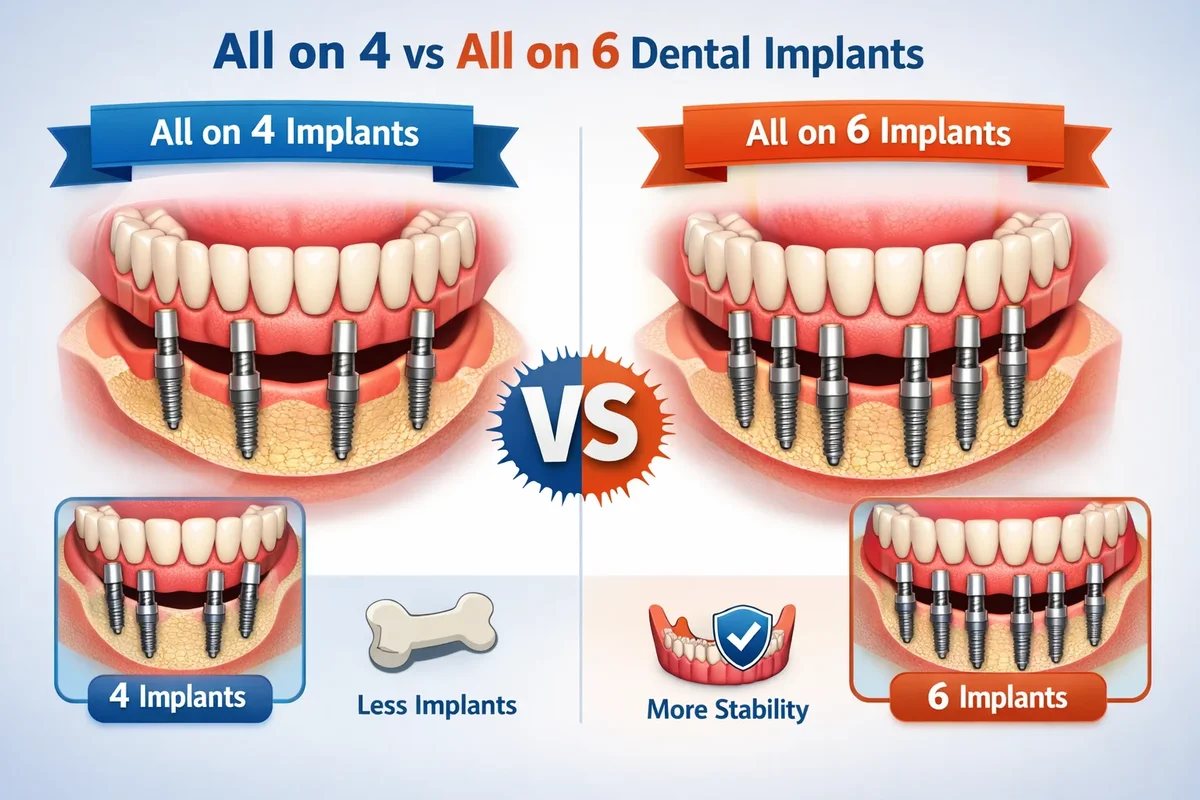
In the all on 4 vs all on 6 dental implants approach, the main difference lies in the number of implants placed in the jaw. The All-on-4 technique uses four implants to support a full dental arch, while the All-on-6 technique uses six implants. Although this difference may seem small, it can affect several important factors such as bite strength, stability, longevity, and bone distribution.
When comparing all on 4 vs all on 6 dental implants, many patients are primarily concerned about durability and long-term outcomes. The All-on-4 technique was originally developed as a minimally invasive solution for patients with limited jawbone density. By placing the rear implants at an angle, dentists can maximize bone contact and avoid the need for bone grafting in many cases. This allows patients with moderate bone loss to still receive a full-arch restoration.
On the other hand, the All-on-6 technique uses two additional implants, which can provide greater support and load distribution across the jawbone. In the discussion of all on 4 vs all on 6 dental implants, this added support often leads to increased stability and reduced stress on each individual implant. This can be particularly beneficial for patients with stronger bite forces or those seeking maximum durability for long-term use.
Another reason why the topic of all on 4 vs all on 6 dental implants is so widely discussed is the impact it has on chewing efficiency and comfort. With more implants supporting the prosthetic bridge, the All-on-6 system may provide improved chewing power and better load distribution during eating. However, the All-on-4 system remains extremely popular due to its efficiency, shorter surgical time, and lower cost.
Patients researching all on 4 vs all on 6 dental implants are also often concerned about appearance. Fortunately, both solutions are designed to look completely natural. Modern prosthetic teeth are crafted from high-quality materials that mimic the color, shape, and translucency of natural teeth. This means that regardless of whether a patient chooses four or six implants, the aesthetic outcome can be highly satisfying.
From a clinical perspective, dentists carefully evaluate several factors before recommending one option over the other in the all on 4 vs all on 6 dental implants decision. These factors include jawbone density, overall oral health, bite alignment, patient age, lifestyle habits, and long-term treatment goals. A personalized consultation is always essential to determine the best solution.
If you are considering a full-mouth dental implant procedure and want expert guidance on all on 4 vs all on 6 dental implants, it is important to consult with an experienced implant specialist. A professional evaluation will include digital imaging, bone density analysis, and a detailed treatment plan tailored to your needs. If you would like to speak with a dental expert about your options, you can reach out through the Redent Klinik Contact Page.
Ultimately, the choice between all on 4 vs all on 6 dental implants depends on individual circumstances and treatment objectives. Both solutions provide life-changing benefits for patients suffering from extensive tooth loss. They restore not only the ability to eat and speak comfortably but also the confidence that comes with having a complete, healthy smile. As dental technology continues to advance, these implant-supported solutions remain among the most effective ways to achieve permanent full-mouth rehabilitation.
1. What Are All on 4 vs All on 6 Dental Implants?
Understanding the difference between all on 4 vs all on 6 dental implants is essential for anyone considering full-mouth dental restoration. When people lose many or all of their teeth, traditional dentures were once the only option. However, modern implant dentistry has introduced advanced full-arch solutions that are far more stable, comfortable, and long-lasting. The comparison of all on 4 vs all on 6 dental implants focuses on two of the most widely used implant-supported restoration techniques available today.
Both treatment methods are designed to replace an entire row of missing teeth using a fixed prosthetic bridge supported by dental implants placed in the jawbone. Instead of replacing each tooth individually, these systems use strategically positioned implants that anchor a full set of artificial teeth. The key distinction when comparing all on 4 vs all on 6 dental implants lies in the number of implants used and how the forces of chewing are distributed across the jaw.
The Concept Behind Full-Arch Implant Restorations
Full-arch implant restorations are designed to provide patients with a permanent alternative to removable dentures. When examining all on 4 vs all on 6 dental implants, the primary goal of both procedures is the same: to restore a complete arch of teeth that looks natural, functions properly, and feels secure.
Dental implants themselves are small titanium posts that are surgically placed into the jawbone. Over time, these implants fuse with the bone through a process known as osseointegration. This biological bonding creates a stable foundation capable of supporting a full dental prosthesis. In discussions about all on 4 vs all on 6 dental implants, the number of implants used directly affects the level of support and stability the final restoration can provide.
The concept behind these treatments is to reduce the number of implants needed while still delivering excellent strength and aesthetics. For many patients researching all on 4 vs all on 6 dental implants, this efficiency makes full-mouth restoration more accessible than traditional implant methods that required 8–10 implants per arch.
What Is the All-on-4 Dental Implant Technique?
The All-on-4 system is a revolutionary treatment designed for patients who need a complete set of replacement teeth but may have limited jawbone density. In the all on 4 vs all on 6 dental implants comparison, the All-on-4 technique uses four implants placed strategically in the jaw.
Two implants are placed vertically in the front of the jaw where bone density is typically stronger, while the two rear implants are placed at an angle. This angled placement allows dentists to maximize bone contact and avoid anatomical structures such as the sinus cavities or nerves.
Key Features of the All-on-4 System
- Uses four implants to support a full arch of teeth
- Rear implants are placed at an angle for better bone support
- Often eliminates the need for bone grafting
- Allows immediate loading in many cases
- Generally involves shorter surgery and recovery time
Because fewer implants are required, many patients considering all on 4 vs all on 6 dental implants view the All-on-4 option as a faster and more affordable treatment.
What Is the All-on-6 Dental Implant Technique?
The All-on-6 system follows the same basic concept as the All-on-4 method but uses six implants instead of four. When evaluating all on 4 vs all on 6 dental implants, the main advantage of All-on-6 is the increased number of anchor points supporting the prosthetic bridge.
With six implants distributed across the jawbone, the chewing forces are spread more evenly. This additional support can enhance the durability and longevity of the restoration. For patients with adequate bone density, many dentists recommend this option when comparing all on 4 vs all on 6 dental implants.
Key Features of the All-on-6 System
- Uses six implants to support a full arch
- Provides stronger distribution of bite forces
- Often increases long-term stability
- May improve durability of the prosthetic bridge
- Suitable for patients with sufficient jawbone density
When patients research all on 4 vs all on 6 dental implants, they often discover that the additional implants in the All-on-6 system can provide extra security and support, especially for patients with strong bite pressure.
Shared Benefits of Both Implant Systems
Despite their differences, both systems offer many similar benefits. Whether choosing All-on-4 or All-on-6, patients gain access to one of the most advanced solutions in restorative dentistry. The comparison of all on 4 vs all on 6 dental implants highlights that both treatments provide life-changing improvements for individuals who struggle with missing teeth.
- Permanent replacement for missing teeth
- Improved chewing ability
- Natural-looking smile
- Prevention of jawbone loss
- Improved speech and comfort
- Fixed restoration that does not move like dentures
Many patients researching all on 4 vs all on 6 dental implants are surprised by how natural these restorations feel compared to traditional dentures. The fixed prosthetic teeth remain securely attached to the implants, allowing patients to eat, speak, and smile with confidence.
Why Understanding the Difference Matters
The reason the comparison of all on 4 vs all on 6 dental implants is so important is that every patient has different oral health conditions. Some individuals may have limited bone density and benefit from the All-on-4 method, while others with stronger bone support may achieve better long-term stability with All-on-6.
Modern dental clinics evaluate multiple factors before recommending a treatment plan, including:
- Bone density and volume
- Jaw structure
- Number of missing teeth
- Bite force and chewing habits
- Overall oral health
Ultimately, the decision between all on 4 vs all on 6 dental implants should be made after a comprehensive dental evaluation. Both procedures represent highly effective solutions for restoring a full smile and improving quality of life. With proper care and regular dental visits, either option can provide many years of reliable performance and comfort.
How All on 4 vs All on 6 Dental Implants Work Step by Step
Understanding the treatment process is one of the most important parts of comparing all on 4 vs all on 6 dental implants. Many patients researching full-arch dental implants want to know exactly what happens during the procedure, how long it takes, and what to expect during recovery. Although the number of implants differs, the treatment process for all on 4 vs all on 6 dental implants follows a very similar clinical pathway.
Both procedures are carefully planned surgical treatments designed to replace a full arch of missing teeth using dental implants anchored into the jawbone. The key difference when comparing all on 4 vs all on 6 dental implants is the number of implants placed and how those implants distribute the chewing forces across the jaw. However, the stages involved in treatment—from consultation to final restoration—are generally the same.
Initial Consultation and Comprehensive Evaluation
The first step in the all on 4 vs all on 6 dental implants treatment process is a detailed dental consultation. During this stage, the dentist evaluates the patient’s oral health, jawbone condition, and overall suitability for implant surgery.
This evaluation typically includes:
- Digital X-rays and 3D CT scans
- Bone density analysis
- Evaluation of gum health
- Assessment of bite alignment
- Review of medical history
These diagnostic tools allow the dentist to determine whether a patient is a better candidate for four implants or six implants. When comparing all on 4 vs all on 6 dental implants, bone density is one of the most critical factors that influences the treatment recommendation.
Patients with moderate bone loss may benefit from the All-on-4 technique, which was specifically designed to maximize existing bone structure. Meanwhile, patients with stronger jawbone support may achieve better long-term stability with the All-on-6 approach. This is why a personalized evaluation is essential when deciding between all on 4 vs all on 6 dental implants.
Treatment Planning and Digital Implant Design
After the evaluation, the dentist creates a customized treatment plan. Modern implant dentistry relies heavily on digital planning technology to ensure precision and safety during surgery. When planning all on 4 vs all on 6 dental implants, the dentist uses advanced software to map the ideal implant placement locations.
This planning stage ensures that implants are positioned where bone density is strongest and where they will provide optimal support for the prosthetic teeth. The software also allows the dentist to simulate the final restoration before surgery even begins.
Key Planning Considerations
- Optimal implant angulation
- Bone volume distribution
- Position of nerves and sinuses
- Bite alignment and chewing forces
- Aesthetic placement of the prosthetic teeth
Careful planning is one of the reasons modern implant procedures like all on 4 vs all on 6 dental implants have such high long-term success rates.
Surgical Placement of the Dental Implants
The next stage in the all on 4 vs all on 6 dental implants procedure is the surgical placement of the implants. This step is performed under local anesthesia, sedation, or general anesthesia depending on the patient’s comfort and clinical needs.
During surgery, the dentist places titanium implant posts into the jawbone. These implants serve as the anchors that will support the full arch of prosthetic teeth.
In the comparison of all on 4 vs all on 6 dental implants, the main surgical difference is simply the number of implants placed:
- All-on-4: Four implants support the entire dental arch
- All-on-6: Six implants support the entire dental arch
In the All-on-4 method, the two posterior implants are often placed at an angle to increase bone contact and avoid anatomical structures. In the All-on-6 method, implants are typically placed vertically across the jawbone to distribute forces more evenly.
Immediate Temporary Teeth Placement
One of the most exciting aspects of modern implant dentistry is the possibility of receiving temporary teeth on the same day as surgery. Many clinics offering all on 4 vs all on 6 dental implants provide immediate-load prosthetics.
This means that patients can leave the clinic with a temporary fixed bridge attached to their implants. These provisional teeth allow patients to smile, speak, and eat soft foods during the healing period.
Immediate loading is often possible because the implants are strategically positioned to provide strong initial stability. However, the dentist will evaluate whether the patient’s bone condition allows immediate loading when planning all on 4 vs all on 6 dental implants.
Healing and Osseointegration Phase
After surgery, the implants begin a critical healing process called osseointegration. This is the stage where the titanium implants fuse with the jawbone to create a permanent and stable foundation.
The osseointegration process typically takes:
- 3 to 4 months for the lower jaw
- 4 to 6 months for the upper jaw
During this healing period, patients with all on 4 vs all on 6 dental implants continue wearing their temporary prosthetic teeth while the implants integrate with the bone.
Healing Tips for Implant Success
- Follow soft food recommendations
- Maintain excellent oral hygiene
- Avoid smoking during healing
- Attend follow-up appointments
- Follow the dentist’s post-operative instructions
Proper healing is essential for ensuring long-term stability when undergoing all on 4 vs all on 6 dental implants.
Final Prosthetic Teeth Placement
Once osseointegration is complete, the final stage of the all on 4 vs all on 6 dental implants process begins. The dentist replaces the temporary teeth with a permanent prosthetic bridge made from durable materials such as zirconia or high-quality acrylic.
These final restorations are custom-designed to match the patient’s natural facial structure and bite alignment. They are carefully crafted to look and function like natural teeth.
After the final prosthesis is placed, patients can fully enjoy the benefits of all on 4 vs all on 6 dental implants, including:
- Improved chewing strength
- Enhanced facial appearance
- Stable and comfortable teeth
- Long-term durability
- Renewed confidence in smiling
The entire process—from consultation to final restoration—typically takes several months. However, the life-changing results make all on 4 vs all on 6 dental implants one of the most transformative treatments available in modern dentistry.
Key Structural Differences Between All on 4 vs All on 6 Dental Implants
When patients research all on 4 vs all on 6 dental implants, one of the most important aspects to understand is the structural difference between these two full-arch implant systems. While both procedures are designed to replace an entire arch of missing teeth using implant-supported prosthetics, the underlying support structure can vary significantly. These structural differences influence stability, chewing strength, longevity, and how the implants interact with the jawbone over time.
The comparison of all on 4 vs all on 6 dental implants primarily revolves around how many implants are placed in the jawbone and how those implants distribute bite forces across the prosthetic arch. Although both systems provide excellent outcomes, their structural design can make one option more suitable for certain patients depending on bone density, jaw anatomy, and long-term functional goals.
Number of Implants Supporting the Prosthetic Arch
The most obvious difference in the discussion of all on 4 vs all on 6 dental implants is the number of implants used to support the dental prosthesis. As the names suggest, the All-on-4 method uses four implants per arch, while the All-on-6 system uses six implants.
In the All-on-4 technique, two implants are placed vertically in the front of the jaw, and two implants are placed at an angle in the back. These angled implants maximize contact with available bone and allow dentists to avoid critical anatomical structures such as nerves or sinus cavities.
In contrast, the All-on-6 system uses six implants spaced more evenly across the jawbone. When comparing all on 4 vs all on 6 dental implants, this additional support can help distribute chewing forces more evenly across the prosthetic bridge.
Why Implant Quantity Matters
- More implants can distribute bite forces more evenly
- Additional support may reduce stress on each implant
- Implant quantity can influence long-term stability
- More implants may improve prosthetic durability
For patients with strong bite forces or larger jaw structures, dentists may recommend six implants when evaluating all on 4 vs all on 6 dental implants.
Implant Placement Angles and Distribution
Another key structural difference between all on 4 vs all on 6 dental implants lies in the positioning and angulation of the implants within the jawbone. Implant placement strategy plays a crucial role in how effectively the implants support the prosthetic arch.
The All-on-4 technique uses tilted implants in the back of the jaw. These angled implants allow the dentist to increase bone-to-implant contact while avoiding areas where bone density may be insufficient. This design is particularly beneficial for patients with moderate bone loss.
On the other hand, the All-on-6 approach often uses a more vertical placement pattern. With six implants evenly distributed across the jawbone, there is typically less need to angle the implants. When comparing all on 4 vs all on 6 dental implants, this symmetrical implant arrangement can provide more balanced support for the prosthetic teeth.
Impact of Implant Angulation
- Angled implants maximize bone contact in All-on-4
- Vertical implants provide balanced support in All-on-6
- Placement strategy affects long-term stability
- Implant angles influence prosthetic load distribution
This structural difference plays an important role in the clinical decision-making process when dentists evaluate all on 4 vs all on 6 dental implants for individual patients.
Load Distribution and Bite Force Management
One of the most significant structural considerations when comparing all on 4 vs all on 6 dental implants is how the chewing forces are distributed across the dental arch. Every time a person bites or chews, pressure is transferred from the prosthetic teeth through the implants and into the jawbone.
With four implants supporting the arch, the All-on-4 system concentrates more force on each implant. However, the angled placement of the rear implants helps distribute this pressure across a wider area of bone.
In the All-on-6 system, the presence of two additional implants allows bite forces to be spread across more support points. This can reduce stress on individual implants and potentially improve long-term durability. For this reason, some dentists consider All-on-6 to offer enhanced load distribution when analyzing all on 4 vs all on 6 dental implants.
Benefits of Improved Load Distribution
- Reduced stress on individual implants
- Improved chewing strength
- Lower risk of prosthetic wear
- Potentially longer implant lifespan
While both methods are designed to withstand normal chewing forces, the structural advantage of additional implants is a key point in the all on 4 vs all on 6 dental implants discussion.
Bone Support Requirements
Jawbone density and volume play a critical role in determining which treatment approach is appropriate. In the comparison of all on 4 vs all on 6 dental implants, bone availability often influences the final treatment plan.
The All-on-4 technique was originally developed for patients who may not have sufficient bone for traditional implant placement. By angling the rear implants, dentists can utilize existing bone more effectively and often avoid the need for bone grafting procedures.
The All-on-6 approach, however, typically requires slightly more bone volume because six implants must be securely anchored into the jaw. Patients with good bone density are often ideal candidates for this method when choosing between all on 4 vs all on 6 dental implants.
Bone Considerations in Implant Planning
- Bone density affects implant stability
- Bone volume determines implant placement options
- Angled implants help preserve existing bone
- Additional implants may require stronger bone support
Advanced imaging technology such as 3D cone-beam CT scans allows dentists to accurately evaluate bone conditions before recommending a solution in the all on 4 vs all on 6 dental implants decision.
Prosthetic Bridge Design Differences
The structural differences between all on 4 vs all on 6 dental implants also extend to the design of the prosthetic bridge that sits on top of the implants. Although both treatments use a full arch prosthesis, the underlying support structure can influence how the bridge is engineered.
With fewer implants, the All-on-4 prosthetic bridge may rely more heavily on the strength of the prosthetic framework. Materials such as reinforced acrylic or zirconia are commonly used to ensure durability.
With six implants supporting the prosthetic arch, the All-on-6 system can provide additional support points that reduce bending forces on the bridge. When discussing all on 4 vs all on 6 dental implants, this additional reinforcement can sometimes allow for even stronger prosthetic designs.
Ultimately, both systems are capable of delivering excellent functional and aesthetic results. The structural differences simply provide dentists with different tools for customizing treatment based on the patient’s oral anatomy and long-term needs. Understanding these structural distinctions is a key step in making an informed decision about all on 4 vs all on 6 dental implants.
Cost Comparison: All on 4 vs All on 6 Dental Implants
One of the most important factors patients consider when comparing all on 4 vs all on 6 dental implants is cost. Full-mouth dental implant treatment represents a significant investment in oral health, function, and long-term quality of life. Because the number of implants, materials used, and surgical complexity vary between the two procedures, the total cost can differ. Understanding the financial aspects of all on 4 vs all on 6 dental implants helps patients plan their treatment and choose the most suitable option for their budget and clinical needs.
Although both procedures aim to restore a full arch of teeth, the number of implants placed during surgery plays a major role in determining price differences. In the discussion of all on 4 vs all on 6 dental implants, the All-on-6 technique typically costs more because it involves two additional implants, additional surgical time, and potentially more complex prosthetic design.
Average Cost of All-on-4 Dental Implants
The All-on-4 system is widely known as a cost-effective full-mouth implant solution. Since it uses only four implants to support a full arch of teeth, the overall treatment cost is often lower compared to procedures requiring more implants. For many patients researching all on 4 vs all on 6 dental implants, this affordability is a major advantage.
The total cost of All-on-4 treatment can vary depending on factors such as geographic location, the clinic’s expertise, materials used for the prosthetic teeth, and whether additional procedures like tooth extractions or bone grafting are needed.
Typical All-on-4 Price Ranges
- United States: $20,000 – $30,000 per arch
- United Kingdom: $15,000 – $25,000 per arch
- Western Europe: $12,000 – $20,000 per arch
- Turkey: $6,000 – $12,000 per arch
Because fewer implants are used, the All-on-4 procedure often offers a faster and more budget-friendly solution for patients evaluating all on 4 vs all on 6 dental implants.
Average Cost of All-on-6 Dental Implants
The All-on-6 system typically involves a slightly higher cost because it requires six implants rather than four. This increases the price of both the surgical procedure and the implant components themselves. When comparing all on 4 vs all on 6 dental implants, the additional implants provide extra stability and support but also raise the overall treatment cost.
Despite the higher price, many patients choose the All-on-6 option because the additional implants can improve load distribution and long-term durability.
Typical All-on-6 Price Ranges
- United States: $25,000 – $35,000 per arch
- United Kingdom: $18,000 – $30,000 per arch
- Western Europe: $15,000 – $25,000 per arch
- Turkey: $8,000 – $15,000 per arch
For patients comparing all on 4 vs all on 6 dental implants, these price differences highlight the importance of balancing cost with long-term stability and personal oral health needs.
Factors That Influence the Total Cost
When discussing all on 4 vs all on 6 dental implants, it is important to understand that the implant count is not the only factor affecting the final treatment price. Several clinical and logistical elements can influence the total cost of the procedure.
Each patient’s treatment plan is unique, which means prices may vary significantly even within the same country or clinic.
Key Cost Factors
- Number of implants placed
- Type of prosthetic material (acrylic vs zirconia)
- Experience and expertise of the implant surgeon
- Clinic location and operating costs
- Need for bone grafting or sinus lifting
- Digital imaging and diagnostic tests
- Sedation or anesthesia requirements
When patients compare all on 4 vs all on 6 dental implants, understanding these factors helps them evaluate quotes from different clinics and make informed decisions.
Long-Term Value vs Initial Cost
While cost is important, it should not be the only factor in choosing between all on 4 vs all on 6 dental implants. Long-term value and durability should also be considered. Dental implants are designed to last many years—often decades—with proper care.
The All-on-6 option may require a slightly higher initial investment, but the additional implants can distribute bite forces more evenly. This may reduce long-term stress on each implant and potentially increase the longevity of the restoration.
However, the All-on-4 system remains an extremely reliable and successful treatment with excellent long-term results. For patients with limited bone density or those seeking a more cost-efficient solution, All-on-4 may provide outstanding value when comparing all on 4 vs all on 6 dental implants.
Why Many Patients Choose Dental Tourism
Because of the high cost of dental implants in some countries, many patients travel abroad for treatment. Dental tourism has become increasingly popular among individuals researching all on 4 vs all on 6 dental implants.
Countries such as Turkey, Hungary, and Mexico offer high-quality dental implant treatments at significantly lower prices compared to the United States or Western Europe. Many international clinics provide complete treatment packages that include consultation, surgery, accommodation, and transportation.
For patients considering dental tourism, it is important to choose a reputable clinic with experienced implant specialists. If you are exploring treatment options or would like personalized guidance on all on 4 vs all on 6 dental implants, you can reach out through the Redent Klinik Contact Page.
Making the Right Financial Decision
Ultimately, the financial decision between all on 4 vs all on 6 dental implants should consider both the short-term cost and the long-term benefits. Patients should evaluate factors such as durability, bone condition, lifestyle habits, and oral health goals before selecting a treatment option.
Both procedures represent advanced dental solutions that can restore a patient’s smile, improve chewing ability, and enhance overall confidence. By carefully weighing the cost considerations and consulting with an experienced dental professional, patients can choose the most suitable solution in the all on 4 vs all on 6 dental implants comparison.
Longevity and Durability of All on 4 vs All on 6 Dental Implants
One of the most important questions patients ask when researching all on 4 vs all on 6 dental implants is how long these implant systems last. Dental implants are designed to be a long-term solution for missing teeth, often lasting decades when properly cared for. However, the number of implants used, the distribution of bite forces, and the patient’s oral health habits can all influence the durability of the restoration.
When comparing all on 4 vs all on 6 dental implants, both systems have extremely high success rates and can provide many years of reliable function. The longevity of these treatments depends not only on the implants themselves but also on the prosthetic bridge, the health of the surrounding bone and gums, and the patient’s commitment to oral hygiene.
Modern implant technology has advanced significantly, allowing full-arch restorations like all on 4 vs all on 6 dental implants to offer exceptional durability. Many clinical studies show success rates exceeding 95% over a 10–15 year period, making them among the most reliable solutions in restorative dentistry.
Average Lifespan of Dental Implants
Dental implants are made from biocompatible titanium or titanium alloys designed to integrate permanently with the jawbone. This process, called osseointegration, creates a stable foundation that can last for decades.
When evaluating all on 4 vs all on 6 dental implants, it is important to distinguish between two components:
- The dental implants embedded in the jawbone
- The prosthetic bridge attached to the implants
The implants themselves often last 20 years or more and may even last a lifetime with proper care. The prosthetic bridge, however, may require replacement or maintenance after 10–15 years depending on wear and material type.
Typical Implant Longevity
- Dental implants: 20+ years or lifetime
- Acrylic prosthetic bridge: 10–15 years
- Zirconia prosthetic bridge: 15–20 years or longer
Both systems in the all on 4 vs all on 6 dental implants comparison offer excellent long-term durability when performed by experienced implant specialists.
How Implant Quantity Affects Durability
One of the key considerations in the all on 4 vs all on 6 dental implants debate is how the number of implants influences long-term durability. The number of implants supporting the prosthetic arch determines how chewing forces are distributed throughout the jaw.
In the All-on-4 technique, four implants carry the load of the entire prosthetic arch. These implants are strategically positioned to maximize bone support, and the angled placement of the rear implants helps distribute bite pressure across the jaw.
In contrast, the All-on-6 system uses six implants, which provides additional support points. When comparing all on 4 vs all on 6 dental implants, this extra support can reduce the amount of stress placed on each individual implant.
Durability Advantages of Additional Implants
- Better load distribution across the jawbone
- Reduced mechanical stress on each implant
- Improved support for the prosthetic bridge
- Potentially increased long-term stability
Although the All-on-4 system is highly reliable, some dentists prefer the All-on-6 approach for patients with strong bite forces or larger jaw structures when evaluating all on 4 vs all on 6 dental implants.
Factors That Influence Implant Longevity
While the structural design of all on 4 vs all on 6 dental implants plays a role in durability, several other factors can significantly influence the lifespan of the implants and prosthetic restoration.
Patients who maintain excellent oral hygiene and attend regular dental checkups often enjoy longer-lasting implant results.
Key Factors Affecting Longevity
- Daily brushing and flossing habits
- Regular professional dental cleanings
- Avoiding smoking or tobacco products
- Managing teeth grinding (bruxism)
- Maintaining healthy gums
- Following dentist recommendations for implant care
When considering all on 4 vs all on 6 dental implants, these lifestyle factors can have as much influence on long-term success as the implant design itself.
Material Strength of the Prosthetic Bridge
The durability of the prosthetic teeth is another important factor in the all on 4 vs all on 6 dental implants comparison. The bridge that sits on top of the implants is typically made from either acrylic resin or zirconia.
Acrylic prosthetics are lighter and more affordable but may require replacement sooner due to wear over time. Zirconia prosthetics are significantly stronger and more resistant to fracture, making them a popular choice for long-term durability.
Because the All-on-6 system distributes bite forces across more implants, some dentists believe it may reduce stress on the prosthetic bridge when comparing all on 4 vs all on 6 dental implants. However, both systems can perform exceptionally well with high-quality materials and proper maintenance.
Clinical Success Rates
Research and clinical data consistently show that both implant systems perform extremely well over the long term. When discussing all on 4 vs all on 6 dental implants, the difference in success rates is often minimal when procedures are performed correctly.
Studies report success rates such as:
- All-on-4 implants: approximately 94–97% success rate
- All-on-6 implants: approximately 95–98% success rate
These statistics demonstrate that both systems are highly reliable solutions for full-mouth rehabilitation.
Long-Term Maintenance and Care
Maintaining the longevity of all on 4 vs all on 6 dental implants requires consistent oral care and periodic professional checkups. Although the prosthetic teeth cannot develop cavities, the surrounding gum tissue and bone must remain healthy to support the implants.
Recommended Implant Care Routine
- Brush at least twice daily with a soft toothbrush
- Use water flossers or specialized implant floss
- Schedule professional dental cleanings every 6 months
- Avoid chewing extremely hard objects
- Wear a night guard if you grind your teeth
With proper care, both systems in the all on 4 vs all on 6 dental implants comparison can deliver long-lasting results that dramatically improve oral function and quality of life. Patients who commit to good oral hygiene and regular dental visits often enjoy their implant-supported smile for decades.
Recovery and Healing Time: All on 4 vs All on 6 Dental Implants
When patients evaluate all on 4 vs all on 6 dental implants, recovery time and healing expectations are often among the most important considerations. Although both treatments are advanced implant-supported restorations designed to replace a full arch of teeth, the healing process involves several biological and clinical stages. Understanding what happens during recovery can help patients feel more confident and prepared when choosing between all on 4 vs all on 6 dental implants.
The overall recovery timeline for all on 4 vs all on 6 dental implants is quite similar, because both procedures rely on the same biological process called osseointegration. This is the stage where the titanium implants fuse with the jawbone and become a stable foundation for the prosthetic teeth. However, slight differences in surgical complexity and implant quantity may influence the immediate recovery experience.
Most patients undergoing all on 4 vs all on 6 dental implants can return to normal daily activities within a few days, although the complete healing period can take several months. During this time, the implants gradually integrate with the bone while the gums heal around the implant posts.
Immediate Post-Surgery Recovery
The first stage of healing after all on 4 vs all on 6 dental implants occurs within the first few days following surgery. Patients typically experience mild swelling, slight discomfort, and temporary sensitivity in the treated area.
Modern implant procedures are designed to minimize surgical trauma. Many clinics use advanced digital planning and guided implant surgery to make the procedure more precise and less invasive.
Common Short-Term Symptoms
- Mild swelling around the gums and cheeks
- Minor bruising near the implant site
- Slight bleeding during the first 24 hours
- Tenderness while chewing
- Temporary speech adjustment
These symptoms are completely normal and usually improve quickly. For patients comparing all on 4 vs all on 6 dental implants, the difference in immediate recovery is usually minimal because both procedures are performed using similar surgical techniques.
Healing Timeline After Implant Surgery
The healing process for all on 4 vs all on 6 dental implants can be divided into several stages. Each phase allows the body to adapt to the implants and gradually strengthen the bone around them.
Typical Healing Stages
- First 48 hours: Swelling and mild discomfort peak and begin to decrease.
- First week: Gum tissue begins healing and inflammation reduces.
- 2–4 weeks: Soft tissues stabilize and chewing comfort improves.
- 3–6 months: Osseointegration completes as the bone fuses with the implants.
During the healing phase, patients who undergo all on 4 vs all on 6 dental implants usually wear temporary prosthetic teeth attached to the implants. These provisional teeth allow patients to maintain normal appearance and basic chewing ability while the implants fully integrate with the jawbone.
Does Implant Quantity Affect Recovery?
When comparing all on 4 vs all on 6 dental implants, many patients wonder whether the number of implants placed affects the healing experience. In most cases, the difference in recovery between the two procedures is relatively small.
The All-on-6 procedure involves placing two additional implants compared to the All-on-4 method. Because of this, surgery may take slightly longer, and there may be slightly more surgical manipulation of the bone and gum tissue.
However, modern surgical techniques make both procedures highly efficient. Most patients report similar recovery experiences regardless of whether they receive four or six implants in the all on 4 vs all on 6 dental implants comparison.
Factors That Influence Recovery
- Overall health of the patient
- Bone density and jaw structure
- Smoking habits
- Oral hygiene practices
- Following post-operative instructions
These factors often have a greater impact on healing than the difference between all on 4 vs all on 6 dental implants themselves.
Diet During the Healing Period
After implant surgery, patients must follow specific dietary guidelines to protect the implants while healing occurs. During the early recovery period after all on 4 vs all on 6 dental implants, soft foods are recommended to avoid placing excessive pressure on the implants.
Recommended Soft Foods
- Yogurt and smoothies
- Mashed potatoes
- Scrambled eggs
- Soft pasta and rice
- Soups and blended vegetables
Patients gradually return to normal foods as healing progresses. Dentists typically recommend avoiding very hard or sticky foods during the first few months following all on 4 vs all on 6 dental implants.
Oral Hygiene During Recovery
Maintaining excellent oral hygiene is essential during the healing period. Even though the prosthetic teeth cannot decay, the surrounding gum tissue must remain healthy for implants to succeed.
Proper hygiene routines after all on 4 vs all on 6 dental implants include gentle brushing, antimicrobial mouth rinses, and specialized cleaning tools designed for implant restorations.
Post-Surgery Oral Care Tips
- Use a soft-bristled toothbrush
- Clean around the prosthetic bridge daily
- Use water flossers to remove debris
- Avoid smoking during healing
- Attend follow-up dental visits
These habits help prevent infection and support the long-term success of all on 4 vs all on 6 dental implants.
When Patients Can Resume Normal Activities
Most patients return to work and normal daily activities within a few days after surgery. Light activities are typically safe within 48–72 hours, although strenuous exercise should be avoided during the first week.
Patients often notice significant improvements in comfort within the first week after all on 4 vs all on 6 dental implants. As the healing process continues, chewing ability gradually improves and the implants become stronger as they integrate with the bone.
By the time the final prosthetic bridge is placed, patients can fully enjoy the benefits of all on 4 vs all on 6 dental implants, including stable teeth, improved chewing strength, and a natural-looking smile.
Who Is the Best Candidate for All on 4 vs All on 6 Dental Implants?
Choosing the right treatment between all on 4 vs all on 6 dental implants often depends on the patient’s oral health condition, bone structure, lifestyle, and long-term dental goals. While both procedures are designed to restore a full arch of missing teeth using implant-supported prosthetics, not every patient is an ideal candidate for both options. Understanding who qualifies for each treatment helps ensure successful outcomes and long-lasting implant stability.
When dentists evaluate all on 4 vs all on 6 dental implants, they carefully analyze several clinical factors before recommending the most appropriate approach. These include jawbone density, gum health, chewing force, medical history, and the patient’s expectations for durability and comfort.
Although both procedures offer highly reliable results, certain patients may benefit more from one technique over the other. The goal of the consultation process is to determine which option in the all on 4 vs all on 6 dental implants comparison provides the safest and most effective long-term solution.
Patients With Extensive Tooth Loss
The most common candidates for all on 4 vs all on 6 dental implants are individuals who have lost most or all of their teeth in one or both arches. Tooth loss can occur due to various factors, including severe tooth decay, advanced gum disease, trauma, or long-term wear.
For patients who are currently using removable dentures or who have many damaged teeth that cannot be restored, full-arch implant systems like all on 4 vs all on 6 dental implants can dramatically improve function and comfort.
Signs You May Need Full-Arch Implants
- Missing most or all teeth in the upper or lower jaw
- Difficulty chewing due to unstable dentures
- Frequent denture discomfort or irritation
- Severe tooth damage that cannot be repaired
- Jawbone shrinkage caused by long-term tooth loss
Patients experiencing these issues often find that treatments like all on 4 vs all on 6 dental implants provide a permanent and life-changing alternative to traditional dentures.
Patients With Limited Jawbone Density
Bone density plays a major role when determining the best candidate for all on 4 vs all on 6 dental implants. After tooth loss, the jawbone gradually shrinks due to lack of stimulation from tooth roots. This bone loss can make it difficult to place traditional dental implants.
The All-on-4 technique was specifically developed to help patients with moderate bone loss. By angling the rear implants, dentists can maximize the use of existing bone without requiring extensive bone grafting procedures.
For this reason, patients with reduced bone volume may be better candidates for All-on-4 when comparing all on 4 vs all on 6 dental implants.
Advantages for Patients With Bone Loss
- Angled implants utilize existing bone
- Often eliminates the need for bone grafting
- Shorter treatment timeline
- Less invasive surgical approach
However, patients with strong jawbone density may also qualify for the All-on-6 system in the all on 4 vs all on 6 dental implants comparison.
Patients With Strong Bite Force
Some individuals naturally have stronger bite forces due to jaw size, chewing habits, or teeth grinding. In these cases, dentists may recommend additional implant support to distribute chewing pressure more evenly.
When evaluating all on 4 vs all on 6 dental implants, the All-on-6 technique can provide additional support points that help reduce stress on each implant. This may be beneficial for patients who exert higher chewing forces during daily activities.
Patients Who May Benefit From All-on-6
- Individuals with strong chewing pressure
- Patients with larger jaw structures
- People seeking maximum implant stability
- Patients wanting additional long-term support
For these individuals, the extra implants used in the all on 4 vs all on 6 dental implants system may provide increased durability and stability.
Patients Seeking Faster Treatment
Another factor influencing the decision between all on 4 vs all on 6 dental implants is treatment efficiency. Many patients want a faster solution that minimizes surgery and recovery time.
Because the All-on-4 system uses fewer implants, it often involves slightly shorter surgical time. In many cases, temporary teeth can be attached on the same day as surgery, allowing patients to leave the clinic with a functional smile.
Patients who prioritize efficiency and shorter procedures may therefore prefer All-on-4 when comparing all on 4 vs all on 6 dental implants.
Patients With Good Overall Health
Like any surgical procedure, dental implant treatment requires patients to be in reasonably good overall health. Dentists evaluating candidates for all on 4 vs all on 6 dental implants will review the patient’s medical history to ensure the body can heal properly after surgery.
Health Conditions That May Affect Implant Eligibility
- Uncontrolled diabetes
- Severe immune disorders
- Heavy smoking habits
- Untreated gum disease
- Bone metabolism disorders
These conditions do not necessarily prevent implant treatment, but they may require additional preparation or medical management before undergoing all on 4 vs all on 6 dental implants.
Patients Seeking Long-Term Smile Restoration
Ultimately, the best candidates for all on 4 vs all on 6 dental implants are individuals seeking a permanent, stable solution to extensive tooth loss. Unlike removable dentures, implant-supported restorations remain fixed in place and function much like natural teeth.
Patients who value long-term comfort, improved chewing ability, and a natural-looking smile often find that full-arch implant treatments provide the most satisfying results.
The decision between all on 4 vs all on 6 dental implants should always be made in consultation with an experienced implant specialist who can evaluate bone structure, oral health, and personal treatment goals. With the right treatment plan, patients can enjoy a strong, stable, and confident smile for many years to come.
Advantages and Disadvantages of All on 4 vs All on 6 Dental Implants
When patients research all on 4 vs all on 6 dental implants, one of the most important aspects they want to understand is the advantages and disadvantages of each option. Both treatments are advanced full-arch restoration methods designed to replace a complete set of missing teeth with implant-supported prosthetics. However, because the number of implants and structural design differ, the benefits and potential limitations can vary.
Understanding the pros and cons of all on 4 vs all on 6 dental implants helps patients make informed decisions about which treatment is most appropriate for their oral health condition, lifestyle, and long-term expectations. While both procedures provide highly successful outcomes, the best option often depends on individual factors such as bone density, chewing habits, and budget considerations.
Advantages of All-on-4 Dental Implants
The All-on-4 technique has become one of the most widely used full-mouth implant solutions because it offers an efficient and cost-effective way to restore a complete smile. When comparing all on 4 vs all on 6 dental implants, the All-on-4 method stands out for its ability to provide stable results with fewer implants.
This approach uses four strategically placed implants to support a full arch prosthesis. The rear implants are angled to maximize bone contact and avoid anatomical structures such as the sinus cavity or nerve canals.
Key Benefits of All-on-4
- Requires fewer implants, reducing surgical complexity
- Often eliminates the need for bone grafting
- Shorter surgical procedure
- Lower overall treatment cost
- Immediate teeth placement possible in many cases
For many patients evaluating all on 4 vs all on 6 dental implants, these advantages make All-on-4 an attractive option, especially for those seeking a quicker and more affordable full-arch restoration.
Disadvantages of All-on-4 Dental Implants
Although the All-on-4 system is highly successful, it may not be ideal for every patient. In the comparison of all on 4 vs all on 6 dental implants, the main limitation of All-on-4 is that fewer implants must support the entire prosthetic bridge.
This means that each implant carries a slightly higher load when chewing or biting. While modern implant materials and placement techniques compensate for this, some dentists prefer additional implants for patients with strong bite forces.
Potential Limitations of All-on-4
- Higher load placed on each implant
- May be less ideal for patients with strong bite forces
- Less structural redundancy if an implant fails
- Prosthetic bridge may experience more stress over time
These factors are important considerations when comparing all on 4 vs all on 6 dental implants, particularly for patients seeking maximum long-term durability.
Advantages of All-on-6 Dental Implants
The All-on-6 system provides additional structural support by using six implants instead of four. When evaluating all on 4 vs all on 6 dental implants, this extra support can improve the distribution of chewing forces across the jaw.
Because the prosthetic bridge is supported by more implants, each implant carries less stress during normal chewing. This can contribute to improved long-term stability and may reduce wear on the prosthetic teeth.
Key Benefits of All-on-6
- Better load distribution across the jawbone
- Reduced pressure on individual implants
- Improved long-term stability
- Enhanced durability of the prosthetic bridge
- Additional structural support for strong bite forces
For patients comparing all on 4 vs all on 6 dental implants, the All-on-6 technique can provide extra confidence in the long-term performance of their dental restoration.
Disadvantages of All-on-6 Dental Implants
While the All-on-6 system offers additional support, it also has certain drawbacks that should be considered when analyzing all on 4 vs all on 6 dental implants.
Because two additional implants must be placed, the surgical procedure can take slightly longer. This can increase the overall cost and may require greater bone volume to securely anchor the implants.
Potential Limitations of All-on-6
- Higher treatment cost due to additional implants
- Longer surgical procedure
- Requires adequate bone density for six implants
- May involve slightly longer healing time
Although these disadvantages exist, many patients still prefer All-on-6 when comparing all on 4 vs all on 6 dental implants because of the extra structural stability it offers.
Shared Advantages of Both Implant Systems
Despite their differences, both systems offer several powerful benefits. Whether a patient chooses four or six implants, all on 4 vs all on 6 dental implants treatments are among the most effective solutions for replacing missing teeth.
Benefits Shared by Both Procedures
- Permanent solution for missing teeth
- Improved chewing ability and bite strength
- Natural-looking smile
- Prevention of jawbone loss
- Greater comfort compared to removable dentures
- Long-term durability with proper care
Patients who undergo all on 4 vs all on 6 dental implants often report dramatic improvements in their quality of life. Eating becomes easier, speech improves, and confidence in smiling returns.
Balancing the Pros and Cons
Choosing between all on 4 vs all on 6 dental implants ultimately requires balancing several factors. Cost, bone density, bite force, and long-term expectations all play a role in determining which option is most suitable.
For patients with moderate bone loss or those seeking a more affordable solution, All-on-4 may be the ideal choice. For patients with strong bone density and a desire for maximum implant support, All-on-6 may provide additional long-term benefits.
Both procedures represent highly advanced dental treatments capable of restoring a complete smile and significantly improving oral function. With proper planning and professional guidance, patients can achieve outstanding results regardless of which option they choose in the all on 4 vs all on 6 dental implants comparison.
How to Choose Between All on 4 vs All on 6 Dental Implants
Choosing the right full-arch restoration can feel overwhelming for many patients. When comparing all on 4 vs all on 6 dental implants, the decision involves several clinical, functional, and financial factors. Both implant systems are designed to replace an entire arch of missing teeth using a fixed prosthetic bridge supported by dental implants. However, selecting the most appropriate option depends on the patient’s bone structure, lifestyle, oral health condition, and long-term expectations.
Understanding how dentists determine the best solution between all on 4 vs all on 6 dental implants can help patients feel more confident about their treatment plan. While both procedures deliver outstanding results, the ideal choice should always be personalized according to the individual needs of the patient.
Importance of a Professional Dental Evaluation
The most critical step in deciding between all on 4 vs all on 6 dental implants is undergoing a comprehensive dental evaluation. Implant specialists use advanced imaging tools and diagnostic techniques to assess the condition of the jawbone and surrounding oral structures.
During this consultation, the dentist will typically perform:
- 3D cone-beam CT scans
- Digital dental impressions
- Bite alignment evaluation
- Bone density analysis
- Comprehensive oral health assessment
These diagnostic tools allow the dentist to determine which implant system provides the safest and most stable foundation. The comparison of all on 4 vs all on 6 dental implants cannot be properly evaluated without understanding the patient’s bone quality and anatomical structure.
Jawbone Density and Implant Support
Bone density is one of the most important factors when selecting between all on 4 vs all on 6 dental implants. Dental implants rely on strong jawbone support to remain stable and functional for many years.
Patients with moderate bone loss may benefit from the All-on-4 technique. Because the rear implants are placed at an angle, the dentist can utilize existing bone more efficiently and often avoid bone grafting procedures.
On the other hand, patients with strong and healthy bone density may be excellent candidates for the All-on-6 approach. When evaluating all on 4 vs all on 6 dental implants, additional implants can provide increased structural support and distribute chewing forces more evenly across the jaw.
Bone Density Considerations
- Limited bone volume may favor All-on-4
- Healthy bone density may support All-on-6
- Bone grafting may expand treatment options
- 3D imaging helps determine optimal implant placement
Ultimately, bone quality plays a crucial role in determining which treatment option in the all on 4 vs all on 6 dental implants comparison is most suitable.
Bite Force and Functional Requirements
Another important factor in choosing between all on 4 vs all on 6 dental implants is the patient’s bite strength. Some individuals naturally exert greater chewing pressure due to jaw size, muscle strength, or teeth grinding habits.
In these cases, the additional implants used in the All-on-6 system can provide extra stability and help distribute chewing forces more effectively. When comparing all on 4 vs all on 6 dental implants, dentists often recommend All-on-6 for patients with stronger bite forces.
Patients Who May Benefit From Additional Implant Support
- Individuals with strong chewing pressure
- Patients who grind their teeth at night
- People with larger jaw structures
- Patients seeking maximum implant durability
However, many patients with normal chewing forces experience excellent results with the All-on-4 system when evaluating all on 4 vs all on 6 dental implants.
Budget and Financial Considerations
Financial factors often play a role in the decision between all on 4 vs all on 6 dental implants. Because the All-on-6 procedure requires two additional implants, the overall cost of treatment may be higher.
For patients seeking a more cost-effective full-arch solution, All-on-4 can provide outstanding results at a lower price point. However, patients who prioritize maximum structural support may prefer the added stability offered by All-on-6.
When evaluating all on 4 vs all on 6 dental implants, it is important to consider both the initial cost and the long-term value of the restoration.
Long-Term Treatment Goals
Patients should also consider their long-term expectations when deciding between all on 4 vs all on 6 dental implants. Some individuals prioritize efficiency and shorter surgical procedures, while others prefer additional implant support for enhanced durability.
Both systems are designed to last many years with proper care. The final choice should align with the patient’s lifestyle, oral health condition, and personal comfort preferences.
Questions Patients Should Ask Their Dentist
- How strong is my jawbone density?
- Which option offers the best long-term stability?
- Will I need bone grafting?
- What are the maintenance requirements?
- How long will the implants last?
These discussions help patients fully understand the benefits and limitations of all on 4 vs all on 6 dental implants before committing to treatment.
The Role of Experienced Implant Specialists
The success of all on 4 vs all on 6 dental implants depends heavily on the experience and skill of the implant surgeon. Advanced training, digital planning tools, and modern surgical techniques all contribute to optimal outcomes.
An experienced implant specialist can design a treatment plan that maximizes stability, aesthetics, and long-term durability. Patients considering implant treatment are encouraged to seek clinics with extensive experience in full-arch restoration procedures.
If you would like professional guidance on choosing between all on 4 vs all on 6 dental implants, you can reach out through the Redent Klinik Contact Page. A consultation with a qualified implant specialist can help determine the most appropriate treatment for restoring your smile.
Ultimately, both treatment options offer life-changing benefits for patients suffering from extensive tooth loss. By carefully evaluating bone density, bite strength, budget, and long-term goals, patients can confidently choose the best solution in the all on 4 vs all on 6 dental implants comparison.