
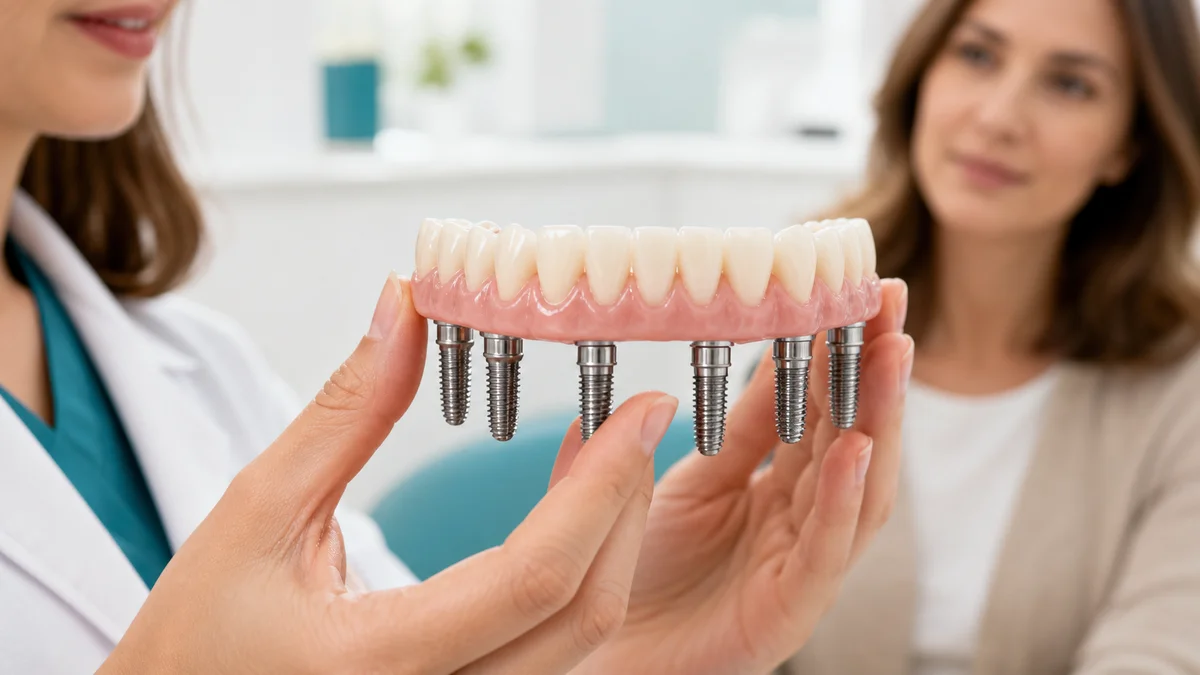
Searching for all on 6 dental implants reviews is understandable because full-arch implant treatment is a major clinical, financial and practical decision. Reviews can reveal how clearly a clinic communicates, whether appointments run as described and how patients experience temporary and final teeth. However, a testimonial is one person’s report. It cannot show unseen bone conditions, verify implant integration, measure bite forces or establish that the same plan is suitable for another person.
“All on 6” generally describes a fixed full-arch prosthesis supported by six implants in one jaw. It does not define one universal operation, one implant layout, one material or one loading schedule. Patients can arrive with different remaining teeth, gum conditions, bone anatomy, medical risks and aesthetic goals. Some receive a temporary fixed prosthesis soon after placement; others need a staged pathway. The final prosthesis may also differ in design and material.
This guide does not reproduce anonymous success stories, invent patient cases or calculate a universal success rate. Instead, it shows how to read reviews alongside consent documents, clinical evidence and an itemized treatment plan. A positive review may be genuine and useful while still being incomplete. A negative review may identify a real service problem while offering too little clinical information to judge the treatment itself.
1. What All-on-6 Describes, and What It Does Not
The number six refers to implants intended to support a complete fixed dental prosthesis in an arch. It does not mean six individual crowns, nor does it mean that every implant carries an equal load. Position, distribution, angle, bone support, prosthesis design, opposing teeth and bite all influence planning. The implant count should follow diagnosis rather than precede it.
The International Team for Implantology consensus on complete-arch fixed prostheses reports no statistically significant survival advantage simply from using fewer than five versus five or more implants in the reviewed evidence. It also recommends considering anatomy, prosthetic design, hygiene space, maintenance, patient preference and the consequences of a future implant complication. This does not make four and six implants interchangeable in every case; it means the number alone is not a quality score.
When reading all on 6 dental implants reviews, look for an explanation of why six implants were selected for that individual arch. “More implants are always better” is marketing, not a complete treatment rationale.
2. All on 6 Dental Implants Reviews Are Experience Data, Not Diagnosis
A review can accurately describe how a patient felt and still be unable to establish clinical effectiveness. Comfort, confidence, speech, chewing and appearance are important patient-reported outcomes. Clinicians also assess different outcomes, such as implant stability, tissue health, prosthesis integrity, hygiene access and radiographic changes. Both perspectives matter, but they answer different questions.
A 2026 systematic review indexed by the U.S. National Library of Medicine evaluated patient-reported and clinician-reported outcomes for maxillary full-arch fixed prostheses supported by different implant numbers. Its very structure illustrates why a star rating cannot replace clinical measurement: satisfaction and comfort are valuable, while biological and mechanical outcomes require professional assessment and defined follow-up.
Use all on 6 dental implants reviews to identify questions for consultation. Do not use them to self-diagnose, choose an implant count or assume another patient’s timeline will apply to you.
3. Check Whether the Review Is Authentic and Independent
Review authenticity matters in every industry, and especially in healthcare. The U.S. Federal Trade Commission distinguishes genuine consumer reviews from fake or false reviews and treats testimonials featured in a business’s own marketing as promotional messages. Material connections, such as payment, free treatment, a discount or employment, can affect how a reader interprets praise and should be disclosed where applicable.
No single clue proves that a review is genuine. A perfect writing style does not prove it is fake, and a brief review does not prove it is real. Look for patterns across independent platforms, dates, reviewer history and specific but non-sensational details. Be cautious when many accounts publish nearly identical wording, all reviews arrive in a short burst or every story promises the same extraordinary result.
- Check whether the reviewer describes an actual treatment stage.
- Look for disclosure of discounts, gifts or other material connections.
- Compare independent platforms with testimonials selected by the clinic.
- Notice repeated scripts, copied phrases or identical photographs.
- Separate comments about transport and hospitality from clinical outcomes.
- Avoid trying to identify a patient through private health details.
Reliable all on 6 dental implants reviews should be considered one input among many, not the final authority.
4. A Decision Table for Reading Full-Arch Implant Reviews
| Review claim | What it may tell you | What it cannot prove | How to verify responsibly |
|---|---|---|---|
| “I had teeth the same day” | A temporary prosthesis may have been fitted promptly | That every patient qualifies or that it was the final bridge | Ask for loading criteria and the temporary/final timeline |
| “The procedure was painless” | That person’s pain experience and anesthesia pathway | Your pain, swelling, healing or complication risk | Discuss anesthesia, expected recovery and warning signs |
| “Six implants are stronger” | The reviewer’s understanding of the plan | A universal advantage over another design | Request the anatomical and prosthetic rationale |
| “I can eat anything” | Improved confidence or function at that moment | Unlimited loading or absence of restrictions | Ask for staged diet and long-term protection advice |
| “My smile looks natural” | Personal satisfaction with appearance | Fit, hygiene access, bite or tissue health | Review design records and maintenance access |
| “The clinic fixed a problem quickly” | Responsiveness in one situation | Terms of aftercare for every complication | Read the written aftercare and warranty policy |
| “The price included everything” | That reviewer’s package experience | Your extractions, grafting, sedation or final material | Compare an itemized quote and exclusions |
| “The implants have lasted for years” | A useful long-term personal observation | Current bone and tissue health without examination | Ask what professional reviews and records were used |
The table turns each claim into a consultation question. It protects the value of patient experience without asking that experience to do the work of diagnosis.
5. Identify Which Treatment Stage the Reviewer Reached
Full-arch implant care can include assessment, removal of failing teeth where indicated, implant placement, a healing period, temporary prosthesis adjustments and delivery of the definitive prosthesis. A review written days after surgery reflects a different stage from one written after final restoration and maintenance visits. Both may be honest, but they answer different questions.
A clinic may invite feedback immediately after travel, when staff communication and the appearance of temporary teeth are fresh. That review cannot report later integration, definitive material performance or long-term hygiene. Conversely, an older review may refer to a protocol, team or laboratory that has since changed. Note the treatment date and whether the reviewer returned for the final bridge.
Strong all on 6 dental implants reviews distinguish the immediate postoperative experience from the final result. If the stage is unclear, do not assume the pictured teeth are definitive.
6. Diagnosis and Candidate Assessment Must Come Before Testimonials
The FDA describes dental implants as medical devices surgically placed in the jaw and advises patients to discuss overall health, healing, risks and alternatives with their provider. For a complete arch, planning may consider medical history, current medicines, remaining teeth, periodontal status, available bone, jaw relationships, smile line, speech, bite and the space needed for the prosthesis.
Smoking can impair healing, and uncontrolled diabetes or local infection can increase risk. The National Institute of Dental and Craniofacial Research identifies smoking and diabetes as important gum-disease risk factors. These do not create a one-line rule for every implant patient; they are reasons for individualized assessment, risk control and informed consent.
No volume of all on 6 dental implants reviews can confirm candidacy. A final recommendation based only on photographs or a sales call should be treated as provisional until examination and appropriate imaging support it.
7. Ask Why Six Implants Were Chosen
Six implants may be selected to achieve an appropriate distribution, support a particular prosthesis design or create options if the arch is segmented. In another patient, anatomy, available bone, prosthetic space or other factors may lead the team to discuss a different number or arrangement. A plan should also consider what happens if an implant cannot be loaded or later develops a complication.
Ask the dentist to show the proposed positions on your imaging and explain the restorative design. Determine whether the plan is for the upper arch, lower arch or both. The upper and lower jaws have different anatomical and biomechanical conditions, so a single marketing diagram cannot represent every case.
In trustworthy all on 6 dental implants reviews, the number six should not be treated as a brand badge. The clinical explanation belongs in your own consent discussion, even if another patient loved the result.
8. Temporary and Final Prostheses Need Separate Reviews
A temporary fixed prosthesis can support appearance and function during healing, but it is not necessarily made from the same material or designed for the same long-term use as the definitive prosthesis. It may be adjusted as tissues change. A final bridge can require new records, verification of implant positions, bite evaluation, aesthetic trials and laboratory work.
Ask reviewers, when appropriate and without pressuring them for private information, whether their comments refer to temporary or final teeth. More importantly, ask the clinic to document both. The quote should identify materials, reinforcement, number of try-in appointments, adjustment policy and the circumstances in which a final prosthesis is delayed.
When all on 6 dental implants reviews praise “same-day teeth,” check whether the account also explains the transition to the definitive bridge. Immediate appearance and complete restorative care are not the same endpoint.
9. Immediate Loading Is a Clinical Decision, Not a Promise
Immediate loading generally means that a prosthesis is connected soon after implant placement under a defined protocol. It does not mean that biological integration is complete or that normal unrestricted chewing begins immediately. The dentist evaluates factors such as implant stability, distribution, bone conditions, prosthesis rigidity, bite and the patient’s ability to follow instructions.
If the planned stability is not achieved, changing to a delayed pathway may be a safety decision rather than a treatment failure. Consent should cover that possibility before surgery. Ask what temporary alternative is available and whether the financial terms change.
Review statements such as “everyone leaves with fixed teeth” need context. Useful all on 6 dental implants reviews can describe what happened, but only the treating team can explain the criteria and contingency plan for your case.
10. Extractions, Grafting and Sinus Procedures Change the Experience
Some full-arch patients have no teeth; others have teeth that may be preserved, treated or removed. The ITI consensus emphasizes considering tooth preservation among reasonable options when teeth remain. Extracting an entire arch should not be justified by a package name or a testimonial alone.
Bone grafting, ridge procedures or sinus-related treatment may be discussed depending on anatomy and the proposed implant positions. They are not automatic parts of every All-on-6 case. Ask what finding supports each procedure, whether it occurs before or during placement, how it affects healing and what alternatives exist.
Two all on 6 dental implants reviews may describe completely different recoveries because one patient had extensive extractions or augmentation and the other did not. Compare treatment complexity before comparing discomfort or speed.
11. Read Function, Speech and Appearance Claims Carefully
Full-arch treatment aims to restore function and appearance, but adaptation varies. Temporary swelling, changes in tongue space, altered speech sounds, bite awareness and learning to clean under the bridge can occur. The prosthesis should be reviewed and adjusted when clinically necessary rather than accepted solely because it looks good in a photograph.
“Natural” is subjective. Ask how tooth position, lip support, gum-colored material, smile line and cleanability are balanced. A bulky design may support missing tissue but affect speech or hygiene. A very thin design may not provide the necessary strength or aesthetics. The answer is individualized.
High-quality all on 6 dental implants reviews may mention adaptation as well as benefits. Be cautious of claims that promise unrestricted eating, perfect speech or an identical sensation to natural teeth for everyone.
12. Long-Term Maintenance Matters More Than the First Week
Implants and the tissues around them require daily cleaning and professional monitoring. The FDA advises following oral-hygiene instructions, scheduling regular visits and promptly reporting looseness or pain. The European Federation of Periodontology describes peri-implant mucositis and peri-implantitis as inflammatory conditions that can threaten supporting tissues and stresses prevention, professional care and early assessment.
A full-arch bridge needs a design that the patient can clean. Ask which brushes, flossing aids or water devices are recommended, how the underside is accessed and whether the prosthesis is removed professionally for maintenance. The schedule should reflect individual risk rather than a universal promise.
- Daily cleaning method for the prosthesis and implant areas
- Professional hygiene and examination schedule
- Baseline and follow-up records where clinically indicated
- Review of bite, screws, prosthetic material and tissue health
- Clear warning signs and an urgent-contact pathway
- Smoking cessation and relevant medical-risk support
- Costs and location of long-term maintenance
The most informative all on 6 dental implants reviews are not necessarily the most enthusiastic; long-term accounts that mention maintenance can reveal whether the patient understood the ongoing commitment.
13. Separate Biological, Mechanical and Service Problems
Negative reviews often combine different issues. A biological problem can involve healing, infection or peri-implant tissues. A mechanical or prosthetic problem can involve a loose screw, fracture, wear, bite or fit. A service problem can involve scheduling, communication, records or billing. Each requires a different response.
The FDA lists risks such as infection, injury to surrounding structures, inadequate function, screw loosening, implant-body failure and difficulty cleaning. These risks should be discussed before treatment. A clinic’s response to a review is more informative when it protects confidentiality, invites appropriate clinical assessment and explains general policy without arguing about private details.
When analyzing all on 6 dental implants reviews, ask what type of problem is being described and whether the writer had a professional examination. Do not diagnose a complication from a public comment.
14. Evaluate Before-and-After Images Without Overconfidence
Photographs can illustrate appearance but cannot show integration, bone levels, cleanability, bite or material integrity. Lighting, angle, lens, lip position and editing can change the impression. A photograph of a smile is not a radiograph, clinical examination or long-term outcome.
Look for consistent framing and a clear statement of the treatment stage. Images should be used with valid patient consent and privacy protection. Avoid galleries that imply a model, stock image or digitally created smile is a real patient outcome. The FTC’s guidance is relevant when testimonials or images are used in promotion and material connections are not obvious.
Use visual material accompanying all on 6 dental implants reviews to understand aesthetic style, not to certify clinical quality or guarantee that your anatomy will produce the same appearance.
15. International and Dental-Travel Reviews Need Extra Context
Travel reviews often focus on airport pickup, hotel coordination, speed and staff hospitality. These details matter, but they do not replace the surgical and restorative plan. Full-arch care may involve multiple visits, healing checks, temporary adjustments and final-prosthesis delivery. A short trip can capture only part of the pathway.
Ask who provides urgent care after returning home, how records are transferred and whether a local dentist has agreed to participate. Include flights, accommodation, time away from work, exchange charges, local assessments and possible return visits when comparing total cost. Travel insurance may not cover elective dental treatment or related complications; current policy terms must be checked directly.
The Redent Klinik English information pages provide general context, and the English contact page can be used to request an itemized preliminary pathway and records checklist. Remote review cannot confirm final suitability.
For international all on 6 dental implants reviews, give more weight to continuity, documentation and final-stage follow-up than to hospitality alone.
16. Compare the Written Quote With What Reviews Praise
A reviewer may say the package included everything, but “everything” is not a contractual term. Your quote should list examinations, imaging, extractions, implant system, abutments, temporary prosthesis, final prosthesis, materials, anesthesia or sedation, laboratory stages, prescribed medicines, reviews and maintenance. Potential extras should have clear clinical triggers.
Ask how the plan changes if an implant cannot be loaded, integration is delayed, the temporary prosthesis fractures or the final bridge needs adjustment. Read warranty terms for components, laboratory work and professional fees separately. No warranty can guarantee biological healing or lifetime freedom from maintenance.
All-inclusive language in all on 6 dental implants reviews is useful only when it matches the written scope offered to you. Do not rely on another patient’s invoice or verbal package description.
17. Red Flags in Review-Led Implant Marketing
- Every review uses the same wording or promises the same result.
- Actors, stock people or AI avatars appear to be real patients.
- Discounted or free treatment is not disclosed in featured testimonials.
- Review volume is presented as proof that a patient is clinically suitable.
- Six implants are described as automatically superior for every arch.
- Immediate fixed teeth are guaranteed before stability is assessed.
- Temporary and definitive prostheses are deliberately blurred together.
- Complications, alternatives and maintenance are absent from consent.
- Remaining teeth are dismissed without discussing preservation options.
- Negative reviewers are threatened or pressured to remove honest opinions.
- The responsible dentists, implant system and laboratory remain unclear.
- A deposit is demanded before the patient can review the complete plan.
A large number of positive comments may still reflect many satisfied patients, but ethical decision-making never requires blind trust. Ask for the information needed to connect reputation with a safe, individualized plan.
Frequently Asked Questions About All on 6 Dental Implants Reviews
Are All-on-6 reviews reliable?
Some are genuine and useful, while others may be incomplete, incentivized or false. Check the platform, timing, treatment stage, reviewer history and any disclosed material connection. Use reviews to generate questions, then verify clinical claims through examination, records and informed consent.
Do six implants always work better than four?
No universal rule supports that conclusion. Implant number depends on anatomy, distribution, prosthesis design, hygiene, maintenance and contingency planning. Evidence summarized by the ITI did not show that implant count alone determines survival. Your dentist should explain the individual rationale.
Can reviews prove an implant clinic’s success rate?
No. Public reviews are not a complete clinical dataset. They may exclude patients who did not post, use inconsistent follow-up and focus on service rather than defined outcomes. Ask how the clinic calculates any claimed rate, over what period and with which patients and endpoints.
What does “same-day teeth” usually mean?
It often refers to a temporary prosthesis connected soon after implant placement when clinical criteria are met. It does not mean integration is complete or that the definitive bridge has been delivered. Ask about loading criteria, diet, adjustments and the final-restoration timeline.
Should I trust before-and-after photos?
They can show an aesthetic example but not bone, tissue health, bite, hygiene access or longevity. Confirm that images represent consented patients, use consistent framing and identify the treatment stage. Do not treat photographs as proof of clinical suitability.
What should I ask a reviewer about their treatment?
Respect privacy. If the person openly invites questions, ask which arch was treated, whether the teeth shown were temporary or final, how long follow-up lasted and how maintenance was arranged. Do not request confidential records or use their answer as your diagnosis.
Why do some All-on-6 reviews mention speech changes?
A full-arch prosthesis can change tooth position, tongue space and contours. Adaptation and adjustments may help, but persistent concerns require professional assessment. Design, fit, bite and material should be reviewed rather than judged from another person’s experience.
What maintenance does an All-on-6 bridge need?
Daily cleaning beneath and around the prosthesis, professional hygiene and periodic clinical review are generally important. Individual schedules and tools vary. Ask how tissue health, bite, screws, material and radiographic findings will be monitored and who provides care after travel.
How should I interpret a negative implant review?
Identify whether it concerns biology, the prosthesis, service, billing or travel. Look at the clinic’s privacy-conscious response and whether professional reassessment was offered. A review may identify a valid concern but cannot establish a diagnosis or the full facts of a confidential case.
What documents matter more than a five-star rating?
An individualized diagnosis, imaging-based plan, alternatives, consent discussion, itemized quote, implant identification, temporary and final prosthesis specifications, aftercare policy, maintenance plan and record-transfer process provide more decision value than a rating alone.
Conclusion: Use Reviews to Ask Better Questions
The best use of all on 6 dental implants reviews is not to copy another patient’s decision. Reviews can help assess communication, organization, adaptation and continuity, but diagnosis requires your medical and dental history, examination, imaging and a prosthetically driven plan. Six implants should be chosen for documented reasons, not because the number sounds premium.
Verify authenticity and material connections. Identify whether each account concerns surgery, a temporary bridge, the definitive prosthesis or long-term maintenance. Compare the review with written consent, an itemized quote, contingency arrangements and a plan for care after travel. A trustworthy clinic should welcome these questions and explain uncertainty without inventing guarantees.
Official Sources and Evidence Notes
- U.S. Food and Drug Administration: Dental Implants, What You Should Know
- American Dental Association
- American Dental Association: Types of Consent
- National Institute of Dental and Craniofacial Research: Gum Disease
- International Team for Implantology: Implant Number for Complete-Arch Fixed Prostheses
- PubMed: Patient- and Clinician-Reported Outcomes for Maxillary Full-Arch Fixed Prostheses
- European Federation of Periodontology: Peri-Implant Diseases
- U.S. Federal Trade Commission: Consumer Reviews and Testimonials Rule
- World Health Organization: Oral Health Fact Sheet
Sources reviewed July 13, 2026. This educational guide does not replace an examination, diagnosis, individualized treatment plan or legal advice about review practices in a specific jurisdiction.