
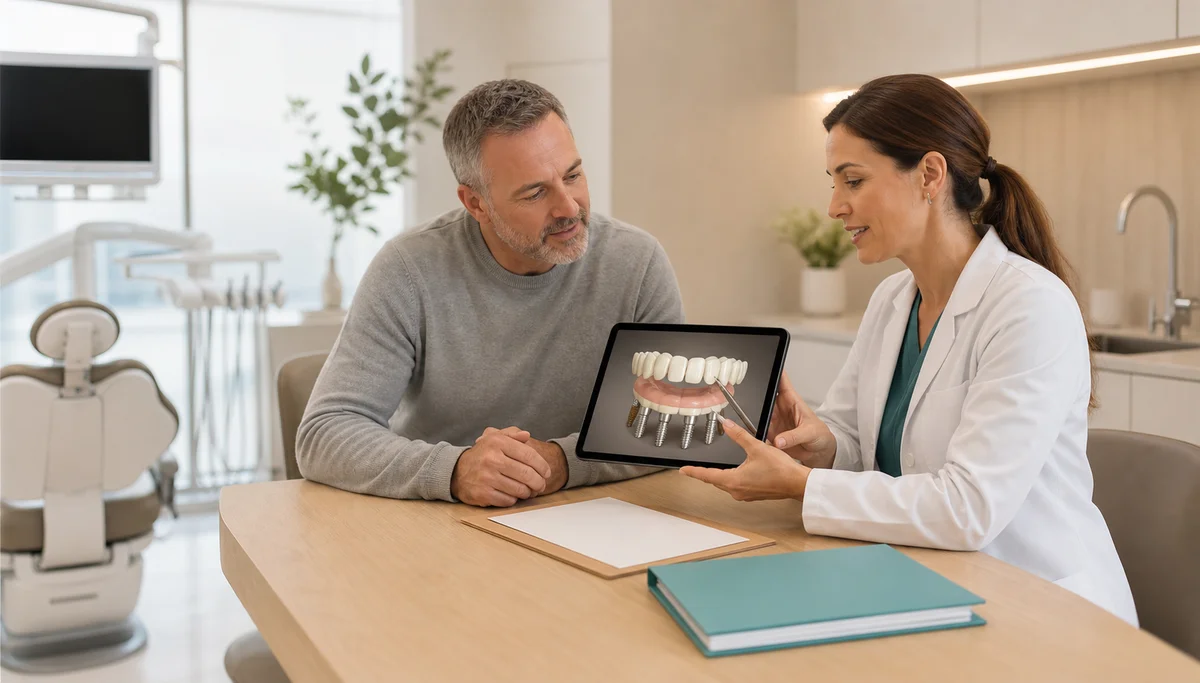
Are full mouth dental implants covered by insurance? Sometimes a plan pays for selected diagnostic, surgical, or prosthetic components, but complete coverage is uncommon and highly contract-specific. Original Medicare generally excludes implants; Medicare Advantage, Medicaid, employer, and individual dental benefits vary. Verify medical necessity, exclusions, network rules, annual maximums, prior authorization, and written estimates before treatment.
When patients ask are full mouth dental implants covered by insurance, they are usually trying to answer two different questions: whether an insurer recognizes any part of the treatment as a benefit, and how much the patient may still owe. A full-arch treatment can include examinations, imaging, extractions, infection control, bone or soft-tissue procedures, anesthesia, implant bodies, abutments, a temporary prosthesis, a final prosthesis, and maintenance. One plan may cover a limited diagnostic service while excluding implant placement; another may cover a conventional denture allowance but not the implant upgrade.
The safest starting point is therefore not a percentage quoted in an advertisement. It is a line-by-line benefits investigation tied to a dentist’s documented diagnosis and proposed procedure codes. Coverage can depend on the type of policy, state, employer contract, network, waiting period, frequency rule, missing-tooth clause, annual or lifetime maximum, and whether treatment starts before authorization. Even a favorable predetermination may describe estimated benefits rather than guarantee final payment.
This guide explains how to investigate are full mouth dental implants covered by insurance without promising a diagnosis, a fixed price, or a particular reimbursement outcome. It is educational, not legal or insurance advice. The treating dentist must determine clinical suitability, and the insurer or plan administrator must confirm benefits under the contract in force on each date of service.
1. What treatment does “full mouth dental implants” actually describe?
“Full mouth implants” is not one universal procedure code. It may refer to separate implant-supported restorations in both arches, fixed full-arch prostheses supported by several implants, implant-retained removable overdentures, or a staged combination. The number and position of implants, whether natural teeth remain, the condition of the bone and gums, and the design of the prosthesis all change the treatment plan.
The FDA describes dental implants as medical devices placed in the jaw to support crowns, bridges, or dentures. It also notes that overall health affects candidacy and healing, that smoking may interfere with healing, and that complications can occur. An online package cannot establish whether an individual needs extractions, grafting, a temporary restoration, or a different alternative. Those decisions require examination and appropriate imaging.
Because the phrase covers several clinical pathways, are full mouth dental implants covered by insurance must be investigated using the exact proposed services. Ask the clinic for a treatment narrative, tooth or arch locations, procedure codes where applicable, material descriptions, sequence, provider names, and alternatives. Coverage cannot be checked accurately against a vague package label. The useful starting question is: are full mouth dental implants covered by insurance for the particular design recommended after examination?
2. Are full mouth dental implants covered by insurance under a dental plan?
Some dental plans list implants as a covered major service; others exclude them or pay only toward a less costly alternative. “Covered” does not mean the insurer pays the whole bill. A plan can apply a deductible, coinsurance, annual maximum, lifetime implant maximum, waiting period, replacement interval, network allowance, or missing-tooth limitation. It can also treat the implant body, abutment, provisional prosthesis, and final prosthesis as separate benefit decisions.
Read the current Evidence of Coverage, Summary Plan Description, certificate, or member contract rather than relying on a generic benefit grid. Confirm that the document applies to your exact plan year and enrollment category. If the policy language is unclear, ask the insurer to identify the page and provision used for its answer. Ask the representative, “are full mouth dental implants covered by insurance under my exact certificate, and which individual components are excluded?” Keep the representative’s name, reference number, and date, but request a written response for a treatment of this scale.
Under a commercial or employer dental plan, are full mouth dental implants covered by insurance often has a component-by-component answer. For example, an examination or extraction may be eligible even when implant placement is excluded. That does not make the entire treatment covered, and an allowable amount can be far below the clinic’s fee.
3. Are full mouth dental implants covered by insurance through Original Medicare?
Medicare’s official dental-services page states that, in most cases, Original Medicare does not cover routine dental services or items such as dentures and implants. Limited dental services may be covered when they are inextricably linked to the success of certain Medicare-covered medical treatments, such as specified transplant, cardiac valve, cancer, or dialysis care. Those narrow medical exceptions are not a general implant benefit.
A hospital setting alone does not turn a noncovered implant restoration into a Medicare benefit. Medicare may cover qualifying inpatient care or certain dental services linked to a covered medical treatment while still excluding the implant-supported prosthesis itself. The precise question is: are full mouth dental implants covered by insurance through Original Medicare, or is only a limited related service potentially eligible? Ask the medical provider and Medicare how each service is classified, who will bill it, and which documentation supports the claimed exception.
For most beneficiaries asking are full mouth dental implants covered by insurance through Original Medicare, the practical answer is that implants are generally not covered. A rare medically related dental service should be verified in writing before care; do not assume that “medically necessary” in everyday language automatically meets Medicare’s specific coverage rules.
4. Are full mouth dental implants covered by insurance in Medicare Advantage?
Medicare Advantage plans must cover Medicare-covered services and may offer supplemental dental benefits. The existence of “dental” on a benefit card does not show that full-arch implants are included. Plan rules may restrict the network, require prior authorization, set a dollar allowance, limit covered categories, or exclude implants while covering examinations, cleanings, extractions, or dentures.
Review the plan’s current Evidence of Coverage, dental rider, provider directory, and authorization process. When calling, ask: are full mouth dental implants covered by insurance under this year’s supplemental dental benefit and this provider network? Ask whether the oral surgeon, restorative dentist, anesthesia provider, imaging facility, and laboratory-related services are all in network. A plan may use a separate dental administrator, so the customer-service number for medical claims may not give a complete dental answer.
With Medicare Advantage, are full mouth dental implants covered by insurance can only be answered by the specific plan, location, provider, and year. Supplemental benefits can change at renewal. Obtain a pre-service estimate using the proposed codes, but remember that final payment may depend on eligibility and remaining benefits on each service date.
5. Are full mouth dental implants covered by insurance through Medicaid?
CMS explains that states must provide dental benefits to children enrolled in Medicaid and CHIP, while states choose whether and how to provide adult dental benefits; there is no federal minimum adult dental benefit. Adult coverage may range from emergency-only care to broader benefits, and limitations can change. Managed-care plans may also have network and authorization processes within the state program.
Contact the state Medicaid agency or the number on the member card. State the question in full—are full mouth dental implants covered by insurance for an adult in this eligibility group?—then ask whether implant placement, bone grafting, anesthesia, abutments, and the final prosthesis are separate benefits. Also ask whether the service requires a documented exception, prior authorization, a specialist referral, or proof that a conventional denture is not clinically appropriate.
Therefore, are full mouth dental implants covered by insurance through Medicaid cannot be answered from another state’s experience. Use your current state handbook and written authorization decision. A provider’s willingness to accept Medicaid for examinations does not prove that the full implant treatment is a covered benefit.
6. Are full mouth dental implants covered by insurance bought through the Marketplace?
HealthCare.gov explains that adult dental coverage is not an essential health benefit. Marketplace consumers may find dental benefits embedded in a health plan or offered through a separate dental plan, but plan availability and terms vary. A stand-alone dental plan may have a waiting period, and consumers should review deductibles, copayments, and covered services before enrolling.
Buying a dental policy after a full-arch treatment has already been recommended does not necessarily create immediate coverage. Waiting periods, missing-tooth provisions, treatment-in-progress clauses, and annual maximums may affect benefits. Before enrolling, ask: are full mouth dental implants covered by insurance from the effective date, or do waiting and treatment-in-progress rules apply? Do not cancel existing coverage or time surgery around an assumption until the new carrier confirms effective dates and limitations in writing.
For Marketplace plans, are full mouth dental implants covered by insurance remains a contract question. Search the plan documents for “implant,” “prosthodontics,” “major services,” “replacement,” “missing tooth,” and “annual maximum,” then confirm the interpretation with the carrier before treatment begins.
7. Which parts might be covered even when implants are excluded?
A denial for implant placement does not automatically answer every related claim. Depending on the plan and clinical facts, separate benefits may exist for examinations, selected X-rays, treatment of active infection, periodontal care, extractions, pathology, or a conventional removable denture. Conversely, a covered extraction does not create coverage for the implants that follow.
Medical insurance may consider a limited service only when it treats a covered medical condition, injury, congenital issue, or qualifying medical-treatment prerequisite under that policy. Dental plans usually handle tooth replacement. Coordination between medical and dental benefits is complex, and duplicate payment is not allowed. Each provider should use accurate documentation and codes; code selection must reflect the service actually performed, not a strategy to force coverage.
When researching are full mouth dental implants covered by insurance, separate the plan into clinical phases:
- consultation, examination, photographs, and diagnostic imaging;
- disease control, periodontal therapy, and treatment of infection;
- extractions, grafting, and anesthesia or sedation when indicated;
- implant bodies, abutments, and surgical guides;
- temporary and definitive fixed or removable prostheses;
- maintenance, repairs, replacement components, and follow-up imaging.
This phased approach gives are full mouth dental implants covered by insurance a precise answer instead of a misleading all-or-nothing label. It also helps the patient compare the insurer’s estimate with the clinic’s complete financial agreement.
8. How prior authorization and predetermination change the answer
Prior authorization is a plan’s advance review of whether stated requirements appear to be met. Predetermination or pre-treatment estimate is an estimate of dental benefits based on submitted information. A useful written request asks: are full mouth dental implants covered by insurance for every submitted code, and what patient share is estimated? Neither response should be described as an unconditional guarantee: eligibility, remaining maximums, coordination of benefits, changes to the clinical plan, and the services actually delivered can affect final payment.
Submit the proposed codes, fees, radiographs, photographs, periodontal findings, diagnosis, treatment narrative, alternatives, and relevant medical history. If both arches are treated in stages, ask whether the plan year resets between phases and how that affects deductibles and maximums. Do not split dates or alter coding solely to manipulate benefits; treatment and claims must remain clinically accurate.
Before relying on are full mouth dental implants covered by insurance, request answers to these questions:
- Is the implant body a covered service, an exclusion, or subject to an alternative benefit?
- Are abutments and the final prosthesis evaluated separately?
- Does a missing-tooth, replacement, or treatment-in-progress rule apply?
- What deductible, coinsurance, annual maximum, or lifetime maximum remains?
- Must each clinician and facility be in network?
- Is authorization required, and how long is the decision valid?
- What documents and appeal deadlines apply after a denial?
9. Decision table: are full mouth dental implants covered by insurance in your situation?
| Coverage route | Starting assumption | Evidence to obtain | Main caution |
|---|---|---|---|
| Original Medicare | Implants generally not covered | Written confirmation of any narrow medical-treatment link | A hospital setting alone does not create implant coverage |
| Medicare Advantage | Supplemental dental benefit may exist | Current Evidence of Coverage and pre-service estimate | Allowance, network, authorization, and exclusions vary |
| Adult Medicaid | State-specific benefit | State handbook and authorization decision | No federal minimum adult dental benefit |
| Employer or individual dental | Plan-specific major-service rules | Certificate, fee estimate, and code-level response | Annual maximum may be much lower than treatment cost |
| Medical insurance | Dental replacement usually outside routine medical benefits | Policy language tied to the qualifying medical condition | Medical necessity does not automatically override an exclusion |
The table shows why are full mouth dental implants covered by insurance is not answered by the plan name alone. The patient’s diagnosis, benefit category, provider, location, dates, and remaining maximums all matter. Use the table to organize calls, not as a promise of payment.
10. How network status and overseas treatment affect coverage
An in-network provider has agreed to the plan’s contract terms, but network participation still does not prove that implants are covered. Out-of-network care may use a lower allowable amount, higher coinsurance, separate deductible, balance billing, or no benefit. Some dental plans have no out-of-network benefit at all.
Treatment outside the United States adds another layer. Original Medicare generally does not cover medical care outside the country except in narrow circumstances, and routine dental implants remain excluded. Private dental and Medicare Advantage plans may restrict benefits to domestic or contracted networks. An international clinic can provide a detailed invoice and clinical records, but those documents do not override a geographic exclusion.
If you are considering treatment abroad, ask are full mouth dental implants covered by insurance using the clinic’s country, provider status, currency, claim form, translation requirements, and payment method. Expect that you may need to pay the clinic directly. Obtain a written insurer response before relying on reimbursement, and budget for travel, future visits, and local follow-up.
Patients exploring international care can review Redent Clinic’s approach and use the contact page to request a documented preliminary review. A remote review is not a final diagnosis, insurance determination, or outcome guarantee.
11. What a complete cost estimate should include
The patient needs two documents: the clinic’s full treatment estimate and the insurer’s benefit estimate. Together, these records turn are full mouth dental implants covered by insurance from a yes-or-no search into a verifiable personal estimate. The difference between them is not always the final patient balance because the clinical plan may change after examination or healing. Ask the clinic to distinguish fixed fees from contingent services such as grafting, additional imaging, treatment of infection, a change in anesthesia, or replacement of a temporary prosthesis.
Include maintenance and complication planning. FDA guidance notes that implants require oral hygiene and regular dental visits, and that later complications can include infection, loosening, functional problems, or device failure. Insurance may apply new deductibles, maximums, replacement intervals, or exclusions to repairs. A commercial “warranty” is not a substitute for clinical follow-up and should be read for travel and maintenance conditions.
A realistic answer to are full mouth dental implants covered by insurance should show:
- the clinic’s fee for every planned and potential component;
- the plan’s allowable amount rather than only the billed charge;
- deductibles, coinsurance, copayments, and remaining maximums;
- noncovered upgrades and any alternative-benefit calculation;
- travel, lodging, time away from work, and follow-up costs;
- financing interest or fees, which are not insurance benefits;
- a contingency amount without assuming a complication will occur.
Only then does are full mouth dental implants covered by insurance become a usable financial estimate. Avoid signing irreversible financing or travel arrangements until both the clinical plan and benefits investigation are complete.
12. What to do if the plan denies implant coverage
Start by reading the denial reason and matching it to the current contract. Common categories include a specific implant exclusion, lack of required documentation, no prior authorization, network restrictions, waiting periods, maximums, replacement rules, or a decision that another benefit applies. A documentation denial may be correctable; an explicit contractual exclusion is a different issue.
Ask the provider whether the submitted diagnosis, narrative, radiographs, and codes accurately describe the plan. In an appeal, restate the exact issue—are full mouth dental implants covered by insurance under the cited provision and documented facts?—and request the clause or clinical criterion used. Follow the stated appeal deadline. An appeal should explain why the proposed treatment meets the plan’s terms, not simply that the treatment is desirable. State insurance departments, employer benefit administrators, Medicare, Medicaid, or plan-specific grievance channels may have different roles.
If the final answer to are full mouth dental implants covered by insurance is no, discuss clinically appropriate alternatives rather than assuming the only choices are full-arch implants or no care. Depending on the diagnosis, alternatives may include preserving treatable teeth, a conventional denture, an implant-retained removable prosthesis, staged treatment, or another design. Suitability must be determined by a dentist after examination.
Frequently asked questions
Are full mouth dental implants covered by insurance if they are medically necessary?
Medical necessity does not automatically override a policy exclusion. A dental plan may apply its implant rules, while medical insurance may cover only limited services tied to a covered medical condition. Submit the diagnosis and proposed codes for written review. The insurer, not the clinic, makes the benefit determination.
Does Medicare pay for All-on-4 or another full-arch implant system?
Original Medicare generally does not cover dentures or implants. Limited dental services may be covered when directly linked to certain Medicare-covered medical treatments, but that does not create routine coverage for a full-arch implant prosthesis. Medicare Advantage supplemental dental benefits vary and must be checked in the plan documents.
Can dental and medical insurance both contribute?
Possibly, but only when each plan has a legitimate covered service and coordination rules are followed. The same charge cannot be paid twice. Examinations, treatment of an injury, or hospital-related medical care may be evaluated differently from tooth replacement. Ask both carriers how claims should be sequenced.
Will a preauthorization guarantee payment?
Usually not. It is an important advance review, but final payment can depend on continued eligibility, benefits remaining on the service date, accurate coding, network status, and whether the performed treatment matches the submission. Read the authorization letter’s limitations and validity dates.
Does a dental discount plan count as insurance coverage?
A discount arrangement is generally not the same as insurance. It may provide negotiated fees with participating providers but does not reimburse claims like an insurance benefit. Confirm the provider, procedure, discount, membership fee, and exclusions directly with the program before treatment.
Can HSA or FSA funds pay for full mouth implants?
Tax-advantaged account rules are separate from insurance coverage. Eligible dental expenses may be payable from an HSA or FSA, but account limits, substantiation, timing, and tax rules apply. Ask the plan administrator or a qualified tax professional; using your own funds does not mean an insurer covered the treatment.
Are full mouth dental implants covered by insurance when treatment is abroad?
Many plans restrict overseas, non-network, or nonemergency care. Some may consider a properly documented claim, but a clinic invoice cannot override a geographic exclusion. Get a written answer naming the country and providers, then budget for direct payment, travel, repeat visits, and long-term local maintenance.
What records should I keep after implant treatment?
Keep the diagnosis, treatment plan, operative notes, implant brand and model, lot or serial information, radiographs, prosthesis materials, prescriptions, invoices, claim forms, explanations of benefits, and follow-up schedule. FDA specifically advises patients to ask which implant brand and model is used and retain that information.
Final answer: verify the benefit, the treatment, and the patient cost separately
Are full mouth dental implants covered by insurance? A plan may contribute to selected components, but complete payment is uncommon and no general answer applies across Original Medicare, Medicare Advantage, Medicaid, employer plans, Marketplace dental plans, or private coverage. The word “covered” is meaningful only when paired with the allowable amount, exclusions, network, authorization, maximums, and dates.
A patient-safe decision keeps clinical suitability separate from reimbursement. First obtain a diagnosis and alternatives; then request a code-level plan and written benefit estimate; finally calculate the noncovered treatment, travel, maintenance, and contingency costs. Recheck benefits before each major stage if treatment crosses a plan year. This process gives are full mouth dental implants covered by insurance a documented, personal answer without turning an estimate into a promise.
Sources
- Medicare.gov: Dental services coverage
- Medicare.gov: Items and services Original Medicare does not cover
- Medicaid.gov: Dental care benefits for children and adults
- HealthCare.gov: Dental coverage in the Marketplace
- HealthCare.gov: Essential health benefits and adult dental coverage
- U.S. Food and Drug Administration: Dental implants—what patients should know
- American Dental Association
- World Health Organization: Oral health fact sheet
- World Health Organization: Patient safety