
When patients visit our clinic and ask, “are traditional braces cheaper than invisalign?”, they are usually trying to make a practical and financially smart decision. Orthodontic treatment is a long-term investment in your smile, oral health, and confidence. Understanding whether traditional braces cost less than Invisalign requires a detailed look at treatment complexity, duration, materials, technology, and overall value. 😊
At first glance, many people assume metal braces are automatically the cheaper option. Historically, this was often true. However, in modern dentistry, the answer to are traditional braces cheaper than invisalign is not always straightforward. In some cases, traditional braces are slightly less expensive; in others, Invisalign may fall within a similar price range depending on your specific orthodontic needs.
Let’s explore this step by step so you can clearly understand the financial comparison.
Average Cost Comparison
In the United States, the average cost of traditional metal braces typically ranges between $3,000 and $7,000. Ceramic braces may cost slightly more, often between $4,000 and $8,000. Invisalign treatment usually falls between $3,500 and $8,000. As you can see, the ranges overlap significantly. This is why the question are traditional braces cheaper than invisalign does not have a universal yes-or-no answer.
If your case is mild to moderate, Invisalign may require fewer aligners, which can lower overall costs. In more complex cases involving severe bite correction or major alignment changes, traditional braces may sometimes be more predictable and cost-efficient. That’s why a personalized consultation is critical before deciding.
Why the Price Ranges Overlap
Modern orthodontics has evolved dramatically. Invisalign uses advanced 3D scanning, digital planning software, and custom-made aligners. Traditional braces, while more mechanical in appearance, also require professional expertise, precise adjustments, and regular appointments. Both treatments involve highly trained orthodontists and similar lengths of care, which explains why their pricing is often close.
So when asking are traditional braces cheaper than invisalign, you must consider that both systems aim to correct misalignment effectively. The difference lies more in the method than in the dramatic difference in cost.
Technology and Material Costs
Traditional braces consist of metal brackets, wires, and elastic bands. They are durable and effective, especially for complex orthodontic problems. Invisalign, on the other hand, uses a series of clear plastic aligners custom-designed through digital imaging.
The digital technology behind Invisalign adds laboratory costs and software planning fees. However, braces require frequent in-office tightening appointments, which also contribute to the total treatment price. Therefore, when patients ask are traditional braces cheaper than invisalign, we explain that both treatments carry different types of costs rather than simply “cheap vs expensive.”
Case Complexity Matters Most
One of the biggest factors affecting whether traditional braces cost less than Invisalign is case complexity. Severe overcrowding, rotated teeth, or jaw misalignment may require advanced orthodontic mechanics. In these situations, braces can sometimes be more cost-efficient because they offer continuous force and control.
For mild spacing or minor alignment corrections, Invisalign may be equally affordable and more convenient. So again, are traditional braces cheaper than invisalign depends largely on the severity of your condition.
Long-Term Value vs Initial Cost
Cost alone should not determine your decision. You must also consider lifestyle, comfort, and aesthetic preferences. Invisalign aligners are removable and nearly invisible, making them popular among adults and professionals. Traditional braces are more visible but often slightly more affordable in some cases.
If braces cost $4,000 and Invisalign costs $4,800, the difference may not be significant when spread over 18–24 months of treatment. When comparing value, many patients realize the difference is smaller than expected. That’s why the question are traditional braces cheaper than invisalign should always be followed by “which option fits my lifestyle and goals best?”
Insurance and Payment Plans
Many dental insurance plans cover orthodontic treatment up to a certain lifetime maximum, typically around $1,000–$3,000. In most cases, insurance covers both braces and Invisalign similarly. This means the financial gap may shrink even further after insurance benefits are applied.
Additionally, clinics often offer monthly payment plans. For example, a $5,000 treatment spread over 24 months equals approximately $208 per month. When patients see the monthly breakdown, the debate about are traditional braces cheaper than invisalign becomes less about total cost and more about personal preference.
So, Are Traditional Braces Actually Cheaper?
In summary, traditional braces are sometimes slightly cheaper than Invisalign, especially for complex orthodontic cases. However, the difference is usually not dramatic. Because pricing overlaps significantly, the answer to are traditional braces cheaper than invisalign depends on:
- The severity of your dental alignment problem
- The length of treatment required
- Your insurance coverage
- Your orthodontist’s expertise and pricing structure
- Your lifestyle and aesthetic preferences
The best way to determine which treatment is right for you is through a professional orthodontic evaluation. A specialist can assess your bite, alignment, and long-term goals to provide a customized cost estimate. Only then can you confidently answer the question: are traditional braces cheaper than invisalign for your specific case.
Ultimately, both treatments are effective, safe, and widely used. The most important factor is choosing a solution that aligns with your health, comfort, and financial situation. Your smile is a lifelong investment — make sure it’s the right one for you. 😁
1. Cost Breakdown: Are Traditional Braces Cheaper Than Invisalign?
When evaluating orthodontic treatment options, one of the most common financial questions patients ask is: are traditional braces cheaper than invisalign? Understanding the complete cost breakdown is essential before making a decision. While many people assume that metal braces automatically cost less, the reality is more nuanced. In this section, we will explore all cost components in detail so you can clearly understand whether traditional braces truly offer a lower price compared to clear aligners.
Average Treatment Costs in 2026
To determine whether are traditional braces cheaper than invisalign, we must first examine national pricing averages. In the United States, traditional metal braces typically range between $3,000 and $7,000. Ceramic braces may cost slightly more, usually between $4,000 and $8,000. Invisalign treatment generally ranges from $3,500 to $8,000, depending on case complexity and duration.
At first glance, traditional braces often start at a slightly lower base price. However, since both treatments overlap significantly in price ranges, the answer to are traditional braces cheaper than invisalign depends heavily on the severity of your orthodontic case and how long treatment will last.
Initial Consultation and Diagnostic Costs
Before beginning orthodontic care, patients undergo diagnostic procedures such as digital X-rays, 3D scans, photographs, and bite analysis. These diagnostic costs typically range from $200 to $500, though many clinics include them in the total treatment fee.
Both braces and Invisalign require comprehensive treatment planning. Invisalign uses advanced digital scanning and simulation software, which adds laboratory and aligner manufacturing fees. However, traditional braces require detailed manual planning and ongoing mechanical adjustments. Therefore, when asking are traditional braces cheaper than invisalign, remember that diagnostic planning expenses are often comparable.
Monthly Adjustment Appointments
Traditional braces usually require in-office adjustments every 4–6 weeks. These visits involve tightening wires, replacing elastics, and monitoring tooth movement. The cost of these visits is typically included in the overall treatment fee, but they represent a significant portion of the orthodontist’s time and expertise.
Invisalign patients may have slightly fewer in-office visits, especially in mild cases, since aligners are changed at home every 1–2 weeks. This can reduce chair time but does not necessarily reduce total cost. That’s why the debate over are traditional braces cheaper than invisalign cannot be decided based solely on appointment frequency.
Material and Manufacturing Expenses
Traditional Braces Components
Traditional braces use brackets, archwires, elastic ligatures, and sometimes additional appliances like expanders or rubber bands. These materials are durable and effective, especially for complex corrections. Their manufacturing cost is relatively standardized, which can sometimes make braces slightly more affordable.
Invisalign Technology
Invisalign aligners are custom-fabricated using patented SmartTrack material and computer-guided treatment simulations. Each patient receives a series of clear trays designed specifically for their teeth. Because of digital production and proprietary technology, Invisalign includes lab costs that may slightly increase total pricing.
However, while braces may have lower raw material costs, Invisalign often offers improved comfort and aesthetics. So when patients ask are traditional braces cheaper than invisalign, the difference may be marginal rather than dramatic.
Treatment Duration and Its Impact on Price
The length of treatment significantly influences total cost. Most orthodontic treatments last between 12 and 24 months. Severe misalignment or bite correction can extend treatment to 30 months or more.
Traditional braces are sometimes preferred for highly complex cases because they provide continuous force and greater control. In such situations, braces may complete treatment more efficiently, potentially reducing overall cost. For mild to moderate cases, Invisalign may achieve similar results within a comparable timeframe.
Therefore, when evaluating whether are traditional braces cheaper than invisalign, treatment duration plays a crucial role. A longer Invisalign plan requiring many aligners can increase costs, while a shorter braces treatment may be more economical—or vice versa.
Additional Costs and Potential Extras
There are also possible extra costs to consider:
- Replacement of lost Invisalign aligners (often $100–$300 per tray)
- Broken bracket repairs for braces (usually included but occasionally charged)
- Retainers after treatment (typically $200–$600)
- Emergency visits
Both systems require post-treatment retainers to maintain results. This cost is generally similar regardless of whether you choose braces or Invisalign. As a result, when analyzing are traditional braces cheaper than invisalign, post-treatment expenses must be factored in equally.
Insurance and Financing Influence
Orthodontic insurance coverage often provides up to $1,500–$3,000 in lifetime orthodontic benefits. Most plans cover braces and Invisalign similarly, meaning your out-of-pocket cost difference may shrink significantly.
Clinics also offer monthly payment plans. For example, a $5,000 treatment divided over 24 months results in payments around $208 per month. When patients see the monthly breakdown, the question are traditional braces cheaper than invisalign becomes less about total cost and more about comfort and lifestyle preference.
Final Financial Perspective
In conclusion, traditional braces are sometimes slightly cheaper than Invisalign, particularly for complex orthodontic cases. However, due to overlapping price ranges and similar treatment durations, the cost difference is often modest. The answer to are traditional braces cheaper than invisalign depends on your unique dental needs, the complexity of correction required, your insurance coverage, and your orthodontist’s pricing structure.
Rather than focusing solely on which option costs less, patients should evaluate overall value, treatment effectiveness, convenience, and long-term satisfaction. A personalized orthodontic consultation remains the most reliable way to determine which treatment fits your financial and clinical situation best. 😊
2. What Factors Influence Orthodontic Treatment Prices?
When patients research orthodontic treatment, they often focus on one central question: are traditional braces cheaper than invisalign? While comparing base prices is helpful, it does not tell the full story. Orthodontic costs are influenced by several clinical, technical, and logistical factors. Understanding these elements will help you see why the answer to are traditional braces cheaper than invisalign depends on much more than the appliance itself.
Case Complexity and Severity of Misalignment
The most important factor influencing orthodontic pricing is case complexity. Mild crowding or small gaps between teeth require less time and fewer adjustments. Severe overcrowding, bite misalignment (such as overbite, underbite, or crossbite), and jaw discrepancies demand more advanced correction.
Traditional braces are often highly effective for complex tooth movements because they provide continuous pressure and allow precise mechanical control. Invisalign has also evolved significantly and can treat many complex cases, but sometimes requires additional aligners or attachments. Therefore, when asking are traditional braces cheaper than invisalign, the severity of your case can significantly influence the final cost.
Mild Cases
In mild cases, Invisalign may require fewer aligners and shorter treatment time, potentially lowering costs. In such situations, the price difference between braces and aligners may be minimal.
Complex Cases
For severe alignment problems, braces may sometimes offer a more predictable and efficient correction path, which can affect overall pricing. This is why the question are traditional braces cheaper than invisalign cannot be answered without a professional orthodontic assessment.
Treatment Duration
The length of orthodontic treatment directly impacts cost. Most treatments last between 12 and 24 months, but some cases extend beyond that timeframe. Longer treatments mean more appointments, more adjustments, and increased professional monitoring.
Traditional braces typically require monthly in-office adjustments. Invisalign patients may switch aligners every 1–2 weeks, with periodic checkups every 6–8 weeks. If treatment extends due to compliance issues or complex tooth movement, the cost may increase. Therefore, when evaluating are traditional braces cheaper than invisalign, treatment duration is a major determining factor.
Orthodontist’s Experience and Location
Geographic location plays a significant role in orthodontic pricing. Clinics located in large metropolitan areas often charge higher fees due to increased operating costs. Additionally, orthodontists with advanced certifications, specialized training, or decades of experience may charge more for their expertise.
Whether you choose braces or Invisalign, the provider’s qualifications and reputation can influence the total fee. So when patients ask are traditional braces cheaper than invisalign, it is important to compare treatment plans within the same clinic rather than between entirely different practices.
Technology and Equipment Used
Modern orthodontics relies heavily on digital technology. Invisalign requires 3D intraoral scanning, digital simulation software, and customized aligner fabrication. These technological components add laboratory and production costs.
Traditional braces, while more mechanical in appearance, also require precise bracket placement, archwire customization, and ongoing adjustments. Clinics that use advanced self-ligating braces or high-end bracket systems may have slightly higher pricing. This technological variation affects whether are traditional braces cheaper than invisalign in your specific case.
Patient Compliance
Compliance is a factor that many patients overlook. Invisalign aligners must be worn 20–22 hours per day to be effective. If patients frequently remove aligners or forget to wear them, treatment may be extended, increasing total cost.
Traditional braces are fixed appliances and do not rely on patient compliance in the same way. Because they remain attached to the teeth, treatment progress is continuous. If compliance becomes an issue, Invisalign may require refinements or additional aligners, affecting pricing. This is another reason why the answer to are traditional braces cheaper than invisalign varies between individuals.
Additional Appliances and Add-Ons
Some orthodontic treatments require additional devices such as:
- Palatal expanders
- Elastics for bite correction
- Temporary anchorage devices (TADs)
- Attachments or buttons for Invisalign
These supplementary tools can increase total treatment cost. Both braces and Invisalign may require add-ons depending on the clinical situation. When calculating whether are traditional braces cheaper than invisalign, these potential additions must be considered.
Retention Phase Costs
After active treatment ends, patients must wear retainers to maintain their new smile. Retainers typically cost between $200 and $600, depending on type and material. This expense applies to both braces and Invisalign patients equally.
Therefore, retention does not significantly influence whether are traditional braces cheaper than invisalign, but it remains an important part of the overall financial picture.
Insurance Coverage and Payment Structures
Orthodontic insurance coverage often provides a fixed lifetime maximum benefit. Most insurance plans treat braces and Invisalign similarly, covering a percentage of the total cost. Monthly financing options also help spread payments over time.
Because insurance and financing reduce upfront expenses, the real-world difference between braces and Invisalign may become smaller than expected. This financial flexibility often shifts the conversation away from simply asking are traditional braces cheaper than invisalign and toward evaluating overall comfort and aesthetic preferences.
Final Consideration
In conclusion, multiple factors influence orthodontic pricing, including case complexity, treatment duration, technology, provider experience, compliance, and geographic location. While traditional braces may sometimes be slightly less expensive, the difference is not universal.
Ultimately, the answer to are traditional braces cheaper than invisalign depends on your unique dental needs and treatment goals. A comprehensive orthodontic consultation is the only reliable way to receive an accurate cost estimate tailored specifically to you. 😊
3. Insurance Coverage Comparison: Braces vs Invisalign
When patients seriously consider orthodontic treatment, cost quickly becomes one of the biggest deciding factors. After asking are traditional braces cheaper than invisalign, the next logical question is: “What does my insurance actually cover?” Understanding how insurance policies handle orthodontic care can dramatically change your out-of-pocket expenses and may even shift the answer to whether are traditional braces cheaper than invisalign in your specific situation.
Orthodontic insurance coverage varies widely depending on your provider, plan type, age restrictions, and lifetime maximum benefits. Let’s break down how insurance typically applies to traditional braces and Invisalign so you can make an informed decision. 😊
How Orthodontic Insurance Typically Works
Most dental insurance plans treat orthodontics as a separate category from general dental care. Instead of unlimited annual benefits, orthodontic coverage usually comes with a lifetime maximum, often ranging between $1,000 and $3,000.
For example, if your total orthodontic treatment costs $5,500 and your plan offers a $2,000 lifetime orthodontic maximum, your insurance would cover up to $2,000, leaving you responsible for $3,500. In this scenario, the difference between braces and aligners may narrow significantly. Therefore, when asking are traditional braces cheaper than invisalign, insurance coverage must always be factored into the equation.
Does Insurance Cover Invisalign the Same as Braces?
In the past, some insurance providers categorized Invisalign as cosmetic treatment, limiting or excluding coverage. However, this is far less common today. Most modern dental insurance plans now treat Invisalign as an orthodontic treatment equivalent to traditional braces.
This means if your plan covers braces, it likely also covers Invisalign up to the same lifetime maximum. When that happens, the financial gap between the two treatments becomes much smaller. In many cases, patients discover that the difference in out-of-pocket expenses is only a few hundred dollars. This often changes how people view the question are traditional braces cheaper than invisalign.
Important Tip
Always confirm directly with your insurance provider whether Invisalign is classified under orthodontic benefits. Small wording differences in policy documents can affect reimbursement.
Age Restrictions in Orthodontic Coverage
Some dental insurance plans provide orthodontic coverage only for patients under 18 years old. This is especially common in employer-sponsored plans. If you are an adult seeking treatment, you may not receive orthodontic benefits at all.
In cases where insurance does not apply, the full treatment cost becomes your responsibility. Under these circumstances, the answer to are traditional braces cheaper than invisalign may matter more financially, since no insurance buffer reduces the total difference.
Percentage-Based Coverage vs Fixed Maximum
Insurance policies typically structure orthodontic benefits in one of two ways:
- Percentage Coverage: Insurance pays a certain percentage (often 50%) up to the lifetime maximum.
- Fixed Maximum Benefit: Insurance covers a set dollar amount regardless of total cost.
For example, if your plan covers 50% of orthodontic treatment up to $2,000, and your braces cost $6,000, insurance will still stop paying once it reaches $2,000. The same would apply to Invisalign if it costs $6,500. This overlap in insurance benefits again reduces the practical difference in answering are traditional braces cheaper than invisalign.
Flexible Spending Accounts (FSA) and Health Savings Accounts (HSA)
Many patients use FSA or HSA funds to help cover orthodontic treatment. These accounts allow you to use pre-tax dollars for eligible medical expenses, including braces and Invisalign.
Using pre-tax funds effectively lowers the overall cost of treatment. For example, if you are in a 24% tax bracket, paying $4,000 with HSA funds could feel like paying closer to $3,040 in after-tax dollars. When factoring in these savings, the financial comparison shifts again. This makes the question are traditional braces cheaper than invisalign less dramatic in real-world budgeting.
Payment Timing and Insurance Disbursement
Orthodontic insurance benefits are often distributed gradually over the course of treatment rather than paid upfront. Insurance companies may divide payments across 12–24 months. If treatment ends early, remaining benefits may not be fully paid.
This structure applies to both braces and Invisalign. Therefore, insurance payout timing does not significantly favor one option over the other when determining are traditional braces cheaper than invisalign.
Out-of-Pocket Comparison Example
Let’s compare two realistic scenarios:
- Traditional braces cost: $5,500
- Invisalign cost: $6,000
- Insurance lifetime maximum: $2,000
After insurance:
- Braces out-of-pocket: $3,500
- Invisalign out-of-pocket: $4,000
In this case, the difference is $500 over a two-year period — roughly $21 per month. For many patients, this small monthly difference makes aesthetics and comfort more influential than cost alone. Suddenly, the question are traditional braces cheaper than invisalign becomes less about affordability and more about lifestyle preference.
Final Takeaway on Insurance Coverage
Insurance plays a major role in determining your actual financial responsibility. In many modern policies, braces and Invisalign receive nearly identical orthodontic coverage. While traditional braces may sometimes have a slightly lower base cost, insurance often reduces the difference even further.
Ultimately, whether are traditional braces cheaper than invisalign depends on your specific insurance plan, lifetime maximum benefits, age eligibility, and available tax-advantaged savings accounts. The best approach is to request a detailed cost estimate from your orthodontist and verify coverage directly with your insurance provider.
Once you have accurate numbers, you can confidently choose the treatment that aligns with both your financial comfort and your smile goals. 😁
4. Payment Plans and Financing Options Explained
After evaluating insurance coverage, many patients still wonder: are traditional braces cheaper than invisalign when paid out-of-pocket? Even if traditional braces appear slightly less expensive at first glance, the way you finance treatment can significantly affect affordability. Understanding payment plans, in-house financing, third-party lenders, and flexible budgeting options can completely reshape how you answer the question are traditional braces cheaper than invisalign.
Orthodontic treatment is rarely paid in full upfront. Most clinics understand that braces and aligners are major investments, and they offer structured financing to make treatment manageable. Let’s explore how payment structures work and how they influence the real-world cost comparison.
In-House Monthly Payment Plans
Many orthodontic clinics provide interest-free in-house payment plans. Typically, patients make a down payment—often between $500 and $1,500—and then spread the remaining balance across 12 to 24 months.
For example:
- Traditional braces total cost: $5,000
- Invisalign total cost: $5,800
- Down payment: $1,000
Remaining balances would be:
- Braces: $4,000 → approx. $167/month for 24 months
- Invisalign: $4,800 → approx. $200/month for 24 months
When broken into monthly payments, the difference becomes $33 per month. In practical terms, this often makes the debate over are traditional braces cheaper than invisalign less dramatic. For many patients, comfort and aesthetics may outweigh a small monthly difference.
Third-Party Financing Providers
Some clinics partner with healthcare financing companies that allow extended payment periods of 36, 48, or even 60 months. While this reduces monthly payments, interest may apply depending on credit approval and plan type.
Low-Interest Plans
Patients with strong credit may qualify for low or zero-interest promotional plans. In such cases, whether are traditional braces cheaper than invisalign becomes less important because long-term installment options make both treatments accessible.
Extended Payment Terms
Longer financing terms reduce monthly payments but may increase total cost if interest is added. For example, financing $5,500 over 60 months at 7% interest increases the overall payment amount. This applies equally to braces and Invisalign.
Down Payment Flexibility
Some clinics offer flexible down payment options. A higher down payment reduces monthly installments and overall financial pressure. For example, placing $2,000 down instead of $1,000 can significantly reduce monthly obligations.
When patients ask are traditional braces cheaper than invisalign, they often focus on total sticker price. However, adjusting the down payment can narrow or widen perceived affordability differences between treatments.
Discounts and Special Promotions
Occasionally, orthodontic clinics offer promotional discounts during certain seasons or community events. Discounts may range from $200 to $500 off total treatment costs.
If a clinic offers a limited-time Invisalign promotion, the cost difference may shrink or even disappear. In such cases, the answer to are traditional braces cheaper than invisalign may shift entirely depending on available discounts.
Employer and Corporate Benefits
Some employers provide additional orthodontic reimbursement benefits beyond standard dental insurance. Corporate wellness programs may include partial coverage or negotiated discounts with specific dental networks.
These benefits apply to both braces and Invisalign, meaning the final financial comparison depends on how much additional support you receive. Again, this reinforces that the answer to are traditional braces cheaper than invisalign is highly individual.
Health Savings Accounts (HSA) and Flexible Spending Accounts (FSA)
Using pre-tax funds from an HSA or FSA effectively reduces the overall cost of orthodontic treatment. For example, if you are in a 25% tax bracket, paying $4,000 through pre-tax funds can save approximately $1,000 in taxes.
This savings applies equally whether you choose braces or Invisalign. Therefore, tax advantages can soften the financial gap and influence how patients evaluate are traditional braces cheaper than invisalign.
Psychological Perspective: Monthly vs Total Cost
Interestingly, many patients shift their focus from total cost to manageable monthly payments. A $30–$50 monthly difference often feels less significant than a $800–$1,000 difference in total price.
When financing spreads payments over two years, patients frequently prioritize comfort, appearance, and lifestyle flexibility over slight cost differences. As a result, the original question are traditional braces cheaper than invisalign may become less central once realistic monthly figures are reviewed.
Transparency and Written Treatment Plans
Before committing to any financing plan, always request a detailed written treatment estimate. This document should outline:
- Total treatment cost
- Insurance contribution
- Down payment amount
- Monthly payment breakdown
- Any interest or administrative fees
Clear financial transparency helps you accurately evaluate whether are traditional braces cheaper than invisalign in your personal situation.
Final Financial Insight
While traditional braces sometimes carry a slightly lower base price, modern financing options significantly reduce the financial gap between braces and Invisalign. Interest-free payment plans, extended financing, employer benefits, and pre-tax accounts all influence final affordability.
Ultimately, whether are traditional braces cheaper than invisalign depends not only on total treatment cost but also on how comfortably you can manage monthly payments. With structured financing, both options can be financially accessible and realistic for most patients.
Careful budgeting, transparent consultation, and understanding all financing pathways will empower you to choose the orthodontic solution that fits both your smile goals and your financial comfort. 😊
5. Treatment Duration and Its Impact on Overall Cost
When comparing orthodontic options, many patients focus only on the base price and ask, are traditional braces cheaper than invisalign? However, one of the most overlooked factors influencing total cost is treatment duration. The length of time you wear braces or aligners directly affects appointment frequency, monitoring requirements, refinement phases, and sometimes even overall financial investment. To truly understand whether are traditional braces cheaper than invisalign, you must evaluate how long each treatment typically lasts and how extended timelines can influence cost.
Average Treatment Length for Braces
Traditional metal braces usually require between 18 and 24 months for moderate orthodontic cases. Mild misalignment may be corrected in as little as 12 months, while severe crowding or bite correction can extend treatment beyond 30 months.
Braces apply continuous pressure to teeth through archwires and brackets, which allows orthodontists to make controlled, predictable movements. Because braces remain fixed to the teeth, progress does not depend on patient compliance in the same way aligners do. This consistency can sometimes shorten treatment time in complex cases. As a result, when patients ask are traditional braces cheaper than invisalign, shorter or more predictable timelines may reduce long-term costs in certain situations.
Average Treatment Length for Invisalign
Invisalign treatment generally ranges from 12 to 24 months, depending on case severity. Mild cases may be completed in under a year, while complex corrections may require multiple sets of aligners.
Unlike braces, Invisalign aligners must be worn for 20–22 hours per day. If patients remove them frequently or fail to follow instructions, treatment can be delayed. Extended treatment often means additional aligners, refinement trays, and follow-up appointments. Therefore, when evaluating are traditional braces cheaper than invisalign, patient compliance plays a key role in total cost control.
How Extended Treatment Increases Costs
Longer treatment duration can impact costs in several ways:
- Additional orthodontic monitoring visits
- Extra aligner sets (for Invisalign refinements)
- Replacement brackets or repairs (for braces)
- Extended retainer monitoring period
Although many clinics include standard refinements in the total Invisalign fee, complex cases requiring multiple refinements may increase costs. Similarly, if braces remain in place longer than expected due to slow tooth movement, extended care may influence final pricing. This is why the question are traditional braces cheaper than invisalign must account for potential timeline extensions.
Complex Cases and Treatment Efficiency
Severe Bite Corrections
For significant overbites, underbites, or crossbites, braces often provide stronger mechanical leverage. In such cases, braces may move teeth more efficiently than aligners, potentially shortening overall treatment duration.
Mild to Moderate Alignment Issues
For simple spacing or mild crowding, Invisalign may achieve results just as quickly as braces. In these scenarios, the difference in total treatment time may be negligible, making the cost comparison between braces and aligners very close.
Therefore, whether are traditional braces cheaper than invisalign can partially depend on how efficiently each system addresses your specific orthodontic problem.
Appointment Frequency and Associated Costs
Traditional braces typically require adjustment appointments every 4–6 weeks. Invisalign check-ups may occur every 6–8 weeks. While braces may involve slightly more frequent visits, Invisalign patients may require additional scans or refinement appointments if aligners are not tracking properly.
Most orthodontists include routine appointments in the total treatment fee. However, extended visits or additional refinement phases could influence final expenses. This subtle difference again affects how we answer are traditional braces cheaper than invisalign.
The Role of Patient Compliance
One major factor influencing Invisalign duration is compliance. If aligners are worn inconsistently, teeth may not move as planned, leading to delays. In contrast, braces remain fixed and continuously active, regardless of patient habits.
For highly disciplined patients, Invisalign can stay on schedule. For less consistent wearers, treatment may extend beyond the projected timeline. In those cases, the financial comparison shifts. Suddenly, the question are traditional braces cheaper than invisalign may tilt in favor of braces due to fewer compliance-related delays.
Refinement Phase Considerations
Many Invisalign cases include refinement aligners after the initial series is completed. These additional trays fine-tune alignment and ensure optimal results. While often included in the total package, extensive refinements could increase overall production costs.
Braces may also require final detailing adjustments, but these are usually part of the standard treatment plan. The need for refinements influences total treatment length and subtly impacts whether are traditional braces cheaper than invisalign in real-world practice.
Long-Term Cost Perspective
Ultimately, shorter treatment duration can mean fewer appointments, less monitoring, and reduced overall expenses. If braces complete complex corrections faster, they may offer better cost efficiency in certain cases. If Invisalign completes mild corrections quickly with minimal refinements, aligners may be equally affordable.
This highlights an important truth: the answer to are traditional braces cheaper than invisalign is closely tied to treatment duration. Faster, more predictable treatment often translates into better cost control.
Final Evaluation
When comparing orthodontic options, always consider projected treatment length alongside base pricing. Ask your orthodontist for a realistic timeline estimate and whether refinements are included in the quoted fee.
In conclusion, treatment duration significantly influences total orthodontic investment. Whether are traditional braces cheaper than invisalign depends not only on starting price but also on how long you will remain in active treatment. Careful planning and professional evaluation ensure you choose the option that delivers efficient results within your financial comfort zone. 😊
6. Maintenance, Repairs, and Hidden Costs
When patients compare orthodontic options, they often focus on the initial quote and ask, are traditional braces cheaper than invisalign? However, beyond the base treatment fee, maintenance requirements, emergency repairs, and unexpected expenses can influence the final financial outcome. To truly understand whether are traditional braces cheaper than invisalign, you must evaluate the long-term upkeep and potential hidden costs associated with each system.
Orthodontic treatment is not simply about placing brackets or wearing aligners. It involves ongoing monitoring, occasional repairs, hygiene considerations, and post-treatment retention. These elements may not always appear in the initial cost estimate but can affect the total investment over time. 😊
Maintenance Requirements for Traditional Braces
Traditional braces consist of brackets bonded to each tooth, connected by archwires and elastic ligatures. Because they are fixed appliances, they require careful daily cleaning and periodic in-office adjustments.
Bracket or Wire Breakage
It is not uncommon for patients to experience a loose bracket or poking wire, especially after eating hard or sticky foods. Emergency visits to repair broken brackets are usually included in the treatment fee, but repeated breakage may lead to additional costs in some clinics.
Frequent repairs can also extend treatment time, indirectly affecting overall value. Therefore, when considering are traditional braces cheaper than invisalign, durability and potential repair frequency should be factored in.
Oral Hygiene Challenges
Braces make brushing and flossing more challenging. Poor hygiene can lead to plaque buildup, enamel decalcification, or gum inflammation. While these are not direct orthodontic costs, additional dental cleanings or restorative treatments may become necessary if oral hygiene is neglected.
Maintenance Requirements for Invisalign
Invisalign aligners are removable and made from smooth, clear plastic. They must be worn 20–22 hours per day and removed only for eating, drinking (except water), and brushing.
Lost or Damaged Aligners
One of the most common hidden costs of Invisalign is replacing lost aligners. Replacement trays may cost between $100 and $300 per aligner, depending on the provider. Multiple lost trays can increase total treatment expenses.
If aligners are not worn as instructed or become warped due to heat exposure, additional refinement sets may be required. This factor influences how we answer the question are traditional braces cheaper than invisalign, especially for patients who may struggle with compliance.
Cleaning and Maintenance Products
Invisalign aligners require daily cleaning using specialized solutions or cleaning crystals. While these products are not extremely expensive, they represent an additional recurring cost compared to traditional braces.
Emergency Appointments and Unplanned Visits
Both braces and Invisalign may require occasional emergency visits. For braces, emergencies typically involve broken brackets or wires. For Invisalign, emergencies may include lost trays or improper tracking of tooth movement.
Most orthodontists include routine emergencies within the treatment package. However, repeated issues may lead to additional charges. Over time, these small expenses can influence the total financial comparison when evaluating are traditional braces cheaper than invisalign.
Dietary Restrictions and Indirect Costs
Traditional braces require patients to avoid hard candies, popcorn, nuts, and sticky foods. While this is not a direct financial cost, lifestyle adjustments may affect food choices and habits.
Invisalign allows patients to eat normally since aligners are removed during meals. However, aligners must be cleaned thoroughly afterward. If patients frequently snack without cleaning properly, additional dental issues could arise.
Although indirect, these lifestyle considerations contribute to the broader analysis of whether are traditional braces cheaper than invisalign when considering convenience and preventive care expenses.
Retainers and Post-Treatment Costs
After orthodontic treatment ends, retainers are essential to maintain results. Retainers typically cost between $200 and $600, regardless of whether you had braces or Invisalign.
Some patients may require replacement retainers over time. Since retention is necessary for both systems, it does not strongly favor one option over the other when determining are traditional braces cheaper than invisalign, but it remains an important part of the total investment.
Long-Term Value Perspective
When comparing maintenance and hidden costs, traditional braces may involve more mechanical repairs, while Invisalign may involve replacement trays and compliance-related refinements. The financial difference depends heavily on patient habits and case complexity.
If a patient frequently breaks brackets, braces may become less cost-efficient. If a patient repeatedly loses aligners, Invisalign expenses may increase. Therefore, personal responsibility plays a crucial role in answering are traditional braces cheaper than invisalign.
Final Analysis
In conclusion, maintenance and hidden costs are often underestimated when comparing orthodontic systems. While traditional braces may sometimes have a slightly lower initial price, unexpected repairs or hygiene-related issues can influence overall expenses. Invisalign, though sometimes slightly higher in base cost, may offer fewer mechanical repairs but carries risks of lost aligners and compliance-related refinements.
Ultimately, whether are traditional braces cheaper than invisalign depends not only on the quoted treatment fee but also on long-term maintenance habits, emergency visits, and personal responsibility throughout the treatment journey. Carefully discussing these factors with your orthodontist ensures a transparent and realistic financial expectation before beginning treatment. 😁
7. Effectiveness Comparison: Value for Money Analysis
When evaluating orthodontic options, many patients initially focus on cost and ask, are traditional braces cheaper than invisalign? However, cost alone does not determine value. True value comes from effectiveness, predictability, long-term stability, and overall treatment satisfaction. Even if one option appears slightly less expensive, it may not necessarily deliver better value. Therefore, answering are traditional braces cheaper than invisalign requires a deeper look at clinical performance and long-term outcomes.
Orthodontic treatment is not simply a cosmetic enhancement—it corrects bite alignment, improves oral function, and supports long-term dental health. Choosing between braces and Invisalign should involve understanding how effectively each system addresses different orthodontic conditions. 😊
Clinical Effectiveness for Complex Cases
Traditional braces have been used for decades and are highly effective in treating severe malocclusions, rotated teeth, significant overcrowding, and complex bite issues. Because braces are fixed to the teeth, they apply continuous pressure and allow orthodontists to make precise mechanical adjustments.
In cases involving major bite correction or jaw discrepancies, braces often provide more predictable results. For these patients, even if someone asks are traditional braces cheaper than invisalign, the better question may be which treatment delivers stronger and more controlled tooth movement.
Why Braces Excel in Complex Movements
- Continuous force without relying on patient compliance
- Precise bracket positioning for controlled movement
- Effective torque and rotational correction
In these scenarios, braces may provide greater overall value, even if the initial cost difference is small.
Effectiveness of Invisalign for Mild to Moderate Cases
Invisalign has significantly advanced in recent years. Modern aligner systems can treat mild to moderate crowding, spacing, and even some bite issues effectively. Through 3D digital planning, orthodontists map each stage of tooth movement before treatment begins.
For patients with less complex needs, Invisalign can deliver results comparable to braces. In these cases, the question are traditional braces cheaper than invisalign becomes less about effectiveness and more about comfort and aesthetics.
Advantages of Invisalign Effectiveness
- Custom-designed aligners for gradual movement
- Digital simulation of final results
- Fewer in-office adjustments
When treatment complexity is low, Invisalign may provide excellent value for money, even if its base price is slightly higher.
Treatment Predictability and Refinements
Predictability plays a crucial role in cost-effectiveness. Braces offer strong mechanical control, often reducing the need for major refinements. Invisalign treatment sometimes requires additional refinement aligners to perfect the final result.
Most orthodontic providers include a limited number of refinements in the total Invisalign package. However, extensive refinements may increase costs. Therefore, when considering are traditional braces cheaper than invisalign, it is important to ask whether refinements are included in your quoted fee.
Long-Term Stability and Retention
After active treatment, both braces and Invisalign patients must wear retainers to maintain results. Long-term stability depends more on retainer compliance than on the appliance used during treatment.
Since retention requirements are similar for both systems, long-term stability does not significantly favor one over the other in determining are traditional braces cheaper than invisalign. However, predictable treatment progression during the active phase can influence overall value.
Comfort and Patient Experience
While not directly related to effectiveness, patient comfort influences perceived value. Traditional braces may cause irritation from brackets and wires, especially after adjustments. Invisalign aligners are smooth and removable, often providing greater comfort.
Some patients consider comfort and aesthetics essential to value. Even if braces cost slightly less, a patient may feel Invisalign delivers better overall value due to improved daily experience. In this context, the question are traditional braces cheaper than invisalign becomes secondary to quality of life during treatment.
Compliance and Treatment Success
One critical factor influencing effectiveness is compliance. Invisalign requires strict adherence to wearing aligners 20–22 hours daily. If compliance is poor, results may suffer, and refinements may be needed.
Braces, being fixed appliances, do not rely on patient discipline in the same way. For patients concerned about compliance, braces may provide more reliable outcomes. This reliability can indirectly influence whether are traditional braces cheaper than invisalign when considering overall value.
Cost vs Outcome: True Value Perspective
To determine true value, patients should consider:
- Total treatment cost
- Effectiveness for their specific case
- Likelihood of refinements
- Comfort and lifestyle compatibility
- Long-term stability
If braces cost $5,000 and Invisalign costs $5,800, but Invisalign offers superior comfort and aesthetics for a mild case, the value difference may justify the additional expense. Conversely, if braces complete a complex case more efficiently with fewer refinements, they may offer stronger cost-effectiveness.
Final Evaluation
In conclusion, effectiveness is central to determining overall value. While many patients ask are traditional braces cheaper than invisalign, the better question may be which option provides the most reliable and efficient correction for your unique orthodontic needs.
Both systems are clinically effective when prescribed appropriately. The right choice depends on complexity, compliance, lifestyle, and personal priorities. A professional consultation ensures that your decision balances both cost and long-term results, delivering true value for your smile investment. 😁
8. Comfort, Aesthetics, and Lifestyle Considerations
When patients compare orthodontic treatments, they often begin with the financial question: are traditional braces cheaper than invisalign? However, cost is only one part of the decision-making process. Comfort, visual appearance, social confidence, dietary flexibility, and daily lifestyle convenience play equally important roles. Even if someone determines that traditional braces may cost slightly less, they may still prefer Invisalign due to lifestyle advantages. Therefore, to fully evaluate are traditional braces cheaper than invisalign, we must examine how each option impacts everyday life.
Visibility and Aesthetic Appeal
One of the most noticeable differences between braces and Invisalign is appearance. Traditional metal braces are clearly visible when smiling, speaking, or laughing. While ceramic braces are less noticeable, they are still detectable at close range.
Invisalign aligners are made of transparent plastic and fit snugly over the teeth, making them nearly invisible. For adults, professionals, and teenagers concerned about self-image, this aesthetic advantage is often decisive. Even if patients initially ask are traditional braces cheaper than invisalign, many ultimately prioritize confidence in social and professional settings.
Professional Environments
In careers that involve public speaking, sales, media appearances, or client-facing roles, discreet orthodontic treatment can feel more comfortable. Invisalign’s low visibility often makes it appealing in these contexts.
Teen and Adult Confidence
Teenagers and adults may feel self-conscious wearing metal braces. While modern braces are smaller and more refined than in the past, they remain visible. Invisalign’s subtle design can reduce social anxiety during treatment.
Comfort and Oral Irritation
Comfort significantly influences patient satisfaction. Traditional braces can cause irritation to the cheeks and lips, especially after adjustments. The brackets and wires may create friction, leading to temporary soreness.
Invisalign aligners are smooth and custom-designed to fit snugly against the teeth. While mild pressure is normal when switching to a new set of aligners, many patients report fewer soft-tissue irritations compared to braces.
When evaluating are traditional braces cheaper than invisalign, it is important to consider whether potential discomfort with braces might influence your overall experience during treatment.
Dietary Flexibility
Traditional braces require dietary restrictions. Patients must avoid hard candies, popcorn, chewing gum, nuts, and sticky foods to prevent bracket damage. These restrictions can feel limiting over the course of 18–24 months.
Invisalign aligners are removed during meals, allowing patients to eat freely without restrictions. After eating, aligners must be cleaned and reinserted. This flexibility often improves overall lifestyle satisfaction.
Although diet restrictions do not directly answer are traditional braces cheaper than invisalign, lifestyle freedom can influence how patients perceive value beyond financial cost.
Oral Hygiene Convenience
Brushing and Flossing with Braces
Braces make oral hygiene more challenging. Special floss threaders, interdental brushes, and extra care are required to prevent plaque buildup. Poor hygiene during braces treatment may increase the risk of cavities or gum inflammation.
Brushing and Flossing with Invisalign
Because Invisalign aligners are removable, brushing and flossing remain relatively normal. Patients simply remove the trays before cleaning their teeth. This convenience often supports better oral hygiene habits.
For patients concerned about long-term oral health maintenance, ease of cleaning may influence their perspective when asking are traditional braces cheaper than invisalign.
Speech and Adaptation Period
Both braces and Invisalign require short adaptation periods. Braces may cause temporary speech changes due to bracket placement. Invisalign may create a slight lisp during the first few days as the tongue adjusts to aligners.
Most speech adjustments resolve quickly for both systems. However, patients who rely heavily on public speaking may prefer Invisalign due to its smoother surface and lower visibility.
Patient Responsibility and Discipline
Invisalign requires strong patient discipline. Aligners must be worn for 20–22 hours daily to remain effective. Forgetting to wear them can delay progress and potentially increase treatment time.
Traditional braces do not rely on patient compliance in the same way because they are fixed in place. For individuals concerned about maintaining consistent habits, braces may provide more reliable progress.
This factor indirectly influences the discussion of are traditional braces cheaper than invisalign, because non-compliance with Invisalign may lead to extended treatment and additional refinement trays.
Psychological and Social Impact
Orthodontic treatment is a long journey, often lasting up to two years. Daily comfort, appearance, and confidence can significantly affect overall satisfaction. Even if someone initially focuses on whether are traditional braces cheaper than invisalign, their final decision may reflect emotional and psychological comfort rather than purely financial comparison.
Balancing Cost with Lifestyle Value
When comparing comfort and aesthetics, Invisalign often provides advantages in discretion and flexibility. Traditional braces, while visible, remain highly effective and reliable. The cost difference between the two treatments is often smaller than expected, especially when insurance and financing options are considered.
Therefore, the question are traditional braces cheaper than invisalign should be weighed alongside lifestyle compatibility. Choosing a treatment that aligns with your comfort, daily habits, and social confidence ensures a positive orthodontic experience from start to finish.
Ultimately, the best decision balances financial considerations with personal comfort and long-term satisfaction. Both braces and Invisalign can deliver excellent results—the right choice depends on your priorities, discipline, and desired treatment experience. 😊
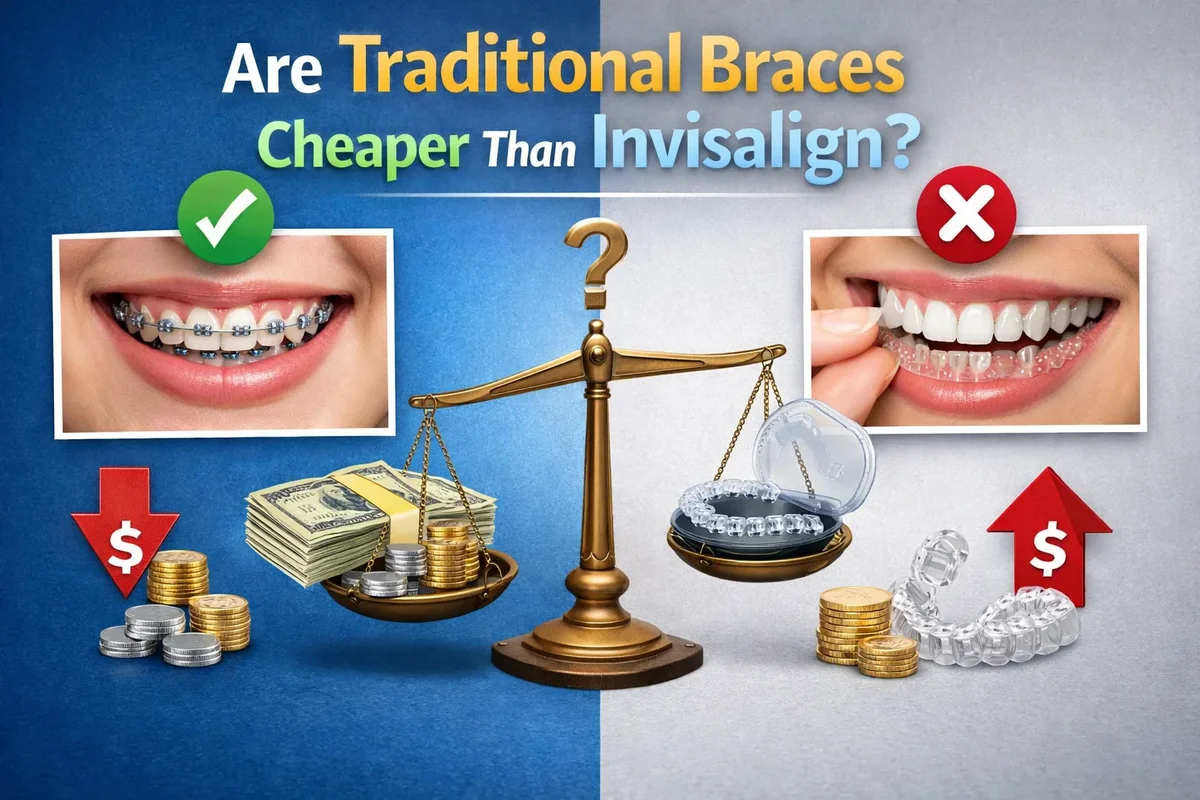
9. Which Option Is More Cost-Effective in the Long Run?
After examining pricing, insurance, maintenance, comfort, and effectiveness, many patients return to the original question: are traditional braces cheaper than invisalign? However, the more strategic question is not only about initial cost, but about long-term cost-effectiveness. A treatment that appears cheaper upfront may not necessarily provide better overall value over time. To truly determine whether are traditional braces cheaper than invisalign, we must evaluate durability, relapse prevention, treatment stability, and total lifetime investment in your smile.
Orthodontic treatment is a multi-year journey followed by lifelong retention. Therefore, long-term cost-effectiveness goes beyond the active treatment phase. 😊
Initial Cost vs Lifetime Investment
At first glance, traditional braces may sometimes have a slightly lower starting price compared to Invisalign. In some cases, braces may cost $4,500 while Invisalign may cost $5,200. Naturally, this prompts patients to ask are traditional braces cheaper than invisalign? The answer in this example is yes—by $700 initially.
However, when distributed across a 24-month treatment plan, that difference equals roughly $29 per month. Over a lifetime of improved oral health and confidence, this monthly difference may be relatively small.
Durability and Risk of Additional Costs
Braces Durability
Traditional braces are fixed appliances and generally remain in place throughout treatment. While brackets can break, most repairs are included in treatment packages. Their fixed nature ensures consistent tooth movement, which can reduce treatment delays.
Invisalign Durability
Invisalign aligners are removable and therefore more susceptible to being lost, cracked, or warped. Replacing lost aligners may increase overall costs. However, responsible use minimizes this risk.
When considering are traditional braces cheaper than invisalign, durability and patient responsibility must be included in the cost-effectiveness equation.
Refinement and Retreatment Risk
Long-term value depends on achieving stable, lasting results. If either treatment requires extensive refinements or prolonged correction due to compliance issues, overall cost-effectiveness decreases.
Braces often provide predictable outcomes for complex cases. Invisalign may require refinement trays, especially if aligners were not worn consistently. Most providers include refinements in the original quote, but extensive adjustments could affect total cost.
Thus, when evaluating are traditional braces cheaper than invisalign, consider not only initial pricing but also the likelihood of extended or repeated treatment phases.
Post-Treatment Retention Costs
Regardless of which system you choose, retainers are mandatory after treatment. Retainers typically cost between $200 and $600, and they may need replacement every few years.
Retention requirements are identical for both braces and Invisalign patients. Therefore, retention does not strongly influence whether are traditional braces cheaper than invisalign, but it is part of the lifetime financial commitment.
Oral Health Benefits and Future Savings
Properly aligned teeth reduce the risk of tooth decay, gum disease, abnormal enamel wear, and jaw discomfort. Investing in orthodontic treatment can prevent costly restorative procedures in the future.
Both braces and Invisalign can deliver these long-term health benefits when treatment is completed successfully. The key factor is choosing the system that ensures compliance and predictable correction. In this broader context, asking are traditional braces cheaper than invisalign becomes less about short-term cost and more about long-term oral health stability.
Psychological and Professional Returns
A confident smile can positively influence personal relationships, career opportunities, and overall self-esteem. While difficult to quantify financially, these benefits contribute to the long-term return on investment.
If Invisalign improves confidence during treatment due to its discreet appearance, some patients may perceive higher long-term value—even if braces initially cost slightly less. Therefore, are traditional braces cheaper than invisalign may not be the only metric that defines cost-effectiveness.
Compliance and Long-Term Stability
Compliance plays a crucial role in lasting results. Braces eliminate compliance concerns during treatment since they are fixed. Invisalign requires consistent wear, but post-treatment retainer use requires discipline for both systems.
If compliance is strong, both treatments can provide stable, durable results. If compliance is weak, long-term value decreases regardless of which system you choose. This reality further complicates the question are traditional braces cheaper than invisalign, because patient behavior significantly influences long-term outcomes.
Final Cost-Effectiveness Conclusion
In the long run, cost-effectiveness depends on:
- Initial treatment price
- Insurance contribution
- Compliance and treatment efficiency
- Risk of refinements or retreatment
- Long-term oral health stability
- Personal comfort and confidence during treatment
While traditional braces may sometimes carry a slightly lower upfront price, the overall long-term difference is often modest. In many cases, both options fall within a similar financial range when insurance and financing are applied.
Ultimately, whether are traditional braces cheaper than invisalign is only one part of the equation. The more important question is which option provides the best balance of cost, effectiveness, comfort, and long-term stability for your specific dental needs.
A professional orthodontic consultation remains the most reliable way to evaluate personalized cost projections and determine the most cost-effective path to achieving a healthy, confident smile that lasts for decades. 😁