
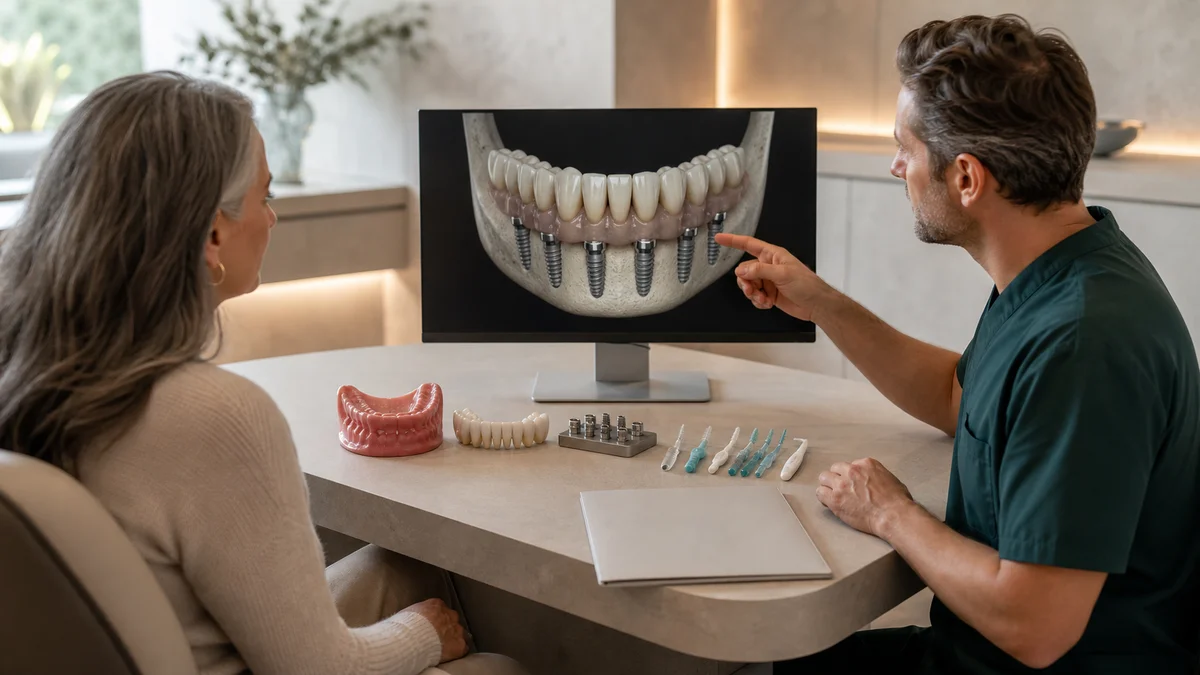
Quick answer: before and after full mouth dental implants can illustrate changes in teeth and smile support, but photographs cannot prove implant health, chewing comfort or longevity. Confirm whether the “after” shows temporary or definitive teeth, ask how the starting condition was diagnosed, and judge the plan through clinical records, risks, maintenance and realistic follow-up.
Searching before and after full mouth dental implants often begins with a visual question: “Could my smile change like that?” The medically useful question is broader: what diagnosis, sequence, trade-offs and long-term responsibilities produced the result? Full-mouth rehabilitation may involve one arch or both arches, retained natural teeth or extractions, a removable implant overdenture or a fixed bridge. Those routes are not interchangeable, and an attractive photograph does not reveal which one was used.
This patient guide explains how to read before and after full mouth dental implants responsibly. It does not diagnose candidacy or promise a particular appearance. A safe recommendation requires an in-person dental and medical history, examination, appropriate imaging and a discussion of alternatives. The principles below help you ask better questions whether treatment is local or requires travel. They also help separate useful documentation from marketing that compresses a complex rehabilitation into two polished frames.
1. What “full mouth dental implants” can actually mean
The phrase is not a single device, brand or protocol. In before and after full mouth dental implants, the “after” may represent a fixed full-arch bridge supported by several implants, an implant-retained removable overdenture, separate implant crowns, or a mixed plan that preserves some treatable teeth. “Full mouth” can mean the upper arch, the lower arch or both, depending on how a clinic uses the term. Ask for the exact prosthesis type in plain language.
A fixed bridge is removed by a clinician, not by the patient. An overdenture is designed for the patient to remove for cleaning and may be retained by attachments or a bar. Each design has different space, bone, hygiene, repair and maintenance requirements. The number and position of implants are planned from anatomy, force and prosthetic goals rather than selected from a photograph. Therefore, two similar-looking examples of before and after full mouth dental implants may involve substantially different treatment.
- Fixed full-arch bridge: can feel stable, but requires carefully designed cleaning access and periodic professional review.
- Implant overdenture: is removable for hygiene; clips, inserts or other attachment parts may wear and need replacement.
- Conventional complete denture: does not require implant surgery and remains a valid alternative for some people.
- Tooth-preserving or mixed rehabilitation: may use periodontal, restorative, endodontic, orthodontic or implant care according to the prognosis of each area.
Preserving a restorable natural tooth can sometimes be appropriate; extracting teeth simply to match a fast package is not a universal clinical rule. A defensible plan explains the prognosis of every remaining tooth and why retention, treatment or removal is being recommended. When assessing before and after full mouth dental implants, look for evidence of diagnosis and consent, not just uniform teeth in the final image.
2. How to read before and after full mouth dental implants safely
Good clinical photographs are records, not guarantees. For before and after full mouth dental implants to be meaningfully compared, the camera angle, magnification, head position, expression and lighting should be reasonably consistent. The timing must also be stated. An image taken immediately after delivery can show swelling or a provisional bridge; one taken years later may show maintenance performance. Filters, whitening, changed exposure and different lip posture can exaggerate a difference.
Ask whether the patient gave consent for educational use and whether the images show an actual documented case rather than stock material, digital simulation or artificial imagery. Privacy may limit how much a clinic can disclose, but the treatment category and timing can still be explained without identifying anyone. Ethical before and after full mouth dental implants should never be presented as a prediction of your personal outcome.
Check 1: Is the starting condition comparable?
A person with a failing removable denture, another with advanced gum disease and a third with heavily restored but maintainable teeth do not share the same baseline. Bone volume, gum display, jaw relationship, lip support, smile line and health conditions can change the plan. A gallery of before and after full mouth dental implants cannot establish that your anatomy, priorities or risk profile match the example.
Check 2: Is the “after” temporary or definitive?
Immediate teeth are often provisional. They may be intentionally lighter, flatter or easier to adjust while tissues heal and the dental team evaluates speech, cleaning and bite. The definitive prosthesis may follow months later and use a different material or contour. Responsible before and after full mouth dental implants identify which stage is shown; “teeth in a day” should not be assumed to mean the final bridge is finished that day.
Check 3: Are function and health documented?
A photograph shows surface appearance. It does not show implant stability, bone levels, gum inflammation, bite contacts, speech adaptation, cleaning access or the patient’s comfort. Ask what clinical and radiographic follow-up occurred and at what interval. The visual “after” in before and after full mouth dental implants is only one component of outcome assessment.
Check 4: Is the image honest about limitations?
Natural-looking teeth differ in shade, texture and proportion. Pink prosthetic material may be needed to replace lost gum and bone volume. The lip line can hide or expose that junction. If every case appears identical, extremely white or free of normal anatomical variation, pause. A credible discussion around before and after full mouth dental implants explains design compromises instead of treating them as editing problems.
3. Diagnosis before treatment: the part photos leave out
The “before” appointment should be a diagnostic process, not a sales photograph. It commonly includes dental and medical histories, current medicines, tobacco or nicotine use, allergy information, previous treatment experiences and the patient’s goals. The clinical examination considers decay, periodontal health, infection, soft tissues, jaw movement, bite, available restorative space and the prognosis of remaining teeth. Imaging is selected according to the clinical question; three-dimensional imaging may be appropriate for implant planning but is not a substitute for examination.
Overall health can affect surgery and healing. Diabetes control, medicines that influence bleeding or bone metabolism, immune conditions, previous radiation, sleep-related breathing issues and smoking history may alter risk or sequencing. Do not stop prescribed medicine on the advice of a website. The treating dentist and relevant physician should coordinate when needed. A trustworthy plan behind before and after full mouth dental implants records these factors and gives patient-specific instructions.
Prosthetic planning should lead implant positioning. The team first considers where teeth need to be for appearance, speech, lip support and function, then assesses whether anatomy can support implants in safe, useful positions. Diagnostic models, scans and photographs may help. If a proposal gives the same implant number and placement pattern to everyone, it has skipped the individual reasoning that before and after full mouth dental implants cannot display.
- Which teeth can reasonably be treated and maintained, and what findings support removal of any tooth?
- Is the proposed restoration fixed or removable, provisional or definitive, and who can remove it?
- What implant system, components and prosthetic materials are planned, and will I receive identifying records?
- Is grafting anticipated, what uncertainty remains until surgery, and how could the plan change?
- How will bite, speech, smile line, lip support and daily cleaning be tested?
- Who performs surgery, who designs and fits the teeth, and who handles complications?
4. The usual treatment sequence behind the transformation
There is no universal timeline for before and after full mouth dental implants. Disease control or urgent treatment may come first. Some patients need periodontal therapy, extraction of non-restorable teeth, management of infection, modification of an existing denture or healing before implant placement. Others may be candidates for extraction, implant placement and a provisional prosthesis in a coordinated stage. The safest sequence depends on biology, anatomy, primary stability, bite and the ability to protect the implants during healing.
Stage 1: information, consent and a prosthetic plan
The team should translate findings into options, including doing less, staging care or using a non-implant alternative. Written consent should cover material risks, benefits, uncertainties and foreseeable additional care. Expectations are discussed with trial tooth positions or digital previews when appropriate, but simulations are planning aids. They do not turn before and after full mouth dental implants into a guaranteed forecast.
Stage 2: surgery and conditional immediate loading
Implants are placed in planned positions, with grafting or other procedures only when indicated. A same-day fixed provisional restoration may be possible when surgical and prosthetic conditions permit, but it is conditional. If stability or anatomy is unsuitable, a removable temporary or a delayed-loading route may be safer. A clinician should be able to explain the backup plan before surgery. The fastest-looking before and after full mouth dental implants is not automatically the best plan for every patient.
Stage 3: healing and provisional adaptation
Healing is active treatment time. The patient follows hygiene and diet guidance, attends reviews and reports increasing pain, swelling, bleeding, fever, numbness, a loose prosthesis or difficulty cleaning. The provisional teeth may be adjusted for pressure, speech and bite. Smoking or nicotine exposure may impair healing and should be discussed honestly. During this interval, before and after full mouth dental implants may show a usable smile, but the biological and functional outcome remains under evaluation.
Stage 4: definitive records, manufacture and delivery
After appropriate healing and reassessment, the team records implant positions and the desired tooth setup, then verifies fit, bite, aesthetics, phonetics and hygiene access. Materials have different wear, repair and laboratory pathways; no material is maintenance-free. At delivery, patients should receive care instructions and implant information. A final image in before and after full mouth dental implants should ideally state that it is the definitive restoration and when it was photographed.
5. A decision table: compare endpoints, not labels
The table is a conversation aid, not an individual recommendation. Each option can be suitable or unsuitable depending on examination findings and preferences. Use it to decode what a clinic means when presenting before and after full mouth dental implants.
| Possible endpoint | What the patient handles | Potential advantages to discuss | Trade-offs and maintenance questions |
|---|---|---|---|
| Preserve and restore selected teeth | Natural teeth plus any crowns, bridges or removable parts | May avoid unnecessary extraction and retain sensation or anatomy | Prognosis varies tooth by tooth; periodontal, root canal or restorative maintenance may continue |
| Conventional complete denture | Patient removes it daily | No implant surgery; can restore teeth and lip support | Movement, adaptation, sore areas, relines and changing jaw shape may require care |
| Implant-retained overdenture | Patient removes it for cleaning | May improve retention while allowing direct hygiene access | Attachments can wear; space, implant distribution, relines and replacement parts matter |
| Fixed full-arch implant bridge | Clinician removes it when indicated | Stable fixed teeth and a planned full-arch form | Surgery, cleaning beneath the bridge, screw or prosthetic complications and repairs require planning |
| Staged or mixed rehabilitation | Combination varies | Can sequence priorities or preserve useful teeth | Longer coordination, transitional prostheses and different maintenance needs across the mouth |
A decision is stronger when the written proposal names the endpoint, not only a branded phrase. It should state what is included in diagnostics, temporary teeth, surgery, components, definitive teeth, reviews and repairs. If you compare before and after full mouth dental implants, confirm that each example reached the same endpoint you are considering.
6. Appearance, speech and chewing: realistic outcome goals
Appearance involves more than tooth colour. Tooth length, width, midline, incisal display, smile curve, gum replacement and lip support interact. Lost bone and gum volume cannot always be replaced by teeth alone; pink restorative material may be needed. Very long teeth can result if the transition is ignored. During planning, ask where the prosthesis-to-tissue junction will sit and whether it shows during a broad smile. This detail is often invisible in selected before and after full mouth dental implants.
Speech can change when tooth position, palatal contour or the space behind the teeth changes. Some adaptation is expected, but persistent difficulty deserves assessment and adjustment. Chewing also improves through gradual adaptation rather than a single dramatic test. Immediate provisional teeth may require a modified diet to reduce load while healing. Marketing around before and after full mouth dental implants should not imply that every food is safe immediately or that natural-tooth sensation is fully reproduced.
Colour preferences should be balanced with face, age, skin tone and material characteristics. A natural result can include subtle translucency and variation. Digital previews and try-ins help communication, yet monitor colour and simulations are imperfect. The final decision should be documented before manufacture. Use before and after full mouth dental implants to identify questions about design—not to choose a tooth shade from another person’s image.
7. Risks, complications and warning signs
Dental implant surgery can involve pain, swelling, bruising, bleeding, infection and injury to nearby structures. Depending on location, there may be risks involving nerves or the sinus. An implant may not integrate or may lose support later. Prosthetic complications can include loose or fractured screws, chipping, wear, fracture, food trapping, bite discomfort or difficulty cleaning. The FDA’s patient information stresses that overall health, healing, oral hygiene and ongoing professional care matter. No gallery of before and after full mouth dental implants can remove these risks.
Long-term inflammation around implants may develop if plaque control and risk management are inadequate. Bleeding, swelling, discharge, persistent bad taste, increasing pocketing, mobility or progressive bone changes need professional evaluation. Regular review allows the team to assess tissues, the prosthesis, hygiene and bite. “Lifetime teeth” is an unsafe shorthand because implants, components and prosthetic materials can experience biological or mechanical complications.
After surgery, follow the treating team’s instructions and emergency route. Seek urgent professional advice for breathing or swallowing difficulty, uncontrolled bleeding, rapidly increasing swelling, severe or worsening pain, fever, allergic symptoms, persistent altered sensation or a loose provisional restoration. This article cannot triage an individual problem. A responsible page showing before and after full mouth dental implants should make access to care clearer, not minimize complications.
8. Maintenance begins before the final photograph
Implants do not decay, but the tissues around them can become inflamed, and the prosthesis can wear or break. Daily cleaning may involve an electric or manual toothbrush, interdental brushes, floss threaders, water irrigation or other aids selected for the design and dexterity. The bridge must have cleanable contours. Ask the clinician to demonstrate and then watch you repeat the technique. If access is impossible on the model, a beautiful example of before and after full mouth dental implants is incomplete evidence.
Recall frequency is individualized. Reviews may include plaque and bleeding assessment, probing when appropriate, bite evaluation, screw or component checks and radiographs based on clinical need. Night-time protection may be discussed for some patients, but it is not a universal solution. Parts can become unavailable over time, so keep the implant manufacturer, model, dimensions and component records. The FDA recommends knowing the brand and model and maintaining oral hygiene and regular visits.
Budget for maintenance rather than viewing it as an unexpected failure. Professional cleaning, attachment replacement, repairs, relines, screw replacement or remaking a worn prosthesis may be needed. Get written information about which items are included during an initial period and which are separate. Long-term before and after full mouth dental implants would ideally include maintenance history, not merely a delivery-day photograph.
9. Price and insurance: compare the complete scope
A responsible article cannot quote one fixed fee for before and after full mouth dental implants. Cost changes with the number of arches, diagnostic records, tooth removal, grafting, implant system, sedation arrangements, provisional prosthesis, definitive material, laboratory steps, follow-up and management of complications. A low headline may omit the final teeth or assume an uncomplicated procedure. An unusually high fee is not proof of quality either.
Request an itemized, written plan after examination. It should distinguish expected from conditional services and explain what happens if immediate loading is not possible. Compare like with like: fixed versus removable, one arch versus two, provisional versus definitive, component brand, warranty terms, hygiene visits and repair responsibility. Insurance coverage varies by contract, medical necessity criteria, waiting periods, annual limits and exclusions. Confirm benefits directly with the insurer; pre-authorization is not always a guarantee of payment.
- Diagnostics, imaging and specialist consultations
- Extractions, grafting or disease-control treatment if indicated
- Implants, abutments, screws and other named components
- Temporary and definitive restorations listed separately
- Sedation or anaesthesia arrangements and the qualified provider
- Planned reviews, emergency care, hygiene and future repairs
- Travel, accommodation, time away from work and a contingency budget
Photos should not pressure a patient into borrowing, rushing or purchasing a package before diagnosis. Use before and after full mouth dental implants as one educational input, then make the financial decision from a complete clinical scope and realistic total cost.
10. Treatment abroad: add travel and continuity checks
Cross-border dental care can add language, record transfer, travel timing and follow-up complexity. The CDC advises medical travellers to research the facility and clinician, arrange follow-up before travel and obtain complete records. Surgery and long journeys can also interact with general travel health risks. Ask the treating team and your physician about timing rather than booking a flight from a generic online schedule.
For treatment in Türkiye, verify that the healthcare provider appears on the current Ministry of Health list for international health tourism. Authorization is an important administrative check, but it does not replace evaluating the individual dentist, proposed plan, informed consent, sterilization practices or emergency arrangements. A clinic may discuss before and after full mouth dental implants by video, yet final diagnosis and consent still require appropriate clinical assessment.
Obtain records in a language you understand: examination findings, imaging, implant system and sizes, surgical notes, component details, prescriptions, laboratory information and the maintenance schedule. Confirm who pays for travel if a review or repair is required and who can source compatible components at home. Continuity is a clinical issue, not an after-sales extra. The real story behind before and after full mouth dental implants continues after the return flight.
11. Red flags when evaluating clinics and galleries
Good communication welcomes uncertainty and alternatives. Be cautious when a permanent plan is issued solely from selfies or a panoramic image, every patient receives the same implant count, or extraction of all teeth is proposed without a tooth-by-tooth rationale. Other warning signs include lifetime guarantees, claims of painless or risk-free surgery, a refusal to name the clinician or implant system, and no written route for complications.
Gallery red flags include mismatched lighting and angles, undisclosed filters, stock images, unidentified digital simulations, only front-smile views, and a failure to state whether teeth are provisional. Pressure tactics may use dramatic before and after full mouth dental implants alongside expiring discounts or celebrity comparisons. A safety-focused clinic should be willing to slow the decision down.
- No examination or periodontal diagnosis before a definitive quote
- No explanation of removable versus fixed, or temporary versus final
- No alternative to extracting every remaining tooth
- No implant identification record or component availability plan
- No demonstration of daily cleaning beneath the proposed bridge
- No named clinician for surgery, restoration and emergency support
- No follow-up plan after travel or after the initial warranty period
12. A practical consultation checklist
Bring your medicine list, medical history, previous radiographs or treatment records when available, and a short description of what matters most: comfort, appearance, removability, treatment time, cleaning ability or budget predictability. Describe previous dental anxiety or sedation experiences. Write down questions before the appointment. The best use of before and after full mouth dental implants is to point to features you want explained, not to demand a copied design.
Ask the clinician to summarize the problem, options, recommended endpoint, material uncertainties and fallback plan. Repeat the plan in your own words. Request time to consider elective treatment and, for extensive irreversible care, consider an independent second opinion. At Redent Clinic, an individual assessment can clarify which questions apply; the contact page can be used to organize an appointment and record-sharing needs. Online information does not replace examination.
Frequently asked questions about before and after full mouth dental implants
Do before-and-after photos prove that implants succeeded?
No. Before and after full mouth dental implants can document visible change, but they do not by themselves prove healthy tissues, stable bone, comfortable function or long-term survival. Ask when the image was taken and what clinical follow-up supports the result.
Does “teeth in a day” mean I receive my final teeth?
Not necessarily. It often refers to a provisional restoration placed on the day of surgery when conditions allow. The definitive prosthesis may be made after healing and further testing. Before and after full mouth dental implants should clearly label a same-day temporary result.
How many implants does a full arch need?
There is no number that is correct for everyone. Anatomy, bone, implant distribution, prosthetic design, bite, opposing teeth and risk factors all matter. A clinician must plan from diagnostic findings. Do not choose a number by matching before and after full mouth dental implants online.
Must every remaining tooth be removed?
No universal rule requires this. Each tooth’s restorability and periodontal, endodontic and structural prognosis should be evaluated. Sometimes removal is appropriate; sometimes treatment or a mixed plan is reasonable. Ask for the rationale before accepting irreversible care based on before and after full mouth dental implants.
Can full-arch implant teeth look natural?
They can be designed with natural proportions, texture and shade, but anatomy and lost tissue influence the result. Pink material or a transition line may be necessary. A try-in supports communication. Another person’s before and after full mouth dental implants cannot predict your exact appearance.
Can I eat normally immediately after surgery?
Diet instructions depend on surgery, stability and the provisional design. Many protocols restrict chewing forces during early healing. Follow the treating team’s specific instructions. A delivery-day before and after full mouth dental implants image does not show what foods are safe.
How long does the whole process take?
Timing varies with disease control, extractions, grafting, healing, loading strategy and prosthetic testing. A same-day temporary does not eliminate biological healing or later definitive work. Treat a fast timeline beside before and after full mouth dental implants as a proposal that requires clinical confirmation.
How do I clean a fixed full-arch bridge?
Cleaning tools may include a toothbrush, interdental brushes, threaders or irrigation devices, chosen for your design and dexterity. The team should demonstrate the technique and verify access. If the underside shown in before and after full mouth dental implants cannot be cleaned, ask whether contours can be changed.
Are full-mouth dental implants guaranteed for life?
No treatment outcome can responsibly be guaranteed for life. Biological and mechanical complications can occur, and prosthetic parts wear. Ask for the written scope of any warranty, exclusions and required maintenance. Guarantees should not be inferred from before and after full mouth dental implants.
What records should I receive?
Request diagnostic and relevant imaging records, the treatment and surgical notes, implant manufacturer and model details, component information, prescriptions, prosthesis material and maintenance instructions. These records matter if another professional must care for the implants after the before and after full mouth dental implants photographs are taken.
When should I get a second opinion?
A second opinion is reasonable for extensive irreversible treatment, especially when every tooth is proposed for extraction, alternatives are unclear, risks are minimized or you feel pressured. Bring the same records so plans can be compared. Different recommendations should be explained from findings, not judged only by before and after full mouth dental implants.
What is the most useful final question?
Ask: “What would make you change this plan?” The answer reveals whether the team has considered anatomy, stability, healing, cleaning and alternatives. Good planning includes contingencies. That is more informative than asking whether your before and after full mouth dental implants will match a selected gallery image.
Key takeaways
Before and after full mouth dental implants are most useful when they are standardized, consented, accurately timed and linked to a clearly named treatment endpoint. They cannot establish your candidacy or predict your result. Put diagnosis, tooth preservation, informed consent, cleanability, component records, complication planning and continuity of care ahead of photographic drama.
Choose the least irreversible option that reasonably addresses your diagnosed needs and preferences. Ask whether the “after” is temporary or definitive, how function and tissue health were assessed, and what maintenance occurred. A safe decision emerges from examination and a written plan; before and after full mouth dental implants should support that conversation, never replace it.
Sources and further reading
- American Dental Association — Professional oral-health resources
- U.S. Food and Drug Administration — Dental Implants: What You Should Know
- American Dental Association, MouthHealthy — Implants
- American Dental Association, MouthHealthy — Dentures
- American Academy of Periodontology — Full Mouth Dental Implants
- U.S. Centers for Disease Control and Prevention — Medical Tourism
- World Health Organization — Oral health fact sheet
- Republic of Türkiye Ministry of Health — Healthcare providers authorized for international health tourism
Educational information reviewed for patient safety. It does not replace an individual examination, diagnosis or treatment plan.