
Quick answer: To find the best dental hygienist near me, verify professional credentials and local scope, then assess the quality of screening, personalised prevention, infection control, communication, accessibility and follow-up. Reviews and distance can help shortlist practices, but they cannot replace a clinical examination, transparent consent or a coordinated dentist–hygienist care plan.
Searching for the best dental hygienist near me is not really a contest for the highest star rating. “Best” should mean the right preventive professional for your needs, working within a qualified dental team, using a documented assessment and explaining why each service is recommended. A comfortable appointment matters, but so do clinical judgment, safe processes and continuity.
Dental hygiene can include oral-health screening, plaque and calculus removal, gum-health measurements, preventive materials and coaching for home care. The exact activities a hygienist may perform, and the level of dentist supervision required, vary by jurisdiction. Your starting point is therefore to verify credentials with the relevant regulator and ask the practice how the hygienist and dentist coordinate diagnosis and treatment.
This guide is written for evidence-based review by Dentist Esma Çevrük Çakır. It offers a framework, not a diagnosis or provider endorsement. To learn about personalised oral care, visit the Redent Klinik English homepage. For an appointment question that is not a medical emergency, use the Redent Klinik contact page. Current availability and professional scope should always be confirmed directly.
1. best dental hygienist near me starts with your definition of “best”
A person with stable gum health may value preventive coaching and gentle routine care. Someone with a history of periodontitis may need detailed periodontal charting, maintenance at an individual interval and close coordination with a dentist or periodontist. A patient with disability may prioritise physical access and adapted home-care instruction. Language, sensory needs and dental anxiety can also change what good care looks like.
Write down your primary goal before opening a map: first preventive visit, routine maintenance, pregnancy-related questions, implant maintenance, bleeding gums, dry mouth, orthodontic appliances or support after periodontal treatment. Symptoms such as persistent swelling, severe pain, a non-healing lesion or dental trauma may require a dentist’s diagnostic assessment rather than a cleaning-only booking.
The best dental hygienist near me should be defined by clinical fit and communication, not by a universal ranking. A professional who recognises a need outside their scope and arranges timely referral demonstrates good judgment.
2. Understand what a dental hygienist does
The American Dental Association describes hygienists as professionals who may perform patient screening, take radiographs, teach oral hygiene and apply preventive materials such as fluoride or sealants. The American Dental Hygienists’ Association describes licensed oral-health professionals focused on preventing oral-health problems through examination, education and preventive or therapeutic services. These descriptions are broad; local law controls the permitted scope.
A hygienist is not the same as a dental assistant. An assistant commonly supports clinical procedures, prepares rooms and performs authorised tasks. A hygienist has dedicated preventive education and licensure. A dentist diagnoses dental disease, creates treatment plans and performs procedures within dental practice. Modern care often depends on coordinated roles rather than one person doing everything.
When asking for the best dental hygienist near me, request the clinician’s full name, professional title and role in your assessment. The practice should be able to explain when a dentist reviews findings and how referrals are managed.
3. Verify credentials before choosing the best dental hygienist near me
Look for a current professional licence or registration in the jurisdiction where care will occur. Use the official regulator’s database when available instead of relying only on a certificate photograph or social-media biography. Check that the name and practice details match. If a register displays restrictions or disciplinary information, read the official context rather than drawing conclusions from an unverified post.
Education and continuing professional development can be relevant, especially for periodontal maintenance, implants, paediatric prevention or patients with complex medical needs. However, a list of courses is not proof that a treatment is necessary or that an outcome is guaranteed. Ask how training changes the assessment and care process.
A trustworthy result for best dental hygienist near me includes verifiable identity and lawful scope. If the practice will not name the treating professional before the appointment, consider another provider.
4. Look for a complete health and oral assessment
Good hygiene care begins before instruments touch the teeth. The clinician should review medical conditions, medicines, allergies, pregnancy status, tobacco or nicotine use, dry mouth, previous dental experiences and current symptoms. Conditions such as diabetes, immune suppression, bleeding disorders or cardiovascular disease may affect planning and coordination, but they do not lead to the same recommendation for every patient.
The oral assessment may include gums, plaque, calculus, bleeding, recession, tooth mobility, implants, restorations and risk factors. Periodontal measurements should be taken when clinically appropriate and recorded so changes can be followed. Radiographs should answer a clinical question and follow local justification rules; more images are not automatically better care.
The best dental hygienist near me should connect findings to a clear explanation. A recommendation such as a shorter recall interval or deeper periodontal instrumentation should have a documented reason, not simply a package name.
5. The best dental hygienist near me builds a personalised prevention plan
The CDC notes that oral diseases are largely preventable through a combination of professional care and self-care. It advises brushing twice daily, cleaning between teeth, limiting added sugar, using fluoride toothpaste and attending dental check-ups, with additional visits when a provider recommends them. These are population-level principles; individual advice should reflect your mouth, dexterity, diet, appliances and disease risk.
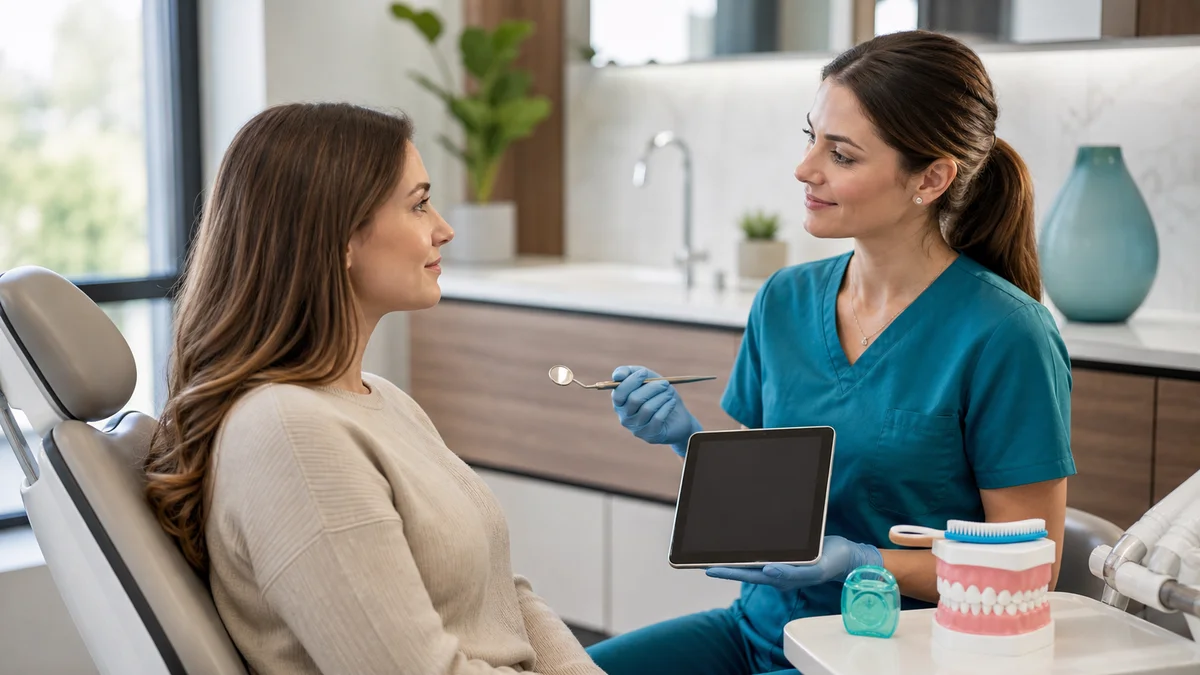
Effective coaching is practical. The hygienist may demonstrate brush angle, an interdental brush, floss holder, water flosser or cleaning around implants, but should avoid turning every option into a product sale. A useful plan names one or two priority behaviours, shows the technique and checks whether it is realistic for your daily routine.
- A brushing technique adapted to your dexterity and gum findings.
- An appropriate method for cleaning between teeth or under appliances.
- Advice for fluoride, dry mouth or sensitivity when clinically relevant.
- A realistic behaviour goal that can be reviewed at the next visit.
Your search for the best dental hygienist near me should favour measurable goals: less bleeding, improved plaque control, stable periodontal measurements or better access around an appliance. Cosmetic brightness alone is not a complete definition of oral health.
The best dental hygienist near me also checks whether the proposed home-care plan is workable between appointments.
6. Routine cleaning and periodontal therapy are not interchangeable
A routine preventive cleaning and treatment for gum disease differ in purpose, assessment and extent. Gingivitis involves inflammation without the same attachment and bone loss seen in periodontitis. The CDC explains that gingivitis can often be prevented and treated with home care and professional cleanings, while periodontitis may require professional management such as scaling and root planing, medication in selected cases or surgery.
Terms such as “deep cleaning” can be confusing. Ask which teeth or areas are involved, what measurements support the recommendation, whether local anaesthesia may be needed and how progress will be reviewed. A flat upgrade offered without periodontal findings deserves clarification.
The best dental hygienist near me will not promise to reverse every stage of gum disease. The goal may be to control inflammation, slow progression and support a maintenance plan coordinated with the dentist or periodontist.
7. Infection control is essential when selecting the best dental hygienist near me
Clean appearance is reassuring, but infection prevention is a system. The CDC publishes dental infection-prevention guidance covering standard precautions, hand hygiene, personal protective equipment, instrument processing, environmental cleaning, dental-unit water and safety monitoring. Patients do not need to inspect every technical detail, but reasonable questions should receive calm, specific answers.
Look for hand hygiene, fresh gloves for your care, protected or disinfected clinical surfaces and packaged sterile instruments where appropriate. Single-use items should not be reused. The team should manage sharps and contaminated materials safely. Barriers, masks and protective eyewear should fit the procedure and current guidance.
For the best dental hygienist near me, ask how instruments are sterilised and how the practice monitors the process. An evidence-based answer is more meaningful than vague claims such as “hospital grade” without explanation.
8. Communication and consent reveal care quality
A good clinician explains findings in plain language, checks understanding and invites questions. You should know what is planned, why it is recommended, what it may feel like, material risks and alternatives, and what may happen if care is deferred. Consent is a conversation that can be revised; signing a form does not replace explanation.
Ask the hygienist to pause if you need a break. A pre-agreed hand signal can help patients who find speaking during treatment difficult. The clinician should distinguish expected temporary sensitivity from signs that need review. Dismissive comments about pain, shame about home care or pressure to purchase add-ons undermine trust.
The best dental hygienist near me treats education as collaboration. Advice should respond to your priorities, culture, budget and abilities without promising a perfect outcome.
Good communication makes the best dental hygienist near me easier to identify than promotional claims do.
9. Accessibility matters in the best dental hygienist near me search
Distance is only one part of access. Confirm step-free entry, lift availability, accessible parking, transfer space, restroom access and whether the dental chair can accommodate your needs. Patients with sensory sensitivity may ask about quieter appointment times, lighting and the possibility of a staged introduction.
Language support should preserve informed consent. Ask whether a qualified interpreter can be arranged rather than relying on a child or an unverified translation app for complex information. People with hearing or visual impairment may need written summaries, captioning, clear masks where appropriate or accessible formats.
A nearby result is not the best dental hygienist near me if the environment prevents safe participation. Confirm access before paying a deposit and document any agreed adjustment.
10. Use reviews carefully, not as clinical evidence
Reviews can reveal patterns about punctuality, respect, explanations and administrative follow-through. They cannot verify diagnosis, sterilisation, legal scope or long-term outcomes. Platforms may contain outdated, incentivised or selectively presented comments. One dramatic account should not outweigh official credentials and a direct conversation.
Read recent reviews across more than one source and look for consistent themes. Consider how the practice responds to criticism without disclosing patient information. Be cautious with guaranteed painless care, perfect results, aggressive discount countdowns and before-and-after claims that omit clinical context.
The phrase best dental hygienist near me should not be decided by star averages alone. Use reviews to prepare questions, then judge the quality of assessment, consent and follow-up yourself.
Recent reviews can shortlist the best dental hygienist near me, but official credentials must still be verified.
11. Compare fees and coverage for the best dental hygienist near me
Ask what the quoted fee includes: examination, periodontal measurements, routine cleaning, radiographs, fluoride, polishing, oral-hygiene instruction or follow-up. A lower headline price may exclude elements another clinic bundles. Conversely, a package may include services you do not need. Final scope should be based on assessment.
Insurance coverage varies by plan, network, frequency rule and medical necessity. Confirm benefits directly with the insurer and request procedure codes when available. Preauthorisation is not always a guarantee of payment. Ask the clinic for an itemised estimate and receipt rather than a verbal total.
Cost is a valid part of the best dental hygienist near me decision, but price does not measure clinical quality. Transparency means you understand the likely scope, alternatives and financial responsibility before care begins.
12. Match the hygienist to medical and dental complexity
Tell the practice about diabetes, cardiovascular conditions, immune suppression, anticoagulants, pregnancy, allergies, dry mouth, head-and-neck radiation, organ transplantation and other relevant history. Do not stop prescription medicines without the prescriber’s advice. The dental team may need to coordinate with a medical clinician or adapt the appointment.
Implants, extensive restorations, braces, removable prostheses and a history of periodontal treatment can require specific monitoring and home-care tools. Ask how the hygienist evaluates these structures and when a dentist or specialist becomes involved. No single instrument or polish is correct for every surface.
For complex needs, the best dental hygienist near me is one who recognises limits, documents changes and communicates across the care team. Confidence without appropriate referral is not a quality marker.
13. The best dental hygienist near me supports anxious patients
Dental anxiety is common and does not reflect poor character. Tell the practice before the visit so it can schedule enough time and discuss what helps. Useful accommodations may include explaining each step, agreeing on a stop signal, offering short pauses, using topical or local anaesthesia when appropriate, or dividing care into stages.
Trauma-informed communication asks permission, avoids surprises and gives the patient choices where clinically possible. “Painless” cannot be guaranteed because sensitivity and procedures vary. A more credible promise is that the team will listen, monitor comfort and adjust within safe limits.
If your search for the best dental hygienist near me is driven by a previous difficult appointment, ask for a consultation before treatment. Notice whether staff respond with curiosity and respect rather than minimising your experience.
14. What happens at a high-quality hygiene appointment
The visit should begin with identity confirmation, medical-history review and a chance to report symptoms or changes. The hygienist then performs an assessment within local scope and records relevant findings. A dentist may examine you during the same visit or separately, depending on need and jurisdiction.
Recommended care might include professional plaque and calculus removal, polishing when indicated, fluoride, desensitising measures and tailored home-care coaching. More extensive periodontal instrumentation should follow documented findings and consent. Treatment should not continue if new information changes the risk without an updated discussion.
The best dental hygienist near me ends the appointment with a summary: what was found, what was done, expected short-term effects, warning signs, home-care priorities and the proposed review interval. Ask for written instructions if useful.
A written summary helps the best dental hygienist near me coordinate later care with the dentist or specialist.
15. Recall intervals should be individual, not automatic
The familiar six-month interval is not the only appropriate schedule. Risk can change with gum disease history, decay activity, tobacco use, dry mouth, orthodontic appliances, implants, manual dexterity and systemic health. Some people may need more frequent maintenance; others may safely attend less often based on professional assessment and local guidance.
Ask which finding supports the proposed interval and what would allow it to change. A shorter interval should have a clinical purpose, not simply renew a subscription. If you move practice, bring records so the new team can understand previous measurements and response to care.
A responsible best dental hygienist near me recommendation is therefore dynamic. The schedule should be reviewed as your risk, self-care and treatment status change.
16. Decision table for the best dental hygienist near me
| Selection factor | What to verify | Positive signal | Reason to ask more |
|---|---|---|---|
| Credentials and scope | Official licence or registration; local permitted duties | Name and role are provided and verifiable | Practice avoids identifying the treating clinician |
| Assessment | Medical history, symptoms, gum findings and risk | Recommendations are linked to documented findings | Same package is offered before assessment |
| Prevention plan | Personalised technique, tools and realistic goals | Advice is demonstrated and checked | Education is replaced by product pressure |
| Infection prevention | Hand hygiene, PPE, instrument processing and surface controls | Team answers specific questions calmly | Only vague claims are offered |
| Consent and comfort | Purpose, risks, alternatives, pauses and aftercare | Questions and stop signals are respected | Guaranteed painless or perfect results |
| Fees and access | Itemised scope, insurance, physical and language access | Adjustments and costs are confirmed in writing | Deposit required before essential questions are answered |
| Follow-up | Records, review interval and dentist/specialist route | Changes are measured over time | No plan exists if symptoms or findings worsen |
Use this table to compare two or three practices rather than dozens of map results. The best dental hygienist near me is the option with the strongest fit across safety, communication, access and continuity—not necessarily the shortest drive.
17. Questions to ask before booking
- Who will provide care, and how can I verify their current licence?
- What is the hygienist’s local scope, and when does a dentist review findings?
- Will the first visit include periodontal and medical-risk assessment?
- How do you decide between routine cleaning and periodontal treatment?
- How are instruments sterilised and cycles monitored?
- Can you accommodate mobility, sensory, language or anxiety needs?
- What does the estimate include, and which items depend on examination?
- How are records, home-care goals and follow-up intervals documented?
These questions make the best dental hygienist near me search more useful than a generic “Are you accepting patients?” call. Clear answers also help you arrive with realistic expectations.
Frequently asked questions: best dental hygienist near me
How can I verify the best dental hygienist near me?
Use the official professional regulator for the place where care will occur. Confirm the clinician’s full name, current status and practice match. Then ask how assessment, infection control, consent and dentist coordination work.
Is the highest-rated hygienist always the best?
No. Reviews reflect experiences and can help identify patterns, but they do not prove diagnosis, legal scope, sterilisation or long-term outcomes. Combine reviews with official credentials and a direct conversation.
Can a dental hygienist diagnose gum disease?
Professional scope and terminology vary by jurisdiction. Hygienists assess and document oral health, while dental diagnosis and treatment-planning rules may differ. Ask the clinic how findings are reviewed by a dentist and follow local regulatory guidance.
Do I need a dentist examination before a hygiene visit?
Requirements vary by location, medical risk and service model. Even where direct access is allowed, symptoms or findings may require dentist assessment. The clinic should explain its lawful process before you book.
How often should I see a dental hygienist?
There is no ideal interval for everyone. Gum history, decay risk, implants, dry mouth, tobacco use, appliances and home care can influence frequency. Ask for the clinical reason behind the proposed schedule.
What is the difference between a routine cleaning and deep cleaning?
A routine cleaning is preventive care for generally stable conditions. “Deep cleaning” often refers to scaling and root planing for periodontal disease. The latter should follow documented periodontal assessment and informed consent.
Can a hygienist clean around dental implants?
Hygienists commonly support implant maintenance within their scope, but assessment, tools and intervals should be tailored to the implant, restoration and surrounding tissues. Ask about experience and dentist coordination.
What should I bring to my first appointment?
Bring identification, insurance details if relevant, a current medicine and allergy list, medical conditions, previous dental records and your main goals or symptoms. Tell the practice about access or anxiety accommodations in advance.
Conclusion: choose evidence, fit and continuity
The best dental hygienist near me is not a single universal winner. The safest choice combines verifiable credentials, a complete assessment, individual prevention, transparent consent, sound infection control, accessible communication and coordinated follow-up. Price, distance and reviews can refine the shortlist, but they should not replace these foundations.
Begin with your clinical needs, verify the treating professional and ask how recommendations will be documented. Seek a dentist promptly for pain, swelling, trauma, a persistent lesion or other new symptoms rather than assuming a cleaning alone will solve the cause.
Choose the best dental hygienist near me by evidence, fit and reliable continuity of care.
Sources and professional guidance
- American Dental Association: Dental Hygienist — overview of hygienist education, screening, prevention and patient education.
- American Dental Hygienists’ Association: Frequently Asked Questions — professional role distinctions and prevention-focused practice.
- CDC: About Oral Health — professional and self-care prevention, dental check-ups and individual risk discussions.
- CDC: About Periodontal Disease — gingivitis, periodontitis, professional cleaning and periodontal management.
- CDC: Dental Infection Prevention and Control — basic expectations and training resources for safe dental settings.
- World Health Organization: Oral Health Fact Sheet — prevention, access and global oral-health context.