
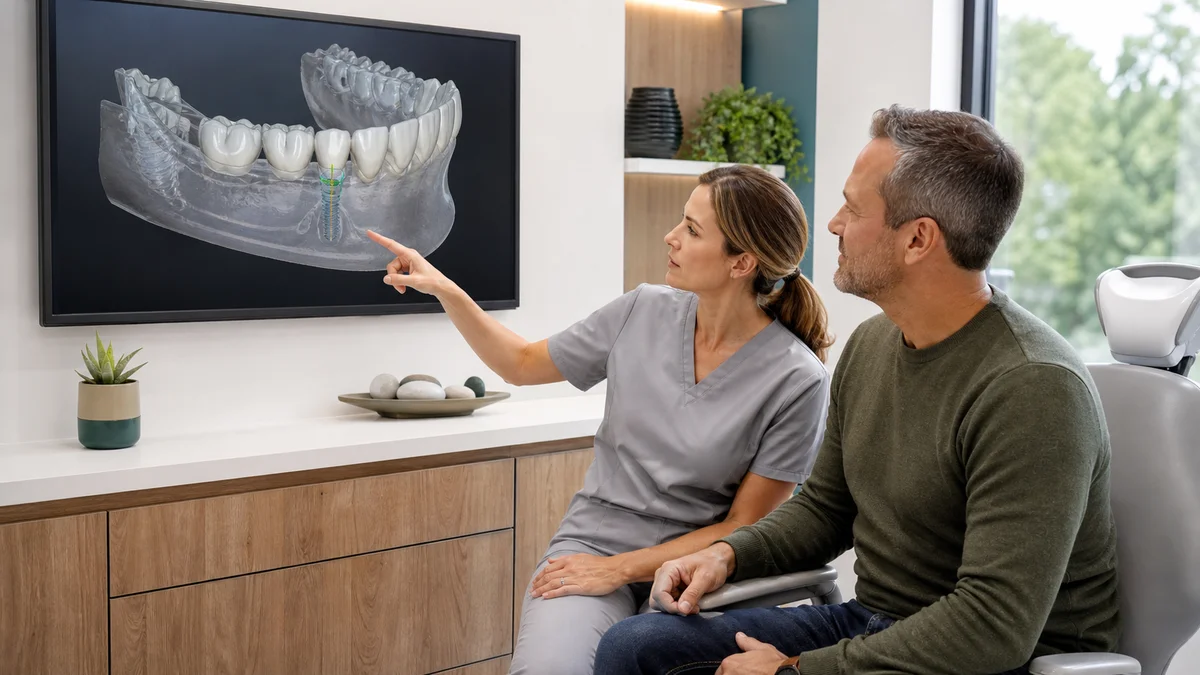
Quick answer: The best dental implants in maryland are not identified by one brand, advertisement, or review score. Start by verifying the treating dentist’s active Maryland license, then compare diagnosis, imaging, alternatives, clinician experience, implant records, written costs, complication plans, and long-term maintenance. The right option depends on your health, anatomy, goals, and ability to attend follow-up.
Searching for the best dental implants in maryland can feel like comparing clinics, implant brands, prices, and promises all at once. Yet an implant is not a stand-alone product. It is a surgically placed medical device that supports a crown, bridge, or denture, and its performance depends on diagnosis, placement, restoration design, hygiene, health, healing, and maintenance. A clinic that is suitable for one person may not be appropriate for another.
“Best” should therefore describe a safe decision process rather than a guaranteed outcome. The best dental implants in maryland for a single missing front tooth may require a different team and timeline from a full-arch restoration, an implant near a sinus, or treatment after periodontal bone loss. A patient with diabetes, a smoking history, anticoagulant use, previous radiation, or complex medical needs may also require additional coordination.
This guide gives you a practical framework for evaluating care without ranking named offices or inventing success statistics. It explains what to verify, which records to request, why a written plan matters, and how to recognize marketing that outruns the available evidence. It cannot diagnose implant candidacy; only an appropriately qualified clinician who examines you and reviews necessary diagnostics can do that.
What “best dental implants in maryland” should mean
A high-quality result begins before surgery. The team should identify why the tooth is missing or failing, assess active disease, understand your priorities, and explain reasonable alternatives. Those alternatives may include preserving a natural tooth, a conventional bridge, a removable prosthesis, orthodontic space management, no immediate replacement, or an implant-supported restoration. Presenting an implant as the only acceptable answer before evaluation is not shared decision-making.
When patients compare the best dental implants in maryland, they should separate four linked decisions: whether an implant is appropriate; who will perform each stage; which implant and restoration design fits the case; and how maintenance or complications will be managed. The surgeon and restorative dentist may be the same person or different clinicians. Either arrangement can work when roles, communication, records, and accountability are clear.
A polished website cannot demonstrate bone quality, prosthetic space, tissue thickness, bite forces, or healing capacity. Reviews may reveal patterns in scheduling or communication, but they cannot predict your biological outcome. The more consequential the treatment, the more weight you should give to verifiable credentials, transparent planning, informed consent, and an accessible follow-up pathway.
best dental implants in maryland begin with candidacy, not sales
The FDA advises patients to discuss benefits, risks, and candidacy with a dental provider before choosing implants. Overall health can affect eligibility, healing time, and how long an implant may remain in place. Smoking can impair healing and may reduce long-term success. The best dental implants in maryland evaluation should therefore include an accurate medical and dental history rather than a same-for-everyone package.
Tell the clinician about diagnoses, allergies, pregnancy, tobacco or nicotine use, alcohol or substance use, previous periodontal disease, grinding, immune conditions, diabetes control, osteoporosis treatment, head or neck radiation, and prior implant problems. Bring a complete medication and supplement list, including anticoagulants, antiplatelet medicines, steroids, antiresorptive drugs, and injectable therapies. Do not stop prescribed medication on your own.
- Describe when and why each tooth was lost, and bring prior dental records if available.
- Report bleeding gums, mobility, drainage, swelling, numbness, sinus symptoms, or bite changes.
- Explain hygiene routines and barriers that may make an implant restoration hard to clean.
- State your functional, appearance, timing, budget, and travel priorities without minimizing trade-offs.
- Ask whether active decay or periodontal disease should be stabilized before implant surgery.
Age alone does not settle candidacy for the best dental implants in maryland, and neither does a remote photo. Growth status, anatomy, disease control, healing risk, dexterity, expectations, and maintenance capacity all matter. If a clinic promises final treatment from a brief online form, ask what remains provisional until examination and imaging.
Verify a Maryland dentist’s license and current status
The Maryland State Board of Dental Examiners provides an official online license verification site. Search the individual treating clinician—not only the practice name—and confirm that the license is active. The database can display statuses such as active, inactive, non-renewed, probation, revoked, suspended, retired, or voluntarily surrendered. A search result is more reliable than a badge copied onto a marketing page.
For the best dental implants in maryland search, write down the full legal name of every clinician expected to perform surgery or restorative care. Match the name to the Board record and the office you contacted. If sedation is proposed, ask which clinician provides it and what permit or facility requirements apply, then verify relevant information through the appropriate official channels.
The Board also publishes public disciplinary orders and notes that an order page may not reflect current licensure status, so use the verification database for the current status. A past public order deserves context, not instant assumptions; read the actual document and its dates. Conversely, the absence of a public order does not guarantee clinical quality or a complication-free result.
License verification is a minimum screen in a best dental implants in maryland search, not a complete ranking system. It does not tell you whether a dentist routinely manages your type of case, how restorations are designed, or how the office responds to complications. Use it as the first non-negotiable check before evaluating experience and clinical planning.
Evaluate the team behind the best dental implants in maryland
Ask who diagnoses, places the implant, performs grafting if needed, designs the provisional, makes the final restoration, and provides maintenance. Titles such as “implant center” or “implant expert” are marketing descriptions unless connected to verifiable education, training, credentials, and scope. A useful conversation focuses on the clinician’s experience with cases similar in anatomy and complexity to yours, not an unverifiable claim to be the best dental implants in maryland provider.
Experience can be discussed responsibly without demanding a guarantee. Ask how often the clinician treats comparable single-tooth, multi-unit, full-arch, grafted, or medically complex cases; what complications they monitor; when they refer; and who is available after hours. A clinician who recognizes limits and coordinates with periodontists, oral and maxillofacial surgeons, prosthodontists, physicians, hygienists, and laboratories may offer safer continuity than a team that claims it never needs help.
Decision table for comparing implant consultations
Use this table to compare written information from more than one consultation. It is not a scoring formula or a substitute for clinical judgment. The best dental implants in maryland plan for you should make the reasons, alternatives, uncertainties, and follow-up responsibilities understandable.
| Decision area | Reassuring evidence | Question to ask | Warning sign |
|---|---|---|---|
| Provider verification | Named treating clinicians and active Maryland licenses | Who performs each stage? | Only a salesperson or practice brand is identified |
| Diagnosis | Clinical findings and justified imaging are explained | What problem is the implant solving? | Plan is finalized from a photo alone |
| Alternatives | Benefits and limitations of realistic options are compared | Can the tooth be preserved? | Every alternative is dismissed without explanation |
| Risk | Personal medical, periodontal, smoking, bite, and hygiene factors are addressed | Which risks apply to me? | “No risk” or guaranteed lifetime language |
| Implant system | Brand, model, dimensions, and component records will be supplied | How are replacement parts obtained? | Device identity is withheld or unknown |
| Restoration | Provisional and final stages, materials, hygiene access, and bite are planned | What is temporary versus final? | “Teeth today” is not defined |
| Cost | Written estimate separates included and possible additional services | What could change the total? | A non-refundable package is pressed before diagnosis |
| Follow-up | Emergency contact, review schedule, maintenance, and repair route are written | Who helps if I move or travel? | Responsibility ends when the balance is paid |
Diagnostic planning for the best dental implants in maryland
Implant planning usually combines history, examination, periodontal assessment, restorative evaluation, and imaging selected for the clinical question. The team may assess tooth prognosis, bone and soft tissue, smile line, prosthetic space, bite, jaw relationship, opening, hygiene access, nerve position, sinus anatomy, and the condition of neighboring teeth. Not every patient needs the same scan, and more imaging is not automatically better.
A best dental implants in maryland consultation should explain why a two-dimensional radiograph, three-dimensional scan, digital impression, photographs, or diagnostic model is being used and how it changes the plan. Three-dimensional technology can support planning, but software does not replace clinical judgment. Ask who interprets the images and how incidental or uncertain findings are handled.
The restorative endpoint should guide implant position in a best dental implants in maryland plan. A device placed wherever bone happens to be available may create poor appearance, an unfavorable bite, inaccessible hygiene contours, or restorative compromises. Ask to see how the proposed tooth or prosthesis relates to implant position before surgery, especially for front teeth and full-arch treatment.
Compare single-tooth, bridge, and full-arch options
A single implant can support one crown without preparing neighboring teeth, but it is not automatically superior to every bridge or tooth-preservation option. Space, bone, gum level, adjacent roots, age, disease, appearance, cost, and time affect the choice. The best dental implants in maryland plan may reasonably be “not yet” if disease control, orthodontic movement, growth, graft healing, or medical review should come first.
Multiple missing teeth may be restored with individual implants, an implant-supported bridge, or a removable implant-assisted prosthesis. The best dental implants in maryland design is not necessarily the one with the most implants. The number and position should reflect anatomy, load, prosthetic design, hygiene, repairability, and evidence—not a package label.
For a failing full dentition, full-arch fixed teeth may be one option, but retaining healthy or strategically valuable teeth can sometimes remain appropriate. Extraction is irreversible. If a plan removes many teeth, ask for a tooth-by-tooth prognosis and consider an independent second opinion before consenting.
Understand “same-day teeth” and full-arch marketing
“Teeth in a day” may mean implant placement with an immediate provisional prosthesis, not delivery of the final restoration or completion of healing. Immediate placement means the implant is placed at or near the extraction visit; immediate loading concerns when a restoration is connected. These are separate decisions with specific anatomical, stability, bite, and risk requirements.
When an office promotes the best dental implants in maryland with a one-day message, ask exactly what you will leave with, whether it is removable or fixed, which diet restrictions apply, when the final prosthesis is made, and what happens if adequate primary stability is not achieved. A safe consent process includes a contingency plan rather than treating every deviation as a surprise.
Final appearance and function with the best dental implants in maryland may evolve through provisional testing, tissue healing, bite adjustment, laboratory fabrication, and maintenance. Faster is not always safer, and a longer staged plan is not automatically old-fashioned. The appropriate sequence depends on the individual diagnosis.
Risks and maintenance for best dental implants in maryland
The FDA lists potential complications including damage to nearby teeth or tissues, sinus perforation, jaw injury, bite problems, screw loosening, implant loosening, local or systemic infection, delayed healing, cleaning difficulty, untreated periodontal disease, and numbness from nerve injury or impingement. Complications may occur early or later and can require additional procedures. The best dental implants in maryland conversation should make those possibilities understandable without using fear.
Peri-implant mucositis involves inflammation in the soft tissues around an implant; peri-implantitis includes supporting bone deterioration. The American Academy of Periodontology identifies factors such as previous periodontal disease, poor plaque control, smoking, and diabetes. Implants need home care and professional monitoring just as natural teeth do, although the tools and intervals may be individualized.
Ask the clinician to show you how the proposed best dental implants in maryland crown, bridge, or denture can be cleaned. A beautiful restoration that traps plaque or cannot be accessed by the patient may create long-term problems. The maintenance plan should cover examinations, hygiene, imaging when indicated, screw or prosthesis checks, bite review, and whom to call for bleeding, swelling, pain, mobility, fracture, or a loose component.
Timeline: surgery is only one stage
A best dental implants in maryland pathway may include disease control, extraction, grafting, implant placement, healing, uncovering, provisional restoration, final restoration, and maintenance. Some stages can be combined when clinically appropriate. FDA patient information notes that implant-body healing may take several months or longer. Do not interpret a temporary tooth as proof that integration is complete.
The best dental implants in maryland timeline should identify which dates are estimates, what clinical milestones must be met, and what could cause a delay. Ask how work, travel, diet, exercise, temporary appearance, pain control, and driving may be affected. If sedation is planned, follow the team’s escort, fasting, and medication instructions exactly.
Written cost questions for best dental implants in maryland
There is no responsible fixed price for every implant case because the diagnosis and scope vary. A quotation may include or exclude consultation, imaging, extraction, grafting, membrane, sedation, implant components, provisional teeth, final restoration, laboratory work, maintenance, and management of complications. Insurance benefits, exclusions, waiting periods, annual maximums, and network rules can also change what a patient pays.
Ask the best dental implants in maryland candidate clinic for a written estimate tied to a written treatment plan. It should distinguish known fees from possible additional services and identify the refund or cancellation terms. Confirm whether the estimate covers the implant body, abutment, and crown or only the surgical component. A low advertised figure may describe only one piece of a multi-stage pathway.
- Request procedure descriptions or billing codes when available so estimates can be compared accurately.
- Ask whether the proposed clinicians and facility are in network, not only whether the office “accepts” insurance.
- Obtain a written predetermination when useful, while recognizing it is not a guarantee of payment.
- Clarify financing interest, deferred-interest triggers, origination fees, late terms, and refund handling.
- Keep copies of the signed plan, consent, estimate, receipts, imaging, and implant system record.
Cost matters when comparing the best dental implants in maryland, but the cheapest initial offer can become expensive if the restoration is incomplete, incompatible components are hard to obtain, or follow-up is inaccessible. Compare the total pathway and the responsibility for repairs, not only the surgery-day number.
Use a second opinion for irreversible decisions
A second opinion about the best dental implants in maryland can be particularly valuable when the plan extracts restorable teeth, requires extensive grafting, proposes a full arch, changes your bite, compresses treatment into a short window, or carries a major financial commitment. Give the second clinician access to relevant images and records, but expect an independent examination where necessary.
Two competent clinicians may recommend different reasonable approaches because evidence, experience, risk tolerance, and patient priorities interact. The goal is not to force identical plans; it is to understand why they differ. A best dental implants in maryland provider should be able to explain its reasoning without discouraging informed questions or independent review.
Marketing red flags that deserve a pause
Urgency, shame, and fear can push patients toward fast commitments. Slow down unless delay itself poses a documented health risk. The phrase best dental implants in maryland is not proof of quality, and search placement is not a clinical credential.
- A guaranteed lifetime result, universal candidacy, or “zero risk” promise.
- A definitive surgical plan or final price based only on a photograph or sales call.
- Refusal to identify the treating clinicians, implant system, laboratory, or follow-up provider.
- Pressure to extract many teeth or sign financing before alternatives and risks are explained.
- Use of a celebrity case, testimonial, or before-and-after image as proof of your likely outcome.
- No written contingency if grafting, immediate loading, or the provisional plan cannot proceed.
- No accessible contact for postoperative concerns, component problems, or long-term maintenance.
Before-and-after images can be useful for discussing design, but they should be authenticated, consented, and presented with context. They do not reveal every complication, maintenance burden, or treatment that occurred between the images.
Comparing Maryland care with planned treatment abroad
Some patients compare the best dental implants in maryland with treatment in another state or country. The clinical questions remain the same, but travel adds handoff, timing, records, language, transport, and urgent-care planning. Consider how postoperative reviews, provisional adjustments, infection concerns, fractures, screw loosening, and final restoration stages will be handled after you return home.
For patients exploring treatment in Türkiye, Redent Klinik describes its approach on the English Redent Klinik homepage, and individual questions can be submitted through the verified English contact page. Remote discussion remains preliminary until appropriate examination and diagnostics are completed. Travel should never be scheduled around a guaranteed treatment outcome.
Ask for records in a usable language and format, including implant brand, model, dimensions, lot information when available, imaging, operative notes, prosthetic design, material details, and follow-up recommendations. Identify a local clinician willing to provide continuity before leaving, not only after a problem develops.
Your consultation checklist
Bring this checklist to each best dental implants in maryland consultation and record the answers in your own words:
- What is the diagnosis, and what happens if treatment is deferred?
- Which teeth can reasonably be preserved, and what alternatives exist?
- Who performs surgery, restoration, sedation, maintenance, and emergency care?
- Which imaging is needed, why is it needed, and who interprets it?
- Which personal risks may affect healing, appearance, function, or longevity?
- What implant system and restorative components are proposed?
- Which parts are temporary, which are final, and what milestones control timing?
- How will the restoration be cleaned, monitored, repaired, or replaced?
- What is included in the written estimate, and what may be added?
- What is the contingency plan if anatomy or stability differs from expectations?
The strongest consultation is not necessarily the one that produces the fastest yes. It is the one that improves your understanding, documents uncertainty, respects your priorities, and gives you a safe route forward—including the option to wait, obtain records, or seek another opinion.
Frequently asked questions about best dental implants in maryland
How do I verify a dentist offering the best dental implants in maryland?
Use the Maryland State Board of Dental Examiners’ official license verification website and search the individual treating clinician by name or license number. Confirm the current status and match the identity to the office. Review public orders separately if relevant. Verification is a starting point; also assess case-specific experience, planning, informed consent, and follow-up.
Is one dental implant brand always best?
No single system is automatically best for every patient. Ask why the system fits the anatomy and restoration, whether it has an appropriate regulatory status, how long components are expected to remain available, and whether you will receive identifying records. Surgical execution, restorative design, hygiene, risk control, and maintenance matter alongside the device.
Can the best dental implants in maryland be completed in one day?
Selected patients may receive implant placement and an immediate provisional restoration in one visit, but that is not the same as biological integration or a final prosthesis. Anatomy, infection, primary stability, bite, medical risk, and prosthetic design influence suitability. Ask what is temporary, what is final, and what the fallback plan is.
Do I need a three-dimensional scan for an implant?
The clinician should select imaging that answers the diagnostic and planning questions while considering radiation and existing records. Three-dimensional imaging can be important in many implant cases, but not every person needs identical imaging. Ask why it is indicated, what it shows, who interprets it, and how it changes treatment.
What records should I receive after implant placement?
Request the implant brand and model, dimensions, site, relevant component or lot information when available, operative notes, imaging, restorative details, maintenance instructions, and contact information. FDA patient guidance specifically encourages asking for the brand and model and keeping it for your records. These details can help future clinicians obtain compatible components.
Are dental implants guaranteed for life?
No ethical clinician can guarantee a biological or prosthetic outcome for life. Implants and their restorations can develop inflammation, bone loss, loosening, fracture, wear, appearance changes, or failure. Health, smoking, hygiene, bite, disease history, design, and maintenance affect risk. Ask what the clinic’s warranty language covers and what it excludes.
How should I compare prices between Maryland clinics?
Compare written best dental implants in maryland plans with the same scope. Determine whether each estimate includes examination, imaging, extraction, grafting, implant body, abutment, provisional, final restoration, sedation, laboratory services, maintenance, and possible additional procedures. Confirm insurance network details and financing terms. A headline price may cover only one component.
When should I seek urgent help after implant surgery?
Follow the treating team’s written instructions. Contact them promptly for worsening pain or swelling, fever, persistent bleeding, pus, a loose implant or prosthesis, new numbness, bite instability, medication reaction, or another unexpected change. Use emergency medical services for breathing difficulty, uncontrolled heavy bleeding, severe allergic symptoms, or other potentially life-threatening problems.
Final perspective
The best dental implants in maryland are not a universal package waiting to be found. They are the result of a verified clinician, diagnosis-led planning, realistic alternatives, clear consent, appropriate device and prosthetic choices, careful execution, accessible records, and long-term maintenance tailored to one patient. Use the fourteen checks above to turn a broad search phrase into a safer, evidence-informed decision.
Sources
- Maryland State Board of Dental Examiners: License verification
- Maryland State Board of Dental Examiners: Public disciplinary orders
- Maryland Department of Health: Board of Dental Examiners
- U.S. Food and Drug Administration: Dental Implants—What You Should Know
- U.S. Food and Drug Administration: Implants and prosthetics
- American Academy of Periodontology: Peri-implant diseases
- American Academy of Periodontology: Single-tooth dental implants
- American Dental Association
- World Health Organization: Oral health fact sheet