
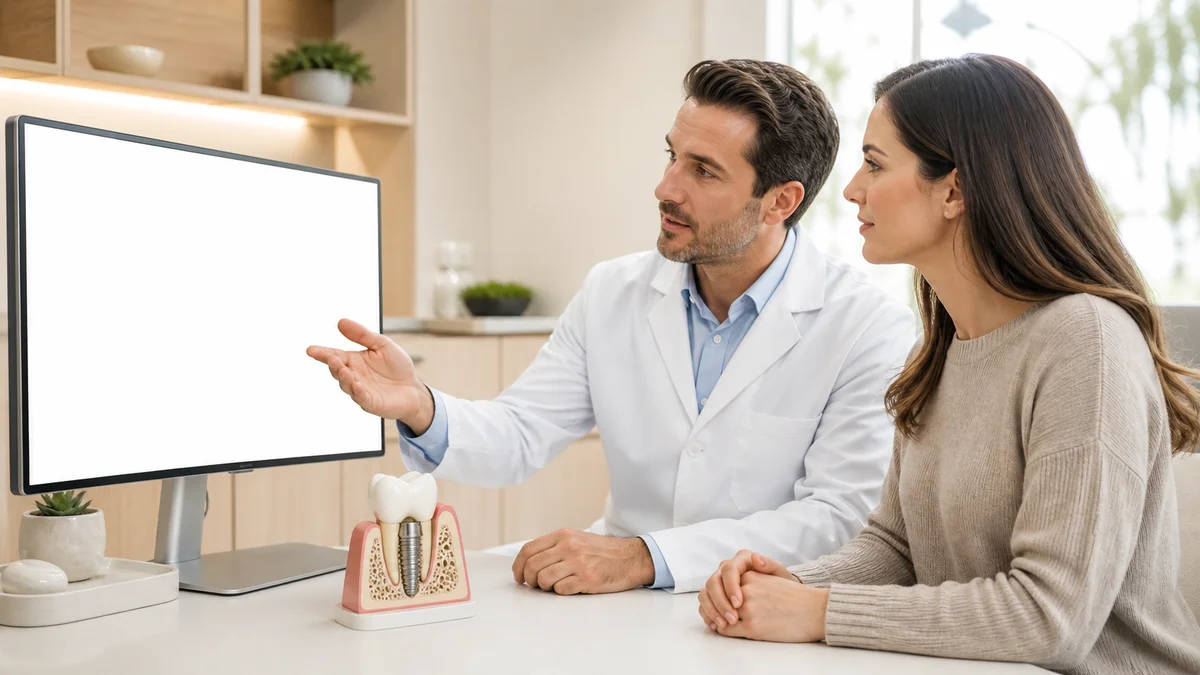
Quick answer: To evaluate best dental implants near me, compare licensed clinicians, complete diagnostic planning, gum and bone assessment, realistic alternatives, itemized fees, implant records, complication protocols, and long-term maintenance. No clinic can guarantee success. Seek urgent care for breathing or swallowing difficulty, rapidly spreading swelling, uncontrolled bleeding, major trauma, or severe post-operative deterioration.
Searching best dental implants near me is understandable when a missing tooth affects eating, speech, confidence, or comfort. Yet “best” is not a universal brand, a five-star score, or the lowest package price. Dental implant care combines diagnosis, surgery, restoration, laboratory work, hygiene, and years of maintenance. The right approach depends on your health, the condition of your mouth, the available bone and soft tissue, the number and position of missing teeth, your preferences, and whether you can maintain the result.
The US Food and Drug Administration describes a dental implant as a medical device placed surgically in the jaw to support a crown, bridge, or denture. The implant body, abutment, screw, and prosthetic tooth are related but distinct parts. A quote that says “implant” may cover only one component. Any best dental implants near me comparison should define exactly which components, procedures, diagnostics, and follow-up visits are included.
This article is general education, not a diagnosis or personalized recommendation. An examination and appropriate imaging are necessary before a clinician can advise whether an implant is suitable. It avoids fixed prices and success promises because anatomy, health, materials, treatment stages, and local fees differ. For information about planned care, you may review Redent Klinik’s English website, but urgent dental or medical problems should be assessed locally.
What “best dental implants near me” should mean
For a patient, the best dental implants near me pathway is one where a qualified team explains the diagnosis, checks risks, offers reasonable alternatives, plans the restoration before surgery, and remains available for maintenance and complications. It should be possible to identify who will perform each stage, who owns the final treatment plan, and what happens if the surgeon, restorative dentist, or laboratory needs to change the plan.
Good care is individualized. A single missing front tooth presents different aesthetic and tissue challenges from a molar, a long-span bridge, or a full-arch restoration. Some sites may accept an implant soon after extraction; others need healing, infection control, bone grafting, or a non-implant solution. A trustworthy best dental implants near me consultation does not force every mouth into the same timeline or product.
“Best” also includes restraint. Preserving a treatable natural tooth may sometimes be preferable to extraction, while a conventional bridge or removable prosthesis may fit another patient’s priorities. The clinician should discuss no treatment when it is reasonable, as well as the effect of delay. A recommendation is stronger when alternatives are described fairly rather than dismissed.
Start the best dental implants near me search with urgent safety
Routine comparison is inappropriate during an emergency. Call emergency services or attend an emergency department for difficulty breathing, swallowing, or speaking; rapidly increasing swelling of the face or neck; swelling near an eye; uncontrolled bleeding; fainting, confusion, or major facial trauma. A hospital may stabilize an airway, bleeding, trauma, or spreading infection, but definitive dental care may still be needed.
Contact a dental professional promptly for severe or worsening pain, localized swelling, fever with dental symptoms, pus or drainage, a recently placed implant that feels mobile, a bite that suddenly feels wrong, persistent numbness, wound breakdown, or pain that is worsening rather than improving. Tell the office the symptoms and timing before asking about best dental implants near me. The team needs clinical details to triage safely.
Do not use leftover or borrowed antibiotics, place aspirin or chemicals on the gum, or adjust an implant component yourself. Follow the treating team’s written post-operative instructions. If you cannot reach them and symptoms are severe or rapidly worsening, seek urgent local assessment. Administrative or travel concerns should never delay care for an airway, bleeding, or spreading-infection risk.
15 checks for a best dental implants near me shortlist
Use these checks before committing to surgery. Not every clinician must have the same specialty title, but the team should have appropriate training, legal authority, experience for the proposed complexity, and a clear referral pathway.
- Verify licensure. Check each treating dentist or specialist through the relevant dental board or official regulator.
- Identify roles. Ask who diagnoses, places the implant, performs grafting, designs the restoration, fits the prosthesis, and provides maintenance.
- Match experience to the case. Ask about training and experience with your specific anatomical and restorative situation, not only total implant volume.
- Require a comprehensive assessment. Medical history, medications, allergies, smoking, oral hygiene, gum health, bite, existing teeth, and patient goals matter.
- Review imaging justification. Ask what each image will add to diagnosis or surgical safety and how radiation exposure is optimized.
- Plan the final tooth first. Implant position should support a cleansable, functional, and realistic restoration.
- Discuss alternatives. Review preserving teeth, bridges, dentures, no treatment, and staged options where appropriate.
- Ask about risk. Include infection, delayed healing, failure to integrate, nerve or sinus injury, graft complications, tissue recession, mechanical problems, and future surgery.
- Request an itemized plan. Separate diagnostics, extraction, grafting, implant body, abutment, provisional tooth, final prosthesis, anesthesia, and follow-up.
- Record the device. Ask for the implant manufacturer, model, dimensions, lot or reference information, and components used.
- Understand timing. Clarify healing phases, temporary teeth, loading decisions, laboratory time, and circumstances that can extend treatment.
- Examine infection control. The clinic should follow regulated sterilization, surgical asepsis, and patient-safety standards.
- Confirm complication access. Know whom to contact after hours, which symptoms are urgent, and where emergency assessment occurs.
- Plan maintenance. Ask how the implant and prosthesis will be cleaned, examined, monitored, and professionally maintained.
- Allow time for consent. You should be able to ask questions and decline or seek a second opinion without high-pressure tactics.
A clinic does not become the best dental implants near me choice merely by answering every question with confidence. Look for specific, documented, balanced answers. An ethical clinician acknowledges uncertainty, explains when additional information is needed, and changes the plan when findings change.
Evaluate clinician qualifications and team coordination
Implant treatment may involve a general dentist, periodontist, oral and maxillofacial surgeon, prosthodontist, dental hygienist, radiology service, and dental laboratory. Titles and scopes vary by jurisdiction. Instead of assuming one title is always superior, ask how the clinician’s education, supervised training, continuing education, and experience relate to your procedure. Verify licensure and any claimed specialty through authoritative records.
Ask the surgeon how many comparable cases they manage, how complications are audited, and when they refer. Ask the restorative clinician how implant position, bite, aesthetics, retrievability, cleaning access, and future repair are planned. For best dental implants near me, surgery and restoration should not operate as isolated purchases. The final prosthesis must be considered before the implant is placed.
Complex bone grafting, proximity to nerves or sinuses, significant medical conditions, full-arch care, or previous implant failure may justify specialist input. A second opinion can be especially useful when extraction of remaining teeth, extensive grafting, immediate loading, or a large financial commitment is proposed. A careful best dental implants near me team should support informed review rather than create artificial urgency.
Expect a full implant assessment, not a sales scan
The FDA advises patients to discuss overall health, benefits, risks, candidacy, healing, and the specific implant system. A proper best dental implants near me assessment begins with why the tooth is missing or threatened, whether disease is active, and whether another treatment could preserve function. It includes gum condition, plaque control, decay, bite forces, available restorative space, soft-tissue volume, bone anatomy, and the health of adjacent teeth.
Tell the clinician about diagnosed conditions, previous surgery, healing problems, diabetes, immune conditions, osteoporosis treatment, radiation therapy, bleeding disorders, allergies, pregnancy, smoking or nicotine use, alcohol or substance use, and every prescription, nonprescription medicine, and supplement. Do not stop medication without the prescriber’s guidance. A best dental implants near me plan coordinates medical questions rather than relying on an online eligibility quiz.
Imaging in a best dental implants near me pathway should be selected for a clinical reason. Two-dimensional radiographs may answer some questions, while cone-beam computed tomography can be appropriate when three-dimensional information about bone, nerves, sinuses, or anatomy will change planning. More imaging is not automatically better. Ask why it is needed, who interprets it, whether recent images can be used, and how findings affect implant position or alternatives.
Compare implant, bridge, denture, and no-treatment options
An implant can support a single crown, a bridge, or a removable or fixed full-arch prosthesis. It can avoid preparing adjacent teeth in some cases and may help maintain bone at the site. However, it requires surgery, healing, cleaning, maintenance, and sufficient tissue. Failure or complications can require repair, removal, grafting, or another operation. That trade-off belongs in every best dental implants near me discussion.
A best dental implants near me comparison should include a tooth-supported bridge when adjacent teeth already need crowns, when surgery is undesirable, or when anatomy or health makes an implant less suitable. A removable partial or complete denture can be less invasive and easier to modify, although stability, comfort, cleaning, and adaptation differ. Sometimes monitoring a space or doing no treatment is acceptable; sometimes migration, function, or appearance makes replacement important.
| Option | Potential advantages | Questions and trade-offs | Maintenance needs |
|---|---|---|---|
| Single implant crown | Independent support; adjacent teeth may not need preparation | Surgery, bone and soft tissue, healing, aesthetics, nerve or sinus proximity | Daily cleaning, professional review, screw/crown and tissue monitoring |
| Tooth-supported bridge | No implant surgery; fixed replacement | Adjacent teeth are prepared; decay, nerve, and structural risks | Clean under bridge, monitor supporting teeth and margins |
| Removable denture | Non-surgical, adaptable, may replace multiple teeth | Movement, bulk, pressure areas, speech and chewing adaptation | Remove and clean, tissue review, adjustment or relining |
| Implant-retained denture | Can improve retention and stability | Surgery plus removable prosthesis; component wear and space | Clean implants and denture; replace worn attachments |
| No immediate replacement | Avoids procedure now | Function, appearance, tooth movement, bone change, future options | Monitor mouth and revisit decision if conditions change |
The best dental implants near me choice is not necessarily an implant if a different option better matches your health, anatomy, finances, maintenance ability, or goals. Ask the clinician to explain why the proposed option is preferred and what new information would change that recommendation.
Understand surgical, biological, and mechanical risks
The FDA lists possible risks including damage to surrounding teeth, sinus perforation, jaw injury, abnormal bite, screw loosening, implant-body failure, local or systemic infection, delayed healing, difficulty cleaning, untreated periodontal disease, and post-surgical numbness from nerve damage or impingement. Risk is individual; a list cannot predict your outcome. A best dental implants near me consultation should relate general risks to your anatomy and health without claiming certainty.
A best dental implants near me risk discussion must explain that failure can occur before integration with bone, after loading, or years later. Biological complications include inflammation in the tissues around an implant and progressive bone loss. Mechanical problems include screw loosening, fracture, ceramic chipping, wear, or changes in the prosthesis. Gum recession or tissue changes may affect appearance, especially in the front of the mouth.
Every best dental implants near me assessment should address smoking and nicotine because they can impair healing and are associated with poorer implant outcomes. Poor plaque control and untreated gum disease increase concern. Diabetes control, medication history, bruxism, immune status, and prior radiation or antiresorptive therapy may influence planning. This does not mean every patient with a risk factor is automatically excluded; it means assessment and risk reduction must be personalized.
Ask what each best dental implants near me clinic considers a complication, how it monitors outcomes, and who pays for diagnostic, surgical, prosthetic, laboratory, and travel costs if retreatment is needed. Avoid claims such as “lifetime guaranteed” unless you receive written terms and understand exclusions. Biological tissues and patient behavior cannot be guaranteed like a simple consumer product.
Question immediate implants, same-day teeth, and full-arch claims
An immediate best dental implants near me proposal may mean inserting an implant at or near the time of extraction. Immediate or early loading refers to when a provisional or definitive restoration begins applying function. These decisions are not interchangeable and are not suitable for every site. Bone stability, infection, bite forces, aesthetics, graft needs, and the type of provisional restoration influence the plan.
“Teeth in a day” may describe a fixed provisional restoration placed on selected implants, not a finished permanent prosthesis or completed biological healing. Ask whether teeth will be extracted, how many implants are planned, whether the provisional is removable, what diet is required, when the final prosthesis is made, and what happens if an implant does not integrate. A best dental implants near me advertisement should not compress a multi-stage process into a misleading slogan.
A full-arch best dental implants near me plan can be transformative for suitable patients but is extensive and difficult to reverse after teeth are removed. Ask for a tooth-by-tooth prognosis, alternatives that preserve strategic teeth, hygiene demonstrations, prosthesis material, repair process, anticipated component wear, and long-term professional maintenance. Consider a second opinion before irreversible extraction of multiple teeth.
Read the implant quote line by line
Implant fees vary with location, complexity, clinician, diagnostics, anesthesia, extraction, grafting, temporary teeth, implant system, laboratory, and final restoration. A one-line package cannot be compared fairly with an itemized plan. When assessing best dental implants near me, ask what is included now, what may be required after examination, and what is definitely excluded.
- Consultation, medical review, diagnostic records, photographs, scans, and radiographs
- Extraction, socket treatment, infection management, and pathology when relevant
- Bone or soft-tissue grafting, membranes, fixation, and graft follow-up
- Implant body, cover screw, healing abutment, restorative abutment, and fixation screw
- Surgical guide design and manufacture when used
- Local anesthesia, sedation assessment, sedation or facility fee, and monitoring
- Temporary removable or fixed restoration and any required adjustments
- Final crown, bridge, or denture, including laboratory and material choice
- Post-operative checks, imaging, hygiene visits, maintenance, and emergency access
- Management of early failure, component repair, relining, or prosthesis replacement
Ask for the full payment schedule and whether a third-party lender is involved. Review annual percentage rate, deferred interest, total repayment, late fees, cancellation rules, and the effect of a treatment change. A low monthly amount does not make one clinic the best dental implants near me option if the total obligation, exclusions, or refund process are unclear.
Insurance benefits are not treatment recommendations. Request a pre-treatment estimate when useful, but understand that it may not guarantee payment. Clinical findings, eligibility, documentation, annual maximums, exclusions, and plan rules can change the final amount. Choose a plan that remains understandable even if the insurer pays less than expected.
Check implant system documentation and future serviceability
The FDA recommends asking for the brand and model of the implant system and keeping the information. After any best dental implants near me treatment, request a device record with the manufacturer, system, implant dimensions, lot or reference details, site, placement date, and relevant components. This can help another clinician identify compatible parts later.
Ask why the system was selected, whether authorized components are used, how long the team has worked with it, and how replacement screws or restorative parts can be obtained. No brand alone produces the best dental implants near me; planning, placement, restoration, biology, hygiene, and maintenance all influence the result. Avoid clinics that will not disclose what was placed.
Discuss whether the final restoration is screw-retained or cement-retained, how it could be removed for repair, and what materials are proposed. Each design has advantages and risks. Ask how excess cement, screw-access filling, passive fit, occlusion, aesthetics, and cleaning access will be managed.
Long-term maintenance is part of the treatment
The American Academy of Periodontology notes that implants require conscientious home care and regular dental visits. Implants cannot develop tooth decay, but surrounding tissues can become inflamed, bone can be lost, and prosthetic components can wear or break. Natural teeth elsewhere in the mouth remain vulnerable to decay and gum disease.
Before treatment, demonstrate how you currently clean and ask what tools the proposed design will require. A single crown, implant bridge, overdenture, and fixed full-arch prosthesis have different cleaning challenges. If you cannot physically access key areas, the design may need modification. The best dental implants near me plan includes a realistic daily-care method, not only a surgical date.
- Brush as instructed with tools that reach the implant restoration and gumline.
- Clean between implants, under bridges, or around attachments using the recommended devices.
- Attend individualized professional maintenance and periodontal review.
- Report bleeding, swelling, pus, new bad taste, discomfort, recession, mobility, or bite change.
- Have screws, clips, attachment inserts, denture fit, and restorative surfaces checked.
- Use a protective appliance if prescribed for grinding or clenching.
- Keep implant records and inform future dental and imaging professionals.
A best dental implants near me maintenance interval should reflect disease history, cleaning ability, smoking, diabetes control, prosthesis design, and clinical findings. A universal schedule may not fit every patient. Ask who will provide maintenance if surgery and restoration occur in different practices or countries.
Use reviews and before-and-after images cautiously
Reviews can reveal communication, scheduling, or billing patterns but cannot prove diagnosis quality, sterile technique, implant positioning, bone stability, or long-term tissue health. Before-and-after photographs may be selected, edited, or unrelated to a case like yours. Consent for image use does not make the result typical.
A clinic advertising best dental implants near me should be able to explain its clinical process without relying on testimonials. Ask to see cases that resemble your missing-tooth pattern only as an educational aid, and ask how long the follow-up lasted. Do not expect your anatomy, healing, or aesthetic result to duplicate another patient’s photographs.
In a best dental implants near me search, be cautious with countdown discounts, guaranteed candidacy, remote diagnosis from a single photo, undisclosed clinicians, claims of zero risk, or payment demands before a medical history and treatment discussion. Independent license verification, transparent consent, itemized planning, and complication access are more meaningful than influencer promotion.
Plan local follow-up before dental implant travel
A travel-based best dental implants near me plan can complicate staged treatment and urgent access. Before choosing care away from home, ask how many visits are needed, how long to remain after surgery or prosthesis delivery, what symptoms prevent flying, and who handles complications after return. Factor flights, accommodation, time off, accompanying support, and possible repeat travel into the total commitment.
For planned treatment at Redent Klinik, the English contact page can be used to discuss records, examination planning, potential stages, and follow-up. Remote communication is preliminary and cannot confirm final candidacy, price, or outcome. If symptoms are urgent, obtain local evaluation instead of waiting to travel.
Ask for copies of imaging, surgical notes, implant identifiers, graft records, prescriptions, laboratory information, and the final prosthesis design. Identify a local dentist willing to provide maintenance before treatment begins. The best dental implants near me comparison should consider continuity after the clinic visit, even when the selected provider is not geographically near.
Frequently asked questions about best dental implants near me
How do I verify that an implant dentist is qualified?
Check current licensure with the appropriate regulator, verify any specialty claim, and ask about training and experience with cases like yours. Identify who will perform surgery, restoration, and maintenance. For best dental implants near me, qualifications should match the complexity rather than rely on a generic certificate or advertisement.
Can a clinic guarantee that my dental implant will succeed?
No ethical clinic can eliminate biological, surgical, or mechanical uncertainty. Health, anatomy, healing, smoking, hygiene, bite forces, disease, planning, technique, and maintenance all matter. Written warranties may cover selected components or fees but do not guarantee tissue response or freedom from future surgery.
Do I always need a bone graft before an implant?
No. Grafting depends on available bone, implant position, tissue goals, timing, anatomy, and the restorative plan. Some sites do not need it, while others need minor or staged augmentation. Ask what evidence supports the recommendation, what material is proposed, and what alternatives exist.
Is a CBCT scan required for every implant?
Three-dimensional imaging can be valuable when it changes diagnosis or surgical planning, especially near nerves, sinuses, or limited bone. Imaging should be justified and optimized for the task. Ask what the scan will answer, who interprets it, and whether recent appropriate imaging can be used.
Are same-day dental implants better?
Not automatically. Immediate placement or loading can be appropriate in selected conditions, but infection, bone stability, tissue, bite forces, and aesthetics affect suitability. “Same-day teeth” often means a provisional restoration while healing continues. Compare risk and follow-up, not speed alone.
How long does dental implant treatment take?
Timing varies with extraction, healing, grafting, implant stability, number of sites, temporary teeth, laboratory stages, and health. Some cases progress in fewer stages; others require months. The best dental implants near me plan gives a range and explains what could shorten or extend it rather than promising a fixed completion date.
What should an implant quote include?
It should separate diagnostics, extraction, grafts, implant body, abutment, temporary restoration, final crown or prosthesis, anesthesia, laboratory fees, reviews, maintenance, and management of complications. Ask for likely exclusions and a payment schedule. Compare equivalent scopes, not headline numbers.
Can implants get infected or develop gum disease?
Implants cannot decay, but the surrounding tissues can become inflamed and lose supporting bone. Daily plaque control, professional maintenance, smoking risk reduction, gum-health management, and prompt review of bleeding, swelling, pus, discomfort, or mobility are important.
What implant information should I keep?
Keep the manufacturer, system, model, dimensions, site, date, lot or reference details, relevant components, surgeon, restorative clinician, and prosthesis records. Also keep scans, radiographs, surgical notes, graft details, and maintenance history. This can help future clinicians obtain compatible parts.
When is a second opinion especially useful?
Consider one before removing multiple restorable teeth, extensive grafting, full-arch treatment, major financial commitments, or a plan that conflicts with another clinician’s advice. It is also sensible after previous implant failure or when risks and alternatives were not explained clearly.
When do implant symptoms need urgent assessment?
Use emergency services for breathing or swallowing difficulty, rapidly spreading swelling, uncontrolled bleeding, eye involvement, confusion, fainting, or major trauma. Contact a dental professional promptly for worsening pain, fever, pus, persistent numbness, wound opening, implant mobility, or a sudden bite change.
A practical final checklist for best dental implants near me
Bring your medical history, medication list, previous dental records, relevant images, priorities, and questions to the consultation. Ask the team to show the diagnosis, proposed implant position, final prosthesis, alternatives, staged timeline, risks, maintenance method, and itemized fees. Take the plan home if the decision is not urgent.
Shortlist a best dental implants near me provider only after confirming license, appropriate experience, comprehensive assessment, restorative-led planning, transparent device records, complication access, and long-term maintenance. Compare what happens before, during, and years after placement—not just the surgery day.
The strongest best dental implants near me decision is one you understand and can maintain. It should preserve safety and realistic alternatives, acknowledge uncertainty, and create a durable relationship for review and repair. If a clinic will not answer essential questions or pressures you toward irreversible care, pause and seek another opinion.
Sources
- US Food and Drug Administration: Dental Implants—What You Should Know
- American Academy of Periodontology: Dental Implant Procedures
- National Institute of Dental and Craniofacial Research: Finding Dental Care
- NIDCR: Dental Materials and implant-related research
- American Dental Association
- World Health Organization: Oral health fact sheet