
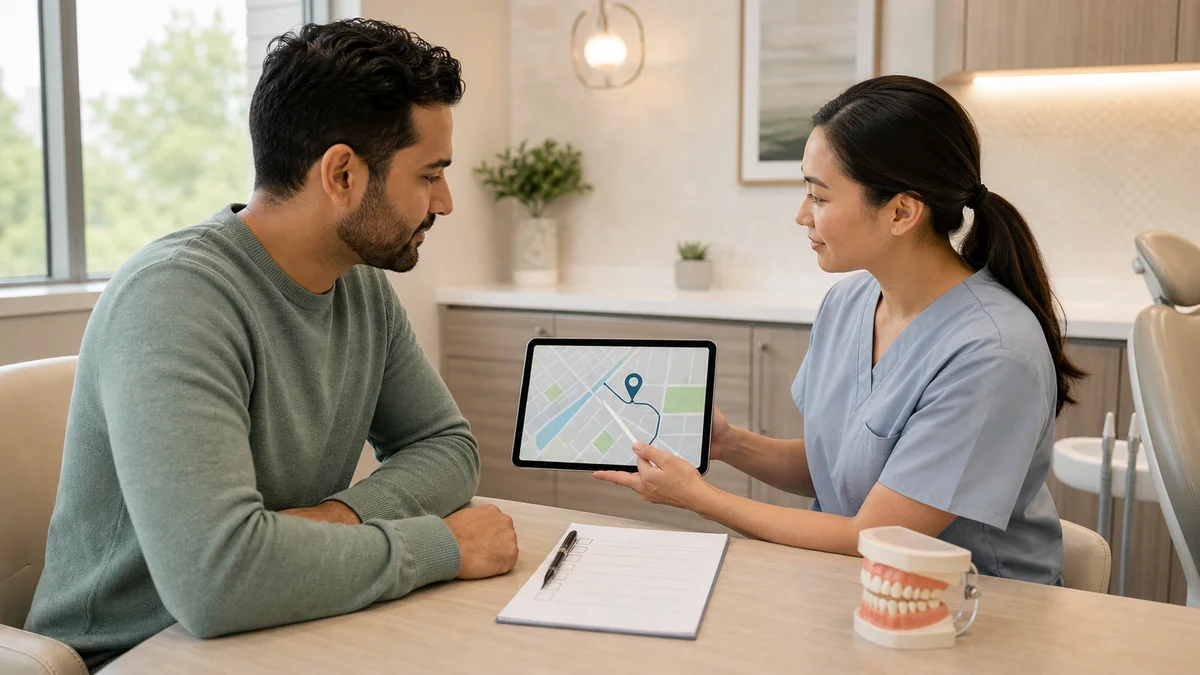
Quick answer: The best dentist close to me is not necessarily the nearest or highest-rated listing. Start by matching the office to your type and urgency of care, then verify the dentist’s license, infection-prevention approach, accessibility, written estimates, communication, after-hours plan, and follow-up. Use reviews as question prompts rather than proof of clinical quality.
Typing best dentist close to me into a search bar may produce dozens of pins, ratings, sponsored placements, and promises. That list can be useful for discovering offices, but it cannot examine your mouth, confirm a professional license, show whether a treatment is appropriate, or predict how a clinic will respond after a difficult appointment. A safer choice comes from turning the search into a structured comparison.
Location still matters. A clinic that you can reach reliably may make preventive visits, staged treatment, urgent reviews, and long-term maintenance easier. Yet distance is only one clinical access factor. Appointment type, professional scope, communication, disability access, cost transparency, and continuity may matter more than a difference of a few minutes. A careful best dentist close to me comparison weighs all of them. This guide explains how to assess those factors without naming a universal winner or replacing an individual examination.
1. Reframe “best dentist close to me” as an access decision
A map ranks distance; it does not rank suitability. Before calling any office, define what “close” means in your life. It might mean near home, work, school, public transport, an accessible parking space, or a caregiver’s route. Consider whether you could return for an unexpected review, not just reach one convenient first appointment. A treatment involving several stages places different demands on travel than a routine examination.
Your best dentist close to me shortlist should therefore reflect the whole care pathway. If you depend on public transport, test the route at the time of day you would attend. If you work shifts, ask which appointment windows are genuinely available rather than relying on advertised hours. If another person assists with consent, mobility, or interpretation, include their availability. Proximity is valuable when it reduces missed visits and supports follow-up, not when it hides gaps in care. Record these facts beside every best dentist close to me result.
- Estimate door-to-door travel time, including parking or transfers.
- Check step-free access, lifts, toilets, seating, and room for a support person.
- Ask how quickly the office can review pain or swelling after treatment.
- Confirm whether the same clinician usually provides continuing care.
- Consider whether future maintenance visits will remain practical.
2. Identify the appointment you actually need
“Dentist” covers different services. A general dentist commonly provides examinations, prevention, fillings, and coordination. Some problems may require referral to a recognized dental specialty, while others first need an urgent assessment. The National Commission on Recognition of Dental Specialties and Certifying Boards describes formally recognized specialties as fields with advanced knowledge and training beyond predoctoral education. A title used in advertising is not automatically the same as a recognized specialty credential, even when it appears prominently in a best dentist close to me listing.
When comparing a best dentist close to me result, state the reason for your visit in plain language. Mention severe pain, swelling, trauma, bleeding, a lost restoration, a child’s age, pregnancy, relevant medical conditions, medicines, or a need for anxiety support. Reception staff can explain whether the office offers an appropriate appointment and how urgent symptoms are handled, although only a clinician can diagnose the cause.
When is distance less important than clinical scope?
A nearby general practice may be the right first contact, but an established diagnosis or complex need can make relevant expertise, hospital support, sedation arrangements, or coordinated specialty care more important than mileage. That distinction can change which best dentist close to me option is suitable. Ask who will perform each part of care, what training is relevant, and where follow-up occurs. Do not assume that a long list of services means every service is delivered by the same professional.
3. Verify the professional license before comparing popularity
Licensure is a foundational check in any best dentist close to me search. In the United States, state dental boards are government agencies that issue licenses, set standards within their authority, and may take disciplinary action. The American Dental Association maintains a directory linking to state boards, while the board itself is the authoritative place to confirm current status. Other countries use their own national or regional regulators; use the relevant official register rather than a clinic badge or social-media biography.
For every best dentist close to me candidate, identify the treating dentist’s full professional name. Search the regulator’s register and match the name, profession, and location. Review the status and any public information the regulator provides. Similar names can occur, so do not rely on initials alone. If a clinic cannot say who is expected to treat you before a planned procedure, ask when that information will be available and verify it before consent or payment.
- Use an official regulator or state board search, not a commercial directory.
- Match the clinician’s full name and profession to the correct record.
- Check that the license is current for the place where care will occur.
- Verify any claimed specialist status through the appropriate official source.
- Ask who is responsible if care involves more than one clinician or facility.
4. Match general care, special interests, and recognized specialties
A general dentist can be an effective home for prevention, diagnosis, restorative care, and referral. Some general dentists undertake additional education in particular procedures. That can be relevant, but patients should understand the difference between a special interest, a certificate, membership, and a formally recognized specialty. The phrase best dentist close to me does not answer that credential question. Ask factual questions about who provides the proposed care, how frequently the team manages similar needs, and when it refers.
The best dentist close to me for a young child may be a family general practice with suitable facilities or a pediatric dentist, depending on the child’s needs. Persistent jaw or facial pain may require a different pathway from tooth decay. Gum disease, root canal treatment, tooth movement, oral surgery, and complex prosthetic rehabilitation can also involve different scopes. An ethical office should be comfortable explaining its limits and arranging a referral when appropriate.
5. Test real availability, not just opening hours
An office can appear open online while having no suitable appointments for weeks. A best dentist close to me result is only useful if the needed service is genuinely available. Call or use the clinic’s secure contact channel and ask about the next appointment of the type you need. Confirm whether the displayed hours apply to clinical care or only to telephone coverage. Ask what happens if symptoms worsen before the visit and where the office directs patients outside normal hours.
Availability also includes follow-up. A best dentist close to me option should be able to explain how post-treatment questions are triaged, whether urgent reviews are available, and who sees patients when the treating dentist is away. No office can promise instant access in every circumstance, but a clear process is more informative than a vague “call us if needed.” Keep emergency contact instructions and know which services operate locally.
Which symptoms need prompt or emergency help?
Seek urgent professional advice for significant facial swelling, spreading infection signs, dental trauma, uncontrolled bleeding, or severe pain that is not manageable. In these situations, do not let a best dentist close to me ranking delay appropriate help. Difficulty breathing or swallowing, rapidly increasing swelling, major facial injury, or a serious allergic reaction can require emergency medical services rather than waiting for a routine dental slot. Online guidance cannot determine your diagnosis or level of risk.
6. Ask concrete questions about infection prevention
Clean décor is not the same as a complete infection-prevention system, whatever a best dentist close to me profile shows. CDC guidance says Standard Precautions are minimum practices for all patient care, regardless of known infection status. They include hand hygiene, appropriate personal protective equipment, respiratory hygiene, sharps safety, safe injections, sterile instruments and devices, and cleaned and disinfected environmental surfaces. The clinic, not the patient, is responsible for implementing professional standards.
When assessing a best dentist close to me candidate, ask how reusable instruments are cleaned, packaged, sterilized, and monitored; how single-use items are managed; and who leads infection-prevention training. You do not need a technical interrogation, and reception staff may arrange for a clinical team member to answer. Look for specific, calm explanations rather than claims that risk is “zero.” No healthcare environment can guarantee zero risk.
7. Evaluate communication and informed consent
A productive best dentist close to me consultation is a two-way conversation. The dentist should take a relevant history, examine you, explain findings in understandable language, discuss reasonable options—including doing nothing or monitoring when clinically appropriate—and describe material benefits, limitations, risks, likely stages, and aftercare. Consent is not merely a signed form; it is an informed and voluntary decision that can be revisited.
The best dentist close to me is a poor fit if you cannot ask questions, request clarification, or take reasonable time to consider non-urgent treatment. Notice whether the team separates facts from preferences and whether images or models are used to support—not replace—an explanation. Ask for the diagnosis and plan in writing. If terminology is unclear, ask what each procedure is intended to achieve and what alternatives exist.
What should happen before irreversible treatment?
Before tooth removal, preparation, implant surgery, or another irreversible step, you should know which tooth or area is involved, why the procedure is proposed, meaningful alternatives, important risks, anticipated stages, who will provide care, expected recovery, and how follow-up works. Finding the phrase best dentist close to me in an advertisement supplies none of that information. The exact consent process depends on the procedure and local law. A second opinion is reasonable when the decision is complex or you remain uncertain.
8. Check accessibility, language, anxiety, and support needs
Access is more than a pin on a best dentist close to me map. Tell the clinic about mobility, sensory, communication, cognitive, medical, or anxiety-related needs before attending. Ask about step-free entry, transfer space, accessible equipment, quiet waiting options, written information formats, interpreter arrangements, and whether a support person can be present. Do not assume that a generic “accessible” label covers what you require.
For a best dentist close to me search, a slightly farther clinic may be functionally closer if it removes a major barrier. Patients with dental anxiety can ask how the team structures appointments, signals pauses, explains sensations, and discusses pain control. Sedation is not the only support strategy and is not suitable for everyone. If sedation is considered, ask about the clinician’s qualifications, monitoring, escort rules, fasting instructions, and emergency arrangements.
9. Read reviews as clues, not clinical evidence
Reviews attached to a best dentist close to me result can reveal recurring themes about scheduling, communication, accessibility, or billing. They cannot verify diagnosis, technical quality, sterility, or whether another patient had the same condition. Privacy rules also mean a clinic may be unable to answer a public complaint with clinical details. A dramatic story—positive or negative—should generate questions rather than a conclusion about your own likely outcome.
The FTC advises consumers to consider the source, compare multiple sources, check recency, notice unusual bursts, examine a reviewer’s history, and remember that fake reviews can be positive or negative. Apply that method to a best dentist close to me shortlist. Sponsored placement is advertising, not an independent quality award. A high average score should never replace license verification, a consultation, or written planning.
Are before-and-after photographs enough?
No. Photographs on a best dentist close to me page may help you discuss appearance goals, but they do not reveal diagnosis, imaging, bite, tooth structure, gum health, complications, maintenance, lighting changes, editing, or whether consent was obtained for display. Ask whether images show the clinician’s own work and what treatment was involved. Your result cannot be guaranteed from another person’s photograph.
10. Confirm insurance participation and request written estimates
“We accept your insurance” can mean that the office will submit claims; it does not necessarily mean every dentist, procedure, laboratory, or facility is in network. Never infer network status from a best dentist close to me label. Contact your insurer using the number on your card and ask it to confirm current network status and benefits. Coverage information is not a clinical recommendation, and preauthorization is not a guarantee that every charge will be paid.
Before choosing the best dentist close to me on price, request a written, itemized estimate after appropriate assessment. It should identify proposed services, stages, likely providers, laboratories or facilities when relevant, and known exclusions. Ask what might change the plan. In the United States, CMS says uninsured or self-pay patients generally have rights to a Good Faith Estimate when care is scheduled at least three business days ahead or when they request one; emergency care is treated differently. Check current rules for your circumstances.
- Confirm network participation directly with both the clinic and insurer.
- Ask whether the estimate covers imaging, anesthesia, laboratory work, temporary care, and reviews.
- Separate the insurance estimate from the clinic’s total treatment estimate.
- Read financing interest, fees, cancellation terms, and refund conditions before signing.
- Keep estimates, consent documents, receipts, benefit explanations, and correspondence.
11. Use the first visit to assess process, not to demand a sales quote
A safe first visit after a best dentist close to me search typically begins with identity confirmation, relevant medical and dental history, symptoms, goals, and an examination appropriate to the concern. Imaging should be based on clinical need rather than treated as an automatic package. You should understand what is being assessed and what remains uncertain. Complex planning may need records, photographs, scans, consultations, or time to review findings.
During a best dentist close to me consultation, listen for a coherent link between findings, diagnosis, options, and the proposed plan. Ask for copies of relevant records and the written plan. You are not obliged to authorize elective treatment immediately. A clinic may charge for professional assessment and records; ask about those fees before the appointment. A responsible estimate follows the diagnostic process instead of pretending every patient needs the same package.
What are pressure red flags?
Be cautious when a best dentist close to me promotion ties non-urgent treatment to an expiring countdown, a large same-day deposit, a promise of perfection, dismissal of alternatives, refusal to identify the treating professional, or reluctance to provide written scope and terms. Urgent disease can require timely decisions, but urgency should be explained clinically. Ask what may happen if care is delayed and whether short stabilization is an option.
12. Compare continuity, records, and aftercare
Continuity can improve understanding of your history, risk factors, preferences, and previous responses to care. Include continuity when judging a best dentist close to me option. Ask whether you will usually see the same dentist, how hygienists and specialists communicate, and how notes, radiographs, photographs, and laboratory information are stored and shared. If the practice changes ownership or a clinician leaves, learn how patients obtain records and continue unfinished care.
A credible best dentist close to me candidate explains maintenance and review before treatment begins. Ask who manages complications, what is included in routine follow-up, which situations may involve additional fees, and how repairs or remakes are assessed. A warranty-style phrase should not be mistaken for a biological guarantee; oral health, material wear, habits, disease, trauma, and maintenance can change outcomes.
13. Use this decision table before booking
Score only information you can verify. A low rating in a critical safety category should not be canceled out by convenience or décor. The table is a conversation aid, not a certification tool or substitute for professional judgment.
| Decision area | What to verify | Reassuring evidence | Reason to pause |
|---|---|---|---|
| Professional identity | Treating dentist and current license | Full name matches the official register | Name withheld or record cannot be matched |
| Clinical fit | Service scope and referral pathway | Clear explanation of limits and referrals | Every problem is sold one standard solution |
| Access | Travel, disability access, timing, urgent reviews | Specific arrangements fit your needs | Advertised access differs from reality |
| Safety systems | Infection prevention and emergencies | Specific processes and trained responsibility | “Zero risk” claims or evasive answers |
| Consent | Diagnosis, options, risks, time to decide | Written plan and questions welcomed | Pressure, guarantees, or alternatives dismissed |
| Costs | Itemized estimate, insurance, exclusions | Written scope and change conditions | Headline price without components |
| Continuity | Records, reviews, complications, maintenance | Named process and accessible follow-up | Aftercare is undefined or remote |
Apply the table to two or three plausible offices from your best dentist close to me search. Write down unknowns instead of assuming the best answer. One short call may resolve scheduling and accessibility; license status should come from an official register; clinical fit requires a professional assessment. Keep commercial features—parking, décor, gifts, promotional financing—separate from patient-safety evidence.
14. Know when a nearby clinic and planned dental travel are different choices
A local search usually assumes easy return visits and access to familiar emergency services. Planned dental care in another city or country has a different risk and logistics profile. Travel time, staged procedures, recovery, records, legal routes, insurance, language, and management of complications all need explicit planning. A clinic abroad should not present itself as “close” simply because a flight is direct.
Redent Klinik provides information for patients considering care in Türkiye, but that is distinct from choosing a local dental home. You can review the clinic’s English-language information on the Redent Klinik website and use the Redent Klinik contact page to request an individual assessment. Do not replace urgent local care with travel planning, and arrange local continuity where needed.
15. Build a final “best dentist close to me” shortlist
After research, remove offices that fail license, identity, scope, access, or transparency checks. For the remaining options, compare the first appropriate appointment, real travel burden, communication, accommodations, written costs, and aftercare. The “best” choice is the one that can provide suitable, ethical, accessible care for your needs—not the business that dominates the map.
Record the date you verified each detail because clinicians, networks, opening hours, and regulations can change. Recheck insurance and licensing before major treatment. If two plans differ substantially, ask each clinician to explain the diagnosis and intended endpoint, then consider an independent second opinion. The final choice in a best dentist close to me search should remain yours, made with understandable information and without pressure.
Frequently asked questions about finding the best dentist close to me
Is the nearest office automatically the best dentist close to me?
No. Distance can support attendance and follow-up, but it does not establish licensure, clinical fit, infection-prevention processes, communication, or cost transparency. Compare the route with the full care pathway. A slightly farther office may be more accessible or appropriate, while an urgent problem may require the earliest suitable service rather than your preferred routine clinic.
Can search ranking identify the best dentist close to me?
No. Search results can be influenced by location, advertising, website optimization, personalization, and platform rules. Ranking is a discovery tool, not a clinical credential. Verify the treating dentist with the official regulator, assess the clinic’s process, and obtain an examination before deciding on treatment.
How many reviews should I read?
There is no safe number that converts reviews into proof. Look across several sources, check dates and reviewer history, notice repeated operational themes, and watch for sudden bursts or incentives. Then verify factual claims independently. Reviews should help you form questions for a best dentist close to me consultation, not determine diagnosis or outcome.
Should I choose a general dentist or a specialist?
A general dentist is often the appropriate first point for comprehensive assessment and coordination. Some needs may benefit from formally recognized specialty care. The decision depends on your findings, complexity, medical history, and available referral pathways. Ask what the clinician provides, what credentials are relevant, and when they refer.
What should I ask when I phone a new dental office?
State the reason and urgency of your visit, then ask about the appropriate appointment, treating professional, current availability, accessibility, language or anxiety support, expected assessment fees, insurance process, and after-hours instructions. Do not request a firm diagnosis or total price by phone when an examination is needed.
Does accepting my insurance mean the dentist is in network?
Not necessarily. “Accepting” insurance may only mean submitting claims. Verify the dentist, location, proposed service, facility, and any separate providers with your insurer and clinic. Ask about deductible, annual maximum, waiting periods, exclusions, and preauthorization. Benefits are not guaranteed until a claim is processed.
Can a dentist guarantee my result?
No responsible clinician can guarantee a biological or cosmetic result for every patient. Diagnosis, healing, anatomy, disease, habits, materials, maintenance, and unexpected complications affect outcomes. Ask for realistic goals, limitations, alternatives, follow-up, and the process for managing concerns rather than a promise of perfection.
Is a free consultation the same as a complete examination?
Not always. Ask what the consultation includes, who conducts it, whether a diagnosis is made, what records or imaging may cost, and whether the visit generates a written plan. A sales discussion, scan, or preliminary conversation may not replace a comprehensive clinical examination.
How do I find lower-cost dental care nearby?
Ask clinics for itemized estimates and phased or alternative plans where clinically appropriate. In the United States, HRSA-funded health centers can provide dental services, serve patients regardless of ability to pay, and adjust fees based on income and family size. Dental schools and local public programs may also have options; eligibility, scope, and waiting times vary.
Should I get a second opinion?
A second opinion can be useful for irreversible, extensive, expensive, or uncertain treatment, or when plans differ greatly. Share relevant records with the second clinician and ask each to explain the diagnosis, alternatives, risks, and intended endpoint. An independent opinion should clarify reasoning, not simply produce another promotional quote.
What if the best dentist close to me cannot see me urgently?
Ask the office where it directs urgent cases and contact an appropriate urgent dental or medical service. Do not wait for a preferred routine appointment if you have rapidly increasing swelling, difficulty breathing or swallowing, uncontrolled bleeding, major trauma, or signs of a serious allergic reaction. Call local emergency services when indicated.
How often should I repeat these checks?
Recheck when you change dentist, begin major treatment, encounter a new provider or facility, or receive information that no longer matches the original plan. Licenses, insurance networks, staff, hours, and policies can change. Keep written records and confirm material changes before consent or payment.
Evidence-based sources
Sources reviewed:
- American Dental Association — State Dental Boards
- National Commission — Recognized Dental Specialties
- CDC — Standard Precautions in Dental Settings
- Federal Trade Commission — How to Evaluate Online Reviews
- Centers for Medicare & Medicaid Services — Good Faith Estimates
- HRSA Bureau of Primary Health Care — What Is a Health Center?
- World Health Organization — Oral Health
Accessed 5 August 2026. Regulations, insurance networks, service availability, and professional records can change; confirm current information with the relevant official body.