
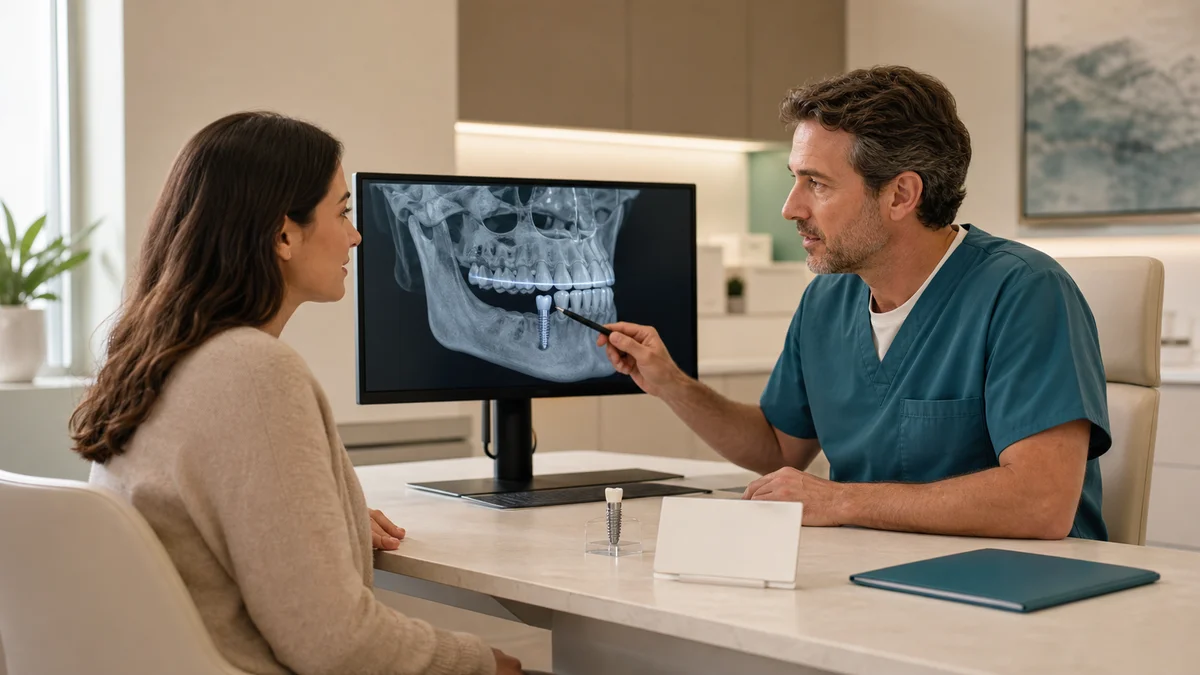
Quick answer: The best places for dental implants are not defined by a country ranking. A safer choice combines a verifiable dentist, an appropriately authorized facility, diagnosis-led planning, infection control, traceable implant components, clear consent, complete records and realistic follow-up. Compare equivalent written plans and total care pathways—not a headline fee, holiday package or guaranteed result.
People searching for the best places for dental implants often expect a list of cities or countries. Geography matters for regulation, travel and access to follow-up, but a flag cannot diagnose bone volume, control gum disease, identify a clinician or explain what a quoted package includes. The useful question is not “Which destination wins?” It is “Which care pathway can be verified, understood and maintained for my individual needs?”
A comparison of the best places for dental implants must start with clinical suitability. Dental implants are devices placed surgically in the jaw and later restored with a crown, bridge or denture. Some patients need disease control, extraction, healing or augmentation before placement. Others may have a reasonable non-implant alternative. No online guide, photograph or remote sales conversation can establish the final plan.
This evidence-based guide is prepared for review by Dentist Esma Çevrük Çakır. It does not rank countries, promise a result or quote a fixed fee. Instead, it explains how to compare local, domestic-travel and international options using official registers, current public-health guidance and written provider evidence. The best places for dental implants for one patient may be unsuitable for another because anatomy, health, expectations, travel tolerance and continuity differ.
1. Why the best places for dental implants are care pathways, not flags
The phrase best places for dental implants can hide several different questions. A patient may be looking for advanced surgery, a specialist opinion, shorter waiting time, communication in a preferred language, a manageable total cost or an opportunity to combine treatment with travel. Those goals should be written down separately because a destination that performs well on one may be weak on another.
Country-level regulation sets a floor, not an individual outcome. Providers within the same city can differ in training, case selection, diagnostic process, laboratory support, emergency arrangements and willingness to share records. A polished clinic may still propose a plan that is difficult to maintain at home. A modest local practice may offer excellent continuity for a straightforward case. Therefore, any list of best places for dental implants should be treated as a starting point for provider-level verification.
A useful shortlist names the treating dentist, identifies the facility, defines the proposed restoration and explains who owns every stage. It also includes a credible route if the original plan changes. These details are more informative than a tourism award, social-media following or collection of before-and-after photographs.
2. Confirm whether implant treatment is suitable before comparing destinations
The US Food and Drug Administration advises patients to discuss candidacy, benefits and risks with a dental provider. Overall health affects candidacy and healing; smoking may impair healing; untreated periodontal disease and local infection are relevant concerns. A search for the best places for dental implants should therefore begin with medical and dental history, examination and appropriate imaging—not a deposit.
The assessment may include the reason for tooth loss, condition of neighbouring teeth, gum health, bite, available bone, smile requirements, oral-hygiene ability and expectations. Medicines, previous radiotherapy, diabetes control, smoking or nicotine use, and conditions affecting healing can change risk or timing. This is not a checklist for self-diagnosis. The treating dentist must interpret the information and, when appropriate, coordinate with other clinicians.
Ask what alternatives are reasonable. Depending on the case, these can include preserving a tooth, a conventional or adhesive bridge, a removable denture, orthodontic space management or no immediate replacement. A credible discussion of the best places for dental implants leaves room for the conclusion that an implant is not the preferred option.
3. Define the exact treatment being compared
“Dental implant” is not one standardized retail product. The FDA explains that a system generally includes an implant body, an abutment and an abutment screw; the restoration supported by that system can be a crown, bridge or denture. One offer may price the fixture only, while another includes the final tooth. Those are not equivalent entries in a best places for dental implants comparison.
Request a written plan that identifies the missing or failing teeth, proposed fixture number and position, surgical stages, provisional restoration and definitive restoration. It should distinguish what is confirmed from what remains conditional on examination or imaging. If grafting, extraction or treatment of gum disease may be needed, ask what finding would trigger it and how consent and cost would be updated.
- Examination, medical review and diagnostic records.
- Radiographs or cone-beam CT only when clinically justified.
- Extraction, periodontal treatment or other disease control.
- Implant fixture, surgical appointment and necessary consumables.
- Bone or soft-tissue procedure, if indicated.
- Healing component, abutment and temporary restoration.
- Definitive crown, bridge or denture and laboratory stages.
- Review appointments, maintenance instructions and emergency access.
- Complete clinical records and implant-system traceability.
When assessing the best places for dental implants, label every line “included,” “excluded” or “conditional.” This simple exercise prevents a fixture-only advertisement from being compared with a complete restorative pathway.
4. Verify the treating dentist in an official register
A clinic brand does not place an implant; a named professional does. Ask who will examine you, who will perform surgery, who will design or fit the restoration and who will manage complications. Search each clinician in the destination’s official public register. For example, the UK General Dental Council register is updated daily and can confirm whether a dental professional is registered and able to practise in the UK.
Registration rules and protected specialist titles differ across jurisdictions. Do not assume that “implantologist,” “cosmetic dentist” or another marketing label has the same legal meaning everywhere. The best places for dental implants comparison should record the clinician’s current registration, relevant recognized qualifications, scope of practice and the authority that handles professional concerns.
Ask about experience in cases similar in complexity to yours, but interpret claims carefully. A large procedure count does not replace appropriate case selection, diagnosis or audited outcomes. If a provider presents a success percentage, request the definition, population, time period, follow-up rate and whether the data were independently reviewed. Testimonials cannot predict your result.
5. Check the facility, authorization and emergency readiness
The clinical setting should be appropriate for the planned procedure and any sedation. Verify licensing or authorization with the competent authority rather than relying on a badge copied onto a website. If Türkiye is being considered among the best places for dental implants, the Republic of Türkiye Ministry of Health publishes lists of healthcare providers authorized for international health tourism. Confirm the exact legal facility, because a similar trading name is not enough.
Ask what emergency equipment, medicines and trained personnel are available, how medical histories are screened and where a patient is transferred if care exceeds the clinic’s capacity. Sedation requires its own assessment, monitoring, recovery and escort arrangements. A package that includes “sleep dentistry” should explain the method, responsible clinician and safety process in writing.
Accreditation can add information, but it is not a guarantee of an individual outcome. Verify the claim directly with the issuing body and check its scope and current status. The strongest best places for dental implants candidates combine appropriate authorization with transparent clinician responsibility and a clear emergency pathway.
6. Ask how infection prevention is implemented
The Centers for Disease Control and Prevention describes Standard Precautions as minimum practices for all patient care. They include hand hygiene, appropriate protective equipment, respiratory hygiene, sharps safety, safe injections, sterile instruments and devices, and cleaned or disinfected surfaces. Implant surgery is an oral surgical procedure, so the best places for dental implants must be able to explain how asepsis and instrument processing are managed.
Patients do not need to audit a sterilization department, but they can ask concrete questions. Who leads the infection-prevention program? How are reusable instruments cleaned, packaged, sterilized and traced? How are surfaces prepared between patients? Are single-use items discarded after one patient? What is the protocol if sterility is compromised? Clear, calm answers are more valuable than vague claims that a clinic is “hospital grade.”
Infection can occur even when appropriate precautions are followed, so no provider should promise zero risk. The goal in choosing among the best places for dental implants is evidence of a functioning safety system, not an impossible guarantee.
7. Examine planning, imaging and restorative design
Implant positioning should be driven by the planned tooth or prosthesis as well as anatomy. Appropriate records can include photographs, conventional radiographs, digital impressions and, when justified, cone-beam CT. More technology does not automatically mean better care. Ask what each test contributes, who interprets it and how the result changes the plan.
The best places for dental implants should explain the relationship between fixture position, bone, nerves, sinuses, gum tissue, bite and hygiene access. Computer-guided surgery can be useful in selected cases, but a guide is a tool, not a substitute for diagnosis or surgical judgement. Similarly, an in-house laboratory may improve coordination without proving that the design is appropriate.
For a front tooth, tissue contours, provisionalization and smile integration may be major concerns. For a back tooth, load, space and access can dominate. Full-arch reconstruction adds jaw relationship, phonetics, cleansability, material thickness and repair planning. A generic best places for dental implants ranking cannot capture these design differences.
8. Require implant-system and component traceability
The FDA recommends asking which brand and model of implant system will be used and keeping that information. Future clinicians may need the exact manufacturer, connection, dimensions and component details. Components are not universally interchangeable. The best places for dental implants should provide an implant record without the patient having to chase it after returning home.
Ask whether original or compatible restorative components are planned, why they were selected, and who supplies the laboratory work. Brand reputation alone cannot prove good diagnosis, placement or maintenance, but unidentified components can complicate later repair. Keep labels or digital traceability details, operative notes, radiographs, abutment information and restoration design in your records.
A commercial warranty is not a biological guarantee. Read what it covers, who pays professional fees, whether routine reviews are mandatory and whether another dentist’s intervention changes the terms. If the best places for dental implants shortlist relies heavily on a “lifetime warranty,” compare exclusions and practical access rather than the headline duration.
9. Compare local, domestic-travel and international routes
There are at least three geographic routes: care close to home, travel within your country, or international treatment. None is automatically superior. Local care may make reviews and urgent access easier. Domestic travel may expand provider choice while preserving familiar regulation. International care may offer different expertise, access, language or cost, but adds borders, transport, insurance and continuity questions.
Use the table to compare routes before naming the best places for dental implants for your circumstances:
| Decision area | Local care | Domestic travel | International travel |
|---|---|---|---|
| Clinician verification | Use local official register | Use the same national register | Identify the destination authority and verify directly |
| Assessment | Usually easier to repeat in person | May need planned trips | Remote discussion remains provisional until examination |
| Follow-up | Often practical for routine reviews | Travel time and cost apply | Requires an agreed home and destination pathway |
| Records | Confirm transfer between providers | Confirm digital access | Request complete records, traceability and useful translation |
| Contingency | Potentially quicker access to treating team | May require another journey | Can require extended stay, new travel or local stabilization |
| Total cost | Clinical fees and local time | Add transport and accommodation | Add flights, accommodation, insurance, currency and possible repeat trips |
| Legal route | Familiar local process | National process usually applies | Rights, complaints and enforcement may differ |
The table does not award points. First remove any route with unverified professionals, an unclear diagnosis, inadequate consent or no feasible follow-up. Among remaining best places for dental implants candidates, compare complete pathways and your ability to attend every necessary stage.
10. Calculate total care cost without relying on fixed package prices
A headline implant fee may exclude assessment, imaging, extraction, grafting, temporary teeth, abutments, final restorations, sedation or maintenance. International treatment can also involve flights, transfers, accommodation, meals, time away from work, an accompanying person, changed bookings and a second or third visit. A responsible best places for dental implants comparison uses current individualized estimates rather than a universal price table.
Ask which currency controls the contract, how long the estimate remains valid, which items can change after examination and when payments become non-refundable. Keep clinical consent separate from credit or finance agreements. Pressure to decide before a promotion expires is not a clinical reason to proceed.
Insurance and public reimbursement rules vary. Planned treatment abroad, treatment-related complications or elective revisions may be excluded from ordinary travel policies. Ask the insurer directly and obtain answers in writing. The clinic cannot guarantee coverage, and an apparently affordable entry in a best places for dental implants list can become costly when excluded follow-up is counted.
11. Test the timeline against biology, not a holiday itinerary
Implant care can include diagnosis, disease control, extraction, healing, placement, integration, impressions and delivery of the definitive restoration. Some stages can be combined for selected patients; others should be separated. The FDA notes that healing after implant-body placement may take several months or longer. “Same day” often describes a provisional restoration, not completion of every stage.
The CDC Yellow Book identifies dental care as a common form of medical tourism and recommends considering the destination, facility and treating professional, as well as continuity and records. The best places for dental implants will not force biology into an inflexible flight schedule or present postoperative recovery as a normal vacation.
Ask for a visit-by-visit plan, expected and possible extended stays, criteria for loading the implant and events that could postpone restoration. Do not purchase restrictive travel until the relevant clinical stage is confirmed. Advice about flying must be individualized according to the procedure, anaesthesia, health and recovery; there is no universal waiting interval suitable for every patient.
12. Build aftercare and complication access into the plan
Aftercare is part of treatment, not a free extra. Before paying, identify planned reviews, urgent contact channels, the clinician responsible for adjustments and which concerns need in-person examination. Remote photographs or messages can support communication but cannot always diagnose infection, mobility, bite problems or a damaged component.
If travelling, speak with a dentist at home before treatment. Do not assume that local clinicians have agreed to maintain or repair another provider’s work. Ask the destination team how records will be transferred, whether local care can be coordinated and who pays if review is needed. The best places for dental implants are only practical if continuity remains accessible after the patient returns.
Seek prompt local professional help for severe or worsening pain, spreading swelling, fever, uncontrolled bleeding, difficulty breathing or swallowing, persistent numbness, a mobile implant or another urgent concern. Waiting for a remote warranty decision can be unsafe. No article about the best places for dental implants should replace emergency assessment.
13. Review consent, communication, records and legal recourse
Valid consent requires information you can understand, time for questions and freedom from inappropriate pressure. Ask which language will be used for examination, consent, instructions and emergency calls. If an interpreter is involved, clarify independence and confidentiality. A coordinator can organize travel, but clinical questions should be answered by an appropriately qualified professional.
Before choosing among the best places for dental implants, request written information on benefits, material risks, alternatives, expected stages, uncertain findings, temporary teeth, final restoration, maintenance and foreseeable additional treatment. Consent should be revisited if the plan changes after examination or during care.
- Named treating clinicians and official registration details.
- Diagnosis, alternatives and signed treatment plan.
- Radiographs, scan access, photographs and relevant clinical notes.
- Implant manufacturer, model, size, site and lot or batch information.
- Abutment, screw and definitive restoration details.
- Prescriptions, operative record and postoperative instructions.
- Review findings, maintenance schedule and emergency contacts.
- Invoices, warranty terms, complaint process and professional indemnity information.
Understand which law and complaint route apply, where a claim would be handled and what remedies are realistically available across borders. The best places for dental implants should explain these issues plainly rather than treating them as negative questions.
14. Recognize marketing red flags before committing
No single warning proves poor care, but several together justify pausing and seeking independent advice. Marketing should never outrun diagnosis. Be cautious when a provider offers a final plan before examination, refuses to identify the dentist, demands a large non-refundable deposit immediately or describes one package as suitable for everyone.
- Guaranteed success, permanence, painlessness or an identical cosmetic result.
- A country ranking presented without dates, scope or independent evidence.
- A quote that does not separate fixture, abutment and restoration.
- Pressure tied to a flight, hotel or expiring discount.
- Before-and-after images used as a prediction for every patient.
- No official registration details for the treating professionals.
- No written explanation of risks, alternatives or changed-plan costs.
- No implant record, compatible-component information or transferable notes.
- A travel schedule with little time for assessment, recovery or review.
- A warranty that requires return travel but offers no urgent-care pathway.
Claims to be among the best places for dental implants should be translated into verifiable facts: who treats, under which authorization, using what plan, with what records and follow-up. If those answers remain vague, do not let a persuasive video or hotel package close the gap.
15. How to evaluate Türkiye and Redent Klinik fairly
Türkiye is widely considered by international patients because of access, travel connections and established health-tourism services. That does not mean every provider is equivalent or that Türkiye is automatically one of the best places for dental implants for every patient. Use the Ministry of Health’s current authorized-provider lists, verify the exact clinic and named dentist, and apply the same clinical and continuity standards used at home.
Patients can review the Redent Klinik English website for general clinic information and use the English contact page to request an individualized assessment pathway. Share accurate medical and dental history and available records. A preliminary remote discussion cannot confirm candidacy or guarantee that the initial proposal will remain unchanged after examination.
Apply the complete best places for dental implants checklist to Redent Klinik and every alternative: named clinicians, official status, diagnosis, reasonable options, proposed components, temporary and definitive restorations, number of visits, records, aftercare and contingencies. Fair comparison means no preferred destination receives an exemption from due diligence.
16. A practical shortlist workflow
Start with several providers only after you understand the broad clinical question. Remove any provider whose professionals or facility cannot be verified. Then ask the remaining clinics to describe the proposed pathway in comparable terms. Do not compare totals until the number of fixtures, type of prosthesis, preparation, temporary care and final restoration are clear.
- Obtain an examination or independent baseline opinion where practical.
- Define your clinical objective, travel limits and follow-up capacity.
- Verify dentist registration and facility authorization independently.
- Request diagnosis-led, itemized and conditional written plans.
- Compare implant traceability, restoration design and maintenance access.
- Add travel, insurance, time and realistic contingency costs.
- Ask who manages urgent and routine care after you return home.
- Take time to review consent and seek a second opinion for extensive or unclear plans.
This workflow converts the phrase best places for dental implants from a marketing search into a documented health decision. Keep unresolved questions visible. A blank cell is information to obtain, not an invitation to assume the most favourable answer.
17. Frequently asked questions about best places for dental implants
Which country has the best places for dental implants?
No official authority provides a universal country winner for individual implant care. Regulation, fees and access vary, and providers within one country are not interchangeable. Identify suitable clinicians and facilities, compare equivalent diagnosis-led plans and include continuity. The best places for dental implants depend on the patient’s clinical needs and ability to complete follow-up.
Are the best places for dental implants always abroad?
No. Local care can offer easier review and emergency access; domestic or international travel can expand options. Each route has trade-offs. The best places for dental implants are those that meet clinical, regulatory, communication and aftercare requirements for the individual—not whichever option is farthest away or marketed most aggressively.
Can online reviews identify the best places for dental implants?
Reviews can reveal service themes but cannot verify diagnosis, infection control, registration, component traceability or long-term outcomes. They may also reflect different treatments and expectations. Use reviews only as one signal. Confirm claims through official registers, written records and direct clinician communication before deciding among the best places for dental implants.
Does a low package price mean poor implant quality?
Not necessarily. Lower fees can reflect currency, operating costs or scope, while a higher fee does not prove better care. Compare what is actually included and whether plans are clinically equivalent. For any best places for dental implants shortlist, evaluate the treating team, facility, restoration design, records and maintenance—not price alone.
How many trips will treatment require?
The answer depends on extractions, healing, grafting, loading and restorative complexity. Some stages may be combined in appropriate cases; others require separation. Ask for a stage-by-stage schedule and reasons another visit could be needed. The best places for dental implants should explain uncertainty rather than guarantee a timetable before examination.
What records should I bring home after implant treatment?
Request the diagnosis and plan, consent, operative notes, images, prescriptions, implant manufacturer and model, dimensions, lot or batch details, abutment and restoration information, laboratory details, review notes and maintenance instructions. Complete records make the best places for dental implants more maintainable when another clinician later needs accurate component information.
Will travel insurance cover planned dental implants?
Ordinary travel insurance often has exclusions, but policies differ. Disclose planned care and ask in writing about cancellation, treatment complications, extended stay, emergency care and return travel. Do not rely on a clinic’s assurance. Insurance clarity belongs in a responsible best places for dental implants comparison.
What if an implant problem develops after I return home?
Use the agreed emergency pathway, but seek prompt local care for concerning symptoms rather than waiting for remote authorization. Ask beforehand who assesses problems, whether local care is coordinated, what a warranty covers and whether return travel is required. The best places for dental implants plan for complications without promising they will never occur.
18. Choose evidence and continuity over a country ranking
The phrase best places for dental implants is most useful when it leads to a shortlist of verifiable care pathways, not a league table of countries. Start with clinical suitability, identify the actual treating professionals, confirm facility status, compare equivalent plans and insist on transferable records. Then consider total cost, travel and personal preferences.
No destination can guarantee integration, aesthetics, comfort or lifetime performance. Good care reduces avoidable risk through assessment, planning, consent, infection prevention, traceability and follow-up. The best places for dental implants are willing to discuss limitations and alternatives as clearly as benefits.
Take the written plan away from the sales conversation. Ask unresolved questions, involve your regular dentist where possible and seek an independent opinion when treatment is extensive. A safe decision remains personal and conditional on examination; it is never created by a headline, fixed package or online ranking.
Official sources for comparing the best places for dental implants
These official and professional sources support the implant-device, infection-control, registration, medical-tourism, oral-health and Türkiye authorization principles used above. Check current versions because registers, rules and provider lists can change.
- US Food and Drug Administration: Dental Implants—What You Should Know
- US Centers for Disease Control and Prevention: Medical Tourism, Yellow Book 2026
- US Centers for Disease Control and Prevention: Standard Precautions in Dental Settings
- General Dental Council: Search the Registers
- Republic of Türkiye Ministry of Health: Authorized Healthcare Providers
- American Dental Association: Evidence-based Oral Health Topics
- World Health Organization: Oral Health Fact Sheet