
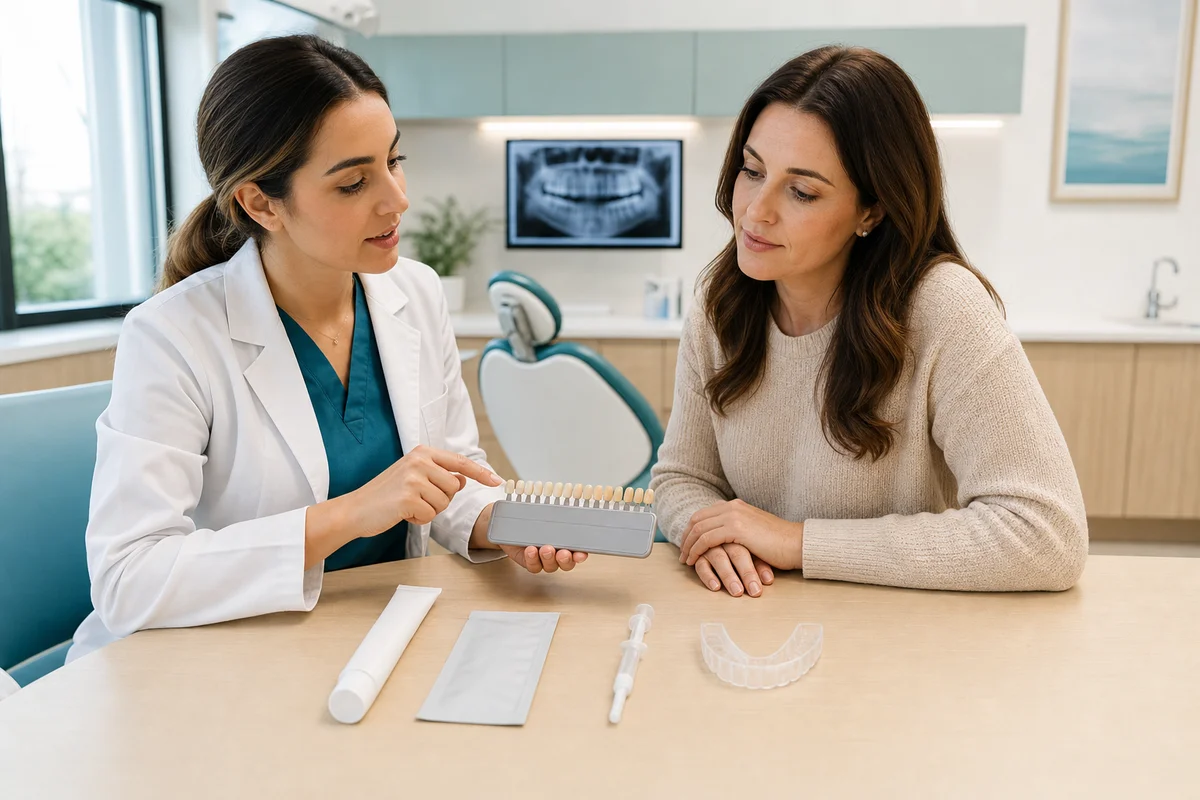
The best rated teeth whitening products are not defined by review stars alone. Look for a product intended for your stain type, credible safety and effectiveness evidence, clear peroxide or abrasive information, complete instructions, realistic claims, and independent acceptance where available. A dentist should first assess decay, gum health, restorations, sensitivity, and the cause of discoloration.
Search results for best rated teeth whitening products mix whitening toothpastes, peroxide strips, paint-on gels, rinses, generic trays, dentist-made trays, and professional treatment. These categories do not work in the same way. A toothpaste may mainly remove surface stain, while a peroxide product can chemically lighten natural tooth structure. A high consumer rating can describe flavor, convenience, shipping, or packaging rather than clinical whitening or safety.
The American Dental Association explains that hydrogen peroxide and carbamide peroxide are commonly used bleaching agents. It also notes that only natural teeth whiten: tooth-colored fillings, crowns, veneers, and implants do not change color with bleaching. Temporary tooth sensitivity and gum irritation are among the most common adverse effects. These facts are essential when comparing best rated teeth whitening products, because a popular kit may be unsuitable for a particular mouth.
This guide does not rank commercial brands, diagnose discoloration, or promise a shade change. Product availability, ingredients, regulations, and acceptance status can change. The goal is to give patients a repeatable method for reading claims, comparing formats, and deciding when professional assessment is safer than self-selection.
What does “best rated teeth whitening products” really mean?
The phrase best rated teeth whitening products sounds objective, but the rating method is rarely standardized. One website may average unverified customer reviews. Another may score price, taste, or ease of use. A professional organization evaluates different questions: whether the stated benefit is supported, the product is safe when used as directed, the label is adequate, and the evidence applies to that exact formulation.
Before trusting a list, ask who created it, how products were selected, whether the author has commercial links, whether negative results were considered, and when the information was updated. Affiliate commission does not automatically make a review false, but it creates an incentive that should be disclosed. “Dentist approved” is also incomplete unless the dentist, criteria, evidence, and specific product are identified.
A useful comparison separates four outcomes:
- surface stain removal: cleaning pigments from the enamel surface;
- chemical bleaching: changing colored compounds within natural tooth tissues;
- optical effect: creating a temporary brighter appearance without meaningful bleaching;
- oral-health benefit: preventing decay or controlling plaque, which is different from cosmetic whitening.
The best rated teeth whitening products for surface coffee stain may not address discoloration caused by trauma, internal tooth changes, medicines, fluorosis, decay, or an old restoration. The cause comes before the category.
Check 1: identify why the teeth look darker
Extrinsic stains collect on the surface and can be associated with tobacco, coffee, tea, red wine, strongly pigmented foods, and oral-hygiene patterns. Intrinsic discoloration is within enamel or dentin and may relate to aging, tooth development, trauma, some medicines, or changes in the pulp. This distinction determines whether best rated teeth whitening products are even relevant. A single dark tooth can require a different investigation from generalized yellowing.
The ADA recommends a clinical examination before bleaching, with radiographs or other tests when appropriate, to identify factors contributing to discoloration. That is why best rated teeth whitening products should not be the first response to pain, a new dark tooth, a cavity, a cracked tooth, bleeding gums, or unexplained color change. Whitening can mask attention from a condition that needs diagnosis.
Professional cleaning may reduce some external stain without bleaching. Conversely, a bleaching toothpaste cannot predictably correct every intrinsic stain. Ask what the product is designed to change and what evidence supports that exact claim.
Check 2: separate whitening toothpaste from bleaching
Many whitening toothpastes rely primarily on abrasives or cleaning agents to remove surface stain. Some include low levels of peroxide or optical agents, but their effect and intended use differ from strips or gels. That category difference matters in every best rated teeth whitening products comparison. The ADA notes that surface-stain removal does not necessarily change the intrinsic color of a tooth.
When comparing best rated teeth whitening products in the toothpaste aisle, do not sacrifice basic cavity prevention for a cosmetic claim. Check whether the toothpaste contains appropriate fluoride for the intended user and whether its instructions match local dental guidance. An overly abrasive or misused product may increase wear, especially when enamel or exposed roots are vulnerable.
A whitening toothpaste may be a reasonable maintenance option for some people, but it cannot whiten fillings or crowns and should not be expected to reproduce professional bleaching. Stop and seek advice if brushing causes persistent pain, visible wear, or gum injury.
Check 3: understand peroxide strips, gels, and trays
Most bleaching strips use peroxide held against natural teeth for a defined contact time. Paint-on gels and tray systems deliver bleaching material differently. Their concentration, fit, exposure time, frequency, storage, and instructions must be compared before calling them best rated teeth whitening products. Saliva and user adherence also influence performance and irritation risk.
For best rated teeth whitening products, more peroxide is not automatically better. Higher concentration or longer contact can increase exposure without guaranteeing a more appropriate result. The ADA reports that sensitivity can occur with all forms of bleaching and may be influenced by active-agent concentration, contact time, existing restorations, and treatment intensity.
Generic trays may allow gel to contact the gums or may distribute it unevenly. A dentist-made tray is designed for an individual fit, but it still requires correct dosing and use. Never improvise with household peroxide, refill a tray with an unapproved substance, or extend treatment because a social-media schedule promises faster whitening.
Decision table for whitening formats
This table organizes best rated teeth whitening products by purpose and evidence questions. It does not select a product for an individual.
| Format | Main intended action | What to verify | Common limitation or risk |
|---|---|---|---|
| Whitening toothpaste | Mostly removes external surface stain | Fluoride, abrasivity context, accepted claims, instructions | Limited effect on intrinsic color; wear or sensitivity with misuse |
| Peroxide whitening strips | Chemically bleaches natural tooth structure | Active ingredient, contact time, fit, evidence, acceptance status | Temporary sensitivity or gum irritation; uneven contact |
| Paint-on gel or generic tray | Delivers bleaching agent at home | Concentration, dosing, tray fit, storage, contraindications | Gel leakage, overuse, unreliable fit, swallowing risk |
| Dentist-made home tray | Supervised bleaching with a custom appliance | Exam, fit, prescribed gel, schedule, sensitivity plan, review | Requires professional assessment and careful adherence |
| In-office whitening | Professionally applied bleaching protocol | Diagnosis, isolation, agent, realistic endpoint, aftercare | Sensitivity and gum irritation can still occur; higher cost |
| Charcoal, acids, or DIY mixtures | Often marketed for stain removal or “natural” whitening | Reliable evidence, abrasivity, acidity, ingredient safety | Weak evidence, enamel wear, irritation, delayed diagnosis |
Check 4: look for independent acceptance, not borrowed badges
The ADA Seal of Acceptance is a voluntary program and a relevant check for best rated teeth whitening products. The ADA states that its Council on Scientific Affairs evaluates scientific evidence and that products carrying the Seal have met program requirements for safety and effectiveness when used as directed. The ADA whitening overview says Seal-bearing consumer whitening products include certain toothpastes and strips; professional products supplied by dentists are not eligible for that consumer Seal pathway.
A valid Seal can help narrow best rated teeth whitening products, but absence of a Seal does not by itself prove a product is unsafe or ineffective. Participation is voluntary and varies by market. Conversely, a logo that resembles a professional seal, an outdated screenshot, or a claim that an ingredient is “ADA approved” is not the same as acceptance of the exact finished product.
Use the current official Seal product search rather than relying on a retailer image. Match the brand, product name, formulation, claim, and package. Regulatory authorization, professional acceptance, and customer ratings are different systems and should not be conflated.
Check 5: read the entire label and instructions
For any candidate among best rated teeth whitening products, inspect the active and inactive ingredients, warnings, age restrictions, intended duration, frequency, storage requirements, expiry, manufacturer identity, contact details, batch information, and local regulatory labeling. Missing or ambiguous instructions make safe use harder.
Do not assume two products with the same headline ingredient are interchangeable. Delivery system, concentration, pH, stabilizers, adhesive, tray design, exposure time, and formulation can change how the product behaves. A trustworthy best rated teeth whitening products review must identify the exact version. Evidence for one formulation may not apply after reformulation or to a similarly named item sold in another country.
Follow the label exactly. Using more gel, stacking strips, sleeping in a short-contact product, or continuing beyond the stated course can increase irritation. Keep products away from children and pets, and do not swallow the material intentionally.
Check 6: natural teeth and restorations will not match automatically
Bleaching changes natural tooth tissues but does not lighten tooth-colored restorations. This limitation applies to every list of best rated teeth whitening products. Fillings, crowns, veneers, bonding, implant crowns, and bridge teeth can therefore look darker or different after surrounding teeth whiten. The mismatch may create a new cosmetic problem that requires professional planning.
Before selecting best rated teeth whitening products, identify visible restorations and discuss the intended shade endpoint. Replacing sound restorations only for color is a separate irreversible and financial decision. It should not be presented as an automatic consequence without consent and alternatives.
Whitening also cannot repair decay, cracks, worn edges, or lost enamel. A whiter appearance is not a measure of oral health. The result varies with starting shade, stain cause, product, adherence, and individual biology, so a specific number of shades cannot be guaranteed.
Check 7: plan for tooth sensitivity
Temporary sensitivity is a recognized effect of bleaching and must be reported when evaluating best rated teeth whitening products. It may feel like short, sharp discomfort with cold air, drinks, or contact. The ADA notes that concentration, exposure, existing adhesive restorations, and treatment intensity may influence risk. Symptoms are often temporary, but persistent or severe pain needs assessment.
The best rated teeth whitening products should provide clear directions about what to do if sensitivity develops: pause, reduce frequency only if the instructions permit, or contact a dentist. Do not use pain medicine, numbing agents, or desensitizers as a way to ignore worsening symptoms without professional advice.
People with existing sensitivity, exposed roots, enamel wear, cracks, recent dental work, or unexplained pain should seek guidance before bleaching. A product review cannot determine whether the pulp or tooth structure is healthy.
Check 8: prevent gum and soft-tissue irritation
Peroxide gel contacting the gums can cause irritation or a temporary pale appearance. Any assessment of best rated teeth whitening products should count this harm, not only shade change. Poorly fitting trays, excess gel, a displaced strip, or incorrect application can increase contact. In professional care, isolation and monitoring help manage exposure; at home, accurate instructions and fit become especially important.
When comparing best rated teeth whitening products, examine whether the delivery system fits the intended teeth and keeps material off soft tissues. A one-size tray may not suit crowded teeth, recession, missing teeth, orthodontic attachments, or unusual anatomy. Stop use and rinse as directed if burning or significant irritation occurs.
Seek urgent help for facial swelling, trouble breathing or swallowing, or a serious allergic reaction. These are not routine whitening effects. Save the package and ingredient list for the clinician.
Check 9: question lights, accelerators, and instant claims
Some kits combine a gel with an LED device and imply that the light independently produces whitening. The relevant questions are whether the exact combined system has clinical evidence, what the active agent does, whether the light changes outcome or only appearance, and what eye and tissue protections are required.
Do not rank best rated teeth whitening products by brightness of the device, number of bulbs, heat, or futuristic styling. A dramatic immediate change can partly reflect dehydration and may not represent a stable shade. “One session,” “zero sensitivity,” “permanent,” and “works for everyone” are claims that require strong product-specific evidence.
A professional light system is not automatically necessary, and a home light does not convert an unknown gel into a proven treatment. Judge the formulation and clinical protocol rather than the accessory.
Check 10: reject acidic fruit, charcoal, and household recipes
MouthHealthy advises that there is no reliable evidence that oil pulling or turmeric whitens teeth and warns against acidic or abrasive home methods. The ADA’s scientific whitening review says evidence is insufficient to show that charcoal oral-care products provide measurable whitening with adequate safety and effectiveness. Abrasion can remove enamel and expose yellower dentin rather than create healthy whitening.
Lists of best rated teeth whitening products sometimes include lemon, vinegar, baking-soda mixtures, charcoal powder, or concentrated household peroxide because they are inexpensive. “Natural” does not mean non-abrasive, neutral in pH, sterile, or safe for gums and enamel. Household chemicals are not formulated or labeled for intraoral bleaching.
Oil, fruit, or spice rituals may also delay diagnosis of decay or gum disease. Daily brushing with fluoride toothpaste, interdental cleaning, limiting stain exposure, avoiding tobacco, and professional care when needed are safer foundations for appearance and health.
Check 11: compare evidence for the exact finished product
An ingredient can have evidence while a finished product does not. Ask whether studies used the same formulation, concentration, delivery system, exposure time, and population. Laboratory tests can help answer mechanism questions, but they do not replace clinical outcomes or adverse-event monitoring.
For best rated teeth whitening products, distinguish a randomized clinical comparison from testimonials, before-and-after photos, influencer demonstrations, manufacturer surveys, and color-edited images. Look for a meaningful comparator, adequate follow-up, transparent funding, prespecified outcomes, and reporting of sensitivity and irritation as well as shade change.
No single study settles every question. Evidence quality, consistency, effect size, applicability, and harms should be considered together. A dentist can help translate general evidence to a mouth with restorations, gum recession, or a particular stain pattern.
Check 12: verify seller, storage, and product integrity
Even a legitimate formulation can become unreliable if counterfeit, expired, opened, diluted, overheated, frozen, or stored outside instructions. Buy from a traceable source, inspect tamper evidence, match the package with official manufacturer information, and keep the receipt and batch details.
A marketplace listing that merges reviews from several variants can distort best rated teeth whitening products. Confirm that reviews refer to the exact item and concentration shown. Be cautious when the seller hides the manufacturer, uses copied professional badges, or makes medical promises that do not appear on the official label.
Do not use a product with damaged packaging, missing instructions, an unexplained odor or texture, or an expired date. Contact the manufacturer or local regulator about authenticity concerns rather than testing the product in your mouth.
Check 13: consider age, pregnancy, and individual conditions
Age restrictions and local rules differ. The ADA whitening review cites pediatric guidance discouraging full-arch cosmetic bleaching in primary and mixed dentition. Pregnancy, breastfeeding, allergies, oral disease, dry mouth, reflux, eating disorders, tobacco use, and medicines may also influence an individual discussion.
The best rated teeth whitening products for a healthy adult cannot simply be transferred to a child or a person with complex medical or dental needs. Read the label, follow jurisdiction-specific rules, and ask a qualified dentist or appropriate clinician when the risk is unclear.
Whitening should not be used to pressure a child or vulnerable person toward an unrealistic appearance. Consent, expectations, and avoidance of unnecessary exposure matter as much as product selection.
Check 14: keep whitening separate from daily disease prevention
A cosmetic product does not replace brushing, fluoride exposure, cleaning between teeth, a balanced diet, or risk-based dental visits. Whitening can make teeth look lighter while decay or gum disease continues. Conversely, naturally darker tooth color does not prove poor hygiene.
When selecting best rated teeth whitening products, maintain a fluoride toothpaste and oral-care routine appropriate to your risk. If a whitening regimen requires changing toothpaste, timing, or brushing behavior, ask how to preserve cavity protection. Do not overbrush to remove color faster.
For English-language information about assessment and cosmetic dental planning, visit the Redent Klinik English website. To share available records or ask how a consultation is arranged, use the English contact page. Online communication cannot diagnose discoloration, approve a product, or guarantee a result.
Check 15: compare total cost, not only package price
OTC products can appear cheaper than dentist-supervised care, but total cost includes repeat purchases, shipping, replacement trays, sensitivity products, wasted items, and management of irritation or mismatch. Professional care includes clinical time and may include custom appliances or review, but scope varies.
The least expensive best rated teeth whitening products list may be costly if it encourages repeated use without diagnosing the stain. Ask how long the course lasts, how many applications the package contains, whether maintenance is expected, and what the stopping rule is. Avoid subscriptions that make cancellation difficult or encourage continuous bleaching.
No ethical product comparison can promise permanent whiteness. Food, drink, tobacco, aging, hygiene, and natural tooth changes affect color. Maintenance should be conservative and discussed if repeated exposure causes sensitivity.
Check 16: use a documented product-selection checklist
Apply the same checklist to every candidate among best rated teeth whitening products:
- What stain type and outcome is the product intended to address?
- Is the cause of discoloration known, and are teeth and gums healthy?
- Does it remove surface stain, chemically bleach, or create an optical effect?
- What are the active ingredients, concentration, delivery method, and contact time?
- Is there product-specific clinical evidence for both benefit and adverse effects?
- Does the exact product currently hold a credible independent acceptance mark?
- Are fluoride and basic cavity-prevention needs preserved?
- Will visible fillings, crowns, veneers, or implant restorations create mismatch?
- Are warnings, age limits, expiry, storage, and manufacturer details complete?
- What should the user do for sensitivity, irritation, or an unexpected reaction?
- Is the seller traceable and the package authentic and tamper-evident?
- Are ratings verified, current, specific to the exact variant, and free of hidden incentives?
- What is the total course and maintenance cost?
- What claim would make you stop and ask a dentist before use?
If a product fails several checks, high star ratings do not repair the missing information. If the discoloration is unexplained or the mouth is not healthy, pause the best rated teeth whitening products search and arrange an examination.
Frequently asked questions about best rated teeth whitening products
Are best rated teeth whitening products safe for everyone?
No. Suitability depends on age, oral health, stain cause, sensitivity, restorations, allergies, medical context, and local product rules. Follow the exact label and ask a dentist when there is pain, decay, gum disease, a single dark tooth, extensive restorations, pregnancy, or uncertainty.
Do best rated teeth whitening products need the ADA Seal?
The ADA Seal is a useful voluntary indicator that an accepted consumer product met program requirements for its stated use. A missing Seal does not automatically prove harm, and professional products are not eligible for the same consumer pathway. Verify current status on the official ADA site.
Are whitening strips stronger than whitening toothpaste?
They usually serve different purposes. Peroxide strips chemically bleach natural tooth tissue, while whitening toothpaste mainly targets surface stain through cleaning and abrasives. “Stronger” is not the same as more suitable or safer. Compare intended action, evidence, exposure, and risk.
Can best rated teeth whitening products whiten crowns or veneers?
No. Bleaching changes natural teeth but does not whiten crowns, fillings, veneers, bonding, or implant crowns. A mismatch may become more visible. Discuss shade planning before whitening if restorations show when you smile.
Why do teeth become sensitive during whitening?
Peroxide can move through tooth tissues and may temporarily irritate the pulp. Concentration, contact time, treatment intensity, exposed roots, cracks, or restorations can influence symptoms. Stop according to instructions and seek assessment for severe, spontaneous, localized, or persistent pain.
Are charcoal products among the best rated teeth whitening products?
Popularity is not proof. The ADA reports insufficient evidence that charcoal oral-care products provide measurable whitening with adequate safety and effectiveness. Abrasive use may wear enamel. Choose evidence-based care and avoid DIY mixtures that contain acids or harsh particles.
Does an LED light make a home whitening kit better?
Not automatically. Evaluate the exact combined system and whether clinical evidence shows a meaningful, stable benefit beyond the gel alone. Device brightness and marketing design are not efficacy measures. Follow eye, tissue, and exposure instructions.
How long should best rated teeth whitening products be used?
Only for the duration and frequency on the exact label or prescribed by a dentist. Products differ, so a schedule cannot be transferred from another kit. Do not extend use to chase an unrealistic shade, and stop for significant irritation or pain.
When should I see a dentist before whitening?
Arrange an assessment for pain, sensitivity, cavities, bleeding gums, exposed roots, cracks, a newly dark or injured tooth, extensive restorations, or uncertainty about the cause. A dentist can discuss whether cleaning, bleaching, restorative care, or no cosmetic treatment is appropriate.
Conclusion: replace star rankings with evidence checks
The safest way to evaluate best rated teeth whitening products is to start with the cause of discoloration, then match the format to the intended outcome. Verify the exact product, active ingredient, delivery method, instructions, independent acceptance, clinical evidence, seller, and adverse-effect plan. Account for restorations and protect everyday cavity prevention.
Reviews can reveal convenience, taste, packaging problems, or adherence barriers, but they cannot diagnose a tooth or guarantee safety. A careful best rated teeth whitening products comparison avoids DIY acids and charcoal claims, treats sensitivity and gum irritation seriously, and uses professional assessment when the mouth or discoloration raises questions. The goal is not the brightest possible shade; it is a realistic, informed choice that respects oral health.
Official sources and evidence resources
- American Dental Association: Whitening overview
- American Dental Association: ADA Seal of Acceptance
- American Dental Association
- ADA MouthHealthy: Natural teeth whitening—fact versus fiction
- NHS: Teeth whitening
- European Commission scientific opinion: Tooth whiteners and hydrogen peroxide
- World Health Organization: Oral health fact sheet