
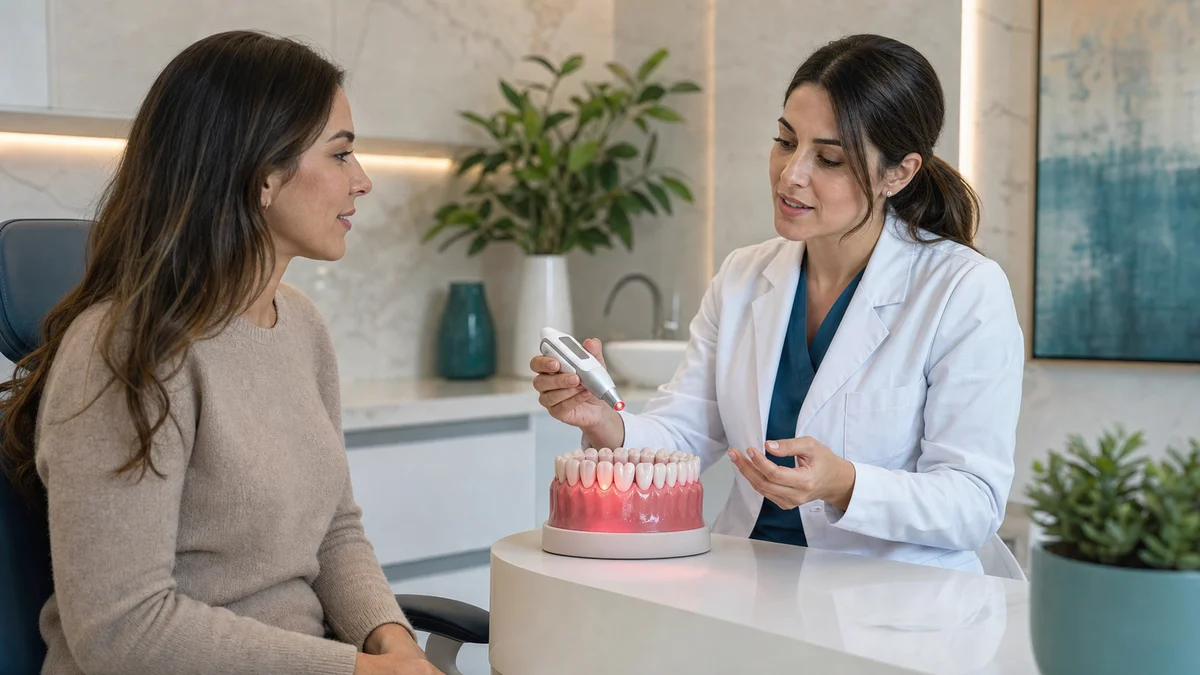
People searching for the best red light therapy for gums often want help with bleeding, tenderness, healing, or periodontal care. Photobiomodulation (PBM)—sometimes called low-level light therapy—uses non-ionizing red or near-infrared light at selected delivery parameters. It is not the same as a heat lamp, a whitening light, or antimicrobial photodynamic therapy that uses a photosensitizer. Those distinctions matter because a device studied for skin, muscle pain, or facial wrinkles cannot automatically be assumed suitable inside the mouth.
There is no evidence-based universal “best” lamp, mouthpiece, wavelength, or home dose for every gum problem. Research has explored PBM as an adjunct to professional periodontal treatment, but protocols vary considerably and guideline conclusions are cautious. The best red light therapy for gums is therefore not a product ranking. It is a clinician-informed decision that starts with a diagnosis, protects proven plaque-control and periodontal treatment, and matches the exact device’s intended use and instructions.
Quick answer: The best red light therapy for gums is not a universally recommended consumer product. If a dentist considers photobiomodulation, choose a device specifically labeled for the intended oral use, with transparent wavelength, irradiance, dose, timing, hygiene, eye-safety, and regulatory information. Use it only as an adjunct; it cannot remove plaque or calculus, replace periodontal treatment, diagnose bleeding, or guarantee healing.
Safety note: This guide is general education, not a diagnosis or a prescription. Seek prompt dental assessment for persistent bleeding, swelling, pus, receding gums, increasing pain, a bad taste, bite changes, or a loose tooth or implant. Facial swelling, fever with spreading infection, difficulty swallowing or breathing, uncontrolled bleeding, or severe rapidly worsening symptoms require urgent local care. Do not delay evaluation while testing a light device.
1. The Best Red Light Therapy for Gums Starts With a Diagnosis
Red or bleeding gums are symptoms, not a device indication on their own. Gingivitis is inflammation generally associated with plaque and may improve when plaque is effectively controlled. Periodontitis involves damage to the supporting tissues and bone; the Centers for Disease Control and Prevention explains that it cannot simply be reversed, although professional care can slow and manage it. Trauma, an ill-fitting restoration, medication effects, dry mouth, infection, pregnancy-related changes, nutritional problems, and oral lesions can also alter gum appearance.
Before choosing the best red light therapy for gums, a dental professional may review your medical and medication history, examine the tissues, measure periodontal pockets, assess plaque and bleeding, evaluate tooth mobility and bite, and use dental imaging when indicated. This tells you whether light is even relevant. A home device cannot measure attachment loss, detect bone loss, remove tartar below the gumline, or distinguish benign irritation from a lesion that needs biopsy.
- Ask for the diagnosis and the goal being measured: pain, bleeding, wound healing, or another outcome.
- Identify the standard treatment that remains necessary whether or not PBM is used.
- Set a review date and objective measures rather than relying only on how red the gums look.
- Agree on symptoms that mean stop the device and contact the dental team.
2. What “Best Red Light Therapy for Gums” Means in PBM Terms
PBM delivers light at selected wavelengths and doses with the aim of influencing biological responses without intentionally cutting or ablating tissue. Devices may use laser diodes or light-emitting diodes, and red and near-infrared bands interact with tissue differently. “Low level” does not make every setup interchangeable. Output at the tissue depends on wavelength, power, beam area, distance, angle, exposure time, pulse mode, and how much light is lost through the applicator or saliva.
The best red light therapy for gums should also be separated from antimicrobial photodynamic therapy (aPDT). aPDT typically combines a light source with a photosensitizing agent to target microorganisms; PBM does not require that photosensitizer. It is also distinct from a surgical dental laser used to cut or coagulate tissue. Product pages may blend these terms, but evidence for one modality cannot simply be transferred to another.
3. Evidence Behind the Best Red Light Therapy for Gums
A 2021 systematic review of human randomized studies found that evidence for PBM added to nonsurgical periodontal treatment was limited by inconsistent dosimetry, methodological differences, and high risk of bias in many included papers. A 2024 review and meta-analysis reported possible adjunctive benefits in some periodontal outcomes, but included protocols ranged across wavelengths, application techniques, session counts, and follow-up periods. Those findings are research signals, not proof that any retail mouthpiece will reproduce a clinic protocol.
Guidelines are deliberately conservative. The European Federation of Periodontology S3 guidance for stage I–III periodontitis does not suggest lasers as routine adjuncts to subgingival instrumentation and does not suggest certain aPDT wavelength ranges as adjunctive care. This does not mean all future PBM research is futile; it means the best red light therapy for gums cannot be declared from marketing claims while standardized, patient-important evidence remains incomplete.
Newer trials of specific dual-light home systems are emerging, including studies in patients already receiving periodontal treatment or supportive care. They should be interpreted according to the tested device, photosensitizer if any, eligibility criteria, comparison group, adherence, professional treatment, and funding or conflicts. One positive trial is not a class-wide endorsement for all red lights.
4. Why the Best Red Light Therapy for Gums Is Not the Brightest
PBM can show a biphasic dose response: more energy is not necessarily more helpful. A brighter-looking source may emit mostly visible red light while a near-infrared component is invisible. Advertised wattage may describe electrical input rather than optical output at the tissue. Without beam area and treatment distance, power alone cannot tell you irradiance; without exposure time, irradiance cannot tell you energy density.
When comparing the best red light therapy for gums, reject “maximum power” as a shortcut. Ask for the protocol at the target tissue, not merely the diode specification. The same nominal wavelength delivered through a close-contact tip, a broad mouth tray, or an external facial panel produces different geometry and dose. If the manufacturer or treating team cannot explain how the labeled protocol was established for the intended oral use, you cannot meaningfully compare it with a published study.
5. Best Red Light Therapy for Gums: Check the Whole Dose
A credible protocol reports more than “red plus infrared.” At minimum, look for wavelength in nanometers, optical power or irradiance at the treatment surface, illuminated area, exposure duration, continuous or pulsed operation, distance from tissue, frequency of sessions, and cumulative course. Energy density is often expressed as joules per square centimeter, but the number is useful only when measurement and geometry are clear.
The best red light therapy for gums is the protocol that matches a defined clinical goal and device, not a wavelength copied from another paper. Gum thickness, pigmentation, inflammation, moisture, applicator contact, and movement can affect delivered light. Consumers should not reverse-engineer a professional laser protocol for an unverified LED panel. Use the manufacturer’s current instructions and the treating clinician’s plan; never extend time or stack sessions because improvement seems slow.
6. Verify the Best Red Light Therapy for Gums Claim With Regulators
In the United States, the Food and Drug Administration regulates medical devices for particular intended uses. FDA explains that it does not recommend or rank individual home devices. A listing, registration, or general statement that a company is “FDA compliant” is not the same as clearance or approval for treating gum disease. Some red-light products are cleared for dermatologic or pain indications; that does not establish oral-tissue performance.
For the best red light therapy for gums, request the exact model number, manufacturer, regulatory pathway or clearance number where applicable, and word-for-word indication for use. Search the regulator’s database rather than relying only on a marketplace badge. In other countries, check the responsible national authority and local labeling. Regulatory authorization for a stated use is not a promise of benefit for every person, and off-label professional use requires clinical judgment and informed discussion.
- Match the model on the box, instructions, charger, and regulatory record.
- Verify that any mouth-contact material and cleaning method are described.
- Check whether the device is prescription-only, professional-use, or genuinely over the counter.
- Read contraindications, warnings, age limits, replacement intervals, and adverse-event instructions.
7. The Best Red Light Therapy for Gums Must Be Designed for Oral Use
A facial mask or skin panel may never have been evaluated for use against wet oral mucosa. Mouthpieces need appropriate materials, edges, thermal control, electrical protection, and a geometry that permits consistent placement without traumatizing the gums. A shared or reusable device also needs validated cleaning and, when applicable, disinfection instructions that do not damage optical surfaces or create cross-contamination.
The best red light therapy for gums should fit without force and should not make you bite hard, stretch a surgical wound, or press on an implant site. Ask whether the applicator is single-patient, single-use, or reusable; whether covers alter the dose; and how saliva is managed. Do not put a handheld skin device, an exposed electrical connector, or a lamp not intended for oral contact into the mouth.
8. Best Red Light Therapy for Gums Requires Eye and Heat Safety
Visible red light can look harmless, while near-infrared radiation may be invisible. Do not stare into emitters or assume closed eyelids are sufficient. Follow the exact device instructions for protective eyewear, bystanders, reflective surfaces, and placement. Protection must be appropriate to the wavelengths and optical density specified by the manufacturer; random tinted glasses are not a substitute.
For the best red light therapy for gums, also check temperature limits, automatic shutoff, charging integrity, ventilation, damaged-cable warnings, and what to do if the applicator feels hot. Stop if you notice burning, blistering, unexpected pain, visual symptoms, or a device fault. Keep devices away from children and from oxygen-enriched settings unless the manufacturer explicitly addresses those conditions. Report serious device injuries through the relevant regulator and seek medical care.
9. Health Screening Before the Best Red Light Therapy for Gums
Tell the dental team about pregnancy, cancer treatment, immune suppression, bleeding conditions, epilepsy or light-triggered symptoms, implanted electronic devices, diabetes, oral surgery, and medicines or supplements that may increase light sensitivity. This list is not a universal prohibition; it is a reason to use the exact labeling and clinical context. Do not stop a prescribed medicine to use a light device.
The best red light therapy for gums plan avoids shining light over an undiagnosed ulcer, persistent red or white patch, pigmented lesion, lump, or area of unexplained bleeding. Any mouth lesion lasting around two weeks, recurring, enlarging, or associated with numbness, difficulty swallowing, or a neck lump deserves professional assessment. Light should never be used to “see if it goes away” when diagnosis is uncertain.
10. The Best Red Light Therapy for Gums Cannot Remove Calculus
The National Institute of Dental and Craniofacial Research explains that periodontal treatment aims to control infection and requires good daily home care. The CDC lists brushing, interdental cleaning, professional cleaning, scaling and root planing, medication in selected cases, and surgery in some advanced cases. A beam cannot mechanically remove hardened calculus or teach an effective cleaning technique.
Even the best red light therapy for gums must sit behind the fundamentals: fluoride toothpaste, gentle twice-daily brushing, effective cleaning between teeth, tobacco cessation support, diabetes management when relevant, and professional periodontal maintenance. If a device routine makes brushing or interdental cleaning less likely, it is working against the stronger evidence base. PBM should not be sold as a detox, bacterial reset, or replacement for deep cleaning.
11. Define Outcomes for the Best Red Light Therapy for Gums
“Healthier gums” is too vague to judge. Agree whether the purpose is short-term discomfort after a procedure, wound-healing support, bleeding reduction alongside gingivitis care, or an adjunct during supervised periodontal treatment. Then choose a measurement and review date. Pain scores, bleeding on probing, plaque levels, pocket depths, clinical photographs, and clinician-rated healing answer different questions.
A responsible trial of the best red light therapy for gums has a baseline, a fixed labeled protocol, and stopping rules. Do not change toothpaste, cleaning tools, supplements, mouthwash, and light exposure simultaneously if you want to understand what helped. More importantly, do not continue solely because you paid for the device. If objective gum health is unchanged or worse, the plan should be reassessed.
12. Compare the Best Red Light Therapy for Gums With This Table
Use this decision table for a professional service or a home-use product. “Not disclosed” is meaningful: it tells you that a best red light therapy for gums claim cannot be independently assessed. A dentist or periodontist can help determine whether the proposed use adds enough plausible benefit to justify cost, effort, and risk.
| Decision check | What good documentation shows | Reason to pause |
|---|---|---|
| Diagnosis and goal | Named condition, standard care, measurable adjunctive goal | “Works for all gum problems” |
| Intended use | Exact oral indication for the exact model | Only skin, wrinkle, muscle, or general wellness claims |
| Optical parameters | Wavelength, irradiance or power, area, time, distance, frequency | Only color, bulb count, or electrical wattage |
| Evidence match | Human studies using the same or clearly comparable protocol | Cell studies or unrelated devices presented as clinical proof |
| Eye and heat safety | Wavelength-specific protection, warnings, shutoff and temperature controls | “Light is natural, so no protection is needed” |
| Oral hygiene | Safe material, cleaning, storage and replacement instructions | No plan for saliva, shared use, or damaged surfaces |
| Follow-up | Baseline, review date, objective measures, stop rules | Indefinite use without periodontal reassessment |
| Commercial terms | Total cost, consumables, warranty, returns and support | Subscription or photosensitizer costs hidden |
13. Calculate the Total Cost of the Best Red Light Therapy for Gums
The purchase price may exclude protective eyewear, disposable tips, mouthpiece replacement, a proprietary photosensitizer used by a dual-light system, shipping, subscriptions, batteries, professional fitting, or follow-up. Ask how long the emitters and battery are expected to maintain output and whether the device can be serviced or calibrated. A cheap untraceable unit may become expensive if it cannot be safely cleaned or supported.
The best red light therapy for gums is poor value when it diverts money from an examination, periodontal instrumentation, maintenance, or proven home-care tools. Compare any out-of-pocket light cost with the incremental benefit expected for your diagnosis. Insurance coverage varies and does not prove effectiveness. Avoid financing pressure, treatment guarantees, and claims that a time-limited discount should replace a second opinion.
14. Marketing Red Flags for the Best Red Light Therapy for Gums
Be skeptical when testimonials replace parameters, or when a company extrapolates from skin studies, laboratory cell experiments, or a different professional laser. “Clinically proven” should link to human research using the same model and protocol for the same oral outcome. A regulator’s logo should not appear as though the agency endorses the seller.
A claim to offer the best red light therapy for gums deserves extra scrutiny if it promises to regrow lost periodontal bone, cure periodontitis, sterilize the mouth, reverse recession, save every loose tooth, or replace professional cleaning. Recession and attachment loss have different causes and do not reliably regenerate from home illumination. Beware of precise success percentages without a source, before-and-after photographs without standardized conditions, or a guarantee of “no side effects.”
- No exact model, manufacturer, manual, or contact address is available.
- Wavelength is listed, but dose, distance, and exposure time are missing.
- A facial beauty clearance is presented as authorization for gum treatment.
- Consumers are told to ignore bleeding because it is part of “detoxification.”
- The protocol tells users to extend exposure whenever results are slow.
- Reviews are incentivized, conflicts are hidden, or returns depend on medical claims.
15. A Safer Step-by-Step Decision Path
First, obtain a diagnosis and complete urgent or active periodontal treatment. Second, ask whether PBM has a defined adjunctive goal for your situation. Third, compare the proposed device and protocol with evidence that actually matches the use. Fourth, verify labeling, regulatory status, dose disclosure, oral materials, cleaning, eye safety, contraindications, and support. Finally, document a baseline and review the outcome with the dental team.
If those conditions cannot be met, the best red light therapy for gums may be no light device at all. Choosing not to add an uncertain adjunct is a valid decision. If PBM is selected, keep the plan modest: follow the exact protocol, maintain standard care, do not share an oral applicator unless its instructions permit safe reprocessing, and stop for unexpected symptoms. Redent Klinik can discuss an individual oral-health plan through the English contact page; general information is available on the Redent Klinik English homepage.
Frequently Asked Questions About the Best Red Light Therapy for Gums
What wavelength is the best red light therapy for gums?
No single wavelength has been established as universally best for all gum conditions. Studies have used different red and near-infrared wavelengths, powers, beam areas, delivery techniques, schedules, and clinical settings. Wavelength alone does not define dose. Use a protocol tied to a specific diagnosis, device, intended oral use, and professional plan rather than selecting the largest nanometer number.
Can red light cure gingivitis?
Do not rely on light as a cure. Plaque-induced gingivitis primarily requires effective plaque removal through home care and professional cleaning when needed. PBM research may explore inflammation-related outcomes, but light cannot remove plaque or hardened calculus. Persistent bleeding needs examination, because periodontitis or another cause may be present. The best red light therapy for gums never replaces brushing, interdental cleaning, or diagnosis.
Can the best red light therapy for gums regrow bone?
A consumer device should not promise to regrow periodontal bone or reverse established periodontitis. Laboratory mechanisms and early clinical signals do not establish predictable regeneration in an individual. Periodontal regeneration, where possible, requires careful case selection and professional treatment. Bone loss should be assessed clinically and radiographically; do not use gum appearance as a proxy.
Is a red-light face mask safe to use inside the mouth?
Not unless the exact model is specifically designed and labeled for that use. Facial devices may have materials, geometry, electrical protection, dose, and cleaning instructions intended only for intact skin. Do not insert a mask component or handheld skin wand into the mouth. The best red light therapy for gums requires oral-compatible design and instructions.
Are LED mouthpieces and professional dental lasers equivalent?
No. They can differ in coherence, divergence, power, spot size, applicator contact, delivered dose, tissue targeting, training requirements, and intended use. A professional laser may also have cutting settings that are not PBM. Evidence for one platform cannot be assumed to validate another. Compare the exact protocol at the tissue, not the color of the light.
How long should red light be used on gums?
There is no universal safe duration. Exposure time is only one part of dose and must be interpreted with irradiance, beam area, distance, wavelength, and schedule. Follow the exact device labeling and clinician’s plan. Do not double sessions, hold the emitter closer, or extend a course because results are slow; that changes the delivered exposure.
Do I need protective eyewear for oral red-light therapy?
Follow the manufacturer’s wavelength-specific instructions and the treating professional’s safety protocol. Never stare into an emitter, and remember that near-infrared output may be invisible. Generic sunglasses or closing the eyes may not provide appropriate protection. The best red light therapy for gums includes clear precautions for the user, clinician, and bystanders.
Can red light be used around dental implants?
PBM has been studied in several implant-related contexts, but that does not make a home device a treatment for peri-implant disease or a loose implant. Bleeding, swelling, pus, bad taste, pain, or mobility around an implant requires assessment. Professional plaque control and cause-directed care remain central. Ask the implant team whether a specific protocol is appropriate and compatible with the restoration.
Should I use red light after gum surgery?
Only if the operating clinician recommends a specific protocol. Research on postoperative PBM is condition- and procedure-specific, with varying outcomes and dosing. An ill-fitting mouthpiece could traumatize a graft or wound, and heat or contamination could be harmful. Follow surgical instructions, avoid improvising with consumer panels, and report increasing pain, bleeding, swelling, discharge, or wound opening.
How can I verify a device’s FDA status?
Use the exact manufacturer and model to search official FDA device databases, then read the indication for use and labeling. Do not treat company registration, facility listing, or the phrase “FDA compliant” as proof that the device is cleared to treat gum disease. FDA states that it does not recommend or rate individual home devices. When uncertain, ask the manufacturer for the clearance number and a dental professional to interpret it.
Bottom Line: The Best Red Light Therapy for Gums Is a Verified Adjunct
The best red light therapy for gums is not identified by a bright glow, influencer ranking, highest wattage, or one attractive wavelength. It begins with diagnosis and established periodontal care. If PBM is considered, the relevant questions are whether the exact device is intended for oral use, whether its complete dose is transparent, whether human evidence matches the goal, and whether safety and follow-up are credible.
Current research is interesting but heterogeneous, and professional guidelines do not support treating light as a routine replacement for periodontal instrumentation. Keep claims proportional to the evidence. Protect your eyes, tissues, medication plan, and budget; never delay assessment of bleeding or a suspicious lesion. A cautious, measurable adjunct may be reasonable in selected care, but no home light can promise healthy gums.
Sources and Further Reading
- Centers for Disease Control and Prevention — About Periodontal (Gum) Disease
- National Institute of Dental and Craniofacial Research — Periodontal (Gum) Disease
- US Food and Drug Administration — Home Use Devices
- US Food and Drug Administration — Home Use Device FAQ
- US Food and Drug Administration — FDA’s Role in Regulating Medical Devices
- PubMed — 2021 systematic review of PBM adjunctive to nonsurgical periodontal therapy
- PubMed — 2024 systematic review and meta-analysis of adjunctive PBM
- PubMed — 2025 umbrella review of photobiomodulation outcomes
- European Federation of Periodontology — Stage I–III periodontitis treatment guideline infographic
- American Dental Association — Nonsurgical treatment of chronic periodontitis chairside guide
- World Health Organization — Oral health fact sheet
Sources were checked on 31 July 2026. Research, device status, labeling, and clinical guidance can change. Verify the exact product and current official information with the relevant regulator, manufacturer, and treating dental professional.