
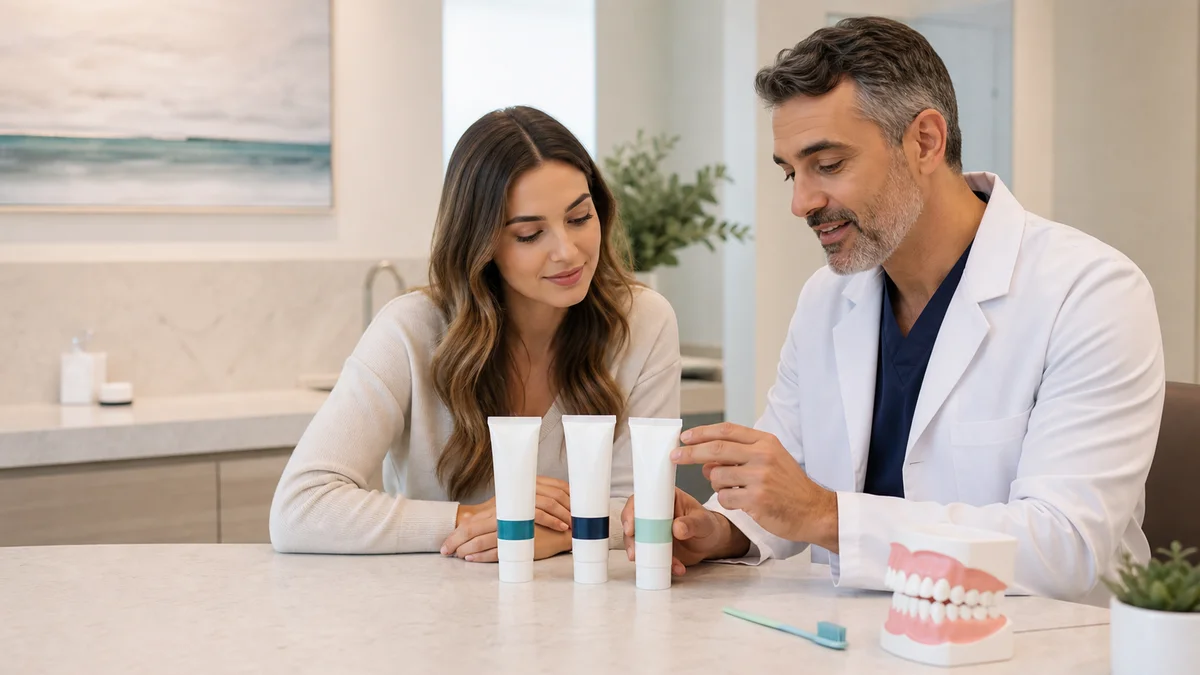
Choosing the best toothpaste for whitening and sensitivity sounds like a simple shopping decision, but two different goals are involved. Whitening toothpaste generally polishes or chemically loosens external stains from coffee, tea, tobacco and food. Sensitivity toothpaste aims to reduce pain from exposed dentine by calming nerve response or blocking pathways within dentine. A formula that cleans aggressively may feel unsuitable for a person with erosion, recession or active irritation.
There is no single best toothpaste for whitening and sensitivity for every mouth. The cause of sensitivity, the type of discoloration, cavity risk, gum condition, restorations, age and brushing technique change the choice. This guide explains how to read an ingredient label and how to recognise a problem that toothpaste cannot solve. It does not diagnose pain, guarantee whitening or replace individual dental advice.
For a broader preventive-care approach, visit Redent Klinik. If sensitivity, discoloration or a recent dental change needs individual review, use the Redent Klinik contact page. Content is prepared for review by Dentist Esma Çevrük Çakır with patient safety prioritised.
1. Best toothpaste for whitening and sensitivity starts with the cause
Sensitivity is a symptom, not a diagnosis. It can occur when dentine is exposed by gum recession, enamel wear, acidic erosion or tooth grinding. It may also follow a filling, professional cleaning or bleaching. Pain from decay, a crack, a leaking restoration, gum disease or inflammation inside a tooth can feel similar. Toothpaste may ease ordinary dentine hypersensitivity, but it cannot repair every source of pain.
Before choosing the best toothpaste for whitening and sensitivity, notice whether discomfort affects many teeth or one tooth, whether it is triggered by cold, heat, sweets or biting, and whether it stops quickly or lingers. A dental professional can assess the cause, especially when symptoms are new, worsening or localised. Do not mask persistent pain indefinitely by switching products repeatedly.
A correct cause gives the phrase best toothpaste for whitening and sensitivity a clinically useful meaning.
2. Fluoride remains the cavity-protection foundation
The American Dental Association explains that toothpastes accepted for an anticavity claim contain fluoride. Fluoride helps strengthen enamel and supports remineralisation at early stages of decay. Sodium fluoride, sodium monofluorophosphate and stannous fluoride are recognised anticavity ingredients in regulated formulations. A “natural,” charcoal or whitening label does not automatically provide the same decay protection.
For most adults, the best toothpaste for whitening and sensitivity should not sacrifice proven cavity protection for a cosmetic claim. Read the active-ingredient panel and follow the age and use instructions on the package. Some people at particularly high decay risk may be prescribed a higher-fluoride toothpaste; that decision belongs to a dental professional and is not a reason to self-select a prescription-strength product.
Fluoride is therefore a primary filter in a best toothpaste for whitening and sensitivity comparison.
3. Desensitising ingredients in the best toothpaste for whitening and sensitivity
The ADA’s current toothpaste overview cites evidence supporting twice-daily use of stannous formulations, potassium with or without stannous ingredients, or arginine for dentine hypersensitivity pain. Products work through different mechanisms. Potassium-based formulas are generally intended to reduce nerve excitability over repeated use. Stannous compounds and arginine-based approaches may help occlude or block dentinal pathways, depending on the formulation.
Ingredient presence alone does not prove that every formula performs identically. Concentration, delivery system, other ingredients, directions and evidence for the finished product matter. The best toothpaste for whitening and sensitivity is therefore one whose complete formulation supports the claim, not a home mixture containing one familiar chemical. Look for an independent acceptance programme where relevant and use the product consistently as directed.
The finished formula matters more than one fashionable ingredient when selecting the best toothpaste for whitening and sensitivity.
- Potassium-based agents: designed for repeated use rather than one instant brushing.
- Stannous fluoride: can combine cavity protection with sensitivity and other oral-health benefits in suitable formulas.
- Arginine-based systems: may help block dentinal tubules in evidence-supported products.
- Standard fluoride: remains essential for routine decay prevention even when another desensitiser is present.
4. What “whitening toothpaste” can and cannot do
Whitening toothpastes primarily remove extrinsic surface stains through polishing particles or other stain-control ingredients. They may make teeth look cleaner and closer to their existing shade. They usually do not produce the same colour change as peroxide bleaching. The ADA notes that only natural teeth whiten; tooth-coloured fillings, crowns, veneers and implant crowns do not change colour with bleaching.
The best toothpaste for whitening and sensitivity must therefore match a realistic goal. If the problem is surface stain, a gentle whitening formula may help. If a tooth is intrinsically darker, has a large restoration or changed colour after trauma, toothpaste is unlikely to create an even result. A dental examination can identify whether cleaning, repair, bleaching or another approach is appropriate.
Realistic expectations prevent the best toothpaste for whitening and sensitivity from being mistaken for a bleaching treatment.
5. Abrasivity, pressure and enamel wear
All conventional toothpastes use some form of abrasive to help remove plaque and debris. Whitening formulas may use polishing systems aimed at stains, but “more abrasive” does not mean “better”. Brushing hard, using a stiff brush, scrubbing horizontally at the gumline or combining several abrasive DIY products can increase wear and gum trauma. Exposed dentine is softer than enamel and may be particularly vulnerable.
When seeking the best toothpaste for whitening and sensitivity, use a soft-bristled brush and gentle technique. Ask a dentist about product abrasivity if you have erosion, recession, worn necks of teeth or a history of aggressive brushing. Do not add baking soda, charcoal powder or acidic fruit to toothpaste. ADA patient resources state that evidence does not support charcoal DIY dentistry as safe or effective for teeth.
Gentle technique is part of the best toothpaste for whitening and sensitivity decision, not an optional extra.
6. Stain removal versus true bleaching
Surface-stain removal and bleaching are different. Toothpaste acts during brief brushing contact and mostly targets the outer surface. Bleaching gels use peroxide chemistry to change coloured molecules within natural tooth structure. Bleaching can cause temporary sensitivity and gum irritation, particularly when products are overused, trays fit poorly or higher concentrations contact tissues inappropriately.
If you already have sensitivity, the best toothpaste for whitening and sensitivity may be part of preparation or symptom control, but it does not make unsupervised bleaching risk-free. Discuss bleaching with a dentist, especially if you have cracks, cavities, recession, restorations or a history of severe sensitivity. In the UK, stronger peroxide whitening products are subject to professional supply and supervision rules.
7. How to read the label without relying on brand rank
Start with the active ingredients and intended claims. Confirm fluoride for cavity protection, then identify the desensitising system. Next read directions, age limits, warnings and frequency. A recognised acceptance seal can indicate that the manufacturer submitted evidence for specified safety and efficacy criteria. The ADA Seal is voluntary, so absence alone does not prove a product is unsafe; it simply removes one independent decision aid.
A responsible best toothpaste for whitening and sensitivity comparison uses the current label rather than online lists that may describe an older formulation. Products with similar names can differ by country or change ingredients over time. Buy from a reputable retailer, keep the packaging, and avoid items with missing ingredient information, unclear responsible-party details or “professional use only” wording offered through an unverified seller.
Checking the current package keeps the best toothpaste for whitening and sensitivity recommendation accurate.
8. Decision table: match the toothpaste to the situation
Use this table to narrow the best toothpaste for whitening and sensitivity choice. It is a screening tool, not a diagnosis. Where a warning sign appears, arrange an assessment rather than expecting a retail product to solve the cause.
| Your main situation | Label priority | Whitening expectation | When to ask a dentist |
|---|---|---|---|
| Cold sensitivity on several teeth with surface stain | Fluoride plus evidence-based desensitiser and gentle stain removal | Reduction of external stain, not bleaching | If it persists despite correct use |
| One painful tooth | Do not use a label to self-diagnose | Whitening is not the priority | Promptly, especially with biting pain |
| Recent professional whitening | Fluoride and desensitising claim | Maintain cleanliness while irritation settles | If pain is severe or prolonged |
| Gum recession or exposed roots | Desensitising formula and gentle technique | Limit aggressive polishing | For recession and gum assessment |
| Crowns, veneers or fillings at the front | Fluoride and non-aggressive cleaning | Restorations will not whiten | Before bleaching to plan shade matching |
| High cavity risk | Professional fluoride advice first | Cosmetic claim is secondary | For a preventive plan |
| Mouth ulcers or detergent irritation | Review flavouring and detergent ingredients | Avoid chasing strong flavour or foam | If lesions recur or do not heal |
| Charcoal or acidic DIY routine | Return to regulated fluoride toothpaste | Stop unproven abrasive or acidic methods | If wear or sensitivity has developed |
9. Best toothpaste for whitening and sensitivity after bleaching
Temporary sensitivity is a recognised adverse effect of vital-tooth bleaching. The risk can relate to peroxide concentration, contact time, technique and individual history. If a dentist provides a whitening plan, follow the schedule and report symptoms rather than extending contact or adding extra applications. More product does not mean a better or safer result.
The best toothpaste for whitening and sensitivity after bleaching is the option recommended for your situation, used according to its label and the clinician’s instructions. Do not place ordinary toothpaste into a tray unless your dentist advises it. Pause and seek guidance for severe pain, tissue burns, swelling or symptoms that do not settle as expected.
10. Restorations, implants and uneven colour
Fillings, crowns, veneers, bridges and implant crowns generally do not lighten with bleaching products. Removing surface stain may improve cleanliness, but the material’s base shade remains. Whitening natural teeth around a restoration can make the mismatch more noticeable. A visible line or dark edge may also relate to gum position, material, decay or leakage rather than surface staining.
For someone with front restorations, the best toothpaste for whitening and sensitivity should prioritise oral health and controlled cleaning. Ask a dentist to assess colour concerns before undertaking stronger whitening. Replacing sound restorations solely for colour has biological and financial consequences, so shade planning should follow examination and realistic discussion.
Restoration shade is a major limit on what the best toothpaste for whitening and sensitivity can achieve.
11. Gum recession, erosion and exposed dentine
Gum recession can expose root surfaces, while dietary acids, reflux, vomiting disorders or acidic habits can contribute to erosion. Whitening cannot rebuild lost tooth structure. Immediate brushing after a significant acid exposure may add mechanical wear; rinsing and receiving individual advice may be more appropriate. Medical causes of recurrent acid exposure also need suitable healthcare support.
In these situations, the best toothpaste for whitening and sensitivity is not selected by “maximum whitening” language. A gentle fluoride and desensitising strategy, pressure control and management of the cause are more important. A dentist may recommend additional fluoride, bonding, gum care or bite management depending on findings, but no option should be assumed without examination.
12. Detergents, flavouring and oral irritation
Toothpastes include detergents for foaming and distribution, flavours for acceptability, humectants to retain moisture and binders for stability. Some individuals associate particular detergents or strong flavours with irritation, peeling or recurrent mouth discomfort. This is not the same as dentine hypersensitivity, and changing a desensitising active ingredient alone may not solve it.
If irritation began with a new product, stop and review the label. The best toothpaste for whitening and sensitivity must also be tolerable enough for regular use. Persistent ulcers, swelling, rash, breathing difficulty or significant tissue change needs professional assessment; urgent medical help is appropriate for signs of a serious allergic reaction.
13. A two-minute technique matters more than extreme claims
The NHS advises cleaning teeth twice daily with fluoride toothpaste and emphasises thorough cleaning. A small-headed, soft-bristled brush can help reach surfaces without excessive force. Angle the bristles to clean teeth and the gumline, move methodically, and clean between teeth with an appropriate interdental method. Spit after brushing and follow local professional guidance about rinsing so fluoride can remain available.
Even the best toothpaste for whitening and sensitivity cannot compensate for a few seconds of forceful scrubbing. Desensitising products commonly require repeated use over time. Follow the package directions instead of rotating daily among several formulas. If one is being trialled, keep the rest of the routine stable so you and your dentist can judge whether symptoms change.
Consistency makes a trial of the best toothpaste for whitening and sensitivity easier to evaluate.
- Brush twice daily for the recommended time with a soft brush.
- Use gentle pressure; a powered brush pressure sensor may help some people.
- Clean between teeth daily using a method suited to your spaces.
- Limit frequent stain-promoting and acidic exposures rather than scrubbing harder.
- Do not combine toothpaste with lemon, vinegar, charcoal or unverified powders.
- Review technique and product choice at routine dental visits.
14. How long should a sensitivity toothpaste take to help?
Some formulations may give an early effect, while others depend on consistent use across days or weeks. The label should explain frequency and any direct-application instructions supported for that product. Stopping after one brushing does not test a repeated-use formula. Equally, continuing for months while a painful tooth worsens is unsafe.
When trialling the best toothpaste for whitening and sensitivity, note the triggers and intensity at the start, then reassess according to the directions. Improvement should not be used to cancel a necessary check-up if the symptom was unexplained. A dentist can distinguish hypersensitivity from decay, cracks, pulp problems and bite-related pain.
A symptom diary adds useful context to a best toothpaste for whitening and sensitivity trial.
15. When whitening should not be the immediate goal
Prioritise examination when there is a cavity, cracked tooth, active gum disease, severe erosion, unexplained colour change, mouth sores or recent trauma. Pregnancy, childhood, complex restorations and active orthodontic treatment may also change the practical approach to cosmetic whitening. The correct response may be prevention or treatment rather than a stronger stain claim.
In these circumstances, the best toothpaste for whitening and sensitivity is secondary to identifying disease. Whitening a painful area can complicate symptoms, and surface-stain removal cannot correct infection. No online article can determine whether a tooth is safe to whiten.
16. Red flags that need dental assessment
Short, sharp cold sensitivity across several teeth may be compatible with dentine hypersensitivity, but important warning signs require attention. Seek dental advice for pain that is spontaneous, wakes you at night, lingers after a trigger, occurs on biting, is confined to one tooth, or is accompanied by swelling, fever, a bad taste or a broken restoration. Urgent services may be needed for spreading swelling or difficulty breathing or swallowing.
Do not let a search for the best toothpaste for whitening and sensitivity delay care. Toothpaste can support daily management but cannot drain an infection, seal a crack, replace a lost filling or treat advanced gum disease. If a dark tooth follows an injury, arrange assessment even if it does not currently hurt.
17. A practical shopping checklist
- Confirm that symptoms are suitable for self-care rather than urgent assessment.
- Choose a fluoride toothpaste appropriate for the user’s age and needs.
- Identify an evidence-based sensitivity active in the complete formula.
- Set a realistic goal: remove external stain, not change restorations.
- Prefer a credible safety and effectiveness mark where available.
- Check the current label because formulations differ by market and time.
- Avoid unverified charcoal, acidic or “professional only” online products.
- Use a soft brush, gentle pressure and consistent twice-daily technique.
- Follow directions for long enough to judge response safely.
- Arrange dental review if sensitivity persists, localises or worsens.
This checklist defines the best toothpaste for whitening and sensitivity by suitability and evidence, not by a universal brand ranking. Availability and labels change, while your diagnosis remains the most important variable.
That approach keeps the best toothpaste for whitening and sensitivity recommendation practical as products change.
Frequently asked questions: best toothpaste for whitening and sensitivity
What ingredient should I seek for sensitive teeth?
Evidence-supported options include stannous formulations, potassium with or without stannous ingredients, and arginine-based systems. The finished formula and correct repeated use matter. A dentist can recommend an option after identifying why sensitivity occurs.
Does whitening toothpaste bleach teeth?
Most whitening toothpaste mainly removes surface stains through polishing or stain-control ingredients. It generally does not create the same intrinsic colour change as peroxide bleaching. Expectations should be limited to natural teeth and external stain.
Should the best toothpaste for whitening and sensitivity contain fluoride?
For most adults, fluoride is a core cavity-prevention feature. ADA-accepted toothpastes with anticavity claims contain fluoride, and WHO includes fluoride toothpaste among important caries-prevention strategies. Individual prescription-strength advice belongs to a dental professional.
Can whitening toothpaste make sensitivity worse?
A product or forceful technique may feel irritating in a person with exposed dentine, erosion or recession. Stop if symptoms clearly worsen and arrange advice. Select gentle brushing and a formulation designed for sensitivity rather than repeatedly scrubbing stains.
Is charcoal toothpaste a good whitening choice?
ADA patient guidance says evidence does not show charcoal dental products to be safe or effective. Charcoal can distract from fluoride protection and may be abrasive in some products. Choose a regulated fluoride toothpaste with supported claims instead.
Can toothpaste whiten crowns, veneers or fillings?
No. Restorative materials do not bleach like natural teeth. Surface cleaning may remove deposits, but the underlying material shade stays. See a dentist before whitening if visible restorations could create an uneven colour result.
How quickly does sensitivity toothpaste work?
It depends on the formulation and cause. Some products are designed for gradual benefit with consistent twice-daily use, while label-supported methods vary. Follow directions and seek examination when pain is severe, localised, lingering or not improving.
Can I use a sensitivity toothpaste during professional whitening?
Often a dentist may incorporate desensitising care, but the exact product and timing should follow the professional plan. Do not put ordinary toothpaste in a whitening tray or change the bleaching schedule without advice.
Why does one tooth hurt when the others do not?
Localised sensitivity can relate to recession, decay, a crack, a restoration, bite stress or inflammation. Toothpaste cannot distinguish them. One-tooth pain, especially pain on biting or lingering pain, deserves dental assessment.
Is a strong mint flavour a sign of better cleaning?
No. Flavour and foam affect the user experience, not proof of stain removal or sensitivity relief. A harsh flavour can be uncomfortable for some people. Judge fluoride, desensitising evidence, stain-control claims and tolerability instead.
Should I rinse immediately after brushing?
NHS guidance supports spitting after fluoride toothpaste rather than washing it away straight away. Follow the product label and personalised dental advice, especially if a prescribed toothpaste or another medicated oral product is used.
Conclusion: choose evidence, tolerability and the correct diagnosis
The best toothpaste for whitening and sensitivity is not the tube with the strongest colour claim. For most adults it combines appropriate fluoride protection, an evidence-supported desensitising system, controlled surface-stain removal and a formula that can be used comfortably and consistently. Technique, pressure and interdental cleaning remain essential.
Remember the limits: toothpaste cannot whiten crowns or fillings, treat a crack or cure infection. Persistent, localised or worsening pain needs examination. Discuss stronger bleaching with a dental professional because sensitivity and gum irritation are recognised effects. Use reputable products, follow the current label and choose oral health before cosmetic speed.
Official and professional sources: best toothpaste for whitening and sensitivity
- American Dental Association: toothpaste, fluoride and desensitising ingredients
- American Dental Association: whitening methods, restorations and sensitivity
- ADA MouthHealthy: choosing fluoride, whitening and desensitising toothpaste
- ADA MouthHealthy: DIY and charcoal-product cautions
- NHS: twice-daily cleaning with fluoride toothpaste
- NHS: toothache warning signs and when to seek care
- U.S. Food and Drug Administration: OTC anticaries toothpaste monograph
- UK Office for Product Safety and Standards: cosmetic and toothpaste product checks
- American Dental Association
- World Health Organization oral health fact sheet