
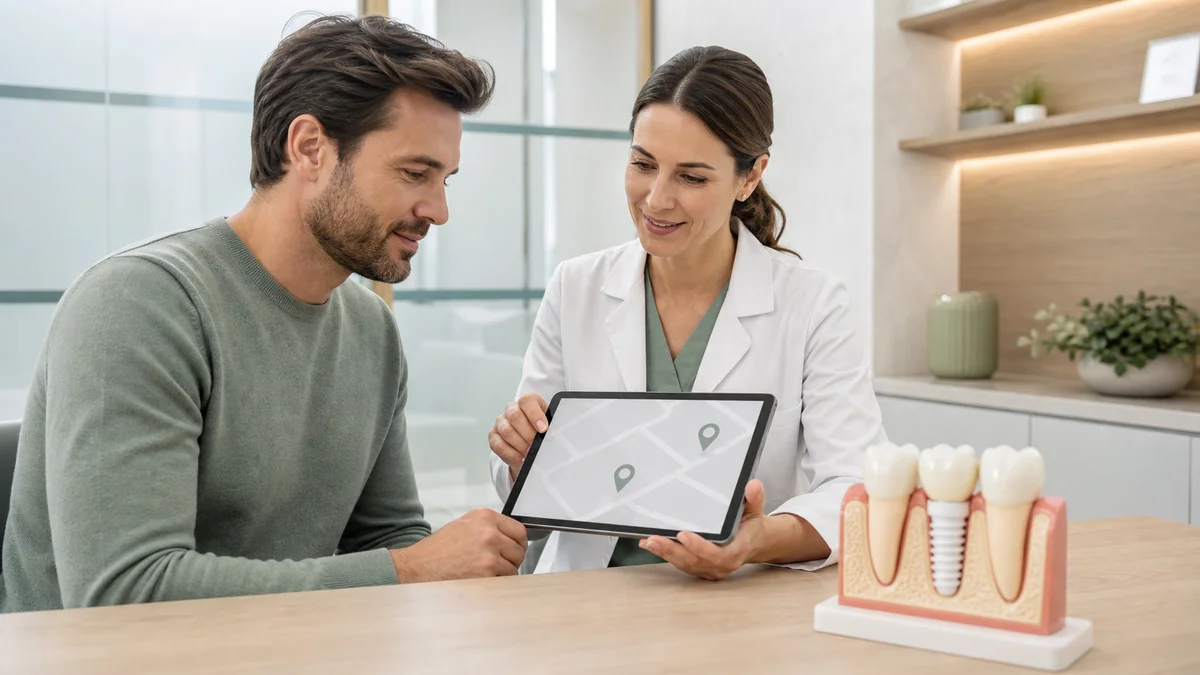
Quick answer: When searching ceramic dental implants near me, confirm that “ceramic” means a zirconia implant body rather than only a ceramic crown. Verify the treating dentist’s licence, experience with the exact one- or two-piece system, diagnostic process, alternatives, written costs, component records and emergency follow-up. Proximity matters, but material-specific planning and maintainable care matter more.
A search for ceramic dental implants near me often begins with a preference for a tooth-coloured or “metal-free” implant. The phrase can be confusing. A clinic may advertise a ceramic crown placed on a conventional titanium implant, while another may offer an implant body made from zirconium oxide, commonly called zirconia. Those are different treatment pathways, with different components, surgical constraints, restorative options and evidence bases.
This guide explains how to identify the actual device being proposed, compare local providers and interpret claims about aesthetics, biocompatibility, allergies and longevity. It does not diagnose candidacy, recommend one material for everyone or promise an outcome. Implant treatment is surgery and requires an individual examination, appropriate imaging when indicated, informed consent and a long-term maintenance plan.
1. What does ceramic dental implants near me actually mean?
The U.S. Food and Drug Administration describes dental implants as medical devices placed in the jaw to support crowns, bridges or dentures. It notes that most implant systems are made from titanium or zirconium oxide. In dentistry, “ceramic implant” usually refers to a zirconia implant body, not simply a white crown. Zirconia is a high-strength technical ceramic; it should not be confused with elemental zirconium metal or with a routine zirconia crown.
An implant system may include the implant body, an abutment and a fixation screw. Some zirconia designs combine the implant and abutment in one piece. Other designs use two pieces so the restorative connection can be handled separately. The composition of screws, sleeves or other components can vary. Therefore, a person seeking ceramic dental implants near me should ask for the manufacturer, model, design and material of every implanted or permanently connected part.
Terminology is the first safety check. “White implant,” “holistic implant,” “metal-free tooth” and “ceramic restoration” are marketing descriptions, not complete device specifications. A transparent consultation identifies the implant body material, connection design and final crown separately.
2. Ceramic dental implants near me versus a ceramic crown
A ceramic crown is the visible replacement tooth. It may be supported by a titanium implant, a zirconia implant or, in other circumstances, a natural tooth. The crown’s colour does not reveal what lies below the gum. If a website shows a white crown and uses the word “ceramic,” it may not be describing a zirconia implant body at all.
Ask the clinic to mark three parts on a diagram: the implant in bone, the abutment passing through the gum and the crown. Then request the material and fee for each part. This prevents a search for ceramic dental implants near me from turning into a comparison of unrelated packages. It also clarifies whether a temporary tooth, laboratory work and restorative appointments are included.
The distinction affects future service. An implant system needs compatible restorative components, instruments and documentation. Keeping the implant label or passport helps another clinician identify the system if maintenance or repair is required years later.
3. What does current evidence say about ceramic dental implants near me?
Recent clinical reviews report promising outcomes for appropriately selected zirconia implants, but the evidence is not identical to the much larger and longer history of titanium systems. A 2026 systematic review comparing zirconia and titanium implants found broadly comparable clinical and radiographic results through the follow-up periods represented, while concluding that long-term evidence for zirconia remains insufficient. It also noted that some available data concern older systems no longer sold.
A 2025 review of immediately loaded zirconia implants found potentially favourable results in selected cases, yet rated the certainty of evidence as low because studies were heterogeneous and often non-randomised. This matters because “same-day” protocols are sometimes promoted alongside ceramic dental implants near me. Encouraging findings do not mean immediate loading is suitable for every site or that a temporary tooth is equivalent to a definitive crown.
Evidence should be applied to the exact system, design and clinical indication. Data for one-piece implants cannot automatically answer every question about two-piece implants. Results in healed single-tooth sites may not transfer to immediate placement after extraction, grafted sites or full-arch treatment. Ask the clinician which evidence is relevant to your proposed plan and what remains uncertain.
4. One-piece or two-piece ceramic dental implants near me
In a one-piece zirconia implant, the implant body and transmucosal abutment are manufactured as a single unit. This avoids an implant-abutment connection at bone level, but it also fixes the abutment position at surgery. Three-dimensional placement, available restorative space and protection during healing become especially important because the visible portion cannot be repositioned like a separate abutment.
Two-piece zirconia systems allow a separate abutment, which may expand restorative choices. Their connection and fixation method differ by manufacturer. Some may use a screw, bonding protocol or additional component whose material should be disclosed. A “metal-free” claim should be checked against the complete system rather than assumed from the white implant body.
When comparing ceramic dental implants near me, ask whether the clinician routinely treats cases with the proposed design, how angulation errors are managed, what provisional restoration is used and how components can be serviced. One design is not automatically superior; suitability depends on the site, tissue, bite and restorative plan.
5. Who may be considered for ceramic dental implants near me?
Candidacy begins with general health, oral health and the specific missing-tooth site. The dentist may assess medical conditions, medicines, allergies, tobacco or nicotine use, previous radiation, gum health, bone volume, neighbouring teeth, smile line and bite. Active infection or uncontrolled periodontal disease may need treatment before implant placement.
The FDA advises patients to discuss benefits, risks and candidacy, to disclose general health factors and to recognise that smoking can impair healing. The National Institute of Dental and Craniofacial Research identifies tobacco use and diabetes among important gum-disease risk factors and emphasises daily plaque control and professional care. These considerations apply regardless of whether a patient found ceramic dental implants near me or chose a titanium system.
Material preference does not override anatomy. A narrow ridge, limited height, high bite force, parafunction or a demanding implant angle may change the device choice or favour another treatment. A responsible clinician can explain why zirconia is reasonable, why another option may be safer, or why no implant should be placed yet.
6. How should a clinic diagnose and plan ceramic dental implants near me?
A complete assessment usually includes an oral examination and appropriate radiographs. Three-dimensional imaging may be indicated when it adds information about bone, neighbouring roots, nerves, sinuses or implant position; it is not automatically required in exactly the same way for every patient. The final crown position should guide surgical planning, because the implant must support a cleanable, functional restoration.
For one-piece zirconia implants, restorative-driven positioning is particularly consequential. The clinician should consider the future crown contour, gum margin, emergence profile and bite before surgery. A diagnostic wax-up, digital plan or surgical guide may help in selected cases, but each tool should have a clinical reason rather than being an automatic package item.
A credible result for ceramic dental implants near me is a personalised plan, not a device sale. Ask to see how the proposed implant position relates to the final tooth, what anatomical limitation could change the plan and what alternative is available if primary stability or bone conditions differ from expectations.
7. How to verify the clinician behind ceramic dental implants near me
Map rank, a polished website and review volume do not establish professional competence. Identify the dentist who will perform the surgery and the dentist responsible for the crown. Verify current professional registration through the relevant dental regulator or licensing board. Titles and training requirements vary by country, so check them in the jurisdiction where treatment will occur.
Ask about experience with the exact zirconia system, not implants in general. Useful questions include how many similar single-tooth sites the clinician has planned, which one- or two-piece design is used, how failures or fractures are managed and where replacement components can be obtained. A numerical case count is not a guarantee, but vague answers may reveal limited system familiarity.
The American Dental Association’s MouthHealthy resource encourages patients considering implants to discuss suitability carefully with a dentist. If you use a professional directory while searching ceramic dental implants near me, treat it as a way to identify candidates for consultation, not as proof that a particular material or plan is appropriate.
8. Decision table for ceramic dental implants near me
| Check | Question to ask | Reassuring evidence | Reason to pause |
|---|---|---|---|
| Terminology | Is the implant body zirconia, or only the crown ceramic? | All components identified in writing | “Ceramic tooth” without a system name |
| Licence | Who performs surgery and restoration? | Named clinicians with verifiable registration | Responsible provider is unclear |
| System | Is it one-piece or two-piece, and what are all materials? | Manufacturer, model and component record supplied | Unqualified “100% metal-free” claim |
| Evidence | Which data apply to this system and indication? | Benefits and limitations discussed | Lifetime success promised |
| Planning | What examination and imaging support the plan? | Restoration-driven, site-specific explanation | Final plan offered without adequate records |
| Alternatives | Why zirconia rather than titanium, bridge or no treatment? | Reasonable options compared | Material preference presented as a diagnosis |
| Costs | Are implant, abutment, crown, graft and reviews included? | Itemised written estimate | Headline price with missing stages |
| Follow-up | Who handles pain, mobility, fracture or travel-related care? | Named contact and maintenance pathway | No plan after crown delivery |
Use the same table for every provider. The best match for ceramic dental implants near me is not automatically the closest clinic or the one with the highest rating. It is the provider that can document a suitable system, sound planning, informed consent and realistic continuity of care.
9. Aesthetics and gum appearance with ceramic dental implants near me
Zirconia is light in colour, which may be attractive where tissues are thin or the smile line is high. However, the implant body should not normally be visible. Gum thickness, implant depth, three-dimensional position, abutment contour, crown design and tissue health all influence the result. A white implant cannot compensate for poor positioning or inflamed tissue.
Ask whether tissue grafting, a provisional crown or a customised emergence profile is being considered and why. These steps are not required for every patient. Photographs of previous cases can illustrate a clinician’s approach but do not predict your result, especially if lighting, healing time and starting conditions differ.
When aesthetics motivate a search for ceramic dental implants near me, request a discussion of realistic limits. No ethical plan can guarantee a perfectly invisible implant margin or a permanent gum level. Natural tissues can change with healing, ageing, disease and oral hygiene.
10. Allergy and “metal-free” claims around ceramic dental implants near me
People may seek zirconia because of a known reaction, a suspected sensitivity or a personal material preference. These are not the same situation. A history of skin reactions, reactions to medical devices or unexplained oral symptoms should be discussed with the treating dentist and, when appropriate, a physician or allergy specialist. An online symptom list cannot diagnose implant-material allergy.
The FDA explains that implant materials are assessed using international consensus standards and biocompatibility testing. Regulatory clearance does not mean every material is ideal for every person, and it does not support broad claims that one implant “detoxes” the body or prevents unrelated systemic illness. Conversely, a personal preference for zirconia can be discussed respectfully without inventing medical necessity.
For ceramic dental implants near me, ask whether the complete system contains a metal screw, sleeve or instrumented component. Request the precise material declaration rather than relying on a slogan. If a clinician recommends testing, ask what question the test is meant to answer and how the result would change treatment.
11. Risks to discuss for ceramic dental implants near me
General implant risks include infection, injury to nearby teeth or tissues, sinus or nerve complications, altered sensation, failure to integrate, poor bite, difficult cleaning and later implant loss. Restorative complications can include loosening, chipping, fracture, cement-related inflammation or an unsatisfactory contour. The probability and management of each risk depend on the site and system.
Zirconia-specific discussion should include the consequences of a one-piece implant’s fixed abutment angle, the repair pathway for the chosen two-piece connection and the possibility of component or implant fracture. The relevance of each concern varies with design, diameter, bite force and clinical use. It is inappropriate to claim that ceramic implants cannot fail because they do not corrode like a conventional metal.
A clinic offering ceramic dental implants near me should explain what happens if primary stability is inadequate, if grafting becomes necessary, if the provisional crown cannot be fitted or if the implant does not integrate. The consent discussion should cover alternatives and the option to delay or decline treatment.
12. Immediate placement and same-day ceramic dental implants near me
Immediate placement means inserting an implant at the time a tooth is removed. Immediate loading or provisionalisation means attaching a restoration soon after placement. These are separate decisions. Infection status, socket anatomy, bone support, soft tissue, implant stability and bite determine whether either approach is reasonable.
A same-day tooth is frequently a carefully adjusted temporary restoration, not the definitive crown. It may need to remain out of heavy contact while healing progresses. If a website promotes immediate ceramic dental implants near me, ask what proportion of patients are changed to a delayed protocol after examination and what happens financially if same-day restoration is not safe.
The 2025 review of immediately loaded zirconia implants described promising performance in selected cases but low-certainty evidence. That supports cautious individual planning, not a universal promise. A protective change in timing should be explained as a clinical decision rather than automatically labelled a failure.
13. Costs and insurance for ceramic dental implants near me
There is no reliable universal price for a zirconia implant. Geography, clinician time, imaging, system cost, laboratory work, provisional restoration, grafting and follow-up all influence the total. A quote may include only surgery and the implant body, while another includes the abutment, final crown and reviews. Compare completed treatment pathways, not headline prices.
Request an itemised estimate that marks examination, imaging, extraction, graft or membrane, implant body, abutment, temporary tooth, definitive crown, laboratory, anaesthesia and follow-up as included, excluded or conditional. For every conditional item, ask which finding triggers it and whether approval will be obtained before treatment.
Insurance coverage varies by contract, indication, waiting period, annual maximum and alternative-benefit rules. A pre-treatment estimate may help but may not guarantee payment. Financing changes when the bill is paid, not whether treatment is suitable. When comparing ceramic dental implants near me, place the cash price, amount financed, fees, total repayment and cancellation terms side by side.
14. Records and traceability for ceramic dental implants near me
The FDA recommends asking for the brand and model of the implant system and keeping that information. Your record should ideally identify the manufacturer, product line, implant dimensions, lot or identifying label, placement date and site. Relevant radiographs, surgical notes, restorative details and laboratory information can support future maintenance or transfer of care.
Traceability matters because component connections are system-specific. If a crown, abutment or fixation element needs service years later, another clinician must know what was used. Ask whether the clinic keeps records securely and whether you will receive a copy without needing to reconstruct the information from an invoice.
Before choosing ceramic dental implants near me, also ask about local access to replacement components. A discontinued or difficult-to-source system may complicate service even when the implant remains integrated. This is one reason to evaluate the care pathway rather than choosing on colour or price alone.
15. Follow-up and maintenance after ceramic dental implants near me
An implant-supported crown requires daily plaque control and professional monitoring. The dentist may review the surrounding gum, bone level, probing findings, bite, crown, connection and cleaning access according to individual risk. Natural teeth and gum disease elsewhere in the mouth remain relevant to the implant environment.
The FDA advises regular visits, careful hygiene and prompt contact if an implant feels painful or loose. NIDCR also emphasises brushing, interdental cleaning, professional care and tobacco cessation for periodontal health. These principles are more important than claims that a smooth or ceramic surface makes an implant maintenance-free.
Clarify what follow-up is included in the quoted price for ceramic dental implants near me. Ask who handles urgent swelling, persistent pain, mobility, a chipped crown or suspected fracture, including outside office hours. Warranty language should distinguish device components, laboratory work and professional fees; it cannot guarantee biological healing or lifelong service.
16. When “near me” includes travel for ceramic dental implants
A nearby provider can make surgery reviews, provisional adjustments and urgent assessment easier. Yet a short driving distance does not compensate for limited experience with the proposed zirconia system. Conversely, travelling to an experienced clinic adds transport, accommodation, time away from work and possible return visits. The practical choice balances expertise and continuity.
If you are considering treatment in Turkey, Redent Klinik’s English patient information hub provides an overview of the care setting, while the English contact page can be used to ask which records are needed for a preliminary review. Remote review remains provisional until the treating team confirms clinical findings.
For travel, ceramic dental implants near me should be interpreted as “care I can realistically complete and maintain.” Ask which stage occurs on each visit, who monitors healing between visits, who can access the system locally and how complications are coordinated after you return home.
17. Red flags while searching ceramic dental implants near me
- The clinic cannot say whether “ceramic” describes the implant body or only the crown.
- No named, verifiably licensed dentist is responsible for surgery and restoration.
- The manufacturer, model, one- or two-piece design or component materials are withheld.
- “Metal-free” is used without accounting for every permanent component.
- Zirconia is claimed to cure, detoxify or prevent unrelated systemic disease.
- Material preference replaces examination, imaging or periodontal assessment.
- Immediate loading, perfect aesthetics or lifetime success is promised to everyone.
- Benefits are presented without the limitations of current long-term evidence.
- The quote omits abutment, crown, laboratory, grafting or follow-up.
- Implant records and identifying labels will not be provided.
- There is no written plan for pain, mobility, fracture or implant failure.
- Payment is pressured before alternatives and consent documents can be reviewed.
One red flag does not prove unsafe care, but it justifies pausing and requesting clarification. Ethical communication about ceramic dental implants near me acknowledges uncertainty, avoids guarantees and gives the patient enough time to compare reasonable options.
Frequently asked questions: ceramic dental implants near me
Are ceramic dental implants near me completely metal-free?
The zirconia implant body is a ceramic, but a complete system may include a fixation screw, sleeve or other component with a different material. Ask for a written component list for the exact one- or two-piece system instead of relying on a general slogan.
Do ceramic dental implants near me work as well as titanium?
Recent reviews report promising and in some comparisons broadly similar medium-term outcomes for selected zirconia implants. However, long-term evidence is less extensive, systems differ and some data concern older products. Your dentist should relate the evidence to the proposed design and site.
Can any dentist place ceramic dental implants near me?
Scope and training rules vary by jurisdiction. Verify the treating dentist’s current registration and ask about experience with the exact zirconia system, restorative design and complication management. General implant experience does not automatically equal material-specific experience.
Are ceramic implants better for allergies?
A suspected material allergy should be evaluated rather than diagnosed from internet symptoms. Zirconia may be discussed as an option, but claims must reflect the full system composition and clinical suitability. Ask whether specialist medical or allergy input would change the treatment plan.
Why can ceramic dental implants near me cost more?
Differences may reflect the system, components, clinician time, planning, temporary restoration, laboratory work and follow-up. A higher fee does not prove better care, and a lower fee does not prove poor care. Compare an itemised route to the definitive crown.
Can I get a same-day ceramic implant and crown?
Some selected sites may allow immediate placement or a promptly fitted temporary restoration, but those are separate decisions and are not suitable for everyone. Stability, bone, infection, tissue and bite must be assessed. The definitive crown may be delivered later.
What implant records should I receive?
Request the manufacturer, system, model, dimensions, identifying label or lot where available, placement site and date, plus relevant imaging, surgical notes and restorative details. Keep the records for maintenance, emergency care and future component identification.
Should I choose the closest clinic?
Distance affects convenience and emergency access, but it should be weighed with verified licensing, system-specific experience, diagnostic quality, transparent costs and follow-up. The safest practical provider is one whose care you can both trust and realistically continue.
Conclusion: choose documented care, not a material slogan
The most useful response to ceramic dental implants near me is a shortlist of clinicians who can name the exact zirconia system, explain one- or two-piece implications, assess health and anatomy, compare alternatives and provide complete records. Current evidence supports zirconia as a possible option in selected cases, but it does not justify universal superiority or lifetime guarantees.
Verify the treating clinicians, compare itemised estimates, keep device information and make sure maintenance and urgent care are workable. Proximity is valuable when it strengthens continuity; it is not a substitute for appropriate planning. A careful consultation should leave you understanding not only what material is proposed, but why it fits your clinical situation and what will happen if the original plan must change.
Official sources and evidence notes
- U.S. Food and Drug Administration: Dental Implants—What You Should Know
- American Dental Association: Professional and Patient Resources
- MouthHealthy by the American Dental Association: Dental Implants
- National Institute of Dental and Craniofacial Research: Periodontal Disease
- Pachiou et al., 2026: Zirconia Compared with Titanium Implants—Systematic Review and Meta-analysis
- Clinical Performance of Immediately Loaded Zirconia Implants, 2025 Systematic Review
- World Health Organization: Oral Health Fact Sheet
Sources checked August 21, 2026. This article provides general education and does not replace an examination, diagnosis, treatment plan, regulatory verification, insurance decision or financial advice.