
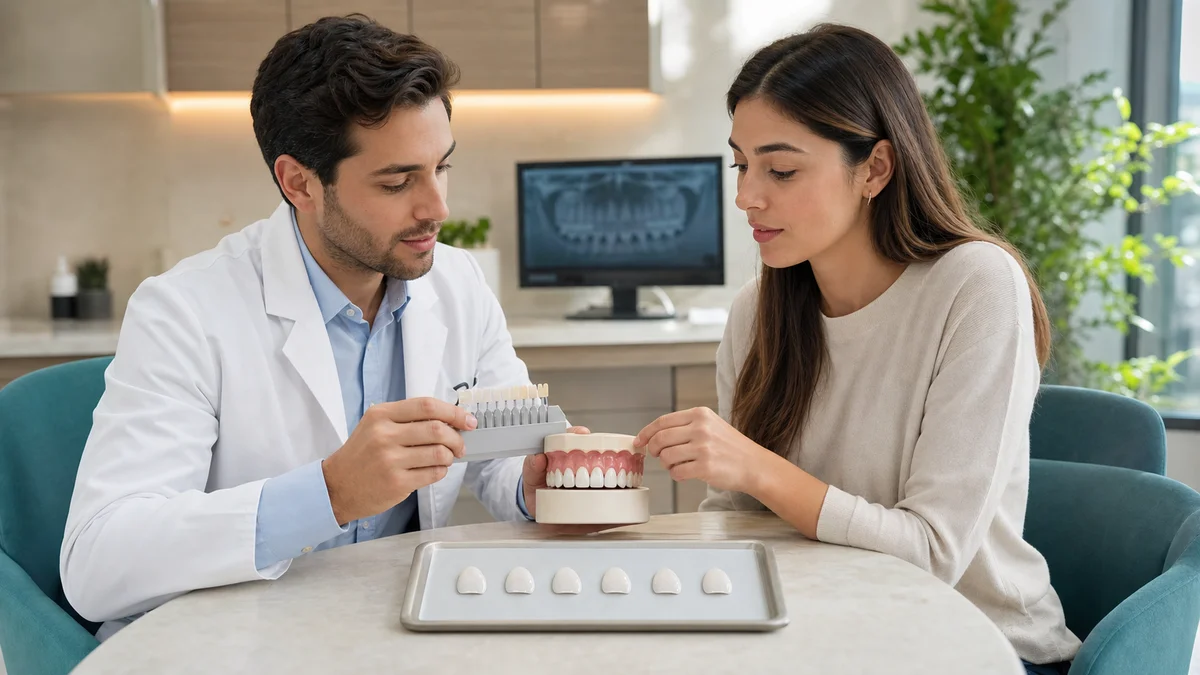
The cost for 6 veneers cannot be estimated responsibly from tooth count alone. It varies with porcelain or composite, tooth preparation, diagnostic design, laboratory work, temporary veneers, bite management, gum or decay treatment and follow-up. Compare written plans that describe the same six teeth, material, appointments, exclusions and maintenance. A licensed dentist must first confirm whether veneers and this number are appropriate.
People often research the cost for 6 veneers because six upper front teeth can sound like a simple, standardized “smile-zone” package. In practice, the same number can represent very different care. One proposal may describe direct composite placed in the clinic; another may describe individually designed porcelain restorations made by a laboratory. One may include planning, temporary restorations and reviews, while another lists only the veneers themselves.
This guide does not publish a fixed fee or decide that six veneers are right for you. It shows how to compare proposals with the same scope, identify clinical questions and count services that advertisements can omit. Definitive recommendations require an examination, appropriate records and a discussion with a qualified dentist. You can use the checklist before contacting Redent Klinik or another properly licensed clinic.
In short, the cost for 6 veneers is a care-plan question rather than a simple multiplication exercise.
Why the cost for 6 veneers is not six times one standard fee
A veneer is a custom covering bonded to the front of a tooth. The American Dental Association’s patient resource explains that the two main categories are porcelain and composite, with different workflows, repair characteristics, stain resistance and possible enamel removal. The American College of Prosthodontists also describes porcelain as a laboratory-made option and composite as a tooth-coloured resin shaped and bonded to the tooth.
Those differences mean that multiplying an advertised “per veneer” figure by six may not produce the actual cost for 6 veneers. Per-tooth advertising can exclude consultation, records, mock-ups, local anaesthetic when indicated, temporaries, laboratory customization, occlusal adjustment, protective appliances, hygiene care or review visits. A package can also include services that another patient does not need.
A fair comparison should hold these variables constant:
- the exact six teeth and the clinical reason for treating each one;
- porcelain, direct composite or another clearly named material;
- the preparation approach and amount of healthy tooth structure expected to be altered;
- diagnostic photographs, scans, impressions, radiographs when justified and design previews;
- temporary restorations and the number of clinical appointments;
- laboratory work, shade characterization and try-in or adjustment stages;
- treatment of decay, gum disease or bite concerns before veneers;
- follow-up, repair, replacement, maintenance and any warranty conditions.
Only after those fields match does the cost for 6 veneers become a meaningful like-for-like comparison.
If the fields differ, the apparent cost for 6 veneers may reflect a different product, appointment pathway or clinical assumption.
1. Confirm why six teeth are being proposed
Six is a number, not a diagnosis. A dentist should first understand what you want to change and whether all six teeth need intervention. The visible width of a smile, tooth proportions, gum display, existing restorations and natural colour transitions vary. A design that ends abruptly at a visible tooth may look different from one planned around the individual smile, but this does not mean more veneers are automatically better.
Ask the clinician to identify each proposed tooth and explain why it is included. If one tooth is healthy and already matches the design, ask whether it can remain untreated. If a tooth has a large filling, crack, decay or loss of structure, a veneer may not be the same restorative choice as it is for a minimally restored tooth. The cost for 6 veneers should correspond to six clinically justified restorations, not a preset sales bundle.
Reasonable alternatives should be discussed. Depending on the concern, they can include professional whitening, orthodontic alignment, composite bonding, enamel recontouring, replacement of an existing restoration or no treatment. Teeth whitening, when appropriate, may be planned before shade selection because porcelain does not whiten like natural enamel. Alternatives have different limits and risks, so suitability cannot be decided by price alone.
Confirming the right tooth count prevents the cost for 6 veneers from driving treatment that is not needed.
2. Porcelain and composite create different cost for 6 veneers
Porcelain veneers are commonly fabricated outside the mouth using impressions or digital scans, then bonded after fit, shape and shade are assessed. Direct composite veneers are generally sculpted chairside from tooth-coloured resin. The ADA notes that composite may require less enamel removal and fewer visits, and can be easier to repair, while porcelain tends to offer greater stain and wear resistance. These are general distinctions, not guarantees for a particular patient.
Material labels alone are insufficient. A porcelain proposal should identify the ceramic or restoration category, laboratory responsibilities and whether characterization, try-in and adjustments are included. A composite proposal should explain whether it covers a full direct veneer on each tooth or more limited edge and surface bonding. Finishing and polishing time can affect the result and maintenance.
When comparing the cost for 6 veneers, do not put a direct composite proposal beside a laboratory-made porcelain proposal as if they were the same product. Compare each pathway on preparation, repairability, expected maintenance, colour stability, appointment time and what happens if one restoration chips or no longer matches.
A material-specific cost for 6 veneers is more informative than a package that never names its restorative technique.
3. Tooth health and gum treatment can alter the plan
Veneers should not be used to conceal untreated disease. MouthHealthy advises that decay and gum disease should be treated first, because placing veneers over unhealthy teeth can worsen existing problems. A clinician may assess oral hygiene, caries risk, gum inflammation, existing fillings, cracks, sensitivity and the amount of sound enamel available for bonding.
If preliminary care is needed, it should appear separately from the cost for 6 veneers. Ask whether the proposal includes periodontal cleaning, replacement of defective restorations, management of active decay or another stabilizing step. These services should not be assumed necessary for everyone, and a website photograph cannot determine them.
Gum contouring is another service sometimes shown in cosmetic plans. It is not automatically required for six veneers. If suggested, ask for the diagnosis, objective, alternatives, expected healing, responsible clinician and separate fee. The visual design should respect periodontal health rather than treating the gum line as a purely decorative border.
Any preliminary treatment should be separated from the cost for 6 veneers so confirmed and conditional care remain visible.
4. Preparation and enamel preservation are central
The ADA states that veneer treatment is not reversible when enamel is removed. The NHS explains that the front of the tooth is reduced for some veneers, although not all veneers require the same approach. Terms such as “minimal-prep” and “no-prep” are not complete clinical descriptions; the dentist should explain what is expected for each tooth.
Before accepting a cost for 6 veneers, request a tooth-by-tooth preparation plan. Ask how the proposed contours avoid over-bulking, how much enamel is expected to remain, whether existing fillings change the bonding surface and what sensitivity or biological risks should be considered. A conservative claim should be supported by records and a design, not only a marketing label.
Preparation decisions may change after the dentist evaluates alignment and intended final shape. A tooth positioned forward can require a different approach from one positioned inward. Orthodontics may sometimes move teeth into a position that allows a more conservative restorative design. That can add time and a separate service, while potentially avoiding unnecessary removal of tooth structure.
This is why a responsible cost for 6 veneers follows design and assessment rather than preceding them.
5. Diagnostic design, mock-ups and previews affect scope
High-quality cosmetic care involves more than selecting a white shade. Planning may use facial and dental photographs, an intraoral scan or impression, bite records and a diagnostic design. A mock-up or provisional preview can help discuss length, width, contours, speech and how the proposed teeth relate to the lips and face. Not every tool is necessary for every case, but the quote should state what is included.
A digital preview is a communication aid, not a guaranteed prediction of the biological and optical result. Ask whether the image is a simple simulation or is derived from the actual restorative design. If a physical mock-up is offered, ask whether it is included in the cost for 6 veneers, whether changes are permitted and how approval is documented before irreversible preparation.
Planning can reduce misunderstandings about “natural,” “bright,” “rounded” or “symmetrical,” which are subjective terms. Bring examples only as a way to explain preferences; another person’s tooth proportions or shade may not suit your anatomy. The dentist and technician should translate preferences into a maintainable design.
Ask whether preview stages are included when you compare the cost for 6 veneers between clinics.
6. Laboratory skill and customization influence the quote
For laboratory-made veneers, the clinic and dental laboratory collaborate on form, surface texture, translucency and shade. A monochromatic shell and a multilayered, highly characterized restoration may involve different work, but complexity should serve the clinical design rather than become a vague premium label. Ask where the restorations are made, what records the laboratory receives and how remakes or shade changes are handled.
The cost for 6 veneers may include a standard laboratory fee, an enhanced characterization process or an in-person technician consultation. The proposal should identify these components. It should also say whether a try-in is planned before definitive bonding and what happens if the agreed design needs adjustment at that stage.
Brand names do not replace informed consent. Ask for the material category, relevant manufacturer information where useful and instructions for future repair. Records help another dentist understand the restoration later. A warranty can describe financial conditions but cannot guarantee that a veneer, tooth or gum will never develop a problem.
Laboratory detail makes the cost for 6 veneers easier to understand and future care easier to coordinate.
7. Temporaries and appointment time may be included or excluded
Porcelain care often involves more than one visit. The American College of Prosthodontists describes consultation and planning, tooth preparation, an impression, temporary veneers and later bonding of the final restorations as a common sequence. Direct composite can often be completed in one clinical visit, although assessment, planning and review may be separate.
Ask whether temporary veneers are needed and included in the cost for 6 veneers. Clarify what to do if a temporary loosens, how speech and bite will be checked, and whether an unscheduled repair carries a separate charge. If you will travel for care, count accommodation, transport and schedule flexibility for every required visit.
Appointment length can vary with complexity and material. Longer is not automatically better, and same-day is not automatically more efficient if it removes a useful evaluation stage. The clinically appropriate sequence should be explained before booking, particularly if preparation is irreversible.
Count every planned appointment when calculating the cost for 6 veneers, especially if travel or time away from work is involved.
8. Bite, grinding and protective care change long-term value
The ADA and ACP both warn that clenching, grinding and certain bite relationships can increase the risk of chipping or cracking. A dentist may assess wear patterns, jaw symptoms and how the teeth meet during movement. Veneers are not a way to ignore an unstable bite or an untreated parafunctional habit.
If a protective appliance is advised, ask whether it is included in the cost for 6 veneers, when it will be made and how it should be maintained. A night guard may help in selected situations but does not make veneers indestructible. The plan should also explain sports mouth protection if relevant.
Bite adjustment, follow-up and repair policies should be written. Report a bite that feels wrong after placement rather than waiting for it to settle indefinitely; MouthHealthy advises patients to tell their dentist when the bite does not feel right. Do not attempt to file or rebond a veneer yourself.
Bite management may therefore add legitimate scope to the cost for 6 veneers for a particular patient.
9. What an itemized cost for 6 veneers should contain
A written plan makes the clinical and financial assumptions visible. The General Dental Council’s standards state that patients should receive a written treatment plan with a realistic cost indication before treatment and should be informed in writing when the plan changes. Although exact legal requirements vary by country, this is a useful transparency benchmark.
Request separate entries for:
- consultation, examination and records;
- diagnostic design, mock-up or trial preview;
- the named six teeth and the material for each veneer;
- preparation, local anaesthetic if indicated and bonding appointments;
- laboratory fabrication, shade work and technician involvement;
- temporary restorations and emergency temporary repair;
- treatment required before veneers, listed as confirmed or conditional;
- review appointments, occlusal adjustment and professional maintenance;
- a protective appliance if recommended;
- repair, remake, warranty, cancellation and refund terms.
The cost for 6 veneers should also state what is excluded. Ask how the clinic authorizes a change and whether you will receive an updated written plan before additional work. A verbal “all-inclusive” promise is difficult to compare or rely on.
A clear exclusion list protects the meaning of the cost for 6 veneers if clinical findings change.
10. Insurance, finance and location require careful comparison
Veneers are commonly considered cosmetic. MouthHealthy notes that insurance may not cover them unless they are deemed medically necessary, and the NHS says veneers are generally available privately unless a clinical need is demonstrated. Coverage depends on the actual policy and jurisdiction, so obtain a written benefit decision rather than assuming reimbursement.
Financing can change affordability but does not change the treatment’s clinical risks. When reviewing the cost for 6 veneers, calculate the total repayable amount, interest, fees, deposit, cancellation rights and what happens if treatment is postponed or the plan changes. Do not compare monthly payments without comparing total obligations.
Clinic location can affect overhead, laboratory access, regulatory requirements and travel costs. A lower local fee does not prove lower quality, and a higher fee does not prove better care. If travel is involved, add transport, accommodation, time away from work, a companion where needed and future return visits. Verify the dentist through the official regulator in the place where care occurs.
Travel and finance should be added to the cost for 6 veneers without being confused with the clinic’s treatment fee.
11. Maintenance and replacement belong in the lifetime calculation
Veneers are not lifetime guarantees. The ADA explains that a veneer can chip, crack, wear or loosen and may need rebonding, repair or replacement. Natural teeth can still develop decay around or beneath restorations. Brushing with fluoride toothpaste, cleaning between teeth and attending appropriate professional reviews remain important.
A realistic cost for 6 veneers includes the maintenance pathway, not just initial bonding. Ask which repairs are possible for the proposed material, what signs require review, how replacement is priced and how shade matching is approached if only one veneer is replaced later. Porcelain and composite may have different repair options.
Protect the restorations from nail biting, pen chewing, packaging opening and other hard-object habits. Follow individualized advice about staining, sport and grinding. Professional cleaning methods may need to account for restorative materials, so tell future dental professionals what you have and keep treatment records.
Maintenance planning turns the initial cost for 6 veneers into a more realistic long-term decision.
12. Use a decision table, not a headline price
Complete this table with each clinic after an examination or a clearly labelled preliminary assessment. Leave unknowns marked as unknown rather than assuming zero. It turns the cost for 6 veneers into a scope-matched decision.
| Comparison field | Plan A | Plan B | Question to resolve |
|---|---|---|---|
| Teeth and diagnosis | Fill in | Fill in | Are the same six teeth clinically justified? |
| Material and technique | Fill in | Fill in | Porcelain, full direct composite or limited bonding? |
| Preparation | Fill in | Fill in | What is expected for each tooth and is it reversible? |
| Records and design | Fill in | Fill in | Are scans, photographs and mock-up included? |
| Laboratory | Fill in | Fill in | Who fabricates and characterizes the veneers? |
| Temporaries | Fill in | Fill in | Are they needed, included and repairable? |
| Preliminary treatment | Fill in | Fill in | What is confirmed, conditional or excluded? |
| Bite and protection | Fill in | Fill in | Is bite analysis or an appliance included? |
| Follow-up | Fill in | Fill in | Which reviews, adjustments and urgent care apply? |
| Repairs and remakes | Fill in | Fill in | What conditions, time limits and exclusions apply? |
| Total and payment | Fill in | Fill in | Are taxes, finance, deposits and changes clear? |
| Alternatives | Fill in | Fill in | Were whitening, alignment, bonding or no treatment discussed? |
Compare the expected initial total, a travel-inclusive total if applicable and a maintenance scenario. This is not a prediction that treatment will fail; it acknowledges that restorations can need care over time. Ask each clinic to explain which findings could change the proposal.
The completed worksheet shows whether each cost for 6 veneers quote truly describes the same care.
Red flags around cost for 6 veneers offers
Pause if a provider guarantees a perfect result, says everyone qualifies, refuses to identify the treating dentist or finalizes treatment without a health history and assessment. The ADA specifically warns against veneer services from unlicensed individuals because of risks such as infection, nerve damage and covering unhealthy teeth.
Other warning signs include:
- the material is described only as “premium” without a clinical category;
- no one explains which six teeth are included or why;
- the plan dismisses decay, gum disease, enamel or bite concerns;
- “no-prep” is promised before the teeth and proposed contours are assessed;
- the provider will not discuss alternatives or irreversible steps;
- the quote omits laboratory, temporaries, reviews and likely conditional care;
- there is pressure to pay a large deposit before written terms are supplied;
- a warranty is presented as a guarantee that teeth or veneers cannot fail;
- before-and-after images replace informed consent and individual planning;
- urgent contact, complaint and repair arrangements are unclear.
A low cost for 6 veneers is not automatically unsafe, and a high one is not automatically excellent. Value comes from appropriate indication, conservative planning, qualified care, understandable consent, traceable materials and maintainable results.
Questions to ask before accepting the plan
Send the same questions to each provider so the cost for 6 veneers can be compared consistently:
- Which six teeth are proposed, and what finding supports a veneer on each one?
- What alternatives could meet my goals with less or no tooth preparation?
- Is the material porcelain or composite, and what exact technique is included?
- How much preparation is expected for each tooth, and which steps are irreversible?
- What records, mock-ups, scans, impressions and radiographs are included?
- Who will perform each stage, and where can I verify the dentist’s registration?
- Who makes the restorations, and how are shade, shape and try-in handled?
- Are temporary veneers needed, and who manages an urgent temporary problem?
- What preliminary treatment is confirmed, possible or excluded?
- How are grinding, bite and a protective appliance addressed?
- Which follow-ups, adjustments, repairs and remakes are included?
- What can change the total, and will I approve an updated plan in writing?
For an individualized assessment rather than a package estimate, use the Redent Klinik contact page to request a consultation. Share health information through a secure, verified channel and allow time for questions before consenting.
That clinical conversation is the appropriate place to refine the cost for 6 veneers for your own teeth and goals.
Frequently asked questions
What is usually included in the cost for 6 veneers?
Inclusions vary. A comprehensive proposal may list examination, design records, preparation, six restorations, laboratory work, temporary veneers, bonding and reviews. Bite protection, gum treatment, decay care, travel and future repairs may be separate. Ask for a written itemization and exclusions; do not assume an “all-inclusive” phrase has a standard meaning.
Is porcelain always more expensive than composite?
Porcelain often involves laboratory fabrication and multiple stages, while direct composite is shaped in the clinic, but fees depend on complexity, clinician time, location and included care. Price alone does not determine suitability. Compare maintenance, repair, preparation, colour stability and the full pathway with a qualified dentist.
Why might one clinic quote a different cost for 6 veneers?
The plans may not match. They can differ in material, preparation, diagnostic design, laboratory customization, temporaries, appointments, preliminary care, protective appliances and follow-up. Ask both clinics to complete the same comparison table. If the diagnoses differ, seek an explanation or another qualified opinion rather than averaging the totals.
Do six veneers always cover the visible smile?
No. Smile width, lip movement and tooth position vary, so six may or may not cover every tooth visible in photographs or conversation. More treatment is not automatically better. A dentist should show which teeth are visible, identify transition points and discuss whether untreated teeth can remain natural or be managed conservatively.
Can six veneers be completed without removing enamel?
Preparation requirements are individual. Some designs may be additive or minimal, while others require enamel reduction to avoid over-contouring and create space. “No-prep” cannot be guaranteed responsibly before assessment and design. Ask for a tooth-by-tooth explanation and remember that removed enamel does not grow back.
Does the cost for 6 veneers include a mock-up?
Not necessarily. Some plans include a digital simulation, diagnostic wax-up or intraoral trial; others charge separately. Ask which preview is offered, what it can and cannot predict, how many design changes are included and whether the approved design guides the laboratory. A simulation is not a result guarantee.
Are veneers covered by dental insurance?
Cosmetic veneers are commonly excluded, although policies and clinical circumstances differ. Obtain a written coverage decision, ask about preauthorization and identify documentation requirements. Do not assume that a monthly finance option is insurance. Review total borrowing costs separately from the clinical proposal.
How long do six veneers last?
No clinician can promise an exact lifespan. Material, preparation, bonding, bite, grinding, oral hygiene, habits, diet, trauma and maintenance all matter. Veneers can chip, loosen, wear or require replacement, while the underlying teeth remain susceptible to disease. Ask for individualized care instructions and repair options.
What if only one veneer chips or changes colour?
Contact a dentist promptly and keep any detached piece safely; do not glue it yourself. Repairability depends on the material, damage, remaining tooth and bite. Matching one replacement to five existing veneers can require careful shade and texture work. Ask about this scenario before treatment and keep material records.
Should I whiten my teeth before six veneers?
If whitening is suitable and desired, a dentist may discuss completing it before final shade selection so untreated teeth and veneers can be coordinated. Whitening is not appropriate for everyone and does not change the colour of porcelain restorations. Timing should follow professional guidance rather than an online schedule.
Can I get an exact cost for 6 veneers from photos?
Photos can support an initial conversation but cannot fully show decay, gum health, enamel, existing restorations or bite. Treat a photo-based figure as preliminary. A definitive plan generally requires an examination and appropriate records. Ask what findings could change the scope and how changes are approved.
Evidence-based next step
Start with oral health and diagnosis, then define your cosmetic goals. Ask for conservative alternatives, review a design and compare written plans that describe the same six teeth and services. Verify the treating dentist, understand irreversible steps, and include maintenance rather than choosing from advertising alone.
The safest interpretation of the cost for 6 veneers is therefore a patient-specific, itemized plan. Material and tooth count matter, but preparation, health, laboratory work, temporaries, bite protection, follow-up and future repairs determine whether two proposals are truly comparable.
Sources and further reading
- American Dental Association MouthHealthy: Veneers
- American Dental Association
- American College of Prosthodontists: Dental Veneers FAQ
- American College of Prosthodontists: Caring for Restored Teeth
- General Dental Council: Communicate Effectively with Patients
- General Dental Council: Dental Costs
- NHS: Dental Treatments and Veneers
- World Health Organization: Oral Health Fact Sheet