
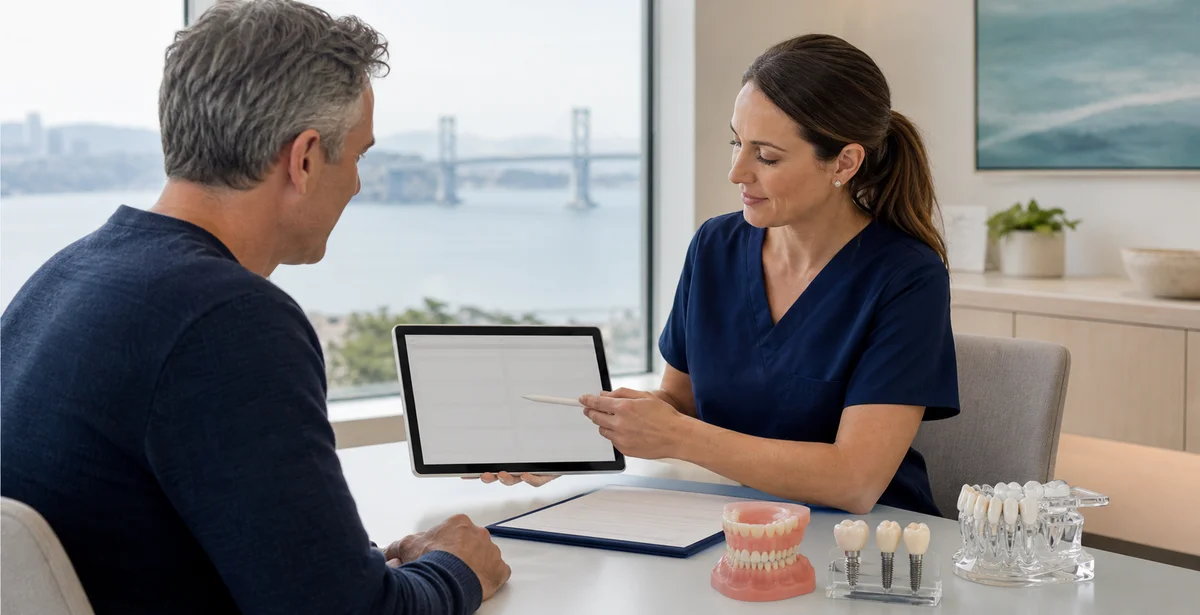
Cost of dental implants in san francisco cannot be reduced to one reliable citywide number. A complete estimate may include examination, imaging, extraction, grafting, implant placement, abutment, temporary and final teeth, anesthesia, facility care, maintenance, and management of changes. Compare the same clinical pathway, verify insurance and provider status, and request itemized written estimates before consenting.
People searching the cost of dental implants in san francisco often encounter prices that describe different products. One advertisement may quote only an implant body. Another may bundle placement, abutment, and crown. A third may describe an arch of temporary teeth but omit extractions, grafting, final prosthesis, sedation, or long-term maintenance. These figures cannot be compared until every component is defined.
San Francisco location influences overhead and access, but geography is only one factor. The diagnosis, number and position of missing teeth, gum health, bone volume, anatomy near nerves or sinuses, restorative design, provider and facility, insurance contract, laboratory, materials, and treatment stages can change a personal estimate. A safe cost of dental implants in san francisco article therefore teaches a budgeting method rather than inventing a local average.
This guide does not diagnose candidacy, set a clinic price, or guarantee a result. Dental implants are surgically placed medical devices, and final planning requires examination and appropriate imaging. Severe swelling, fever, uncontrolled bleeding, trauma, worsening general condition, or difficulty breathing or swallowing needs prompt local care; shopping for an elective quote should not delay urgent evaluation.
1. Why cost of dental implants in san francisco is not one price
An implant restoration normally includes at least an implant body in bone, an abutment that connects the implant to a prosthesis, and a crown, bridge, or denture. These parts can be provided by different clinicians at different times. The FDA describes implant systems as including an implant body and abutment and advises patients to ask which brand and model is used and keep that information.
The clinical pathway may begin before implant placement. A failing tooth might need extraction. Active gum disease may require control. Bone or soft tissue may need management, while another patient may be ready for placement without grafting. Healing can take months or longer, and temporary teeth may be needed. The cost of dental implants in san francisco should show these stages instead of presenting surgery as a finished tooth.
A preliminary quote based on a phone call, photo, or old panoramic image is not a final treatment plan. Examination can identify decay, periodontal disease, restorative-space problems, bite issues, anatomical limits, or medical considerations that alter options. A transparent practice explains what the initial figure assumes and how changes are approved and priced. For that reason, the cost of dental implants in san francisco should always be linked to a dated clinical plan.
2. The 13 components of an itemized implant estimate
Use the following checklist to convert a headline cost of dental implants in san francisco into a comparable written pathway. Not every patient needs every item; inclusion must follow clinical need.
- Consultation and examination: medical and dental history, oral assessment, diagnosis, and discussion of alternatives.
- Imaging and records: appropriate radiographs or three-dimensional imaging when clinically justified, plus scans or models.
- Disease stabilization: management of active decay, periodontal disease, infection, or hygiene limitations before surgery.
- Extraction: removal of a tooth, complexity of the procedure, and preservation of the site where indicated.
- Bone management: graft material, membrane, sinus-related procedure, fixation, and follow-up when needed.
- Soft-tissue management: grafting or contour procedures that are not automatic for every site.
- Implant placement: implant body, surgical procedure, components, and routine postoperative checks.
- Temporary restoration: removable or fixed temporary teeth and adjustments during healing.
- Abutment: stock or custom component, connection procedure, and related laboratory work.
- Final prosthesis: crown, bridge, overdenture, or full-arch restoration, material, design, and laboratory.
- Anesthesia or sedation: local anesthesia, sedation provider, monitoring, and facility requirements.
- Maintenance: professional reviews, hygiene, imaging when indicated, and replaceable prosthetic parts.
- Contingency: plan changes, additional visits, complications, repair, or replacement under stated written policies.
Ask whether the quote is per implant, per tooth, per arch, or for the entire case. In full-arch care, the number of implant bodies is not the same as the number of teeth shown in the prosthesis. A “tooth in a day” phrase may refer to a temporary restoration rather than the definitive prosthesis. The final design and timing should be explicit when comparing the cost of dental implants in san francisco.
3. Decision table for comparing San Francisco implant quotes
The table below helps compare the cost of dental implants in san francisco without assuming that the lowest total represents the same care.
| Quote pattern | What may be included | Questions to ask | Main caution |
|---|---|---|---|
| “Implant starting at” | possibly implant placement only | Are abutment, crown, imaging, graft, and temporary included? | A starting price may not describe a finished tooth. |
| Single-tooth package | implant, abutment, and crown in some offers | Which materials, visits, providers, and changes are excluded? | Extraction and grafting may be separate. |
| Full-arch package | multiple implants and a temporary or final arch | Is the quoted prosthesis temporary or definitive, and what maintenance follows? | Advertisements can combine unlike prosthetic designs. |
| Insurance estimate | expected plan payment for selected codes | Are eligibility, network, deductible, annual maximum, and authorization current? | Estimated benefits are not guaranteed claim payment. |
| Self-pay Good Faith Estimate | expected charges from a provider or facility | Are all involved providers represented, and what unknown changes are excluded? | Federal dispute eligibility has specific conditions. |
| Overseas or distant package | clinical care plus some travel logistics | Who handles healing, final restoration, emergencies, records, and local maintenance? | Repeat travel and local follow-up can change total cost. |
Normalize quotes into the same columns: diagnosis, site, component, provider, facility, quantity, fee, expected insurance payment, patient estimate, service date, and excluded items. This makes the cost of dental implants in san francisco easier to compare across genuinely equivalent plans. If two plans use different clinical approaches, first ask each team to explain why its design is appropriate. Price comparison should never pressure a clinician into an unsuitable plan.
4. Imaging, anatomy, and diagnosis can change the budget
Implant planning evaluates bone dimensions, gum condition, restorative space, neighboring roots, bite, and important anatomy. Three-dimensional imaging may be clinically appropriate in some cases but is not automatically required for every dental question. Ask why each image is needed, which provider interprets it, and whether the fee is in the estimate.
Upper back-tooth sites may require attention to the sinus, while lower-jaw planning must respect nerves and other structures. Bone defects, previous infection, trauma, or long-term tooth loss can affect complexity. This is why a personal cost of dental implants in san francisco can change after complete records even if another person received an implant in the same neighborhood.
The final prosthesis must also fit the bite and be maintainable. A surgical position that cannot support a cleanable, functional tooth is not a successful financial shortcut. Restorative planning should occur before placement, with communication among the surgeon, restorative dentist, laboratory, and patient when more than one provider is involved. Imaging is therefore a clinical variable in the cost of dental implants in san francisco, not merely an optional add-on.
5. Extraction, grafting, and tissue procedures are not automatic
An implant site may be ready after healing, suitable for immediate placement, or require a staged approach. These are clinical decisions, not universal package features. Extraction difficulty, infection, bone defect, soft-tissue needs, and stability of the planned implant influence timing. Ask the clinician to explain the indication, alternatives, expected healing, and how the cost of dental implants in san francisco changes under each branch.
Bone-graft quotes should identify the procedure, site, material category, membrane or fixation when used, and follow-up. More material is not automatically better. A second opinion can be useful when a proposal adds extensive grafting, removes several restorable teeth, or substantially changes the original plan.
Soft-tissue procedures may be recommended to improve tissue volume, stability, cleanability, or aesthetics, but they are not interchangeable with treatment of active disease. Request a separate explanation and fee so the cost of dental implants in san francisco separates optional and clinically indicated items. Consent should describe risks, recovery, alternatives, and uncertainty without guaranteeing that a particular contour or appearance will be achieved.
6. Temporary and final teeth must be priced separately
A temporary tooth protects appearance and function during healing but may not have the same material, contour, strength, or longevity as the definitive restoration. In immediate full-arch care, the teeth delivered on surgery day are often provisional. The estimate should state when the final prosthesis is made, what records are needed, and how many adjustment visits are included.
The final crown or arch can involve different materials, laboratory workflows, designs, and maintenance requirements. Ask what is included in the quoted cost of dental implants in san francisco: abutment, screws, framework, individual crowns, denture components, impressions or scans, try-ins, insertion, and early adjustments. Brand terms should not substitute for a plain-language design description.
Repairs and replacement parts are normal long-term considerations. A written warranty may have conditions, exclusions, geographic limits, and required maintenance; it is not a biological success guarantee. Clarify who pays professional, laboratory, travel, imaging, and component fees if a temporary breaks, a screw loosens, or the definitive prosthesis needs adjustment. Those terms belong in the long-range cost of dental implants in san francisco.
7. Sedation and facility fees can be separate
Many implant procedures use local anesthesia. Sedation may be considered for anxiety, complexity, medical factors, or patient needs, but it carries additional risks and requirements. The estimate should identify the depth of sedation, qualified provider, monitoring, setting, duration, medicines, recovery, escort rules, and separate facility or anesthesia fees.
California regulates dental licenses and anesthesia-related permits or certificates. The Dental Board of California provides public license verification. If sedation is planned, verify the relevant credentials and ask who performs the procedure while monitoring the patient. A high or low sedation fee does not prove safety.
Insurance can evaluate anesthesia differently from implant placement. Written authorization for one service may not include the other. Ask each payer and provider which codes, setting, diagnosis, and network rules apply. Anesthesia and facility charges should appear separately in the cost of dental implants in san francisco. Do not assume that performing surgery in a hospital automatically makes an otherwise excluded dental service medically covered.
8. Dental insurance and medical insurance require separate checks
Dental plans may exclude implants, pay a percentage after a deductible, apply an annual maximum, impose frequency or replacement rules, use an alternative benefit, or require a network. Medical plans commonly exclude routine tooth replacement, with limited review in defined trauma or reconstruction circumstances. Obtain the governing documents for both.
When estimating the cost of dental implants in san francisco, ask for component-level benefit information rather than “Are implants covered?” Submit the proposed extraction, graft, implant, abutment, crown or prosthesis, anesthesia, and facility services separately as the payer requires. Verify eligibility on every expected service date because treatment may cross plan years.
Prior authorization and a pre-treatment estimate are not final payment guarantees. Network changes, deductible, annual maximum, missing documentation, different final codes, altered treatment, or eligibility changes can affect responsibility. Recheck the cost of dental implants in san francisco after every written benefit response. Ask the payer to cite exclusions and appeal rights in writing and keep call references and submissions.
Insurance verification checklist
- exact medical and dental plan names, member category, and active dates;
- implant, graft, prosthodontic, accidental-injury, and reconstruction language;
- deductible, coinsurance, annual maximum, lifetime or frequency limits;
- waiting period, missing-tooth rule, or alternative-benefit provision where applicable;
- network status of surgeon, restorative dentist, anesthetist, and facility;
- prior authorization, documentation, and claim-form requirements;
- coordination order when medical, dental, accident, or secondary coverage overlaps;
- written estimate, denial provision, and appeal deadline.
9. Medi-Cal coverage needs member-specific confirmation
California DHCS states that Medi-Cal includes dental benefits and lists dental implants among benefits for eligible members, while detailed program materials indicate that implant services can require specific conditions and authorization. Coverage depends on membership, age or eligibility category, medical necessity criteria, provider enrollment, documentation, and current program rules. A general webpage is not an approval for an individual case.
For a San Francisco Medi-Cal member, contact Medi-Cal Dental and an enrolled provider before treatment. Ask whether the proposed implant, graft, abutment, prosthesis, anesthesia, and facility are benefits for the member and whether a Treatment Authorization Request is required. Confirm that the provider accepts the applicable Medi-Cal delivery system, not merely some Medicaid or Medi-Cal patients.
Children and youth under 21 can have distinct EPSDT protections. DHCS explains that medically necessary services may be reviewed under EPSDT and provides an example in which an implant-retained fixed prosthesis may be authorized when conventional prosthetics cannot adequately restore an edentulous area. That example still requires patient-specific review and does not create universal implant coverage or a universal cost of dental implants in san francisco.
10. Self-pay patients can request written estimates
CMS explains that people in the United States who are uninsured or choose not to use insurance generally can receive a Good Faith Estimate for scheduled care or on request under applicable federal rules. The estimate is a list of expected charges, not a bill or a treatment guarantee. Emergency care and some situations follow different rules.
Current CMS consumer guidance notes that estimates may list charges from a single provider or facility, so a patient should request an estimate from each entity involved. A complex implant pathway can include a dentist, surgeon, anesthesia provider, laboratory arrangement, and facility. Ask whether each party’s fee appears in the cost of dental implants in san francisco estimate.
CMS also describes a patient-provider dispute process for eligible uninsured or self-pay patients when a billed amount from a provider is at least $400 above that provider’s Good Faith Estimate, subject to rules and deadlines. Keep the estimates and bills together with the documented cost of dental implants in san francisco. Do not assume that this protection applies to every dental bill or insured claim; confirm current eligibility through official guidance.
11. Verify the dentist, office, and sedation credentials
The Dental Board of California licenses and regulates dentists and dental assistants and directs consumers to the state license search. Verify the clinician’s current license, address of record, and public disciplinary documents where available. If another professional administers sedation, verify the relevant license and permit or certificate.
License verification is a safety step, not a quality ranking. Ask who performs extraction, grafting, placement, and restoration; how the professionals coordinate; what implant system is used; which laboratory makes the prosthesis; and who manages urgent problems. Provider roles should be named in an estimate of the cost of dental implants in san francisco. A treatment coordinator can explain logistics but should not replace diagnosis and informed consent from a licensed clinician.
Do not choose solely from reviews or before-and-after photographs. Such material cannot show selection criteria, complications, maintenance, or outcomes for a person with your anatomy and health. A provider should discuss alternatives, risks, limits, timing, follow-up, and the reasons behind the proposed cost of dental implants in san francisco.
12. Financing changes cash flow, not treatment value
Financing can distribute payments over time, but it does not reduce the clinical scope or prove affordability. Compare cash price, deposit, amount financed, annual percentage rate, fees, total repayment, deferred-interest deadline, late-payment consequences, credit impact, refund method, and responsibility if the treatment plan changes.
Ask whether a discount requires paying the full case before all stages occur. Understand cancellation and refund terms for unperformed work, custom laboratory items, and third-party financing. Compare total repayment with the cash cost of dental implants in san francisco. Never let a promotion expiration date determine whether extraction, grafting, sedation, or implant surgery is appropriate.
For a realistic cost of dental implants in san francisco, include time away from work, transportation, parking, caregiver or escort needs, medicines, soft-food supplies, and unplanned visits. A payment plan with a small monthly figure can still have a high total repayment.
13. Maintenance and biological risk belong in the budget
FDA patient guidance emphasizes regular cleaning and professional visits after implant treatment. Implants are not immune to plaque-related disease, component wear, or restorative problems. Long-term planning may include hygiene visits, examinations, periodic imaging when indicated, replacement of attachments, screw tightening, repairs, or a new prosthesis.
Smoking can impair healing, and uncontrolled diabetes or active local infection can increase risk. The clinician should review general health, medicines, allergies, gum condition, hygiene, and healing factors. Never stop prescribed medication without guidance from the appropriate clinician. Insurance approval does not erase biological risk or create a guaranteed lifespan.
The FDA lists possible complications including damage to nearby teeth or tissues, sinus injury, bone injury, bite problems, component loosening, infection, cleaning difficulty, altered sensation, and implant failure. Informed consent should address material risks and alternatives. A contingency reserve belongs in the cost of dental implants in san francisco because not every repair or retreatment is covered by an initial package or insurance.
Frequently asked questions about cost of dental implants in san francisco
What is the average cost of dental implants in san francisco?
A single credible citywide average cannot describe all pathways. Quotes may represent placement only, a completed single tooth, or a multi-implant arch and may omit extraction, grafting, temporary teeth, sedation, facility, and maintenance. Request itemized examination-based estimates and compare the same components rather than relying on an online average.
Does the quoted implant price include the crown?
Not always. Implant body placement, abutment, and crown can be separate services from different providers. Ask whether the temporary, abutment, final crown, laboratory, scans, insertion, and adjustments are included. The complete cost of dental implants in san francisco should distinguish placement from a finished tooth.
Why can the price change after imaging?
Imaging and examination can reveal anatomy, bone defects, disease, restorative-space limits, or neighboring structures that alter treatment options. The clinic should explain the clinical reason, alternatives, and revised cost of dental implants in san francisco before proceeding. No additional treatment should be assumed solely because it increases the quote.
Does dental insurance cover implants in San Francisco?
Some plans provide limited benefits; others exclude implants or apply deductibles, annual maximums, waiting periods, network rules, frequency limits, or an alternative benefit. Coverage is controlled by the current contract and individual claim. Deduct verified benefits from the cost of dental implants in san francisco only after a written estimate, not a verbal promise.
Can medical insurance pay after an accident or cancer treatment?
Some medical plans review defined trauma or disease-related reconstruction, but routine tooth replacement is commonly excluded. Jaw reconstruction, grafting, implant placement, and prosthetic teeth may receive separate determinations. Any medical-plan contribution changes the cost of dental implants in san francisco only after service-specific written decisions; medical necessity alone does not guarantee coverage.
Does Medi-Cal cover dental implants?
DHCS lists implants as a Medi-Cal benefit, but detailed eligibility, exceptional or medically necessary conditions, authorization, provider, and documentation rules apply. Member age and category may matter. Contact Medi-Cal Dental and an enrolled provider before treating a program benefit as a reduction in the cost of dental implants in san francisco.
Can I receive an implant and crown on the same day?
Immediate placement or a same-day temporary restoration may be possible in selected cases, but a definitive crown or arch may follow after healing. Anatomy, stability, bite, disease, and risk factors matter. Ask whether the advertised teeth are temporary or final and how the cost of dental implants in san francisco changes if immediate loading is not appropriate.
Is bone grafting always needed?
No. Need depends on anatomy, defect, implant plan, timing, and restorative goals. Ask the clinician to show why a graft is recommended, discuss alternatives and staging, and itemize material, membrane, procedure, imaging, and follow-up within the cost of dental implants in san francisco. A routine package should not replace patient-specific justification.
Is the cheapest implant a safe choice?
Price alone does not determine safety or quality. Verify diagnosis, license, implant records, infection control, restorative plan, follow-up, emergency access, and what the quote excludes. A high cost of dental implants in san francisco also does not guarantee success. Choose a transparent, clinically justified plan you can maintain.
What records should I keep?
Keep diagnosis, images, consent, itemized plan, estimates, insurance responses, operative notes, implant brand and model, site, placement date, graft details, prosthetic design, laboratory information, and maintenance schedule. The written cost of dental implants in san francisco and approved changes belong in this file. These records help another professional identify components and manage future care.
What if my final bill is much higher than the estimate?
Ask for an itemized explanation and compare it with authorized changes and the written cost of dental implants in san francisco. Eligible uninsured or self-pay patients may have a federal dispute option when a provider’s bill is at least $400 above that provider’s Good Faith Estimate. Current rules, timelines, and exceptions apply; use CMS guidance.
A safer formula for the true total
Use this formula: examination and records + disease control + extraction + graft or tissue procedures + implant placement + temporary tooth + abutment + final prosthesis + anesthesia and facility + maintenance + travel and time + contingency − only verified insurance payment. It converts the cost of dental implants in san francisco from a marketing number into a patient-specific budget.
Ask each provider to state assumptions, included visits, excluded services, valid dates, and the process for approving changes. A durable cost of dental implants in san francisco comparison preserves those assumptions in writing. Confirm insurance, Medi-Cal, or self-pay protections with the responsible program. Verify the California license and any relevant sedation credential. Retain implant and prosthetic records for future maintenance.
For English-language information about staged implant assessment, visit the Redent Klinik overview. To share existing images and ask how an itemized plan is developed, use the Redent Klinik contact page. Remote review can support planning but does not replace a clinical examination.
This evidence-informed article is prepared for clinical review by Dentist Esma Çevrük Çakır. It prioritizes transparent limitations and patient safety. It is not a price quotation, diagnosis, insurance guarantee, legal opinion, or individualized treatment recommendation.
Official sources and verification date
Consumer rights, California program, licensing, and implant safety information was checked on August 13, 2026 against the following official sources:
- CMS: Good Faith Estimates for uninsured or self-pay patients
- CMS: No Surprises Act rules and fact sheets
- US Food and Drug Administration: Dental implants — what you should know
- Dental Board of California: Information for consumers and license verification
- California DHCS: Medi-Cal benefits
- California DHCS: Medi-Cal Dental
- Medi-Cal Dental: EPSDT services
- American Dental Association
- World Health Organization: Oral health fact sheet
Clinical review note: This patient guide is prepared for review by Dentist Esma Çevrük Çakır. Fees, plan benefits, networks, public-program rules, and legal protections can change. Obtain current written information from the provider, payer, and responsible agency.