
The cost of total mouth dental implants is one of the most frequently researched topics among individuals seeking a permanent, comfortable, and natural-looking solution for tooth loss. Patients often want clarity not only about pricing but also about what factors shape the total expense, what benefits they receive in return, and how the investment compares with other restorative options. In this comprehensive guide, we will explore every essential detail so users can make an informed, confident decision about their oral health. 😊
Before diving into figures, it’s important to understand that the cost of total mouth dental implants is influenced by a variety of personalized factors—including bone density, implant materials, surgical techniques, and the expertise of the dental team. While many people simply search for price numbers, the truth is that successful full-mouth restoration requires a customized approach designed around the patient’s anatomical needs and long-term oral health goals.
Total mouth implant treatments usually refer to full arch implant restoration for both jaws (upper and lower). These solutions typically include All-on-4, All-on-6, or full-arch individual implant setups. Each method comes with its own advantages, healing characteristics, and value-related differences. That’s why the cost of total mouth dental implants often varies widely depending on the treatment path chosen. To ensure proper safety and professionalism, it’s always advised to check guidelines from trusted organizations like the
American Dental Association.
When patients seek a permanent solution rather than removable dentures, total mouth dental implants become an excellent long-term choice. Unlike traditional dentures, implants fuse with the bone through a biological process called osseointegration. This provides exceptional strength, durability, and chewing comfort. Over the years, individuals often find that the cost of total mouth dental implants provides far more value compared to frequently replacing dentures or dealing with discomfort associated with unstable prosthetics.
Another important point is that full mouth implant treatments significantly improve quality of life. They restore up to 90% of natural chewing ability, prevent bone loss, improve facial structure, and boost overall confidence. Patients often describe the transformation as “life-changing,” which explains why many consider the investment worthwhile despite the initial expense. When viewed as a long-term oral health solution, the cost of total mouth dental implants becomes a structured, value-packed investment—rather than simply a cosmetic enhancement.
Research shows that a customized treatment plan almost always leads to superior results. Surgeons assess bone health, gum condition, smile design requirements, implant brand selection, prosthetic materials (such as zirconia or titanium), anesthesia options, and post-operative care needs. All these elements collectively shape the final cost of total mouth dental implants. For example, individuals requiring bone grafting, sinus lifting, or advanced reconstruction may have additional steps included in their treatment plan.
Additionally, the region and clinic you choose significantly influence pricing. In countries with advanced dental tourism, such as Turkey, total mouth implant treatments are often far more affordable than in the USA, Canada, or Western Europe—yet performed with the same high-quality materials and expertise. Clinics like Redent Klinik welcome international patients, and anyone seeking guidance may visit:
Redent Klinik Contact Page.
As you explore further sections of this guide, you will notice the term “full mouth implant pricing” and other semantically related concepts. These LSI terms help describe the overall treatment value and broaden your understanding of how comprehensive this dental solution really is. A well-informed patient is always better positioned to evaluate the true cost of total mouth dental implants and recognize which options suit their goals best.
In the remainder of this article, we will break down treatment types, step-by-step procedures, long-term benefits, hidden fees, financing possibilities, and comparison models like All-on-4 versus All-on-6. Each section will give you deep insights into the full scope of total mouth restoration so that you know exactly what to expect—financially, medically, and aesthetically. This ensures that your journey toward a healthier smile becomes smooth, predictable, and deeply rewarding. 😄
Full Mouth Dental Implants Overview: What Patients Really Need to Know
When people begin researching the cost of total mouth dental implants, they often discover that full-mouth restoration is not a single, one-size-fits-all procedure. Instead, it is a comprehensive dental treatment designed to replace all missing or severely damaged teeth using advanced implant-supported prosthetics. This section explains in full detail how full arch implant systems work, why their value extends beyond price figures, and what patients should understand before committing to treatment. 😄
Full mouth implant therapy typically consists of placing 4 to 8 implants per arch, depending on bone structure, implant design, and the surgeon’s clinical strategy. These implants act like artificial roots, anchoring a custom-made prosthetic arch that restores chewing power, aesthetics, and long-term stability. Because this treatment fully rehabilitates the mouth, patients quickly realize that the cost of total mouth dental implants reflects a complete transformation of oral health—not just a cosmetic upgrade.
Understanding How Full Arch Implant Systems Work
The biological foundation of full mouth implants is osseointegration—where titanium implants fuse with the jawbone. This fusion creates a solid, immovable support for the prosthetic teeth, allowing patients to chew, speak, and smile confidently. The treatment eliminates the problems associated with removable dentures, such as slipping, discomfort, and sore spots. In nearly all full arch systems, the implants stimulate the jawbone, preventing deterioration. This long-term biological benefit is an important factor influencing the overall cost of total mouth dental implants.
Because full arch implant therapy restores both functionality and appearance, it becomes a life-changing solution for individuals who have struggled with dental issues for years. Many clinics design personalized digital smile plans using 3D imaging, ensuring that the final aesthetics perfectly match the patient’s facial proportions. These digital tools also help reduce complications and shorten surgical time, which contributes to treatment value.
Types of Full Mouth Implant Concepts and Why They Matter
Several implant concepts exist, and each affects the cost of total mouth dental implants differently. Understanding these variations helps patients decide which system matches their needs and expectations. The most common options include:
All-on-4 Implant Concept
This method uses four implants per arch—two straight anterior implants and two angled posterior implants. It is ideal for patients with moderate bone loss. The All-on-4 technique often offers a lower cost compared to other systems because it uses fewer implants and may eliminate the need for complex bone grafting. However, selecting the right candidate is crucial, since not everyone qualifies.
All-on-6 Implant Concept
The All-on-6 method uses six implants per arch and generally offers enhanced stability, especially for patients with adequate bone density. While slightly higher in price, the added strength and distribution of chewing force make it a preferred choice for long-term durability. Because of this enhanced stability, some patients perceive the cost of total mouth dental implants with All-on-6 as offering better lifetime value.
Full-Arch Individual Implants
This approach involves placing 8–10 implants per arch and attaching individual crowns or segmented bridges. It is the most natural-feeling and longest-lasting solution, but also the most expensive due to the number of implants and the complexity of fabrication. Patients seeking maximum aesthetics and precision may find this option ideal.
What Makes Full Mouth Implant Treatment Unique?
Unlike traditional dentures that rest on the gums, full mouth implants create a permanent foundation for a fixed prosthesis. This stability allows patients to enjoy nearly all foods, maintain proper digestion, and speak without discomfort. The emotional relief that comes from restoring a complete, functional smile is often described as priceless. When factoring in the long-term oral health benefits, patients understand why the cost of total mouth dental implants reflects a holistic transformation rather than a simple dental procedure.
Additionally, implant-supported prosthetics prevent the accelerated bone loss normally triggered by missing teeth. Jawbone resorption can change facial shape, causing premature aging. Implants halt this process by preserving bone volume. This medical advantage is a major reason why many patients prefer full mouth implants over dentures or bridges.
Clinical Steps Included in Full Mouth Restoration
A full treatment plan generally consists of:
- Comprehensive clinical evaluation and 3D imaging
- Creation of a personalized digital smile design
- Pre-surgical preparation (cleaning, extractions, gum therapy)
- Implant placement surgery
- Attaching a temporary prosthetic (same-day smile)
- Healing and osseointegration period
- Fabrication and placement of the final prosthetic arch
- Post-operative checkups and long-term maintenance guidance
Each of these phases contributes to the total cost of total mouth dental implants, but together they ensure a stable and functional long-term outcome. Successful full arch restoration is not rushed; it is a carefully sequenced medical treatment with multiple precision steps.
How This Treatment Aligns With Patient Expectations
Most patients choosing total mouth implants want a long-lasting, natural-looking smile that does not shift or cause pain. They value durability over temporary solutions. Full mouth implants satisfy these expectations better than any other restorative method. Patients frequently report that their quality of life improves dramatically—chewing comfort increases, social confidence returns, and daily routines become easier. Many say that once they experience the benefits, the cost of total mouth dental implants feels justified.
In summary, full mouth implants are more than a dental procedure—they are a full oral rehabilitation system that restores function, aesthetics, and confidence. Understanding the structure of the treatment helps patients appreciate both the process and the investment. In the next section, we will analyze how different implant types influence pricing so readers gain a clear understanding before comparing clinics or planning treatment.
Types of Full Arch Implant Solutions and How They Affect Total Cost
When evaluating the cost of total mouth dental implants, one of the most decisive factors is the type of full arch implant solution recommended for the patient’s oral condition. Each implant system comes with its own structure, number of implants, long-term durability, aesthetic potential, and material requirements. These variations directly influence the financial investment, treatment stages, and lifetime value. To help you understand the full picture, this section provides a deeply detailed breakdown of each full arch solution and how it contributes to the total cost.
Patients often assume that all full mouth implant treatments follow the same method, but modern dentistry offers several advanced solutions. The final treatment plan is determined based on a combination of jawbone density, gum health, bite analysis, facial proportions, and personal expectations. The cost of total mouth dental implants will always be tied to the complexity of these needs and the selected implant technique.
Main Full Arch Implant Solutions Explained
Understanding the different restoration models allows patients to make informed decisions about which solution best aligns with their long-term dental goals and budget. Below are the three most widely used full arch implant approaches: All-on-4, All-on-6, and full-arch individual implants.
1. All-on-4 Implant System
The All-on-4 system uses four strategically placed implants per arch. Two implants are positioned vertically at the front, and two are angled at the back to maximize support even in cases of bone loss. This approach is often considered the most economical full arch method, resulting in a typically lower cost of total mouth dental implants compared to other options.
Its advantages include:
- Reduced surgical steps and healing time
- Often avoids bone grafting procedures
- Immediate temporary prosthesis on the same day
- Effective for patients with mild to moderate bone reduction
Because it uses fewer implants and requires less complex surgical intervention, All-on-4 is often chosen by individuals seeking a more budget-friendly yet durable implant solution. However, long-term load distribution may be less robust compared to systems using more implants, which is important to consider for patients with heavy bite forces.
2. All-on-6 Implant System
The All-on-6 system increases the number of implants to six per arch, providing improved stability, better force distribution, and enhanced longevity. This treatment is widely considered a balance between affordability and long-term performance. Naturally, the cost of total mouth dental implants in an All-on-6 plan is higher than All-on-4 because of additional surgical work, more implants, and potentially more complex prosthetic design.
Benefits of All-on-6 include:
- Greater structural stability
- More even load distribution for chewing
- Reduced risk of implant overload or failure
- Superior long-term durability
For patients with better bone density and who want a more secure foundation, All-on-6 offers excellent long-term value. The prosthetic can also be customized with high-end materials like zirconia, further impacting the total cost.
3. Full-Arch Individual Implants
This method is the most comprehensive solution. Instead of a single full arch prosthesis, 8 to 10 implants are placed per jaw, supporting individual crowns or segmented bridges. This system mimics natural teeth more closely than any other option and offers maximum chewing performance.
However, because of the number of implants, custom fabrication, and extended surgical planning, this approach results in the highest cost of total mouth dental implants. Patients who choose this option typically prioritize naturalness, precision, and long-term durability over initial price considerations.
Advantages include:
- Extremely natural feel and appearance
- Best bite force replication
- Highest long-term stability
- Independent crown replacement if needed
Material Options and Their Influence on Pricing
Another major factor affecting the cost of total mouth dental implants is the material used for the final prosthesis. The two most common materials are:
Zirconia
Zirconia prosthetics are known for their exceptional strength, biocompatibility, and premium aesthetics. Resistant to wear, fractures, and staining, zirconia provides one of the most natural-looking results. However, it also increases treatment costs due to the complex milling process and high production value.
Acrylic Hybrid Prosthetics
Acrylic prosthetics, often reinforced with a titanium bar, offer a more cost-effective solution. They look natural and provide good durability, although they may require more frequent replaceable components compared to zirconia. Patients choosing an acrylic hybrid often see a moderate reduction in the cost of total mouth dental implants.
Additional Clinical Requirements That Affect Total Cost
Several auxiliary procedures may be required depending on the patient’s oral health condition, such as:
- Bone grafting
- Sinus lift surgery
- Gum tissue treatment
- Tooth extractions
- Soft tissue contouring
- Temporary prosthesis fabrication
Each of these additional treatments can influence the final cost of total mouth dental implants, as they extend the complexity, time, and clinical resources needed for complete rehabilitation.
Choosing the Right Implant System for Long-Term Value
Patients should remember that the cheapest solution may not always be the best for long-term oral health. The ideal implant system is determined by bone structure, facial harmony, bite dynamics, and lifestyle habits. A detailed consultation with a specialized implant clinic helps ensure the best balance between cost and long-term success.
By understanding these variations in full arch implant systems, patients gain a clearer picture of why the cost of total mouth dental implants can differ dramatically between clinics, regions, and individual cases. The next section will outline the full step-by-step process of treatment so you understand exactly what you’re paying for.
Step-by-Step Breakdown of the Total Mouth Implant Treatment Process
Understanding the full treatment pathway is essential for anyone evaluating the cost of total mouth dental implants. Many patients initially assume the treatment consists of only a surgical phase, but in reality, it is a carefully controlled, multi-stage medical process. Each phase—from diagnosis to final prosthetics—requires precision, expertise, and high-quality materials. Because of this, the total investment includes far more than the implants themselves. This section presents a detailed, transparent, and patient-friendly breakdown of the entire full-mouth restoration journey.
A complete full arch rehabilitation typically spans several weeks or months depending on individual healing ability, bone density, gum health, and prosthetic requirements. Although the timeline varies, the sequence of steps remains consistent. By understanding each stage, patients can clearly see how the cost of total mouth dental implants is calculated and why it ensures such long-term value.
Initial Diagnostic Stage
The first step involves a comprehensive evaluation. Rather than a simple visual exam, high-quality full arch implant planning demands advanced diagnostic tools. These early steps form the foundation for clinical accuracy and treatment safety.
1. Clinical Examination and Medical History Review
The dentist evaluates oral health, checks for infections, assesses bite alignment, reviews previous dental treatments, and analyzes general health factors. Because implant surgery requires good systemic and oral health, this review helps the clinician design a safe treatment plan.
2. 3D CBCT Scan and Digital Impressions
A Cone Beam Computed Tomography (CBCT) scan provides a complete 3D model of the patient’s jawbone. This scan shows bone density, nerve pathways, sinus areas, and anatomical limitations. CBCT imaging is essential for understanding whether bone grafting or sinus lifting is needed, which affects the cost of total mouth dental implants.
3. Personalized Digital Smile Design
Using software, the dental team designs a customized smile that reflects facial symmetry, bite mechanics, and aesthetic goals. This simulation ensures that the final prosthetic teeth perfectly match the patient’s facial structure.
Pre-Surgical Preparation
Before implant placement, the mouth must be prepared to create an ideal environment for long-term implant stability.
4. Tooth Extractions (If Needed)
Any decayed, loose, or non-restorable teeth are removed. In many cases, implants can be placed immediately after extractions. The number of extractions may influence the cost of total mouth dental implants if the patient has many remaining damaged teeth.
5. Gum Therapy and Infection Treatment
Healthy gums are essential for implant success. Gum disease or residual infections must be treated before surgery to ensure long-term stability and to avoid complications.
6. Bone Grafting or Sinus Lift (If Required)
For patients with bone loss, grafting may be necessary to create a strong foundation for the implants. Bone augmentation procedures add to the total cost of total mouth dental implants but are crucial for long-term implant health.
Surgical Phase: Implant Placement
This is the core of the treatment. During this stage, titanium implants are inserted into the jawbone to serve as artificial roots.
7. Implant Insertion
Using the 3D scan as a guide, the surgeon precisely places 4, 6, or more implants per arch depending on the chosen method (All-on-4, All-on-6, or individual implants). Modern clinics use navigation software or computer-guided templates to ensure accuracy.
8. Angled Posterior Implant Placement (If Needed)
In cases where bone is limited in the back jaw, angled implants are used to bypass the sinus and avoid grafting. This technique is common in All-on-4 systems and can reduce the overall cost of total mouth dental implants by eliminating the need for extra surgical procedures.
Immediate Restoration Phase
Most full-mouth implant treatments allow for a temporary prosthesis to be attached on the same day as surgery. This is known as “immediate loading.”
9. Temporary Full Arch Prosthesis
The temporary prosthesis provides aesthetics and function during healing. Patients can eat soft foods and enjoy a complete smile from day one. The temporary arch also acts as a guide for adjustments before final prosthetic fabrication.
Healing and Osseointegration
Healing is a vital stage where the bone fuses with the implants. This process, called osseointegration, typically takes 3–6 months.
10. Monitoring and Lifestyle Guidelines
Patients attend follow-up visits to ensure proper healing. Diet instructions, hygiene practices, and activity limits are reviewed. Successful osseointegration is essential for the long-term success and value of the cost of total mouth dental implants.
Final Prosthetic Placement
After healing, the temporary arch is replaced with the final, highly customized prosthetic.
11. Zirconia or Acrylic Final Prosthesis
The patient chooses between zirconia (premium, durable, natural-looking) or hybrid acrylic (cost-effective, comfortable) prosthetics. The choice of material directly influences the cost of total mouth dental implants.
12. Final Bite Adjustment and Aesthetic Refinement
The clinician ensures that the final arch fits flawlessly, chewing pressure is balanced, and aesthetics align with the digital smile design created earlier.
Post-Treatment Maintenance
Full mouth implants can last decades with proper care. Patients receive long-term maintenance guidance, including:
- Regular dental check-ups
- Professional implant cleaning
- At-home oral hygiene routines
- Night guard recommendations (if needed)
Completing all these stages ensures optimal function, durability, and aesthetics. With each phase carefully executed, the patient achieves a fully restored smile that feels natural and secure. Understanding this process allows patients to see why the cost of total mouth dental implants is a long-term investment in their oral health and overall quality of life.
Key Factors That Influence the Cost of Total Mouth Dental Implants
The cost of total mouth dental implants varies significantly from one patient to another because full-mouth restoration is a fully customized medical procedure. There is no universal price tag that applies to everyone. Instead, the final investment is shaped by clinical requirements, anatomical conditions, chosen materials, surgical techniques, prosthetic design, and even geographic location. This section provides a detailed and transparent breakdown of all the major factors that determine treatment cost, helping patients understand exactly what they are paying for and why these factors matter for long-term success.
Before diving deeper, it is important to highlight that full arch implant therapy is not just a cosmetic procedure. It involves advanced surgical planning, high-precision engineering, and medical-grade materials designed to last decades. When patients evaluate the cost of total mouth dental implants, they are truly assessing a life-changing healthcare investment that restores chewing function, appearance, and oral health stability.
1. Number of Implants Used in the Treatment
The quantity of implants placed per arch is one of the biggest determinants of final cost. Depending on the chosen method, patients may need 4, 6, or up to 10 implants per arch.
All-on-4 (Four Implants Per Arch)
This method typically has a lower cost of total mouth dental implants because it uses fewer implants and often avoids additional bone grafting. It is highly efficient and ideal for patients with reduced bone density.
All-on-6 (Six Implants Per Arch)
Using six implants increases stability and longevity. This improves long-term value, but it raises the total cost due to more implant fixtures, longer surgery time, and more complex prosthetic support.
8–10 Implants Per Arch (Individual Full Arch Implants)
This premium restoration method mimics natural teeth most closely. Because it requires more implants, advanced engineering, and custom crowns, it results in the highest cost of total mouth dental implants.
2. Bone Density and the Need for Additional Procedures
Patients with bone loss may need preparatory treatments before implant placement. These steps reinforce the jawbone and ensure long-term implant stability.
Bone Grafting
Bone grafts restore missing bone tissue. The complexity of grafting—from minor particulate grafts to major reconstruction—significantly affects pricing.
Sinus Lift Surgery
For upper jaw implants, sinus lift procedures may be necessary to create enough bone height. This is a delicate surgery that adds to the cost of total mouth dental implants but is essential for implant success in many cases.
Soft Tissue Treatment
Gum reshaping, infection treatment, and periodontal therapy may be required to establish a healthy environment before implants are placed.
3. Implant Brand and Material Quality
Implant brands vary widely in engineering quality, precision, biocompatibility, and long-term performance. Premium implant manufacturers invest in decades of research and provide proven clinical success rates.
Titanium Implants
Most implants are made of medical-grade titanium, known for its biocompatibility and strength. High-end titanium implant systems generally increase the cost of total mouth dental implants but offer superior reliability.
Zirconia Implants
Zirconia implants are metal-free alternatives with excellent aesthetics and biocompatibility. They tend to cost more due to specialized manufacturing.
4. Final Prosthetic Material
The prosthetic arch is another major cost component. Its materials influence durability, chewing strength, and aesthetics.
Zirconia Prosthetics
Highly durable, natural-looking, stain-resistant, and long-lasting. Zirconia is the most premium option, often raising the overall cost of total mouth dental implants.
Acrylic Hybrid Prosthetics
More affordable and lighter, usually reinforced with a titanium bar. Acrylic prosthetics offer good aesthetics at a lower cost, making them a popular choice for budget-conscious patients.
5. Surgical Technique and Technology Used
Advanced surgical methods greatly improve safety and success rates, but they also influence the total investment.
Computer-Guided Implant Placement
Using 3D digital planning and surgical guides enhances accuracy and reduces complications. These precision tools add to the cost of total mouth dental implants but deliver superior outcomes.
Immediate Loading Technology
Some clinics provide same-day temporary teeth. This advanced procedure reduces waiting time but requires specialized tools and expertise.
6. Geographic Location of the Clinic
Implant costs vary globally. For instance, clinics in Turkey—such as Redent Klinik—offer world-class full arch implant solutions at significantly lower prices than the US, Canada, or Western Europe. This makes international dental tourism a major factor in reducing the cost of total mouth dental implants.
7. Dentist Experience and Clinic Reputation
Highly skilled implantologists with extensive experience may charge higher fees. However, their expertise minimizes risks, improves long-term success, and ensures high-quality results. Choosing a well-established clinic increases value in relation to cost.
8. Temporary Prosthetics and Follow-Up Care
Temporary teeth, post-operative care, and follow-up appointments are essential and included in most treatment plans. These necessary services also contribute to the cost of total mouth dental implants.
By understanding all these factors, patients can accurately evaluate pricing differences between clinics and make confident decisions about their oral health investment. In the next section, we will compare All-on-4 and All-on-6 systems in greater detail to help you choose the best full arch solution for your needs.
All-on-4 vs. All-on-6 Implant Costs: Which Option Offers Better Value?
When researching the cost of total mouth dental implants, one of the most frequent questions patients ask is whether All-on-4 or All-on-6 implant systems provide better value. Both techniques are widely used in modern full arch rehabilitation, both are highly successful, and both can dramatically restore chewing ability and smile aesthetics. However, each method has unique advantages, structural differences, and long-term cost implications that influence the final decision.
This section explains the differences between these two popular implant concepts in clear detail, helping you understand how each system impacts durability, functionality, aesthetics, and overall investment. We will examine implant placement, bone requirements, prosthetic stability, expected lifespan, and long-term performance. By the end, you will gain a clear understanding of how the cost of total mouth dental implants varies between All-on-4 and All-on-6—and which one may align best with your personal goals and anatomical needs.
Structural Differences Between All-on-4 and All-on-6
The names of the systems refer to the number of implants placed in each arch. All-on-4 uses four implants, while All-on-6 uses six. Although the difference seems small, the additional support from two more implants can significantly change the treatment’s biomechanics and long-term stability.
All-on-4 Implant Structure
In the All-on-4 technique, two implants are placed at the front of the jaw vertically, and two are angled in the back to maximize bone contact. This strategic positioning allows surgeons to avoid sinus lifting in the upper jaw and bypass areas with insufficient bone. As a result, the All-on-4 design can reduce the cost of total mouth dental implants by eliminating the need for additional procedures such as bone grafting.
All-on-6 Implant Structure
The All-on-6 technique provides a broader and more stable foundation. With six implants supporting the prosthesis, chewing forces are distributed more evenly across the jaw. This enhanced mechanical stability increases the durability of the final restoration, especially for patients with strong bite forces or those seeking maximum longevity. Naturally, placing six implants increases the cost of total mouth dental implants, but it also increases long-term structural strength.
Who Is the Ideal Candidate for Each Solution?
Not every patient is suited for the same implant technique. The decision depends on bone density, gum health, lifestyle, and long-term expectations.
Ideal Candidates for All-on-4
- Patients with moderate to severe bone loss
- Individuals wanting to avoid bone grafting
- Those seeking a cost-effective full arch solution
- Patients who prefer a shorter surgery duration
- Individuals needing immediate temporary teeth
All-on-4 is often recommended for patients who want reliable results at a more accessible price. Because it uses fewer implants, the cost of total mouth dental implants is generally lower.
Ideal Candidates for All-on-6
- Patients with good jawbone density
- People who want maximum long-term durability
- Those with strong chewing forces
- Patients who prefer premium full arch restorations
- Those seeking improved load distribution and implant stability
All-on-6 is well-suited for long-term performance and offers excellent value for patients willing to invest slightly more in structural stability.
Comparing Durability and Long-Term Performance
Both systems are highly successful, but the number of implants can influence how well the prosthesis withstands daily functional demands.
All-on-4: Durability Insights
All-on-4 solutions have proven clinical success over many years. However, because there are only four implants supporting the entire arch, each implant carries more load. This can be a concern for patients with heavy bite pressure or bruxism (teeth grinding). Still, All-on-4 remains structurally sound for most individuals and provides exceptional lifestyle improvements at a lower cost.
All-on-6: Durability Insights
The All-on-6 method offers superior load distribution. With two additional implants supporting the prosthetic arch, chewing forces are shared more evenly. This extra support generally increases the longevity of the restoration. The potential for long-term performance is one of the reasons the cost of total mouth dental implants may be slightly higher—but many patients see this as a valuable investment in future comfort and stability.
Impact on Aesthetics and Smile Design
Both systems allow for stunning smile transformations, but the number of implants can influence how the prosthetic is designed.
All-on-4 Aesthetic Considerations
Allows for natural full arch prosthetics, but may require more gum-colored material to support aesthetics, especially in cases of bone loss.
All-on-6 Aesthetic Considerations
With better structural support, All-on-6 designs can sometimes achieve more refined aesthetics and reduce the need for excessive gum-colored resin.
Comparing Costs: Which Option Offers Better Value?
The key question many patients ask is: “Which option is more cost-effective?”
All-on-4 Cost Overview
Generally more affordable because of:
- Fewer implants
- Less surgical time
- Reduced risk of needing bone grafts
- Shorter overall treatment timeline
This often makes All-on-4 the more accessible entry point for patients evaluating the cost of total mouth dental implants.
All-on-6 Cost Overview
Higher initial investment due to:
- More implants
- Longer surgery
- Potentially more complex prosthetic requirements
However, All-on-6 often provides better lifetime value because of its increased durability and stability.
Final Verdict: All-on-4 or All-on-6?
Ultimately, the “best” choice depends on the patient’s bone density, budget, expectations, and long-term goals.
Patients seeking affordability and efficiency may prefer All-on-4, while those emphasizing longevity and enhanced support often choose All-on-6. Regardless of the method, both options offer powerful, life-changing results. Understanding the differences helps patients appreciate how the cost of total mouth dental implants aligns with their health priorities and lifestyle needs.
Long-Term Benefits and Lifetime Value of Full Mouth Dental Implants
When evaluating the cost of total mouth dental implants, patients often focus on upfront pricing without fully understanding the enormous long-term value these restorations provide. Full mouth dental implants are not a temporary fix but a transformative, structural rehabilitation of the oral cavity—designed to last decades. This section explores the lifetime benefits, health advantages, functional improvements, and financial value of choosing a complete implant-supported restoration.
Unlike removable dentures or short-term dental solutions, full arch implants offer stability, confidence, and durability that significantly improve quality of life. While the initial investment may seem high, the long-term rewards—both functional and emotional—are exceptional. Understanding these rewards allows patients to see the cost of total mouth dental implants as a comprehensive health investment rather than a simple dental expense.
1. Exceptional Chewing Power and Functional Strength
One of the most immediate benefits of full mouth implants is the dramatic improvement in chewing ability. Traditional dentures restore only 20–30% of natural bite force, whereas full arch implants restore up to 90%. This enhanced function significantly improves digestion, nutrition, and overall comfort.
Improved Dietary Freedom
With implant-supported teeth, patients can enjoy foods that are typically difficult for denture wearers—such as nuts, meats, raw vegetables, and crunchy fruits. The freedom to eat without fear of slippage or pain greatly enhances daily quality of life. When assessing the cost of total mouth dental implants, this restored functionality becomes a major value factor.
Better Digestion and Nutrient Absorption
Strong chewing contributes to better digestion. Patients often report improvements in gastrointestinal health because implants allow them to chew more effectively and diversify their diet.
2. Prevention of Bone Loss and Facial Collapse
Missing teeth cause the jawbone to deteriorate over time due to lack of stimulation. Dentures do nothing to prevent this resorption, and as bone decreases, the face begins to sag, creating an aged appearance.
Long-Term Jawbone Preservation
Dental implants stimulate the jawbone just like natural tooth roots. This preserves bone density and prevents further deterioration. Because this structural benefit lasts a lifetime, it significantly increases the long-term value of the cost of total mouth dental implants.
Improved Facial Symmetry and Youthfulness
By maintaining bone structure, implants prevent hollow cheeks, wrinkles around the mouth, and drooping facial contours. Patients often experience a rejuvenated facial appearance that restores confidence.
3. Long-Lasting Stability and Durability
High-quality implants integrate with the jawbone through osseointegration, forming an exceptionally strong foundation.
Decades of Reliable Performance
With proper care, implant fixtures can last 25 years or more—often a lifetime. This long duration makes the cost of total mouth dental implants far more economical over time than replacing dentures or bridges every few years.
Low Maintenance Requirements
Implant-supported prosthetics require simple hygiene routines similar to natural teeth. There is no adhesive, soaking solution, or constant adjustment required, saving patients considerable time and money.
4. Emotional and Psychological Benefits
Dental implants influence more than just function—they have a strong impact on emotional well-being.
Boosted Self-Confidence
Smiling freely, speaking naturally, and no longer worrying about dentures slipping gives patients a renewed sense of confidence. Many describe the treatment as “life-changing,” especially those who struggled with long-term dental problems.
Improved Speech and Clarity
Removable dentures often affect pronunciation and cause speech difficulties. Full mouth implants eliminate this issue by providing stable, fixed teeth that function like natural ones.
5. Financial Benefits Over Time
Although the initial cost of total mouth dental implants may appear higher than dentures, the long-term financial advantages are substantial.
Reduced Long-Term Dental Costs
Dentures require frequent replacements, repairs, relines, and maintenance. Over the course of 10–20 years, these expenses can exceed the cost of implants.
No Need for Adhesives or Special Cleaning Products
Implant patients avoid spending money on adhesives, cleaning tablets, and specialized denture solutions. This ongoing savings adds to the lifetime financial value.
6. Overall Improvement in Quality of Life
Full mouth implants allow patients to live more comfortably, confidently, and actively. They restore natural-like functionality, enabling people to enjoy social activities, dine out without fear, and smile openly.
Greater Social Comfort
Many patients regain the ability to socialize without worrying about their teeth shifting, clicking, or falling out. This emotional relief improves mental well-being and everyday happiness.
Enhanced Daily Comfort
Because implants are fixed and do not press against the gums like dentures do, patients experience less irritation, fewer sores, and no rubbing sensations.
7. Better Oral Health and Hygiene
Implants help maintain oral health by preserving bone structure and reducing the risk of gum recession caused by dentures.
Easier Cleaning Routine
Patients can brush and floss implant-supported teeth much like natural teeth. This reduces periodontal issues and helps maintain long-term oral stability.
Lower Risk of Gum Problems
Improved oral hygiene reduces the likelihood of infections, inflammation, and tissue damage.
In summary, the long-term benefits of full mouth implants extend far beyond aesthetics. When evaluating the cost of total mouth dental implants, patients should consider the decades of improved function, comfort, health, and self-confidence the treatment delivers. This lifetime value makes implants not only a medical solution, but also a permanent enhancement to quality of life.
Hidden Fees and Common Pricing Mistakes to Avoid Before Treatment
Many patients begin their research expecting clear and straightforward pricing for full arch restoration, only to discover that the cost of total mouth dental implants can vary dramatically between clinics. One of the biggest reasons for this confusion is the number of hidden fees or incomplete price estimates that some dental centers provide. To help patients avoid unpleasant surprises and ensure complete transparency, this section offers a detailed breakdown of the most common hidden costs, pricing mistakes, and misconceptions that can significantly affect the total investment.
Understanding all elements of full arch implant pricing is essential for making an informed, confident, and financially secure decision. Below, you will learn how treatment plans are structured, where hidden charges often appear, and how to protect yourself from misleading offers that make the cost of total mouth dental implants seem lower than it truly is.
1. Hidden Fees Often Overlooked in Initial Quotes
Some clinics advertise extremely low implant prices but omit critical treatment components. This creates artificially low starting estimates that balloon once the patient begins treatment.
Bone Grafting and Sinus Lifts Not Included
Many patients require bone augmentation procedures, especially those who have worn dentures for years or have untreated gum disease. Some clinics exclude grafting and sinus lift fees from the advertised cost of total mouth dental implants, only adding them later as “extra surgical fees.”
Bone grafting, depending on its complexity, can cost hundreds or even thousands of dollars in some countries. Patients should always ask whether grafting is included and whether their bone condition requires it.
Extractions Charged Separately
If you still have remaining damaged or decayed teeth, they must be removed before implant surgery. Some clinics offer full arch packages but charge per-tooth extraction, adding unexpected costs.
Temporary Prosthesis Not Included
Most reputable clinics provide same-day temporary teeth after implant placement. However, some low-cost ads exclude temporary prosthetics from the base price, even though this step is essential for comfort, aesthetics, and function during the healing phase.
2. Underestimating the Importance of High-Quality Materials
Patients often compare clinics solely based on price without understanding the major differences in implant brands and prosthetic materials.
Low-Cost, Generic Implant Brands
Generic or untested implant brands significantly reduce the upfront cost of total mouth dental implants but pose long-term risks. Implants from unknown manufacturers may lack reliability data, proper testing, or international certifications.
While premium brands like Straumann, Nobel Biocare, and Neodent cost more, they offer superior engineering and decades of research-backed success.
Cheap Prosthetic Materials
Acrylic prosthetics reinforced with titanium are common and provide good value. However, extremely low-cost clinics may use inferior acrylic or fragile composite materials that fracture, discolor, or wear down prematurely.
Patients should always ask whether the final prosthetic is zirconia, hybrid acrylic, or another material—and verify its manufacturing quality.
3. Misleading “Per Arch” vs. “Per Implant” Pricing
Some clinics advertise prices “per implant,” which can mislead patients into assuming the total cost is low. Full arch restorations require multiple implants, a temporary prosthesis, final prosthesis, and surgical planning—none of which are covered in a simple per-implant quote.
Per Implant Advertisements
A price such as “$800 per implant” may sound affordable, but it often excludes:
- Surgical planning and diagnostic imaging
- Abutments
- Full arch prosthetics
- Bone grafts or sinus lifts
- Anesthesia
- Follow-up care
When combined, these excluded items dramatically increase the true cost of total mouth dental implants.
Per Arch Packages
A complete per-arch package should include every stage of treatment—from initial consultation to final zirconia or hybrid prosthesis. This is generally the most transparent pricing model.
4. Sedation and Anesthesia Costs
Another hidden fee involves sedation options. Patients often assume sedation is included, only to learn there are additional charges.
Local Anesthesia
Local anesthesia is usually included, but more advanced sedation methods may not be.
IV Sedation or General Anesthesia
Clinics may charge significantly more for IV sedation, especially if performed by an anesthesiologist. Patients should always confirm sedation costs before agreeing to treatment.
5. Ignoring Aftercare and Maintenance Expenses
Long-term maintenance is crucial to the success and durability of implants. Some clinics offer follow-up care at no additional charge, while others bill separately.
Post-Operative Appointments
Follow-up visits ensure proper healing and implant integration. Some clinics include these costs, while others add them later.
Adjustments and Repairs
Temporary prosthetics may require adjustments. High-quality clinics include such adjustments in their treatment plans, avoiding unexpected fees.
6. Choosing Clinics Based Only on the Lowest Price
It’s natural to look for affordability, but choosing the cheapest clinic can create long-term complications.
Risks of Bargain Clinics
Low-cost providers may cut corners by:
- Using inexperienced surgeons
- Using low-quality implants
- Skipping essential diagnostics
- Rushing surgical planning
- Providing non-customized prosthetics
This can compromise comfort, aesthetics, and implant lifespan—leading to even higher costs down the line.
7. How to Avoid Pricing Traps and Hidden Fees
To avoid being misled, patients should always request a detailed, itemized treatment plan containing every stage and associated cost.
Questions Every Patient Should Ask
- Does this price include temporary and final prosthetics?
- Are bone grafts, sinus lifts, or extractions included?
- What implant brand will be used?
- Does the package cover anesthesia and sedation?
- What follow-up care is included?
- Is there a warranty on implants or prosthetics?
By understanding these common pricing mistakes and hidden fees, patients can evaluate the cost of total mouth dental implants realistically and choose a clinic that offers true long-term value. Transparent pricing and experienced clinicians ensure a safe, predictable, and satisfying full arch restoration experience.
How to Choose the Right Clinic for Total Mouth Dental Implant Treatment
Selecting the right clinic is one of the most crucial steps when evaluating the cost of total mouth dental implants. Even when two clinics offer similar pricing, the quality of the surgical outcome, prosthetic design, materials used, and long-term success rate can differ dramatically. The choice of clinic directly influences treatment safety, the durability of the implants, aesthetic results, comfort during recovery, and overall patient satisfaction. This section offers a comprehensive guide on how to evaluate implant clinics, what to look for, what to avoid, and how to ensure that you invest in a center that delivers excellence rather than shortcuts.
Full mouth implant treatment is a complex procedure that requires advanced training, precision planning, and high-end technology. Patients who choose their clinic carefully often experience significantly better outcomes—and fewer complications. By understanding the factors described below, you can make an informed decision that maximizes the long-term value of the cost of total mouth dental implants.
1. Verify the Experience and Credentials of the Implant Surgeon
One of the most decisive factors in treatment success is the skill and experience of the implantologist.
Look for Specialized Training
Choose a dentist who has specialized training in implant dentistry, oral surgery, or prosthodontics. Surgeons who perform numerous full arch restorations each year often achieve higher success rates.
Review Certifications and Professional Memberships
Membership in reputable organizations—such as international implant academies—indicates dedication to continuing education and adherence to professional standards. Clinics aligned with trusted authorities demonstrate the expertise that justifies the cost of total mouth dental implants.
2. Evaluate the Technology and Diagnostic Tools Used
High-quality clinics use advanced diagnostic equipment to ensure precision and safety.
CBCT 3D Scanning
A 3D CBCT scan is essential for evaluating bone density, nerve positions, and sinus anatomy. Clinics lacking this technology may take shortcuts that compromise results.
Digital Smile Design
Top-tier clinics offer digital treatment previews so patients can visualize their new smile before surgery. This improves communication, accuracy, and final aesthetic outcomes.
Computer-Guided Implant Surgery
Guided surgery improves precision and reduces risk, contributing to long-term implant success. Clinics using such tools produce outcomes that justify the investment associated with the cost of total mouth dental implants.
3. Assess Implant Brands and Prosthetic Quality
Not all implants or prosthetic materials are equal. High-quality materials lead to longer-lasting results.
Reputable Implant Brands
Brands like Straumann, Nobel Biocare, and Neodent have decades of research, high survival rates, and global support systems. Choosing such brands enhances the reliability of your treatment.
Zirconia and Hybrid Prosthetics
Premium zirconia prosthetics offer maximum durability and aesthetics, while hybrid acrylic teeth provide affordability and comfort. A good clinic explains the differences and ensures patients understand how material choices influence the cost of total mouth dental implants.
4. Review Before-and-After Images and Patient Testimonials
Real patient experiences offer valuable insight into clinic quality.
Before-and-After Galleries
Detailed photo galleries show the clinic’s actual results—not stock images. Look for consistent improvement in aesthetics, function, and facial harmony.
Verified Patient Reviews
Reviews from real patients help identify patterns: great communication, high success rates, or potential red flags.
Video Testimonials
Video reviews provide additional reassurance, as patients share their genuine experiences with treatment, healing, and results.
5. Check Transparency and Clarity in Pricing
A reputable clinic provides a complete, itemized treatment plan that includes every stage.
Complete Package Pricing
Transparent clinics list all services in the initial quote: diagnostics, surgery, temporary teeth, final prosthetics, and follow-up visits. Hidden fees create confusion and inflate the true cost of total mouth dental implants.
Clear Explanations of Additional Procedures
If bone grafting, sinus lifting, or extractions are needed, reputable clinics explain the costs upfront to ensure there are no surprises.
6. Evaluate the Clinic’s Sterilization Standards and Safety Protocols
High-quality clinics follow strict sterilization protocols to minimize infection risk.
Dedicated Surgical Rooms
Clinics with dedicated surgical theatres often provide safer and more controlled environments for implant placement.
Strict Hygiene Standards
Look for clinics that use medical-grade sterilization equipment and follow international infection-control guidelines.
7. Assess the Communication and Patient Support System
Excellent communication and follow-up care are indicators of a trustworthy clinic.
Detailed Consultations
Clinicians must take time to explain every step of the procedure, review X-rays, and discuss realistic expectations.
Friendly and Responsive Staff
Responsive teams help patients feel comfortable and supported—especially during the healing period.
Post-Operative Follow-Up
High-quality clinics include follow-up appointments and ongoing guidance as part of the total treatment plan, enhancing the long-term value of the cost of total mouth dental implants.
8. Location and Patient Convenience
Location affects both treatment comfort and overall experience.
Travel-Friendly Clinics
Some clinics provide services geared toward international patients, including transportation assistance, hotel partnerships, and translation support. Such facilities offer elevated service quality while maintaining competitive pricing.
In summary, choosing the right clinic is essential for ensuring that the cost of total mouth dental implants translates into long-lasting, comfortable, and aesthetically pleasing results. By evaluating surgeon expertise, technology, materials, transparency, and patient care, you can confidently select a clinic that prioritizes safety, precision, and your long-term oral health.
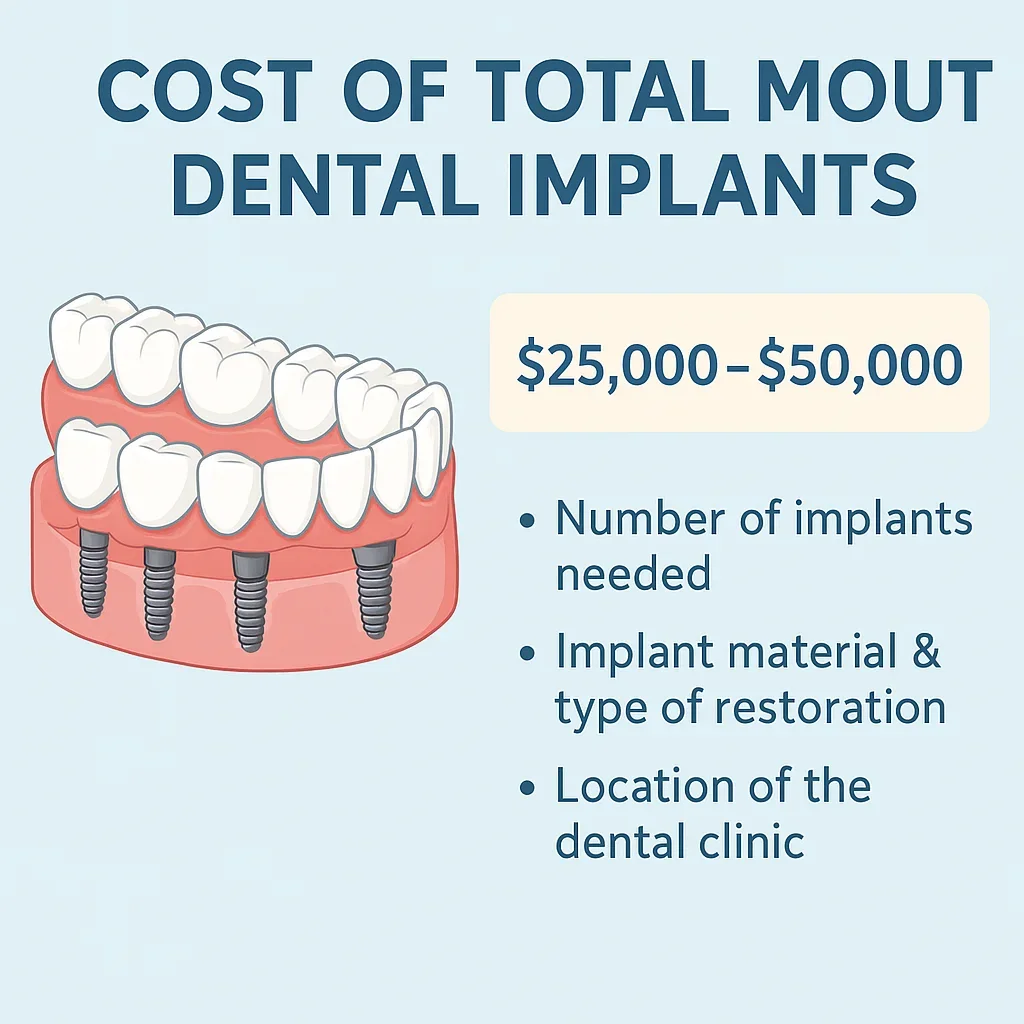
Financing Options and Insurance Insights for Full Mouth Implant Costs
The cost of total mouth dental implants can feel overwhelming at first glance, but with the right financing strategy and a clear understanding of insurance possibilities, patients can make treatment far more affordable and manageable. Full arch implant restoration is a major oral health investment—one that restores chewing function, aesthetics, confidence, and long-term wellness. Because of its transformative impact, many clinics, financial institutions, and dental insurance providers offer programs to help patients distribute costs over time.
This section provides a complete overview of how financing works, what payment plans are available, how insurance can help, what questions patients should ask before making financial commitments, and how to avoid common pitfalls. By understanding these options, you can manage the cost of total mouth dental implants without compromising on the quality of care or the long-term results of your treatment.
1. Understanding Why Full Mouth Implants Are a Long-Term Investment
Before exploring financing or insurance coverage, it’s essential to recognize why full mouth implant treatment carries a higher cost compared to dentures or bridges. Unlike removable prosthetics, implants preserve bone health, restore natural chewing strength, and last decades with proper care.
Cost vs. Value Perspective
While the upfront cost may be significant, full mouth implants eliminate the need for constant adjustments, replacement dentures, adhesives, and frequent dental visits. Over 10–20 years, these savings add tremendous value and reduce the long-term financial burden. This lifetime perspective helps patients understand that the cost of total mouth dental implants aligns with both medical benefits and long-term savings.
2. Financing Plans Provided by Dental Clinics
Many modern clinics offer in-house financing options to make the treatment more accessible.
Zero-Interest Payment Plans
Some clinics offer 6- to 18-month interest-free payment options. These plans allow patients to divide the overall cost into multiple manageable monthly installments without paying additional interest.
Extended Low-Interest Financing
For patients who prefer lower monthly payments over longer time periods, dental centers may partner with third-party lenders that provide extended financing with a small interest rate. These plans help distribute the cost of total mouth dental implants across 24, 36, or even 60 months.
Custom Payment Schedules
Some clinics design personalized payment timelines based on the patient’s budget and treatment phases. This flexibility can make high-quality care accessible without requiring a large upfront payment.
3. External Financing Through Healthcare Credit Providers
In addition to in-house financing, patients can use healthcare-specific credit companies to spread out their payments.
Medical Credit Cards
Programs like CareCredit or similar providers allow patients to use a health-designated credit line specifically for major dental procedures. These programs may offer promotional interest rates, making them an attractive option.
Personal Medical Loans
Some financial institutions offer medical loans at competitive rates. These loans can be used for full arch implants and paid back over several years. They provide another structured way to manage the cost of total mouth dental implants.
4. Savings Accounts and Pre-Tax Options (Varies by Country)
In some countries, government-supported programs allow patients to use pre-tax income for major healthcare expenses.
Health Savings Accounts (HSA)
HSAs let patients use tax-free funds for qualified medical expenses. In certain regions, full mouth implants may qualify as medically necessary.
Flexible Spending Accounts (FSA)
FSAs allow employees to set aside pre-tax money for dental treatments, reducing overall financial burden.
Patients should check local regulations, as coverage varies widely depending on the country.
5. Insurance Considerations and What to Expect
Dental insurance coverage for implants varies dramatically. While some insurance plans still classify implants as cosmetic, many modern policies are beginning to recognize their medical importance.
Basic Insurance Limitations
Most insurance plans do not cover the full cost of total mouth dental implants. However, they may cover diagnostic imaging, extractions, temporary prosthetics, or portions of surgical procedures.
Partial Coverage for Medically Necessary Procedures
In some cases, bone grafting, gum treatment, or infection control may be covered because they are essential for oral health—not cosmetic.
Annual Maximums
Many dental insurance plans have annual spending limits between $1,000 and $2,000, which is only a small portion of the total investment.
Medical Insurance Possibilities
In exceptional cases—such as trauma, congenital defects, or medical conditions—medical insurance may cover part of the implant surgery.
6. Dental Tourism and How It Reduces Overall Costs
Many patients choose to travel abroad for treatment due to lower prices in certain countries. For example, high-quality clinics in Turkey often offer complete full arch implant packages that are 60–70% more affordable than in the US, Canada, or Western Europe, without compromising quality.
Benefits of Dental Travel Packages
These packages often include:
- Hotel accommodation
- Airport transfers
- Translation services
- Post-operative follow-up
Travel-friendly clinics provide outstanding care while significantly reducing the cost of total mouth dental implants.
7. Questions to Ask Before Choosing a Financing Plan
To avoid surprises, patients should ask clinics and financing providers the following questions:
- What is the total treatment cost, including extras?
- Are there any hidden fees or interest charges?
- What is the interest rate for long-term financing?
- Is there a penalty for early repayment?
- Does the clinic assist with insurance claims?
8. Red Flags to Avoid
Some clinics advertise suspiciously low prices or unrealistic financing terms.
Extremely Low Upfront Prices
If the total offered price is far below market value, this may indicate inferior materials, inexperienced surgeons, or incomplete treatment packages.
No Written Treatment Plan
A reputable clinic always provides a detailed, written breakdown of every stage of treatment—including all associated costs.
In conclusion, patients have many options to make the cost of total mouth dental implants more manageable. By understanding financing plans, insurance benefits, dental tourism opportunities, and potential red flags, individuals can confidently plan their treatment while protecting their financial well-being.