
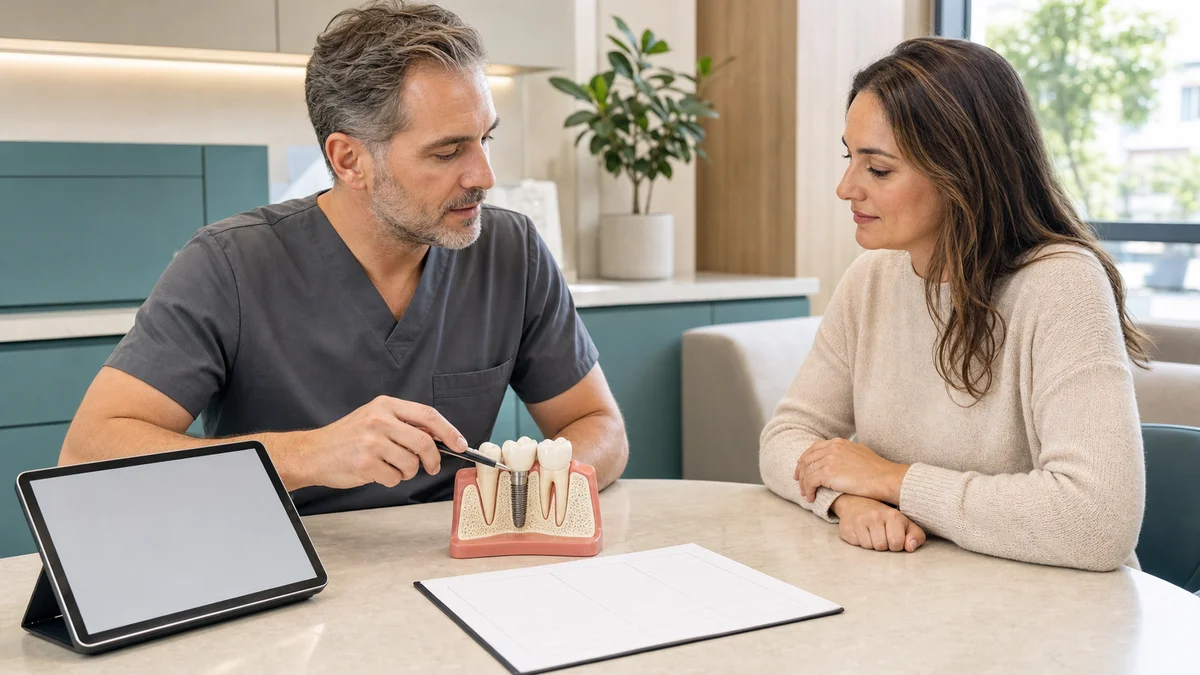
current cost of dental implants is not one universal fee. A complete quote may include examination and imaging, disease control, extraction, implant body, abutment, temporary tooth, final crown or bridge, bone or gum procedures, sedation, reviews and maintenance. Ask for a tooth-by-tooth written plan showing what is included, conditional or excluded. Your anatomy, health, restoration design, location and coverage determine the actual total.
People searching current cost of dental implants often see figures that describe different services. One advertisement may list only the screw placed in bone; another may include the connector and crown; a third may describe a whole-arch provisional bridge but not the definitive restoration. Those amounts cannot be compared until every clinical and prosthetic component is identified.
Dental implants are medical devices surgically placed in the jaw. The U.S. Food and Drug Administration explains that an implant system includes an implant body and an abutment and may include an abutment screw; the abutment supports a crown, bridge or denture. The visible tooth is therefore not the implant body itself. This distinction is the foundation of an honest current cost of dental implants estimate.
This guide does not publish a fixed price or promise candidacy, healing time or longevity. Fees change with country, currency, clinician, laboratory, diagnosis, materials and treatment date. Instead, it gives you a reproducible method to compare written plans. You can also review clinician-led treatment information on the Redent Klinik English website, but only an examination can determine an individual plan.
Why the current cost of dental implants has no single number
“An implant” may mean a single implant body, a complete single-tooth restoration, two implants supporting a bridge, several implants supporting a removable overdenture, or a fixed full-arch prosthesis. Each has a different number of devices, connectors, prosthetic teeth, appointments and maintenance requirements. A price without the treatment design is incomplete.
Patient factors also change the sequence. Some sites can be treated after routine planning; others require control of periodontal disease, extraction, socket healing, bone augmentation, sinus-related planning or soft-tissue management. General health, medicines, smoking, bite forces and oral hygiene can affect candidacy and healing. The FDA advises patients to discuss benefits, risks and suitability with their provider and notes that healing may take several months or longer.
A meaningful current cost of dental implants answer must therefore name the restoration, tooth or arch, implant count, clinical stages and included follow-up. The most recent online headline is not a personal quote.
1. Confirm what the quoted “implant” includes
For a single missing tooth, the final reconstruction commonly has three main layers: the implant body in bone, the abutment connecting through the gum, and the crown that replaces the visible tooth. Additional small components, impressions or scans, laboratory analogues and screws may be part of the workflow. A temporary tooth may be separate.
- Implant body: the device placed surgically in the jaw.
- Abutment and screw: the connector between implant and restoration.
- Provisional restoration: a temporary tooth or bridge used during selected phases.
- Definitive restoration: the final crown, bridge, overdenture or fixed full-arch prosthesis.
- Clinical and laboratory work: planning, placement, impressions or scans, fabrication, fitting and adjustment.
Ask the clinic to tick each line as included, excluded or not yet known. The current cost of dental implants cannot be verified when the visible crown or final bridge is missing from the estimate.
This component check prevents current cost of dental implants comparisons from mixing a device-only offer with a completed tooth.
2. Identify the replacement design before comparing fees
A single-tooth implant differs from an implant bridge. An overdenture clips to implants but remains removable by the patient; a fixed full-arch prosthesis is removed only by a clinician when indicated. These options differ in implant count, prosthetic materials, laboratory complexity, cleaning access and repair pathway.
“Full mouth” is also ambiguous. It may refer to one arch or both, fixed or removable teeth, immediate provisional teeth or final teeth, and retained natural teeth or planned extractions. Do not assume a package covers upper and lower arches because its photographs show a complete smile.
The first page of a current cost of dental implants proposal should state the design in plain language. It should list each arch, the planned implant count and whether the prosthesis is fixed or patient-removable.
Once the design is named, current cost of dental implants becomes a comparison of like-for-like treatment rather than slogans.
3. Add consultation, imaging and digital planning
Planning may include medical and dental history, clinical examination, periodontal evaluation, photographs, scans or impressions, bite records and radiographs. Three-dimensional imaging may be indicated when it answers a surgical question, but not every test is automatically necessary for every person. The clinician should explain why each record is taken.
Implant planning considers bone dimensions, nearby teeth, nerves, sinus anatomy, prosthetic space and the intended final tooth position. A surgical guide may be recommended for certain cases. A guide is a planning and placement aid, not a guarantee of an outcome.
Ask whether imaging, radiology reporting, planning software, guide design and guide fabrication are included in the current cost of dental implants. If older scans are available, the dentist must decide whether they are current and suitable rather than simply reusing them to save money.
Diagnostics are a legitimate part of current cost of dental implants when they answer documented safety and restorative questions.
4. Separate disease control and extraction
Implants do not treat active tooth decay or periodontal disease elsewhere in the mouth. Plaque control, gum stability and management of infection are important before elective implant care. WHO notes that oral diseases are largely preventable and highlights poor hygiene and tobacco among modifiable risk factors.
If a failing tooth remains, the plan may include extraction, management of infection, socket preservation or a healing period. A simple extraction is not the same as removal of a fractured or impacted root, and an extraction fee does not automatically include grafting. The sequence may change after the site is examined directly.
For current cost of dental implants, request separate diagnoses and separate lines for periodontal treatment, extraction and site preservation. Do not let an “all included” phrase obscure which conditions are excluded.
Disease-control items can change current cost of dental implants, but they must remain clinically justified rather than automatically added to every package.
5. Understand bone graft and sinus-related charges
An implant needs an appropriate three-dimensional foundation. Where bone volume or contour is insufficient, the dentist may discuss grafting, ridge augmentation, socket preservation or a sinus-related procedure. These terms describe different interventions with different materials, surgical time, healing and risk.
A graft is not automatically required for every implant, and a remote photograph cannot establish need. Ask what clinical or radiographic finding supports the recommendation, which material and technique are proposed, whether membranes or fixation are involved, and whether the procedure is staged or performed with implant placement.
The current cost of dental implants estimate should mark grafting as confirmed, conditional or not indicated. If the decision can only be made during surgery, obtain the possible added charge and consent process in advance.
Bone and sinus procedures can materially change current cost of dental implants because they add treatment, materials, reviews and sometimes another healing stage.
6. Price the temporary tooth separately
“Teeth in a day” and similar phrases may refer to provisional teeth attached soon after placement in selected patients. Immediate placement, immediate loading and a same-day temporary are different decisions. Each depends on site conditions, implant stability, bite, prosthetic design and clinician judgment.
A temporary restoration may be removable, tooth-supported or implant-supported. It may need relining, repair or replacement while tissue changes. The provisional shape can help guide soft tissue and test appearance or function, but it is not necessarily made from the same material as the final restoration.
Ask whether the current cost of dental implants includes an interim tooth, how many provisional repairs are covered, what eating restrictions apply and when the definitive restoration is charged.
Temporary care is part of current cost of dental implants whenever you need appearance or function during healing; it should never be confused with the final prosthesis.
7. Distinguish implant placement from the final crown or bridge
Surgery and prosthetic reconstruction may be performed by one clinician or coordinated across practitioners. The surgeon’s invoice may end after placement and uncovering, while a restorative dentist and laboratory provide the abutment and crown later. A referral plan should identify responsibility for each phase.
For a crown, ask whether the abutment is prefabricated or custom, whether the restoration is screw-retained or cement-retained, what material category is proposed, and which laboratory fabricates it. These decisions can affect retrievability, contour, aesthetics, repair and fee. No one design is universally superior for every site.
A complete current cost of dental implants comparison combines surgical and restorative quotations without counting the same component twice.
Final restoration details give current cost of dental implants clinical meaning beyond the implanted screw.
8. Ask about implant system and traceability
The FDA recommends asking for the brand and model of the implant system and keeping that information. Traceability matters because future clinicians may need compatible instruments, screws or components for maintenance or repair. A verbal description such as “premium implant” is not a substitute for records.
Ask for a device or implant passport where available, including manufacturer, system, dimensions and placement date. Clarify whether the quoted abutment and restorative components are compatible with the planned system and whether replacements can be obtained in your home country.
Brand alone should not determine treatment or imply success, but component availability can influence future current cost of dental implants. A less familiar system may create logistical expense if a screw or prosthetic part is needed later.
Traceability protects the long-term usefulness of the current cost of dental implants investment without creating a lifetime warranty.
9. Include sedation and medical coordination only when indicated
Local anesthesia is common in implant procedures, while additional sedation options vary by case, facility, jurisdiction and patient need. Sedation can introduce separate assessment, monitoring, medication, staffing, recovery and escort requirements. It should not be added automatically because an implant is being placed.
Medical conditions and medicines can affect surgical planning. The implant clinician may coordinate with a physician where appropriate, but patients should not stop or change prescribed medicines without professional direction. Uncontrolled diabetes, smoking and local infection are among factors the FDA discusses in relation to healing or failure risk.
If sedation or medical tests are recommended, ask why and how they change current cost of dental implants. The written estimate should distinguish required facility charges from optional comfort services.
Medical coordination belongs in current cost of dental implants only when it responds to the individual health assessment.
10. Account for healing stages and review visits
Implant treatment is often a sequence rather than one appointment. It can include placement, post-operative review, suture management, healing, exposure or abutment connection where needed, scans or impressions, try-in, delivery and bite adjustment. The exact sequence varies with the system and clinical plan.
Time itself is not a billable component in a simple sense, but more stages can mean additional visits, travel, temporary care and time away from work. The FDA notes that healing may take several months or longer and that a temporary abutment is commonly present during healing.
Ask which routine reviews are included in current cost of dental implants, how long the included period lasts and what would trigger a separately charged visit.
A stage schedule makes current cost of dental implants easier to budget and prevents the first surgical payment from being mistaken for the total.
11. Budget for complications without assuming they will occur
Most planning aims to reduce risk, but no clinician can guarantee that an implant will integrate or remain complication-free. The FDA lists possible injury to nearby teeth or tissues, sinus perforation, jaw fracture, abnormal bite, screw loosening, local or systemic infection, implant looseness, cleaning difficulty, untreated periodontal disease and nerve-related numbness.
A complication is not proof of negligence, and a low fee is not proof of poor care. What matters financially is the written policy: which early adjustments, emergency visits, screw tightening, provisional repairs, graft reviews or removal procedures are included, and which require a new plan.
The current cost of dental implants should not add an invented “failure fee,” but it should disclose who provides urgent care and how unplanned treatment is assessed.
Transparent complication policies help patients judge current cost of dental implants without turning a risk discussion into a result guarantee.
12. Compare one implant, an implant bridge and alternatives
One missing tooth may be managed with an implant crown, a tooth-supported bridge, an adhesive bridge, a removable partial denture, orthodontic space closure or sometimes monitored space, depending on the site and clinical circumstances. Multiple missing teeth may not require one implant per tooth; a bridge may use fewer implant supports, but design depends on biomechanics and anatomy.
Alternatives involve different trade-offs. A conventional bridge uses neighboring teeth; a removable denture has different stability and maintenance; orthodontics takes time and requires retention; no replacement can allow functional or positional consequences in some sites. A dentist should explain benefits, risks, invasiveness, maintenance and prognosis.
Compare the whole pathway, not only current cost of dental implants. The lowest initial fee may not be the most appropriate plan, and the highest fee does not guarantee an outcome.
Alternatives give current cost of dental implants the clinical context needed for informed consent.
13. Insurance, public coverage and financing
Coverage depends on country, contract, indication, provider network, waiting periods, exclusions, annual or lifetime limits and prior authorization rules. NHS guidance says implants are usually private and expensive, with limited exceptions for particular clinical needs. In the United States, dental plans differ, and Medicare dental coverage rules are specific; never infer coverage from another person’s claim.
Ask the insurer in writing using the exact procedure codes and staged treatment plan. A pre-estimate or authorization may not guarantee payment if eligibility or circumstances change. Confirm whether grafting, temporary teeth, final prosthesis and maintenance are assessed separately.
For financed current cost of dental implants, calculate the deposit, every installment, interest or fees, total of payments, missed-payment consequences and refund rules. A monthly figure is not the treatment total.
Insurance and finance can change out-of-pocket current cost of dental implants, but neither should determine diagnosis or hide the full obligation.
14. Calculate dental travel as an all-in journey
Cross-border care can change clinic fees, but also adds flights, accommodation, local transport, meals, companion costs, currency conversion, time off work and possible return visits. A short itinerary may be incompatible with disease control, staged grafting, healing, laboratory remakes or review of tissue response.
Check clinician registration, clinic licensing, consent documents, device records, laboratory information, complaint pathway and emergency arrangements in the treatment country. Ask who can maintain the implant system at home and whether remote advice replaces or only supplements an examination.
International current cost of dental implants equals the full clinical plan plus realistic travel for every expected stage, not merely the advertised surgery package.
Follow-up logistics can change current cost of dental implants substantially if a prosthetic adjustment or repair requires another trip.
15. Add maintenance to the ownership cost
Implants and prostheses require daily cleaning and professional review. The FDA advises careful oral hygiene, regular dental visits and prompt contact if an implant is loose or painful. Cleaning needs vary with a single crown, bridge, overdenture or fixed full-arch design.
Maintenance may involve examination, radiographs when indicated, professional cleaning, screw checks, replacing worn overdenture attachments, repairing veneering material, replacing a night guard or removing a prosthesis for service. Natural teeth and implants can both be affected by plaque-related disease.
Ask for a written maintenance schedule and typical policy for repairs. Long-term current cost of dental implants should reserve for care without claiming a precise service life.
Maintenance turns current cost of dental implants into a healthcare ownership budget rather than a one-time device purchase.
16. Decision table for current cost of dental implants
Complete this table from two written plans. Use “unknown” rather than guessing.
| Quote item | Plan A | Plan B | Question before consent |
|---|---|---|---|
| Replacement design | Record crown, bridge, overdenture or fixed arch | Record exact design | Are these clinically equivalent? |
| Arch and tooth sites | Record every site | Record every site | Is one or both arches included? |
| Implant count | Record planned number | Record planned number | Why is this support design proposed? |
| Diagnostics | List examination and imaging | List examination and imaging | Which records are clinically indicated? |
| Site preparation | Mark extraction or graft status | Mark extraction or graft status | Confirmed, conditional or excluded? |
| Temporary teeth | Describe and price | Describe and price | Is this provisional or definitive? |
| Implant system | Record brand and model | Record brand and model | Will I receive traceability records? |
| Final prosthesis | Record material and retention | Record material and retention | Are abutments and laboratory work included? |
| Reviews | Record included period | Record included period | What triggers another charge? |
| Maintenance | Record cleaning and repair policy | Record cleaning and repair policy | Who provides long-term care? |
| Travel | Add every expected trip | Add every expected trip | What if a remake is needed? |
| Total obligation | Add confirmed and conditional items | Add confirmed and conditional items | What is still unknown? |
The table makes current cost of dental implants comparable across scope, risk and aftercare. It does not determine which plan is clinically appropriate.
17. Formula for an itemized estimate
Use a written equation rather than a single headline:
Consultation and indicated records + disease control + extraction + site development + implant placement + sedation when indicated + provisional restoration + abutment + final crown, bridge or denture + included reviews + maintenance allowance + travel and finance costs − confirmed insurance payment = estimated out-of-pocket current cost of dental implants.
Mark each element as confirmed, conditional or excluded. Do not subtract expected insurance until the payer confirms how the claim is handled, and do not assume a promotional “free” item has no conditions. Record the currency, tax status and validity date of every quote.
This formula keeps current cost of dental implants tied to documents you can update if the diagnosis or exchange rate changes.
18. Final questions before signing
- What diagnosis and goal support the proposed implant treatment?
- What alternative treatments, including no replacement, were discussed?
- Which implant sites, arch and prosthesis are included?
- Does the estimate include the implant body, abutment and final restoration?
- Which extractions, grafts or sinus procedures are confirmed or conditional?
- What temporary tooth will I have during healing?
- What implant system is used, and will I receive its records?
- Who provides surgery, prosthetics, emergencies and long-term maintenance?
- What clinical reviews, repairs or remakes are included?
- What happens financially if the plan changes after surgery begins?
- How many trips and how much healing time are expected?
- What is the total of payments after finance and travel?
Answers should match the consent form and itemized current cost of dental implants quote. Do not accept a fixed outcome or lifetime promise in place of documented risks and maintenance.
Frequently asked questions about current cost of dental implants
What is the current cost of dental implants per tooth?
There is no universal per-tooth amount. A complete single-tooth plan can include diagnosis, imaging, extraction or grafting where needed, implant body, abutment, temporary tooth, final crown and reviews. Location, materials and patient anatomy also vary. Ask for a dated itemized quote.
Does the advertised implant price include the crown?
Not always. Some prices describe only surgical placement of the implant body. Confirm whether the abutment, screw, temporary tooth, final crown, laboratory work and fitting are included. A device-only amount is not the price of a completed tooth.
Why can two current cost of dental implants quotes differ so much?
The plans may use different prostheses, implant counts, diagnostic records, graft assumptions, temporary teeth, materials, laboratories and follow-up. Compare every site and component. A price difference is not evidence of quality by itself.
Are bone grafts always required?
No. Need depends on bone dimensions, implant position, site history and the restorative plan. The clinician should explain the examination or imaging finding, technique, material, timing and added fee. Some decisions may remain conditional until surgery.
Can I receive a temporary tooth immediately?
Possibly, but immediate placement and loading are individual clinical decisions. The temporary may be removable or fixed and may not be the final restoration. Ask about candidacy, bite restrictions, repair policy and the separate final-prosthesis stage.
How long does implant treatment take?
Timing varies with disease control, extraction, grafting, healing, implant stability and prosthetic work. The FDA notes that healing may take several months or longer. Your clinician should provide a staged estimate without guaranteeing an exact biological timetable.
Will insurance pay the current cost of dental implants?
Coverage varies by contract, country, indication, network, exclusions and benefit limits. Submit the exact staged plan to the payer and request a written response. Authorization or an estimate may not guarantee payment if eligibility or circumstances change.
Is a lower implant price unsafe?
Price alone cannot establish safety or quality. Evaluate clinician credentials, diagnosis, consent, implant traceability, infection control, restorative design, emergency pathway and maintenance. A higher price also cannot guarantee success.
Do dental implants last forever?
No clinician should promise lifetime survival. Implants, screws and prostheses can develop biological or mechanical complications and may need maintenance, repair or replacement. General health, smoking, oral hygiene, bite and attendance influence risk.
When should I contact a dentist after implant care?
Seek prompt advice for increasing pain, swelling, bleeding, discharge, fever, persistent numbness, a loose implant or prosthesis, or a changed bite. Difficulty breathing or swallowing and rapidly spreading facial swelling require urgent medical assessment.
A safer conclusion than one price
The most useful current cost of dental implants is a dated, itemized total linked to a diagnosis and final restoration design. It names the implant body, connector, temporary care, definitive teeth, site procedures, reviews and maintenance. It also makes conditional charges visible before treatment starts.
Cost cannot replace candidacy or informed consent. The FDA advises discussing benefits, risks, general health, smoking, healing and device identification with the provider. A lower quote should not remove necessary planning, and a higher one cannot guarantee integration or lifetime service.
If you want to prepare for a clinician-led assessment, use the Redent Klinik English contact page. Bring medical information, prior images and competing written quotes. The final current cost of dental implants should be understandable enough that you know what tooth or arch you will receive, who maintains it and which expenses remain uncertain.
Official sources
- U.S. Food and Drug Administration: dental implant components, patient recommendations, benefits and risks
- NHS: dental implants, treatment structure and access
- Centers for Medicare & Medicaid Services: current Medicare dental coverage framework
- American Dental Association MouthHealthy: handling dental costs and plan types
- American Dental Association
- World Health Organization: oral health fact sheet