
Quick answer: custom abutment cost has no dependable universal amount. The total can reflect the scan or impression, patient-specific CAD/CAM design, implant-compatible component, material, laboratory work, clinician approval, placement, crown, adjustments, and follow-up. Compare itemized plans after an examination, and confirm what insurance, financing, travel, remakes, and maintenance could add before choosing.
Searching for custom abutment cost usually means a patient has already seen an implant estimate and wants to know why one connector costs more than another. The abutment is the component between an implant fixture and the restoration. A custom abutment is designed for an individual site rather than selected only from a range of prefabricated shapes. That difference can affect design work, laboratory steps, material, delivery time, and the way a quote is structured.
A headline price cannot show whether the proposed abutment is compatible with the implant, whether the final crown is included, or whether the surrounding gum and bite have been properly assessed. This guide explains how to compare scope without giving a fixed fee, remote diagnosis, or outcome promise. It uses current device and patient-safety information from the U.S. Food and Drug Administration and periodontal guidance from the American Academy of Periodontology. Individual recommendations still require an examination and complete records.
For an overview of restorative planning, visit the Redent Klinik English website. If you want a written, case-specific assessment after sharing appropriate records, use the Redent Klinik contact page. A remote estimate should remain conditional until a clinician examines the implant site and confirms the exact system and restorative plan.
1. What does custom abutment cost actually describe?
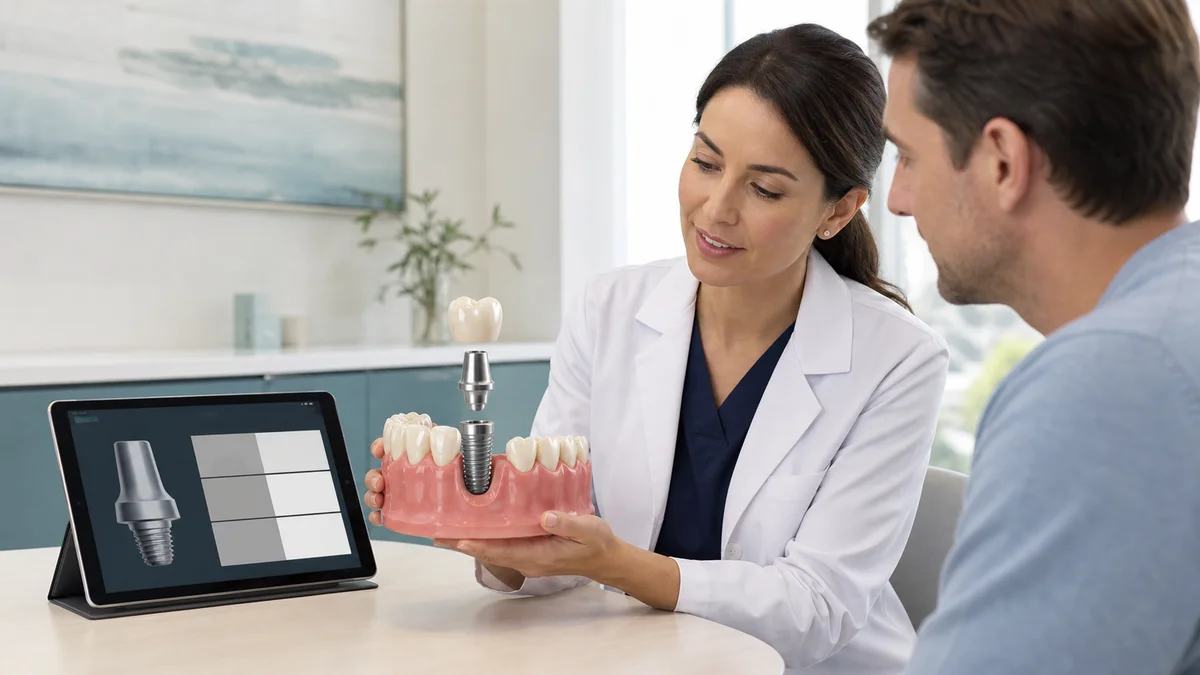
The FDA classifies dental implant abutments as devices used with endosseous dental implants. Patient-specific abutment clearances describe a component made to support a final prosthesis and designed from case information. In a single-tooth restoration, the implant fixture is placed in bone, the abutment connects to that fixture, and the crown restores the visible tooth. These are related but distinct components.
That distinction is essential when comparing custom abutment cost. One estimate may list only the laboratory-manufactured abutment. Another may combine the abutment, screw, digital design, crown, and delivery appointment. A third may bundle the entire implant process, including surgery. None of those formats is automatically wrong, but comparing their totals without normalizing the scope can create a misleading “cheap versus expensive” conclusion.
Ask the practice to identify the clinical endpoint represented by the number. Does it end when the component arrives from the laboratory, when the dentist seats it, or when the final crown is adjusted and accepted? Also ask whether taxes, shipping, scan bodies, implant-level records, provisional restorations, and follow-up are separate. The useful number is the amount attached to a clearly defined service, not a vague average.
2. Stock versus custom abutments: why the distinction changes the quote
A stock abutment is a prefabricated component available in predetermined shapes, heights, and angles. A custom abutment is designed within the permitted parameters of a device system for a specific patient and implant position. FDA summaries for patient-specific abutments describe CAD/CAM design based on the planned prosthesis and case indications. They also emphasize prescription use and compatibility with identified implant systems.
The difference in custom abutment cost can therefore reflect digital or conventional records, technician time, design review, milling or other validated manufacturing, quality checks, and the selected material. It does not follow that every implant needs a custom component. In some positions, a compatible stock abutment may satisfy the restorative plan. In other positions, patient-specific contours or angulation may help the clinician manage restorative space, crown form, or margin placement.
“Custom” is a manufacturing and design description, not a guarantee of comfort, appearance, hygiene, or long-term success. The most expensive option is not automatically the most suitable. Ask the restorative dentist to explain what problem the custom design is intended to solve, which alternative was considered, and whether the benefit is clinically meaningful in your site.
3. What should an itemized custom abutment cost include?
A complete quote should separate required services from possible additions. The laboratory fee is only one part. Some practices include implant-level scanning, design communication, placement, and adjustment in one restorative fee; others bill them separately. Written detail protects both the patient and the care team when the treatment occurs over several appointments.
When reviewing custom abutment cost, ask whether the following are included, excluded, or dependent on clinical findings:
- Examination, periodontal assessment, bite evaluation, and review of medical and dental history.
- Appropriate imaging and confirmation of the implant brand, platform, size, connection, and position.
- Implant-level digital scan or impression, scan body or impression component, and verification records.
- CAD/CAM design, technician communication, restorative dentist approval, and any design revision.
- The patient-specific abutment, definitive screw or other specified retaining component, material, and manufacturer.
- Laboratory quality checks, shipping, taxes, sterilization or handling requirements, and traceability records.
- Clinical try-in or seating, radiographic confirmation when justified, torque according to system instructions, and bite checks.
- The provisional or definitive crown, crown material, laboratory shade work, contacts, occlusion, and delivery.
- Post-delivery review, routine adjustments, and written terms for a design error, manufacturing defect, or remake.
If the crown is not included, request a separate restorative estimate. If the implant was placed by another clinician, confirm who will obtain the device record and accept responsibility for compatibility. An “all-inclusive” label should never replace a list of components and conditions.
4. How CAD/CAM design and laboratory workflow affect custom abutment cost
Patient-specific work begins with accurate records. Depending on the system and case, the restorative team may use an implant-level intraoral scan or a conventional impression. A scan body or impression coping communicates the three-dimensional implant connection and orientation. The laboratory then designs the abutment in relation to the proposed crown, nearby teeth, available space, soft-tissue contours, and system limits.
Part of custom abutment cost may pay for this workflow rather than for raw material alone. A design might need review by the restorative dentist before manufacture. FDA-cleared patient-specific abutment summaries describe clinician prescription and, in some systems, clinician approval before production. That approval is a safety and accountability step; it should not be treated as a decorative digital add-on.
More complex is not always better. Repeated design changes can add time, but a laboratory should not be encouraged to add unnecessary complexity merely to justify a fee. Ask who designs the component, which validated workflow is used, how the implant position is verified, and what happens if the clinical fit does not match the digital plan. A transparent process explains both the fee and the limits of the technology.
5. Compatibility, material, and traceability in custom abutment cost
The connection between the implant and abutment is mechanically important. FDA documentation for patient-specific abutments identifies compatible implant systems and describes performance testing at the implant-abutment interface. Patients should receive the implant brand and model information and keep it in their records. A generic statement that a component “fits most implants” is not enough.
A responsible custom abutment cost comparison records the implant manufacturer, platform, connection, abutment manufacturer, material, screw, and any system-specific limitations. If a third-party component is proposed, ask whether it is authorized or cleared for that connection and how the treatment team documents compatibility. A lower component fee can be poor value if future dentists cannot identify or service the system.
Custom abutments are commonly discussed in titanium, zirconia, or hybrid configurations, but the available choices depend on the device system and clinical indication. Material selection may consider strength, tissue position, restorative space, esthetic demands, crown design, and the clinician’s ability to retrieve or maintain the restoration. No material is universally superior. Ask why a material is recommended and whether its laboratory, repair, and replacement implications are included.
6. Does crown retention change custom abutment cost?
A restoration may be designed with screw retention, cement retention, or another system-specific approach. The choice is not merely a pricing preference. Access-hole position, implant angulation, retrievability, restorative space, esthetics, occlusion, material thickness, soft-tissue conditions, and the risk of residual cement can influence planning. The dentist should explain the selected design in relation to the individual site.
For a cement-retained crown, custom abutment cost may be separate from the crown because the patient-specific abutment is manufactured first and the crown fits over it. For some screw-retained designs, the abutment and crown relationship may be combined differently. A line item called “implant crown” does not reveal which components are included, so ask for the exact restorative architecture.
Neither retention approach guarantees a complication-free result. Screws can loosen or components can wear; cement-related tissue problems are possible if excess material remains. These risks do not dictate the same answer for every patient. The relevant question is whether the proposed design can be delivered, cleaned, monitored, and repaired predictably in that specific position.
7. custom abutment cost decision table: compare like with like
This table is a comparison aid, not a treatment recommendation or fee schedule. Enter the answers from each practice after examination. If a row is unclear, the totals are not yet comparable.
| Option or decision | Why it may be discussed | What the quote should identify | Question to ask |
|---|---|---|---|
| Compatible stock titanium abutment | A prefabricated shape may meet the restorative requirements | Exact system, component, screw, placement, and crown status | What clinical need would a custom design add in this site? |
| Custom titanium abutment | Patient-specific contours, height, or angulation may be planned | Scan or impression, design, manufacture, material, screw, and delivery | Who approves the design and how is compatibility documented? |
| Custom zirconia or hybrid option | Esthetic or restorative considerations may justify discussion | Device configuration, material limits, laboratory, and replacement terms | Why is this material appropriate for my position and bite? |
| Screw-retained restoration | Retrievability or cement avoidance may matter | Abutment-base relationship, screw, access closure, crown, and maintenance | Where will the access channel emerge and can the restoration be serviced? |
| Cement-retained restoration | Access position or crown design may favor this approach | Separate abutment and crown fees, cementation, margin plan, and follow-up | How will excess cement be controlled and the tissue monitored? |
The table helps reveal why two custom abutment cost figures may be different without proving that the higher or lower one is better. Compatibility, complete scope, clinical appropriateness, and maintenance access matter more than the label alone.
8. How examination findings influence custom abutment cost
An abutment cannot be designed safely from price preferences alone. The restorative dentist may assess implant position, depth, angle, stability, surrounding tissue, emergence space, neighboring teeth, opposing bite, parafunctional habits, smile line, hygiene access, and the health of the implant site. The implant record and current imaging may be necessary when another practice placed the fixture.
These findings can change custom abutment cost because they can change the records, design, material, provisional phase, or crown. They may also reveal that the implant is not ready to restore or that another clinical issue needs attention. An online calculator cannot determine implant integration, tissue health, connection damage, or whether a restorative plan is feasible.
The American Academy of Periodontology advises that implant candidates need appropriate oral and general health, adequate bone, healthy gums, home care, and regular visits. That guidance supports a broader point: paying for a custom component does not replace periodontal assessment or maintenance. If the tissue is inflamed, the bite is unstable, or the implant information is unknown, clarifying those issues is more important than rushing the laboratory order.
9. Insurance and custom abutment cost
Dental benefits vary by contract. The implant fixture, abutment, crown, imaging, provisional restoration, and associated procedures may be evaluated separately. A plan can apply deductibles, coinsurance, annual maximums, waiting periods, frequency limits, missing-tooth rules, alternate-benefit provisions, network rules, or exclusions. Coverage of one part does not prove coverage of the complete restoration.
To estimate net custom abutment cost, ask the practice for an itemized treatment plan and request a written predetermination from the insurer. Compare the submitted fee with the plan’s allowed amount, then apply the remaining deductible, coinsurance, and annual maximum. Confirm whether the laboratory-made custom component and the final crown are considered distinct services under your plan.
A predetermination is generally an estimate, not a guarantee of payment. Eligibility, remaining benefits, clinical documentation, network status, and the plan itself can change before the claim is processed. Do not begin irreversible treatment solely because a representative gave an informal telephone estimate. Keep the written response and ask the practice which amount remains uncertain.
10. Financing the custom abutment cost safely
Financing can spread payments, but it does not reduce the clinical fee unless a genuine discount is documented. Medical credit cards, installment plans, and third-party loans may include interest, deferred-interest conditions, origination fees, late fees, or credit consequences. The U.S. Consumer Financial Protection Bureau advises consumers to understand promotional terms and what happens if a balance is not paid within the specified period.
When financing custom abutment cost, write down four separate figures: the total dental treatment fee, the insurer’s estimated payment, the amount borrowed, and the total of all loan payments. Compare annual percentage rate and total repayment, not just a monthly amount. Do not count uncertain insurance benefits as money already received.
Ask how refunds are handled if the component is not manufactured, the design changes, or a planned service is not provided. If the lender pays the clinic in advance, establish whether any refund returns to the loan balance or to the patient. Read the agreement before signing; a clinical consent form and a credit agreement are different documents.
11. Travel, dental tourism, and custom abutment cost
Patients comparing countries may see different fees because wages, laboratory markets, overhead, exchange rates, taxes, and local pricing structures differ. The safe comparison still requires identical scope. Add travel, accommodation, time away from work, extra appointments, payment conversion fees, temporary restoration care, and the possibility of returning for an adjustment.
For international custom abutment cost, verify the treating dentist’s authorization, implant brand and platform, abutment manufacturer, device traceability, laboratory, material, consent language, professional liability arrangements, and complaint process. Ask who will manage a loose screw, a fractured crown, tissue inflammation, or a remake after you return home. A local dentist may charge for assessment and may not have the required components.
A travel date should not force a final component onto an implant that is not clinically ready. Remote quotations should state their assumptions and remain conditional until examination. Be cautious with universal candidacy, a guaranteed timeline, pressure to pay immediately, or a promise that a custom abutment eliminates future risk.
12. Maintenance, repairs, and lifetime custom abutment cost
Delivery of the crown is not the end of implant care. The patient must be able to clean around the restoration, and the dental team should monitor the soft tissues, contacts, bite, screw or cement interface, and bone when clinically indicated. The FDA and periodontal guidance emphasize oral hygiene and regular professional review.
A lifetime view of custom abutment cost includes possible maintenance, professional cleaning, imaging when justified, crown repair, access-hole restoration, screw replacement, and management of tissue problems. These events do not occur in every case, and no responsible clinician can predict a universal schedule. Ask which routine reviews are included and which are billed separately.
Clarify the difference between a manufacturer’s device warranty, a laboratory remake policy, and the clinic’s clinical service terms. A warranty may have time limits, maintenance requirements, and exclusions. It cannot guarantee integration, prevent peri-implant disease, or promise that a crown will never chip, loosen, or wear. Keep the device identification and final restoration records for future care.
13. Red flags in a custom abutment cost quote
A price can look precise while leaving out the information needed for an informed decision. Pause and ask for clarification if you encounter any of these signs:
- A fixed final quote based only on a photograph, message, or panoramic image without an appropriate examination.
- No identification of the implant brand, platform, connection, abutment manufacturer, material, or screw.
- An “implant crown” price that does not say whether design, custom abutment, laboratory, placement, and adjustments are included.
- A claim that custom is always superior to stock, or that one material is best for every patient.
- A guarantee of appearance, comfort, implant survival, gum stability, or a complication-free lifetime.
- Pressure to authorize manufacture before the design, refund terms, and alternative plan are explained.
- No process for clinician design approval, component traceability, laboratory remake, or unexpected lack of fit.
- An insurance estimate presented as guaranteed payment or financing shown only as a monthly amount.
- No maintenance plan or no named provider for urgent care after travel.
These signs do not prove improper care, but they show that the custom abutment cost comparison is incomplete. Seek a written explanation or an independent restorative opinion when the implant record, diagnosis, compatibility, or scope remains uncertain.
14. Questions to ask before accepting custom abutment cost
Use the same checklist at every consultation. Consistent questions make different quote formats easier to normalize:
- What clinical finding makes a patient-specific abutment appropriate for this implant site?
- Would a compatible stock component meet the same restorative goal, and what are the trade-offs?
- Which implant brand, platform, connection, and size are recorded, and who verified them?
- Which company manufactures the abutment, what material is used, and is the component intended for this implant connection?
- Who creates and approves the CAD/CAM design before manufacture?
- Does the price include records, scan body, design, screw, shipping, placement, radiographic checks, crown, and adjustments?
- Which findings could change the estimate or delay restoration?
- What happens if the component does not fit, the tissue changes, or the crown requires a laboratory remake?
- How will the restoration be cleaned, retrieved, repaired, and monitored?
- Which insurance amount is estimated rather than confirmed, and what is the financing total?
After the answers are documented, custom abutment cost becomes a comparison of complete clinical plans rather than isolated line items. A well-explained quote should show what is known, what remains conditional, and who is responsible at each stage.
custom abutment cost FAQs
Is custom abutment cost always higher than a stock abutment?
Often a patient-specific workflow has additional design and laboratory steps, but pricing structures vary. A bundled stock-abutment crown at one practice cannot be compared directly with a custom component-only fee at another. Ask for the same endpoint and inclusions. The clinically appropriate choice depends on implant position, tissue, restorative space, crown plan, compatibility, and maintenance—not price alone.
Does custom abutment cost include the implant crown?
Not necessarily. The abutment and crown are different parts, and practices may bill them separately or together. Request a written statement covering the scan or impression, design, component, screw, laboratory, placement, crown material, delivery, and adjustments. If the crown is excluded, obtain its estimate before calculating the total restorative cost.
Can a dentist quote custom abutment cost before examining me?
A practice can explain typical fee structure or provide a conditional range, but a final plan requires adequate clinical information. Implant identity, position, tissue health, bite, restorative space, and readiness for restoration must be assessed. A remote estimate should list assumptions and possible changes rather than present a diagnosis or guaranteed final amount.
Why does custom abutment cost vary by material?
Material can change the validated device configuration, manufacturing workflow, laboratory fee, and restorative design. Titanium, zirconia, and hybrid arrangements have different indications and limitations depending on the system. The dentist should explain why the material suits the individual site; a higher material price does not by itself prove a better outcome.
Will dental insurance cover custom abutment cost?
Coverage depends on the exact plan and clinical documentation. Benefits may treat the implant, abutment, and crown separately and may apply deductibles, coinsurance, annual limits, exclusions, waiting periods, or alternate benefits. Obtain an itemized predetermination, but remember that it is generally an estimate and not a guarantee of payment.
Can custom abutment cost change after the laboratory starts?
It can if the approved plan changes, the implant record proves different, additional records are needed, or the crown scope was not included. The practice should explain authorization, cancellation, refund, revision, and remake terms before manufacture. No added service should appear without a clinical explanation and informed financial consent.
Does paying a higher custom abutment cost guarantee better gums or esthetics?
No. Patient-specific contours may be chosen to support a restorative objective, but tissue response and appearance depend on many biological, surgical, restorative, and hygiene factors. No component or fee guarantees an outcome. Ask what the design is intended to improve, what its limitations are, and how the area will be maintained.
What records should I receive after paying custom abutment cost?
Ask for the implant brand and model, platform or connection, abutment manufacturer and material, relevant component or lot information when available, crown information, and the treating clinicians’ records. Also keep the itemized invoice, design approval or laboratory documentation supplied to the practice, maintenance instructions, and written warranty or remake terms.
How can I compare custom abutment cost between countries?
Match the implant system, records, component, material, crown, appointments, maintenance, and remake terms. Then add travel, lodging, time, payment conversion, and possible return care. Confirm who will manage complications at home. A lower travel quote can still be reasonable, but only a transparent like-for-like comparison shows the likely total.
What is the safest next step after receiving a custom abutment cost estimate?
Ask the restorative dentist to connect every line item to the diagnosis and final design. Verify implant compatibility, crown inclusion, insurance assumptions, financing total, maintenance, and remake rules in writing. If the implant identity or recommendation remains unclear, pause manufacture and seek the missing records or an independent opinion.
Conclusion: turn custom abutment cost into a complete plan
The useful question is not simply whether a custom component is expensive. It is whether the proposed abutment is compatible, clinically justified, traceable, included in a complete restorative plan, and maintainable. A custom design can be valuable when it solves a specific restorative problem, but it is not automatically necessary and cannot guarantee a result.
Compare custom abutment cost only after every practice defines the same endpoint. Confirm records, design approval, material, manufacturer, screw, crown, delivery, follow-up, insurance assumptions, financing, travel, and remake terms. Then weigh the clinical explanation, continuity of care, and patient safety alongside the total.
Sources and clinical references
- American Dental Association — professional oral-health authority
- U.S. Food and Drug Administration — 510(k) record for Custom Abutments
- U.S. Food and Drug Administration — patient-specific TruAbutment device summary
- U.S. Food and Drug Administration — patient-specific abutment device summary
- American Academy of Periodontology — single-tooth dental implants
- American Academy of Periodontology — dental implant procedures and candidacy
- U.S. Consumer Financial Protection Bureau — medical credit cards and payment plans
- World Health Organization — oral health fact sheet
Clinical review note: This educational article is prepared for review by Dentist Esma Çevrük Çakır. It does not diagnose an individual, replace an examination, quote a fixed fee, or promise treatment results.