
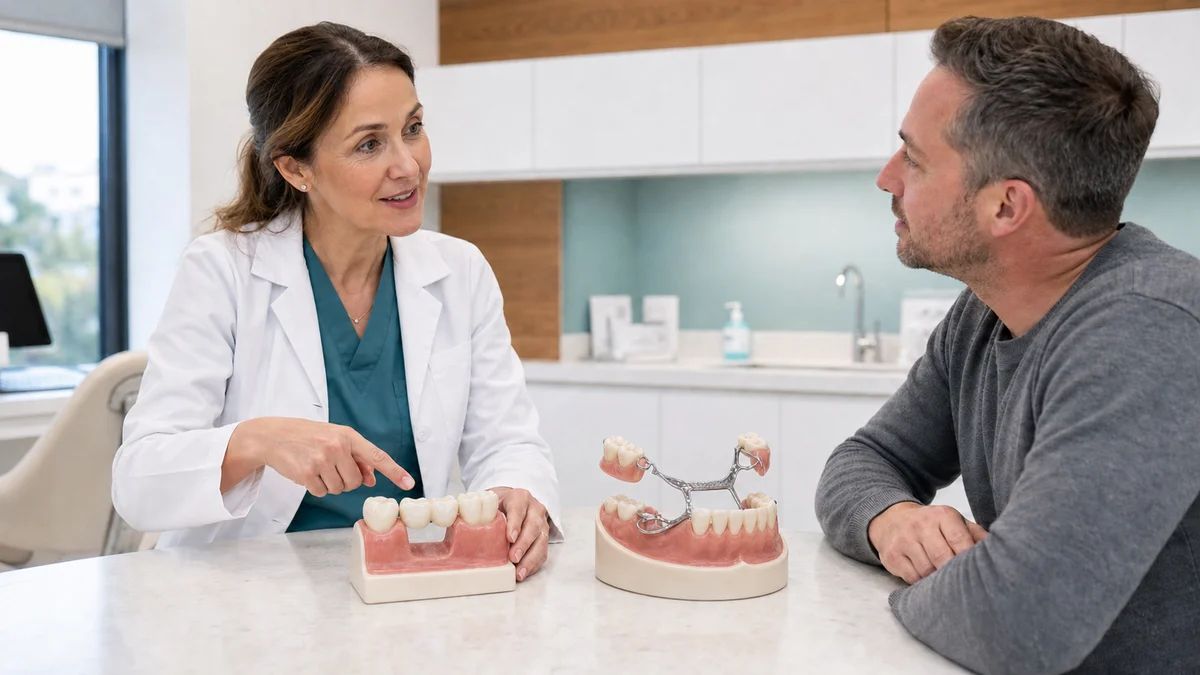
Quick answer: The search dental bridge or dentures which is better cannot be answered by saying fixed is always superior to removable. A bridge may suit a short, bounded gap with dependable support; a partial or complete denture can replace multiple, scattered or full-arch missing teeth and can be removed for cleaning. Gap pattern, support teeth, hygiene, adaptability, comfort, repair and patient priorities decide.
People asking dental bridge or dentures which is better are often comparing two products before defining the missing-tooth pattern. That order can mislead. One absent tooth between two healthy teeth presents a different problem from several gaps around the arch, missing back teeth with no tooth behind them, or a jaw with no natural teeth. The foundation and distribution of the gaps narrow the options before appearance, cost or convenience are discussed.
A dental bridge is fixed in the mouth. A conventional tooth-supported bridge usually has retainers on teeth beside a gap and one or more replacement teeth, called pontics, joined between them. Some adhesive or resin-bonded bridges use a wing bonded mainly to enamel with less preparation. A removable denture may be partial, replacing some teeth, or complete, replacing all teeth in one jaw. Partial dentures may use acrylic, a metal framework, clasps, rests or other components according to design.
The NHS describes bridges as fixed replacements supported by surrounding teeth and dentures as removable replacements. Leeds Teaching Hospitals adds an important qualification: bridges are not possible or suitable for every gap, while partial dentures can replace one or more teeth and may also replace lost gum and bone contour with a flange. The decision is therefore not simply permanent versus temporary.
This guide uses a ten-point support map. It cannot diagnose a mouth, promise comfort, quote a universal lifespan or replace a clinical examination. Its purpose is to help patients ask why a fixed or removable design fits their anatomy and daily life.
dental bridge or dentures which is better: The Short Decision Rule
A bridge often becomes a leading option when a short gap has suitable support, the restoration can be cleaned, and preparing or bonding to adjacent teeth is proportionate. A denture often moves forward when several teeth are missing in separate areas, a gap has no suitable tooth behind it, lost gum volume must be replaced, future tooth loss is plausible, or a removable and more adaptable design better fits the patient.
Neither pathway is automatically more conservative. A conventional bridge may require irreversible preparation of support teeth. A partial denture avoids full crown preparation in many designs but can cover gum and tooth surfaces, use clasps or rests, and create plaque-retentive areas if design and hygiene are poor. The safest comparison counts the biological commitment on both sides.
Point 1: Map Every Missing Tooth Before Choosing Fixed or Removable
Start with a tooth chart, not a brochure. Identify which teeth are missing, which are expected to remain, whether the gaps are bounded by teeth at both ends and whether upper and lower teeth still meet in stable contacts. A single bounded gap may be mechanically suitable for a bridge. Several non-adjacent gaps may require multiple bridges, while one removable partial denture could replace teeth in more than one area.
A free-end gap, where the back teeth are missing and there is no natural tooth behind the space, changes support. A conventional tooth-supported bridge cannot simply extend indefinitely into unsupported space. A carefully selected cantilever bridge may work in limited situations, but removable partial dentures and implant-supported options enter the discussion more commonly for distal-extension patterns.
When all teeth in one jaw are missing, the direct comparison is no longer a conventional tooth-supported bridge versus a partial denture. Options may include a conventional complete denture, an implant overdenture that remains removable, or an implant-supported fixed full-arch prosthesis. These have different surgery, support, hygiene, repair and cost implications and should not be collapsed into the word “bridge.”
Replacement is not mandatory for every space. In selected mouths, accepting a stable gap or closing it orthodontically may be reasonable. Appearance, chewing, speech, tooth movement, bite stability and patient preference must be considered. An online article cannot determine whether no replacement is safe for a specific gap.
Point 2: Test the Proposed Bridge Support Teeth
A bridge is only as dependable as its supports and connectors. The dentist evaluates decay, fillings, cracks, crown height, root shape, root canal status, periodontal support, mobility, gum health, alignment and the direction of chewing forces. A tooth that looks intact above the gum can still have inadequate root or bone support.
A conventional bridge may be proportionate when adjacent teeth already need crowns because of structural damage or large failing restorations. It can be a larger biological sacrifice when sound neighbouring teeth must be reduced mainly to support the gap. In that setting, an adhesive bridge, removable partial denture, implant-supported crown, orthodontic closure or no replacement may deserve discussion.
Resin-bonded bridges can preserve more tooth structure in suitable cases, especially where enamel is available for bonding and the bite permits the design. They can debond, however, and are not a universal solution for every span or load. A debonded bridge should be professionally assessed; it may reveal a design, bite or bonding issue rather than a need for household glue.
Support-tooth prognosis should be written tooth by tooth. If one retainer develops decay, fracture, periodontal loss or endodontic disease, the connected bridge may need access, removal, repair or replacement. The future consequence of one support failing belongs in the original consent discussion.
Point 3: Test the Remaining Teeth for a Partial Denture
A partial denture also depends on its foundation. Remaining teeth may provide rests, guide surfaces, clasping or other support and retention. The gums and residual ridges support parts of the appliance. The distribution of these supports affects movement during chewing.
Before treatment, active decay and periodontal inflammation should be controlled. Teeth with uncertain prognosis need special attention because losing one later may change the fit or design. One advantage of some acrylic partial dentures is that a replacement tooth may sometimes be added after further tooth loss, although whether modification is safe depends on the appliance and new anatomy. A metal framework is thinner and stronger than acrylic in many designs, according to Leeds Teaching Hospitals, but is not suitable for every patient and may be less readily altered.
Clasps can be visible depending on location. Tooth-coloured or flexible components are sometimes marketed as invisible, yet appearance cannot be separated from support, hygiene, adjustability and material behavior. A hidden clasp that does not support the denture appropriately is not a clinical improvement.
The design should show which tissues support the appliance, which components resist movement and how the patient will clean around them. “A plate with teeth” is not an adequate prescription.
Point 4: Compare the Right Designs, Not Two Broad Labels
The table below identifies common design branches. It is not a substitute for examination, imaging selected for need or a laboratory prescription.
| Missing-tooth pattern | Designs usually discussed | Why one may lead | Question before choosing |
|---|---|---|---|
| One short gap bounded by teeth | Adhesive bridge, conventional bridge, implant crown, small partial denture, orthodontic closure or no replacement | A fixed design may avoid a removable appliance; a denture avoids some irreversible preparation and surgery | Do the adjacent teeth independently need crowns, and is enamel suitable for an adhesive design? |
| Several scattered gaps | Removable partial denture, multiple fixed units, implant-assisted options or a combined plan | One partial denture can replace teeth in multiple regions | Would several bridges create too much tooth preparation, complexity or cleaning burden? |
| Back teeth missing with no distal support | Distal-extension partial denture, implant-supported replacement, selected cantilever or no replacement | A conventional bridge may lack a suitable tooth behind the gap | How will the appliance control movement and distribute load? |
| Substantial gum and ridge volume missing | Denture with flange, implant-supported removable prosthesis, or carefully designed fixed replacement | A removable flange can replace teeth and lost soft-tissue contour without an excessively long fixed tooth | Can appearance, speech, lip support and cleaning be achieved without a bulky design? |
| All teeth missing in one jaw | Complete denture, implant overdenture or implant-supported fixed full arch | No natural teeth remain to support a conventional tooth bridge | What surgery, dexterity, maintenance and repair burden is realistic? |
| Extraction and healing are still in progress | Immediate denture, temporary replacement, delayed definitive design or selected fixed provisional | A removable immediate appliance can replace teeth during healing but fit changes as tissues remodel | What relines, adjustments or remake may be needed after healing? |
| Support teeth have poor prognosis | Disease control, revised removable design, extraction planning, implant assessment or no immediate replacement | A fixed bridge may connect its future to unstable teeth | Which teeth are expected to remain maintainable? |
Point 5: Cleaning Is a Design Requirement
Fixed does not mean self-cleaning. A conventional bridge connects its pontic to retainers, so ordinary floss cannot drop through the contact from above. Cleaning under the pontic and around retainers may require a floss threader, superfloss, interdental brush, end-tufted brush or irrigator as an adjunct. Pontic shape should permit access without creating a food trap or injuring tissue.
A removable partial denture can be taken out so every surface is visible, but it creates two cleaning jobs: the appliance and the mouth. Plaque accumulates on natural teeth and prosthetic surfaces. The US National Institute of Dental and Craniofacial Research describes plaque as a biofilm that forms on teeth and dental prosthetics, including dentures.
NHS denture advice recommends cleaning remaining teeth, gums and tongue, brushing the denture separately, rinsing after meals and generally removing dentures at night unless the dentist advises otherwise. Cleaning recommendations can vary with the material, attachments and product instructions. Abrasive toothpaste and hot water may damage some dentures.
Manual dexterity, vision, cognitive function and caregiver support belong in the design decision. A technically elegant bridge that a patient cannot clean is not lower maintenance. A complex partial denture that cannot be inserted, removed and brushed safely is also not suitable. Ask for a live demonstration before treatment.
Point 6: Comfort, Speech and Adaptation Are Personal
A bridge is fixed and usually feels more tooth-like because there is no plate to remove. That can help patients who strongly dislike a removable appliance. However, a bulky pontic, food trapping, pressure at the gum or a high bite can still create discomfort. A fixed restoration must be reviewed if it moves, feels high or causes persistent pain.
A new denture occupies space over gums and may extend across parts of the palate or behind teeth. Adaptation can involve altered speech, increased saliva, pressure areas and learning to chew with both sides. Leeds Teaching Hospitals advises patience and practice, beginning with softer, non-sticky food and small pieces. Soreness should be adjusted professionally rather than filed at home.
Dry mouth can make removable appliances less comfortable and increases caries risk around remaining teeth. A strong gag reflex, mucosal sensitivity, reduced tongue control or neuromuscular conditions can affect tolerance. Conversely, a denture can restore lip and cheek support where substantial tooth and ridge volume are missing, something a narrow bridge may not reproduce naturally.
Previous experience matters but does not prove a new design will feel identical. Ridge shape, tooth loss, bite and materials may have changed. A trial set-up can help evaluate tooth position, smile, speech and lip support before processing a denture, but it cannot guarantee adaptation.
Point 7: Appearance Is More Than Whether Clasps Show
A bridge can create a natural-looking tooth emerging from the gum when the ridge, space, shade and soft tissue permit. If the ridge has lost substantial volume, a fixed pontic may need to be long, bulky or combined with gum-coloured material. Cleaning and speech can constrain the ideal cosmetic contour.
A partial denture can replace both teeth and missing gum contour. Its flange may support lips and cheeks, while its clasps or framework may be visible in certain smiles. Tooth position must balance appearance with support, bite and phonetics. Choosing an unnaturally white shade or overly regular teeth can make either option conspicuous.
Photographs, a diagnostic set-up and discussion of the gum line, smile line and facial support make expectations more specific. A promised “invisible” restoration should be treated cautiously. Different lighting, speech and movement reveal details that a still image may hide.
When searching dental bridge or dentures which is better, ask which option can meet the aesthetic goal without compromising support or hygiene. Appearance is one gate, not a veto over biology.
Point 8: Plan for Change, Repair and Future Tooth Loss
Mouths change. Remaining teeth can develop disease, gums and ridges can remodel, restorations can wear and medical or dexterity needs can evolve. A useful plan describes what happens when something changes rather than promising permanence.
A bridge may be repairable after a small chip or loss of cement, but decay beneath a retainer, fracture of a support tooth or connector failure can affect the connected unit. Removing a bridge may damage it, and replacement may require additional treatment. Records of tooth numbers, materials, cement and laboratory are useful.
Acrylic dentures may sometimes be relined, rebased, repaired or have teeth added. Metal frameworks can also be repaired or altered in selected circumstances, but changes may be technically limited. NHS guidance notes that dentures can loosen as gums and jawbone change and may become worn or damaged.
Immediate dentures deserve a separate expectation. They are inserted around the time of extraction, when the tissues have not completed healing. NHS and Leeds guidance explain that fit changes as the mouth heals, so adjustments, relining or replacement may be needed. This does not mean the appliance failed; it means the biological foundation changed.
Point 9: Use Evidence Without Pretending It Gives a Universal Winner
Research on removable partial dentures reports improvements in chewing or oral-health-related quality of life in many participants, but certainty and study quality vary. A systematic review and meta-analysis found that evidence for long-term quality-of-life effects of removable partial dentures remained insufficient. A 2024 systematic review reported positive changes in several measures of masticatory performance after partial-denture treatment, but this does not compare every denture with every bridge.
Another systematic review comparing metal and acrylic partial dentures found no clear difference in some patient-reported outcomes and judged much of the evidence low quality. Material selection should therefore reflect support, thickness, adjustability, comfort and maintenance rather than a blanket statement that metal or acrylic always wins.
Bridge studies are equally design-specific. A conventional bridge, adhesive bridge, cantilever, implant bridge and full-arch fixed prosthesis do not share one prognosis. Span length, support, connectors, material, bite and cleaning differ.
The honest evidence-based conclusion is conditional: both fixed bridges and removable dentures can restore function and appearance in selected patients, and neither can be ranked without anatomy, design and patient priorities.
Point 10: Compare Complete Pathways and Written Quotes
A price comparison is meaningful only when the clinical pathways match. A bridge quote may include examination, imaging, core build-ups, root canal treatment, support-tooth crowns, temporary bridge, laboratory work, cementation and review. A denture quote may include extractions, healing, impressions or scans, jaw records, try-in, processing, clasps, attachments, fit adjustments and later relining.
Request a written breakdown covering:
- which teeth are missing and which teeth provide support;
- the exact bridge or denture design and material;
- why adjacent teeth do or do not need preparation;
- temporary or immediate appliances during healing;
- laboratory stages and trial appointments;
- cleaning tools and instructions;
- adjustments, relines, repairs and reviews included;
- treatment excluded from the estimate;
- what happens if another tooth is lost;
- insurance assumptions versus confirmed benefits.
A fixed price cannot be given responsibly without diagnosis, and a higher fee does not prove a better design. Equally, choosing the lowest initial quote can be costly if it omits disease control, support-tooth treatment, a temporary or foreseeable maintenance.
Decision principle: Choose the least biologically costly design that restores the teeth you actually need, can be cleaned and maintained by the person who will use it, and leaves a realistic repair pathway.
When a Bridge May Move Ahead
A fixed bridge may be a strong candidate when:
- the missing-tooth span is short and structurally appropriate;
- support teeth have a favorable periodontal and structural prognosis;
- adjacent teeth already need crowns, or a conservative adhesive design is suitable;
- the patient can clean under the pontic and around retainers;
- the bite and available connector space support the proposed material;
- fixed feel is a major priority and the biological cost is acceptable;
- future support-tooth failure and repair consequences are understood.
This is not a guarantee. Decay, periodontal disease, pulpal problems, fracture, wear, chipping, loss of retention and hygiene difficulties remain possible.
When a Denture May Move Ahead
A removable denture may be a strong candidate when:
- several teeth are missing in separate parts of the arch;
- a back-tooth gap has no suitable distal abutment;
- lost gum and ridge contour need replacement for lip support or appearance;
- remaining teeth should not receive multiple full-crown preparations;
- an adaptable appliance is useful because further tooth loss is plausible;
- surgery is not desired or is unsuitable after medical assessment;
- the patient or caregiver can insert, remove and clean the appliance;
- the expected adaptation, clasp appearance and night-time removal are acceptable.
A denture is not automatically temporary or inferior. It is a different prosthetic strategy. Its quality depends on diagnosis, design, impressions or scans, jaw records, laboratory work, fit, bite, hygiene and review.
Planning Treatment at Redent Klinik in Turkey
Remote photographs can show visible gaps but cannot establish periodontal support, root condition, decay, ridge shape, mucosal health, bite or dexterity. A definitive bridge or denture plan should follow clinical examination and any radiographs justified by findings. Patients travelling for care should allow enough time for records, disease control, laboratory stages, try-in, fitting and adjustment.
At Redent Klinik, bring recent radiographs where available, previous bridge or denture records, a medicines list, allergy information and details of any tooth mobility, dry mouth, gagging or difficulty cleaning. To request an assessment, use the Redent Klinik contact page.
If follow-up will occur in another country, request copies of the treatment plan, tooth numbers, bridge material, denture design and laboratory information. Clarify how pressure areas, a high bite, clasp adjustments, loss of retention or a loose bridge will be managed after travel.
Safety Signs and When to Seek Dental Care
Contact a dentist if a bridge becomes loose, a support tooth hurts, floss catches at a new margin, food trapping increases or the bite changes. A fractured or ill-fitting denture that causes trauma, slips, clicks, produces persistent sores or can no longer be worn also needs assessment. Do not bend clasps, grind acrylic or use household glue.
Red or bleeding gums, persistent bad taste, swelling, bad breath with other symptoms, pain on biting or drainage may indicate disease that a prosthesis alone cannot solve. The NHS advises assessment for painful, slipping, worn or damaged dentures and for very red or bleeding gums.
Facial swelling with difficulty breathing or swallowing, rapidly spreading swelling, eye involvement, serious trauma or uncontrolled bleeding requires urgent local care. Do not delay emergency treatment to travel to a preferred clinic.
Frequently Asked Questions
dental bridge or dentures which is better for one missing tooth?
For one bounded gap, an adhesive or conventional bridge may provide a fixed option, while a small partial denture avoids surgery and may avoid extensive preparation. An implant crown, orthodontic closure or accepting the gap may also be considered. Adjacent tooth condition, bone, bite, appearance, hygiene and patient preference determine the best pathway.
Are bridges always more comfortable than dentures?
Many patients find a fixed bridge more tooth-like because there is no removable plate, but comfort is not guaranteed. An over-contoured pontic, high bite or food trap can cause problems. Dentures require adaptation and may create pressure areas, but a well-designed appliance can be comfortable after appropriate adjustments and practice.
Do healthy teeth have to be filed down for a bridge?
A conventional bridge usually requires preparation of support teeth. A resin-bonded bridge can require much less preparation in selected cases. When adjacent teeth are intact, discuss the biological cost alongside a partial denture, implant crown, orthodontic closure or no replacement. The least invasive suitable option depends on the gap and bite.
Can a denture replace several gaps at the same time?
Yes. A removable partial denture can replace teeth in more than one region of the same arch, which may avoid several separate fixed bridges. Its framework, clasps, rests, gum coverage and path of insertion must be designed around the remaining teeth and ridge. Cleaning and future modification should be discussed.
Can I sleep with a partial or complete denture?
NHS guidance generally advises removing dentures at night unless the dentist gives a specific reason not to. Removal allows cleaning and gives oral tissues a rest. Storage depends on material and professional instructions. Patients with unusual medical, swallowing or accommodation needs should follow individualized advice.
Will a partial denture damage my remaining teeth?
It should not be assumed to damage teeth, but plaque retention, poor fit, uncontrolled movement or inappropriate design can increase risk. Remaining teeth and the denture need daily cleaning, and support teeth need review. A well-designed appliance distributes forces and provides access for hygiene; it still requires patient maintenance.
Can teeth be added to a denture later?
Sometimes, especially with selected acrylic dentures. Feasibility depends on the existing appliance, location of the newly missing tooth, fit, bite and condition of the framework. An addition may be unsuitable if the denture is worn, unstable or poorly designed. Metal frameworks can be more limited to alter.
What happens if a bridge support tooth fails?
The connected bridge may be affected. Options can include endodontic access, repair, removal, replacement, extraction of the support, a revised bridge, implant treatment or a removable prosthesis. The cause and remaining support determine the pathway. This possibility should be explained before bridge preparation.
Are metal partial dentures better than acrylic dentures?
Not universally. Metal frameworks can be thinner and stronger and may provide controlled support, while acrylic designs may be useful as immediate, transitional or adaptable appliances. Patient-reported research does not establish one universal winner. Tooth pattern, support, modification needs, appearance, cost and laboratory design guide selection.
Do dentures stop the jawbone from changing?
No. Gums and residual ridges can change after tooth loss, especially during healing after extraction. Dentures may loosen and need adjustment, relining or replacement. Implant support can change retention and load in suitable patients, but it introduces surgery, components and maintenance and does not eliminate biological change.
How long do bridges and dentures last?
There is no guaranteed lifespan. Bridge outcome depends on support teeth, fit, material, bite, cleaning and disease risk. Denture outcome depends on wear, fit, ridge change, handling, cleaning and remaining teeth. Regular review aims to identify repair, reline or replacement needs before function or tissues are harmed.
When is a second opinion useful?
Consider one before preparing healthy teeth, extracting potential supports, accepting a long-span bridge, or choosing a denture without a clear support and cleaning design. A second opinion is also useful when a fixed result, painless adaptation or guaranteed lifespan is promised without a full clinical assessment.
Conclusion: Choose the Support Strategy Before the Product
The safest answer to dental bridge or dentures which is better begins with the map of missing and remaining teeth. A bridge can be a proportionate fixed solution for a suitable bounded gap with dependable supports. A denture can replace multiple or full-arch gaps, restore lost gum contour and offer a removable, adaptable pathway. Neither design wins every case.
Ask the clinician to show the gap pattern, name each support, explain the biological cost, demonstrate cleaning and describe what happens after further tooth loss or repair. Add comfort, speech, appearance, dexterity, travel and cost only after those foundations are clear. The best replacement is the one that fits the anatomy, can be maintained in daily life and preserves sensible future options.
Sources
- NHS: Dentures
- NHS: Dental Treatments, Bridges and Dentures
- Leeds Teaching Hospitals NHS Trust: Removable Partial Dentures
- Guy’s and St Thomas’ NHS Foundation Trust: Replacing Missing Teeth
- Journal of Dentistry: Oral Health-Related Quality of Life After Removable Partial Dentures, Systematic Review
- International Journal of Prosthodontics: Removable Partial Dentures and Masticatory Performance, Systematic Review
- Journal of Prosthodontics: Patient-Reported Outcomes of Metal and Acrylic Partial Dentures
- US National Institute of Dental and Craniofacial Research: Plaque and Interdental Cleaning
- American Dental Association
- World Health Organization: Oral Health