
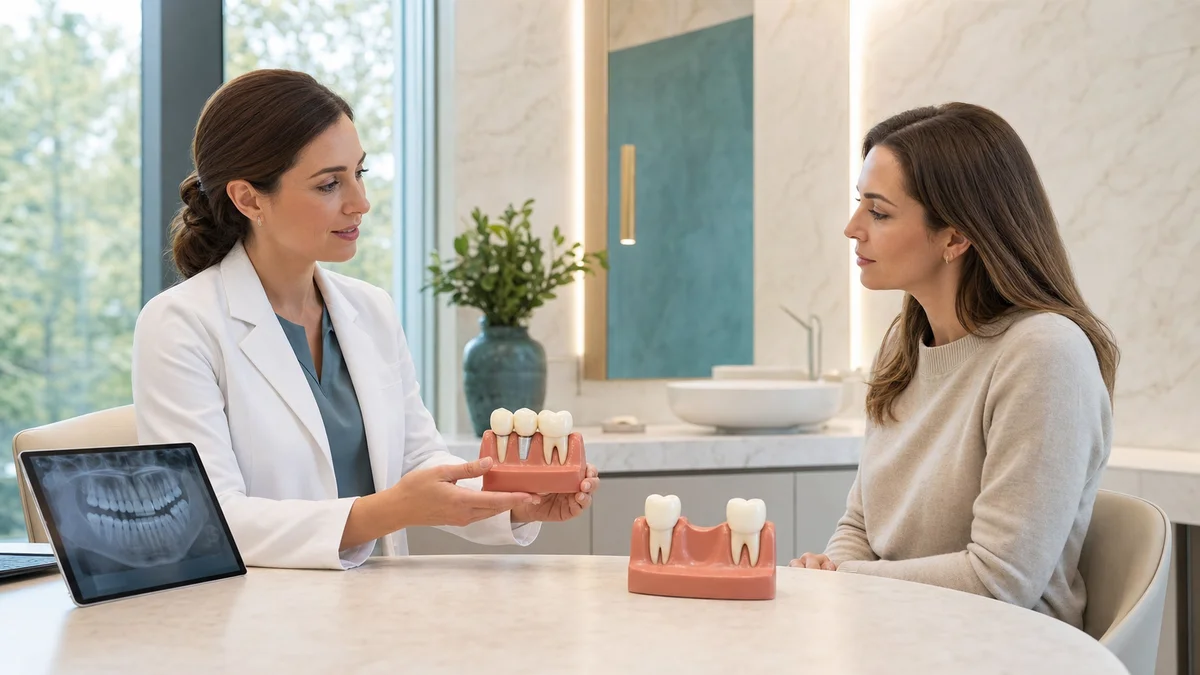
Quick answer: Dental bridge pros and cons depend on the gap, supporting teeth, gum health, bite and cleaning ability. A bridge is fixed, can restore appearance and chewing without surgery at the missing-tooth site, and may use existing crowned teeth. Trade-offs include tooth preparation, extra load on supports, difficult cleaning, decay or gum risk and eventual repair or replacement.
Replacing a missing tooth is not simply about filling a visible space. The best option should protect remaining teeth, support comfortable function, remain cleanable and fit the patient’s priorities. Comparing dental bridge pros and cons gives a structured way to discuss a conventional bridge, resin-bonded bridge, implant-supported restoration, removable denture or carefully monitored space. It cannot decide treatment without an examination.
A photograph or price list does not show root condition, active decay, gum support, bite force, space, bone anatomy or the condition of the teeth beside the gap. Those findings can reverse the apparent advantages and disadvantages. This article explains the main trade-offs, questions and warning signs so that consent can be specific rather than promotional. It is educational and does not replace diagnosis by a dentist.
What Is a Dental Bridge?
A bridge replaces one or more missing teeth with a false tooth or teeth connected to support. The NHS dental treatments guide describes a bridge as a fixed replacement supported by surrounding teeth. Unlike a removable denture, a fixed bridge is not taken out by the patient for routine cleaning.
The American College of Prosthodontists bridge overview explains the traditional design: teeth on both sides of the gap are prepared for crowns, a false tooth is joined to those crowns, and the unit is cemented to the prepared teeth. However, “bridge” is not one single design. Support may come from natural teeth, adhesive wings or implants, and each arrangement changes the dental bridge pros and cons.
- Conventional bridge: crowns on supporting natural teeth hold one or more replacement teeth.
- Cantilever bridge: support is taken from one side in carefully selected situations.
- Resin-bonded bridge: one or more wings are bonded to a supporting tooth, often with less preparation.
- Implant-supported bridge: implants rather than natural teeth support the replacement teeth.
These categories should not be treated as interchangeable. Span length, location, enamel available for bonding, support-tooth condition and bite all affect suitability. A dentist may also discuss whether the space needs replacement at all and what could happen if it is monitored.
Dental Bridge Pros and Cons at a Glance
The table is a conversation aid, not a ranking. A feature that is beneficial in one mouth may be a disadvantage in another. For example, crowning a heavily restored adjacent tooth may be reasonable, while preparing an untouched healthy tooth requires a different discussion.
| Option | Potential advantage | Important trade-off | Key assessment question |
|---|---|---|---|
| Conventional tooth-supported bridge | Fixed, familiar workflow, may use teeth already needing crowns | Supporting teeth are prepared and linked | Are the support teeth strong, restorable and appropriately aligned? |
| Resin-bonded bridge | Can preserve more tooth tissue in selected cases | Bonding and bite limitations; possible debonding | Is there suitable enamel and a favourable contact pattern? |
| Implant-supported crown or bridge | Does not rely on preparing adjacent teeth | Surgery, healing, bone and medical considerations | Are local anatomy, health and maintenance conditions suitable? |
| Removable partial denture | Can replace several teeth without fixed preparation of every support | Removable, may feel bulky and needs adaptation | Can the patient wear, clean and tolerate the design? |
| Monitored space | No restorative procedure now | Appearance, movement, food trapping or function may be affected | What is the expected consequence of leaving this particular gap? |
Dental Bridge Pros and Cons: Benefit 1—A Fixed Replacement
A fixed bridge remains in the mouth during eating and speaking. Some patients prefer this because there is no daily removal, insertion or movement associated with a removable appliance. The replacement tooth can be shaped to support appearance, contact with neighbouring teeth and a functional chewing surface.
“Fixed” does not mean maintenance-free or permanent. It means the patient does not remove it. The entire unit still needs brushing, cleaning beneath the false tooth and professional review. In a balanced account of dental bridge pros and cons, convenience must be paired with the ability to clean an area that ordinary floss may not enter from above.
Dental Bridge Pros and Cons: Benefit 2—No Surgery at the Gap for a Tooth-Supported Bridge
A conventional tooth-supported bridge can replace a missing tooth without placing an implant in the gap. This may matter when a patient prefers to avoid surgery, when healing time is a concern or when anatomy and medical considerations make implant assessment more complex. It does not make a bridge automatically safer; preparation and loading of natural support teeth are different biological costs.
When discussing dental bridge pros and cons, separate “no implant surgery” from “non-invasive.” Conventional bridge preparation removes tooth structure from supporting teeth. Local anaesthesia, temporary restorations, impressions or scans and cementation are still clinical procedures. The benefit is better understood as a different treatment route, not the absence of treatment.
Dental Bridge Pros and Cons: Benefit 3—Using Teeth That Already Need Restoring
If a tooth beside the gap already has a large failing restoration, significant structural loss or another reason for a crown, including it as a support may align two needs. A bridge can then replace the missing tooth while restoring an adjacent compromised tooth. This is very different from preparing an intact, healthy neighbour solely to carry a bridge.
A careful dental bridge pros and cons review asks what each support tooth would need if no bridge were placed. If a crown is indicated independently, the additional sacrifice may be smaller. If the tooth is sound, the consent discussion should make the irreversible preparation clear and compare tissue-preserving alternatives.
Dental Bridge Pros and Cons: Benefit 4—Potentially Efficient Treatment Staging
Many conventional bridges can be planned through preparation, a temporary phase and definitive fitting without a surgical healing interval at the missing-tooth site. That may make sequencing easier for some patients. Laboratory fabrication still takes time, and complex bite, gum, root canal or foundation work can add visits.
Efficiency should not be confused with a guaranteed schedule. The tooth or gum may need stabilisation, the temporary bridge may reveal changes, or the final restoration may require correction. In dental bridge pros and cons, a shorter anticipated pathway is useful only if quality checks and biological stop points are preserved.
Dental Bridge Pros and Cons: Benefit 5—Restoring Appearance and Contact
A well-designed replacement can reduce the visual effect of a gap and help restore a contact that limits food packing. It can support speech and chewing in appropriate locations. The shape should emerge naturally from the gum area without creating an uncleanable pressure point. Colour, translucency, tooth proportions and the visible gum line influence the result.
Appearance has limits. Artificial material does not change exactly like natural enamel, gum contours can alter, and a long-standing gap may have tissue loss that makes an ideal tooth shape difficult. The aesthetic side of dental bridge pros and cons should include a realistic discussion of symmetry, cleanability and what can be previewed before final cementation.
Dental Bridge Pros and Cons: Benefit 6—An Alternative When an Implant Is Not Preferred
The American College of Prosthodontists notes that a fixed bridge can be a viable alternative in suitable circumstances even though implants are often considered for missing teeth. A bridge may be discussed when a patient does not want implant therapy, when timing differs, or when support teeth and the gap favour a prosthetic solution.
The comparison is not “bridge good, implant bad” or the reverse. Implant treatment has surgical, anatomical, medical, healing and maintenance considerations; a tooth-supported bridge has preparation, support-tooth, cement and hygiene considerations. A patient-specific dental bridge pros and cons analysis compares consequences using the same clinical findings and timeframe.
Dental Bridge Pros and Cons: Drawback 1—Preparation of Supporting Teeth
A traditional bridge normally requires reduction of the teeth carrying the retainer crowns. That tissue does not grow back. Preparation must create room for restorative material, appropriate shape and a margin while preserving as much useful structure as possible. The pulp inside a tooth can be affected by existing decay, previous restorations, cracks and cumulative treatment.
Preparation is among the most important dental bridge pros and cons because it changes more than the missing-tooth site. Supporting teeth may later need repair, root canal treatment, new foundations or replacement restorations. This does not mean these outcomes are inevitable; it means the health and prognosis of every support should be documented before consent.
Dental Bridge Pros and Cons: Drawback 2—The Supports Become Linked
A conventional bridge functions as one connected unit. If one support develops decay, fracture, pulpal symptoms, gum loss or loss of retention, the problem can affect the entire bridge. Access for root canal treatment may sometimes be made through a restoration, but diagnosis and repair choices are case-specific.
Linking teeth can distribute force, yet it also links maintenance and failure decisions. A localised problem may require removal or replacement of a larger restoration. This interdependence belongs in every dental bridge pros and cons discussion, especially when the support teeth have unequal strength or prognosis.
Dental Bridge Pros and Cons: Drawback 3—Cleaning Beneath the Replacement Tooth
A toothbrush can clean accessible outer surfaces but cannot pass through a connected bridge. The patient may need a floss threader, suitable interdental brush, water flosser or another device recommended for the design. The American College of Prosthodontists specifically notes that special aids are available to keep bridges clean.
The NIDCR oral-hygiene guidance explains that plaque buildup contributes to tooth decay and gum disease and recommends regular interdental cleaning. In practical dental bridge pros and cons, the question is not whether cleaning is theoretically possible but whether the patient can perform it comfortably every day.
- Ask the clinical team to demonstrate cleaning on the final bridge.
- Confirm which device fits beneath the replacement tooth without force or trauma.
- Clean the support-tooth margins as well as the underside of the false tooth.
- Report persistent bleeding, swelling, bad taste, food trapping or a new cleaning obstruction.
- Use fluoride toothpaste and follow a personalised prevention plan.
Dental Bridge Pros and Cons: Drawback 4—Decay and Gum Disease Can Still Occur
Bridge material does not develop a cavity, but the supporting natural teeth can decay at exposed or leaking margins. Plaque around retainers and beneath the false tooth can irritate the gum. Early disease may be painless, which is why prevention and review remain important after the gap appears “finished.”
The UCLH prosthodontic service notes that patients with poor oral hygiene or unstable caries are not normally accepted for its specialist crown and bridge treatment pathway. That policy illustrates a general principle: active disease should be stabilised. Among dental bridge pros and cons, baseline disease control can matter more than the brand of material.
Dental Bridge Pros and Cons: Drawback 5—Cement Loss, Chipping or Fracture
A bridge may loosen if cement fails, a support changes or the restoration fractures. Ceramic can chip, connectors can be stressed and heavy biting, clenching or grinding can increase mechanical demand. A cantilever or long-span design may behave differently from a short conventional bridge, so design cannot be selected by appearance alone.
Mechanical dental bridge pros and cons include repairability. A small surface chip may have different options from a fractured connector or decayed support. Ask whether a repair would be possible, what replacement could remove from the supporting teeth and whether a protective appliance is appropriate for diagnosed grinding or sports exposure.
Dental Bridge Pros and Cons: Drawback 6—Bone and Gum Contours May Change
A tooth-supported false tooth sits above the healed ridge; it does not replace a natural root in the bone. After tooth loss, ridge shape can change over time. A bridge may restore the visible crown area but cannot guarantee preservation of the original bone or gum contour. Tissue loss can create an appearance gap, speech concern or food-trapping space beneath the replacement tooth.
This aspect of dental bridge pros and cons is particularly important in the front of the mouth or after trauma and gum disease. The dentist may assess tissue volume, smile line and pontic design. Some situations may require a different tooth shape, gum-coloured restorative material, tissue treatment or another replacement strategy.
Dental Bridge Pros and Cons: Drawback 7—Maintenance and Replacement Are Expected Possibilities
No restoration should be promised for life. Wear, biological change, accidental damage, disease and material fatigue can create a need for maintenance, repair or replacement. A bridge that has functioned for years may still need reassessment if the gum recedes, a support tooth changes or the bite alters.
A trustworthy explanation of dental bridge pros and cons avoids a fixed lifespan guarantee. Instead, ask which factors matter in your case, what professional monitoring is recommended and how a future replacement could affect the support teeth. Longevity should be discussed as a range of possible outcomes, not a sales promise.
Who May Be a Suitable Candidate?
Suitability depends on more than having a gap. Support teeth need adequate structure, roots and gum support; active decay and inflammation should be managed; the bridge needs room and a cleansable design; and the bite should not overload the proposed unit. Medical history, dry mouth, smoking, dexterity, grinding and previous restorative experience can change the plan.
For a resin-bonded design, enamel quality, position and contact pattern are particularly relevant. For a conventional design, the independent restorative need and pulpal status of support teeth deserve attention. A complete dental bridge pros and cons evaluation uses clinical examination and appropriate imaging rather than deciding from a panoramic image or digital mock-up alone.
- Gap factors: number and position of missing teeth, space, ridge and gum contour.
- Support factors: decay, fillings, cracks, root form, mobility and periodontal support.
- Bite factors: opposing teeth, available height, guidance, clenching and grinding.
- Maintenance factors: cleaning access, dexterity, saliva, diet and review attendance.
- Preference factors: surgery, removability, appearance, timing, repair and follow-up.
How Planning Can Improve Dental Bridge Pros and Cons
Good planning cannot eliminate uncertainty, but it can reduce avoidable risk. The sequence may include stabilising decay and gum disease, assessing vitality, examining the bite, evaluating restorability, discussing alternatives and selecting a cleanable design. Diagnostic models, scans or provisional restorations may help test appearance and function.
During treatment, conservative preparation, moisture control, accurate impressions or scans, laboratory communication and a stable temporary bridge support the process. Before final cementation, the clinician can verify marginal fit, contacts, bite, appearance and access for cleaning. These checks convert general dental bridge pros and cons into measurable clinical decisions.
Consent should also include stop points. What happens if decay extends farther than expected? What if a support tooth becomes symptomatic? What if the bridge cannot be cleaned or the appearance is not accepted at try-in? A plan that permits reassessment is safer than one that assumes cementation must occur.
Daily Care After a Bridge Is Fitted
Brush twice daily with fluoride toothpaste and clean beneath the false tooth and around each retainer. The best interdental device depends on the bridge’s contour and the patient’s skill. Do not force an oversized brush or snap floss into the gum. A dentist or hygienist should demonstrate technique and check it at review.
Limit frequent sugary foods and drinks, avoid tobacco and discuss dry mouth. Do not use the bridge to open packages or bite very hard objects. If grinding is suspected, assessment may include the bite, muscle symptoms and whether a protective option is suitable. These habits influence long-term dental bridge pros and cons without guaranteeing an outcome.
Warning Signs and When to Seek Care
Arrange assessment if the bridge feels loose, moves, chips, develops a rough edge, traps new amounts of food, causes persistent pain or is associated with bleeding or swollen gums. Do not use household glue. If the bridge detaches, keep it safely and avoid chewing on the support teeth until professional review.
Spreading facial swelling, fever, severe uncontrolled pain, significant bleeding or systemic illness requires urgent professional advice. Difficulty breathing or swallowing is an emergency. These symptoms are not unique to bridges. Knowing escalation signs is part of dental bridge pros and cons because follow-up must remain accessible after treatment.
Travelling for Treatment: Follow-Up Matters
A bridge may involve assessment, preparation, a temporary restoration, laboratory work, fitting and review. Travel plans should allow for unexpected changes, not only the shortest advertised schedule. Ask who will manage sensitivity, a loose temporary, bite adjustment, cement failure or a support-tooth problem after you return home.
Patients considering care in Türkiye can explore the English-language Redent Klinik website and request an individual conversation through the Redent Klinik contact page. Remote records can help with preparation, but they cannot settle the final dental bridge pros and cons without an in-person clinical assessment.
Questions to Ask Before Consent
A written answer to the following questions makes dental bridge pros and cons more specific:
- Which bridge design is proposed, and what supports it?
- Would the adjacent teeth need crowns if the bridge were not placed?
- How much tooth structure is expected to be removed?
- What is known about the pulp, roots, gum support, decay and bite?
- How will I clean beneath the replacement tooth, and can I practise the method?
- What alternative options fit the same clinical findings?
- What symptoms are expected, and which need prompt or urgent review?
- Who provides maintenance, repair and emergency care if I live elsewhere?
- What happens if one support tooth later needs treatment?
Frequently Asked Questions About Dental Bridge Pros and Cons
What are the main dental bridge pros and cons?
Main advantages are fixed replacement, restoration of appearance and chewing, and avoiding implant surgery at the gap for a tooth-supported design. Main trade-offs are preparation of support teeth, linked failure decisions, specialised cleaning, decay or gum risk, mechanical complications and future replacement.
Does a dental bridge damage healthy teeth?
A conventional bridge usually requires irreversible preparation of its supporting teeth. Whether that is an acceptable biological cost depends on their existing condition and the alternatives. A resin-bonded design may preserve more tissue in selected cases, while an implant has a different risk profile.
Is a bridge better than an implant?
Neither is universally better. A bridge may avoid surgery and use teeth already needing crowns; an implant may avoid preparing adjacent teeth. Anatomy, health, bone, support-tooth prognosis, maintenance, timing and preference determine the comparison. A personalised dental bridge pros and cons review is necessary.
Can food get under a dental bridge?
Food and plaque can collect beneath the false tooth if its contour or cleaning routine is unsuitable. The area should be designed for hygiene, and the patient should be shown an appropriate floss threader, interdental brush, water flosser or other aid. Persistent trapping needs assessment.
Can supporting teeth get cavities?
Yes. Bridge material does not decay, but natural support teeth can develop decay at exposed or compromised margins. Fluoride toothpaste, plaque removal, dietary control, saliva management and regular examinations help reduce risk. Early decay may not be painful.
What happens if one support tooth fails?
The bridge may need removal, repair, redesign or replacement, depending on the cause and remaining structure. Root canal access is sometimes possible through a restoration, but no single solution fits every case. This linked outcome is a central part of dental bridge pros and cons.
How long does a dental bridge last?
No exact lifespan can be promised. Outcome depends on support teeth, fit, material, bite forces, cleaning, decay activity, gum health and maintenance. Ask about case-specific factors, warning signs and the likely consequence of future replacement rather than relying on a guaranteed number.
Can a loose bridge be glued back at home?
No household adhesive should be used. Avoid chewing on the bridge and arrange professional assessment. A dentist needs to check for cement loss, decay, fracture and support-tooth damage before deciding whether recementation is safe or another treatment is required.
Is a resin-bonded bridge always more conservative?
It often requires less preparation, but suitability depends on enamel, gap position, bite, support and design. Debonding or metal visibility may be relevant in some cases. Conservative preparation is valuable only when the restoration can function and be maintained predictably.
Can a bridge prevent bone loss?
A tooth-supported bridge replaces the visible tooth but does not place a root in the missing-tooth bone. Ridge shape may continue to change after tooth loss. The clinical significance varies with site, tissue, appearance and alternatives, so the issue belongs in the dental bridge pros and cons discussion.
Is a dental bridge hard to clean?
It requires a different technique because connected teeth prevent ordinary floss from dropping through. Many patients can clean effectively with instruction and suitable aids. Dexterity, bridge contour and motivation matter, and the technique should be demonstrated rather than merely described.
Should every missing tooth be replaced?
No. The effect of a gap varies with location, opposing teeth, movement, appearance, food trapping and function. Observation may be reasonable in selected cases, while other gaps benefit from replacement. A dentist should explain the predicted consequences and monitoring plan.
Balanced Takeaway on Dental Bridge Pros and Cons
A dental bridge can be a useful fixed replacement when its support teeth, design, bite and hygiene access are favourable. Its strengths include fixed function, potentially efficient staging and avoidance of implant surgery at the missing-tooth site. Its costs include preparation, linked support teeth, specialised cleaning and possible biological or mechanical failure.
The safest decision does not come from choosing the longest guarantee or most expensive material. It comes from matching the restoration to the diagnosis, preserving sound tissue where possible, controlling disease and arranging accessible maintenance. This evidence-based guide to dental bridge pros and cons is intended for review by Dentist Esma Çevrük Çakır and does not replace individual dental care.
Sources and Further Reading
- American Dental Association — professional oral-health authority.
- American College of Prosthodontists: Bridges — fixed bridge design, supports and cleaning.
- NHS: Dental treatments — bridge definition and fixed replacement context.
- NIDCR: Oral Hygiene — plaque removal, fluoride and interdental care.
- UCLH: Prosthodontic services — disease stability and complex restorative assessment.
- NHS: Dental services and treatment planning — risks, benefits and informed treatment plans.
- World Health Organization: Oral health fact sheet — global oral-health context.