
Building a dental clinic website that truly attracts and converts visitors into loyal patients is more than just about design — it’s about trust, communication, and functionality 🦷. In the digital age, most people begin their healthcare journey online, searching for reliable and friendly dental professionals nearby. If your website doesn’t make a strong first impression, you’re losing potential clients before they even step into your clinic.
To stand out among competitors, a successful dental clinic website must combine aesthetics, usability, SEO, and emotional connection. Think of your site as your digital waiting room — clean, welcoming, and filled with the right information that helps patients make confident decisions about their oral health. Let’s explore how to build the perfect online presence that truly reflects the quality of care your dental practice offers.
Understanding What Patients Expect from a Dental Website
When patients visit a dental clinic website, they want reassurance and clarity. They’re looking for information about treatments, clinic hours, professional credentials, and above all, a sense of comfort and credibility 😷. Studies show that visitors decide within 5 seconds whether to stay on a website or leave. That means your homepage needs to load quickly, feature professional images, and clearly display your value proposition — for example: “Trusted Family Dentistry in Your City.”
Beyond visuals, your content should communicate empathy and expertise. Simple language, friendly tones, and transparent explanations of procedures build trust. Including real patient testimonials or before-and-after photos can significantly improve conversion rates. This combination of emotional connection and professional presentation transforms a basic dental clinic website into a patient magnet.
Designing for Trust and Professionalism
Your website design reflects your brand’s identity. Patients often judge your dental services based on your site’s appearance — even before reading any reviews. A well-structured dental clinic website should use calming colors such as white, blue, or mint green, which are psychologically linked to cleanliness and safety. Include clear, high-quality images of your dental team, clinic interior, and smiling patients. Avoid cluttered layouts and distracting animations; simplicity and clarity win attention.
Typography and readability are also essential. Use a legible font and keep paragraphs short. Consistent spacing and white space help users navigate comfortably. Moreover, your “Contact” and “Book Appointment” buttons should be easily visible and mobile-friendly 📱. According to Google, 61% of users are unlikely to return to a site that isn’t mobile responsive. So, ensure your dental clinic’s website looks flawless on all screen sizes.
SEO Optimization: Getting Found Online
No matter how beautiful your website looks, it won’t attract new patients unless it ranks high on Google. Effective SEO for dental clinic websites involves optimizing keywords, metadata, headings, and internal linking. For instance, using semantic terms like “dental practice website,” “dentist website design,” and “oral care site” helps search engines understand your niche more comprehensively. You should also write unique title tags and meta descriptions that include your target keyword naturally.
Another essential step is obtaining high-quality backlinks from authoritative sources such as the American Dental Association. These links boost your credibility and domain authority. Additionally, ensure your site loads fast (under 3 seconds) and uses HTTPS security — both are ranking signals. You can also add schema markup for dental services to help Google display rich snippets like reviews and ratings directly in search results ⭐.
Building Credibility Through Content
Content marketing plays a major role in the success of your dental clinic website. Every page should educate, inform, and reassure potential patients. Blog articles about oral hygiene tips, implant care, or dental anxiety management can position your clinic as an expert resource. Educational videos and infographics help simplify complex procedures and boost user engagement. Remember to keep your writing patient-centered — address common concerns, use friendly tones, and always emphasize comfort and safety.
Integrate an internal link such as Redent Klinik Contact Page to make it easier for users to reach out instantly when they’re ready to book. This seamless navigation between content and conversion pages is key for high-performing healthcare websites.
Emphasizing Accessibility and Communication
Accessibility ensures everyone — including individuals with disabilities — can easily navigate your dental clinic website. Add alt text to all images, maintain proper color contrast, and use descriptive labels for buttons and links. Also, enable multiple contact options such as online booking, live chat, and WhatsApp integration. Patients value responsiveness; if they can contact your team within seconds, they are more likely to trust your clinic.
Adding a FAQ section is another smart way to improve both SEO and user satisfaction. Address questions like “What’s the best time to visit a dentist?” or “How painful is a root canal?” This not only improves your site’s ranking for long-tail queries but also builds authority and trust among visitors 👩⚕️.
Final Thoughts
Creating the perfect dental clinic website is about blending design, SEO, and patient empathy into a seamless digital experience. A clean layout, fast loading speed, engaging visuals, and informative content make all the difference. Your website is the bridge between curiosity and trust — it’s the moment where potential patients decide whether to call you or click away. With consistent optimization, you can transform your dental site into your most powerful marketing tool, one that continuously attracts and retains new patients.
Why Every Modern Dental Practice Needs a Professional Website
In today’s digital-first world 🌐, a dental clinic website is no longer optional—it’s an essential component of any modern dental practice’s success strategy. Whether your clinic is newly established or a well-known local brand, your website serves as the central hub of communication, marketing, and patient engagement. People now rely heavily on online research before choosing healthcare providers, meaning your online presence directly influences whether patients book an appointment or look elsewhere.
The Digital Shift in Patient Behavior
According to recent studies, over 77% of patients search online before scheduling a dental appointment. This statistic highlights a fundamental truth: potential patients are actively seeking trustworthy dental professionals online, and your dental clinic website is their first impression. A modern, well-designed site signals reliability, professionalism, and attention to detail—qualities that patients subconsciously associate with the quality of your clinical services 🦷.
When visitors find your website via Google or social media, they expect instant access to vital information such as location, services offered, credentials, and reviews. If your site is outdated, slow, or confusing, users are likely to leave and seek alternatives. This is why an optimized and user-friendly dental clinic website acts as a 24/7 receptionist, guiding potential patients toward scheduling their first visit.
Establishing Trust Through Online Presence
Trust is the foundation of every patient relationship. Without it, even the best dental care cannot retain clients long-term. A professional dental clinic website helps establish credibility by showcasing your expertise, qualifications, and genuine commitment to patient care. Features such as dentist bios, clinic certifications, and verified testimonials from real patients play a critical role in this trust-building process.
Additionally, consistency in your branding—logos, colors, tone of voice—creates a cohesive image that patients recognize across platforms. If your social media accounts, Google Business Profile, and website all reflect the same professional identity, your brand appears more reliable and approachable. Think of your website as your clinic’s handshake in the digital world 🤝—it introduces you, communicates your values, and reassures patients that they’re in good hands.
Transparency and Patient Education
Transparency builds long-term trust. A dental clinic website that includes clear explanations of procedures, recovery expectations, and preventive care tips empowers patients to make informed decisions. It’s not just about marketing; it’s about patient education. Pages explaining topics such as “What to Expect During a Root Canal” or “How to Maintain Dental Implants” not only improve SEO but also demonstrate that you genuinely care about patient well-being.
When your content answers common questions proactively, you reduce anxiety and make your clinic stand out as a compassionate and knowledgeable healthcare provider. Patients are far more likely to choose a dentist who helps them feel informed and comfortable long before they step into the office chair.
How a Website Enhances Local Visibility
For dental professionals, local search visibility is everything. Most people searching for oral care services include location-based terms like “dentist near me” or “dental clinic in [city name].” A properly optimized dental clinic website can dominate these local search results, driving organic traffic directly from your community. Integrating your clinic’s details—address, phone number, and Google Maps location—into every page helps search engines associate your practice with your geographic area.
Local SEO strategies, such as embedding patient reviews, adding local keywords, and maintaining consistent NAP (Name, Address, Phone) data, are vital. Moreover, having an embedded Google Map widget on your contact page improves both usability and ranking potential. Don’t forget to link to your Redent Klinik Contact Page or similar pages, enabling visitors to book an appointment directly after learning about your services.
Marketing Power and Brand Authority
Your dental clinic website acts as your main digital marketing platform. It supports all your promotional channels—Google Ads, Facebook campaigns, and even email newsletters. When potential patients see your ads online, they’re likely to visit your website next to learn more. If that site reflects professionalism and provides valuable content, they’ll take the next step toward booking an appointment.
Beyond visibility, your website also helps establish brand authority. Publishing consistent blog articles on topics like cosmetic dentistry, orthodontics, or preventive care signals to search engines (and patients) that your practice is knowledgeable and up-to-date. You can even reference reputable associations like the American Dental Association to support your content with credible, science-based information. This not only improves SEO but also enhances your brand’s perceived expertise.
24/7 Accessibility and Convenience
Unlike your physical clinic, a website never closes 🕓. This round-the-clock accessibility means potential patients can read about treatments, check office hours, or fill out appointment forms even after your clinic has closed for the day. For people with busy schedules, this flexibility is invaluable. Integrating features like online booking forms, chatbot support, and automated appointment reminders increases convenience and patient satisfaction.
Furthermore, your dental clinic website acts as a reliable resource hub. Patients who visit your site repeatedly for advice or follow-up instructions build loyalty to your brand. Over time, this loyalty translates to word-of-mouth referrals—one of the most powerful growth drivers in healthcare marketing.
The ROI of a Professional Dental Website
While designing and maintaining a dental clinic website requires an investment, the long-term return far outweighs the cost. A single well-optimized site can attract hundreds of new visitors monthly, leading to a steady stream of patient inquiries. Tracking analytics through tools like Google Analytics helps you measure conversions, user behavior, and engagement. By continuously improving weak areas—like bounce rate or page load time—you can refine your marketing strategy and maximize your return on investment.
Conclusion
Ultimately, every modern dental practice needs a professional dental clinic website to thrive in today’s competitive market. It’s the foundation of your online identity, the bridge between patients and care, and the most powerful marketing asset you own. A well-built website showcases your professionalism, improves patient trust, and drives sustainable growth year after year. By investing in a strong online presence, your clinic positions itself not just as another dental office—but as the trusted choice in oral healthcare 🏆.
Essential Features Every Dental Clinic Website Must Include
A successful dental clinic website is not just about appearance—it’s about delivering functionality, trust, and user satisfaction. Patients expect modern, intuitive, and informative sites that reflect the professionalism of the dental practice behind them. To meet these expectations, your website must include several key features that improve credibility, usability, and conversion rates. Whether you’re building a new website or improving an existing one, understanding these essential elements can make the difference between a visitor leaving or booking an appointment 💡.
1. A Clean and Intuitive Homepage
Your homepage serves as the digital front door of your dental clinic website. It must instantly communicate who you are, what services you offer, and why patients should trust you. A clutter-free layout with a strong headline and call-to-action (CTA) such as “Book an Appointment” or “Meet Our Dentists” is essential. Use professional imagery of your clinic and staff, and include a concise summary of your key dental services. Studies show that users decide whether to stay on a site within 3–5 seconds—so make your first impression count 🦷.
Moreover, adding trust signals like certifications, years of experience, and awards helps users feel confident in your expertise. Simple navigation, a visible menu bar, and a contact button in the header all contribute to better user flow. When visitors can find what they need quickly, they’re far more likely to convert into paying patients.
2. Detailed Service Pages for Every Treatment
A truly effective dental clinic website goes beyond listing services—it explains them in detail. Each service page should have a clear structure that outlines the procedure, benefits, duration, recovery time, and aftercare. For example, separate pages for “Dental Implants,” “Teeth Whitening,” or “Orthodontics” not only enhance user experience but also boost SEO performance by allowing Google to index each topic individually.
Make sure these pages use relevant keywords naturally and answer the most common patient questions. Including before-and-after images, testimonials, and FAQs adds credibility. Patients want reassurance, and your service pages are where they make their final decision about contacting you. Including a link to your Redent Klinik Contact Page at the end of each service description improves conversion rates significantly.
Content Tips for Service Pages
- Use high-quality images and diagrams to illustrate procedures.
- Include estimated treatment durations and recovery timelines.
- Add clear CTAs like “Request a Consultation” or “Ask a Dentist.”
- Use internal links to guide users toward related treatments.
3. Clear Navigation and Logical Structure
Navigation determines how easily users move through your dental clinic website. A confusing or cluttered menu is one of the fastest ways to lose potential patients. Limit your main menu to 5–7 items—such as Home, About, Services, Testimonials, Blog, and Contact. Dropdown menus should be concise, categorized logically, and mobile-friendly. Remember, simplicity enhances usability and accessibility.
Another key component is internal linking. When visitors read about “Dental Crowns,” you can link them to “Tooth Restoration” or “Dental Hygiene” pages for related content. This not only keeps them engaged longer but also improves your site’s SEO performance. Logical site architecture helps Google understand your content hierarchy, boosting your organic visibility.
4. Mobile Optimization and Fast Loading Speed
With over 70% of healthcare searches now performed on mobile devices, a mobile-friendly design is non-negotiable. A responsive dental clinic website adapts seamlessly to any screen size, ensuring that buttons, text, and images display correctly. Large clickable buttons, legible fonts, and minimal scrolling enhance usability. Google prioritizes mobile-first indexing, meaning your mobile version affects your overall rankings.
Equally important is loading speed. Every extra second your site takes to load can lead to a 20% drop in conversions. Optimize your images using formats like WebP, compress files, and implement caching. Patients seeking quick dental information won’t wait for slow pages—they’ll move on to competitors.
5. Secure and Trustworthy Platform (HTTPS)
Security is one of the most underestimated features of a dental clinic website. Since patients may submit personal information through contact forms or booking pages, SSL encryption (HTTPS) is essential. It ensures data privacy and gives visitors confidence in your site. Google also ranks secure websites higher than non-secure ones, so this small upgrade brings significant benefits in both trust and SEO.
6. Contact and Booking Integration
A top-performing dental clinic website always provides frictionless communication. Integrating online booking forms, live chat, and a clickable phone number simplifies the appointment process. Ideally, your contact section should include your address, email, phone number, clinic hours, and a Google Maps location. A “Request Appointment” form that automatically syncs with your internal calendar streamlines operations and enhances user experience 📅.
Additionally, embed a chatbot or an FAQ bot to answer common questions instantly. Patients appreciate instant responses—especially outside office hours. This automated support increases engagement and reduces missed opportunities.
7. Testimonials and Patient Reviews
Social proof plays a critical role in patient decision-making. Including verified testimonials, star ratings, and success stories strengthens the emotional appeal of your dental clinic website. If possible, feature short video reviews or “before and after” case studies—these visuals make your credibility tangible. Encourage happy patients to share their experiences online; authentic reviews improve SEO through user-generated content and enhance overall trust.
Best Placement for Testimonials
- On the homepage, below your service introduction.
- On each service page, aligned with relevant treatments.
- In a dedicated “Reviews” or “Patient Stories” section.
8. Educational Blog Section
Adding a blog to your dental clinic website is an excellent way to demonstrate expertise and maintain SEO relevance. Regularly publishing content about oral hygiene tips, new dental technologies, or common treatment myths attracts both new and returning visitors. Google favors websites that consistently update valuable, original content. You can reference credible organizations like the American Dental Association to reinforce the accuracy of your posts.
Well-written blogs also provide shareable content for social media and email newsletters, expanding your online visibility. Every blog post is an opportunity to rank for new keywords and attract long-tail search traffic from users seeking answers to specific dental questions.
9. Visual and Multimedia Elements
Images and videos bring your dental clinic website to life. They make abstract dental procedures easier to understand and foster emotional connection. Include short explainer videos, team introductions, or patient success stories. Use professional photography to maintain consistency and quality. Avoid generic stock photos; authenticity resonates far more with real audiences.
10. Analytics and Continuous Improvement
Finally, no dental clinic website is complete without analytics tracking. Integrating Google Analytics and Google Search Console allows you to measure how users interact with your site, which pages attract the most traffic, and where improvements are needed. Regular analysis ensures that your website continues to evolve with patient expectations and SEO trends.
In summary, a professional dental website is not built overnight—it’s an evolving platform that reflects your clinic’s growth, values, and quality of care. By including all these essential features, your site will not only attract visitors but convert them into lifelong patients 💙.
Design Principles for a Trustworthy and Modern Dental Website
Design is the silent ambassador of your brand 🦷. A dental clinic website that looks clean, professional, and modern instantly communicates reliability and expertise to potential patients. In dentistry, where trust is everything, visual presentation and usability can make or break a patient’s decision to contact your clinic. A well-designed site is not only aesthetically appealing but also strategically built to enhance user experience, boost SEO, and encourage conversions. Let’s explore the essential design principles that every dental practice should follow to create a trustworthy digital presence.
1. Simplicity and Clarity in Layout
The most effective dental clinic website designs embrace simplicity. Avoid cluttered pages, flashing banners, or overwhelming colors. Instead, opt for a clean, structured layout that directs the user’s attention to the most important elements—such as your headline, services, and contact button. White space is your friend: it makes the site look organized, increases readability, and creates a calm atmosphere that aligns perfectly with healthcare professionalism.
Visitors should be able to understand your clinic’s main message within seconds. A minimalist design not only enhances aesthetics but also improves loading speed—an essential ranking factor. Keep menus short and intuitive, and ensure that all CTAs (“Book Now,” “Learn More”) stand out with clear contrast and accessible placement.
2. Color Psychology and Emotional Design
Colors influence how users feel when they visit your dental clinic website. Blue, white, and light green are the most trusted choices in the medical field—they convey cleanliness, calmness, and care. Avoid overly bright or dark tones that might cause discomfort. Instead, use accent colors strategically for CTAs and highlights to create a visual hierarchy.
For instance, soft blue backgrounds combined with white space evoke calmness, while green accent buttons suggest health and growth. Consider adding subtle gradient transitions or shadow effects to give depth without overwhelming the user. A consistent color palette across all pages enhances brand recognition and professional cohesion 🎨.
Practical Color Tips
- Limit your palette to 2–3 main colors and 1 accent color.
- Ensure at least a 4.5:1 contrast ratio for accessibility.
- Use calming, cool colors for backgrounds and warm tones for CTA buttons.
3. Typography and Readability
Readable typography is one of the most underestimated aspects of dental clinic website design. Your text should be easy to scan, even for older visitors or users with visual impairments. Use modern sans-serif fonts like Open Sans or Lato for main content and slightly bolder headings for hierarchy. Maintain consistent font sizes across pages, typically 16–18px for paragraphs and 24–32px for headings.
Ensure sufficient line spacing and contrast between text and background. Avoid using too many font types, as it distracts users and reduces visual harmony. Proper typography not only improves readability but also contributes to the professional tone of your brand.
4. Visual Storytelling Through Imagery
High-quality visuals are the heartbeat of an effective dental clinic website. Use authentic photographs of your dental team, clinic environment, and smiling patients to humanize your brand. Avoid generic stock photos that feel impersonal. Real images convey warmth, approachability, and trust—key emotions in healthcare marketing.
Video content further enhances engagement. Short clips of patient testimonials, dental procedures (explained gently), or behind-the-scenes tours can make your clinic feel more transparent. Ensure that all media files are optimized for fast loading and use modern formats such as WebP to improve page performance and SEO. This balance between visuals and function creates an immersive, emotionally resonant experience for users 📸.
5. Mobile-First and Responsive Design
Since the majority of users access health-related content via smartphones, every dental clinic website must be built with a mobile-first mindset. Responsive design ensures that the layout automatically adapts to any screen size—desktop, tablet, or mobile. Buttons should be large enough to tap comfortably, text should wrap properly, and navigation menus must be easily accessible through collapsible icons.
Test your design across different devices and browsers to ensure consistency. A responsive website not only satisfies users but also improves Google rankings, as mobile usability is a key factor in search algorithms. Your goal is to make every visitor’s journey effortless, regardless of how they access your site.
6. Navigation Flow and User Journey Mapping
Great design anticipates user needs. Before structuring your dental clinic website, define your patient personas: are they seeking cosmetic dentistry, emergency care, or pediatric services? Once you know their goals, map their journey through your site—from initial curiosity to booking an appointment. Each page should lead naturally to the next, with CTAs guiding users toward conversion.
Use breadcrumb navigation, consistent menus, and footer links to help users find information quickly. Additionally, include an always-visible “Contact” or “Book Now” button in your header so visitors never have to search for it. Smooth navigation is the digital equivalent of a friendly receptionist—it guides, informs, and reassures visitors at every step 👩⚕️.
7. Accessibility and Inclusivity in Design
Accessibility isn’t optional—it’s a moral and professional responsibility. A well-designed dental clinic website should be usable by everyone, including people with disabilities. Add alt text to images, ensure keyboard navigation compatibility, and use descriptive labels for forms and buttons. Implement ARIA (Accessible Rich Internet Applications) attributes for screen reader support. Accessibility compliance (WCAG 2.1 standards) not only improves usability but also expands your patient base.
Key Accessibility Practices
- Maintain proper color contrast ratios for readability.
- Ensure all forms are labeled clearly for screen readers.
- Avoid flashing animations or auto-playing videos that may cause discomfort.
8. Consistent Branding and Identity
Your dental clinic website should reflect your brand’s core values. Consistency across colors, typography, tone, and logo placement helps build trust and recognition. Every visual element—from your favicon to your appointment buttons—should align with your clinic’s professional identity. If your clinic uses uniforms, interior color themes, or logo colors, integrate them subtly into your website’s design to create harmony between your online and offline image.
9. Performance and Technical Design Optimization
Even the most beautiful design is useless if the website loads slowly or breaks frequently. Optimize your dental clinic website for performance by minimizing code, compressing images, and enabling browser caching. Use a reliable hosting service with an SSL certificate for security. Regularly update plugins, themes, and scripts to prevent vulnerabilities. Test loading times using tools like Google PageSpeed Insights and aim for scores above 90 for desktop and 80 for mobile.
Additionally, include a sitemap and clean URL structure for better crawlability. Good technical hygiene ensures that both users and search engines perceive your site as trustworthy and efficient.
10. Emotional Connection Through Design
Beyond structure and colors, emotional design makes your dental clinic website memorable. Smiling imagery, warm tones, and friendly copy create positive associations with your brand. Use testimonials, family-oriented visuals, and language that conveys compassion rather than formality. When users feel emotionally connected, they are far more likely to book appointments and recommend your clinic to others.
Conclusion
In the competitive world of digital healthcare, great design is your clinic’s strongest marketing tool. A well-crafted dental clinic website reflects not only your professionalism but also your empathy and commitment to patient care. By prioritizing simplicity, accessibility, emotional design, and responsiveness, you create an online experience that mirrors the comfort and trust patients feel inside your clinic. Combine this with consistent branding, SEO optimization, and user-centered thinking, and your website will become a powerful engine for long-term growth and patient loyalty 💙.
SEO Strategies to Rank Your Dental Clinic Website on Google
Having a beautiful dental clinic website is only the beginning — if it’s not visible on Google, it’s invisible to potential patients. Search Engine Optimization (SEO) is what bridges the gap between your dental expertise and the patients who are looking for you online 🦷. An effective SEO strategy ensures that your website ranks high for key dental-related searches, bringing a consistent flow of new patients to your clinic. Below, we’ll explore proven, comprehensive SEO techniques specifically tailored for dental practices that want to dominate local and global search results.
1. Keyword Research: The Foundation of SEO Success
The backbone of every successful dental clinic website SEO plan is detailed keyword research. Start by identifying what potential patients are typing into Google — phrases like “dentist near me,” “cosmetic dentistry,” “tooth implant specialist,” or “emergency dental care.” Incorporate both short-tail (e.g., “dental implants”) and long-tail keywords (e.g., “affordable dental implant clinic in London”) to cover a broad and targeted audience.
Use keyword tools such as Google Keyword Planner, Ahrefs, or SEMrush to determine monthly search volumes, difficulty levels, and user intent. Patient-focused keywords are best: they indicate strong purchase or booking intent. For example, “best dental clinic website for family care” or “book online dental checkup” show a high likelihood of conversion. Your goal is to match the language of your audience, not just search algorithms.
2. On-Page Optimization Techniques
Once you’ve identified your keywords, the next step is to optimize your on-page elements. Each page of your dental clinic website should have a unique meta title, meta description, and well-structured heading hierarchy (H1, H2, H3). Always include your target keyword in the first 100 words of your content and within subheadings naturally. Google rewards sites that demonstrate clarity and topical relevance.
Optimize images using descriptive filenames and ALT text — e.g., “teeth-whitening-treatment.webp.” Use internal links to guide users and search engines between relevant pages, such as linking your “Implants” page to your “Oral Surgery” page. This strengthens your site’s structure and distributes authority evenly. Finally, ensure that URLs are short, descriptive, and keyword-rich (for instance, /dental-implants-turkey is much better than /page?id=123).
Pro On-Page SEO Checklist
- Include the main keyword in the meta title, H1, and URL.
- Use 2–3 related LSI terms like “dental website design,” “dentistry online platform.”
- Add schema markup for “Local Business” and “Dentist.”
- Optimize content for readability — short sentences and bullet points help.
3. Content Marketing: Educate and Engage
Google loves websites that provide value through helpful, original content. A successful dental clinic website should maintain an active blog that educates readers about oral care, dental technologies, and treatment options. This positions your clinic as an authority in your field while increasing organic reach.
For example, articles like “10 Signs You Need a Root Canal” or “The Complete Guide to Teeth Whitening” are great traffic magnets. To reinforce authority, reference reputable sources such as the American Dental Association. Always write in a patient-friendly tone, addressing concerns directly rather than using overly technical jargon. Incorporate engaging visuals and internal links to your Redent Klinik Contact Page to lead readers toward scheduling an appointment.
4. Local SEO: Be Visible in Your Community
Most dental patients search locally. Therefore, local SEO is the most critical factor for a dental clinic website. Start by creating or optimizing your Google Business Profile (formerly Google My Business). Ensure your NAP (Name, Address, Phone Number) is consistent across your website, Google listing, and online directories.
Encourage satisfied patients to leave positive reviews on Google — these directly impact local rankings and build credibility. Embed a Google Map on your contact page, and add local keywords such as “dentist in Istanbul” or “family dental care in Berlin” throughout your site. Listing your clinic in reputable local directories like Yelp, Healthgrades, and Zocdoc also enhances visibility and trust.
Key Local SEO Boosters
- Use geo-targeted keywords in titles and meta descriptions.
- Include your city name in image ALT texts and schema markup.
- Add testimonials and community mentions to your homepage.
- Publish local blog posts (e.g., “Top Dental Care Tips for Istanbul Residents”).
5. Technical SEO and Website Performance
A fast, secure, and well-structured dental clinic website is crucial for both ranking and user experience. Ensure your site uses HTTPS encryption for security and trustworthiness. Page loading speed should be under three seconds — you can test and improve it using tools like GTmetrix or PageSpeed Insights. Compress large images, leverage browser caching, and use a content delivery network (CDN) to ensure global speed consistency.
Also, pay attention to crawlability and indexability. Submit an XML sitemap to Google Search Console, fix broken links, and remove duplicate content. Implement structured data (schema) to enhance your search listings with reviews, opening hours, and FAQs. This added metadata helps Google understand your pages better, improving click-through rates.
6. Backlink Building and Online Authority
Backlinks are one of the most powerful ranking factors. A strong dental clinic website gains credibility when other trusted domains link back to it. Focus on quality over quantity — aim for backlinks from healthcare blogs, dental associations, and local news outlets. You can achieve this through guest posting, press releases, or collaborating with other clinics and universities on dental awareness content.
Additionally, make your website so informative that others naturally link to it. Create shareable infographics, research-based articles, and patient education resources that become linkable assets. Backlinks from reputable sources signal to Google that your content is trustworthy and valuable, helping you climb higher in search rankings.
7. User Experience (UX) and Behavioral Signals
Google increasingly measures user experience as an SEO factor. A dental clinic website that’s easy to navigate, mobile-friendly, and visually appealing encourages longer visit durations and lower bounce rates. Use clear CTAs, consistent menus, and logical page flow. Incorporate engaging visuals, but avoid intrusive pop-ups that frustrate visitors.
Monitor analytics to identify weak points — for instance, if users frequently leave your pricing or service pages, consider improving content clarity or adding more visuals. The more comfortable users feel navigating your site, the more likely they’ll book an appointment and increase your overall conversion rate.
8. Social Media and Cross-Platform Integration
SEO doesn’t exist in isolation. Integrating your dental clinic website with social platforms like Instagram, Facebook, and LinkedIn strengthens your brand visibility. Share your latest blog posts, treatment success stories, and patient testimonials across channels. Social signals indirectly influence SEO by increasing visibility, backlinks, and user engagement. Adding share buttons to blog posts helps users promote your content organically 📱.
9. Tracking and Continuous Improvement
SEO is an ongoing process, not a one-time setup. Regularly monitor your dental clinic website’s performance using Google Analytics and Search Console. Track metrics such as organic traffic, average session duration, and keyword positions. Identify which pages perform best and which need optimization. Update content every few months to maintain freshness — search engines favor active websites.
Keep up with algorithm changes and patient behavior trends. As search evolves, adaptability ensures that your website stays ahead of competitors in visibility and performance. Continuous learning, testing, and refining are the keys to long-term SEO success in the dental industry 💪.
Conclusion
Ranking a dental clinic website on Google requires strategy, patience, and consistent effort. From keyword research and local SEO to content creation and backlinks, each element contributes to higher visibility and patient trust. When implemented correctly, these SEO strategies turn your website into a top-ranking, patient-generating powerhouse. The result? A thriving dental practice that connects with the right audience — exactly when they need you most.
User Experience (UX) Tips to Keep Patients Engaged
A beautiful dental clinic website can attract attention, but only a well-optimized user experience (UX) can keep visitors engaged long enough to become patients. User experience refers to how easily and pleasantly visitors can interact with your site. For dental practices, this means providing clarity, comfort, and trust at every digital touchpoint 🦷. Whether a patient is searching for information, trying to book an appointment, or checking clinic hours, a smooth and intuitive experience makes all the difference. Let’s explore how to design an engaging UX that converts visitors into loyal patients.
1. Prioritize Easy Navigation and Logical Structure
Navigation is the backbone of great UX. A dental clinic website should help users find what they need within two or three clicks. Use a clean, organized menu that includes your main sections: Home, About, Services, Testimonials, Blog, and Contact. Group related topics under dropdown menus, such as “Cosmetic Dentistry” and “Restorative Care.” This structure reduces confusion and encourages visitors to explore deeper pages.
Every page should include a breadcrumb trail so users know where they are and can easily return to the previous section. Avoid overwhelming your visitors with too many links or pop-ups. Remember, simplicity creates comfort. The more effortless the browsing experience, the higher your conversion rate.
2. Optimize Page Load Speed
Slow websites are patient killers. Research shows that over 50% of users leave a page if it takes more than 3 seconds to load. A fast-loading dental clinic website signals professionalism and technical competence. Compress images, use modern formats like WebP, and activate browser caching to reduce loading times. Choose a reliable hosting provider and enable content delivery networks (CDNs) to improve performance worldwide.
Google also uses loading speed as a ranking factor, meaning that faster websites not only retain visitors but also rank higher in search results. A well-performing site is essential for both SEO and user satisfaction.
3. Mobile-Friendly Experience
Today, most users search for dental services via smartphones 📱. Therefore, your dental clinic website must be fully responsive, meaning it should adjust seamlessly across devices and screen sizes. Ensure that buttons are large enough for tapping, text is legible without zooming, and menus are easy to open. Avoid heavy animations or scripts that slow down mobile performance.
Implement a “sticky” navigation bar that stays visible as users scroll. Include a one-click “Call Now” button so mobile users can contact you instantly. Since mobile usability is a critical part of Google’s ranking algorithm, optimizing for smartphones directly impacts your SEO and patient engagement.
4. Create a Visually Balanced and Clean Interface
Visual hierarchy guides users’ attention. A well-designed dental clinic website should strategically use color, spacing, and typography to emphasize important information like CTAs, contact details, or service highlights. Avoid cluttered backgrounds and busy designs. Instead, use plenty of white space to create a relaxing feel — similar to the cleanliness and calmness of a professional dental environment.
For example, feature your “Book an Appointment” button in a contrasting color, placed consistently across all pages. Use bold headings and short paragraphs to make information scannable. Clear, visual flow improves comprehension and reduces cognitive load for your visitors.
Practical Visual UX Tips
- Use color contrast to draw attention to primary CTAs.
- Keep page layouts symmetrical and consistent across sections.
- Include smiling faces of real patients or staff to build emotional connection.
5. Build Trust Through Human-Centered Content
Beyond design, UX depends on how trustworthy and relatable your content feels. Your dental clinic website should communicate empathy and professionalism. Replace technical jargon with simple explanations of dental procedures. Incorporate visuals and infographics to make complex treatments easy to understand.
Testimonials, staff introductions, and “About Us” stories humanize your practice. Patients want to know who will be treating them, so showcase your team with authentic photos and credentials. Include a link to your Redent Klinik Contact Page prominently within your content so patients can connect immediately after building trust.
6. Engaging Call-to-Actions (CTAs)
A dental clinic website should guide users toward a specific goal — typically booking an appointment. Effective CTAs are clear, visible, and action-oriented, using verbs like “Schedule Now,” “Contact Us Today,” or “Get a Free Consultation.” Place CTAs at strategic points: after introducing services, at the bottom of blog posts, and within the site header.
Use consistent button colors and microcopy that reduces hesitation. For instance, instead of “Submit,” use “Book My Visit.” This friendly tone increases click-through rates by making the action feel personal and inviting 💬.
7. Accessibility and Inclusivity for All Users
Accessibility ensures that everyone — including people with disabilities — can use your dental clinic website comfortably. Implement features such as keyboard navigation, alt text for images, and sufficient color contrast for text visibility. Use ARIA labels for assistive technology compatibility and avoid automatic pop-ups or autoplay videos that may disorient users.
Complying with accessibility guidelines (WCAG 2.1) not only enhances inclusivity but also improves your SEO. Search engines reward websites that are user-friendly and accessible to all audiences. Inclusivity builds trust and expands your potential patient base.
8. Emotional Engagement and Trust Signals
Emotional design is a vital part of UX. Visitors should feel calm, confident, and reassured while browsing your dental clinic website. Use smiling faces, soft color palettes, and reassuring copy to create a sense of comfort. Display certifications, professional memberships, and reviews to reinforce credibility. Reference authoritative bodies like the American Dental Association to show your adherence to international dental standards.
Subtle animations or transitions can add liveliness, but overusing them may distract visitors. Every design element should serve a purpose — helping users trust, learn, and act.
9. Reduce Friction in Booking and Communication
The fewer steps between a visitor and a booked appointment, the better. Simplify your forms: request only essential information such as name, phone number, and preferred appointment date. Integrate a “Click to Call” or WhatsApp link for instant communication. If possible, offer live chat or chatbots for quick answers.
For returning patients, consider adding a patient login portal to manage appointments and records securely. A frictionless user journey transforms your dental clinic website into a reliable digital assistant — one that enhances convenience and patient satisfaction.
Smart Conversion Practices
- Offer multiple contact options (form, phone, chat).
- Display success messages clearly after form submissions.
- Automate appointment confirmation emails instantly.
10. Analyze and Improve Based on User Feedback
UX design is never static — it evolves with your users’ needs. Use tools like Google Analytics, Hotjar, or Microsoft Clarity to track how patients interact with your dental clinic website. Identify which pages they linger on and where they drop off. Gather feedback through surveys or post-visit questionnaires to understand pain points.
For example, if many users abandon your booking form, it might be too long or confusing. Small tweaks like reducing form fields or improving button visibility can drastically boost conversions. Regular updates based on real user data ensure your website remains fresh, relevant, and patient-focused over time 🔄.
Conclusion
Delivering an exceptional user experience is the secret to turning website visitors into loyal patients. A dental clinic website that’s fast, intuitive, mobile-friendly, and emotionally engaging stands out in the competitive healthcare market. By combining smooth navigation, accessibility, empathetic content, and clear calls-to-action, your site becomes a digital reflection of your clinic’s professionalism and care. Remember: every click, scroll, and interaction shapes how patients perceive your brand. Make their journey pleasant — and they’ll reward you with trust and long-term loyalty 💙.
How to Showcase Dental Services Effectively on Your Website
A dental clinic website is much more than an online brochure — it’s the digital representation of your expertise, professionalism, and patient-centered care. The way you present your dental services can determine whether a visitor simply browses or actually books an appointment. Effective service showcasing combines design, content, visuals, and user psychology to clearly communicate value, trust, and differentiation. Let’s explore the strategies that help make your services stand out and convert casual visitors into loyal patients 🦷.
1. Structure Your Services Page Logically
A well-organized dental clinic website must present its services in a way that’s intuitive for both users and search engines. Start with a main “Services” page summarizing all offerings, then create individual pages for each treatment such as “Dental Implants,” “Orthodontics,” “Root Canal Treatment,” and “Teeth Whitening.” This not only improves user experience but also enhances your SEO since each service page can target specific keywords.
Include short, descriptive paragraphs for each service on the main page, linking to detailed subpages. For example, under “Cosmetic Dentistry,” list procedures like veneers and smile design with clickable links. Visitors appreciate clear pathways that guide them directly to what they need — this structure also helps Google crawl your site efficiently.
Checklist for Service Page Structure
- Create a dedicated landing page for each service.
- Include an easy-to-navigate “breadcrumb trail” on all service pages.
- Use descriptive page titles and meta tags for every procedure.
- Link related services together for better engagement and SEO.
2. Write Clear, Patient-Focused Descriptions
When describing services on your dental clinic website, clarity is key. Patients are often anxious about dental treatments, so they seek straightforward explanations that reduce fear. Avoid technical jargon; instead, explain procedures in plain language. For example, instead of saying “endodontic therapy,” say “root canal treatment that relieves pain and saves your natural tooth.”
Each service description should include four essential components:
- What the treatment is
- Why it’s needed
- How it’s performed
- What patients can expect after treatment
End each section with a friendly call-to-action, such as “Book your appointment today on the Redent Klinik Contact Page.” Keeping the tone compassionate and informative builds trust and encourages immediate action.
3. Visual Storytelling Through Images and Videos
Visual content is one of the most powerful tools for communicating your services. A high-quality dental clinic website should include real photos of your clinic, staff, and patients (with consent). Avoid overused stock images — authenticity creates emotional connection and trust. For complex procedures, use diagrams or short explainer videos to demonstrate what patients can expect in a simple, non-intimidating way 🎥.
“Before and After” galleries are particularly effective for cosmetic treatments. Showcasing real transformations demonstrates your clinic’s capability and builds credibility. Always optimize images for fast loading, using modern formats like WebP, and include descriptive ALT text such as “teeth whitening result before and after.”
4. Highlight Benefits Instead of Just Features
Patients don’t just care about what you do — they care about how it helps them. When crafting service descriptions, focus on benefits rather than features. For example, instead of saying, “We use advanced X-ray technology,” say, “Our digital X-rays minimize discomfort and provide faster, more accurate results.”
This patient-centered approach turns your dental clinic website into a persuasive marketing tool rather than just an informational platform. Use bullet points to make benefits easy to scan, and emphasize comfort, precision, and long-term oral health improvements throughout your text.
5. Include Real Testimonials and Case Studies
Social proof is one of the most powerful motivators in healthcare decisions. Integrate verified patient testimonials, star ratings, and detailed case studies into your service pages. A dental clinic website that displays authentic success stories reassures new visitors of your reliability and skill.
Each testimonial should include the patient’s first name (or initials), their city, and a short comment. Combine these with photos or short clips when possible. If you specialize in treatments like dental implants, present 2–3 mini case studies showing the problem, solution, and result. This storytelling approach connects emotionally with readers and inspires trust.
Testimonial Placement Tips
- Place 1–2 testimonials midway through each service page.
- Add a dedicated “Patient Stories” section for long-form success cases.
- Use star icons ⭐ or rating visuals for added credibility.
6. Incorporate Internal and External Links for Credibility
Interlinking enhances user engagement and SEO authority. Within your dental clinic website, link relevant pages together — for instance, connect “Dental Crowns” with “Tooth Restoration” or “Root Canal Treatment.” This keeps visitors on your site longer and guides them through related procedures. Additionally, add external links to reputable sources like the American Dental Association for scientific validation.
These outbound links act as trust signals, showing both users and Google that your content aligns with credible organizations. However, ensure links open in a new tab so users remain on your site while exploring references.
7. Use Visual Icons and Infographics for Clarity
Visual aids make complex dental information more digestible. Consider using icons to represent treatments — for example, a tooth for “General Dentistry,” a sparkle for “Teeth Whitening,” or braces for “Orthodontics.” Infographics summarizing procedure steps, recovery timelines, or oral hygiene tips keep users engaged while educating them effectively 🧩.
Infographics can also increase sharing potential across social media platforms, bringing additional organic traffic to your website. Make sure they match your brand colors and design aesthetics to maintain a professional look.
8. Include Pricing or “Starting From” Estimates Transparently
While some clinics prefer not to list full prices online, including “starting from” ranges can build transparency and trust. A dental clinic website that addresses cost concerns upfront reduces hesitation. If exact pricing isn’t possible, create a “Treatment Cost Guide” section explaining factors that influence prices, such as materials, complexity, and technology used.
Patients appreciate honesty, and this transparency encourages them to reach out for personalized quotes. You can also include a downloadable PDF guide to educate patients about pricing without cluttering the main page.
9. Showcase Your Team’s Expertise Alongside Services
Pair each service with brief introductions to the specialists who perform it. Visitors love knowing who will treat them and what qualifications they hold. Adding headshots, credentials, and years of experience builds confidence. Your dental clinic website should celebrate the professionalism of your team — it’s a core component of brand identity and patient trust.
Quick Profile Tips
- Include certifications and professional memberships (e.g., ADA, EDA).
- Use warm, professional photos with natural lighting.
- Highlight ongoing training or specialized expertise.
10. End with a Strong Call-to-Action (CTA)
Every service page should end with a compelling CTA that directs users toward the next step. Your dental clinic website might use lines like “Book Your Consultation Today” or “Get Your Perfect Smile with Us.” Add a clickable button leading to your appointment form or contact page. The CTA should stand out visually, using a contrasting color and persuasive language that inspires confidence and action.
For added engagement, you can integrate an appointment widget or chatbot to allow instant booking. Making the conversion process simple and seamless significantly increases the likelihood of turning readers into patients.
Conclusion
Showcasing dental services effectively requires a blend of clarity, empathy, and design excellence. A dental clinic website that organizes information logically, uses visuals intelligently, and speaks directly to patient needs will naturally outperform competitors. By focusing on authenticity, readability, and trust-building elements such as testimonials and expert profiles, you create an experience that informs and converts. Your website should not only describe treatments — it should tell your story, demonstrate expertise, and make every visitor feel one step closer to a healthier smile 😁.
Best Practices for Mobile Optimization in Dental Websites
In an era where nearly 80% of patients use smartphones to search for local healthcare providers 📱, mobile optimization has become an indispensable part of every dental clinic website. If your site isn’t mobile-friendly, you’re likely losing potential patients before they even see your services. Mobile optimization ensures that your website looks professional, loads fast, and functions flawlessly on every device — from iPhones to Android tablets. For dental practices, this isn’t just a technical requirement; it’s a patient experience necessity. Let’s explore the strategies and design principles that ensure your dental website delivers excellence on mobile.
1. The Importance of Mobile-First Design
A dental clinic website must be designed with a mobile-first approach — meaning the layout, visuals, and usability are built primarily for smartphones before adapting to desktops. This is because Google uses “mobile-first indexing,” which means it primarily crawls and ranks the mobile version of your site. If your mobile layout is incomplete or unoptimized, your rankings suffer dramatically.
Start by simplifying your content and navigation for small screens. Use vertical scrolling instead of horizontal menus, and ensure all important elements — such as phone numbers, CTAs, and appointment forms — are instantly visible without requiring zooming or side-scrolling. Remember: convenience drives conversions, and a frictionless mobile experience signals professionalism and trustworthiness.
Mobile-First Key Practices
- Use responsive frameworks like Bootstrap or Tailwind CSS.
- Test design consistency across multiple screen sizes.
- Keep page layouts vertical and thumb-friendly.
- Prioritize visibility of contact options and call buttons.
2. Speed Optimization: Every Second Counts
Patience is rare online. A slow dental clinic website frustrates users and sends negative signals to Google. Studies show that a one-second delay in loading time can reduce conversions by 20%. To achieve optimal performance, minimize image sizes, compress files, and enable caching. Tools like Google PageSpeed Insights and GTmetrix can identify performance issues and suggest improvements.
Implement lazy loading for images and videos so they appear only when users scroll. Use next-gen formats like WebP, and consider a Content Delivery Network (CDN) to distribute your site’s content globally for faster access. Mobile users often rely on variable connections — so your site must remain quick even under weak signal conditions.
3. Simplify Navigation for Mobile Users
Mobile visitors tend to browse with one hand, so your navigation should be thumb-friendly. Replace long menus with a simple hamburger icon that expands intuitively. Use sticky headers that remain visible as users scroll, ensuring easy access to your “Book Now” or “Contact Us” buttons. A well-structured navigation flow is essential for retaining visitors on your dental clinic website.
Consider grouping pages logically — for example, combining “Treatments,” “Team,” and “Reviews” under one expandable menu. Always keep CTAs at the bottom and center, where thumbs naturally rest. The smoother your navigation, the more seamless the experience, leading to higher engagement and appointment requests.
Navigation Optimization Tips
- Use short menu titles (maximum 2–3 words each).
- Ensure all clickable elements have at least 48px spacing.
- Add a fixed footer with call and chat options.
- Include breadcrumb trails for user orientation.
4. Responsive Images and Layout Adaptation
Visuals are crucial for engagement, but they must adapt properly to mobile screens. Every dental clinic website should implement responsive image tags that automatically resize photos based on screen resolution. Large, unoptimized images can distort layouts and drastically slow loading times.
Use CSS “object-fit” properties to maintain consistent aspect ratios, and avoid oversized banners that push vital information below the fold. Always preview how images, infographics, and testimonials appear on smaller devices. Professional, well-aligned visuals ensure credibility and comfort — essential for healthcare audiences seeking reassurance and quality.
5. Mobile-Friendly Forms and CTAs
Appointment forms are often the final conversion point on a dental clinic website, so they must be optimized for mobile use. Keep forms short — request only essential information like name, phone number, and preferred date. Use dropdowns, radio buttons, and autofill features to reduce typing time. If possible, integrate a date picker for appointment scheduling.
CTAs such as “Book Appointment” or “Call Now” should be large, visually distinct, and consistently placed throughout the site. Add clickable phone numbers and WhatsApp links to enable instant connection. This level of convenience builds trust and increases conversions dramatically.
CTA Placement Best Practices
- Place CTAs above the fold and after key content sections.
- Use high-contrast colors like teal or gold for buttons.
- Keep button text under 5 words for clarity and impact.
- Ensure touch targets are finger-sized for accessibility.
6. Typography and Readability on Small Screens
Readable typography directly influences patient engagement. Your dental clinic website should use legible font sizes (at least 16px for body text) and high contrast between text and background. Avoid decorative fonts that may appear distorted on smaller screens. Line spacing should be generous (1.5–1.8) for easier scanning. Short paragraphs and bullet points make reading effortless, especially for older users or those on the go.
Additionally, avoid justified text alignment, as it can cause irregular spacing on mobile. Stick to left-aligned paragraphs for better readability. Clear, accessible typography ensures patients can quickly find information without frustration.
7. Mobile Accessibility and Inclusivity
Accessibility is as important on mobile as it is on desktop. Every dental clinic website should be inclusive, ensuring that people with disabilities can navigate and interact easily. Add ARIA labels for screen readers, and provide sufficient contrast between text and background colors. Make sure forms and buttons can be used with keyboard navigation or voice commands.
Accessibility also extends to color blindness and cognitive load. Avoid relying solely on color cues (like red and green) to convey information, and use clear text labels instead. A truly accessible mobile site demonstrates professionalism and care — qualities patients look for in their dental providers.
8. Local SEO and Click-to-Call Integration
Mobile users are often searching for immediate dental help, which makes local SEO a priority. Optimize your dental clinic website with location-based keywords like “dentist near me” or “dental implants in Berlin.” Embed a Google Map in your contact section and make your address clickable for quick navigation.
Integrating a “Click-to-Call” feature allows visitors to reach your clinic instantly. This functionality dramatically increases conversions because it reduces friction between discovery and action. Remember to include business hours and real-time chat options for after-hours inquiries.
9. Test Across Devices and Browsers
Not all mobile devices display content the same way. Regular testing ensures that your dental clinic website performs consistently across various screen sizes and operating systems. Use tools like BrowserStack or Responsinator to test compatibility with iPhones, Androids, and tablets. Check for broken layouts, overlapping elements, and button misplacements.
Testing should also include different browsers such as Chrome, Safari, and Firefox. This ensures that no visitor encounters an error that might lead to abandonment. Continuous performance monitoring helps maintain a flawless user experience.
10. Security and Mobile Privacy
Mobile visitors frequently share personal details such as contact information or appointment requests. Therefore, a dental clinic website must prioritize mobile security. Implement SSL certificates (HTTPS), use encrypted forms, and clearly state your privacy policy. This transparency builds confidence and aligns with patient data protection standards such as GDPR.
For additional safety, include a “Secure Form Submission” notice near your contact or booking forms. Patients need to feel confident that their information is protected — and that your clinic values their privacy as much as their oral health 🔒.
Conclusion
Mobile optimization is no longer optional — it’s the heartbeat of modern healthcare marketing. A responsive, fast, and user-friendly dental clinic website ensures that patients can connect with your clinic anytime, anywhere. From design and speed to accessibility and security, every mobile detail impacts how patients perceive your professionalism. By applying these best practices, your website will not only attract visitors but also deliver a smooth, trustworthy, and conversion-driven experience — one tap at a time 💙.
Integrating Online Booking and Contact Forms Seamlessly
In today’s digital-first environment, convenience drives patient decisions. One of the strongest conversion tools a dental clinic website can have is a seamless online booking and contact system. Patients expect to be able to schedule appointments anytime, without needing to call during office hours. A frictionless, user-friendly booking interface builds trust, reduces administrative work, and increases appointments — all while improving user experience and patient satisfaction. Let’s explore how to integrate these systems effectively and optimize them for maximum engagement and conversion 🦷.
1. The Importance of Seamless Appointment Booking
Every modern dental clinic website should feature an intuitive online appointment system. Patients are busy and value simplicity — they want to see available times, choose their preferred dentist, and confirm their visit in under a minute. When the booking process is complicated or slow, potential patients often leave and find a competitor’s site that makes it easier.
Integrating a real-time scheduling system minimizes back-and-forth communication. These tools can sync directly with your clinic’s management software, ensuring availability is always up-to-date. Additionally, automated confirmation emails and SMS reminders reduce no-shows and improve operational efficiency.
Core Benefits of Online Booking Integration
- 24/7 appointment scheduling for patient convenience.
- Reduced administrative workload for front-desk staff.
- Higher appointment completion rates through automated reminders.
- Increased patient satisfaction and professionalism perception.
2. Choosing the Right Booking Platform
The technology you choose plays a major role in how smooth your dental clinic website’s booking experience feels. You can opt for integrated plugins like Amelia, SimplyBook.me, or Calendly, depending on your WordPress or custom CMS setup. Ensure that your selected system is responsive, HIPAA-compliant (if applicable), and compatible with your patient management software.
When evaluating options, look for features such as calendar sync, multi-provider scheduling, automated reminders, and multilingual support. These functionalities create a professional and global-ready image, especially important for clinics attracting international patients.
3. Optimizing the Booking Form Layout
Your booking form should feel effortless. Limit the number of fields — only ask for essential details like name, phone number, email, service type, and preferred appointment time. Every additional field increases friction and decreases form completion rates. For better UX, use dropdowns and radio buttons instead of open text fields.
A clean, minimal form design keeps your dental clinic website looking professional and organized. Include a progress bar if your form has multiple steps to reassure users of completion time. Position your booking form prominently on the homepage and service pages, so it’s visible without scrolling. Studies show that clearly displayed forms can increase conversion rates by up to 45%.
Form Optimization Tips
- Keep forms under five input fields whenever possible.
- Use auto-fill for returning users.
- Ensure mobile-friendly design with large, easy-tap fields.
- Add real-time form validation to reduce submission errors.
4. Integrating Contact Forms for Quick Inquiries
Not every visitor is ready to book immediately — some want to ask a question or clarify details. That’s where a dedicated contact form comes in. Your dental clinic website should offer a quick inquiry form for general communication. Place it in the footer, contact page, or as a floating “Ask a Question” button.
Ensure all submissions trigger an auto-response email confirming receipt. A polite, friendly message like “Thank you for reaching out to Redent Klinik! Our team will contact you shortly” assures patients that their message won’t be ignored. Connecting your form to a CRM or email automation system ensures follow-ups happen promptly and efficiently.
5. Enhancing Accessibility and Trust
Trust and accessibility are vital in healthcare. Patients must feel secure when sharing personal data online. Ensure your booking and contact forms are fully encrypted using SSL (HTTPS). Display a small lock icon or text such as “Your information is secure and confidential” below the form fields — this reassurance increases submission rates significantly.
Additionally, include your clinic’s contact details (phone, WhatsApp, and email) near the form for users who prefer direct communication. A transparent, approachable presentation helps your dental clinic website establish credibility and accessibility.
6. Connecting to CRM and Calendar Systems
For smooth internal operations, your dental clinic website should connect booking forms directly to your CRM or dental management software. Platforms like HubSpot, Pabau, and Dentrix integrate easily with modern websites. This automation ensures patient data flows securely into your scheduling and communication systems, minimizing human error.
When properly integrated, your team can view bookings, send reminders, and track patient history from one centralized dashboard. This saves time and helps provide a more personalized experience during appointments. Data synchronization also ensures staff don’t double-book or miss patient details.
7. Incorporating Live Chat and Chatbots
Chatbots are revolutionizing how patients engage with clinics online. A responsive chatbot integrated into your dental clinic website can handle appointment requests, FAQs, and simple triage before a live staff member steps in. It allows instant communication — a major advantage in converting visitors into patients.
AI-powered chatbots can also recommend treatments based on user input, guide them to relevant pages, and even initiate booking links directly. For example, when someone types, “I have tooth pain,” the chatbot can reply, “We recommend a quick dental check-up. Would you like to book an appointment?” This interactive experience boosts engagement and leads to more confirmed appointments 🤖.
Chatbot Integration Advantages
- 24/7 support, even outside clinic hours.
- Automated lead qualification and form pre-filling.
- Personalized user journeys based on inquiry type.
8. Designing Thank-You Pages That Convert
After a patient books an appointment or submits a message, redirect them to a customized “Thank You” page. This often-overlooked step enhances the professional image of your dental clinic website. Use this space to confirm their action, provide next steps, and encourage engagement — such as following your social media or reading a blog post about dental care tips.
Thank-you pages can also serve as micro-conversion points by offering free guides or consultation vouchers. For instance, “Download our Free Dental Hygiene Ebook” keeps users interacting with your brand even after they complete their booking.
9. Testing and Monitoring Form Performance
Regularly test your online booking and contact forms to ensure they work flawlessly across all devices and browsers. A broken or delayed form submission can cost valuable leads. Tools like Google Tag Manager, Hotjar, or Clarity can help analyze how users interact with your forms — where they drop off, how long they take to complete, and which fields create friction.
Use A/B testing to optimize form placement, color schemes, and button labels. For example, switching from “Submit” to “Book My Visit” can increase conversions by up to 20%. Data-driven adjustments will ensure your dental clinic website remains efficient, persuasive, and user-friendly.
10. Compliance with Privacy and Data Protection Regulations
Since online booking involves collecting personal information, your dental clinic website must comply with data protection standards such as GDPR or HIPAA. Include a privacy checkbox with clear consent wording, and link to your privacy policy. Make it explicit how patient data will be used, stored, and protected.
Transparency builds credibility and shows professionalism. Patients want to know their health-related data is secure. This compliance not only avoids legal issues but also enhances brand trust and loyalty 💼.
Conclusion
Integrating online booking and contact forms seamlessly is essential for converting website visitors into active patients. A well-optimized dental clinic website doesn’t just inform — it engages, reassures, and empowers users to take action instantly. By focusing on convenience, security, and user experience, your clinic can create a booking process that feels personal, effortless, and trustworthy. Every click should bring patients one step closer to healthier smiles and a stronger connection with your clinic 🌟.
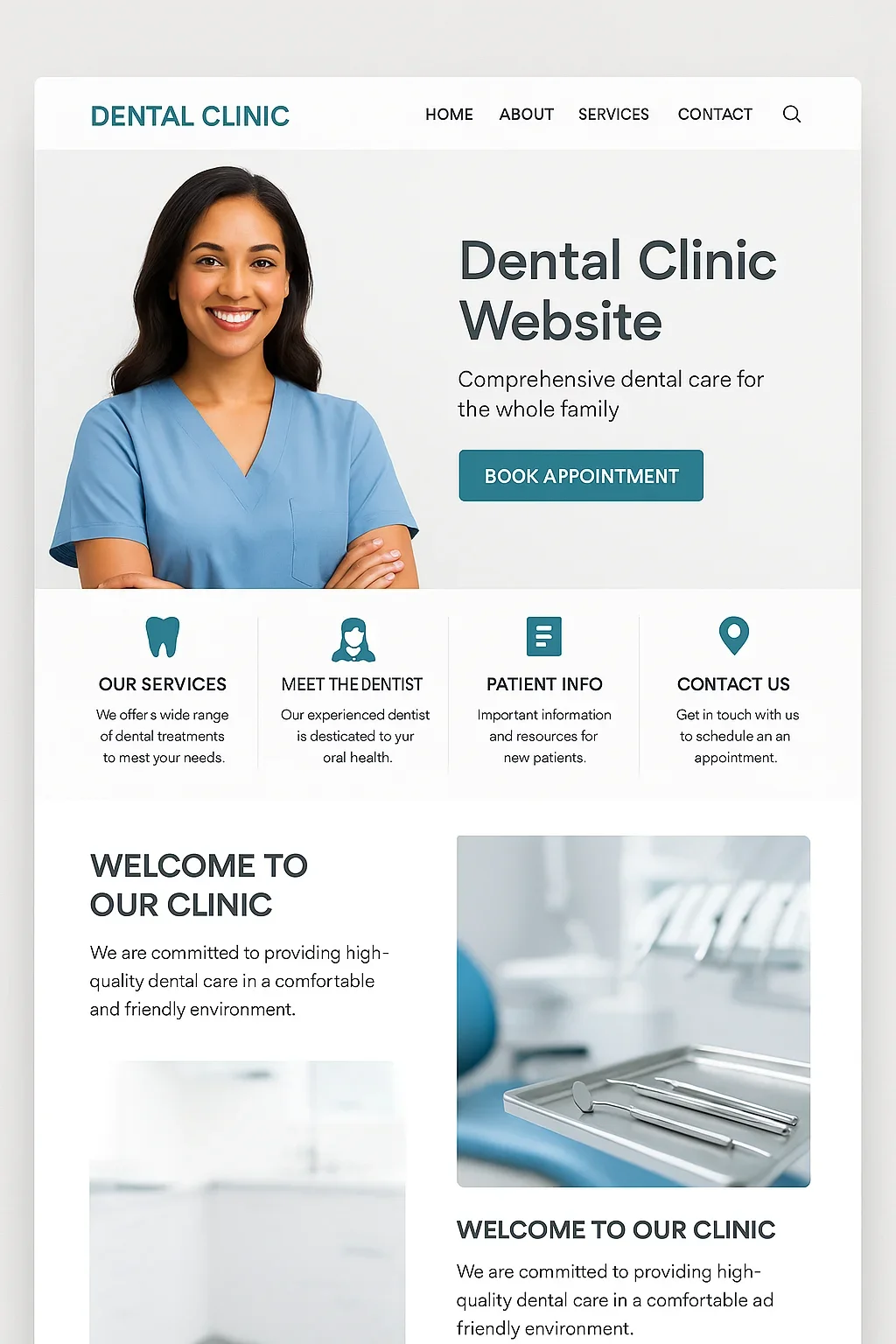
Top Mistakes to Avoid When Building a Dental Clinic Website
Creating a dental clinic website can be exciting, but many practices unintentionally make errors that prevent their sites from performing well. From poor mobile optimization to missing SEO elements, even small oversights can drastically reduce visibility, trust, and conversions. A well-built website should function as your digital front door — welcoming, professional, and patient-centered. Below, we’ll examine the most common mistakes dental clinics make and explain how to avoid them, ensuring your website attracts, engages, and converts visitors effectively 🦷.
1. Ignoring Mobile Optimization
One of the most damaging mistakes is failing to make your dental clinic website mobile-friendly. Over 75% of users now search for local healthcare services on their phones. If your site doesn’t adjust properly on small screens or takes too long to load, users will leave instantly. Google’s “mobile-first indexing” also means unoptimized sites rank lower in search results.
To avoid this, ensure your website uses a responsive design that automatically adapts to different devices. Compress images, minimize scripts, and test your site’s performance regularly on multiple smartphones. A mobile-friendly interface signals professionalism and boosts both user satisfaction and SEO ranking.
Key Mobile Optimization Fixes
- Adopt a responsive framework (e.g., Bootstrap, Tailwind CSS).
- Use clear navigation and large, tappable buttons.
- Keep forms short and mobile-optimized.
- Test site speed regularly with PageSpeed Insights.
2. Weak or Generic Content
Another major pitfall is publishing vague or duplicate content. Many clinics copy material from other sites, thinking it saves time — but this severely harms SEO and credibility. Google rewards original, informative content written for humans, not search bots. Patients visiting your dental clinic website expect expert advice, explanations of services, and reassurance about their concerns.
Focus on writing unique content that reflects your practice’s voice. Use patient-friendly language to describe treatments clearly and highlight what makes your clinic different — such as advanced technology, personalized care, or multilingual staff. Fresh, relevant content improves engagement and positions your clinic as a trusted authority in dentistry.
3. Poor Website Navigation
Complicated navigation confuses visitors and increases bounce rates. A cluttered menu or too many nested pages make it hard for patients to find information quickly. Every dental clinic website should feature a simple, well-organized structure: Home, Services, About, Blog, Testimonials, and Contact.
Include internal links between related pages to help both users and search engines explore your site efficiently. For example, connect your “Dental Implants” page with “Bone Grafting” or “Crown Restoration.” Logical navigation creates a frictionless browsing experience, improving engagement and conversions.
Navigation Best Practices
- Limit the main menu to 6–7 core items.
- Use descriptive, keyword-rich menu labels.
- Include a visible search bar on every page.
- Maintain consistent menu placement across devices.
4. Neglecting SEO and Metadata
Without proper SEO, even a stunning dental clinic website can remain invisible to potential patients. Common SEO mistakes include missing meta titles, duplicated descriptions, or forgetting to include target keywords. These issues make it difficult for Google to understand and rank your content correctly.
Each page should have a unique title tag and meta description containing relevant keywords like “dental implants in Istanbul” or “family dentist near me.” Also, use H1, H2, and H3 headings properly — your target keyword should appear naturally in at least one main heading per page. Optimizing URLs, images, and schema markup further enhances your site’s visibility and professionalism.
Simple SEO Fixes
- Use the keyword “dental clinic website” naturally within content and headings.
- Write meta titles under 60 characters and meta descriptions under 160.
- Compress images and include descriptive ALT text.
- Add structured data (LocalBusiness, Dentist) for better indexing.
5. Overlooking Loading Speed and Performance
A slow dental clinic website frustrates users and damages SEO. Studies show that a delay of just 3 seconds can lead to a 40% drop in engagement. Common culprits include oversized images, unoptimized code, and excessive plugins. To ensure top performance, host your site on a reliable server and use caching tools to store frequently accessed elements locally.
Additionally, enable content delivery networks (CDNs) to accelerate load times globally. Regularly audit your website using GTmetrix or Pingdom to identify bottlenecks and improve speed. The faster your website loads, the more professional it appears — and the more likely visitors are to stay.
6. Missing Clear Calls-to-Action (CTAs)
Without clear CTAs, even the best design won’t generate appointments. Many clinics make the mistake of burying their contact buttons or using generic labels like “Submit.” A well-placed, action-driven CTA guides users toward taking the next step — booking an appointment or contacting your team via the Redent Klinik Contact Page.
To optimize conversions, use compelling phrases such as “Book Your Visit,” “Schedule Consultation,” or “Get a Healthier Smile Today.” Ensure CTAs are visible above the fold and repeated throughout your dental clinic website in strategic places like the header, sidebar, and footer.
7. Lack of Visual Consistency and Professional Design
A visually inconsistent website erodes trust. Avoid mixing too many fonts, colors, and design elements. Patients associate visual harmony with credibility and care. Every dental clinic website should reflect the calm, clean, and welcoming environment of a professional dental office.
Stick to your brand colors and use high-quality images of your team and facilities. Consistency in design builds recognition and confidence. If your layout looks outdated, consider a modern redesign focusing on white space, simple icons, and balanced typography for a contemporary and trustworthy appearance.
8. Ignoring Analytics and User Feedback
Many clinics neglect to track how users interact with their site. Without analytics, you can’t know which pages perform well or where visitors drop off. Integrate tools like Google Analytics, Search Console, and Hotjar to gain insights into visitor behavior on your dental clinic website.
Collect data on metrics such as session duration, conversion rate, and exit pages. Combine these insights with user feedback forms to identify weak spots. Regular analysis ensures continuous improvement and keeps your website competitive and effective over time.
Essential Metrics to Monitor
- Bounce rate (aim for under 40%).
- Average session duration (target 1.5+ minutes).
- Conversion rate from CTAs or booking forms.
- Traffic sources (organic, social, referral).
9. Failing to Update Content Regularly
Outdated information — such as old pricing, expired offers, or inactive staff members — can damage credibility instantly. A successful dental clinic website must stay up-to-date to reflect your clinic’s current services, technologies, and certifications. Inactive blogs or outdated treatment descriptions give visitors the impression that your practice is not evolving.
Schedule quarterly reviews to refresh text, update imagery, and ensure all links work properly. Adding new blog posts or patient education articles boosts SEO and keeps your site dynamic and engaging.
10. Neglecting Legal and Privacy Compliance
Finally, every dental clinic website must comply with legal requirements like GDPR, HIPAA, or equivalent regional laws. Failing to include a Privacy Policy, Terms of Use, or Cookie Notice can lead to penalties and erode patient trust. Use a visible footer section to include these links and display a cookie consent banner upon site entry.
In healthcare, data sensitivity is paramount. Ensure contact forms are encrypted and disclose how patient information is stored or shared. Legal transparency not only ensures compliance but also builds confidence and professionalism 💼.
Conclusion
Avoiding these common mistakes can transform an average dental clinic website into a high-performing, patient-attracting digital powerhouse. Prioritize mobile optimization, clarity, security, and ongoing improvement. By building a site that’s visually appealing, SEO-optimized, and patient-focused, you create a lasting impression of expertise and trust. Remember: your website is not just a marketing tool — it’s the first and most powerful interaction patients have with your clinic. Treat it with the same care and precision you give to every smile you create 😁.