
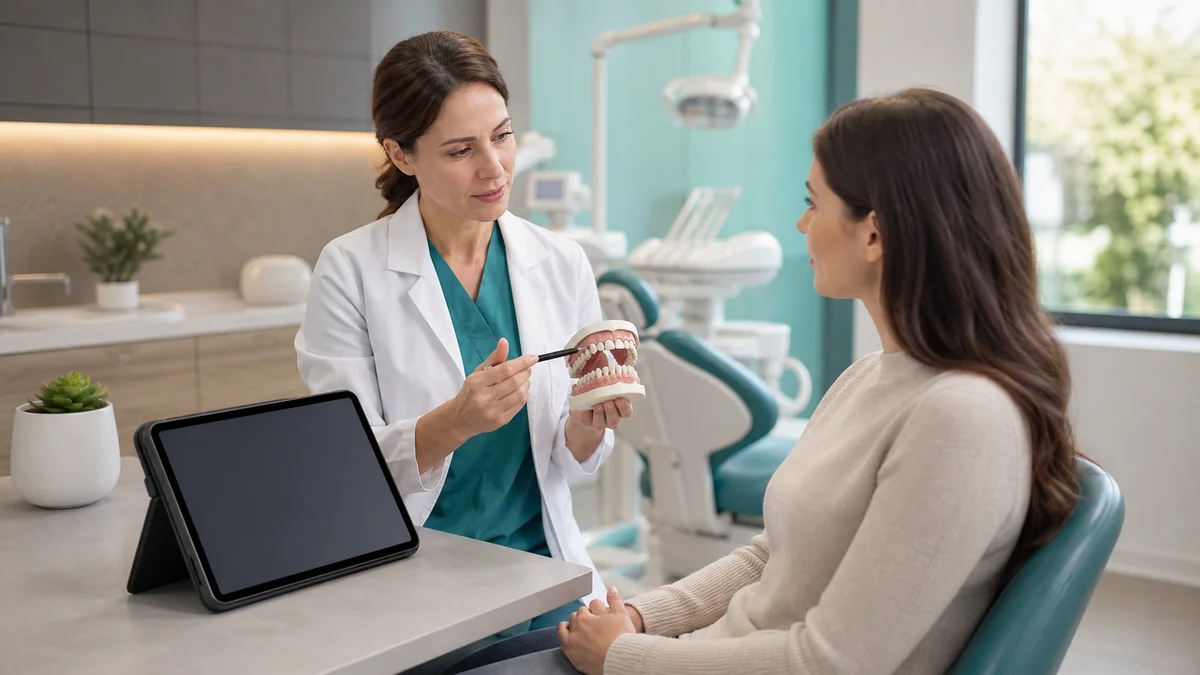
Quick answer: Choose a dental clinic by verifying its clinicians, scope, infection-control systems, diagnostic process, written options, fees, accessibility and follow-up—not by décor or ratings alone. Ask who will treat you, why imaging or treatment is recommended, what alternatives exist and how complications are managed. For expensive, elective or irreversible care, review records and consider an independent second opinion.
A dental clinic is more than a treatment room. It is a coordinated care system involving licensed clinicians, dental nurses or assistants, hygienists, reception staff, sterilization processes, records, laboratories, referral partners and emergency arrangements. A polished website may show services and technology, but it cannot prove that the clinic is the right match for an individual patient.
The safer question is not simply “Which office looks best?” It is “Which team can identify my needs, explain uncertainty, offer reasonable options and support me before, during and after treatment?” This guide turns that question into practical checks. It does not diagnose symptoms, rank individual providers, promise results or set a universal price.
Urgency changes the process. Trouble breathing or swallowing, uncontrolled bleeding, major facial trauma, or rapidly increasing facial swelling with fever or systemic illness may require urgent medical or dental assessment. Do not delay necessary care while comparing amenities. For routine, elective or complex decisions, however, a structured comparison can reduce avoidable risk.
1. dental clinic selection starts with your actual need
Before calling any office, write down why you need care. A person seeking prevention has different priorities from someone with acute pain, a child needing behavior support, or an adult considering extensive rehabilitation. Defining the goal helps a dental clinic give you appropriate appointment timing and assign the right clinician.
- Routine care: examination, risk assessment, preventive cleaning, maintenance and straightforward restorations;
- Urgent symptoms: pain, swelling, trauma, a fractured tooth or a lost restoration that needs triage;
- Specialty need: complex root canal care, periodontal treatment, orthodontics, oral surgery, pediatric care, oral medicine or orofacial pain;
- Rehabilitation: several missing, heavily restored or worn teeth requiring staged planning;
- Cosmetic concern: tooth color, shape or position where conservative alternatives should be discussed;
- Access need: mobility, sensory, language, anxiety or medical support that must be arranged in advance.
Ask whether the office routinely handles the problem you describe or mainly offers a different service. A responsible team should recognize its limits and refer when appropriate. A long menu of procedures does not mean every dentist in the building has equal training or provides every service.
2. verify every dental clinic clinician and credential
Facility branding does not replace individual professional accountability. Ask for the full name and role of the dentist who will examine you, the person expected to perform each procedure and the clinician responsible for follow-up. Verify licenses through the regulator in the country or region where care will occur.
A dental clinic may include general dentists and clinicians with postgraduate specialty training. The National Commission’s recognized specialty list illustrates that fields such as endodontics, periodontics, prosthodontics, orthodontics and oral surgery have distinct scopes. Recognition rules vary by jurisdiction, so confirm local requirements directly.
dental clinic titles require context
Marketing terms such as “cosmetic specialist,” “implant expert” or “smile designer” may describe an interest rather than a legally recognized specialty. Ask for the program name, institution, length, supervised clinical content and certifying organization. Independently check the source rather than relying only on a badge embedded on the clinic website.
An active license is a baseline, not a guarantee. If a regulator publishes restrictions or disciplinary decisions, read the original record and note dates, outcomes and current conditions. Do not substitute rumors, directory labels or anonymous posts for official documentation.
3. assess whether the dental clinic listens before recommending
A safe first visit usually begins with medical and dental history, medications, allergies, previous treatment, symptoms, anxiety, pregnancy possibility when relevant, and behaviors that may affect oral health. The team should ask about your priorities and explain which parts of the examination are appropriate.
Notice whether the dental clinic distinguishes a finding from a diagnosis and a diagnosis from a proposed treatment. A stain is not automatically decay requiring a restoration; a missing tooth does not automatically require an implant; and an image alone does not determine the full plan. Clinical context matters.
questions that reveal the reasoning process
- What is the diagnosis, and how certain is it?
- Which examination finding, test or image supports it?
- What is likely to happen if we monitor for a defined period?
- What are the conservative, alternative and no-treatment options?
- Which risks are common, serious or especially relevant to my health?
- What could change the plan after treatment begins?
- When would you refer this case to another clinician?
Two ethical clinicians can make different reasonable recommendations. Evidence, experience, anatomy, prognosis and patient preferences must be integrated. The important signal is whether you can follow the reasoning and make a voluntary choice without being rushed.
4. expect individualized imaging at a dental clinic
Radiographs and three-dimensional scans can answer important questions, yet more imaging is not automatically safer or more advanced. The American Dental Association’s evidence resources emphasize clinical decision-making based on the patient’s condition, professional expertise, needs and preferences.
Ask the dental clinic what a proposed image is intended to show and how the result could affect management. Recent usable records from another office may sometimes prevent unnecessary repetition. A new image can still be justified by poor quality, changed symptoms, elapsed time, different anatomy or a new treatment question.
Three-dimensional imaging should not be treated as a souvenir or a universal package. Its larger field of information can be valuable for selected procedures, but the dentist should define the indication. The same principle applies to photographs, digital scans and other diagnostic technology: the tool should serve a clinical question.
5. infection prevention is a dental clinic system
A tidy reception area does not prove correct instrument reprocessing. The CDC’s summary for dental settings identifies basic expectations for safe care. Standard Precautions include hand hygiene, appropriate protective equipment, respiratory hygiene, sharps safety, safe injections, sterile instruments and clean clinical surfaces.
It is reasonable to ask who coordinates infection prevention at the dental clinic, how reusable instruments are cleaned and packaged, which sterilization methods are used, how cycles are monitored and what happens after a failed indicator. Staff should be able to describe an organized process or connect you with the responsible person.
dental clinic observations have limits
You may see hand hygiene, glove changes, intact instrument packages and preparation of clinical-contact surfaces. One moment can be misunderstood, so ask for an explanation before drawing a conclusion. Patients do not need access to confidential logs to ask whether monitoring, maintenance and corrective procedures exist.
The CDC notes that Standard Precautions apply regardless of a patient’s known infection status. A dental clinic should also have written processes for staff training, respiratory symptoms, exposure incidents and medical emergencies. Safety should not depend on one employee remembering an unwritten routine.
6. informed consent at a dental clinic is a conversation
A signature on a form is not the whole consent process. The ADA’s informed consent guidance describes consent as an ongoing discussion. Patients should receive understandable information about the proposed care, material risks, expected benefit, reasonable alternatives and likely consequences of declining.
A trustworthy dental clinic allows time for questions and respects a patient’s right to pause or refuse. Consent obtained after sedation has started, under unexpected financial pressure or without an opportunity to understand the plan may not represent meaningful participation. Legal details vary by jurisdiction, but patient autonomy remains a central ethical principle.
translate technical language into a decision
Ask the dentist to identify the tooth or site, show the relevant finding and describe what tissue will be removed or altered. Terms such as “full-mouth,” “all-on,” “smile makeover” or “complete rehabilitation” are not sufficiently specific on their own. The plan should describe stages, materials, alternatives, maintenance and foreseeable contingencies.
If you need interpretation, request it before signing documents. Family members can support a patient, but professional language assistance may be more appropriate for complex decisions. Confirm which versions of consent and aftercare information the office can provide.
7. use a dental clinic decision table, not impressions alone
Apply the same questions to every office. A structured comparison reduces the influence of décor, charisma and promotional urgency. Record answers after the visit while the details are fresh.
| Decision area | What to verify | Why it matters |
|---|---|---|
| Treating team | Names, roles, licenses and relevant training | The brand is not the clinician |
| Clinical scope | Experience with your type of problem | Avoids mismatching complexity and competence |
| Diagnosis | Finding, evidence and level of uncertainty | Separates care from marketing |
| Options | Monitoring, conservative and alternative approaches | Supports patient autonomy |
| Imaging | Individual reason for each image or scan | Balances value and exposure |
| Infection control | Written systems, sterilization and monitoring | Protects patients and staff |
| Estimate | Itemized services, materials and possible extras | Makes financial comparisons fairer |
| Timeline | Visits, laboratory work, healing and reviews | Creates realistic expectations |
| Access | Language, disability, anxiety and medical needs | Care must be usable in practice |
| Emergency plan | After-hours contact and backup provider | Complications do not follow office hours |
| Maintenance | Home care, professional checks and likely repairs | Long-term care continues after delivery |
| Records | How to obtain charts, images and itemized receipts | Preserves continuity and second opinions |
Technology can support care but should not receive a score by itself. Ask how a scanner, microscope, laser, milling device or surgical guide changes your case. The most expensive or newest tool is not necessarily the least invasive option, and equipment cannot compensate for an unsupported diagnosis.
8. compare dental clinic estimates in writing
A reliable quote generally follows an appropriate examination. Cost depends on the diagnosis, procedure scope, materials, laboratory, provider, facility, medications, imaging, follow-up and local rules. Avoid assuming that a headline price includes every clinically necessary component.
Ask the dental clinic for an itemized plan identifying teeth or sites, stages, materials and likely additional scenarios. Clarify which amounts are estimates, which deposits are refundable and how the office obtains approval before adding non-urgent services. A fixed outcome or lifetime of service cannot be guaranteed because biology, use and maintenance vary.
questions before financing treatment
- Which diagnostic, clinical, laboratory and follow-up services are included?
- Which foreseeable findings may change the price or timeline?
- Who provides the credit, and what are the interest rate, fees and total repayment?
- When are funds released, and how are cancellations or plan changes handled?
- Does a warranty exclude biological complications, maintenance or outside care?
- Can you take the documents home before committing?
Insurance or public coverage rules should be confirmed with the payer as well as the office. A dental clinic can submit information and estimate benefits, but it may not control the payer’s final decision. Obtain written authorization when required and keep copies of the plan, correspondence and receipts.
9. accessibility belongs in dental clinic quality
A technically suitable plan is not useful if the patient cannot enter the building, communicate, tolerate the visit or return for maintenance. Ask about step-free access, transfer support, accessible toilets, hearing or visual accommodations, sensory needs, interpreter arrangements and appointment length before booking.
Tell the dental clinic about relevant medical conditions, medications, allergies and previous difficulties. Some patients need coordination with a physician or a setting with additional monitoring. Staff should discuss what they can safely provide and when another facility would be more appropriate.
dental anxiety needs a specific plan
Anxiety support can include a pre-visit conversation, stop signal, step-by-step explanations, topical and local anesthesia, shorter appointments, breaks and gradual care. If sedation is suggested, ask the exact level, who administers it, what authorization applies, how vital signs are monitored, what fasting and escort rules apply and how emergencies are managed.
Sedation should help a patient receive appropriate care; it should not make an unclear plan easier to accept. Provide accurate information about sleep apnea, heart or lung conditions, pregnancy, liver or kidney disease, medicines, nonprescribed substances and previous anesthesia reactions. Do not alter medication without professional advice.
10. understand what your first dental clinic visit may include
Visit structure varies with symptoms and scope. A routine first appointment may include history, examination, gum assessment, caries risk review and clinically indicated imaging. An urgent appointment may focus on pain control and identifying conditions that cannot safely wait. A complex consultation may gather records before final recommendations.
Do not assume that every dental clinic will provide definitive treatment at the first visit. Diagnosis, medical consultation, laboratory work or referral may be needed. For elective irreversible treatment, time to review the plan is often a safety benefit rather than an unnecessary delay.
- Bring current medications, allergies and relevant medical information;
- Bring previous images, reports and implant or prosthesis records if available;
- List symptoms, their timing and what makes them better or worse;
- Write down your priorities, concerns and questions;
- Ask whether you should eat, take routine medication or arrange transport beforehand;
- Request a written summary if several options are discussed.
11. check emergency and aftercare systems at a dental clinic
Ask who answers questions after treatment, what symptoms require an urgent call, where adjustments occur and who covers evenings or weekends. A complex procedure may involve temporary restorations, healing checks or laboratory stages. The office should explain the realistic route if something loosens, fractures, bleeds, swells or becomes unexpectedly painful.
An organized dental clinic provides procedure-specific aftercare and documents what was done. Instructions should distinguish expected temporary effects from warning signs. The patient should know whether to call the clinic, an on-call provider, an emergency dentist or a hospital service.
Long-term maintenance is equally important. Natural teeth, implants, crowns, veneers, dentures and orthodontic appliances all require home care and professional review. Ask which maintenance can be provided locally if you travel for treatment or move away.
12. second opinions and dental clinic records protect continuity
An independent second opinion is particularly useful when a plan affects many teeth, removes restorable teeth, involves surgery, prepares healthy tissue for aesthetic reasons, addresses persistent unexplained pain or requires a major financial commitment. Obtain records and an itemized proposal so the second clinician can assess the same problem.
Different recommendations do not automatically mean someone is wrong. Ask each dental clinic to explain the diagnosis, prognosis without treatment, least invasive reasonable option, material risks and maintenance. If the difference remains large, a relevant specialist consultation may help resolve the uncertainty.
Ask how to obtain your chart, radiographs, scans, photographs, referral letters, laboratory details and itemized receipts. Privacy and release rules vary, but records should be managed in a way that supports patient welfare and continuity. Keep your own organized copy.
13. dental clinic red flags that justify a pause
No single administrative mistake proves unsafe care. Look for a pattern in how the office handles evidence, consent, money and questions. Several of these signs warrant slowing down:
- The treating clinician’s identity, license or relevant permit cannot be verified;
- A major diagnosis is made from a selfie without appropriate examination;
- Every patient appears to receive the same number of veneers, crowns or implants;
- Monitoring, referral and conservative alternatives are dismissed without explanation;
- “Zero risk,” “permanent,” “guaranteed” or “pain-free for everyone” claims are used;
- You are pressured to start elective irreversible care or financing immediately;
- Risks, maintenance and possible additional services are not discussed;
- Questions about sterilization, records, emergency cover or second opinions are discouraged.
A better sign is transparent uncertainty. The dental clinic explains what is known, what remains unclear, what could change the plan and when referral is appropriate. Respect for a patient’s decision to wait or decline is part of a safe relationship.
Frequently asked questions about a dental clinic
How do I know whether a dental clinic is licensed?
Check the facility and individual clinicians through the relevant health or professional regulator where treatment will occur. Rules differ by country and region. Search legal names, confirm current status and read official documents directly. A website badge or directory profile is not a substitute.
Does a clean-looking dental clinic prove safe sterilization?
No. Appearance does not show whether reusable instruments are correctly cleaned, packaged, sterilized and monitored. Ask the team to describe its infection-prevention system. CDC guidance provides a useful baseline for questions about Standard Precautions, instrument processing and clinical surfaces.
Should a dental clinic take X-rays at every first visit?
Not automatically. Imaging should follow history and examination and answer an individual diagnostic question. Recent usable records may sometimes be transferred. New images can be appropriate when symptoms, quality, time or treatment needs differ. Ask why each image is expected to help.
Can one dental clinic provide every specialty?
Some multidisciplinary centers include several recognized specialties; others coordinate external referrals. Confirm which clinician provides each service and what their training covers. A responsible general dentist should refer when diagnosis, complexity or risk would benefit from specialist input.
Is the most expensive dental clinic automatically better?
No. Fees reflect many factors and do not independently prove diagnostic or technical quality. Compare the clinical plan, materials, team, infection control, follow-up and included services. The lowest headline price can also be misleading if essential stages are excluded.
Can a dental clinic guarantee a treatment result?
A clinic may describe service terms or laboratory warranties, but biology prevents a responsible guarantee of a specific health outcome or lifespan. Starting condition, healing, disease risk, habits and maintenance all influence results. Ask what is covered, excluded and required.
When should I get a second opinion from another dental clinic?
Consider it for extensive, elective, irreversible, uncertain or expensive plans, particularly when recommendations differ sharply from prior care. Bring the same records and ask the second clinician to state the diagnosis and options independently before comparing conclusions.
What should I bring to a dental clinic appointment?
Bring medication and allergy information, relevant medical history, previous dental records, implant details, insurance documents if applicable, and a written symptom timeline. A question list can help. Ask in advance about fasting, routine medicines or transportation if sedation is possible.
How do I evaluate online reviews for a dental clinic?
Use reviews to identify recurring practical themes such as communication, scheduling and billing. They cannot prove diagnostic accuracy or long-term outcomes. Check dates, specificity and the treating clinician’s name, then verify official credentials and judge the consultation yourself.
What if I need low-cost dental clinic care?
The U.S. National Institute of Dental and Craniofacial Research suggests checking dental schools and local health resources in the United States. Other countries have different public, university or charitable pathways. Confirm eligibility, scope, waiting time and continuity before relying on a program.
Can I choose a dental clinic abroad?
Yes, but compare regulation, travel fitness, records, treatment stages, recovery time, emergency access, complication care and maintenance at home. Do not treat remote advice as a diagnosis. Clarify who is clinically responsible and how cross-border follow-up will work before paying.
14. choose a dental clinic through a verifiable process
Start with your need, then verify the people expected to provide care. Examine how the team reaches a diagnosis, selects imaging, explains alternatives and manages infection prevention. Compare itemized plans, accessibility, consent, emergency cover, records and maintenance using the same questions.
A suitable dental clinic does not have to promise perfection. It should make uncertainty visible, respect patient autonomy and offer a realistic plan that fits the clinical problem. For information about care in Istanbul, visit Redent Klinik; for records, scheduling and initial questions, use the Redent Klinik contact page. An online discussion cannot replace an in-person examination.
Medical note: This educational article is intended for review by Dentist Esma Çevrük Çakır and prioritizes evidence-based communication and patient safety. It does not provide an individual diagnosis, emergency triage, price quote, insurance decision or treatment guarantee.
Sources for evaluating a dental clinic
- Centers for Disease Control and Prevention — basic expectations for safe dental care
- Centers for Disease Control and Prevention — Standard Precautions
- American Dental Association — clinical practice guidelines and evidence
- American Dental Association — informed consent and refusal
- National Commission — recognized dental specialties
- National Institute of Dental and Craniofacial Research — finding dental care
- American Dental Association
- World Health Organization — oral health fact sheet