
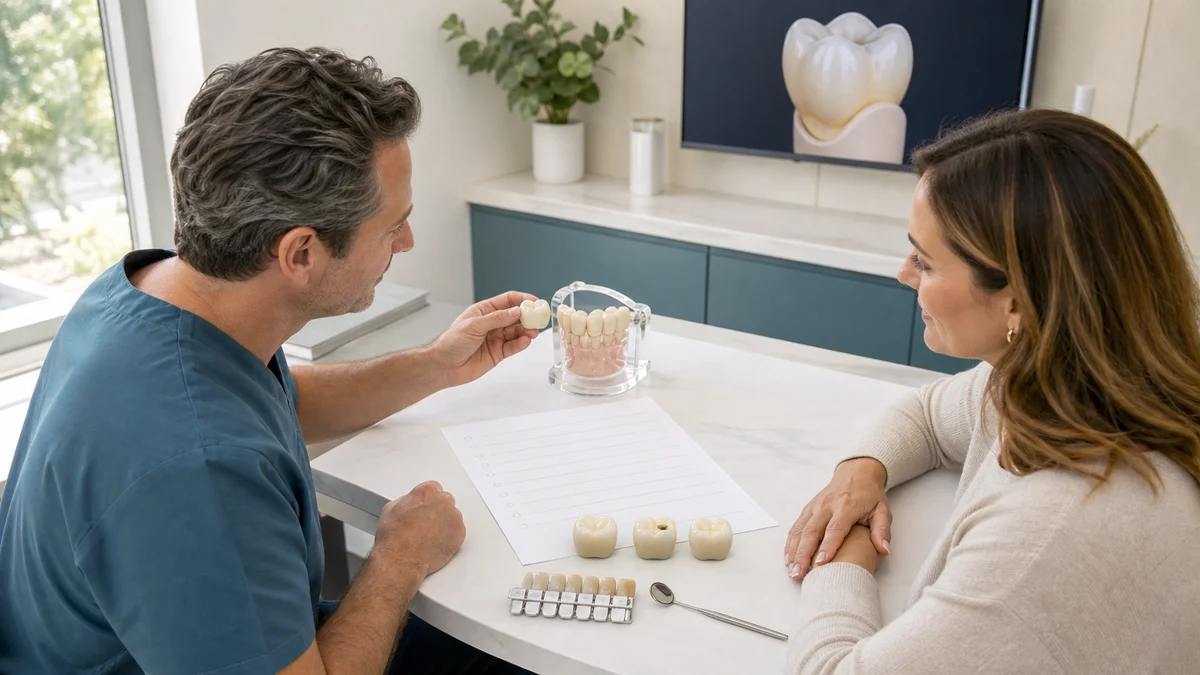
Quick answer: dental crown repair cost changes with the diagnosis: an intact loose crown may be re-cemented, a limited chip may be repairable, and a damaged or poorly fitting crown may need replacement. The total can also include examination, imaging, provisional care, laboratory work or treatment beneath the crown. Request written essential and conditional fees before deciding.
A loose, chipped or detached crown often leads to one urgent question: what will it cost? The honest answer begins with another question: what exactly failed? dental crown repair cost is not a universal procedure fee. It can describe a brief adjustment, re-cementation, a localized material repair, removal and replacement of the crown, or a broader plan for the tooth, gum or implant component underneath it.
This guide is designed to help you read an estimate line by line. It does not diagnose a crown from symptoms or promise a price, lifespan or result. A dentist needs to examine the restoration and its support before confirming a treatment route. When you understand how a clinic builds a dental crown repair cost estimate, you can compare plans more fairly and consent with fewer financial surprises.
1. Start with the diagnosis, not dental crown repair cost
A crown is an artificial restoration that surrounds remaining tooth structure or is placed on an implant. According to the American Dental Association’s glossary, crowns can be made from metal, ceramic or polymer materials and retained by cement or mechanical means. That definition explains why “repair” can mean very different work from one patient to another.
A crown may be loose because cement has failed, but it may also have lost retention because of decay, a fractured buildup, an altered bite or insufficient support. A chip may be superficial, or it may be part of a crack that compromises the restoration. A crown can look intact while the tooth below needs treatment. Until those possibilities are assessed, any dental crown repair cost is only a broad planning figure.
Ask the dentist to name the finding before naming the fee. Useful wording includes: “The crown is intact but no longer retained,” “There is a localized ceramic defect,” or “The margin and supporting tooth are compromised.” A diagnosis-linked dental crown repair cost is easier to understand than a vague charge labeled only “crown repair.”
2. Four different services may be called crown repair
Patients and clinics do not always use the word “repair” in the same way. Separating the possible routes prevents an apparently low quote from being mistaken for a complete plan. The following table is a discussion aid, not a self-diagnosis.
| Finding after examination | Possible clinical route | What the estimate may contain | Main uncertainty |
|---|---|---|---|
| Intact crown is loose or detached and still fits appropriately | Clean, assess and re-cement when suitable | Focused examination, imaging if indicated, cement removal, isolation, cementation and bite check | Whether the crown and supporting tooth are genuinely reusable |
| Small localized chip with acceptable fit and sound remaining structure | Polish, monitor or use a compatible localized repair | Surface preparation, bonding protocol, repair material, contouring, polishing and adjustment | Material identification, fracture depth and bite load |
| Extensive fracture, poor margin, repeated loosening or nonrepairable crown | Remove and replace the crown | Removal, preparation, scan or impression, provisional crown, laboratory or chairside fabrication and fitting | Condition of the tooth once the old crown is removed |
| Decay, crack, pulpal disease, gum problem or implant-component issue | Treat the underlying condition before or with restorative care | Condition-specific treatment plus any repair or new crown | Extent and restorability of the supporting structure |
Each row creates a different dental crown repair cost. If a phone estimate does not identify which row it assumes, ask for the assumption in writing. The estimate should also explain what evidence would move the case from a conservative route to replacement or additional treatment.
3. Estimate line 1: focused examination
The examination is the foundation of the estimate. A dentist may inspect the crown’s mobility, margin, contacts, appearance and material; evaluate the surrounding gum; test the supporting tooth; and review how the teeth meet. The goal is not merely to confirm that something feels loose. It is to identify the cause and determine whether the crown, tooth and surrounding tissues are suitable for repair.
Ask whether the examination fee is included in dental crown repair cost or charged separately. Also ask whether the quoted examination is limited to the problem tooth or part of a broader dental assessment. Neither arrangement is automatically wrong, but the scope should be clear when comparing clinics.
4. Estimate line 2: diagnostic records and imaging
A visual check cannot reveal every problem beneath a crown. Depending on the history and findings, radiographs or other records may be indicated to assess decay, root condition, bone levels, an implant component or the relationship between the crown and tooth. Not every person requires the same images, so a responsible estimate should connect each record to a clinical question.
Recent images from another practice may sometimes be useful, but the new dentist must decide whether they show the relevant area and still represent the current situation. Ask whether imaging is included in dental crown repair cost, whether copies can be shared with you, and what decision the proposed image is expected to support.
5. Estimate lines 3 and 4: removing and re-cementing a crown
When a crown has detached intact, re-cementation may appear simple. The dentist still needs to remove residual cement, clean the surfaces, check the crown’s internal fit, inspect the supporting structure and ensure that the restoration seats fully. The area must be managed with a dental material and technique appropriate to the crown and clinical conditions.
A re-cementation dental crown repair cost may therefore include professional time, isolation, cleaning, cement, seating verification and bite adjustment. It should state whether the figure assumes the crown is reusable. If the crown will not seat, the margin is open, decay is present or the supporting tooth is fractured, the plan can change.
Repeatedly re-cementing a crown without identifying why it loosens may postpone necessary care. Ask whether the cause appears to be isolated cement failure or a structural problem. A low immediate dental crown repair cost is not a saving if the same failure returns because the underlying issue was not addressed.
6. Estimate line 5: localized chip repair
Some limited defects may be polished or repaired rather than replacing the whole restoration. An ADA clinical report on defective restorations emphasizes appropriate case selection, repair material and technique. The remaining restoration and tooth must be suitable. Not every all-ceramic crown or fracture can be repaired predictably.
Localized dental crown repair cost can reflect identification of the crown material, surface conditioning, a compatible adhesive approach, restorative material, contouring, polishing and bite adjustment. Location matters: a visible front-tooth defect has different aesthetic demands from a small posterior defect, while a contact or biting surface may experience heavier forces.
Ask whether the proposed work is polishing, adding repair material or replacing part of a layered restoration. Ask how the defect’s depth and position affect expected limitations. The dentist should explain what the repair can reasonably achieve without guaranteeing invisibility or permanence.
7. Estimate lines 6 to 9: a replacement crown
If the crown is extensively fractured, no longer fits, repeatedly loosens or cannot be repaired while protecting the tooth, replacement may be recommended. A new crown is a sequence, not a single object. The quote may involve removing the existing restoration, preparing the tooth, recording its shape, protecting it temporarily and delivering the final crown.
For replacement, dental crown repair cost should clarify whether these components are included:
- Removal of the old crown and any difficult sectioning required.
- Preparation or refinement of the supporting tooth.
- Digital scanning or a conventional impression and bite record.
- A provisional crown and any routine provisional adjustment.
- Laboratory or chairside fabrication of the final crown.
- Try-in, contact and shade evaluation, cementation and bite adjustment.
- A clearly stated policy for follow-up adjustments, without a biological guarantee.
One clinic may bundle all of these steps, while another lists them separately. A fair comparison uses the total expected dental crown repair cost, not only the line for the final crown. If the plan is expected to take more than one visit, ask what protects the tooth between appointments.
8. Estimate line 10: crown material and laboratory work
The ADA’s overview of indirect restorative materials explains that material classes differ in composition, physical properties, processing, clinical indications, aesthetics and cost considerations. Ceramics can chip or fracture, while metal, ceramic, resin-based and combined systems behave differently. Material choice must fit the individual case.
Laboratory work can influence dental crown repair cost, but a higher material price is not automatically a better clinical choice. Ask for the proposed material in plain language, why it suits the tooth location and bite, whether it is monolithic or layered when relevant, and whether laboratory charges are included. Appearance preferences, available tooth space, opposing teeth and parafunctional forces may all affect the recommendation.
If two quotes name different materials, they are not directly equivalent. Compare the dentist’s rationale, preparation needs, appearance goals and maintenance expectations alongside dental crown repair cost. Avoid choosing from marketing labels alone.
9. Estimate line 11: treatment under the crown
A crown does not prevent all future decay, fractures or disease in the tooth beneath it. Once an old crown is removed, the dentist may find softened tooth structure, a failed buildup or a crack that was not fully visible beforehand. Symptoms such as persistent pain, swelling, sensitivity or pain on biting may also require investigation of the pulp, root or surrounding tissues.
The National Institute of Dental and Craniofacial Research notes that untreated tooth decay can progress to pain, infection and tooth loss; advanced problems can include abscess, facial swelling and fever. If the supporting tooth needs care, the total dental crown repair cost may include a separate buildup, endodontic assessment or root canal treatment, periodontal care, decay removal or another condition-specific procedure.
These procedures should not be treated as automatic add-ons. Ask which findings support them and whether they are essential, conditional or alternatives. Useful estimates show a base pathway and a clearly labeled contingency. That makes dental crown repair cost more honest even when the exact condition cannot be known until the crown is removed.
10. Estimate line 12: implant crown components
A crown on an implant has a different support system from a crown on a natural tooth. Mobility may come from cement, a retaining screw, an abutment, the crown itself or another component. The implant must also be assessed. Pressing, twisting or gluing a mobile implant crown at home can complicate professional care.
For an implant case, dental crown repair cost may depend on whether the restoration is screw-retained or cement-retained, whether the system and components can be identified, whether a screw or abutment is reusable, and whether the crown can be removed without damage. Records from the original practice may help identify the system, but they do not replace examination.
Ask for separate entries for professional assessment, imaging if indicated, crown work and replacement components. If the movement appears to involve the implant rather than only the prosthetic crown, seek prompt professional assessment.
11. Estimate line 13: urgent and out-of-hours care
An urgent visit may have a separate fee, especially outside normal hours, and the first appointment may focus on safety and temporary stabilization rather than final restoration. Ask what the urgent service includes and whether its fee is credited toward later treatment. A temporary measure and a definitive repair should not be confused when reviewing dental crown repair cost.
Contact a dentist promptly for a loose, broken or detached crown. Avoid chewing hard or sticky foods on that side and keep a detached crown in a clean container. Do not use superglue or household adhesive. These products are not designed for oral tissues or accurate dental seating.
- Seek urgent local dental or medical care for facial swelling, fever, severe or rapidly worsening pain.
- Difficulty breathing or swallowing may be an emergency; contact local emergency services.
- Report significant trauma, uncontrolled bleeding or a possibly inhaled component immediately.
- Bring the detached crown and relevant dental records to the appointment if available.
When red-flag symptoms are present, delaying care to search for the lowest dental crown repair cost can increase risk. The priority is timely assessment and control of pain, infection or injury.
12. Insurance: separate clinical need from plan payment
Dental benefit plans apply their own contracts, definitions and limitations. Re-cementation, repair and replacement may be processed as different services. A plan may also impose a replacement-frequency rule or use an alternative benefit. The ADA’s current crown and core-buildup claim guidance notes that some payers apply replacement periods, while plan rules vary and clinically necessary treatment may not meet a particular reimbursement threshold.
For an insured dental crown repair cost, request four separate figures where possible: the dentist’s full fee, the plan’s estimated allowed amount, the estimated plan payment and your estimated responsibility. The ADA glossary distinguishes a dentist’s full fee from plan reimbursement concepts and explains that deductibles, coinsurance, exclusions and limitations influence benefits.
A predetermination or pre-treatment estimate can improve planning, but it is not necessarily a guarantee of payment. Eligibility, annual maximums, remaining benefits, network status and the final procedure submitted can change the outcome. If treatment changes after the crown is removed, ask how the clinic will update both the clinical plan and estimated dental crown repair cost.
13. Financing: calculate the amount you will actually pay
A monthly payment does not reveal the final price. The U.S. Consumer Financial Protection Bureau advises consumers to examine terms for medical credit cards and payment plans, including deferred interest. If a promotional balance is not paid in full by its deadline, interest and fees can make the total much higher.
Before financing dental crown repair cost, ask for:
- The cash price and amount financed.
- The interest or annual percentage rate and whether it can change.
- Every setup, account, late or early-settlement fee.
- The number, amount and due date of payments.
- Whether interest is waived, deferred or charged retroactively.
- The total amount payable if all payments are made as scheduled.
- The effect of missed payments on interest, collections and credit reporting.
Choose the clinically appropriate route first, then compare payment methods. If staged care is possible, ask which step is urgent, what can safely wait and whether staging changes total dental crown repair cost. Do not interpret access to financing as evidence that a procedure is necessary.
14. How to compare two written estimates
Place estimates side by side and match their assumptions. Are both for re-cementation, or is one for a new crown? Do both include examination, imaging, provisional care and laboratory work? Are they based on the same material and the same condition of the supporting tooth? A difference in dental crown repair cost may reflect missing lines rather than a true difference for equivalent care.
Use a short comparison sequence:
- Write the diagnosis and proposed route at the top of each estimate.
- Mark every included service and every excluded service.
- Circle conditional charges and ask what clinical finding triggers them.
- Compare materials, visit count, provisional care and laboratory inclusion.
- Separate insurer estimates from the clinic’s full fee.
- Compare cash total with financed total, not monthly payments alone.
- Record important limitations and follow-up arrangements.
A second opinion can be reasonable for an unexpected replacement or extensive underlying treatment, provided urgent symptoms are not neglected. The aim is not to force every dentist into the same plan but to understand why the plans and dental crown repair cost differ.
15. Planning care when travel is involved
If you are considering treatment away from home, include travel, accommodation, number of visits and possible follow-up in the comparison. A provisional crown may need review, a laboratory restoration may require another appointment, and an unexpected finding can change the schedule. A headline dental crown repair cost without these practical details is incomplete.
Ask who will manage urgent symptoms after you return home, how records will be shared and what routine adjustments are included. Follow-up arrangements do not guarantee an outcome, but they clarify responsibility. You can review the clinic’s approach through the Redent Klinik English information page and send relevant questions using the Redent Klinik contact page. A personalized dental crown repair cost still requires clinical evaluation.
Frequently asked questions about dental crown repair cost
Can a clinic confirm dental crown repair cost from a photo?
A photo can help show a visible chip or missing crown, but it cannot reliably assess the margin, underlying decay, root, bite or implant components. It may support triage, not a definitive diagnosis. A responsible dental crown repair cost should be confirmed after examination and any clinically justified records.
Is re-cementing a crown the same as repairing it?
Not always. Re-cementation restores retention when the crown and support are suitable. Localized repair may add or reshape material, while replacement involves making a new restoration. Ask which service the estimate describes because each creates a different dental crown repair cost.
Can every chipped crown be repaired?
No. Repair suitability depends on crown material, size and location of the defect, margin integrity, remaining tooth, appearance requirements and bite forces. Some limited chips can be polished or repaired; extensive damage may require replacement. The explanation should accompany the dental crown repair cost.
Why can the estimate change after the old crown is removed?
The crown can conceal decay, a damaged buildup or a crack that was not fully visible beforehand. The estimate should label likely contingencies and the findings that would trigger them. This does not eliminate uncertainty, but it makes the potential dental crown repair cost clearer before treatment begins.
Does dental crown repair cost include a temporary crown?
Only if the written estimate says so. A replacement completed over multiple visits may need a provisional restoration, while re-cementation or localized repair may not. Ask whether making, fitting and adjusting the provisional are included in dental crown repair cost.
Will insurance cover a replacement crown?
Coverage depends on the individual plan. Replacement-frequency limits, deductibles, coinsurance, annual maximums, exclusions and network rules may apply. A pre-treatment estimate can help but may not guarantee payment. Keep the insurer estimate separate from the clinic’s full dental crown repair cost.
Can I glue a detached crown back at home?
Do not use superglue or household adhesive. It can affect oral tissues, prevent correct seating and complicate care. Store the crown safely, avoid chewing on the tooth and contact a dentist promptly. Home improvisation should not replace evaluation of the cause or dental crown repair cost.
What documents should I request?
Request the diagnosis, itemized plan, essential and conditional fees, proposed material, estimated visit sequence, insurer assumptions and financing terms if relevant. Copies of appropriate diagnostic records may also help continuity. Together these documents make dental crown repair cost easier to compare.
Make the decision with a complete total
The smallest number is not always the least expensive route, and the largest plan is not automatically the most appropriate. The useful comparison is between clinically reasonable options that include the same steps. Ask what failed, why the suggested treatment addresses it, what alternatives exist and what finding could change the plan.
Before consenting, confirm the diagnosis, route, included services, conditional treatment, material, insurance assumptions, timing and total payable. That turns dental crown repair cost from a vague label into an informed decision. This evidence-based, patient-safety-first content is intended for review by Dentist Esma Çevrük Çakır and cannot replace an individual dental examination.
Sources
- American Dental Association — Glossary of Dental Terms
- ADA News — Repair of defective restorations
- American Dental Association — Materials for Indirect Restorations
- American Dental Association — 2026 Crown and Core Buildup Claim Guide
- National Institute of Dental and Craniofacial Research — Tooth Decay
- MouthHealthy by the ADA — Dental Emergencies
- Consumer Financial Protection Bureau — Medical Credit Cards and Payment Plans
- World Health Organization — Oral Health