
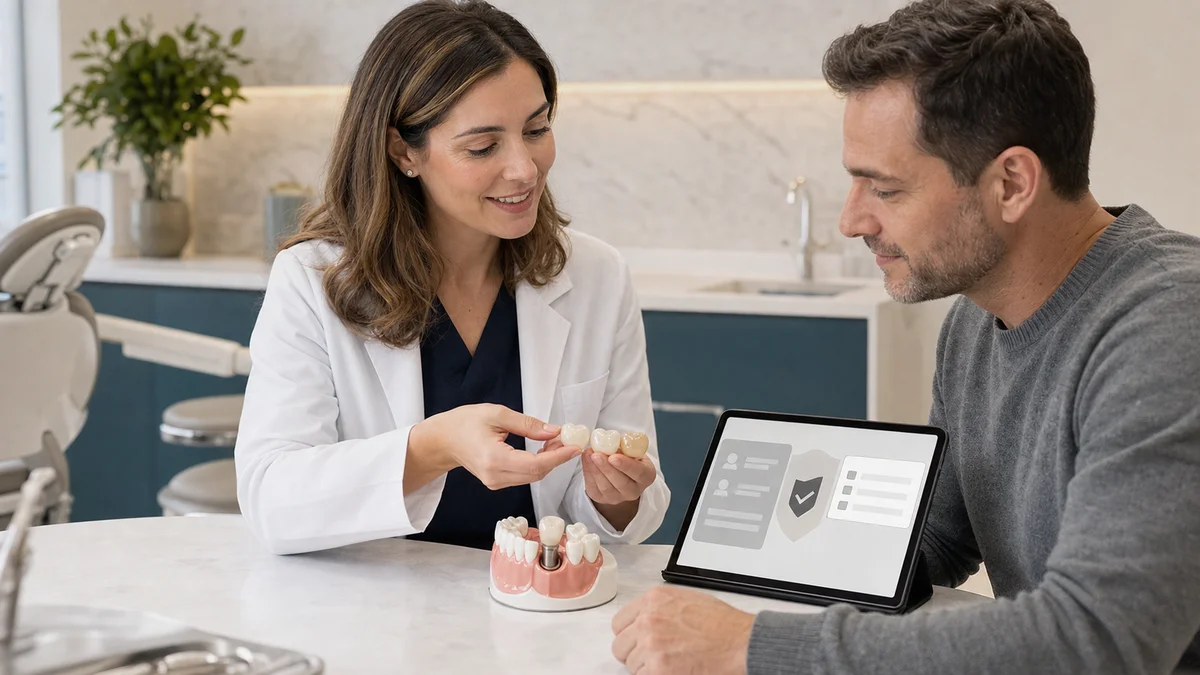
Quick answer: Reviews can reveal patterns in communication, comfort, scheduling and aftercare, but they cannot diagnose your tooth or prove that one crown material is best. Use recent comments from several independent sources, look for specific and balanced experiences, verify the dentist’s credentials, and compare the written diagnosis, alternatives, material, laboratory process, fee scope and follow-up policy.
Reading dental crowns reviews is a sensible way to learn how a clinic communicates and supports patients. Yet a high star rating cannot show whether your tooth needs a crown, how much healthy structure remains, whether the nerve or gums need treatment, or which material fits your bite. A review reflects one person’s circumstances and expectations; a clinical decision requires an examination, diagnosis and informed consent.
The American Dental Association’s MouthHealthy resource explains that a crown covers a tooth to restore shape and size, strengthen a tooth with a large filling, protect a weak or broken tooth, support a bridge, improve appearance or cover an implant. Those uses are not interchangeable. When comparing dental crowns reviews, first ask whether the reviewer had a similar treatment goal—without assuming that a superficially similar smile means the same diagnosis.
This guide provides a practical method for separating useful signals from promotional noise. It does not reproduce invented testimonials, declare one clinic “best,” promise a crown’s lifespan or replace personal dental advice. Outcomes depend on tooth condition, preparation design, material, bite forces, laboratory quality, cementation, hygiene and maintenance. Reviews can inform a shortlist, but they should never overrule a qualified assessment.
What Dental Crowns Reviews Can and Cannot Tell You
Good dental crowns reviews may describe whether the clinic explained options, managed anxiety, respected appointment times, provided a temporary crown and responded when a bite felt high. Repeated comments about clear consent, accessible aftercare or unresolved communication problems can be relevant. These are service-experience signals, not clinical proof.
Reviews usually cannot verify the original diagnosis, radiographs, amount of tooth preparation, isolation, laboratory prescription, crown fit or long-term tissue response. A photograph may show color and shape, but it does not show decay under the margin, root condition, microscopic cracks or how the bite functions. Even a sincere reviewer may misunderstand which material or procedure they received.
Treat dental crowns reviews as one evidence layer. Combine them with the dentist’s registration, relevant training, written treatment plan, material disclosure, infection-control standards, laboratory process and follow-up policy. If the clinic’s explanation conflicts with your examination findings or seems to promise certainty, obtain clarification or another qualified opinion.
Start With the Purpose of a Crown
A crown may be recommended for structural, restorative, functional or aesthetic reasons. The NHS describes a crown as a cap that completely covers a real tooth and notes that crowns can be made from metal, ceramic or porcelain fused to metal. The ADA adds that crowns may strengthen teeth with large fillings, protect weak teeth, restore broken teeth, attach bridges or cover implants.
Before searching dental crowns reviews, ask what problem the proposed crown is intended to solve. Could a direct filling, inlay, onlay or other conservative restoration be reasonable? Does the tooth need root-canal or gum assessment? Is the crown for a natural tooth or an implant? What happens if no treatment is chosen? The answers establish whether reviews about other cases are even comparable.
A crown normally requires some degree of tooth preparation, which is not reversible. The amount and design depend on the tooth, existing damage, material and retention needs. Informed consent should cover the nature of the preparation, reasonable alternatives, material choices, expected appointments, temporary restoration and relevant risks. No collection of dental crowns reviews substitutes for that conversation.
12 Signals to Look for Across Review Platforms
A single dramatic comment can be memorable, but patterns are more useful. When reading dental crowns reviews, compare several independent platforms and the clinic’s own site. The US Federal Trade Commission advises consumers not to rely on star ratings alone because some ratings and reviews can be fake or misleading. Its review rule also addresses fake, false and certain incentivized or suppressed reviews in the United States.
- Specificity: useful reviews describe communication, appointment stages or follow-up rather than generic praise.
- Recency: current reviews are more relevant to the present team, systems and laboratory arrangements.
- Range: a credible profile normally contains varied experiences rather than only identical superlatives.
- Timing: a sudden burst of similar comments can deserve closer scrutiny.
- Independent sources: compare clinic-controlled testimonials with third-party platforms.
- Disclosure: note whether a reviewer received an incentive or has another relationship with the business.
- Clinical humility: beware of reviews presented as proof that every patient gets the same result.
- Aftercare detail: comments about bite adjustment, sensitivity and response to concerns can be informative.
- Privacy-respecting responses: a clinic should not expose confidential health details while replying.
- Problem resolution: professional, calm replies may reveal more than the original complaint.
- Consistency with verified information: treatment claims should match the clinic’s written policies and credentials.
- No pressure: incentives conditioned on positive sentiment or attempts to suppress honest criticism are warning signs.
These checks do not prove that an individual review is true or false. They help you assign appropriate weight. A person evaluating dental crowns reviews should remain open to both positive and negative patterns while recognizing that satisfied and dissatisfied patients may be more motivated to post than those with an uneventful experience.
How to Compare Crown Cases Without Comparing Unlike Treatment
Two crown cases can differ in tooth position, remaining structure, previous fillings, root treatment, gum level, bite force and aesthetic demand. An implant crown has a different foundation from a crown cemented or bonded to a natural tooth. Front-tooth color matching differs from protecting a heavily restored molar. Therefore, “mine looked similar” is not enough to make dental crowns reviews clinically equivalent.
Look for the scope behind a result. Was the review about one crown or a larger smile rehabilitation? Did the patient receive gum contouring, whitening, orthodontics or implant treatment as well? Was the photograph taken immediately after treatment or after tissue maturation? Was lighting standardized? Without context, dramatic images can encourage unrealistic comparisons.
Before-and-after pictures should be presented with consent and should not imply a guaranteed outcome. Ask whether the images show the clinic’s actual patient, whether they were digitally altered and whether the accompanying explanation identifies relevant combined procedures. Use dental crowns reviews to generate questions, not to choose a tooth preparation or material by popularity.
Crown Materials: Reviews Do Not Replace Case Selection
The ADA’s evidence summary on indirect restorative materials explains that materials differ in composition, physical and mechanical properties, processing methods and indications. Options may include metal alloys, metal-ceramic, all-ceramic systems such as different zirconias or glass ceramics, and resin-based materials in selected roles. Each category contains variations; “porcelain” or “zirconia” alone may not fully identify a product or design.
Aesthetic comments in dental crowns reviews can describe what a reviewer liked, but material selection must also consider tooth location, remaining structure, preparation space, opposing teeth, bite, grinding, bonding conditions, color of the underlying tooth or implant component, allergy history where relevant and laboratory capability. A material that looks excellent in one front tooth may not be the preferred choice in another clinical situation.
Ask the dentist to name the material and explain why it suits your case, including alternatives and trade-offs. Appearance, strength, repairability, wear against opposing teeth and cementation technique may all matter. No material is indestructible, and marketing terms such as “premium” do not establish clinical suitability. Balanced dental crowns reviews acknowledge that maintenance and complications remain possible.
A Decision Table for Evaluating a Clinic
Use this table after creating a shortlist from dental crowns reviews. It compares verifiable processes rather than promising a result. A clinic does not need identical methods for every patient, but it should be able to explain its reasoning clearly.
| Decision area | Evidence to request | Why it matters |
|---|---|---|
| Diagnosis | Examination findings, clinically indicated radiographs and treatment goals | A crown should solve an identified problem, not follow a testimonial trend. |
| Alternatives | Reasonable restorative or no-treatment options with trade-offs | Informed consent requires more than one promoted pathway where alternatives exist. |
| Material | Specific material category, indication and relevant limitations | “Ceramic” and “zirconia” are broad labels, not complete plans. |
| Laboratory | Digital or conventional records, shade process and quality checks | Fabrication and communication influence fit, contour and appearance. |
| Temporary phase | Provisional crown plan and instructions if it loosens or fractures | A temporary protects the tooth and tests comfort while the final crown is made. |
| Fit and bite | Margin, contact and bite checks plus adjustment route | Comfort and cleansability cannot be judged from a star rating. |
| Aftercare | Review schedule, urgent contact route and written policy | Complications require access to clinical assessment, not only customer service. |
| Fee scope | Included, excluded and conditional services | A headline price may omit build-ups, root treatment, temporaries or laboratory changes. |
If a clinic scores well in dental crowns reviews but cannot document these basics, the rating should not outweigh the missing information. Conversely, a few complaints do not automatically invalidate a qualified provider; examine the nature, date and response, then ask direct questions.
Credentials, Scope of Practice and Accountability
Verify that the treating dentist is registered with the relevant national or regional regulator. Check the official register rather than trusting a badge copied onto a website. Registration confirms authorization to practise; it does not rank clinicians or guarantee a specific result. Additional prosthodontic training may be relevant for complex cases, but the title should be verifiable.
When dental crowns reviews mention a clinic brand, determine who will actually examine, prepare and fit your crown. Ask whether different clinicians handle stages and who remains responsible for the plan. If care is arranged abroad, confirm the route for records, consent, complications and local follow-up after returning home.
The UK General Dental Council says dental advertising should help patients make informed choices. Regardless of jurisdiction, promotional claims should be accurate, supportable and clear about who provides care. A clinic should not imply regulator endorsement merely because its professionals are registered. Reviews, awards and “expert” labels require context.
The Consultation Matters More Than the Star Average
A high-quality consultation connects symptoms, findings and goals. The clinician should assess the tooth, gums, bite and neighboring teeth, review medical and dental history, and use radiographs when clinically indicated. If a previous root canal, post, large core, crack, active decay or gum problem is present, the plan and prognosis may change.
Bring questions generated by dental crowns reviews, but ask the dentist to interpret them for your mouth. For example, reports of sensitivity after a crown do not establish what you will feel. Temporary sensitivity can have different causes, and persistent or severe symptoms need evaluation. Ask which signs are expected, which require a prompt call and how the clinic handles them.
Request the diagnosis, proposed procedure, material, risks, alternatives, number of visits, temporary crown plan, fee scope and aftercare in writing. A simulation or sample crown can support discussion but is not a guarantee. If pressure, fear or a limited-time promotion prevents careful consent, pause. Redent Klinik describes its patient-centred approach on the English clinic website, while suitability still requires personal assessment.
Laboratory Quality, Digital Workflows and Fit
Crowns are indirect restorations: they may be designed and fabricated in a dental laboratory or through an in-office digital workflow. The ADA notes that indirect materials historically involved laboratory work or additional visits, while digital fabrication is changing delivery. Technology can improve communication and efficiency, but a scanner or milling machine does not replace diagnosis, preparation quality or clinical verification.
Some dental crowns reviews praise same-day care; others value a laboratory technician’s custom shade work. Neither route is universally superior. The relevant question is whether the workflow suits the tooth and aesthetic complexity and whether the final crown is checked for margins, contacts, contour, shade, bite and cleansability before or at cementation.
Ask whether a try-in is possible, how color changes are handled and what happens if the crown does not meet agreed clinical standards. A small bite adjustment can be a normal part of fitting; repeated unexplained discomfort needs reassessment. The clinic should not dismiss a concern solely because the crown looks good in a photograph or because other dental crowns reviews are positive.
Fees, Warranties and What the Quote Includes
Reviewers often discuss price without revealing the clinical scope. One quote may include examination, records, core build-up, temporary crown, laboratory work and review; another may list those services separately. Root-canal treatment, gum procedures, extraction or implant care may be separate if indicated. Compare written line items, not a single number from dental crowns reviews.
- Examination, photographs, scan or impression and clinically indicated radiographs
- Removal of an old restoration and management of hidden decay or fracture
- Core build-up or post assessment when required
- Temporary crown and replacement policy if it loosens
- Named final material and laboratory or digital fabrication
- Shade review, try-in and adjustments
- Cementation or bonding and post-fitting bite check
- Follow-up visit and access for urgent concerns
- Insurance documentation, payment schedule and cancellation terms
- Commercial warranty conditions and patient maintenance responsibilities
A warranty cannot guarantee that a living tooth, gum, root or implant will never change. It may define how the practice handles a material defect or remake within a period, subject to exclusions. Read the terms and separate them from clinical prognosis. Positive dental crowns reviews should not be interpreted as a lifetime promise.
How to Spot Manipulated or Low-Value Reviews
The FTC’s Consumer Reviews and Testimonials Rule took effect in the United States on October 21, 2024. Its guidance addresses fake or false reviews, certain insider reviews without proper disclosure, incentives conditioned on particular sentiment, company-controlled sites presented as independent and certain review-suppression practices. Other countries have their own laws, so this is a consumer-awareness example rather than legal advice for every location.
While reading dental crowns reviews, watch for identical wording, implausibly rapid posting, descriptions of the wrong service, unverified “independent” ranking sites controlled by a provider, undisclosed incentives or a profile that contains only perfect generic praise. None of these signs proves deception alone. Use them to lower confidence and check additional sources.
Also avoid overvaluing negative reviews that focus only on an outcome without clinical context. Complications can occur despite appropriate care, while poor communication or inadequate response is still relevant. Look for how the clinic responds: respectful acknowledgment, invitation to discuss privately and no disclosure of confidential details. Hostile or revealing replies can be a warning sign independent of the treatment dispute.
Patient Safety and Red Flags
A crown should follow a diagnosis, not a catalogue selection. Be cautious if a provider recommends many crowns without explaining the condition of each tooth, dismisses more conservative alternatives, guarantees a perfect smile, promises an absolute lifespan or refuses to identify the material. Unlicensed treatment or irreversible preparation without proper examination can cause serious harm.
Do not let dramatic dental crowns reviews normalize excessive tooth reduction or encourage you to copy another patient’s plan. Ask how much structure is expected to be removed and why, what preserves the tooth, and whether orthodontics, whitening, bonding or no treatment could address your goals. Complex full-mouth rehabilitation may warrant a second opinion.
After fitting, contact the clinic for severe or persistent pain, swelling, a crown that feels loose, a bite that remains markedly high, inability to chew, or signs of infection. Seek urgent care for spreading swelling, fever with worsening dental symptoms, difficulty breathing or swallowing, uncontrolled bleeding or significant trauma. An online review thread cannot triage your individual condition.
Aftercare: What Long-Term Reviews Often Miss
A crown covers a tooth but does not make its margins immune to plaque, decay or gum disease. The ADA emphasizes personalized home care, including twice-daily brushing with fluoride toothpaste and cleaning between teeth. Your dentist may recommend floss, interdental brushes or other tools based on the crown contact and gum condition.
When comparing dental crowns reviews, notice whether they reflect immediate appearance only or also discuss later checks and maintenance. Early satisfaction is important but cannot predict long-term service. Grinding, hard-object habits, diet, dry mouth, decay risk, gum health and attendance at reviews influence what happens after treatment.
Ask the clinician how often your crown and supporting tooth should be reviewed, what symptoms to report and whether a night guard is relevant. Avoid opening packages with teeth and discuss sports protection when appropriate. Maintenance reduces avoidable risk but cannot guarantee that a crown or tooth will last forever.
A Consultation Checklist Based on Reviews
Turn dental crowns reviews into specific questions rather than assumptions. Bring this checklist to the consultation and record the answers in the written plan.
- What is the diagnosis, and why is a crown recommended?
- What reasonable alternatives exist, including no treatment?
- How much tooth preparation is expected and why?
- Does the tooth need decay, root-canal or gum assessment first?
- Which crown material and design are proposed, and what are the trade-offs?
- Who performs each clinical stage, and which laboratory or digital workflow is used?
- Will I receive a temporary crown, and what if it loosens?
- How are shade, fit, contacts and bite checked?
- What is included, excluded and conditional in the fee?
- What symptoms should prompt a call, and how is aftercare arranged?
- What does the warranty cover, and which maintenance conditions apply?
- How can I obtain my records if I need a second opinion or move?
If you want to ask Redent Klinik about records, consultation logistics or follow-up, use the English contact page. Photographs can support initial communication, but a final diagnosis and plan should not be guaranteed from images or dental crowns reviews alone.
Frequently Asked Questions
Can dental crowns reviews prove a dentist is clinically excellent?
No. Reviews can reveal service patterns, but reviewers usually cannot assess preparation geometry, margin quality, material indication or biological prognosis. Verify registration, ask for a written diagnosis and evaluate consent, records, laboratory process and aftercare. Use dental crowns reviews as one part of due diligence, not a clinical credential.
Should I choose the clinic with the highest star rating?
Not automatically. Star averages can hide differences in review count, age, source, incentives and service mix. The FTC advises consumers not to rely on ratings alone. Read recent detailed comments on several platforms, investigate suspicious patterns and compare verifiable treatment processes. The best shortlist from dental crowns reviews still requires consultations.
Are before-and-after crown photos reliable?
They can demonstrate a clinic’s aesthetic style when they are genuine, consented and presented with context. Lighting, angle, editing and combined treatments can change appearance. Photos do not show roots, margins or bite. Ask whether the case involved whitening, gum treatment, orthodontics or multiple crowns before applying it to your own dental crowns reviews research.
Which crown material gets the best reviews?
No material is universally best. Material choice depends on tooth position, remaining structure, bite, space, aesthetics, bonding conditions, opposing teeth and other factors. The ADA notes that indirect materials have different properties and indications. Popularity in dental crowns reviews cannot replace case selection by a dentist.
Do positive reviews guarantee a painless crown?
No. Comfort varies with the tooth, procedure, anesthesia, temporary phase and individual response. A clinician can explain expected sensations and warning signs but cannot guarantee a symptom-free course. When reading dental crowns reviews, focus on whether concerns were assessed and managed, not claims that every patient felt nothing.
What if I find a serious negative review?
Read the details, date and clinic response, then look for a repeated pattern. One dispute may lack clinical context, but concerns about consent, privacy, inaccessible aftercare or unresolved safety issues deserve questions. Do not ask the clinic to disclose another patient’s records. Use the issue to refine your dental crowns reviews checklist.
Can a dentist guarantee how long my crown will last?
No responsible clinician can guarantee a fixed biological lifespan. Material, tooth health, fit, bite forces, grinding, hygiene and maintenance affect service. A commercial warranty may describe certain remake terms but is not the same as prognosis. Be cautious when dental crowns reviews are marketed as proof of permanent results.
How many consultations should I have?
One thorough consultation may be enough for a straightforward case, while a second opinion can be valuable when many teeth are involved, prognosis is uncertain, irreversible preparation is extensive or proposals differ sharply. The purpose is not to collect endless dental crowns reviews, but to understand diagnosis, options and trade-offs before consenting.
Bottom Line: Reviews Inform, Examination Decides
Useful dental crowns reviews can help you assess communication, consistency, aftercare and problem resolution. They cannot determine whether your tooth needs a crown, select a material or guarantee appearance, comfort or longevity. The most reliable decision combines independent review patterns with verified credentials, a complete examination, written diagnosis, reasonable alternatives and transparent follow-up.
Choose a clinic willing to explain uncertainty, preserve tooth structure where clinically appropriate and document what is included. Compare actual clinical processes rather than promotional rankings. In the end, dental crowns reviews should help you ask better questions—not make an irreversible treatment decision for you. This article is educational and does not replace individualized dental advice.
Sources and Further Reading
- American Dental Association MouthHealthy — Crowns
- American Dental Association — Materials for Indirect Restorations
- NHS — Dental Treatments and Crowns
- US Federal Trade Commission — Consumer Reviews and Testimonials Rule
- General Dental Council — Guidance on Advertising
- American Dental Association
- World Health Organization — Oral Health