
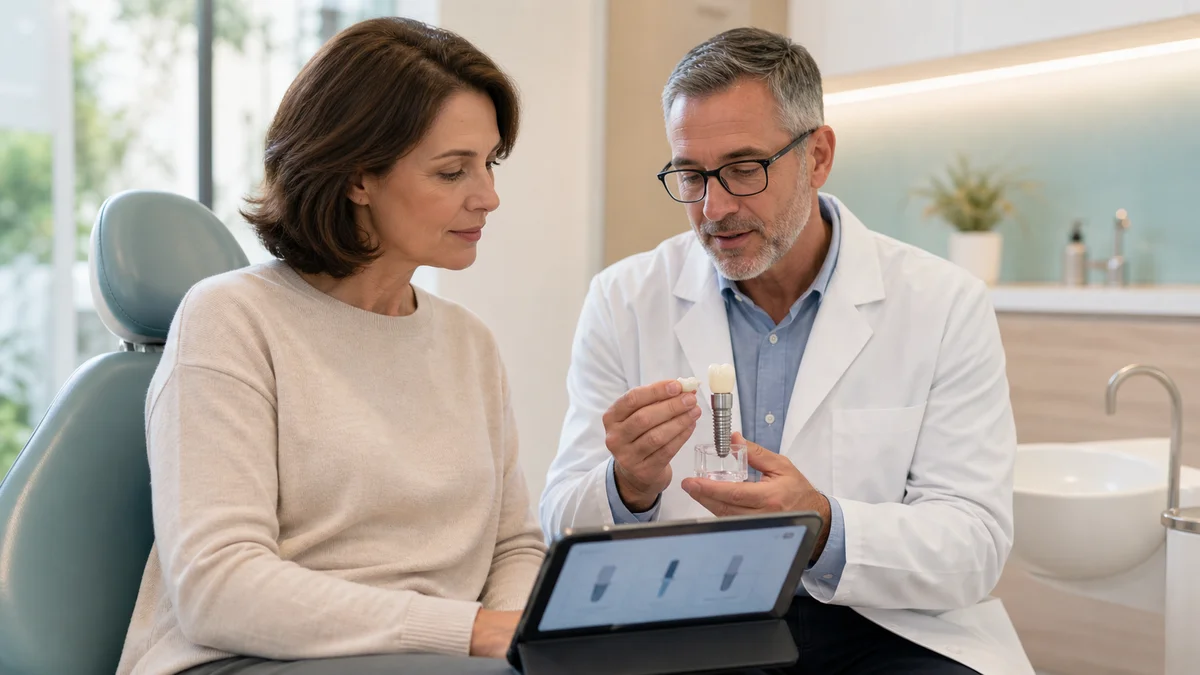
Quick answer: A dental implant same day plan may mean placing an implant when a tooth is removed, attaching a temporary tooth soon after placement, or both. It rarely means every stage and the final crown are completed in one visit. Suitability depends on diagnosis, bone and gum conditions, implant stability, bite, health risks and a safe fallback plan.
The promise of a dental implant same day is appealing: fewer gaps in the smile, fewer surgical visits and a faster provisional result. Yet “same day” is not one standard procedure. It can describe the timing of implant placement, the timing of a temporary restoration, or a full-arch provisional bridge. Those are separate decisions, and each can change after examination or even during surgery.
Healthdirect explains that implant treatment is usually completed in stages and often takes several months while bone grows around the implant. Immediate approaches can shorten selected parts of that pathway, but they do not eliminate healing. The safest interpretation of dental implant same day is therefore a planned protocol for carefully selected patients, not a guarantee that biology will follow a marketing timetable.
This guide provides general education based on Australian public-health information and international implant consensus resources checked in August 2026. It cannot diagnose your site, promise an outcome or decide whether immediate care is appropriate. A registered dental practitioner must examine you, review relevant imaging and explain alternatives. Seek urgent assessment for difficulty breathing, rapidly spreading swelling, uncontrolled bleeding or other severe symptoms.
1. dental implant same day can describe three different timelines
The first step is to ask exactly what the clinic means by dental implant same day. The International Team for Implantology defines immediate implant placement as placing the implant into the extraction socket on the day the tooth is removed. It defines immediate restoration as connecting a prosthesis within one week while keeping it out of contact with the opposing teeth, and immediate loading as connecting a prosthesis in contact with the opposing arch within one week.
In everyday advertising, all three may be called “same-day teeth,” even though their clinical demands differ. A front tooth may receive an implant and a non-biting temporary crown. A molar may receive an implant but no visible tooth while it heals. A full arch may receive several implants and a fixed provisional bridge, followed by a later definitive prosthesis. The correct pathway is based on the individual case, not on the label.
- Immediate placement: the implant enters a fresh extraction socket during the extraction appointment.
- Immediate provisional restoration: a temporary tooth is attached soon after implant placement and usually protected from heavy bite contact.
- Immediate loading: the restoration functions against the opposing teeth within the immediate loading period.
- Delayed or conventional pathway: extraction, implant placement or restoration is postponed to allow planned healing.
Ask the clinic to put the intended sequence in writing. A responsible dental implant same day proposal should name what is placed, what is temporary, what is delayed and which findings would trigger a different plan.
Clear terminology keeps dental implant same day expectations aligned with the actual clinical protocol.
2. Same-day placement and same-day teeth are not the same promise
An implant may be placed immediately without receiving a crown that day. Conversely, a provisional tooth can sometimes be supported by adjacent teeth or a removable appliance rather than by the new implant. This distinction matters because a newly placed implant needs mechanical stability while bone healing develops. A temporary tooth must also protect the surgical site, preserve appearance and remain cleanable.
When a dental implant same day advertisement says “walk out with a tooth,” ask whether that tooth is fixed or removable, supported by the implant or another structure, in contact during biting, and intended as a provisional or final restoration. Ask what material it uses, how long it is expected to serve and what restrictions apply.
The final crown or bridge is often made after tissue contours and implant integration can be reassessed. A later definitive restoration may use different materials and more detailed bite, shape and colour decisions. Calling the first tooth “temporary” does not mean it is unimportant; it means it has a defined role while healing continues.
Every dental implant same day quote should distinguish the provisional tooth from the definitive restoration.
3. Who may be considered for dental implant same day treatment?
There is no online checklist that can confirm eligibility. A clinician generally evaluates the reason for tooth loss, the extraction socket, infection, remaining bone, gum condition, smile line, bite, neighbouring teeth and the space available for an implant and restoration. Medical history, medicines, smoking or vaping, diabetes, previous radiotherapy, osteoporosis treatment, bleeding risk and the ability to maintain hygiene can alter planning.
Healthdirect notes that a dental professional checks whether there is enough bone, whether the gums are healthy, which medicines are taken and whether medical conditions may affect care. Those checks apply to any implant and become especially important when a dental implant same day timeline leaves less opportunity to wait for tissue healing before a provisional tooth is attached.
Potentially favourable features do not guarantee immediate care. The dentist may look for an intact or manageable socket, adequate bone in a safe position, controlled soft-tissue conditions, the ability to achieve primary implant stability and a bite that can protect the provisional restoration. Aesthetic expectations and the patient’s ability to follow a soft-diet and review schedule also matter.
Suitability for dental implant same day is confirmed through findings, not through age or appearance alone.
4. Why the plan can change during the appointment
Imaging can estimate anatomy, but the condition of the socket and the stability of the implant are confirmed clinically. A tooth may fracture differently than expected during removal. Bone defects or infection may be more extensive. The implant may not achieve the stability needed for the proposed provisional restoration. Changing to a staged pathway in those circumstances can be a safety decision, not a failed treatment.
Before agreeing to dental implant same day, ask for “Plan B.” It could involve grafting and waiting, placing the implant without loading, using a removable temporary tooth, or postponing implant placement. Confirm which additional costs could arise and whether the same clinician will explain the change before proceeding whenever circumstances allow.
A clinic that guarantees immediate loading before examination or promises never to alter the timeline ignores clinical uncertainty. Good consent includes the conditions under which the immediate option will be abandoned and what temporary appearance or function you can expect instead.
A safe dental implant same day plan treats the fallback as essential, not as an afterthought.
5. Examination and imaging come before a same-day claim
A proper assessment for dental implant same day normally includes a medical and dental history, examination of teeth and gums, periodontal assessment, bite analysis and appropriate imaging. Photographs, models or digital scans may help design the restoration. Three-dimensional cone-beam imaging may be indicated to assess bone and nearby anatomy, but it must be justified for the individual patient.
The clinician should determine whether the tooth can reasonably be saved and whether active disease requires management. A painful or broken tooth is not automatically an implant case. Root canal treatment, periodontal care, a conventional bridge, a removable denture or no immediate replacement may be alternatives. The TGA’s consumer questions advise discussing whether the implant is needed, what happens without it, and the risks and benefits of alternatives.
Ask who reviews the imaging and who designs the final tooth position. Implant placement should be restoratively driven: the desired crown or bridge position, bite and cleansability should guide the surgical plan. Technology supports that process but does not replace diagnosis, competence or informed consent.
Digital tools can support dental implant same day planning but cannot certify eligibility by themselves.
6. Primary stability and bite control are decisive
Primary stability describes the mechanical stability of the implant at placement. It is not the same as biological integration, which develops during healing. The clinician assesses whether the achieved stability, bone condition, implant design and planned restoration support the chosen timing. The exact measurements and thresholds are clinical decisions and should not be copied from a generic website.
For a dental implant same day provisional tooth, bite forces must be considered carefully. A temporary crown may be shaped or adjusted to reduce contact. Full-arch provisional bridges distribute forces across several implants but introduce their own design, hygiene and breakage considerations. Clenching, grinding or an unfavourable bite may alter eligibility or require protection.
Immediate treatment does not mean unrestricted chewing. Follow the written diet and hygiene instructions even if the tooth feels stable. Loading a provisional restoration beyond the plan can contribute to movement, screw problems, fracture or loss of integration. Contact the clinic if the bite suddenly feels different or the provisional tooth moves.
Bite protection is a central condition of successful dental implant same day care.
7. Compare immediate and staged pathways with a decision table
The table below helps structure a dental implant same day discussion. It is not a scoring system and cannot select the protocol for you. Each option may be appropriate in a different clinical situation.
| Pathway | What may happen first | Possible advantage | Key limitation or question |
|---|---|---|---|
| Immediate placement, no implant-supported tooth | Extraction and implant placement occur together | May reduce a separate placement appointment | How will appearance and function be managed during healing? |
| Immediate placement with non-biting provisional | Implant and protected temporary tooth are provided | May preserve appearance in a selected site | Can stability, tissue and bite conditions safely support it? |
| Immediate functional loading | Prosthesis is connected and functions early | May restore selected function sooner | How are force, implant number, stability and diet controlled? |
| Staged placement or loading | Healing occurs before the next implant stage | Allows time to manage tissue, grafting or stability concerns | What temporary tooth and additional visits are required? |
| Non-implant alternative | Bridge, denture or tooth-preserving care is considered | Avoids implant surgery in appropriate cases | What are the effects on other teeth, comfort and maintenance? |
International consensus recognises immediate placement and loading combinations as documented protocols, but that does not establish superiority for every patient. Evidence must be applied to the specific tooth, arch, restoration and risk profile. A staged approach is not automatically old-fashioned, and an immediate approach is not automatically advanced.
The right dental implant same day decision is the protocol that fits the assessed case, not the fastest label.
8. What actually happens on a dental implant same day appointment?
The sequence varies, but the day often begins with confirmation of the treatment plan, consent, medical status, site and medication instructions. Local anaesthesia is commonly used. If sedation is proposed, separate assessment, fasting, escort and monitoring instructions may apply. Never assume the advertised package includes sedation or that it is suitable for you.
The tooth may be removed as carefully as possible, and the socket is assessed. The implant site is prepared, the implant is placed and stability is evaluated. Bone or soft-tissue grafting may be considered. If the predefined criteria are satisfied, the provisional crown or bridge is fitted and the bite is adjusted. If they are not, the fallback plan is used.
A dental implant same day visit can be long, especially for full-arch treatment, but speed is not the quality measure. Site checks, imaging review, sterile technique, verification of components, provisional design and clear postoperative instructions matter more than finishing by a promised hour. Arrange transport, time off and appropriate support based on the clinic’s advice.
Preparation and verification matter more than the clock in a dental implant same day appointment.
9. Temporary teeth have rules and limitations
A same-day provisional restoration is designed for healing conditions, not necessarily as the final aesthetic or mechanical result. It may have a different contour, colour, surface, tooth length or bite from the definitive crown or bridge. These differences can be intentional to protect tissues, reduce load and guide later design.
Ask whether the dental implant same day temporary is fixed or removable and who can remove or repair it. Confirm how to clean beneath or around it, which foods to avoid, whether it can be worn at night if removable, and how soon it will be reviewed. Do not adjust or glue a loose provisional at home.
- Follow the prescribed soft-food period and avoid biting directly on the treated site when instructed.
- Use the cleaning method demonstrated by the clinical team rather than forcing floss around a healing site.
- Take only medicines advised for you and do not start leftover antibiotics.
- Keep all early review appointments even if the restoration looks and feels comfortable.
- Report movement, a changed bite, fracture, increasing pain or swelling promptly.
The definitive restoration is normally planned after the clinician reassesses integration and tissue response. Ask what evidence is required before the temporary is replaced, what laboratory steps follow and whether the final restoration is included in the original estimate.
Provisional care is one stage of dental implant same day, not the end of treatment.
10. Risks do not disappear because treatment is faster
Healthdirect lists possible implant complications including infection, nerve damage, sinus problems and injury to surrounding teeth. Other implant or restoration problems can include failure to integrate, gum recession, aesthetic limitations, inflammation around the implant, loosening or fracture of components and the need for additional treatment. Your clinician should explain which risks are material in your case.
A dental implant same day protocol adds timing-specific considerations. The extraction socket may be compromised, the provisional may transmit force, or the desired immediate plan may not be achievable. This does not mean immediate treatment is inherently unsafe; it means selection, execution and contingency planning are essential.
Ask how urgent concerns are handled during evenings or weekends. Expected bruising, discomfort, swelling and minor bleeding should be distinguished from symptoms requiring prompt review. Difficulty breathing, rapidly spreading swelling, uncontrolled bleeding or severe systemic symptoms need urgent medical attention. In Australia, call 000 for an emergency.
Emergency access belongs in the original dental implant same day plan.
11. Smoking, diabetes, gum disease and medicines matter
Do not hide medical or lifestyle information because you want to qualify for dental implant same day. Smoking, periodontal history, plaque control, diabetes, bone-related conditions, bleeding disorders, cancer care and some medicines can affect treatment decisions or risk. Their presence does not create one universal answer; the clinician must assess severity, control and the proposed procedure.
Bring an accurate medicine list, including non-prescription products and injections. Do not stop anticoagulants, osteoporosis medicines or any prescribed treatment without coordinated professional advice. If medical consultation is needed, ask which clinician will request it and whether the implant timeline should wait.
Risk reduction may involve smoking cessation support, periodontal treatment, improved plaque control, management of infection or better control of a medical condition. A slower plan can be the better plan if it creates safer conditions. Patient safety is more important than keeping an advertised date.
Risk modification can improve the foundation for dental implant same day or justify a staged alternative.
12. Full-arch “teeth in a day” is a separate category
Full-arch immediate treatment can involve removing remaining teeth, placing several implants and fitting a fixed provisional bridge. It is substantially different from replacing one tooth. Planning includes the amount and distribution of bone, prosthetic space, bite, speech, lip support, hygiene access and how forces will be shared across implants.
For full-arch dental implant same day, ask how many implants are planned, whether the number may change, what happens if one lacks stability, and whether the provisional bridge is fixed. Clarify the material, reinforcement, repair process, cleaning design and conversion to a definitive prosthesis. “Fixed” does not mean maintenance-free or permanent.
Also ask what will happen to any remaining teeth and whether alternatives could preserve them. Extraction is irreversible. A second opinion is reasonable when the plan involves removing multiple teeth, extensive grafting, sedation or a major financial commitment. Give each clinician access to relevant records so the opinions can address the same findings.
Full-arch dental implant same day requires a broader decision than replacing one missing tooth.
13. Read the itemised quote beyond the headline price
The cost of dental implant same day depends on what the phrase includes. An advertised amount may cover only implant placement or a temporary restoration. Other plans may include extraction, imaging, grafting, sedation, the implant, abutment, provisional tooth, laboratory work, final crown or bridge, reviews and maintenance. Compare like with like.
Healthdirect advises obtaining a quotation and understanding treatment costs before starting. Ask how long the estimate is valid, which findings could change it, who authorises additions and what happens if the immediate protocol changes to a staged plan. Confirm cancellation, refund and finance terms before paying a large deposit.
- Identify whether extraction, implant placement and grafting are separate items.
- Separate the temporary tooth from the definitive crown, bridge or full-arch prosthesis.
- List imaging, surgical guides, anaesthesia or sedation and laboratory fees.
- Confirm the number and location of implants assumed by a full-arch quote.
- Ask which reviews, repairs, hygiene visits and complication care are included.
- Obtain item numbers and verify any private health benefit directly with your insurer.
A warranty is a commercial document, not a guarantee of biological success. Read its maintenance conditions, exclusions and remedy. Do not let warranty wording delay assessment of pain, swelling, bleeding, movement or breakage.
Total scope is the fair way to compare dental implant same day costs.
14. Verify clinicians, components and ongoing responsibility
Ask for the full names of the dentist who diagnoses the case, the clinician who places the implant and the clinician who restores it. Verify Australian registration and specialist titles through Ahpra where relevant. A general dentist may provide implant care when educated, trained and competent within scope; specialist involvement may be appropriate for selected complexity.
A safe dental implant same day pathway also documents the implant system and components. Ask why the system is proposed, whether compatible parts are likely to be available and what records you receive. The TGA encourages consumers to ask whether a proposed implant is approved for its intended use, whether the product or procedure is new, and where further information can be found.
Responsibility should remain clear after the first day. Confirm who reviews healing, who provides the definitive restoration, who manages an urgent problem, and what happens if you move or cannot return. Keep imaging, consent, implant and component details, laboratory records and maintenance history in an accessible file.
Traceable components and named clinicians strengthen dental implant same day continuity.
15. Recovery, cleaning and maintenance continue for years
Immediate appearance does not equal immediate healing. Healthdirect notes that bone growth around an implant takes time and advises following postoperative instructions. Bruising, pain, swelling and some bleeding can occur. The exact recovery pattern varies with the site, extraction, grafting, number of implants, restoration and individual health.
Once healed, implant care includes brushing teeth and gums, cleaning between implants and other teeth with an appropriate method, and attending regular dental checks. A full-arch bridge may require special aids and professional cleaning access. Ask for hands-on instruction instead of relying on a generic video.
The long-term success of dental implant same day care depends on monitoring tissues, plaque control, bite, screws and prosthetic materials. An implant cannot develop tooth decay, but its surrounding tissues can become inflamed and restorations can wear or fracture. Agree on a personalised recall schedule before treatment.
Maintenance remains part of dental implant same day treatment for as long as the implant is in function.
Questions to take to a consultation
Use these questions to turn dental implant same day advertising into a clinical conversation:
- What does “same day” mean in my written plan: placement, provisional restoration, functional loading or all three?
- Can this tooth be saved, and what are the bridge, denture and no-treatment alternatives?
- Which examination and imaging findings support immediate treatment?
- What stability, bone, tissue and bite criteria must be met on the day?
- What is the fallback if one criterion is not met?
- Is the same-day tooth fixed, removable, biting, non-biting, temporary or final?
- Who performs each stage, and how can I verify registration and specialist titles?
- What risks are most relevant to my health and implant site?
- Which components and stages are included in the itemised estimate?
- Who handles urgent problems, maintenance, repairs and the definitive restoration?
You can review general implant information at the Redent Klinik English information hub and use the Redent Klinik contact page to ask how assessment, provisional stages and follow-up are organised. Online contact cannot confirm eligibility. Compare any proposal with an examination and, for extensive or irreversible care, consider a second opinion.
Frequently asked questions about dental implant same day
Can I really get a dental implant same day as an extraction?
Sometimes an implant can be placed into the extraction socket during the same appointment. That does not automatically mean a crown will be attached or used for biting. Socket condition, bone, infection, anatomy, implant stability and the restorative plan influence the decision. A fallback should be agreed before extraction.
Is the same-day tooth permanent?
Often it is a provisional crown or bridge designed for the healing period. The definitive restoration may be made later after the implant and tissues are reassessed. Ask the clinic to identify each restoration in writing, state its material and explain when and why it is replaced.
Does dental implant same day mean I can eat normally that night?
No. Immediate restoration does not remove healing restrictions. You may be instructed to follow a soft diet and avoid direct biting or heavy chewing on the site. Full-arch provisionals also have dietary limits. Follow the individual written plan and report movement, fracture or a changed bite.
Is same-day treatment more successful than delayed treatment?
No protocol is best for every case. Immediate approaches are documented for selected indications, while staged protocols remain valid and may be preferable when stability, tissue, grafting or health conditions require healing time. Ask the clinician to explain why one protocol fits your findings and what evidence supports that choice.
Can I have dental implant same day treatment if there is infection?
An online answer cannot decide this. The type, extent and control of infection, surrounding bone and soft tissues, ability to clean the site and the proposed procedure all matter. The dentist may treat disease, change the timing, graft or use another temporary option. Do not rely on a remote guarantee.
Will I need bone grafting?
Some immediate sites need no graft, while others may require grafting around the implant or a staged reconstruction. Imaging estimates the site, but extraction can reveal additional defects. Ask whether grafting is planned, optional or a possible intraoperative addition and how it changes cost, risk, timing and loading.
How long does a dental implant same day appointment take?
It depends on the number of teeth, extraction difficulty, imaging and guide workflow, grafting, sedation, provisional design and whether treatment is single-tooth or full-arch. Ask the clinic for a realistic range for your plan, including recovery and transport arrangements, rather than expecting a universal appointment length.
What if the implant is not stable enough for the temporary tooth?
The clinician may leave the implant unloaded, use a different temporary solution, graft the site or move to a staged pathway. That contingency should be part of consent. Protecting healing is more important than delivering an implant-supported tooth merely to satisfy the phrase “same day.”
Are “teeth in a day” and one dental implant same day equivalent?
No. “Teeth in a day” often refers to a full-arch provisional bridge supported by several implants. A single implant replaces one tooth and has different stability, aesthetic and bite considerations. In both situations, the first restoration may be provisional and long-term maintenance is required.
When should I seek urgent help after implant treatment?
Follow the treating team’s written instructions and contact them for worsening or unexpected symptoms such as increasing pain, swelling, persistent bleeding, fever, discharge, altered sensation, provisional movement or breakage. Difficulty breathing, rapidly spreading swelling, uncontrolled bleeding or severe systemic symptoms require urgent medical help.
Sources and further reading
- Healthdirect Australia: dental implant procedure, preparation, risks and aftercare (last reviewed February 2025)
- Therapeutic Goods Administration: five questions before a medical implant (updated June 2023; reform overview updated August 2024)
- International Team for Implantology: implant placement and loading protocol definitions and consensus
- International Team for Implantology: immediate placement and loading decision tree
- PubMed: 2024 systematic review of anterior implant placement and loading protocols
- PubMed: 2024 systematic review of immediate versus conventional loading for implant-supported removable prostheses
- American Dental Association: oral-health information and professional resources
- World Health Organization: oral health fact sheet
Sources were checked on 11 August 2026. This evidence-based guide does not replace examination, diagnosis or personalised advice from a registered dental practitioner.