
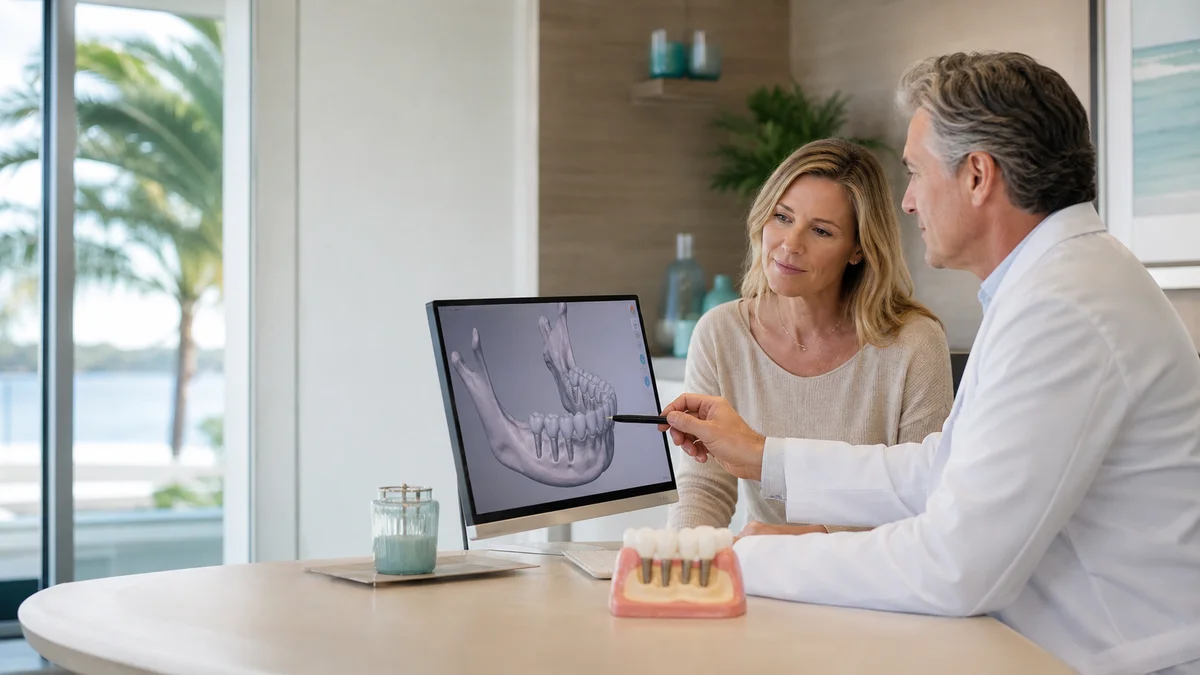
Quick answer: When comparing dental implants cape coral options, verify the dentist’s active Florida license, insist on an examination-based diagnosis, and compare itemized plans rather than advertised starting fees. The plan should identify the implant system, surgical and restorative stages, possible grafting, temporary teeth, anesthesia, final restoration, maintenance, insurance assumptions, and who manages complications. Implant suitability and timing are individual clinical decisions.
Searching for dental implants cape coral can lead to pages that make unlike treatments look interchangeable. A single implant crown is not the same service as an implant-supported bridge, a removable overdenture, or a fixed full-arch restoration. A price may cover only the implant body, while another includes the abutment, crown, imaging, surgery, temporary tooth, and follow-up. The first safe comparison is therefore not “Which office is cheapest?” but “Are these plans solving the same clinical problem with the same documented scope?”
This guide is educational and cannot diagnose missing teeth, bone volume, infection, gum health, bite forces, or medical risk. Photographs and a phone call may help an office prepare for a consultation, but they do not replace an examination. The content is prepared for review by Dentist Esma Çevrük Çakır and uses patient-safety language: no result is guaranteed, no fixed price fits every patient, and treatment should not begin until benefits, risks, alternatives, costs, and follow-up are understood.
1. What dental implants cape coral means in a treatment plan
dental implants cape coral is a location-based search phrase, not a clinical diagnosis. The U.S. Food and Drug Administration describes a dental implant system as an implant body placed in the jaw, an abutment that extends through the gum, and a prosthetic tooth or teeth supported by the system. These components may be placed or restored by different clinicians at different appointments. Ask which person is responsible for diagnosis, surgery, restoration, and long-term recall.
In a dental implants cape coral comparison, an “implant” quote may omit the visible crown. It may also exclude extraction, bone grafting, a surgical guide, tissue management, sedation, temporary restoration, or the final abutment. Before comparing two offices, request the tooth number, treatment type, component list, implant manufacturer and model, proposed restoration, and stage-by-stage fee. A written plan should label which findings are confirmed and which services are only possible contingencies.
2. Start with the missing-tooth diagnosis, not the device
A careful dental implants cape coral consultation begins by asking why the tooth is missing or cannot be maintained. Active decay, periodontal disease, infection, cracks, inadequate restorative space, bite problems, or trauma may change the sequence. The dentist should also assess adjacent teeth and alternatives. Replacing one missing tooth with an implant may avoid preparing neighboring teeth, but an implant is not automatically preferable to a conventional bridge, removable prosthesis, orthodontic space management, or monitored nonreplacement.
When reviewing dental implants cape coral recommendations, saving a restorable natural tooth can sometimes be the more conservative plan. Conversely, repeated procedures on a tooth with a poor prognosis may not be sensible. The point is not that one option is always superior; it is that the recommendation should follow the diagnosis. Ask for the advantages, limitations, likely maintenance, and consequences of declining each reasonable option. Informed consent is a conversation, not merely a signature collected on surgery day.
3. Candidacy is broader than having enough bone
dental implants cape coral candidacy depends on oral and general health. The FDA advises patients to discuss overall health because it can influence candidacy, healing time, and how long an implant remains in service. The history should cover current medicines, allergies, diabetes control, immune conditions, bleeding risk, prior radiation, antiresorptive medicines, smoking or nicotine use, previous periodontal disease, and earlier implant complications. A dentist may need to coordinate with a physician; that does not mean every condition excludes treatment.
For dental implants cape coral, local factors matter too: plaque control, gum inflammation, bone shape, nerve and sinus anatomy, available space, grinding or clenching, and the ability to clean the proposed restoration. A full-arch bridge that cannot be cleaned is not a low-maintenance solution. If dexterity, vision, caregiving, or transportation affects daily hygiene and professional follow-up, include it in the design discussion before surgery.
- Complete medical and dental history, including supplements and nonprescription medicines
- Periodontal assessment and control of active oral disease
- Bite, restorative space, smile, speech, and cleaning-access evaluation
- Review of nicotine use, diabetes, healing history, and relevant medical care
- A realistic plan for home hygiene and recurring professional maintenance
4. Imaging for dental implants cape coral should answer a question
Imaging is often important in dental implants cape coral planning, but more imaging is not automatically better. The FDA explains that dental cone-beam computed tomography, or CBCT, creates three-dimensional information and can support implant planning. It also generally exposes a patient to more radiation than conventional dental X-rays. The FDA and American Dental Association recommend dental imaging only when necessary for diagnosis or treatment.
During a dental implants cape coral consultation, ask what clinical question the scan will answer, whether earlier images are usable, which region must be captured, and how radiation is minimized while preserving diagnostic quality. CBCT can help evaluate bone dimensions and nearby anatomy, yet software planning does not eliminate surgical judgment. Request copies of relevant radiographs, the scan data if available in a transferable format, and the written interpretation or planning notes needed for future care.
5. Verify the Florida dentist’s license and relevant permits
Before scheduling dental implants cape coral treatment, use the Florida Department of Health’s Medical Quality Assurance license-verification service. The Florida Board of Dentistry states that the public portal can show license status and available disciplinary cases or public complaints. Match the clinician’s name and practice details rather than relying on a website badge. A clean public record does not predict an individual outcome, but an active license is a fundamental check.
If a dental implants cape coral plan proposes sedation or general anesthesia, ask who administers it, what level is intended, and which permit or professional credential applies. The Florida Board separately identifies anesthesia permits in its licensing information. The office should explain monitoring, escort and fasting instructions, medication restrictions, emergency procedures, and how you will travel home. “Sedation dentistry” is not one uniform service; nitrous oxide, oral medicines, intravenous sedation, and general anesthesia have different risks and requirements.
6. Match the restoration to the actual problem
dental implants cape coral plans can support several kinds of restorations. A single missing tooth may receive one implant, abutment, and crown. Several missing teeth may be restored with an implant-supported bridge. A fully edentulous arch may use a removable overdenture or a fixed full-arch prosthesis, but these are not interchangeable. The number and position of implants, restorative material, retrievability, hygiene access, repair pathway, and maintenance burden differ.
Terms such as “all-on-X,” “teeth in a day,” or “permanent teeth” are marketing shorthand, not complete designs. Ask whether the same-day teeth are temporary, what diet restrictions apply, when the final restoration is expected, and what happens if an implant does not integrate. “Fixed” usually means the patient does not remove the prosthesis; it does not mean the restoration never needs professional removal, repair, screw replacement, or renewal.
7. Understand extractions, grafts, and sinus procedures
A quote for dental implants cape coral may change after the dentist evaluates extraction sites and bone anatomy. Some sites can receive an implant at extraction, while others require healing first. Bone grafting, ridge preservation, ridge augmentation, or a sinus-related procedure may be considered, but the need, material, timing, benefits, limitations, and alternatives should be explained. Grafting does not guarantee that a later implant can be placed.
Ask whether each graft is confirmed or contingent, who performs it, what material is proposed, and whether the fee includes follow-up. The treatment plan should distinguish the biological goal from the product used. Swelling, bruising, pain, infection, graft exposure, sinus symptoms, nerve symptoms, delayed healing, and need for additional surgery are examples of issues that may belong in the consent discussion, depending on the procedure.
8. Immediate placement and immediate teeth are different decisions
dental implants cape coral advertisements may combine “immediate implant” and “same-day teeth,” but the concepts differ. Immediate placement refers to inserting an implant at an extraction visit. Immediate loading refers to attaching a temporary restoration without waiting for conventional healing. Either may be suitable in selected conditions, and either may be inappropriate when stability, infection, bone, bite, or patient factors are unfavorable.
The FDA notes that healing after implant-body placement may take several months or longer. A temporary tooth can support appearance or selected function during this period, but restrictions may be necessary. Ask what objective findings allow immediate loading, whether the temporary is included, what foods to avoid, how to clean it, and what the fallback plan and fee are if the implant cannot be loaded or does not integrate.
9. Compare dental implants cape coral itemized costs
A trustworthy dental implants cape coral estimate separates confirmed care from possible care. There is no responsible universal price because tooth count, bone anatomy, disease control, implant components, restoration type, anesthesia, laboratory work, and maintenance vary. A low advertised fee may be a legitimate limited offer, but it cannot be compared with a comprehensive fee until inclusions and exclusions are explicit.
- Diagnosis: examination, records, imaging, scan interpretation, and planning
- Surgical stage: extraction, implant, guide, graft, membranes, and follow-up
- Temporary stage: temporary tooth or denture, adjustments, and diet period
- Restorative stage: abutment, impression or scan, laboratory, try-in, and final prosthesis
- Anesthesia: local anesthesia, sedation provider, facility, medicines, and monitoring
- Maintenance: hygiene devices, recall, imaging, professional cleaning, and repairs
- Contingencies: failed integration, remaking a temporary, extra grafting, or component replacement
Request the fee’s validity period, payment schedule, financing terms, cancellation policy, laboratory remakes, warranty conditions, and responsibility for outside specialists. Financing lowers the monthly payment, not necessarily the total. Compare annual percentage rate, deferred-interest triggers, lender fees, and what happens to the loan if treatment changes or stops.
10. Insurance, Medicare, and benefit estimates
dental implants cape coral coverage depends on the plan, diagnosis, codes, exclusions, waiting periods, annual maximum, missing-tooth rules, network status, and coordination of benefits. A pre-treatment estimate can be useful, but it is not the same as a guarantee of payment. Ask the insurer directly which surgical and restorative codes require prior authorization and whether grafts, CBCT, anesthesia, temporary teeth, or the final restoration have separate limits.
The Centers for Medicare & Medicaid Services states that Original Medicare generally excludes routine services connected with the care or replacement of teeth. CMS describes limited circumstances in which dental services are inextricably linked to the clinical success of certain Medicare-covered medical services. Some Medicare Advantage plans offer additional dental benefits. Therefore, neither “Medicare never covers anything dental” nor “Medicare covers my implant” should be assumed without a plan-specific written determination.
11. A decision table for comparing consultations
Use this table to compare dental implants cape coral plans on the same terms. An unknown item should stay marked “unknown”; do not convert it to zero cost or guaranteed inclusion.
| Decision area | Ask for in writing | Warning sign | Safer comparison |
|---|---|---|---|
| Diagnosis | Tooth/site, findings, alternatives, prognosis | Final plan from photos alone | Examination-based rationale |
| License | Treating clinicians and roles | Only a brand or office name | Active Florida record checked |
| Implant system | Manufacturer, model, component record | “Premium implant” only | Traceable compatible system |
| Scope | Surgery, abutment, temporary, final tooth, reviews | One unexplained package line | Itemized stages and contingencies |
| Sedation | Level, provider, permit, monitoring, escort | Risk-free sedation claim | Individual risk assessment |
| Timeline | Healing, temporary phase, final restoration | Guaranteed same-day final result | Criteria plus fallback plan |
| Aftercare | Recall, hygiene, emergencies, repair fees | Implants need no maintenance | Long-term written protocol |
12. Implant brand and component traceability matter
For dental implants cape coral, the FDA recommends asking for the brand and model of the implant system and keeping that information. Retaining the implant-body, abutment, and component details can help if you move, travel, or need a future repair. Ask for an implant record or “passport” with site, placement date, system, dimensions, and relevant components. A brand name does not guarantee success, but missing records can complicate maintenance.
Ask how readily compatible components are available and whether the restorative dentist works with the chosen system. The crown or full-arch prosthesis also needs documentation: retention method, restorative material, screw information when relevant, and laboratory. If a proprietary component is used, learn how another office would identify and obtain it. Keep records securely rather than depending on one practice’s software indefinitely.
13. Sedation should not replace communication
A dental implants cape coral office may offer sedation for anxiety or surgical complexity. Consent, alternatives, and financial decisions should be completed while you can understand and consider them—not after cognition is affected. Provide an accurate health history and disclose alcohol, cannabis, prescription medicines, supplements, sleep apnea, prior anesthesia reactions, and transportation limitations. Never alter medicines or fasting without instructions from the treating professionals.
Ask who remains responsible during recovery and whom to call after hours. You may need an adult escort and should not drive, work, sign contracts, or make important decisions for a specified period. The office should give written instructions tailored to the sedation method. Claims that a method has no risk, is appropriate for everyone, or ensures you will remember nothing deserve clarification.
14. The timeline includes healing and restoration
dental implants cape coral treatment may involve diagnosis and disease control, extraction, grafting, implant placement, integration, exposure or abutment connection, impressions, try-in, delivery, and maintenance. Some stages can be combined; others may require healing. Calendar estimates should be ranges with clinical checkpoints rather than promises tied to a vacation or insurance year.
Ask what must be true before moving to the next stage. These criteria may include tissue health, implant stability, imaging, comfort, and ability to maintain hygiene. If you are a seasonal resident or travel frequently, identify who will handle urgent care when you are away and whether another dentist has the records and components required. A rushed final restoration can create problems that are harder to correct later.
15. Long-term cleaning and peri-implant health
dental implants cape coral care continues after the final crown or bridge. The FDA recommends regular cleaning and dental visits and advises contacting the provider if an implant feels loose or painful. The American Academy of Periodontology explains that inflammation can affect tissues around implants; redness, tenderness, or bleeding can be warning signs. Prior periodontal disease, poor plaque control, smoking, and diabetes are among relevant risk factors discussed by the Academy.
Your dentist should demonstrate cleaning with tools that fit the restoration. A fixed full-arch bridge may need threaders, interdental brushes, or a water irrigator, but device choice should be individualized. Recall intervals depend on risk; no single schedule suits everyone. At maintenance visits, clinicians may evaluate plaque, bleeding, probing findings where appropriate, bone levels, bite, screws, restorative wear, and your ability to clean.
16. Smoking, diabetes, and modifiable risk
A responsible dental implants cape coral plan does not hide risk factors. The FDA states that smoking may affect healing and decrease long-term implant success. The Centers for Disease Control and Prevention also notes that smoking makes gum healing harder. Quitting support can be part of treatment preparation, but no brief abstinence promise should be presented as eliminating risk.
Diabetes is not an automatic exclusion, yet current control and coordination may affect timing and monitoring. Do not change diabetes medicine or other treatment on a dental website’s advice. Discuss recent health information with your dentist and relevant medical clinician. Likewise, grinding, inadequate hygiene, and missed recalls may call for design changes or protective strategies; a night guard is not automatically required for every patient.
17. Red flags and urgent symptoms
During a dental implants cape coral search, be cautious about guaranteed outcomes, lifetime devices, treatment without records, pressure to pay before examination, refusal to name clinicians, an unexplained proprietary package, or a claim that implants never need maintenance. Reviews and before-and-after photographs may help you form questions, but they do not show your diagnosis, denominator of outcomes, or how complications were managed.
After treatment, follow the office’s specific instructions. Seek urgent medical evaluation for trouble breathing or swallowing, rapidly spreading facial or neck swelling, uncontrolled bleeding, severe trauma, chest pain, or a serious allergic reaction. Contact the dental team promptly for increasing pain, fever with worsening symptoms, persistent numbness, drainage, a changing bite, a loose implant or restoration, or an inability to maintain fluids. Do not wait for an online review response when urgent care is needed.
18. A 17-point checklist before you commit
Bring this dental implants cape coral checklist to consultations. A question may have more than one acceptable answer; the safety value comes from receiving a clear, individualized explanation and documenting the plan.
- 1. What diagnosis and prognosis apply to each tooth or site?
- 2. Can any natural tooth reasonably be maintained?
- 3. What alternatives, including no immediate treatment, were discussed?
- 4. Is the treating dentist’s Florida license active?
- 5. Who plans surgery, performs it, and restores the implant?
- 6. What imaging is necessary, and what question does it answer?
- 7. Is grafting confirmed, possible, or not anticipated?
- 8. What implant manufacturer, model, and components are proposed?
- 9. Is the temporary tooth included, and what restrictions apply?
- 10. When is the final restoration expected, and what are the checkpoints?
- 11. Which sedation method, provider, permit, and escort rules apply?
- 12. Does the written total include surgery, abutment, crown, and follow-up?
- 13. Which possible additions have stated prices?
- 14. What has the insurer actually confirmed in writing?
- 15. What records and implant identification will you receive?
- 16. How will emergencies, failures, repairs, and outside care be handled?
- 17. What daily cleaning and professional maintenance are required?
19. Local care versus planned treatment travel
dental implants cape coral offers the practical advantage of nearby surgery, adjustments, and maintenance for many residents. Some patients also compare treatment in another city or country. The clinical standard for comparison remains the same: diagnosis, clinician credentials, components, total cost, realistic healing, record portability, complication access, and long-term recall. A lower procedure fee may be offset by travel, lodging, time away, and return visits; a nearby office may still be unsuitable if the plan is unclear.
Patients considering an international alternative can learn about Redent Klinik and request an individualized discussion through the Redent Klinik contact page. Remote information should remain preliminary until an in-person examination. No clinic—local or abroad—should promise candidacy, a fixed total, immediate final teeth, or a guaranteed result without the necessary clinical findings.
20. Frequently asked questions about dental implants cape coral
How much do dental implants Cape Coral offices charge?
A dental implants cape coral search cannot produce one reliable universal fee. One quote may describe only an implant body while another includes extraction, graft, abutment, crown, temporary tooth, imaging, sedation, and follow-up. Request itemized plans for the same clinical solution, separate confirmed from possible services, and verify insurance directly. Do not use an advertised starting price as the final budget.
Can I get a final dental implant plan from a free consultation?
A dental implants cape coral consultation can be valuable, but a final plan requires enough diagnostic information. Ask whether the appointment includes a dentist’s examination, periodontal evaluation, imaging review, diagnosis, alternatives, and written estimate. A sales discussion, panoramic image, or photographs alone may not establish bone anatomy, disease control, bite, or medical suitability.
Does every implant consultation require a CBCT scan?
Not every dental implants cape coral consultation automatically requires CBCT. The FDA says CBCT should be used when necessary to provide clinical information that other imaging cannot supply. The dentist should justify the scan, choose an appropriate field, review previous imaging, and use optimized exposure. For many implant plans, three-dimensional anatomy is important, but the decision remains based on the clinical question.
Are same-day implants and teeth safe?
In a dental implants cape coral plan, immediate placement or loading may be considered for selected patients and sites; neither is appropriate for everyone. Bone, infection, implant stability, bite, restoration design, and behavior affect the decision. Ask whether “same-day teeth” are temporary, what restrictions apply, and what happens if the planned stability is not achieved.
Will Medicare pay for dental implants?
For dental implants cape coral, Original Medicare generally excludes routine dental care and tooth replacement. CMS recognizes limited dental services that are inseparably linked to certain covered medical care, and some Medicare Advantage plans offer added dental benefits. Ask the plan for a written determination using the proposed codes and diagnosis before assuming any contribution.
How long does the complete implant process take?
A dental implants cape coral sequence can range from combined stages to many months, depending on extraction healing, grafting, implant integration, tissue management, and restoration. The FDA notes that implant-body healing may take several months or longer. Request a range, decision checkpoints, temporary-tooth plan, and contingencies rather than a guaranteed calendar date.
Which implant brand is best?
No brand in a dental implants cape coral comparison overrides diagnosis, surgery, restoration, hygiene, and maintenance. Ask whether the system is appropriately cleared for the intended use, supported by accessible components, and familiar to the team. The FDA recommends keeping the brand and model in your records. Traceability is more useful than an unexplained “premium” label.
Do implants last for life?
No dental implants cape coral clinician can promise a lifetime result. Biological inflammation, infection, smoking, systemic health, grinding, hygiene, restorative wear, screw problems, trauma, and missed maintenance can affect an implant system. Ask what the warranty covers, for how long, under which recall conditions, and whether it includes professional fees, laboratory work, and related procedures.
What should I take to a second opinion?
For a dental implants cape coral second opinion, bring the written diagnosis, tooth and site numbers, radiographs and CBCT data, medical history, periodontal findings, proposed implant system, staged treatment plan, and itemized estimate. Records let the second clinician compare the same problem. The ADA’s ethics guidance supports meaningful patient involvement and access to information beneficial to future treatment.
What if my implant feels loose or painful?
After dental implants cape coral care, contact a dental provider promptly if something feels loose or painful. The moving part may be a crown, screw, abutment, or implant body, and these situations require different responses. Avoid testing or tightening it yourself. Worsening swelling, fever, difficulty swallowing or breathing, uncontrolled bleeding, or serious systemic symptoms require urgent assessment.
Conclusion: choose a documented, maintainable plan
The best dental implants cape coral decision is not defined by the shortest timeline, largest discount, or most dramatic image. It is a plan that preserves reasonable alternatives, is based on an examination, names responsible clinicians, documents components, explains anesthesia and imaging, separates confirmed and contingent costs, provides portable records, and makes long-term cleaning and professional maintenance realistic.
Verify the Florida license, ask your insurer rather than the office to confirm benefits, and take time for a second opinion when the plan is extensive or irreversible. The World Health Organization frames oral health as part of overall health, and implant treatment should follow that same perspective. Restoring a tooth is only the beginning; disease control, daily care, periodic review, and timely response to problems remain central to protecting the result.
Sources and official verification links
- U.S. Food and Drug Administration — Dental Implants: What You Should Know: components, candidacy, risks, records, healing, and maintenance.
- U.S. Food and Drug Administration — Dental Cone-Beam Computed Tomography: appropriate use, benefits, and radiation considerations.
- Florida Board of Dentistry: official licensing, license verification, anesthesia permits, and complaint access.
- Florida Board of Dentistry — License verification FAQ: public license status and available discipline information.
- Centers for Medicare & Medicaid Services — Medicare Dental Coverage: general exclusion and limited medically linked dental services.
- American Dental Association: national professional and patient-care resources.
- American Dental Association — Patient Autonomy: treatment alternatives, patient involvement, and records.
- American Academy of Periodontology — Peri-Implant Diseases: warning signs, risk factors, hygiene, and monitoring.
- Centers for Disease Control and Prevention — Smoking, Gum Disease, and Tooth Loss: tobacco and gum healing.
- World Health Organization oral health fact sheet: oral health and prevention framework.