
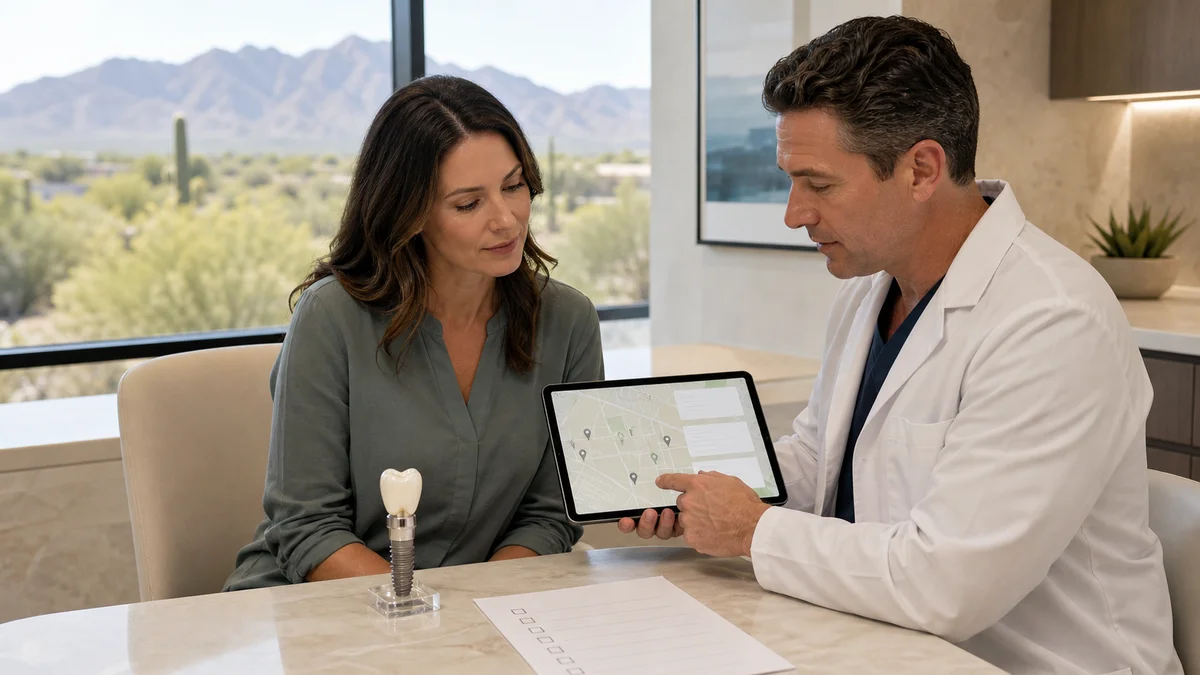
Quick answer: Before choosing dental implants in phoenix az, verify the named dentist through the Arizona Board, confirm any sedation permit, and compare individualized written plans rather than advertisements. Ask who owns surgery, restoration, complications, device records, and maintenance. Your health, gum condition, anatomy, goals, and ability to attend follow-up—not a headline price—should guide treatment.
A search for dental implants in phoenix az can produce dozens of clinics, prices, maps, ratings, and treatment labels in seconds. The difficult part is not finding an advertisement. It is identifying a team whose professional status can be verified, whose recommendation follows a real diagnosis, and whose plan connects surgery, restoration, risk management, and long-term maintenance. A polished website or convenient location may help you create a shortlist, but neither can decide whether an implant is appropriate for your mouth or health.
Dental implants are medical devices surgically placed in the jaw to support a crown, bridge, or denture. The US Food and Drug Administration advises patients to discuss candidacy, overall health, smoking, expected healing, benefits, risks, and the brand and model of the implant system. That makes choosing dental implants in phoenix az different from comparing an ordinary retail service. The safest comparison begins with named professionals and clinical evidence, then considers logistics and cost.
Arizona offers useful verification tools. The Arizona State Board of Dental Examiners maintains a searchable database that can serve as primary-source verification of an Arizona license. State law also says that a healthcare advertisement using a professional’s name must identify the title and type of license under which that person practices. If sedation is proposed, permit status and the responsible provider matter. These checks do not guarantee a result, but they reduce avoidable uncertainty.
This article is patient education, not a diagnosis, referral, fixed price, or outcome promise. Implant pathways range from a single healed site to immediate placement, grafting, multiple implants, overdentures, or full-arch care. Some people need periodontal treatment, medical coordination, a different tooth-replacement option, or no implant treatment. Use the framework below to ask the same questions at every consultation.
1. Define what dental implants in phoenix az means for your case
“Dental implant” is often used as if it describes one product. In reality, treatment has surgical and restorative components. The implant body is placed in bone, an abutment connects to it, and a crown, bridge, or removable prosthesis restores function. Timing, component selection, temporary teeth, tissue management, and maintenance vary with the diagnosis. A quote for an implant body alone is not comparable with a plan that includes every restorative stage.
Start by defining the problem. Is one tooth missing? Is a damaged tooth being considered for removal? Are several teeth absent? Is an existing denture unstable? Are there aesthetic concerns in the front of the mouth? Does a previous implant feel loose or painful? The answer determines which clinicians, records, risks, and alternatives should be discussed. A general search for dental implants in phoenix az becomes useful only after the proposed scope is clear.
- Single-tooth care: ask how implant position, gum shape, space, bite, and the final crown are planned together.
- Multiple missing teeth: clarify whether individual implants, an implant-supported bridge, or a removable option is being compared.
- Denture support: identify the number and position of implants, attachment system, relines, repairs, and hygiene needs.
- Immediate or full-arch claims: distinguish same-day temporary teeth from a final restoration and ask what happens if immediate loading is not suitable.
- Grafting or complex anatomy: ask who performs each procedure, what findings justify it, and when referral is appropriate.
Does every missing tooth need dental implants in phoenix az?
No. Reasonable alternatives can include retaining and restoring a treatable tooth, a conventional bridge, a removable prosthesis, postponing definitive treatment while disease is controlled, or accepting a space in selected circumstances. Each option has trade-offs. Only an individualized examination can determine which choices deserve consideration.
2. Verify providers offering dental implants in phoenix az
Identify the dentist who will diagnose, the clinician who will place the implant, the dentist who will design and fit the restoration, and anyone responsible for sedation or grafting. A clinic brand is not a professional license. Search each name in the Arizona Board’s online directory and check the license type, current status, and location. The Board notes that its database can be used for primary-source verification, while also acknowledging that posting delays or errors remain possible.
Ask whether the practice entity is registered where required and look for current licensure or registration information displayed at the office. Arizona law permits dentistry through specified professional entities and registered business organizations, and requires current license receipts to be readily observable. If a website names a clinician, Arizona’s health-professional advertising statute requires the title and type of license to be identified.
Be precise about specialty language. “Implant dentist,” “implant center,” or “smile expert” may be marketing descriptions rather than recognized specialty credentials. If a provider claims specialist status or board certification, verify it through the appropriate official or certifying body. A large number of reviews for dental implants in phoenix az does not turn an unverifiable title into a qualification.
Does an active license prove expertise in dental implants in phoenix az?
An active license is a foundational verification, not a complete measure of experience or case-specific competence. Ask how the clinician’s training and current practice relate to your proposed procedure, how often similar complexity is managed, which outcomes are audited, and when the clinician refers to another provider. Good judgment includes recognizing limits.
3. Put candidacy before dental implants in phoenix az prices
The FDA states that overall health affects candidacy and healing. A safe assessment may consider medical diagnoses, medicines and supplements, allergies, previous surgery or radiotherapy, bleeding risk, immune function, bone metabolism, diabetes control, tobacco or nicotine use, oral hygiene, gum disease, and the ability to attend follow-up. Do not stop prescribed medicine because of an online article or dental advertisement; changes require advice from the appropriate treating professional.
The dental examination may include teeth, gums, plaque control, periodontal stability, available space, soft tissues, bite, jaw relationships, and the intended restoration. Imaging should answer a clinical question. Two-dimensional images and three-dimensional cone-beam computed tomography have different roles; a CBCT scan can be valuable when justified, but it is not a substitute for history and examination. Ask why each image is needed, what it shows, and how it changes the plan.
A clinic should not confirm candidacy for dental implants in phoenix az from a photograph, chat message, or price request alone. Preliminary remote information can help organize a visit, but the final recommendation requires suitable records. Be wary of universal approval, manufactured urgency, or a promise that medical factors cannot affect the plan.
Can smoking or diabetes affect dental implants in phoenix az?
Yes. The FDA notes that smoking may impair healing and that uncontrolled diabetes may be associated with systemic infection risk. The American Academy of Periodontology also identifies smoking, diabetes, prior periodontal disease, and poor plaque control among concerns for peri-implant disease. This does not create an automatic answer for an individual; disclose your history so the dental and medical teams can assess it.
4. Match dental implants in phoenix az to procedure complexity
A straightforward healed single-tooth site is different from a front-tooth site, immediate placement after extraction, a site near a nerve or sinus, a narrow ridge, severe bone loss, multiple implants, or full-arch reconstruction. The restorative design also changes difficulty. A fixed crown, an implant bridge, and an overdenture place different demands on space, components, bite, cleaning, and repair.
Ask the provider to describe your complexity without promising certainty. Which findings make the case routine or challenging? Is grafting being considered, and what is its purpose? Will a temporary tooth be fixed, removable, or absent during healing? Who determines whether immediate loading is safe? What backup plan applies if primary stability or tissue conditions do not support the preferred timing?
When comparing dental implants in phoenix az, make sure each estimate describes the same pathway. A “same-day” label may refer to extraction and implant placement, placement of a temporary restoration, or a full-arch provisional. It does not necessarily mean the final restoration is completed that day, nor does it guarantee that the advertised pathway fits every patient.
5. Require restorative-first planning for dental implants in phoenix az
The desired tooth position, bite, cleansability, appearance, and prosthetic space should inform where the implant is placed. This is sometimes described as restorative-driven or prosthetically driven planning. It helps connect the surgical site to the final crown, bridge, or denture. If surgery and restoration are provided by different clinicians, ask how they share scans, images, design information, component choices, and progress notes.
A written plan should state the diagnosis, intended implant site, stages, clinician responsible for each stage, anticipated healing, temporary restoration, proposed final restoration, reasonable alternatives, material risks, review schedule, and foreseeable contingencies. It should distinguish services that are planned from services that might become necessary after new findings.
Before consenting to dental implants in phoenix az, ask who has final responsibility for the integrated plan. Who decides the implant position? Who approves the temporary tooth? Who checks the bite? Who addresses a loose screw, fractured provisional, or difficult-to-clean contour? “We work as a team” is useful only when the names and handoffs are clear.
Why does the final crown matter for dental implants in phoenix az?
The implant supports a restoration, so its three-dimensional position affects appearance, bite, access for cleaning, component selection, and future repair. The surgeon needs restorative information before placement. A technically integrated plan is more meaningful than choosing the implant body in isolation.
6. Check sedation permits for dental implants in phoenix az
Many implant procedures can be performed with local anesthesia. Some patients may be offered minimal, moderate, deep sedation, or general anesthesia depending on the procedure, health assessment, provider, and setting. These are not interchangeable. Ask exactly what level is proposed, who administers it, who monitors you, what credentials and permits apply, and what emergency equipment and recovery process are available.
The Arizona Board lists anesthesia and sedation permits among its licensing categories and fees, and Arizona rules establish permit pathways for different sedation levels. Verify the responsible provider and relevant authorization rather than relying on the phrase “sleep dentistry.” If an outside physician anesthesiologist or certified registered nurse anesthetist is involved, ask how that clinician is licensed, credentialed, and integrated with the dental team.
For dental implants in phoenix az involving sedation, provide an accurate medical and medication history and follow fasting, escort, driving, and postoperative instructions exactly. Plan transportation before the appointment. Do not assume a rideshare alone satisfies escort or supervision requirements; follow the clinic’s written instructions and the responsible clinician’s assessment.
Do I need sedation for dental implants in phoenix az?
Not necessarily. Local anesthesia may be sufficient for many procedures, while sedation can be considered for selected clinical or patient needs. The appropriate approach depends on health, anxiety, procedure complexity, medicines, and provider assessment. Ask about benefits, risks, alternatives, recovery, monitoring, and cost separately.
7. Compare complete dental implants in phoenix az estimates
There is no responsible universal price for implant care. Fees may include consultation, imaging, tooth removal, grafting, surgical guide, implant body, abutment, temporary tooth, laboratory work, final restoration, sedation, medications, reviews, hygiene, repairs, or maintenance. Some quotes include many of these; others describe only one stage. Insurance, financing, and provider-network rules add another layer.
Request an itemized estimate connected to the written clinical plan. Ask what is included, excluded, optional, or contingent. Clarify deposits, payment timing, laboratory fees, component changes, remakes, transfers of care, cancellation, refunds, and what happens financially if the implant does not integrate or treatment pauses. Verify insurance directly with the insurer; a benefit estimate or preauthorization may not guarantee payment.
Compare dental implants in phoenix az by total scope, not an advertised monthly payment. Financing approval does not establish clinical suitability. If third-party credit is offered, read the annual percentage rate, deferred-interest conditions, fees, and total repayment before signing. A lower initial figure can become a higher total if necessary stages are omitted.
| Comparison item | Evidence to request | Decision question |
|---|---|---|
| Professional status | Arizona Board license result and named clinician | Who diagnoses, operates, restores, sedates, and maintains? |
| Clinical need | Examination findings, diagnosis, and justified imaging | Why is this option appropriate, and what alternatives exist? |
| Treatment scope | Written surgical and restorative sequence | What is planned, conditional, included, and excluded? |
| Safety pathway | Consent, sedation verification, aftercare, and emergency contacts | Who manages an unexpected finding or complication? |
| Long-term value | Device record, maintenance plan, and itemized total estimate | Can the result be cleaned, serviced, and monitored? |
8. Inspect safety beyond dental implants in phoenix az marketing
A beautiful clinic is not the same as an infection-prevention program. CDC Standard Precautions for dental settings include hand hygiene, appropriate personal protective equipment, respiratory hygiene, sharps safety, safe injection practices, sterile instruments and devices, and clean and disinfected environmental surfaces. All dental settings should make infection prevention a priority.
Patients do not need to conduct a technical inspection, but the clinic should answer reasonable questions. How are reusable surgical instruments cleaned, packaged, sterilized, and monitored? Are single-use items discarded after use? Who leads infection-prevention training? How are treatment-room surfaces prepared? Clear processes and consistent staff behavior are more meaningful than a vague claim of sterility.
The FDA recommends asking for the brand and model of the implant system and retaining the information. After dental implants in phoenix az are placed, request the device record and relevant operative documentation. Future clinicians may need component information for maintenance or repair. Ask how substitutions are authorized and documented if the planned system or component changes.
- Confirm the implant manufacturer and model before or at placement and keep the record.
- Request copies of relevant images, operative notes, restorative details, and consent documents.
- Ask whether components are original, compatible, or substituted and how that affects service.
- Understand how records are released if you move, travel, or change providers.
- Ask for written postoperative and emergency contact instructions.
9. Understand risks before dental implants in phoenix az
The FDA lists possible complications including damage to nearby teeth or tissues, sinus perforation, jaw fracture, bite problems, screw loosening, implant-body failure, infection, delayed healing, difficulty cleaning, untreated periodontal disease, and numbness from nerve injury. Not every risk has the same relevance or likelihood for every patient. Consent should focus on the material risks of your procedure and the steps used to reduce or manage them.
Ask what symptoms are expected after the planned surgery, how discomfort is managed, and which findings require contact. Worsening swelling, fever, uncontrolled bleeding, breathing or swallowing difficulty, severe or escalating pain, persistent or new numbness, a loose implant or restoration, or signs of spreading infection need prompt professional assessment; breathing or swallowing problems may require emergency services.
Be cautious if advertisements for dental implants in phoenix az promise “zero pain,” “no risk,” “permanent teeth,” universal candidacy, or guaranteed integration. An office can explain comfort measures, estimated timelines, quality controls, and contractual warranties. It cannot guarantee biology, sensation, healing, component longevity, or freedom from complications.
How long do dental implants in phoenix az take?
There is no universal timeline. It depends on disease control, extraction timing, bone and soft-tissue needs, primary stability, healing, medical factors, restorative design, and whether a temporary tooth is used. The FDA notes that healing of the implant body may take several months or longer. Ask for a stage-based estimate and contingencies, not a guarantee.
10. Plan travel and follow-up for dental implants in phoenix az
Phoenix is geographically spread out, and implant care usually involves more than one visit. Map the locations for consultation, imaging, surgery, sedation, restorative appointments, hygiene, and emergencies. If different offices are involved, ask where records are held and which site assesses urgent concerns. Convenient access can matter when a temporary restoration needs adjustment or a symptom needs prompt review.
Do not schedule important driving, work, travel, strenuous activity, or caregiving responsibilities until you understand the clinician’s restrictions. Sedation may require an escort and no driving. Heat, outdoor activities, dehydration risk, and long journeys can complicate ordinary recovery logistics, but only the treating clinician can give instructions for your procedure and health. Follow written directions rather than general internet advice.
If you are traveling to Phoenix for care, ask how many visits are anticipated and which must occur in person. Obtain a local emergency pathway, device details, and copies of records. When comparing distant and local dental implants in phoenix az, include transportation, accommodation, time away from work, return visits, repairs, and the feasibility of long-term maintenance.
Can I fly or drive after dental implants in phoenix az?
That depends on the procedure, sedation, medicines, complications, and clinician’s advice. Do not drive after sedation unless the responsible clinician explicitly clears it under the applicable protocol. Ask before treatment about travel timing, escort requirements, activity limits, and what to do if symptoms develop away from the clinic.
11. Test dental implants in phoenix az reviews carefully
Reviews can reveal patterns in communication, scheduling, record access, comfort, and follow-up. They cannot verify bone anatomy, implant position, component authenticity, informed consent, periodontal stability, or long-term clinical outcome. A review posted on surgery day cannot evaluate integration, the final restoration, or maintenance. Read the timeline and procedure context.
Look across more than one source. Note whether comments are recent, detailed, procedure-specific, and spread over time. Repeated generic phrases, sudden rating bursts, undisclosed incentives, or a supposedly independent rating page controlled by the clinic weaken reliability. A clinic response should protect patient privacy rather than disclosing health details to win an online dispute.
Use reviews of dental implants in phoenix az to create questions. If several people mention difficulty obtaining postoperative help, ask about triage times and after-hours coverage. If estimates changed, ask how contingencies are disclosed. If reviewers praise speed, ask which stage was completed quickly. Verified policies and written answers should carry more weight than stars.
12. Plan maintenance for dental implants in phoenix az
Implant treatment continues after the final crown, bridge, or denture is delivered. The restoration and surrounding tissues need cleaning, professional monitoring, and occasional technical service. A clinician may assess plaque control, gum health, probing findings where appropriate, bite, mobility, screws, attachments, restorative materials, and radiographic findings when clinically justified.
The American Academy of Periodontology describes peri-implant mucositis as inflammation limited to soft tissues and peri-implantitis as inflammation with deterioration of supporting bone. Red or tender gums and bleeding when brushing can be warning signs. Prior periodontal disease, poor plaque control, smoking, and diabetes are among relevant risk factors. Regular professional review and daily home care matter.
Before choosing dental implants in phoenix az, ask who will provide maintenance, at what estimated interval, with which home-care tools, and at what separate cost. Clarify what a warranty requires. A “lifetime” label often contains exclusions and maintenance conditions; it does not mean the implant or restoration is biologically guaranteed for life.
Are dental implants in phoenix az maintenance-free?
No. Implants cannot decay like natural teeth, but surrounding tissues can become inflamed, restorations and components can wear or loosen, and cleaning access can be difficult. The care plan should include individualized home hygiene, professional monitoring, and a pathway for repair.
13. Use red flags when comparing dental implants in phoenix az
One unclear answer may be correctable; a pattern deserves caution. Pause if the clinic will not name the treating clinicians, Arizona license status cannot be verified, a claimed specialist title is vague, sedation responsibility is unclear, or nobody owns the final restoration. Other concerns include diagnosis by message alone, pressure to pay immediately, refusal to provide records, and claims that every person is a candidate.
Clinical red flags include a plan that ignores active gum disease, unexplained imaging, no discussion of alternatives, a surgical position chosen without restorative input, no device record, or no maintenance pathway. Financial red flags include a headline price without scope, financing before diagnosis, hidden contingency fees, or a warranty presented as an outcome guarantee.
- No named, verifiable Arizona-licensed dentist responsible for the care.
- Unverified specialty, board-certification, or “expert” claims.
- Unclear anesthesia level, permit, monitoring, or emergency responsibility.
- Guaranteed integration, painlessness, permanence, or universal candidacy.
- No itemized surgical and restorative sequence or device identification.
- No written complication, transfer, after-hours, or maintenance plan.
14. Bring 19 questions about dental implants in phoenix az
Use the same list at every consultation. A consistent method helps you compare reasoning rather than sales style. Bring your medical conditions, medicines and supplements, allergies, nicotine history, relevant dental records, insurance information, and goals. If helpful, bring a trusted support person or qualified interpreter, subject to clinic policy.
- Who diagnoses, places the implant, restores it, provides sedation, and maintains it?
- Can I verify each professional’s Arizona license and claimed credentials?
- What findings support the diagnosis and implant recommendation?
- Which medical, periodontal, smoking, anatomy, or bite factors affect my plan?
- Why is each image or test clinically justified?
- What implant and non-implant alternatives are reasonable?
- How complex is this case, and when would you refer?
- How was the restoration planned before implant placement?
- What are the surgical, healing, temporary, and final stages?
- What changes if immediate placement or loading is not suitable?
- What material risks and warning signs are relevant to me?
- If sedation is offered, what level, provider, permit, monitoring, and escort apply?
- How does the clinic implement infection-prevention standards?
- Which implant system and components are planned, and what record will I receive?
- What exactly is included, excluded, conditional, or financed?
- Who manages non-integration, infection, numbness, loose parts, or fracture?
- How do urgent and after-hours contacts work?
- What professional maintenance and home care are expected?
- Can I receive copies and time for an independent second opinion?
When should I seek a second opinion on dental implants in phoenix az?
A second opinion is reasonable whenever you want one and is particularly useful for extensive, irreversible, complex, costly, or unexpectedly urgent treatment. Request copies of records and compare diagnoses, not just prices. If disease is genuinely urgent, ask what must be treated promptly and what can safely wait.
What should I bring to a dental implants in phoenix az consultation?
Bring a complete medicine and supplement list, medical conditions, allergies, nicotine history, previous dental records and images, insurance details, goals, and written questions. Tell the clinic about prior implant or graft treatment. Do not withhold health information because you fear it may change the plan; changing the plan can be a safety decision.
What matters more than a low advertised price?
Verified clinicians, a defensible diagnosis, justified imaging, coordinated surgical and restorative planning, informed consent, safe processes, complete device records, complication ownership, and maintainable follow-up matter more. The most useful estimate is the one connected to that evidence.
15. Choose dental implants in phoenix az from evidence
Begin with two or three plausible clinics. Verify the named clinicians in the Arizona Board directory. Attend a proper assessment. Obtain findings, options, risks, the staged plan, and the itemized estimate in writing. Resolve contradictions before consenting. If the recommendation is extensive or the urgency is unclear, consider an independent second opinion.
For patients comparing local care with treatment abroad, Redent Klinik provides an English overview of dental services and patient information. You can use the English contact page to request an individualized consultation. Remote information remains preliminary until suitable clinical assessment is completed, and travel should be considered only with a realistic follow-up and emergency plan.
The best decision about dental implants in phoenix az is not the one with the loudest claim, shortest timeline, or smallest monthly payment. It is the plan that explains why treatment is appropriate, who is accountable, how risk is managed, what records you receive, and how the result will be maintained. Use dental implants in phoenix az searches as a map to verifiable care—not as a substitute for diagnosis. Compare dental implants in phoenix az only after every provider is answering the same clinical question.
Sources and patient resources
- US Food and Drug Administration: Dental Implants—What You Should Know
- Arizona State Board of Dental Examiners: Search for a Dental Professional
- Arizona State Board of Dental Examiners: Licensure FAQs
- Arizona Legislature: ARS 32-3213, health-professional advertising disclosure
- Arizona Legislature: ARS 32-1262, practice entities and license display
- US Centers for Disease Control and Prevention: Standard Precautions in Dental Settings
- American Academy of Periodontology: Peri-Implant Diseases
- ADA MouthHealthy: Dental Implants
- American Dental Association
- World Health Organization: Oral Health Fact Sheet
Clinical review note: This evidence-informed patient education article is prepared for review by Dentist Esma Çevrük Çakır. It does not replace an examination, diagnosis, personalized treatment plan, professional license check, informed consent, urgent assessment, or individual financial advice.