
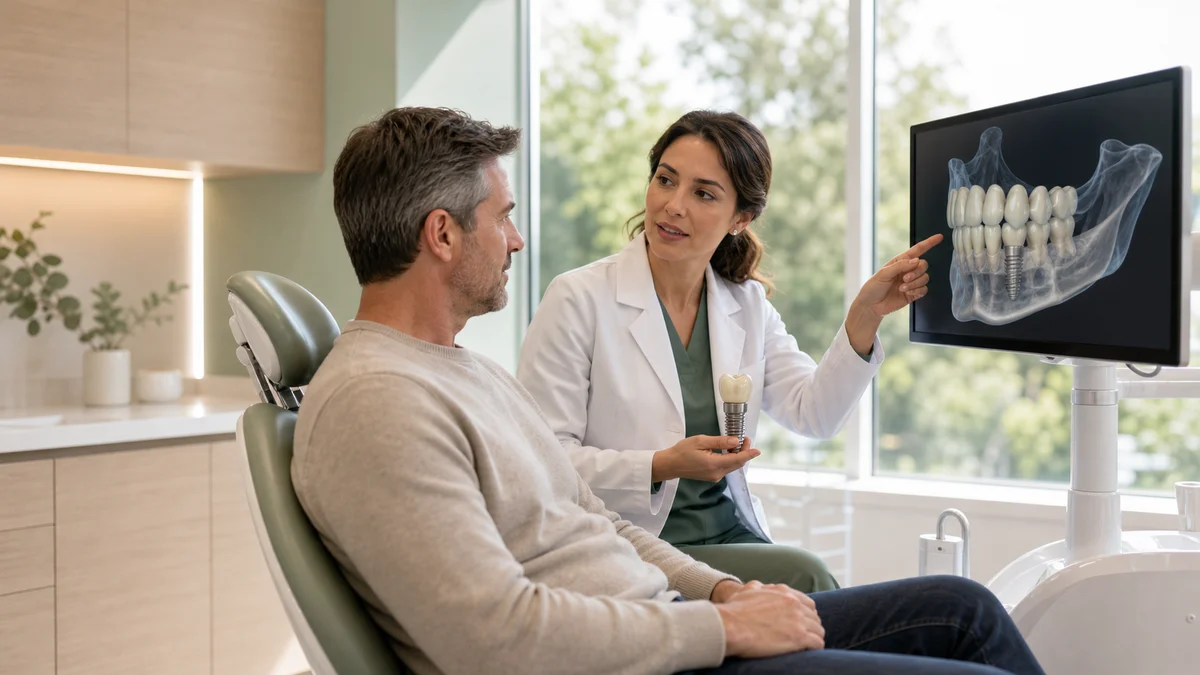
When comparing dental implants in san jose ca, verify the dentist’s California license, ask who performs each stage, and request a diagnosis-based plan with itemized fees, alternatives, risks, and follow-up. Implant treatment is not one standard package: gum health, available bone, medical history, restorative design, imaging, and maintenance all affect whether it is appropriate and how it is staged.
Searching for dental implants in san jose ca can quickly produce polished galleries, promotional prices, and promises of a new smile. Those are easy to compare, but they do not answer the questions that matter most: Is an implant suitable for your mouth and health? Who is responsible for surgery and the final tooth? What records support the plan? What is included in the estimate? How will the clinic help if healing is slower than expected?
A dental implant is a medical device placed in the jaw to support a crown, bridge, or denture. The visible tooth and the implant body are different components, often joined by an abutment. That distinction matters because planning, surgery, laboratory work, bite adjustment, and maintenance may be delivered by one clinician or coordinated across several clinicians. The U.S. Food and Drug Administration advises patients to discuss benefits, risks, candidacy, and the implant system with their dental provider. This guide turns that advice into a practical local checklist.
No online article can determine candidacy or replace an examination. This guide does not diagnose a missing-tooth problem, promise an outcome, or endorse a particular San Jose office. It helps you compare dental implants in san jose ca with better questions and clearer expectations. If you have facial swelling, uncontrolled bleeding, difficulty breathing or swallowing, fever with rapidly worsening oral symptoms, or severe symptoms after surgery, seek urgent professional assessment rather than relying on internet guidance.
1. Start with the problem, not the implant package
A responsible consultation starts by identifying why a tooth is missing, failing, or uncomfortable and by evaluating the whole mouth. A single missing tooth, several missing teeth, and a loose full denture create different restorative problems. Untreated decay, active gum inflammation, an unstable bite, or an uncertain tooth prognosis may change the order of care. The best answer may be an implant, but it may also be preserving a restorable tooth, a conventional bridge, a removable appliance, orthodontic space management, or no immediate replacement.
Before accepting dental implants in san jose ca, ask the dentist to show you the problem on your clinical images and explain the proposed objective in plain language. “Replace tooth number 19 with an implant-supported crown after healing” is more informative than “premium implant package.” The plan should distinguish necessary care from optional cosmetic changes and identify any findings that need stabilization first.
- What is the diagnosis for each tooth and the surrounding gum and bone?
- Can any questionable tooth reasonably be treated and retained?
- What happens if I postpone replacement while monitoring the site?
- Which alternatives avoid surgery, and what are their tradeoffs?
- What evidence would make the dentist revise the current plan?
2. Verify the California dental license and responsible clinicians
The Dental Board of California licenses and regulates dentists and provides consumers with a route to the state’s license search. Before choosing dental implants in san jose ca, verify the name and license status of each dentist who will provide care. A clinic brand is not a professional license. If the treatment involves separate surgical and restorative providers, identify both before paying a nonrefundable amount or scheduling surgery.
License verification is a baseline check, not a quality score. It does not tell you how often a dentist performs a particular procedure or whether your anatomy is straightforward. Ask about relevant education, current experience with cases similar in complexity to yours, and the clinician’s threshold for referral. A thoughtful dentist should be comfortable explaining when another provider, such as a periodontist, oral and maxillofacial surgeon, prosthodontist, endodontist, or medical clinician, should participate.
How should I verify a provider offering dental implants in san jose ca?
Use the official Dental Board of California consumer page and its link to the Department of Consumer Affairs license search. Search the individual dentist’s legal name, confirm that the license is current, and review any publicly displayed disciplinary information. Then ask the office who will place the implant, who will design and deliver the restoration, and who will handle urgent questions. Record names rather than relying on job titles in advertising.
3. How dental implants in san jose ca are planned, placed, and restored
Implant care is a chain of decisions. The surgeon must place the implant where it can be restored safely, and the restorative dentist must design a tooth that can be cleaned and used comfortably. If those decisions are disconnected, an implant may integrate with bone yet be difficult to restore or maintain. When comparing dental implants in san jose ca, ask how the surgical and restorative plans are coordinated before treatment begins.
A useful answer names the responsible clinician for extraction, grafting if indicated, implant placement, temporary teeth, final abutment and crown, bite adjustment, and maintenance. It also explains how records move between providers and who makes the final call if conditions during surgery differ from the scan. There is no single staffing arrangement that fits every patient; clarity and coordination matter more than whether care is delivered under one roof.
4. The health assessment before dental implants in san jose ca
The FDA notes that overall health affects candidacy, healing, and how long an implant may remain in place. A safe assessment for dental implants in san jose ca should therefore include more than a quick look at the gap. Expect questions about diagnoses, previous surgery, allergies, tobacco or nicotine exposure, alcohol and recreational drug use, pregnancy status where relevant, prior radiation, bone-related medicines, diabetes control, bleeding conditions, sleep apnea, and past complications with anesthesia or dental care.
Bring a current medication and supplement list with doses. Blood thinners, medicines that affect bone metabolism, immune-modifying therapies, and some other prescriptions may influence planning, but patients should not stop prescribed medication on their own. The dental clinician may need to communicate with the prescriber. A condition does not automatically rule out an implant; it may require stabilization, additional information, a modified plan, or a different option.
- Current medicines, supplements, allergies, and prior reactions
- History of diabetes, heart conditions, immune conditions, or bleeding concerns
- Smoking, vaping, nicotine, cannabis, alcohol, and other exposures
- Gum disease history, grinding, clenching, and previous implant problems
- Prior head or neck radiation and medicines affecting bone
- Ability to clean the proposed restoration and attend maintenance visits
5. Imaging for dental implants in san jose ca should answer a clinical question
Clinical examination and appropriate imaging help the dentist assess the site, nearby structures, bone dimensions, tooth roots, and restorative space. A three-dimensional cone-beam CT scan may be useful in many implant cases, especially when anatomy or surgical planning requires information that two-dimensional images cannot provide. It should still be justified for the individual patient. More imaging is not automatically better, and a scan does not replace examination or professional judgment.
For dental implants in san jose ca, ask what question each image answers, whether previous recent images can be used, and how the clinic limits exposure while obtaining diagnostic quality. Request a clear explanation of the planned implant position relative to the final tooth. If a guide is proposed, ask how it is designed, verified, and used. “Computer guided” describes a workflow; it is not a guarantee of a complication-free result.
Does everyone considering dental implants in san jose ca need a CBCT?
Not necessarily. The need and field of view depend on the clinical question, anatomy, existing records, and planned procedure. Ask the dentist why the scan is indicated for you, what it changes in the plan, and whether the image will be interpreted for findings beyond the implant site. If the explanation is unclear, a second opinion can help before additional radiation or irreversible care.
6. Gum health and hygiene before dental implants in san jose ca
Implants cannot decay like natural teeth, but the surrounding tissues can become inflamed and lose support. Existing periodontal disease, plaque accumulation, smoking, and an uncleanable restoration can complicate long-term maintenance. The World Health Organization identifies tobacco use and poor oral hygiene among important risk factors for periodontal disease. The American Dental Association also emphasizes personalized home care rather than a one-size-fits-all routine.
A plan for dental implants in san jose ca should document periodontal findings and describe what must improve before surgery. Ask how the proposed crown, bridge, or denture will be cleaned, which tools fit beneath it, and how often the dentist expects professional maintenance based on your risk. If no one discusses cleaning access until after the final restoration is delivered, an important design question may have been missed.
7. Infection prevention for dental implants in san jose ca
Implant placement is a surgical procedure. The Centers for Disease Control and Prevention describes Standard Precautions as the minimum infection-prevention practices for all patient care and includes hand hygiene, appropriate protective equipment, sharps and injection safety, sterile instruments and devices, and clean environmental surfaces. Patients do not need to audit a sterilization room, but respectful safety questions should receive clear answers.
When visiting offices for dental implants in san jose ca, notice whether the environment appears organized and whether staff can explain instrument processing, surface disinfection, and surgical setup without becoming evasive. Ask how sterile implant components are handled and how the clinic monitors sterilization. A premium lobby does not establish clinical safety; repeatable systems, trained staff, documentation, and adherence to manufacturer instructions do.
8. Know the system used for dental implants in san jose ca
The FDA advises patients to ask what brand and model of implant system is used and to retain that information. This matters because an implant-supported tooth is not one interchangeable object. Implant body, abutment, screw, and restoration must work as a system, and future providers may need accurate component details for maintenance or repair.
Before proceeding with dental implants in san jose ca, ask whether the system is legally marketed in the United States, how replacement components are obtained, and what documentation you receive after placement. Keep the manufacturer, system, dimensions, lot or reference information if available, site, placement date, and treating clinician with your health records. “Lifetime implant” language should not replace these facts or the need for maintenance.
9. Separate immediate placement, immediate loading, and final teeth
Words such as “same day” can refer to different events. An implant may be placed immediately after extraction, a temporary tooth may be attached soon after placement, or a full-arch provisional restoration may be delivered on the day of surgery. None of those phrases means the final restoration is complete or that every patient is eligible for the same protocol.
When advertisements for dental implants in san jose ca emphasize speed, ask exactly what is placed that day, whether it is removable or fixed, what foods and activities are restricted, and what conditions would require a delayed approach. Primary stability, infection, bone anatomy, bite forces, systemic health, and restorative design may affect timing. A slower plan is not automatically inferior; it may reflect risk management.
Can dental implants in san jose ca provide a tooth in one day?
Some carefully selected patients may receive an immediate provisional tooth or bridge, but the phrase “one day” does not describe biological healing or delivery of the definitive restoration. Ask for a written stage-by-stage plan and a contingency if adequate stability is not achieved. No responsible clinician can promise the same timeline before reviewing your examination and imaging.
10. Treat grafting as a clinical decision, not a default add-on
Bone or soft-tissue augmentation may be recommended to create adequate support, protect nearby anatomy, improve tissue form, or make a restoration easier to maintain. It is not automatically required for every implant, and the type and timing can vary. Ask the dentist to show the deficiency, explain the intended benefit, name the material category, and discuss alternatives and uncertainties.
For dental implants in san jose ca, a written plan should state whether grafting is anticipated, optional, or only a possibility discovered during surgery. It should also address donor or processed material sources, relevant risks, healing checkpoints, and how an unexpected need affects fees and timing. Consent should occur before sedation or surgery, when you can still weigh the information without pressure.
11. Choose an anesthesia plan proportional to the procedure
Local anesthesia is commonly part of implant surgery. Some patients may also be offered nitrous oxide, oral medication, or intravenous sedation depending on anxiety, procedure complexity, health, provider qualifications, and facility capabilities. Deeper sedation is not an automatic marker of higher-quality care. It adds assessment, monitoring, escort, fasting, medication, and recovery considerations that should be discussed individually.
If sedation is included with dental implants in san jose ca, ask who administers it, what permit or credential applies, how you are monitored, who remains responsible during recovery, and what emergency equipment and transfer plan are available. Give a complete health history and follow written instructions. Arrange a responsible adult and transportation when required; do not assume a rideshare alone satisfies the office’s discharge policy.
12. Costs for dental implants in san jose ca: compare itemized estimates
No responsible guide can quote a fixed implant price without knowing the site, records, components, restoration, and related care. A headline may cover only the implant body while excluding imaging, extraction, grafting, temporary teeth, abutment, crown, anesthesia, laboratory work, adjustments, or follow-up. A full-arch advertisement may also depend on financing terms or a particular restorative material.
Ask every office quoting dental implants in san jose ca for an itemized written estimate using the same treatment assumptions. Separate professional fees, facility or anesthesia fees, laboratory charges, and optional upgrades. Clarify what happens financially if surgery is stopped, more time is required, a provisional breaks, an implant does not integrate, or the definitive design changes. A fair comparison includes both the expected pathway and foreseeable contingencies.
| Decision area | What a useful answer includes | Reason to pause |
|---|---|---|
| Diagnosis and alternatives | Site-specific findings, tooth-preserving options, bridge or removable options, and no-treatment consequences | Only one package is presented before a complete examination |
| Provider responsibility | Names and roles for surgery, restoration, urgent care, and maintenance | The clinic cannot say who will perform a major stage |
| Imaging | The clinical question, image type, interpretation, and how findings affect the plan | Technology is marketed as a guarantee |
| Timeline | Stages, healing checkpoints, provisional status, and contingency for delay | Final teeth or healing are promised on a universal date |
| Fees | Itemized components, included follow-up, exclusions, refund terms, and change-order process | A low headline price cannot be reconciled to a complete restoration |
| Maintenance | Cleaning access, recall plan, wear protection where indicated, and repair responsibility | No long-term maintenance is discussed |
13. Insurance for dental implants in san jose ca: verify before treatment
Dental benefits are contracts, not clinical recommendations. Coverage may differ for examination, imaging, extraction, grafting, implant placement, abutment, crown, provisional teeth, anesthesia, and maintenance. Plans may have exclusions, waiting periods, annual maximums, frequency rules, missing-tooth provisions, downgrades, or network requirements. Medical insurance and dental insurance also apply different definitions and documentation standards.
For dental implants in san jose ca, request procedure codes and a written treatment estimate, then contact the insurer using the number on your plan documents. Ask whether a pretreatment estimate or prior authorization is available and whether it is binding. Confirm the expected patient share for each stage, not just a total. Keep in mind that an insurer’s payment estimate is not a guarantee of eligibility on the service date, and denial does not by itself determine whether treatment is clinically appropriate.
- Which codes and tooth or arch sites will be submitted?
- Which provider and facility are in network, if network status matters?
- Are grafting, sedation, provisional, abutment, and crown considered separately?
- What annual maximum, deductible, waiting period, or frequency limit applies?
- How will the clinic notify me before a plan change creates a new charge?
14. Read consent as a conversation, not a signature task
Informed consent should connect your diagnosis to the proposed procedure, expected benefits, material risks, reasonable alternatives, and the option to decline. FDA patient information lists possible implant complications such as injury to nearby teeth or tissues, infection, altered sensation, bite problems, screw loosening, difficulty cleaning, and failure of the implant body. Your personal discussion should be tailored to the site, health history, and proposed technique.
Before dental implants in san jose ca, ask for enough time to read the plan and consent before taking sedating medicine. Clarify who to call, how complications are evaluated, and which additional care may involve fees. A consent form does not waive professional responsibility, and a list of risks does not mean they will occur. Its purpose is to support an informed, voluntary choice with realistic uncertainty.
What risks should be discussed for dental implants in san jose ca?
The discussion should cover risks relevant to your anatomy and plan, which may include infection, delayed healing, injury to nearby structures, numbness, sinus-related complications in some upper-jaw sites, inadequate stability, implant or restoration failure, aesthetic limitations, cleaning difficulty, bite complications, and the possibility of additional procedures. Ask which risks are common, which are serious, and how the clinic reduces and manages them.
15. Plan around San Jose travel, work, and continuity
Local logistics can influence the safety and convenience of multi-stage care. San Jose and the wider Bay Area involve variable traffic, work schedules, and travel distances. Ask when an escort is required, how long appointments may take, whether you should avoid driving or work tasks, and where urgent assessments occur after hours. Do not schedule surgery immediately before travel unless the treating team has reviewed the plan.
Patients comparing dental implants in san jose ca should also ask what happens if a dentist leaves the practice or if the laboratory or surgeon is elsewhere. Obtain copies of scans, photographs, treatment notes, implant identifiers, and final-restoration details. Continuity is easier when the record is portable. If you may move, verify whether the system and components are accessible through other U.S. providers.
16. Know the healing checkpoints and warning signs
Healing varies by patient, site, and procedure. The FDA notes that healing for the implant body may take several months or longer. That is a general statement, not a promised calendar. Your written instructions should explain expected short-term symptoms, permitted cleaning, diet changes, medicine use, activity limits, and scheduled reviews. Follow the treating clinician’s directions rather than applying a generic online timetable.
After receiving dental implants in san jose ca, contact the treating office promptly for symptoms outside the expected course, increasing pain or swelling, fever, persistent bleeding, new or worsening numbness, a loose implant or restoration, a bite that suddenly feels different, drainage, or difficulty cleaning. Seek emergency care for trouble breathing or swallowing, rapidly spreading swelling, or another severe medical concern. Do not wait for a routine appointment when symptoms are escalating.
17. Protect the restoration with long-term maintenance
Implant care continues after the final crown or bridge. The FDA advises regular cleaning and dental visits and says patients should report a loose or painful implant. Maintenance may include monitoring gum tissues, bone levels when indicated, bite, screws, restorative wear, and home-cleaning effectiveness. Full-arch restorations may require special aids and periodic professional access beneath the prosthesis.
A good provider of dental implants in san jose ca should explain the maintenance plan before treatment, not after delivery. Ask who provides hygiene care, whether the restoration can be removed if necessary, which parts are expected to wear, and what is excluded from any written warranty. A warranty is a business term with conditions; it is not proof that biological tissues or mechanical components cannot develop problems.
A practical consultation checklist for dental implants in san jose ca
Bring this list to more than one consultation when the plan is extensive, irreversible, unusually costly, or difficult to understand. A second opinion is especially useful when recommendations differ about saving teeth, grafting, immediate loading, number of implants, or a full-arch transition. Give each clinician access to adequate records so you are comparing informed plans rather than quick impressions.
- Verified California license and named clinician for each treatment stage
- Written diagnosis, alternatives, and reason the proposed option fits your goals
- Medical-history review and coordination with other clinicians when needed
- Imaging rationale and an explanation of nearby anatomy
- Implant system, component record, and future repair pathway
- Itemized estimate with insurance assumptions and financial contingencies
- Written consent, aftercare, urgent-contact, and maintenance plans
If you are evaluating care across countries as well as dental implants in san jose ca, use the same safety questions. Redent Klinik’s English-language dental care overview can help you compare how a clinic describes coordinated planning, while the Redent Klinik contact page is the appropriate place to request an individualized assessment. Remote photos or messages can support an initial conversation, but final candidacy and fees require clinical evaluation and appropriate records.
Frequently asked questions about dental implants in san jose ca
Am I automatically a candidate for dental implants in san jose ca?
No. Candidacy depends on the condition of the site and whole mouth, restorative space, gum health, available bone, health history, medicines, nicotine exposure, ability to maintain hygiene, and your goals. Some factors can be improved; others may favor a different approach. Only a qualified clinician who has examined you and reviewed appropriate records can provide an individualized recommendation.
How long do dental implants in san jose ca take from start to finish?
There is no universal duration. Evaluation, extraction, grafting, implant placement, healing, provisional care, laboratory work, and final restoration may occur in different combinations. The FDA notes that implant-body healing may take several months or longer. Ask for a range and milestones, plus an explanation of what could shorten or extend the plan. Treat an exact pre-examination completion promise cautiously.
How much do dental implants in san jose ca cost?
The meaningful number is a written, diagnosis-based total for your expected pathway. It may include records, surgery, implant components, grafting, anesthesia, temporary teeth, laboratory work, final restoration, adjustments, and follow-up. Avoid comparing a single implant-body advertisement with a complete tooth estimate. Ask how fees change if extra procedures are needed or the original plan cannot be completed.
Does insurance cover dental implants in san jose ca?
Coverage varies by contract and treatment stage. Obtain procedure codes and request a pretreatment estimate when available. Confirm deductibles, annual maximums, waiting periods, network rules, missing-tooth provisions, and whether related procedures are separate benefits. Neither approval nor denial substitutes for a clinical decision. Get financial terms from the clinic and coverage information from the insurer in writing when possible.
Are same-day dental implants in san jose ca safer or better?
Not inherently. Immediate placement or loading can be appropriate in selected circumstances, while a staged approach can be safer or more predictable in others. The terms describe timing, not quality. Ask what “same day” means, which restoration is provisional, what stability and anatomy are required, and what the backup plan is if conditions do not support immediate treatment.
What records should I receive after dental implants in san jose ca?
Request the final treatment plan, consent and aftercare instructions, relevant images, implant site and placement date, manufacturer and system information, component details when available, restoration material, and the names of responsible clinicians. Also keep invoices and insurance correspondence. These records can help another dentist identify parts and understand the original design if you move or need urgent repair.
Should I get a second opinion before dental implants in san jose ca?
A second opinion is reasonable whenever you want more clarity and particularly when the plan involves removing restorable teeth, major grafting, sedation, full-arch reconstruction, a large financial commitment, or sharply different options. Ask the second clinician to review sufficient records. Disagreement does not automatically mean either provider is wrong; ask each to explain assumptions, evidence, and contingencies.
What are red flags when shopping for dental implants in san jose ca?
Pause if surgery is offered without an adequate examination, the treating dentist is unnamed, a universal result or timeline is guaranteed, the estimate omits the final restoration, alternatives are dismissed, pressure is applied to pay immediately, risks are minimized, or long-term maintenance is absent. Marketing language is not evidence. A trustworthy team welcomes questions and documents the plan.
Can I smoke or vape during treatment for dental implants in san jose ca?
Tell the clinician about all nicotine and tobacco exposure. The FDA states that smoking may affect healing and reduce long-term implant success. Do not conceal use or rely on a last-minute pause without guidance. Ask for a realistic cessation plan and support, how exposure changes risk, and whether the dentist recommends delaying treatment until modifiable risks are better controlled.
How do I clean dental implants in san jose ca?
Follow individualized instructions for the specific crown, bridge, or denture. Daily plaque removal and professional monitoring remain important. The right brush, interdental aid, flossing method, or water device depends on access and design. Ask the hygienist to demonstrate and then watch you use the technique. Report bleeding, swelling, bad taste, pain, loosening, or difficulty reaching an area.
Make the decision on evidence, fit, and follow-up
The most useful comparison of dental implants in san jose ca is not “Which office has the lowest starting price?” It is “Which plan explains my diagnosis, alternatives, risks, responsibilities, costs, and maintenance most clearly?” A well-designed implant restoration must fit your anatomy, health, bite, cleaning ability, priorities, and capacity for follow-up. Premium care is demonstrated through disciplined assessment and transparent communication, not decorative surroundings or absolute claims.
Take written questions, invite a trusted person when the plan is complex, and ask for records before making an irreversible decision. Verify the individual license, understand the device and restoration, compare complete estimates, and leave room for biological uncertainty. Those steps do not eliminate risk, but they make consent more informed and help you choose dental implants in san jose ca with a safer, more durable framework.
Sources reviewed for this dental implant guide
- U.S. Food and Drug Administration: Dental Implants — What You Should Know
- Centers for Disease Control and Prevention: Infection Prevention and Control in Dental Settings
- Dental Board of California: Information for Consumers and License Verification
- American Dental Association
- American Dental Association: Home Oral Care
- World Health Organization: Oral Health Fact Sheet
Sources were reviewed for patient-safety principles, device basics, infection prevention, license verification, and oral-health maintenance. They support general education and do not replace an examination, diagnosis, or individualized consent discussion.