
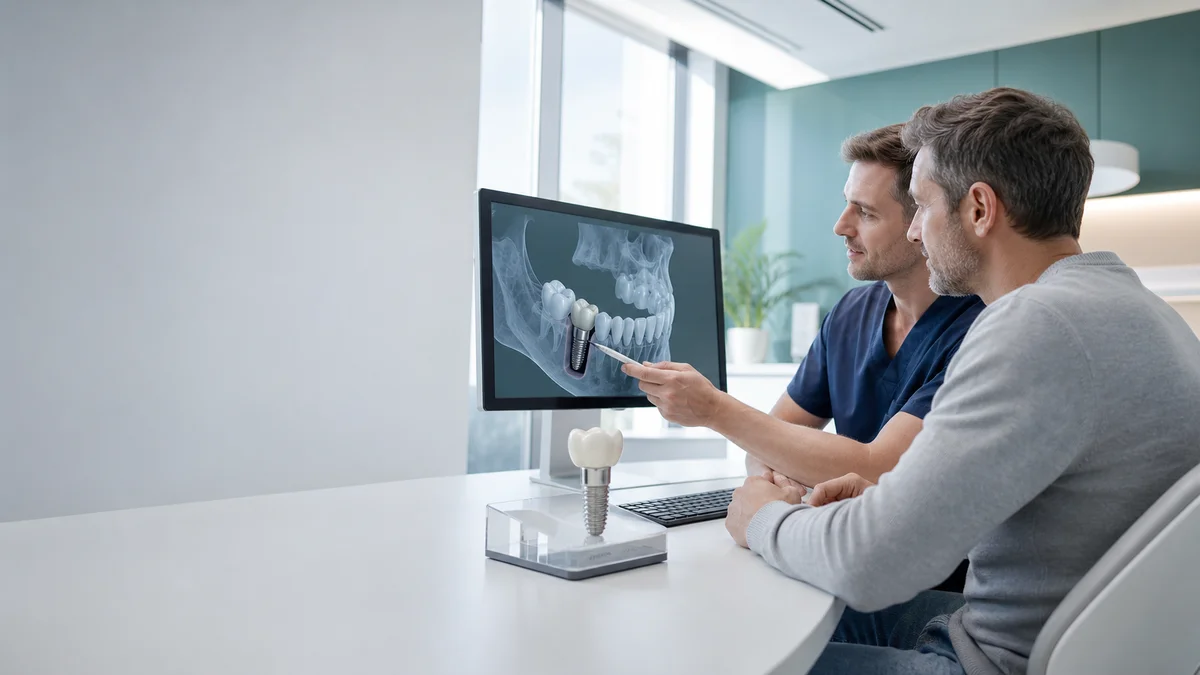
Quick answer: Compare dental implants in uk by checking the clinician’s registration, the practice regulator, your diagnosis, alternatives, imaging, written costs, implant records, healing time and aftercare. NHS access is limited and private fees vary. A safe decision follows an examination and informed consent, not a headline price or a promised result.
Searching for dental implants in uk can lead to hundreds of clinics, finance offers and simplified treatment claims. The useful question is not which advert looks most attractive; it is whether the proposed care fits your mouth, health, priorities and capacity for maintenance. An implant is a medical device placed in bone. The visible tooth is a separate restoration, and every stage needs diagnosis, consent, technical planning and follow-up.
This guide gives you 17 practical checks for comparing care in England, Scotland, Wales or Northern Ireland. It explains NHS access, private treatment plans, professional registration, imaging, grafting, risks, travel and maintenance. It is educational and cannot diagnose implant suitability. A dentist must examine you, review appropriate radiographs and discuss reasonable alternatives before making a personal recommendation.
1. Understand what dental implants in uk actually include
A dental implant usually replaces the root of a missing tooth. After it is placed in the jaw, an abutment connects it to a crown, bridge or implant-retained denture. The implant, connector and visible restoration are related but distinct components. A quote that says only “one implant” may therefore omit clinically necessary work or the final tooth.
According to the NHS information published by Guy’s and St Thomas’, the pathway can involve assessment, any required preparatory treatment, implant placement, healing and construction of the final restoration. The total process often requires several appointments over months. When comparing dental implants in uk, ask the clinic to map every proposed stage and identify who is responsible for each one.
- Initial examination, periodontal assessment and diagnostic imaging
- Management of active decay, gum disease or infection before surgery
- Extraction or bone-grafting procedures, if clinically indicated
- Implant placement, healing checks and any temporary replacement
- Abutment and definitive crown, bridge or denture
- Long-term reviews, professional cleaning and repair arrangements
The sequence is not identical for everyone. A healthy single-tooth space can be very different from a full-arch reconstruction or an area with substantial bone loss. Treat any one-size-fits-all timetable with caution.
2. Confirm that dental implants in uk suit your health
Suitability depends on more than age or the number of missing teeth. The clinical team should review your medical conditions, medicines, allergies, smoking or vaping, previous radiotherapy, gum health, bite, oral hygiene and ability to attend maintenance. Diabetes, immune conditions, antiresorptive medicines and anticoagulants do not automatically rule treatment in or out, but they can change risk assessment and planning.
Active gum disease, untreated decay or infection generally needs attention before implant placement. Cambridge University Hospitals also highlights the importance of a stable dentition and notes that heavy clenching or grinding can overload implant restorations. A responsible consultation for dental implants in uk should investigate these factors rather than moving directly to a sales quotation.
Give a complete, current medication list and do not stop prescribed medicine without instructions from the relevant prescriber. Tell the dentist about previous implant failures, difficult healing and symptoms such as unexplained bleeding or numbness. The clinician may communicate with your GP or specialist when that is appropriate and you consent.
3. Compare dental implants in uk with reasonable alternatives
Informed consent requires a meaningful discussion of alternatives, including the option of no immediate replacement when clinically reasonable. Depending on the space, remaining teeth and your preferences, choices may include a removable denture, a conventional bridge, a resin-bonded bridge, orthodontic space management or monitoring. Each option has its own maintenance demands and biological trade-offs.
For example, a bridge may avoid implant surgery but can involve neighbouring teeth. A removable denture may be less invasive and easier to modify, but some people find it less stable. An implant can avoid preparing adjacent teeth, yet it requires surgery, adequate tissue, healing and lifelong care. Comparing dental implants in uk properly means comparing complete pathways, not simply a device against an empty space.
Ask the dentist to explain what could happen if you defer treatment, which alternatives protect function, and why the recommended option fits your diagnosis. Take time to consider the explanation. Consent is an ongoing conversation and can be withdrawn before treatment.
4. Verify the dentist and practice before dental implants in uk
Anyone practising dentistry in the UK must be appropriately registered with the General Dental Council. Search the GDC register using the clinician’s name or registration number and check that the details match the person treating you. Registration is a baseline safeguard; it is not a guarantee of a particular outcome. You should still ask about the clinician’s relevant implant training, experience with cases like yours and access to referral support.
Regulation of practices differs across the four nations. In England, the Care Quality Commission provides a service finder and inspection reports. CQC dental services are not presented with the same star-rating approach used for some other services, so read the report rather than searching only for a score. Scotland, Wales and Northern Ireland have their own health and care oversight arrangements. For dental implants in uk, confirm which regulator covers the clinic’s location.
- Verify the treating dentist on the official GDC register.
- Ask who will place the implant and who will make the restoration.
- Check the practice with the regulator for its UK nation.
- Ask how urgent complications are handled outside normal hours.
- Confirm where records and radiographs will be retained.
5. Check NHS access for dental implants in uk
NHS guidance says implants are usually provided privately and are only sometimes available through the NHS, such as for limited clinical needs. Specialist services describe restricted eligibility and prioritisation. This means missing teeth alone should not be treated as confirmation that the NHS will fund implants. Criteria, referral routes and local commissioning decisions can affect access.
If you think you may qualify, begin with an NHS dentist or the team managing the underlying condition and ask whether a referral is appropriate. Request a clear explanation if implants are not available through the proposed pathway. When seeking dental implants in uk, do not pay a private deposit on the assumption that you can recover the fee from the NHS later.
A clinic may provide both NHS and private dentistry. The Competition and Markets Authority’s patient guidance says the dentist should explain which options are NHS and which are private, including the likely costs, risks, benefits and outcomes. Ask for this distinction in writing.
6. Demand diagnosis-led imaging for dental implants in uk
Implant planning starts with the final restoration: where the replacement tooth must sit, how it will meet the opposing teeth and whether it can be cleaned. The clinician then determines whether an implant can be positioned safely to support that design. A visual inspection or a panoramic image alone may not answer every three-dimensional question.
Depending on the case, appropriate imaging may include intraoral radiographs, a panoramic radiograph or cone-beam computed tomography. CBCT should be justified because it uses ionising radiation. Ask what the image is intended to show, who will report it and how it changes the plan. Good planning for dental implants in uk considers nearby nerves, sinuses, bone contours and the intended restoration.
Digital scans and planning software can improve communication, but a colourful screen does not replace clinical judgement. Ask the dentist to show you the proposed implant position and explain limitations or uncertainty in plain language.
7. Obtain an itemised quote for dental implants in uk
There is no responsible universal price for implant treatment. The total varies with the diagnosis, number and position of missing teeth, imaging, extractions, grafting, sedation, temporary teeth, laboratory design, components and follow-up. Geography and the complexity of coordinating different clinicians can also matter. A low advertised entry price may describe only one component.
For private dental implants in uk, obtain a written treatment plan that identifies what is included, excluded and conditional. It should state how long the quotation remains valid, how staged payments work, what happens if the plan changes and which cancellation or refund terms apply. Do not allow time-limited pressure to replace informed consent.
- Consultation, study models or digital scans and all required radiographs
- Extractions, infection control or periodontal treatment
- Bone or soft-tissue grafting and the materials proposed
- Implant fixture, abutment, provisional tooth and final restoration
- Sedation, medicines, review visits and emergency appointments
- Repairs, replacement components and maintenance after completion
Compare like with like. A plan that includes grafting, a custom abutment and a definitive ceramic crown cannot be fairly compared with a fixture-only headline. Finance can make payments easier, but assess the total repayable amount and regulated credit terms rather than only the monthly figure.
8. Ask how grafting changes dental implants in uk
Bone and gum tissue can shrink after tooth loss. Some sites need augmentation to provide suitable support or improve the contour around the planned restoration. Grafting may occur before, during or occasionally after implant placement, depending on the defect and technique. It can add procedures, healing time, cost and uncertainty.
Ask why grafting is recommended, what material is proposed, what alternatives exist and what happens if the graft does not perform as hoped. The source of any graft material should be explained. If a clinic recommends dental implants in uk without discussing a visible tissue deficit or the limits of the available bone, seek clarification before consenting.
“Bone graft” is a broad label, not a single procedure. A small contour graft is different from sinus augmentation or rebuilding a larger defect. Your written plan should use enough detail to understand the scope and recovery.
9. Treat immediate dental implants in uk as a clinical option
“Immediate” can describe implant placement on the day a tooth is removed, attachment of a temporary tooth soon after placement, or both. These are not interchangeable. A temporary restoration may also be kept out of normal biting contact while healing occurs. Immediate protocols can reduce certain stages for selected patients, but they are not suitable in every site.
Bone quality, infection, implant stability, tissue shape, bite forces and the ability to protect the area influence the decision. When an advert presents immediate dental implants in uk as routine, ask what clinical thresholds must be met and what the fallback plan is if stability is insufficient on the day.
A conventional healing approach is not automatically inferior. The safest timing is the one supported by the examination and your risk profile. Avoid interpreting “same-day teeth” as a promise of the final restoration or guaranteed integration.
10. Clarify sedation for dental implants in uk
Local anaesthetic is commonly used for implant placement. Some patients may also be offered conscious sedation when anxiety, procedure length or complexity makes it appropriate. Sedation changes assessment, monitoring, escort and recovery requirements; it does not make surgical risks disappear.
Before accepting sedation with dental implants in uk, ask which technique is proposed, who provides it, what training and monitoring are available, and what fasting or medication instructions apply. Confirm whether you need an adult escort and how long driving, work or important decisions should be avoided. Tell the team about sleep apnoea, respiratory disease, pregnancy, substance use and all medicines.
If fear is the main concern, ask about staged appointments, communication signals, topical anaesthetic and behavioural support as well as medication. You should never feel embarrassed about dental anxiety.
11. Keep device records for dental implants in uk
Implants and their restorative components come in different systems and sizes. Future maintenance can be easier when another dentist knows the manufacturer, model, dimensions and component details. Ask for an implant record or “passport” after placement and retain it with your radiographs, treatment plan and correspondence.
For dental implants in uk, confirm that replacement components can be sourced and ask what happens if the treating clinician moves or the clinic closes. No device lasts forever without the possibility of maintenance. Crowns, screws, clips and denture components may wear, loosen or need replacement even when the implant remains integrated.
Records are especially important if you relocate or receive care abroad later. Store a digital copy securely and tell your general dentist which system was used.
12. Understand the risks of dental implants in uk
Implant treatment can be successful, but no ethical clinician can guarantee integration, comfort, appearance or lifetime. Early problems can include pain, swelling, bleeding, infection, injury to nearby structures or failure of the implant to bond with bone. Later problems can include inflammation around the implant, bone loss, recession, food trapping, altered speech, component fracture or loosening.
Risk depends on the site, health, hygiene, smoking, bite, design and maintenance. Guy’s and St Thomas’ notes that smoking increases complications and that implants can fail to integrate. When discussing dental implants in uk, ask for risks that are specific to your anatomy and proposed restoration rather than relying on a generic consent form.
Know the clinic’s urgent-contact process. Increasing swelling, persistent bleeding, fever, difficulty swallowing or breathing, or new and worsening numbness needs prompt professional assessment; breathing or swallowing difficulty can require emergency care. Do not try to diagnose an implant problem from photographs alone.
13. Plan the visits and recovery for dental implants in uk
Implant care is a pathway, not one appointment. Assessment, stabilisation of oral disease, surgery, healing, impressions or scans, trial stages, fit and review may occur on different dates. Grafting or complex restorations can lengthen the sequence. Ask for a realistic range rather than a guaranteed completion date.
If you are travelling within Britain for dental implants in uk, include transport, accommodation, time away from work and the possibility of unplanned reviews. Long journeys immediately after sedation or surgery may be unsuitable. A clinic far from home should explain how it coordinates routine hygiene and urgent care with your local dentist.
Before surgery, obtain written instructions about food, medicines, escorts and oral hygiene. After surgery, follow the personalised cleaning, diet and medication advice. Contact the clinic if your recovery departs from what was explained.
14. Build long-term care into dental implants in uk
An implant cannot develop tooth decay, but the surrounding gum and bone can become inflamed and the restoration can suffer mechanical problems. Home cleaning needs to reach the implant margins and spaces beneath bridges or dentures. The tools may include a suitable toothbrush, interdental brushes, floss designed for bridges or an oral irrigator, depending on professional advice.
Maintenance intervals should reflect your gum health, plaque control, smoking, diabetes, restoration design and previous disease. Reviews can include probing, assessment of bleeding, bite checks and radiographs when clinically justified. A plan for dental implants in uk is incomplete if it ends when the crown is fitted.
Ask who will provide professional maintenance, what it may cost and how the implant team communicates with your general dentist or hygienist. Report looseness, bleeding, swelling, unpleasant taste, recession or a change in your bite rather than waiting for pain.
15. Compare UK treatment with dental care abroad
Some people compare local care with overseas treatment because of availability, timing or price. The same clinical checks still apply, but travel adds responsibility for records, follow-up and complications. UK government guidance advises people considering treatment abroad to research the provider, aftercare, insurance and arrangements if urgent treatment or an early return becomes necessary.
Do not compare a package price with dental implants in uk until both plans include the same diagnosis, device components, temporary and final teeth, grafting, sedation, accommodation, repeat travel, maintenance and possible remedial work. Standard travel insurance may exclude planned treatment or its complications; read the policy and obtain written confirmation.
If you are considering a consultation in Turkey, Redent Klinik provides an overview of its approach on the English clinic page. You can also use the English contact page to request a personal assessment and a written scope. Remote information can help prepare questions, but the final plan may change after an in-person examination and appropriate imaging.
16. Use a decision table for dental implants in uk
This table turns marketing language into verifiable questions. Record the clinic’s answer and where it appears in your documents. A blank or vague answer is a reason to pause, not necessarily proof of poor care.
| Decision area | Evidence to request | Pause if |
|---|---|---|
| Clinician and practice | GDC registration, relevant training and national regulator details | The treating clinician is unclear or registration cannot be verified |
| Diagnosis | Clinical findings, gum assessment and justified imaging | A definitive plan is sold before proper assessment |
| Alternatives | Benefits, limits and risks of bridges, dentures and no immediate treatment | Only the implant option is discussed |
| Scope and costs | Itemised written plan covering all expected stages | The headline fee excludes the restoration or likely extras |
| Timing | Appointment sequence, healing range and fallback plan | A completion date or outcome is guaranteed |
| Device | Manufacturer, component details and implant record | Future component availability cannot be explained |
| Aftercare | Maintenance schedule, urgent contact and repair policy | Care appears to end at fitting |
Use the same table for every proposal for dental implants in uk. Consistent questions make it easier to compare clinical scope, not sales presentation.
17. Recognise red flags around dental implants in uk
Pause if you are pressured to pay immediately, offered a guaranteed lifetime result, discouraged from seeking a second opinion or asked to accept major treatment without an examination. Be cautious when the final restoration, grafting, aftercare or complications are absent from the written plan. Before-and-after photographs can illustrate a clinic’s work but cannot predict your result.
For dental implants in uk, reliable communication should distinguish facts, clinical judgement and uncertainty. The team should welcome questions, provide accessible consent information and explain how complaints are handled. GOV.UK consumer guidance says dental providers should have a formal complaints procedure and should not pressure patients into decisions.
A second opinion is reasonable when the plan is extensive, the diagnosis is unclear or different clinicians propose substantially different approaches. Bring copies of your radiographs and plans so the comparison is informed.
Frequently asked questions about dental implants in uk
Are dental implants in uk available on the NHS?
They are usually provided privately. NHS treatment may be available for limited, prioritised clinical indications and often involves referral to a specialist service. Eligibility is not determined by a website or advert. Ask your NHS dentist or relevant hospital team whether referral is appropriate in your circumstances.
How much do dental implants in uk cost?
There is no single safe figure because the total depends on diagnosis, imaging, tooth removal, grafting, number of implants, restorative design, sedation and follow-up. Request an itemised written plan and compare identical scopes. Confirm the total repayable amount if finance is offered.
How long does treatment take?
A straightforward case can still require assessment, placement, healing, restoration and review over several visits. Grafting, infection control or a complex bridge may extend the pathway. Ask for a realistic range and what findings might change it; do not rely on a guaranteed completion date.
Can I have a tooth on the same day?
Some selected sites allow immediate placement or a temporary restoration, but “same day” does not always mean the final tooth. Adequate bone, implant stability, tissue condition and controlled bite forces matter. The clinician should explain the conventional alternative and the fallback plan before surgery.
Do dental implants in uk last for life?
No lifetime can be guaranteed. Implants and restorations can function for many years, but biology, hygiene, smoking, health, bite and component wear affect outcomes. The crown, screw, bridge or denture parts may require repair or replacement even if the implant remains stable.
Can smokers receive dental implants in uk?
Smoking does not produce the same answer for every patient, but it is associated with greater implant complications and can impair healing. Tell the team accurately about tobacco and nicotine use. Ask for cessation support and an explanation of how smoking changes your personal risk and maintenance plan.
Is a bone graft always necessary?
No. Grafting is considered when bone or tissue is insufficient for the planned position or contour. The dentist should explain the defect, material, timing, alternatives and added risks. A scan alone does not decide the issue without the clinical and restorative plan.
Who can place dental implants in uk?
A UK dentist must be registered with the General Dental Council and work within their training and competence. Check the treating professional on the official register, then ask about relevant education, experience, case complexity, referral relationships and how complications are managed.
What should I keep after implant treatment?
Keep the written treatment plan, consent information, radiographs or scan reports where supplied, receipts and the implant device record showing manufacturer and component details. These documents can help another clinician maintain or repair the restoration if you move or the original practice changes.
When should I seek urgent help after implant surgery?
Follow your clinic’s personalised instructions. Contact the clinical team promptly for worsening swelling, persistent bleeding, fever, increasing pain, discharge or new numbness. Difficulty breathing or swallowing can be an emergency and needs immediate assessment through the appropriate emergency service.
Final checklist before you consent
The safest decision about dental implants in uk is documented and unhurried. You should understand the diagnosis, alternatives, proposed sequence, important risks, likely limitations, costs and maintenance. You should know who is treating you, how their registration was checked and who to contact if recovery is not as expected.
Take the written plan home, compare it against the 17 checks and ask for unclear terms to be explained. A premium clinic experience is useful only when it supports careful assessment, transparent consent and dependable aftercare. Your final choice should reflect your health and priorities rather than a universal ranking or promise.
Sources and further reading
- NHS: Dental treatments, including implant availability
- Guy’s and St Thomas’ NHS Foundation Trust: Dental implants
- Care Quality Commission: Find and check a dentist in England
- GOV.UK and CMA: Choosing and paying for dental care
- General Dental Council: Search the register
- American Dental Association: Oral health information
- World Health Organization: Oral health fact sheet