
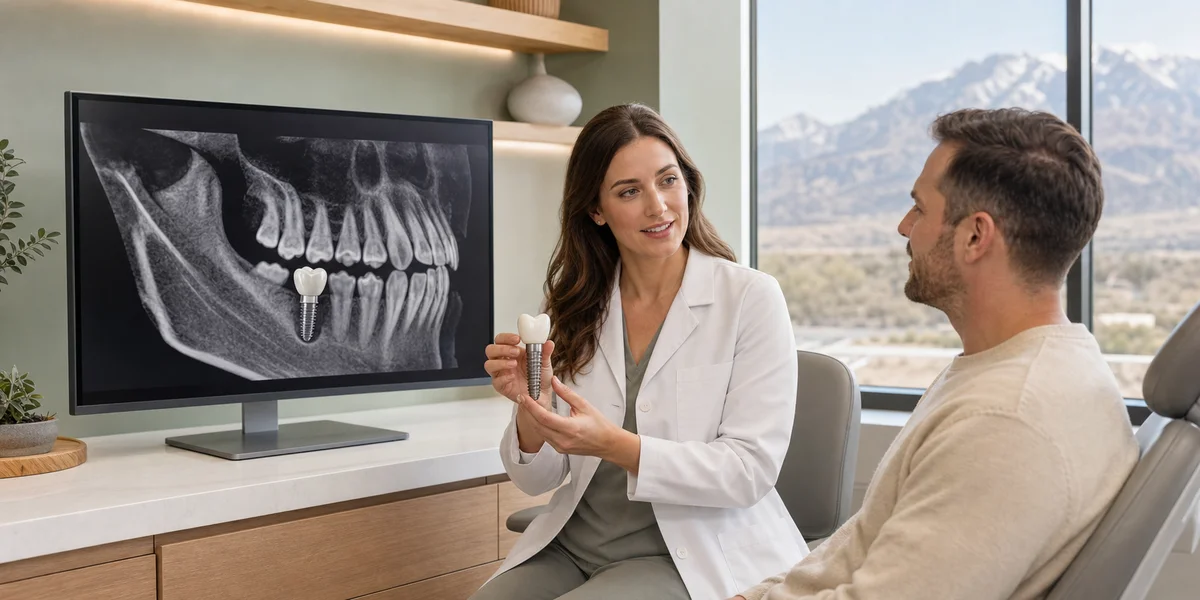
Quick answer: Dental implants in Utah can replace selected missing teeth, but suitability depends on oral health, bone and gum conditions, medical history, smoking, bite forces and the proposed restoration. Verify the treating dentist’s Utah license, request an itemised plan, understand who performs each stage and compare risks, maintenance and alternatives before consenting.
Searching for dental implants in Utah often produces a long list of clinics, promotional prices and treatment timelines. The safest first step is not choosing the most persuasive offer. It is defining the clinical problem: which teeth are missing or cannot be saved, what replacement would improve, whether active disease has been controlled and what treatment sequence is realistic for your health and daily life.
A dental implant is a device placed surgically in the jawbone to support a crown, bridge or denture. The visible replacement tooth is only one part of the system. Diagnosis, surgery, healing, restorative design and long-term maintenance all influence the result. A patient may see one practice for the whole pathway or receive coordinated care from a general dentist, oral surgeon, periodontist, prosthodontist and dental laboratory.
This evidence-based guide explains how to compare plans without promising a diagnosis, lifespan or result. It draws on current patient information from the U.S. Food and Drug Administration, the American Dental Association and official Utah licensing resources. A face-to-face examination and appropriate imaging remain essential.
1. What Dental Implants in Utah Actually Include
The implant body usually sits within the jawbone and functions as an artificial root. An abutment connects that body to the restoration. The restoration may be a single crown, a bridge replacing several teeth, or a prosthesis replacing most or all teeth in an arch. The number of missing teeth is not automatically the same as the number of implants required.
The FDA describes dental implants as medical devices surgically implanted into the jaw to support artificial teeth. That definition helps separate the surgical device from the crown or denture that patients see. When comparing proposals, ask the clinic to identify each component, its manufacturer, the intended restoration and who is responsible for future replacement or repair.
Some advertised packages combine examination, imaging, extraction, grafting, implants, temporary teeth and a final prosthesis. Others quote only the implant placement. A low headline figure may therefore describe a different scope from a higher comprehensive estimate. Written itemisation makes plans comparable.
2. Start with Diagnosis, Not a Product Package
A missing tooth can affect chewing, appearance, speech or comfort, but it does not always require an implant. The dentist should first assess why the tooth was lost, whether disease remains and whether adjacent teeth or the bite need attention. If a tooth is still present, its restorability should be considered before an irreversible extraction.
The assessment may include periodontal charting, decay and restoration review, bite evaluation, photographs, conventional radiographs and, when clinically justified, three-dimensional imaging. The imaging choice should answer a specific planning question while avoiding unnecessary exposure. A scan alone is not a complete diagnosis.
Active gum disease, uncontrolled decay or untreated infection can undermine implant planning. Stabilising those conditions may be more urgent than setting a surgery date. Patients with extensive tooth loss may also need the restorative position planned first so that implants are placed where they can support cleanable, functional teeth rather than merely where bone looks available.
- Confirm which teeth are missing, failing or still restorable.
- Identify active decay, gum inflammation, infection and bite problems.
- Define whether the goal is a crown, bridge, removable denture or fixed full-arch restoration.
- Ask how the planned tooth position guides implant placement.
- Request alternatives and the consequences of delaying or declining treatment.
3. Who May Be Suitable and Who May Need to Wait?
Suitability is individual. The FDA notes that overall health affects candidacy, healing time and how long an implant may remain in place. The dental team should review medications, allergies, previous surgery, gum history, diabetes control, smoking or nicotine use, immune conditions, bone-related medicines and any history of radiation in the head or neck.
Enough bone must be present in an appropriate position, but bone volume is only one factor. Gum tissue, mouth opening, nerve and sinus anatomy, restorative space, opposing teeth, cleaning ability and bite forces also matter. Bone grafting may be proposed when anatomy is insufficient, yet grafting adds another procedure, risk profile, cost and healing period.
A temporary delay may be appropriate when active infection or periodontal disease needs treatment, a medical condition is not adequately controlled, nicotine use is affecting healing risk, oral hygiene is not yet predictable or the final restorative design is unclear. Waiting is not a rejection; it can be a risk-reduction step.
Age alone does not determine candidacy in adults. Functional goals, health, anatomy, ability to maintain the restoration and willingness to attend reviews are generally more useful considerations. Patients who are still growing require special caution because implants do not move like natural teeth as the jaws develop.
4. Verify the Dentist and the Planned Team in Utah
Patients considering dental implants in Utah can use the state’s official Division of Professional Licensing system to check a dentist’s license status. Search using the clinician’s full name and the relevant dental profession. A clinic brand or advertising profile is not a substitute for verifying the individual responsible for care.
Utah law requires a license to practise dentistry, and state standards require licensees to work within acts permitted by law and within their education, training, experience and competence. A license verifies legal status; it does not by itself tell you how frequently a clinician performs a particular implant or reconstructive procedure.
Ask who diagnoses the case, places the implant, provides anaesthesia or sedation, performs grafting, designs the temporary restoration, fits the final teeth and handles complications. If several clinicians are involved, request a named coordinator and clarity about records sharing, fees and after-hours contact.
- Check the dentist through the Utah DOPL Licensee Lookup.
- Ask about training and experience relevant to your exact procedure, not implants in general.
- Confirm any required sedation or anaesthesia permit when applicable.
- Ask where surgery takes place and how emergencies are managed.
- Request the names and roles of every clinician involved in the plan.
5. Imaging, Bone and Anatomical Safety
Implant placement must account for the available bone and nearby structures. In the lower jaw, nerves can be relevant; in the upper back jaw, the sinus may limit space. The clinician also considers adjacent tooth roots and the thickness of facial and lingual bone. These relationships can influence implant size, angulation, grafting needs and whether the original proposal should change.
Three-dimensional cone-beam computed tomography may be useful for selected cases, particularly when anatomy cannot be assessed adequately with two-dimensional images. It should be interpreted together with the clinical examination and restorative plan. Patients can ask what question the scan answers, who interprets it and whether an incidental finding requires follow-up.
Guided surgery can assist with translating a digital plan to the mouth, but a guide does not remove biological uncertainty or replace clinical judgement. Mouth opening, guide fit, bone quality and intraoperative findings can require modification. Marketing terms such as “computer-guided” should therefore be discussed as tools, not guarantees.
6. Treatment Stages and Realistic Timing
The pathway for dental implants in Utah can include disease control, extraction, grafting, implant placement, healing, abutment treatment and delivery of the final restoration. Some stages may happen together; others need separation. The schedule depends on anatomy, infection, stability, grafting, health, restoration type and the clinician’s risk assessment.
Immediate placement means an implant is inserted at or near the extraction visit. Immediate loading means a temporary restoration is connected early. These are different concepts, and neither is suitable for every site. A temporary tooth may be primarily cosmetic and may need reduced biting pressure during healing.
The FDA states that healing of the implant body may take several months or longer. A longer pathway does not automatically signal a problem, while a one-day temporary restoration does not mean biological integration is complete. Ask for a stage-by-stage timeline with the conditions that must be met before moving forward.
| Decision point | What to confirm | Why it matters |
|---|---|---|
| Tooth removal | Whether the tooth is truly non-restorable and whether infection is present | Extraction is irreversible and may change bone and soft tissue |
| Bone graft | Material, objective, alternatives and added healing time | Not every site or patient needs the same augmentation |
| Implant placement | Anatomical clearance, restorative position and primary stability | Placement must support both safety and a cleanable final tooth |
| Temporary teeth | Whether they are fixed or removable and what foods or forces to avoid | Appearance and function during healing vary by design |
| Final restoration | Material, screw- or cement-retention, bite and hygiene access | The prosthetic design affects maintenance and repair |
| Long-term review | Recall interval, professional cleaning and complication contact | Implants and their restorations require continuing care |
7. Risks and Uncertainty to Discuss Before Consent
Implant treatment can improve chewing and support a stable replacement, but it is surgery and complications can occur. The FDA lists potential problems including injury to nearby teeth or tissues, sinus perforation, jaw injury, altered bite, component loosening, infection, delayed healing, implant body failure and numbness related to nerve injury.
Risks differ by location and patient. A single front implant with adequate tissue is not equivalent to a grafted posterior site or a full-arch reconstruction. Consent should focus on the proposed procedure, not a generic form. Ask which risks are most relevant to your images and history, how the team reduces them and what would happen if the implant does not integrate.
Smoking or nicotine exposure can impair healing. Uncontrolled diabetes, untreated periodontal disease and difficulty cleaning can also increase concern. These factors do not all produce a simple yes-or-no answer, but they should be discussed honestly and managed where possible.
Late complications matter too. Gum and bone inflammation around an implant can progress, restorative screws may loosen, porcelain or acrylic may chip, and bite changes may require adjustment. A plan is incomplete if it explains placement but not surveillance, maintenance and repair.
8. Cost Variables for Dental Implants in Utah
There is no safe universal price for dental implants in Utah. The final cost depends on the number and position of missing teeth, examination and imaging, extraction difficulty, grafting, implant components, anaesthesia, temporary teeth, laboratory work, restoration material, clinician involvement and follow-up. Current clinical conditions can change the plan after examination.
Request a written estimate that distinguishes the surgical and restorative phases. It should state what is included, what is provisional, which services could be added and how a change is authorised. Ask whether emergency visits, replacement temporaries, sedation, scans, graft materials and maintenance are separate.
Insurance coverage varies by policy, network, diagnosis, waiting period, annual maximum and exclusions. A pre-treatment estimate from an insurer is not a guarantee of payment. Confirm both the clinical plan and the benefit calculation, and ask what happens if treatment spans benefit years.
Financing can spread payments but does not reduce biological risk. Compare the total payable amount, interest, deferred-interest terms, fees, refund policy and responsibility if treatment changes. Never allow a limited-time discount to replace time for informed consent or a second opinion.
9. Compare Implants with Other Missing-Tooth Options
An implant is not automatically better than every alternative. A tooth-supported bridge may be reasonable when adjacent teeth already need crowns. An adhesive bridge can preserve more tooth structure in selected sites. A removable partial denture may replace several teeth without implant surgery. Some gaps can be accepted when function, appearance and stability are not meaningfully affected.
Orthodontic movement may close or redistribute a space in suitable cases. If a compromised tooth can be predictably restored, keeping it may also remain an option. Each choice has trade-offs involving surgery, tooth preparation, treatment time, cost, cleaning, repair and long-term uncertainty.
Ask the dentist to compare options using the same goals. If the goal is better chewing, discuss expected functional limits. If appearance is the priority, discuss gum contours and temporary teeth. If avoiding surgery is important, request non-surgical alternatives. A balanced plan includes the option of no immediate treatment when clinically reasonable.
10. Full-Arch and “Same-Day” Offers Need Extra Detail
Full-arch treatment may use several implants to support a fixed or removable prosthesis. It is more complex than replacing one tooth because the bite, smile, speech, cleansability and relationship between the jaws must be planned together. Existing teeth may be removed, making the decision especially consequential.
“Same-day teeth” commonly refers to a temporary prosthesis delivered near the surgery date, not the final restoration or the completion of healing. Ask whether the temporary is fixed, what foods are allowed, how it is cleaned and what conditions could require leaving it out or changing the design.
The final prosthesis may use different materials and may be delivered only after tissue changes stabilise. Clarify whether the quoted package includes that final prosthesis, how many try-ins or adjustments are included and what future component replacement could cost. Request a contingency plan for implant loss or fracture before treatment begins.
11. Maintenance Is Part of the Treatment
The FDA advises patients to follow oral-hygiene instructions, clean implants and surrounding teeth regularly, attend dental visits and report looseness or pain promptly. Implant-supported teeth cannot decay like natural enamel, but the surrounding gums and bone remain vulnerable to inflammation and disease.
Home care depends on the restoration. A single crown may need brushing and interdental cleaning. A bridge or full-arch prosthesis may require floss threaders, interdental brushes, water irrigation or other tools demonstrated by the dental team. The design should leave realistic access for the patient’s dexterity.
Professional reviews can check tissue health, plaque control, probing findings when appropriate, bite, mobility and restoration integrity. Imaging may be used when clinically indicated rather than automatically at every visit. Keep the implant brand and model information the FDA recommends retaining in your records.
Contact the treating clinic if an implant restoration feels loose, the bite changes, pain develops, swelling or drainage appears, or cleaning becomes difficult. Rapidly increasing facial swelling, difficulty breathing or swallowing, uncontrolled bleeding or systemic illness can require urgent or emergency assessment.
12. Local Care, Travel and Second Opinions
Local treatment can simplify follow-up, emergency access and communication between surgical and restorative teams. Utah’s geography and travel distances may still affect appointment planning, especially for patients outside the Wasatch Front. Ask how often visits are expected and which problems require an in-person review.
Some patients compare dental implants in Utah with treatment in another state or country. The clinically relevant comparison is not location alone. Compare diagnosis, credentials, materials, stages, temporary care, complication management, maintenance and the ability to share records. Include travel, accommodation and time away from work in any financial comparison.
For an international second opinion, you can review the Redent Klinik English site and use the Redent Klinik Contact Page to ask what records would be needed. Remote review can organise questions, but it cannot replace the examination and imaging required before final suitability, surgery or price is confirmed.
If treatment is performed far from home, obtain a written handover plan. It should identify who manages early healing, who can remove sutures, how urgent images are shared, which implant system was used and who pays for unplanned care. Confirm that a local dentist is willing and able to provide follow-up rather than assuming it.
13. Consultation Questions That Reveal Plan Quality
- What is the diagnosis, and which findings show that an implant is appropriate?
- Can any tooth be preserved, and what alternatives have been considered?
- Who will place the implant and who will make the final restoration?
- Is the treating dentist’s Utah license current, and are any relevant permits required?
- What imaging is needed, and what anatomical risks does it show?
- Do I need a graft, and what changes if I decline or postpone it?
- What implant system and components are planned?
- Will I have a temporary tooth, and what are its limitations?
- What is included in the estimate, and which events could add cost?
- What are the most relevant risks in my case?
- How will I clean the final restoration?
- Who manages complications during evenings, weekends or travel?
14. Frequently Asked Questions About Dental Implants in Utah
How do I verify a dentist offering dental implants in Utah?
Use the official Utah Division of Professional Licensing Licensee Lookup and search the clinician’s name under the relevant dental profession. Review the displayed license status and any linked public information. Then ask the clinician about education, training and experience for your specific surgery and restoration.
How much do dental implants in Utah cost?
There is no single reliable price without examination and a defined scope. Cost can include imaging, extraction, grafting, implant placement, abutment, temporary restoration, final crown or prosthesis, anaesthesia and follow-up. Compare itemised written estimates rather than headline figures.
Can I receive a tooth on the same day as the implant?
Some selected patients can receive an early temporary restoration, but that does not mean healing is complete or that the final tooth has been delivered. Bone conditions, implant stability, bite forces and restorative design determine whether early loading is appropriate.
Are dental implants guaranteed to last for life?
No. Implants and restorations can function for a long time, but biological and mechanical complications occur. Health, smoking, periodontal history, cleaning, bite, design and maintenance all affect risk. A lifetime guarantee should be read carefully for exclusions and should never replace clinical consent.
Do I always need a bone graft?
No. Grafting depends on site anatomy, the desired implant position and the restoration. Some sites have adequate tissue; others require augmentation or an alternative design. Ask the clinician to show why grafting is proposed and discuss the material, risks and timing.
Does insurance cover dental implants in Utah?
Coverage depends on the individual policy and treatment code. Network status, annual maximums, waiting periods, missing-tooth clauses and medical necessity rules may apply. Request a pre-treatment estimate, but remember it is not a guarantee of insurer payment.
What should I do if an implant feels loose or painful?
Contact the treating dental provider promptly and avoid repeatedly testing or loading the area. The movement may involve the restoration or the implant body, and only an examination can distinguish them. Increasing swelling, fever, drainage or systemic illness needs timely assessment.
Is travelling for implant treatment safe?
Travel is not automatically safe or unsafe. The plan must account for examination, clinician credentials, procedure complexity, flight or driving timing, early complications, follow-up and records. Confirm who provides care after you return home before accepting treatment.
15. Final Decision: Compare the Whole Care Pathway
The best way to compare dental implants in Utah is to evaluate the entire pathway: diagnosis, provider credentials, restorative design, surgical plan, risk reduction, costs, temporary care and maintenance. A polished simulation or low promotional price cannot establish whether the treatment is appropriate.
Verify the dentist’s license, ask who performs every stage and request a plan that names the implant system, restoration, expected sequence and alternatives. Take time for a second opinion when extraction, grafting or full-arch treatment is proposed. The purpose is not to find a universal “best” clinic but to identify a plan that is understandable, maintainable and proportionate to your needs.
A final recommendation can change after examination, imaging or disease control. Good consent makes that uncertainty visible and explains the next decision point. It also gives you a clear route for questions, urgent care and long-term review after the visible treatment is complete.
Sources
- U.S. Food and Drug Administration: Dental Implants — What You Should Know
- MouthHealthy by the American Dental Association: Dental Implants
- American Dental Association
- World Health Organization: Oral Health
- Utah Division of Professional Licensing
- Utah DOPL Licensee Lookup and Verification System
- Utah Code 58-69-802: Practice Within Competency
- Utah Code Title 58, Chapter 69: Dental Licensing