
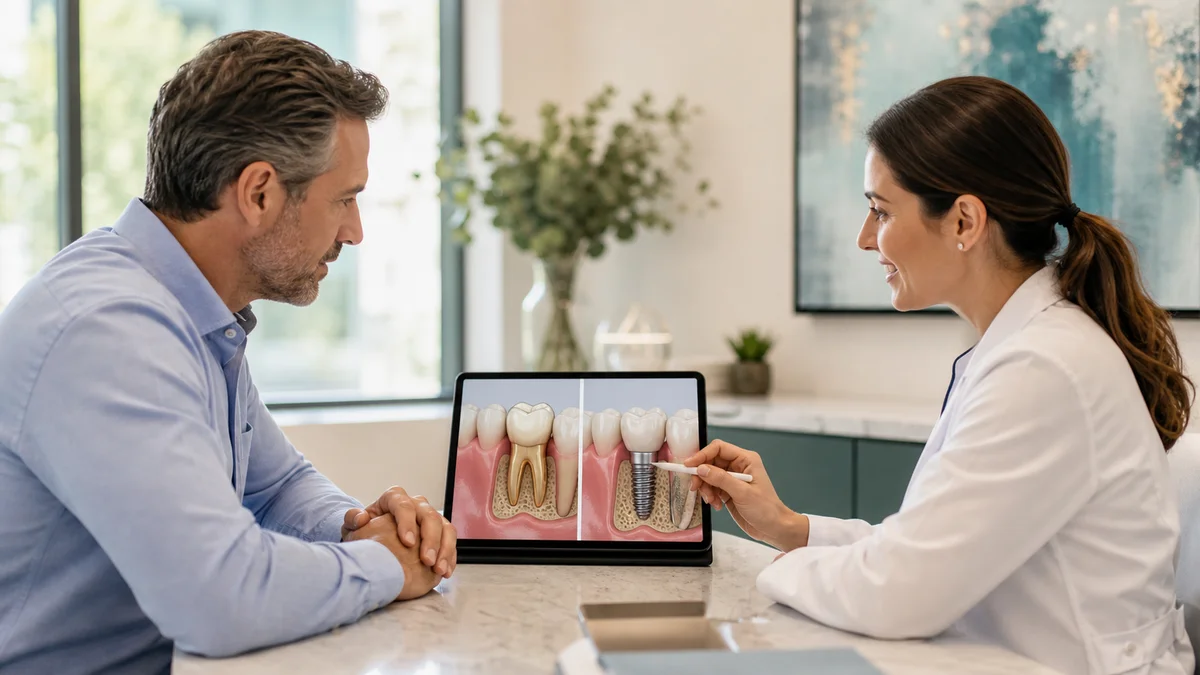
Quick answer: The choice between dental implants vs crowns usually starts with one question: can the natural tooth be predictably retained? A crown covers an existing tooth, while an implant replaces a missing tooth root and normally supports its own crown. Examination, imaging when justified, gum and bone health, treatment burden, maintenance, risks, timing, and total cost all shape an individual plan.
Comparing dental implants vs crowns can sound like choosing between two versions of the same product. Clinically, that is usually the wrong starting point. A conventional dental crown is a restoration fitted over a prepared natural tooth. A dental implant is a device placed in the jaw to replace a missing root; after healing, it can support an implant crown. In other words, an implant treatment often includes a crown, while a tooth-supported crown depends on keeping the natural root.
This distinction matters because removing a tooth is irreversible. A patient-safe discussion should first ask whether decay, fracture, previous treatment, gum support, root condition, remaining tooth structure, bite forces, and restorability allow the tooth to be retained with a reasonable outlook. Only then can the benefits and burdens of preservation be compared with extraction and replacement. No online guide can make that diagnosis, and neither pathway can promise a lifetime result.
This evidence-informed guide explains the questions behind dental implants vs crowns, including candidacy, surgery, healing, appearance, function, risks, maintenance, and full-pathway cost. It is designed to help you prepare for a dental consultation, not to prescribe treatment. At Redent Klinik, an individual plan follows an examination and a transparent discussion of alternatives; you can explore the English clinic overview or use the contact page to arrange an assessment.
1. What dental implants vs crowns really compares
Within a dental implants vs crowns consultation, a crown is a tooth-shaped covering. The American Dental Association’s patient resource explains that crowns may strengthen a tooth with a large filling, protect a weak or broken tooth, restore form and function, or complete a dental implant. To place a crown on a natural tooth, the dentist generally reshapes the tooth so the restoration can fit over it. The tooth, root, and supporting tissues remain part of the system.
On the implant side of dental implants vs crowns, the restoration has different components. The implant body is placed surgically in the jawbone, an abutment connects to it, and a crown is made above the gum. The US Food and Drug Administration describes this structure and notes that treatment planning depends on the patient’s overall health, healing capacity, oral health, and ongoing care. The visible result may resemble a natural-tooth crown, but its biological foundation is different.
That means the practical comparison is often “retain and restore this tooth” versus “remove it and replace the missing tooth,” not simply dental implants vs crowns. If the tooth is already absent, a natural-tooth crown alone cannot fill the space. Options might include an implant-supported crown, a bridge, a removable prosthesis, orthodontic space management in selected cases, or accepting the space after discussing consequences. If a present tooth needs only a filling, onlay, or other conservative restoration, a full crown or an implant may both be more treatment than necessary.
2. Start the decision with restorability, not the material
The most important first step in dental implants vs crowns is deciding whether the existing tooth is restorable. “Restorable” is not a judgment that can be made from one symptom or a photograph. The dentist may assess how much sound tooth remains, whether decay extends below the gum, where a fracture travels, the health and length of the root, the quality of previous root canal treatment, periodontal support, mobility, bite contacts, and the possibility of creating a clean, stable restoration margin.
In a dental implants vs crowns assessment, a tooth can look badly broken yet still have a possible preservation pathway. Conversely, a tooth that looks intact may have a deep crack or poor support. Diagnostic tests and appropriate radiographs help distinguish these situations. Three-dimensional cone-beam CT is useful for selected implant and complex diagnostic questions, but it is not automatically required for every crown. FDA and ADA guidance supports using dental X-rays, including CBCT, only when clinically necessary because imaging should provide a benefit that justifies radiation exposure.
Ask the dentist to show you the findings and explain uncertainty. Useful questions include:
- What specific finding makes the tooth restorable, questionable, or non-restorable?
- How much healthy tooth structure will remain after decay or an old restoration is removed?
- Would root canal treatment, a core build-up, periodontal treatment, or crown lengthening be considered?
- Is there a crack, and can its extent be confirmed before an irreversible decision?
- How do gum support, bone levels, mobility, grinding, and the opposing teeth affect the outlook?
- What are the reasonable alternatives, including a more conservative restoration or no immediate replacement?
- What finding during treatment could change the plan, and how would cost and consent be handled?
A second opinion can be particularly valuable when extraction is recommended for a symptom-free tooth, when the diagnosis is uncertain, or when the proposed plan is extensive. A second opinion is not a guarantee that the tooth can be saved. It is a way to confirm the evidence, understand trade-offs, and make an informed choice before an irreversible step.
3. How a natural-tooth crown pathway works
In the crown pathway, the dentist first stabilizes active disease and prepares the retained tooth. The exact sequence varies. It may involve removing decay or an old filling, building up missing structure, managing the pulp or root canal if clinically indicated, shaping the tooth, scanning or taking an impression, placing a temporary crown, and later fitting the definitive restoration. Some systems allow same-day manufacture, but speed does not remove the need for diagnosis, margin quality, bite assessment, and informed consent.
The crown side of dental implants vs crowns is not a protective shield that makes a tooth immune to disease. The junction between crown and tooth must be cleaned, the supporting gum and bone must remain healthy, and the restoration must tolerate functional forces. Decay can develop at a crown margin. Cement can fail. Ceramic can chip. The underlying tooth can fracture, become symptomatic, or later require endodontic treatment. These possibilities do not mean crowns are poor care; they explain why maintenance and realistic expectations matter.
When discussing dental implants vs crowns, preserving a suitable natural tooth can avoid extraction and implant surgery. It may also shorten the treatment path because there is no need for bone integration. However, a complicated tooth-saving pathway can involve several procedures and may still carry uncertainty. The right comparison should include all anticipated stages rather than treating “crown” as a single appointment.
4. How an implant-supported crown pathway works
The implant pathway in dental implants vs crowns normally begins after the tooth is missing or after extraction has been agreed. Assessment includes oral and medical history, gum health, plaque control, available bone, the position of nearby teeth and anatomical structures, the bite, and the planned final crown. Implant placement should be planned from the desired restorative result backward; simply putting a screw where bone exists may not create the best position for cleaning, function, or appearance.
Healing is a central difference in dental implants vs crowns. After implant placement, bone needs time to integrate with the implant surface. The ADA and FDA both note that this process takes time and can require months. Some patients may have a temporary restoration during healing, while others need a space left unloaded. Immediate placement or immediate loading may be possible in selected clinical situations, but these terms do not mean the treatment is instantly complete or risk-free. Bone grafting, soft-tissue procedures, or staged treatment can lengthen the pathway.
Once the implant side of dental implants vs crowns reaches satisfactory integration and tissue conditions, the clinician connects the restorative components and fits the crown. Even after completion, the implant requires home cleaning and professional monitoring. The implant cannot develop tooth decay, but tissues around it can become inflamed. The American Academy of Periodontology describes peri-implant mucositis and peri-implantitis; risk assessment, plaque control, smoking status, diabetes management, and a history of periodontal disease can all matter.
5. A 12-factor dental implants vs crowns comparison
The following factors provide a structured discussion. They are not a scoring tool, because one decisive clinical finding may outweigh several preferences.
- Presence of a tooth: A natural-tooth crown needs a retained tooth. An implant is considered for a missing or planned-to-be-removed tooth.
- Restorability: Sound remaining structure, root condition, fracture location, decay, and periodontal support influence whether a durable crown can be made.
- Irreversibility: Crown preparation removes some tooth structure; extraction removes the entire tooth. Patients should understand both irreversible steps.
- Surgery: Implant placement is a surgical procedure. A routine crown is not, although supporting procedures for the tooth may still be invasive.
- Healing: A crown can often be completed without months of bone integration. An implant may require staged healing and sometimes grafting.
- Medical context: Healing, medication, tobacco use, diabetes, immune status, previous radiotherapy, and other factors may change implant planning.
- Gum and bone health: Both pathways need healthy supporting tissues. Active periodontal disease should be evaluated and managed.
- Appearance: Tooth color, gum levels, tissue thickness, implant position, and neighboring teeth shape the result. No material guarantees a perfect match.
- Function and bite: Grinding, clenching, span, tooth position, and opposing teeth affect loading and possible protective strategies.
- Maintenance: Both need daily plaque control and reviews. Tools and cleaning access may differ around an implant crown.
- Repairability: Ask which components can be repaired or replaced and what happens if the underlying tooth, screw, abutment, crown, bone, or gum develops a problem.
- Full-pathway burden: Compare time, visits, surgery, temporary teeth, travel, expected maintenance, and itemized total cost—not merely the crown fee.
This dental implants vs crowns framework keeps the dental implants vs crowns conversation anchored in health and function. Material names such as zirconia, porcelain-fused-to-metal, titanium, or ceramic are secondary to diagnosis, design, tissue conditions, and workmanship. The most expensive material cannot correct a non-restorable foundation or an implant placed in an uncleanable position.
6. Decision table for common clinical starting points
| Starting situation | Discussion to prioritize | Why it matters | Questions to ask |
|---|---|---|---|
| Natural tooth is present and appears restorable | Conservative restoration, onlay, or natural-tooth crown as indicated | Extraction would be irreversible and an implant is not automatically an upgrade | What healthy structure remains, and what is the expected maintenance? |
| Natural tooth has uncertain restorability | Further diagnosis, specialist input, staged assessment, and backup plan | A hidden crack, deep decay, root condition, or limited support can change the pathway | What evidence supports each prognosis, and when would the decision be revisited? |
| Tooth is judged non-restorable | Extraction rationale plus replacement options, timing, and no-replacement alternative | An implant-supported crown is one option, not the only automatic next step | Would a bridge or removable option be reasonable? Is grafting anticipated? |
| Tooth is already missing | Implant crown, bridge, removable prosthesis, space management, or monitoring | A conventional crown cannot replace a root or span an empty space by itself | How will each option affect adjacent teeth, cleaning, bite, time, and cost? |
| Active gum disease or poor plaque control | Stabilization, hygiene support, risk reduction, and reassessment | Both tooth and implant outcomes depend on healthy, maintainable tissues | What must improve before definitive work, and how will it be monitored? |
| Severe pain, swelling, fever, trauma, or spreading infection signs | Prompt local clinical assessment and urgent management | The immediate priority is safety, not elective comparison shopping | Where should urgent care be obtained, and when can definitive options be reviewed? |
The table shows why dental implants vs crowns is not a universal head-to-head contest. The starting diagnosis selects the relevant branch. A good written treatment plan should identify the present condition, proposed pathway, alternatives, material uncertainties, review schedule, and what would trigger a change.
7. Tooth preservation versus extraction
In dental implants vs crowns, keeping a natural tooth is often desirable when it can be restored predictably and maintained. Natural periodontal tissues provide sensory feedback, and tooth preservation avoids an extraction socket and implant surgery. But “save every tooth at any cost” is not a safe absolute. Repeated procedures on a severely compromised tooth can consume time and money without creating an acceptable foundation. The decision depends on the specific tooth and the whole-mouth plan.
Likewise, a dental implants vs crowns discussion should not describe implant treatment as inherently superior to a restorable tooth. Implants are valuable replacements for missing teeth, but they are not biologically identical to teeth. They lack a periodontal ligament, have different tissue attachment, and can face both biological and mechanical complications. Marketing language such as “permanent,” “maintenance-free,” or “guaranteed for life” should prompt questions.
When extraction is proposed, ask for the clinical reason in plain language and whether it is urgent. Ask if a specialist opinion could clarify endodontic, periodontal, restorative, or surgical feasibility. If infection or acute symptoms require timely care, do not postpone necessary assessment merely to continue online research. Breathing or swallowing difficulty, rapidly increasing swelling, uncontrolled bleeding, significant facial trauma, or systemic illness can require urgent or emergency help.
8. Surgery, healing, and treatment time
The timeline is one of the clearest differences in dental implants vs crowns. A straightforward crown usually follows tooth preparation and laboratory or chairside fabrication. A temporary crown may protect the tooth between visits. Additional treatment, such as root canal therapy or gum procedures, can add stages. Symptoms or unexpected findings can change the schedule.
An implant path can include extraction, socket healing, grafting, implant placement, integration, soft-tissue shaping, restorative records, provisionalization, and final crown delivery. Some stages can sometimes be combined, but combining them is a clinical decision, not a speed guarantee. Cambridge University Hospitals describes surgical and restorative phases and notes that healing commonly takes months, with longer treatment possible when grafting is needed. Other health systems may quote different overall ranges because protocols and case complexity vary.
For either dental implants vs crowns pathway, ask for a sequence rather than a promised completion date:
- Which steps are diagnostic, surgical, restorative, or laboratory stages?
- Will there be a temporary tooth, and what limitations will it have?
- What healing milestone must be reached before the next step?
- Which delays are clinically normal, and which symptoms need a call?
- Who provides urgent care if you live far away or travel after treatment?
- How are changes documented, consented to, and priced?
Do not schedule important travel or public events around an optimistic best-case dental implants vs crowns estimate without discussing contingencies. Healing is individual. A slower schedule is not automatically a failure; it may reflect a cautious response to tissue conditions.
9. Risks and candidacy in dental implants vs crowns
Every dental implants vs crowns intervention has risks. With a natural-tooth crown, possible issues include sensitivity, pulpal inflammation, need for later root canal treatment, decay at the margin, gum irritation, loss of retention, wear, fracture of the restoration, or fracture of the tooth. The likelihood depends on the starting condition, preparation, material, bite, hygiene, and follow-up. A crown does not treat active gum disease or compensate for an unmanageable crack.
For the implant side of dental implants vs crowns, the FDA lists potential complications such as injury to surrounding structures, altered sensation, sinus involvement in the upper jaw, infection, implant-body failure, component loosening, bite problems, and cleaning difficulty. These events are not inevitable, but they belong in informed consent. Implant surgery also creates a healing wound, and individual medical factors can affect that healing.
Medical risk can alter a dental implants vs crowns plan. Smoking is particularly relevant because official sources note its effect on healing and implant risk. Diabetes does not automatically exclude implant care, but disease control and overall health need individual assessment. Medication history matters, including medicines affecting bone metabolism, immunity, clotting, or wound healing. Never stop prescribed medicine based on a blog; the dental team should coordinate with the prescribing clinician when needed.
Implant candidacy within dental implants vs crowns also depends on a maintainable final design. Sufficient bone volume is important, but so are gum architecture, restorative space, neighboring roots, smile line, cleaning access, and the patient’s ability to attend review. A CBCT may support three-dimensional planning when justified. The smallest number of scans that answers the clinical question is preferable to routine imaging without a clear indication.
10. Appearance, chewing, and front-versus-back teeth
Patients often ask whether dental implants vs crowns look and feel different. Both can be designed to resemble a tooth, but the final appearance depends on more than shade. The shape and position of the restoration, gum level, tissue thickness, neighboring teeth, light reflection, implant angulation, and laboratory communication all contribute. In the front of the mouth, gum symmetry and the transition between restoration and tissue can be especially demanding.
On appearance, dental implants vs crowns begin with different tissue relationships. A natural-tooth crown may preserve the existing gum relationship, although decay, trauma, preparation, or periodontal surgery can alter it. An implant placed after extraction may undergo tissue changes during healing. In selected cases, grafting or provisional shaping is considered to support the planned contour, but no clinician can guarantee that tissue will remain exactly unchanged.
For posterior dental implants vs crowns, chewing force, available height, opposing teeth, and parafunction become prominent. Neither a strong crown nor a strong implant makes clenching harmless. A dentist may discuss material choice, occlusal adjustment, protective appliances, or management of contributing habits. Report recurrent chipping or loosening rather than repeatedly repairing the visible component without evaluating the cause.
11. Cleaning, maintenance, and long-term expectations
The safest long-term expectation in dental implants vs crowns is that both options require care. Brush with fluoride toothpaste as advised for natural teeth, clean between teeth or around implant components using tools matched to the design, and attend a risk-based review schedule. Professional assessment may include gum inflammation, probing when appropriate, mobility, bite, crown margins, component stability, and radiographs when clinically indicated.
The two dental implants vs crowns foundations face different disease mechanisms. A natural tooth remains susceptible to decay. The area where the crown meets tooth structure deserves careful plaque control. Dry mouth, frequent sugar exposure, inadequate cleaning, or inaccessible margins can increase risk. An implant cannot develop a cavity, but plaque can inflame peri-implant tissues. Bleeding, swelling, pus, increasing discomfort, recession, bad taste, loosening, or a change in bite deserves prompt assessment.
No credible dental implants vs crowns explanation should give a universal lifespan. Studies report outcomes for groups under defined conditions, while an individual’s restoration can fail earlier or function much longer. Outcome is influenced by diagnosis, technical quality, biology, health behavior, trauma, bite, maintenance, and how “success” is defined. Ask what monitoring and repair would look like rather than requesting a guaranteed number of years.
12. Compare total costs without relying on a headline price
Price matters in dental implants vs crowns, but a fixed online number can be misleading. A natural-tooth crown quote may or may not include examination, radiographs, removal of an old restoration, a core build-up, root canal treatment, temporary restoration, laboratory fee, gum treatment, occlusal appliance, and reviews. An implant quote may or may not include extraction, grafting, scans, surgical guide, implant body, abutment, temporary tooth, final crown, sedation, and maintenance.
For a fair dental implants vs crowns cost comparison, ask for itemized written pathways that include foreseeable stages. Insurance coverage, exclusions, waiting periods, annual limits, and preauthorization vary. A pre-treatment estimate is not always a payment guarantee. If financing is used, compare annual percentage rate, fees, total repayment, deferred-interest rules, and what happens if the clinical plan changes.
Patients travelling for dental implants vs crowns treatment should include transport, accommodation, time away from work, the number of return visits, management of complications, record transfer, and local follow-up. A lower initial fee can become less attractive if repairs require international travel. Conversely, a complex preservation plan may be worthwhile even if its initial cost is higher than a simple extraction; the question is value and suitability over the whole pathway, not the cheapest isolated procedure.
Questions to take to your consultation
Use these prompts to turn a broad dental implants vs crowns search into a personal, evidence-based conversation:
- What is the diagnosis, and can you show me the clinical or imaging evidence?
- Is the tooth predictably restorable? What makes the outlook favorable or uncertain?
- Is a filling, onlay, root canal, periodontal treatment, or other conservative option relevant?
- If extraction is recommended, what are all reasonable replacement and no-replacement options?
- Do I need CBCT, and what specific question will it answer?
- How do my gum health, bone, medical history, medicines, smoking, and bite affect the plan?
- What are the main biological, surgical, restorative, and mechanical risks?
- What temporary restoration will be used, and what is the realistic sequence?
- How must I clean the result, and who provides maintenance if I move or travel?
- What is included in each written estimate, and what could add cost?
- What happens if the tooth proves non-restorable during preparation or the implant does not integrate?
- Can I have copies of my images, implant brand and model records, consent, and final plan?
Frequently asked questions about dental implants vs crowns
Are dental implants vs crowns alternatives for the same problem?
Not always. A conventional crown covers a retained natural tooth. An implant replaces a missing root and generally supports an implant crown. If a tooth is present and restorable, the comparison may be preservation versus extraction and replacement. If the tooth is already missing, the relevant alternatives may be an implant crown, bridge, removable prosthesis, space management, or no replacement after professional assessment.
Is it better to save a natural tooth or get an implant?
A restorable, maintainable natural tooth is not automatically inferior to an implant. Saving it may avoid extraction and surgery. However, a severely fractured, decayed, infected, or poorly supported tooth may not provide a predictable foundation. “Better” depends on diagnosis, prognosis, risks, patient priorities, and whole-mouth planning. Ask for the evidence supporting restorability and consider a second opinion before elective extraction when uncertainty remains.
Can a crown be placed where a tooth is missing?
A stand-alone conventional crown needs support. It may sit on a prepared natural tooth or on an implant abutment. A bridge uses neighboring teeth or implants to support a replacement tooth across a space. Therefore, saying “I need a crown” does not identify the foundation. The dentist should explain whether the proposal is a natural-tooth crown, implant-supported crown, or bridge unit.
Does getting a crown always require root canal treatment?
No. Many crowned teeth do not need root canal treatment. It may be considered when the pulp is irreversibly inflamed, infected, or otherwise unable to remain healthy, based on examination and testing. A heavily restored tooth can develop symptoms later, so informed consent should include that possibility. Root canal treatment should not be presented as automatic solely because a crown is planned.
How long does dental implants vs crowns treatment take?
A crown pathway can sometimes be completed in one or several visits, depending on diagnosis, supporting treatment, fabrication, and response. Implant care commonly includes surgical healing and osseointegration over months; extraction, grafting, or tissue procedures may add stages. Immediate techniques are suitable only in selected cases. Ask for a personalized sequence with contingencies, not a guaranteed completion date.
Is an implant crown more difficult to clean?
Cleaning difficulty depends on the shape and position of the restoration, gum contours, contact areas, and individual dexterity. Some implant crowns are straightforward to clean; others need interdental brushes, floss aids, or water irrigation as instructed. Natural-tooth crown margins also require careful plaque control. Ask the clinician or hygienist to demonstrate cleaning before treatment is considered complete.
Can I get an implant if I smoke or have diabetes?
Smoking and diabetes do not create the same decision for every person, but both require honest risk assessment. Official patient resources note that smoking can impair healing, and diabetes control can affect planning. A clinician should review your health, medicines, gum status, and ability to maintain care. Do not conceal tobacco use or change prescribed medication without coordination with the appropriate healthcare professional.
Do dental implants last longer than crowns?
No universal lifespan comparison is reliable. A natural-tooth crown, implant body, abutment, and implant crown are different components with different potential complications. Outcomes depend on the starting condition, design, technical execution, health, hygiene, bite, and maintenance. Ask how success is defined, which component might need repair, and what follow-up is needed rather than relying on a lifetime claim.
When should I seek urgent dental care?
Seek prompt local assessment for severe or worsening pain, swelling, fever, trauma, uncontrolled bleeding, a loose restoration with choking risk, or signs of spreading infection. Difficulty breathing or swallowing and rapidly increasing facial or neck swelling can be emergencies. Urgent care addresses safety first; the definitive dental implants vs crowns decision can be revisited after immediate risk is controlled.
A safe decision is diagnosis-led and reversible where possible
The central lesson is simple: dental implants vs crowns cannot be decided from a price list, a material name, or a social-media image. First establish whether a natural tooth exists and can be predictably restored. Then use this dental implants vs crowns framework to compare the complete pathways, including irreversible steps, treatment burden, healing, risks, function, appearance, maintenance, repair, and cost.
A trustworthy dental implants vs crowns plan acknowledges uncertainty, explains alternatives, uses imaging only when justified, and gives you time to ask questions. A dental implants vs crowns second opinion can also clarify uncertain restorability before extraction. The plan should never guarantee a result or pressure you into extraction because an implant is marketed as an upgrade. This article is prepared for clinical review by Dentist Esma Çevrük Çakır and prioritizes informed consent and patient safety; it does not replace an examination or an individualized diagnosis.
Sources and patient resources
- US Food and Drug Administration: Dental Implants — What You Should Know
- US Food and Drug Administration: Dental Cone-beam Computed Tomography
- American Dental Association MouthHealthy: Crowns
- American Dental Association MouthHealthy: Implants
- American Dental Association
- American Academy of Periodontology: Peri-implant Diseases
- Cambridge University Hospitals NHS Foundation Trust: Dental Implants in Restorative Dentistry
- Guy’s and St Thomas’ NHS Foundation Trust: Dental Implants
- NHS: Dental Treatments
- World Health Organization: Oral Health Fact Sheet
Clinical review note: This evidence-informed educational article is prepared for review by Dentist Esma Çevrük Çakır. Sources were accessed in August 2026. It does not replace an examination, diagnosis, consent discussion, or individual treatment plan.