
When patients lose multiple teeth or even a full arch, one major question quickly arises: dental implants vs permanent dentures — which solution is better? 🤔 This comparison is not just about replacing missing teeth; it is about restoring confidence, chewing ability, speech clarity, facial structure, and long-term oral health. Understanding the real differences between dental implants vs permanent dentures allows you to make an informed decision that fits your lifestyle, budget, and medical condition.
In today’s modern dentistry, both options are considered advanced restorative solutions. However, the way they function inside the mouth is fundamentally different. When evaluating dental implants vs permanent dentures, it is important to understand how each treatment interacts with your jawbone, gums, and daily habits. Patients often assume they are interchangeable, but the truth is that dental implants vs permanent dentures serve similar goals through very different biological and mechanical principles.
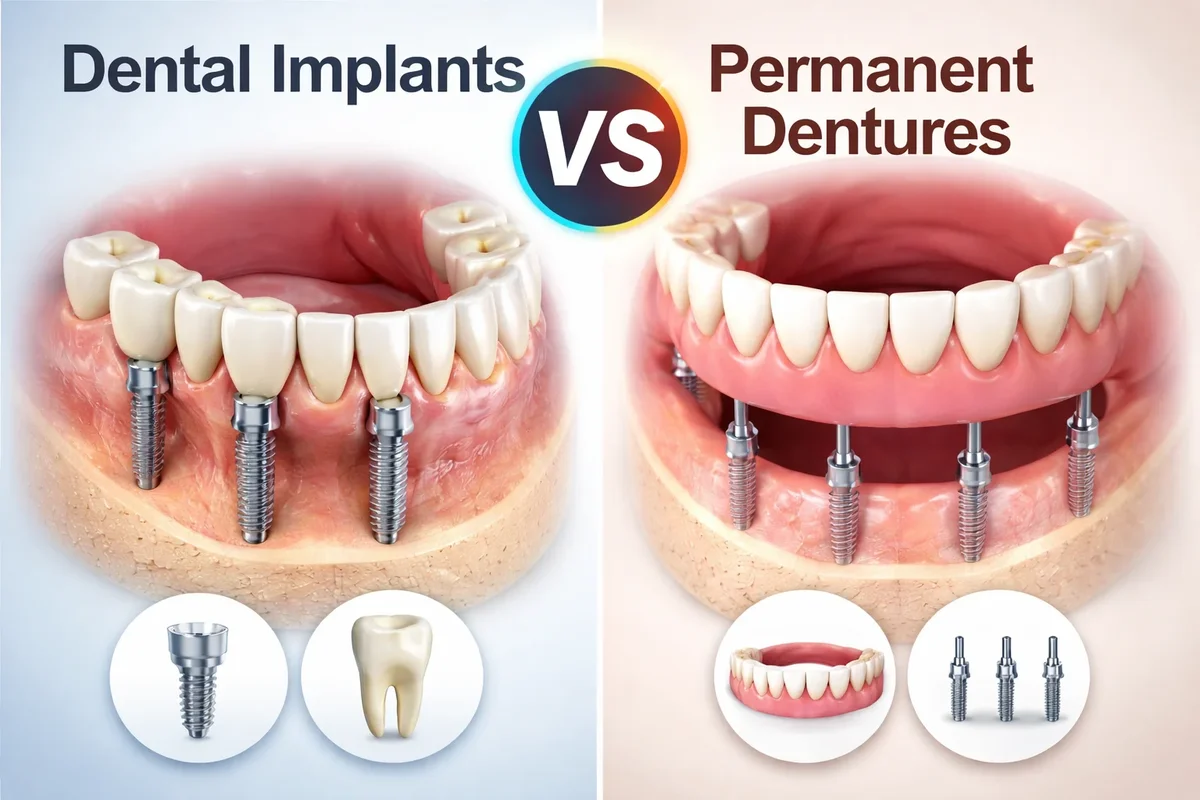
Dental implants are titanium posts surgically placed into the jawbone to act as artificial tooth roots. Over time, they integrate with the bone through a process called osseointegration. This creates a stable, long-term foundation for crowns, bridges, or full-arch restorations. In contrast, permanent dentures (also called fixed dentures or implant-supported dentures) are full-arch prosthetic teeth secured onto multiple implants. So when comparing dental implants vs permanent dentures, you are not necessarily choosing between implants and no implants — permanent dentures often rely on implants as well, but in a different structural configuration.
One of the most important factors in the discussion of dental implants vs permanent dentures is stability. Traditional removable dentures can shift or slip, but permanent dentures are fixed in place and do not come out daily. Meanwhile, individual dental implants replace each tooth separately or support bridges. Therefore, dental implants vs permanent dentures is often a comparison between single-tooth precision and full-arch efficiency.
Patients researching dental implants vs permanent dentures are usually concerned about comfort, appearance, chewing strength, and longevity. Dental implants are widely known for mimicking natural teeth in both function and appearance. Permanent dentures, on the other hand, are ideal for patients who have lost all teeth in one arch and want a stable, non-removable solution without replacing each tooth individually. In this sense, the debate of dental implants vs permanent dentures depends heavily on how many teeth are missing and what your long-term expectations are.
Another critical aspect of dental implants vs permanent dentures is bone preservation. When teeth are lost, the jawbone begins to shrink over time. Dental implants stimulate the bone similarly to natural tooth roots, helping prevent bone loss. Permanent dentures supported by implants also provide bone stimulation, but the distribution of force differs from single implants. That is why understanding dental implants vs permanent dentures is essential not only for aesthetics but also for maintaining facial structure and oral health.
Cost is also part of the dental implants vs permanent dentures conversation. While dental implants can be more expensive when replacing multiple teeth individually, permanent dentures may offer a more cost-efficient full-arch solution. However, price should never be the only deciding factor. According to the American Dental Association, treatment planning should consider long-term health benefits, durability, and patient-specific medical factors.
Functionally, when comparing dental implants vs permanent dentures, chewing efficiency plays a major role. Dental implants often allow nearly 100% natural biting force. Permanent dentures restore strong function as well, but because they replace an entire arch as one unit, they may distribute pressure differently. For many patients evaluating dental implants vs permanent dentures, the ability to eat confidently without worry is the ultimate deciding factor. 🍎🥩
Speech clarity is another detail often overlooked in the dental implants vs permanent dentures discussion. Poorly fitted removable dentures can affect pronunciation. Fixed solutions, including both implants and permanent dentures, significantly improve speech stability. Therefore, the dental implants vs permanent dentures decision also influences communication comfort and self-confidence.
Maintenance requirements further distinguish dental implants vs permanent dentures. Dental implants are brushed and flossed similarly to natural teeth. Permanent dentures require specialized cleaning techniques under the prosthetic arch. Both options require excellent oral hygiene, but the daily routine differs slightly. Understanding these differences makes the dental implants vs permanent dentures choice more practical and realistic.
Ultimately, the question of dental implants vs permanent dentures is not about which treatment is universally better. It is about which treatment is better for you. Your bone density, medical history, number of missing teeth, aesthetic expectations, and budget all influence the final decision. If you are unsure which solution fits your needs, you can consult directly with specialists through the Redent Klinik Contact Page for a personalized evaluation.
In summary, dental implants vs permanent dentures represents one of the most important decisions in restorative dentistry. Both options offer life-changing improvements, but their structure, longevity, cost, and maintenance differ significantly. By understanding the core differences in dental implants vs permanent dentures, patients can move forward confidently, knowing they are investing in a healthier, stronger, and more beautiful smile. 😊
1. What Are Dental Implants vs Permanent Dentures?
When patients begin researching dental implants vs permanent dentures, the first step is understanding exactly what each treatment involves. While both solutions are designed to replace missing teeth permanently, their structure, placement, and long-term function differ significantly. The comparison of dental implants vs permanent dentures is not simply about appearance — it is about biology, biomechanics, and long-term oral health outcomes.
In modern restorative dentistry, both options are considered fixed (non-removable) solutions. However, when analyzing dental implants vs permanent dentures, it becomes clear that the core difference lies in how each restoration interacts with the jawbone and soft tissue. Let’s break this down in detail.
What Are Dental Implants?
Dental implants are small titanium posts surgically inserted into the jawbone to replace missing tooth roots. Over several months, the implant integrates with the bone through osseointegration, forming a stable and durable foundation. In the discussion of dental implants vs permanent dentures, implants are often considered the gold standard for single-tooth or multiple-tooth replacement because they function independently.
Structure of a Dental Implant
When comparing dental implants vs permanent dentures, it is important to understand implant components:
- Implant Post: The titanium screw placed into the jawbone.
- Abutment: A connector that links the implant post to the crown.
- Crown: The visible artificial tooth.
Each implant supports an individual crown, bridge, or partial prosthesis. Therefore, in the dental implants vs permanent dentures comparison, implants offer a tooth-by-tooth replacement approach. This structure closely mimics natural teeth, preserving bone and delivering high chewing efficiency.
What Are Permanent Dentures?
Permanent dentures, also known as fixed full-arch dentures or implant-supported dentures, are complete sets of prosthetic teeth anchored to multiple implants. In the context of dental implants vs permanent dentures, permanent dentures are typically recommended for patients who have lost all teeth in one arch (upper or lower jaw).
Unlike removable dentures, permanent dentures are fixed in place and cannot be taken out daily by the patient. They are secured onto strategically placed implants, usually four to six per arch. When analyzing dental implants vs permanent dentures, this approach replaces an entire row of teeth with one unified prosthetic structure.
How Permanent Dentures Are Structured
In the dental implants vs permanent dentures debate, structure matters greatly:
- Multiple implants placed in the jaw.
- A full-arch prosthetic bridge attached to those implants.
- A single continuous restoration instead of individual crowns.
This means that while both solutions involve implants, the dental implants vs permanent dentures distinction lies in whether each tooth is individually restored or replaced as a full arch unit.
Key Structural Differences Between Dental Implants vs Permanent Dentures
Understanding structural differences helps patients fully grasp dental implants vs permanent dentures:
1. Number of Implants Used:
In dental implants, each missing tooth may require its own implant. In permanent dentures, fewer implants support an entire arch.
2. Load Distribution:
When comparing dental implants vs permanent dentures, implants distribute force individually, while permanent dentures spread chewing pressure across the arch.
3. Maintenance Access:
Implants can be cleaned like natural teeth. Permanent dentures require special hygiene tools to clean underneath the prosthetic arch.
Who Typically Chooses Dental Implants vs Permanent Dentures?
The decision between dental implants vs permanent dentures often depends on the extent of tooth loss:
- Patients missing one or several teeth typically prefer dental implants.
- Patients missing all teeth in an arch often consider permanent dentures.
Bone density also influences the dental implants vs permanent dentures choice. Patients with sufficient bone volume may be candidates for multiple implants, while those with moderate bone loss may benefit from full-arch solutions that require fewer implant sites.
Biological Impact of Dental Implants vs Permanent Dentures
Another crucial difference in dental implants vs permanent dentures lies in bone stimulation. Dental implants act like natural roots and stimulate the jawbone directly at each placement site. Permanent dentures also stimulate bone, but only at the implant anchor points. Over time, this may create subtle differences in bone preservation patterns.
This is why dental professionals carefully evaluate dental implants vs permanent dentures before recommending treatment. The long-term health of the jawbone plays a major role in facial structure preservation and overall oral stability.
Aesthetic and Functional Considerations
In terms of appearance, both solutions offer highly aesthetic outcomes. However, when comparing dental implants vs permanent dentures, implants often provide slightly more individualized natural emergence profiles. Permanent dentures create a uniform and harmonious full smile design, especially beneficial in full-mouth rehabilitation cases. 😁
Functionally, both allow patients to eat confidently. Still, chewing mechanics may feel more natural with individual implants because they replicate separate tooth roots. Therefore, understanding dental implants vs permanent dentures ensures patients know what to expect from daily performance.
Why Understanding Dental Implants vs Permanent Dentures Matters
Choosing between dental implants vs permanent dentures is a life-changing decision. Both are advanced, long-lasting restorative options. However, the structural and biological differences make each suitable for different clinical scenarios.
By fully understanding dental implants vs permanent dentures, patients can evaluate comfort, function, maintenance, cost, and long-term outcomes realistically. A personalized consultation remains the most reliable way to determine which solution aligns with your oral health goals and lifestyle.
In summary, dental implants vs permanent dentures is not a simple either-or question. It is a strategic choice between individual tooth-root replacement and full-arch restoration supported by implants. Knowing these foundational differences empowers you to make a confident, informed decision about your smile’s future. 😊
2. How Dental Implants Work: Structure, Surgery & Healing
To fully understand the long-term implications of dental implants vs permanent dentures, it is essential to examine how dental implants actually work. Dental implants are not simply artificial teeth placed on the gums; they are medically engineered titanium structures designed to replace natural tooth roots. When comparing dental implants vs permanent dentures, the biological integration process of implants is one of the most important distinctions that influences durability, stability, and bone preservation.
Dental implants function by anchoring directly into the jawbone. This process creates a strong and stable foundation that mimics the behavior of natural teeth. While both options in the dental implants vs permanent dentures comparison may involve implants, individual dental implants follow a specific surgical and healing pathway that patients should clearly understand before making a decision.
The Structure of a Dental Implant System
In the discussion of dental implants vs permanent dentures, structure determines performance. A dental implant system typically consists of three key components:
- Implant Fixture: A biocompatible titanium screw placed inside the jawbone.
- Abutment: A connector that links the implant to the prosthetic tooth.
- Dental Crown: The visible portion that looks and functions like a natural tooth.
Unlike permanent dentures, which replace an entire arch as a single unit, dental implants can replace teeth individually. Therefore, when evaluating dental implants vs permanent dentures, implants offer a modular approach that closely replicates natural tooth anatomy.
The Surgical Procedure Explained
One of the main differences patients consider in dental implants vs permanent dentures is the surgical process. Implant placement is a minor oral surgery performed under local anesthesia or sedation.
Step 1: Consultation & Imaging
Before placing implants, 3D imaging such as CBCT scans is used to evaluate bone density and nerve positioning. This planning stage is critical in the dental implants vs permanent dentures decision because adequate bone volume determines candidacy.
Step 2: Implant Placement
The titanium implant is surgically inserted into the jawbone. The procedure typically takes 1–2 hours per implant. Compared to permanent dentures, which may use fewer implants for a full arch, single dental implants require precise positioning for each missing tooth. This surgical precision is a defining factor in dental implants vs permanent dentures.
Step 3: Osseointegration
After placement, the healing phase begins. Over 3–6 months, the implant fuses with the jawbone in a process called osseointegration. This biological integration is what makes dental implants extremely stable. In the broader conversation of dental implants vs permanent dentures, this integration gives implants their long-term strength and natural bite force.
Step 4: Abutment & Crown Placement
Once healing is complete, the abutment is attached and a custom-made crown is placed. The result is a restoration that looks, feels, and functions like a natural tooth.
Healing and Recovery Timeline
Healing plays a significant role in the dental implants vs permanent dentures comparison. Dental implants require a healing period because the bone must fuse with the implant. Patients may experience mild swelling or discomfort for a few days after surgery, but most return to normal activities quickly.
Permanent dentures, especially immediate-load full-arch systems, may sometimes be attached shortly after implant placement. However, the biological healing process still occurs underneath. Therefore, understanding healing expectations is vital when comparing dental implants vs permanent dentures.
Bone Stimulation and Long-Term Stability
A major advantage of dental implants in the dental implants vs permanent dentures debate is bone stimulation. Natural teeth stimulate the jawbone during chewing. When teeth are lost, the bone begins to shrink. Dental implants replicate this stimulation because they function as artificial roots.
Although permanent dentures also rely on implants for support, the force distribution differs. Individual implants stimulate bone precisely at each tooth location, whereas permanent dentures concentrate stimulation around anchor points. This distinction significantly influences the long-term evaluation of dental implants vs permanent dentures.
Functional Strength and Bite Force
One of the reasons many patients choose implants in the dental implants vs permanent dentures comparison is chewing efficiency. Dental implants can restore up to 90–100% of natural bite force. This allows patients to eat a wide variety of foods confidently. 🍎🥩
Permanent dentures also restore strong function, but because they operate as a connected arch, the sensation may differ slightly. Therefore, in terms of individual tooth biomechanics, dental implants often feel closer to natural teeth in the dental implants vs permanent dentures comparison.
Longevity and Maintenance
Durability is another critical factor in dental implants vs permanent dentures. With proper oral hygiene, dental implants can last 20 years or more — often a lifetime. The titanium fixture itself rarely fails once fully integrated. Crowns may need replacement over time due to wear, but the implant base remains stable.
Maintenance involves brushing, flossing, and regular dental visits. Unlike removable dentures, implants are cleaned similarly to natural teeth. This straightforward hygiene routine makes dental implants highly appealing in the dental implants vs permanent dentures discussion.
Are Dental Implants Right for Everyone?
While implants offer numerous benefits in the dental implants vs permanent dentures comparison, not all patients are immediate candidates. Adequate bone density and overall health are required. Smokers, uncontrolled diabetics, or patients with severe bone loss may need additional procedures such as bone grafting.
In summary, dental implants work through surgical placement, biological fusion, and long-term functional integration. Their ability to mimic natural tooth roots makes them a powerful option in the dental implants vs permanent dentures evaluation. By understanding the structure, surgery, and healing process, patients can make a confident, informed decision about whether implants align with their long-term oral health goals. 😊
3. Understanding Permanent Dentures: Fixed Full-Arch Solutions
When patients compare dental implants vs permanent dentures, many initially focus on implants without fully understanding what permanent dentures actually involve. Permanent dentures — also known as fixed implant-supported dentures or full-arch fixed prostheses — are advanced restorative solutions designed to replace an entire upper or lower arch of missing teeth. In the broader discussion of dental implants vs permanent dentures, permanent dentures offer a streamlined and efficient way to restore a full smile without replacing each tooth individually.
Unlike traditional removable dentures that sit on the gums, permanent dentures are anchored securely onto multiple dental implants. This structural difference dramatically improves stability, chewing strength, and confidence. Therefore, when analyzing dental implants vs permanent dentures, it is essential to understand that permanent dentures are not removable appliances — they are fixed restorations supported by implants.
What Exactly Are Permanent Dentures?
Permanent dentures are full-arch prosthetic teeth attached to 4–6 dental implants per jaw. These implants act as anchors, supporting a single, custom-designed prosthetic bridge that replaces all missing teeth in that arch. In the dental implants vs permanent dentures comparison, permanent dentures are typically recommended for patients who have lost all or most of their teeth.
This approach is sometimes referred to as “All-on-4” or “All-on-6” treatment concepts. Rather than placing an implant for every missing tooth, a strategic number of implants are positioned to support the entire arch. When evaluating dental implants vs permanent dentures, this reduced number of implants often makes permanent dentures a more cost-effective and time-efficient option for full-mouth rehabilitation.
How Permanent Dentures Are Placed
Step 1: Evaluation and Digital Planning
Before treatment begins, advanced imaging such as CBCT scans is used to assess bone quality and determine ideal implant placement. This planning stage is critical in both dental implants vs permanent dentures cases because bone density directly impacts treatment success.
Step 2: Implant Surgery
Four to six implants are placed strategically into the jawbone. These implants may be angled in specific positions to maximize bone contact and avoid anatomical structures such as sinuses or nerves. In the context of dental implants vs permanent dentures, permanent dentures require fewer implants than individual tooth replacement, which can simplify surgery.
Step 3: Temporary Fixed Teeth
In many cases, a temporary fixed denture is attached shortly after implant placement. This allows patients to leave the clinic with functional teeth the same day. This immediate function advantage is one of the most appealing aspects in the dental implants vs permanent dentures discussion. 😊
Step 4: Final Prosthetic Placement
After healing and osseointegration, the final custom-designed permanent denture is secured onto the implants. This final restoration is crafted from durable materials such as zirconia or high-quality acrylic over a titanium framework.
Advantages of Permanent Dentures
Understanding benefits is crucial when evaluating dental implants vs permanent dentures. Permanent dentures offer several significant advantages:
- Full Smile Restoration: Replace an entire arch at once.
- Improved Stability: No slipping or movement like removable dentures.
- Enhanced Chewing Ability: Stronger bite compared to traditional dentures.
- Immediate Results: Often receive fixed teeth on the same day.
For patients missing all teeth, the efficiency of permanent dentures often makes them a strong competitor in the dental implants vs permanent dentures comparison.
Limitations and Considerations
While permanent dentures are highly effective, they are not identical to replacing each tooth individually. In the dental implants vs permanent dentures debate, it is important to consider potential limitations:
- Bone stimulation occurs primarily at implant anchor points rather than at every tooth position.
- Cleaning underneath the prosthetic arch requires specialized tools such as water flossers.
- If one implant fails, the entire arch may require adjustment.
These factors highlight why careful consultation is essential when deciding between dental implants vs permanent dentures.
Chewing Efficiency and Daily Comfort
Permanent dentures restore strong chewing function, often reaching 80–90% of natural bite force. In the comparison of dental implants vs permanent dentures, this level of performance satisfies most patients, especially those transitioning from removable dentures.
Speech clarity also improves dramatically. Because the prosthesis is fixed, there is no movement during speaking. Many patients report increased confidence when choosing permanent dentures in the dental implants vs permanent dentures decision process.
Longevity of Permanent Dentures
With proper care, implants supporting permanent dentures can last decades. The prosthetic arch itself may require replacement after 10–15 years depending on material wear. In the overall dental implants vs permanent dentures evaluation, both options offer long-term durability, though maintenance needs differ.
Who Is an Ideal Candidate?
Permanent dentures are often ideal for:
- Patients missing all teeth in one or both arches.
- Individuals tired of removable dentures.
- Patients seeking faster full-arch rehabilitation.
When comparing dental implants vs permanent dentures, patients with extensive tooth loss often find permanent dentures more practical than placing 10–14 individual implants per arch.
Final Thoughts on Permanent Dentures
In the comprehensive comparison of dental implants vs permanent dentures, permanent dentures stand out as a highly efficient, stable, and aesthetically pleasing full-arch solution. They combine the stability of implants with the efficiency of replacing all teeth at once.
Ultimately, understanding how permanent dentures function allows patients to weigh their options clearly in the dental implants vs permanent dentures decision. For full-mouth restoration cases, permanent dentures provide life-changing improvements in confidence, function, and overall quality of life. 😁
4. Cost Comparison: Dental Implants vs Permanent Dentures
For many patients researching dental implants vs permanent dentures, cost is one of the most decisive factors. While both options are considered long-term restorative investments, their pricing structures differ significantly depending on the number of implants required, materials used, surgical complexity, and geographic location. Understanding the financial aspect of dental implants vs permanent dentures helps patients make realistic and confident decisions without unexpected surprises.
It is important to remember that pricing should not be evaluated based on initial cost alone. When comparing dental implants vs permanent dentures, long-term durability, maintenance expenses, and potential replacement needs must also be factored into the equation. A treatment that appears less expensive upfront may cost more over time if it requires frequent adjustments or replacements.
Average Cost of Dental Implants
In the dental implants vs permanent dentures discussion, individual dental implants are typically priced per tooth. In the United States, the average cost per single dental implant (including implant, abutment, and crown) ranges between:
• Implant placement: $1,500 – $3,000
• Abutment & crown: $1,000 – $2,000
Total per tooth: $2,500 – $5,000
When evaluating dental implants vs permanent dentures, replacing multiple missing teeth individually can quickly increase total cost. For example, replacing six missing teeth with six implants could range from $15,000 to $30,000 or more. However, implants offer individualized restoration and often superior bone preservation.
Additional Costs to Consider
In some dental implants vs permanent dentures cases, patients may require:
- Bone grafting ($300 – $3,000 depending on extent)
- Sinus lift procedures ($1,500 – $5,000)
- Temporary restorations
These additional procedures can influence the total investment when choosing dental implants in the dental implants vs permanent dentures comparison.
Average Cost of Permanent Dentures
Permanent dentures, often referred to as full-arch implant-supported dentures, typically replace all teeth in one arch using 4–6 implants. In the dental implants vs permanent dentures evaluation, this solution may be more cost-efficient for patients missing an entire arch.
• Implant placement (4–6 implants): $8,000 – $15,000
• Fixed prosthetic arch: $7,000 – $15,000
Total per arch: $15,000 – $30,000
While the total may appear high, replacing 12–14 teeth individually with implants would generally exceed this amount. Therefore, when comparing dental implants vs permanent dentures, permanent dentures often provide financial efficiency for full-mouth rehabilitation cases.
International Cost Comparison
Many patients researching dental implants vs permanent dentures also consider treatment abroad. In countries known for dental tourism, prices may be 40–70% lower than in the United States or Western Europe, while still maintaining international quality standards.
For example, in certain accredited clinics:
- Single dental implant: $700 – $1,500
- Full-arch permanent denture: $6,000 – $12,000
However, patients should always verify clinic credentials and follow guidance from reputable organizations such as the American Dental Association when evaluating treatment options in the dental implants vs permanent dentures comparison.
Long-Term Value vs Initial Investment
When analyzing dental implants vs permanent dentures, focusing only on initial cost can be misleading. Dental implants, although sometimes more expensive upfront per tooth, may last 20+ years with proper care. Permanent dentures also provide long-term stability, but the prosthetic arch may need replacement after 10–15 years depending on wear.
Therefore, in the dental implants vs permanent dentures decision-making process, patients should consider:
- Expected lifespan of the restoration
- Maintenance and hygiene costs
- Future repair or replacement expenses
- Insurance or financing options
Insurance and Financing Options
Dental insurance coverage for dental implants vs permanent dentures varies widely. Some plans cover part of the crown or denture portion but exclude implant surgery. Others may classify implants as major restorative procedures with partial reimbursement.
Many clinics offer flexible financing plans, allowing patients to spread payments over time. When comparing dental implants vs permanent dentures, monthly financing options can make either solution more accessible.
Cost vs Quality of Life
Beyond numbers, the financial comparison of dental implants vs permanent dentures should also account for quality-of-life improvements. Restored chewing ability, enhanced confidence, improved speech, and preserved facial structure all contribute to long-term well-being. 😊
Patients who choose the right solution for their needs often find the investment worthwhile. In many dental implants vs permanent dentures cases, selecting the most appropriate treatment — rather than the cheapest — leads to greater long-term satisfaction.
Final Thoughts on Cost Comparison
In summary, the financial comparison of dental implants vs permanent dentures depends heavily on the number of missing teeth and the patient’s clinical condition. Individual implants may be ideal for limited tooth loss but can become expensive in full-arch cases. Permanent dentures often provide a more cost-efficient solution for complete arch restoration.
Ultimately, understanding the full financial picture of dental implants vs permanent dentures empowers patients to plan realistically while prioritizing long-term oral health, stability, and confidence. 💡