
In today’s digital-first world, a dental office website is no longer just an online brochure—it’s the central hub of your practice’s brand, patient communication, and growth strategy. Patients don’t simply stumble across dental practices anymore; instead, they actively search, compare, and evaluate online before booking an appointment. This means that your website often becomes the very first impression potential patients will have of your clinic. A well-built site can immediately establish trust, while a poorly designed one may push visitors to your competitors.
Research indicates that over 75% of patients search online before choosing a healthcare provider. This highlights why a dental office website is not just optional, but essential. It serves as your 24/7 receptionist—answering questions, providing valuable information, showcasing services, and encouraging online bookings. Without it, even the best dental clinic may remain invisible to a large portion of potential patients who are browsing for solutions near them.
Another important factor is credibility. Imagine you are a new patient looking for cosmetic dentistry. If one dental office has a polished website with clear service descriptions, testimonials, and easy appointment scheduling, while another has little to no online presence, which one would you trust more? Studies reveal that users judge a brand’s credibility within seconds of landing on a site. For dental professionals, this is crucial, since oral health is highly personal and patients want assurance they are in safe hands.
Building an effective dental office website is also about accessibility. Today’s patients expect instant answers: What treatments are offered? How much will they cost? What insurance options are accepted? How can I contact the clinic? A strategically structured website addresses these needs by combining clear navigation, well-organized service pages, and a prominent Redent Klinik Contact Page for patient inquiries. By reducing friction in finding information, you ensure patients stay engaged and are more likely to convert into bookings.
Beyond information sharing, a modern dental practice website boosts search engine rankings. With the right SEO strategies, your clinic can appear at the top of Google results when users type “dentist near me” or “dental implants in [city].” Ranking high means more visibility, more clicks, and ultimately more new patients. Search engines reward websites that are user-friendly, mobile-responsive, and rich in helpful content. This is why your dental office website must be optimized from the ground up—not only for patients but also for Google’s algorithms.
Another benefit lies in patient communication. Your site can host a blog covering oral hygiene tips, treatment explanations, and FAQs. This positions your clinic as an authority in dental care and provides a steady flow of content for social media channels. Including authoritative links, such as the American Dental Association, further strengthens credibility and provides patients with reliable external resources. Patients appreciate when clinics go beyond self-promotion and actually educate their audience, making them feel more valued and informed.
Trust-building goes even deeper with testimonials and case studies. Featuring real before-and-after photos, patient reviews, and video testimonials on your dental office website demonstrates transparency and results. These elements act as powerful social proof, influencing decision-making more than any marketing slogan. In fact, surveys show that 9 out of 10 consumers trust online reviews as much as personal recommendations. For a dental practice, this means that one satisfied patient story can inspire dozens of new bookings.
Usability and design are equally crucial. An effective dental office site is not cluttered, confusing, or outdated. Instead, it incorporates clean layouts, high-quality visuals, fast-loading pages, and clear calls-to-action like “Book an Appointment.” A slow or unattractive site frustrates visitors, causing them to leave within seconds. On the other hand, an appealing, easy-to-navigate site creates a positive perception of professionalism and care.
Importantly, your dental office website can integrate technology that saves time for both staff and patients. Features like online appointment booking, live chat support, digital patient forms, and payment portals reduce administrative workload and improve patient satisfaction. This digital convenience aligns with the modern patient’s expectations, especially younger demographics who prefer handling everything from their smartphones.
Finally, let’s address marketing. Your website is the foundation of all online marketing campaigns. Whether you run Google Ads, Facebook promotions, or email newsletters, all of them ultimately drive users back to your site. Without a strong online presence, your marketing budget risks being wasted. Conversely, when your website is optimized, every campaign becomes more cost-effective, because visitors are more likely to convert into real patients.
To summarize, a dental office website is not simply a technical necessity—it is the digital doorway to patient trust, professional authority, and long-term practice growth. From first impressions and SEO rankings to patient communication and appointment scheduling, it impacts every part of your clinic’s success. Investing in a high-quality website is, therefore, not just about aesthetics, but about building a sustainable and thriving dental practice in today’s competitive healthcare landscape. 🌟
Why Every Dental Practice Needs a Professional Website
In an age where more than 90% of patients research healthcare providers online before making an appointment, a dental office website has become the cornerstone of success for modern clinics. Patients expect to find accurate information, compare dental services, and evaluate reviews before they even pick up the phone. Without a professional online presence, a dental practice risks losing potential patients to competitors who have invested in user-friendly, informative websites. A website is not just a marketing tool; it’s an operational necessity that drives credibility, trust, and growth.
First Impressions Shape Patient Decisions
Your website often serves as the first interaction a patient has with your clinic. A visually appealing, easy-to-navigate dental office website creates a sense of trust and professionalism from the moment a visitor lands on the homepage. Studies show that it takes less than 7 seconds for users to form an impression about a business based on its website. A cluttered or outdated site can send the wrong message, while a polished and modern design reassures visitors that the practice is reputable and trustworthy.
The Importance of Professional Branding
A consistent design—logo, color palette, typography, and imagery—creates strong brand recognition. For dental practices, branding is not just aesthetics; it communicates reliability and quality. Patients who see cohesive branding on your dental office website, business cards, and physical clinic will perceive your practice as organized and dependable. This sense of cohesion strengthens loyalty and encourages word-of-mouth referrals.
Enhancing Accessibility and Convenience
Patients today expect instant access to information. A professional dental practice website functions as a 24/7 resource where visitors can explore treatment options, check insurance acceptance, and even schedule appointments online. By integrating an easy-to-use appointment booking system, your staff saves time and patients enjoy convenience. Features like contact forms, live chat, and an FAQ page can drastically reduce phone call volume while keeping patients engaged.
Patient Portals and Online Resources
Many modern websites include patient portals where individuals can view their treatment history, download forms, or even pay bills online. These integrations simplify administrative tasks and improve patient satisfaction. A well-structured dental office website not only provides convenience but also demonstrates that the clinic embraces modern technology, which is highly valued by younger, tech-savvy patients.
Building Credibility and Trust Through Content
Credibility is one of the biggest deciding factors when patients choose a dentist. A dental office website can showcase case studies, testimonials, and before-and-after galleries that highlight the clinic’s expertise. Publishing a blog with oral health tips, dental hygiene guides, and treatment explanations positions your practice as an authority in the industry. Linking to reliable resources like the American Dental Association also shows transparency and commitment to evidence-based care, strengthening patient confidence.
Social Proof and Patient Testimonials
Testimonials act as digital word-of-mouth. Adding a review section to your dental office website encourages new patients to trust your services. When combined with star ratings from Google Business or Yelp, these testimonials influence decision-making more than any advertisement. Surveys reveal that 84% of people trust online reviews as much as recommendations from friends, underscoring their power in healthcare marketing.
Improving Local SEO and Visibility
Beyond patient experience, a professional dental office website boosts your search engine visibility. By optimizing your site with targeted keywords, schema markup, and accurate business listings, you improve your chances of appearing in “dentist near me” searches. For local practices, this is crucial, as most patients will not travel far for routine dental care. Consistent local SEO strategies, such as integrating Google Maps and structured data, ensure that your clinic appears prominently in local search results.
Competitive Advantage in the Digital Age
If your competitors have functional, attractive websites while your clinic lacks one, you are at an immediate disadvantage. Patients often compare multiple options online before booking, and the clinic with the most professional dental office website typically wins. Investing in modern features—mobile responsiveness, secure HTTPS encryption, and fast loading speeds—gives your practice a strong competitive edge in a crowded market.
Supporting Marketing Campaigns and Growth
Your website is the central hub for all digital marketing campaigns. Whether through Google Ads, Facebook promotions, or email newsletters, all traffic ultimately directs patients back to your dental office website. If your site is poorly optimized, even the best ad campaigns will underperform. On the other hand, a streamlined, user-friendly site ensures that marketing dollars deliver higher ROI by converting visitors into scheduled appointments. For example, a well-designed landing page for teeth whitening services can significantly increase conversion rates compared to generic service listings.
Integration With Contact Points
It’s essential that your website connects smoothly with your practice’s communication channels. Clear calls-to-action, like “Schedule an Appointment” or links to the Redent Klinik Contact Page, guide visitors toward booking. By providing multiple contact options—phone, email, forms—you make it easy for patients to choose their preferred method, which increases overall conversion.
Future-Proofing Your Practice
Technology continues to evolve, and dental practices that fail to keep up risk falling behind. A professional dental office website serves as a scalable foundation that can be upgraded with emerging features like AI-driven chatbots, virtual consultations, and advanced analytics. Practices that invest early in strong digital infrastructure are better positioned for long-term growth and adaptability.
In summary, a dental office website is no longer optional—it is the backbone of patient acquisition, trust-building, and practice expansion. From shaping first impressions and enhancing accessibility to boosting SEO visibility and supporting marketing campaigns, it touches every aspect of modern dentistry. By embracing professional website development, dental practices not only secure their present but also prepare for a competitive, technology-driven future. 🌐
Essential Features of a High-Converting Dental Office Website
A dental office website is more than just a digital business card—it is a powerful conversion tool that can turn curious visitors into loyal patients. To achieve this, your website must include specific features that build trust, guide users smoothly, and motivate them to take action. A high-converting website balances user experience, design, and strategic functionality. In this section, we will break down the most important elements that every dental practice should integrate into its online presence to maximize both visibility and patient acquisition.
Clear and Intuitive Navigation
The navigation structure of a dental office website should be simple, intuitive, and accessible. Visitors should never struggle to find critical pages such as services, contact information, or appointment booking. A cluttered menu leads to frustration and quick exits, while a streamlined one encourages exploration. Best practices include limiting the top menu to essential categories, using drop-downs for secondary information, and ensuring all links are easy to read on both desktop and mobile devices.
Key Navigation Pages to Include
- Homepage with an overview of services
- Dedicated “Services” page for treatments offered
- About Us page introducing the dental team
- Contact page with forms, phone numbers, and directions
- Blog for patient education and SEO ranking
When navigation is effortless, visitors are more likely to stay longer, read more, and book an appointment.
Mobile Responsiveness
Over 70% of healthcare-related searches occur on smartphones, making mobile responsiveness a non-negotiable feature for a dental office website. If your site doesn’t adapt to smaller screens, patients will likely abandon it and move to a competitor. A responsive design ensures that images, buttons, and forms automatically adjust to fit any device, offering the same seamless experience across desktops, tablets, and mobile phones.
Why Mobile Optimization Impacts SEO
Google prioritizes mobile-friendly websites in its rankings. This means that without a responsive design, even the most beautiful site may struggle to appear in local search results. A fast-loading, mobile-ready site not only improves usability but also significantly boosts visibility in search engines.
Compelling Visual Design and Branding
The visual design of your dental office website communicates professionalism and trustworthiness. Patients often judge the quality of care based on how polished your website looks. Use high-resolution images of your clinic, smiling staff, and real patient results to create a welcoming impression. Avoid generic stock photos whenever possible—authentic imagery resonates better with patients.
Design Elements That Drive Conversions
- Consistent brand colors and typography
- Whitespace for readability and focus
- Clear call-to-action buttons (“Book Appointment”)
- Hero section with patient-centered messaging
By combining strong branding with user-centered visuals, your dental office website instantly feels more credible and approachable.
SEO-Optimized Content
No matter how visually appealing your site is, without well-optimized content, it will be invisible to search engines. Every dental office website should include strategically placed keywords, semantic LSI terms, and local SEO elements such as city-specific service pages. Content should also be written in a patient-friendly tone, avoiding overly technical language while still demonstrating expertise.
Content Essentials for Ranking
- Dedicated service pages for each treatment (e.g., dental implants, teeth whitening)
- FAQ section addressing common patient concerns
- Blog articles covering preventive care and oral health tips
- Meta titles and descriptions optimized for search engines
Educational content also builds trust, positioning your practice as an authority. Linking to reputable organizations such as the American Dental Association strengthens credibility while improving SEO performance.
Online Appointment Scheduling
Convenience drives conversions. Patients prefer the ability to book appointments directly through your dental office website. An integrated scheduling system allows patients to select available dates, complete forms, and even receive confirmation emails—all without making a phone call. This is particularly attractive to younger demographics who value self-service options.
Features of a Patient-Friendly Booking Tool
- Real-time availability calendar
- Automated email or SMS reminders
- Integration with your practice management software
- Mobile-friendly design for easy booking on-the-go
Online scheduling not only improves patient satisfaction but also reduces staff workload, creating a more efficient clinic workflow.
Trust-Building Elements
Patients want proof that your clinic delivers quality care. Incorporating trust elements into your dental office website can dramatically increase conversions. These include patient testimonials, reviews, case studies, and certifications. Before-and-after galleries for cosmetic treatments are especially effective in showcasing results.
Integrating Social Proof
Displaying reviews from Google Business, Yelp, or Healthgrades directly on your site makes testimonials more credible. Video testimonials add an extra layer of authenticity, showing real patients sharing their experiences. Trust badges such as “Certified by the American Dental Association” reassure visitors that your clinic meets industry standards.
Fast Loading Speed and Security
Speed is another critical factor in conversions. A dental office website that loads in more than 3 seconds risks losing up to 50% of visitors. Compressing images, enabling caching, and using a reliable hosting provider are essential to maintain speed. Additionally, SSL encryption (HTTPS) is a must-have for both patient data security and SEO ranking.
Why Patients Care About Security
Patients share sensitive personal and medical information when booking appointments. Without proper encryption, they may feel uneasy and abandon the process. A secure website not only protects data but also signals professionalism and responsibility.
Easy Contact Options
A high-converting dental office website makes it simple for patients to get in touch. Prominently displaying phone numbers, email addresses, and clickable contact buttons ensures patients don’t waste time searching. A well-placed link to the Redent Klinik Contact Page is a perfect example of guiding visitors to a direct communication channel.
In conclusion, the essential features of a high-converting dental office website go beyond aesthetics. From intuitive navigation and responsive design to trust-building elements and secure booking systems, every detail contributes to a patient’s decision to choose your clinic. By implementing these features, dental practices not only attract more visitors but also ensure those visitors take the crucial next step—booking an appointment. 🚀
Best Design Practices for Modern Dental Websites
The design of a dental office website plays a critical role in attracting and retaining patients. A well-designed website not only communicates professionalism but also creates an intuitive and enjoyable user experience that guides visitors toward booking appointments. In healthcare, where trust and credibility are paramount, design can make or break a patient’s decision to choose your clinic over a competitor. In this section, we’ll explore the best practices that modern dental websites should follow to maximize usability, trust, and conversion rates.
User-Centered Design Principles
A dental office website should always prioritize the needs of its users—patients. User-centered design ensures that every element on the page is strategically placed to make navigation easy and informative. Patients should be able to locate services, contact information, and booking options within seconds. Avoid unnecessary complexity; simplicity often translates to higher usability and patient satisfaction.
Examples of User-Centered Elements
- Clear call-to-action buttons such as “Book an Appointment” or “Call Now”
- Readable fonts sized appropriately for desktop and mobile
- Color contrasts that improve visibility for all age groups
- Breadcrumb navigation for easy backtracking
When patients don’t have to think twice about where to click, your dental office website becomes a stress-free tool that fosters engagement and loyalty.
Responsive and Mobile-Friendly Design
Mobile-friendliness is a core requirement for modern websites, especially in healthcare. Over half of dental patients search for clinics using mobile devices. If your dental office website is not responsive, visitors may struggle with tiny fonts, unclickable buttons, or misaligned images. This creates frustration and often drives them to competing practices with more mobile-ready designs.
Benefits of Mobile-First Design
- Google ranks mobile-friendly websites higher in search results
- Improved patient engagement through easier browsing
- Higher conversion rates from mobile users
- Better accessibility for patients with disabilities
By designing with mobile in mind, you ensure that your dental office website delivers consistent quality across all devices.
Visual Hierarchy and Readability
The arrangement of design elements influences how visitors process information. A proper visual hierarchy ensures that the most important information—such as services, contact details, and booking options—stands out. A modern dental office website should use headlines, subheadings, and bullet points to structure information for skimming readers, while maintaining depth for those who want detailed insights.
Design Techniques That Enhance Readability
- Strategic use of whitespace to avoid clutter
- Contrasting headings for quick scanning
- Short paragraphs with clear messaging
- Icons and visuals to represent services
These small design details significantly improve usability and encourage patients to stay longer on your site.
High-Quality Visuals and Authentic Imagery
Images are one of the most persuasive elements of any dental office website. Authentic photos of your clinic, staff, and real patients create trust and relatability, while stock photos often feel impersonal. Videos introducing the dental team or explaining procedures can also humanize the practice and build stronger patient connections.
Using Multimedia for Engagement
- Before-and-after galleries for cosmetic procedures
- Short explainer videos on treatments
- Virtual office tours to familiarize patients
- Team photos to create personal connections
Visual storytelling is a powerful way to make a lasting impression and differentiate your practice from competitors.
Fast Loading Speed and Technical Performance
Even the best-looking website fails if it loads too slowly. Studies show that a delay of just one second can reduce conversions by 7%. For a dental office website, speed is essential to keeping patients engaged. Optimizing image sizes, enabling caching, and using reliable hosting are crucial steps in ensuring your site performs well under all conditions.
Performance Optimization Techniques
- Compressing images without sacrificing quality
- Using content delivery networks (CDNs)
- Minimizing JavaScript and CSS files
- Implementing lazy loading for non-critical visuals
Patients equate fast-loading sites with professionalism, so speed optimization is a direct reflection of your clinic’s reliability.
Trust Signals and Security Features
Trust is a cornerstone of healthcare. A modern dental office website should display security features like HTTPS encryption, trust badges, and professional certifications. Additionally, displaying affiliations with credible organizations such as the American Dental Association enhances authority and reliability.
Key Trust-Building Design Features
- Visible SSL certificate (HTTPS)
- Clear display of dentist qualifications and credentials
- Accreditations and association memberships
- Patient testimonials with photos or videos
These elements help reassure patients that their personal and health data is safe and that they are choosing a credible dental provider.
Effective Calls-to-Action (CTAs)
No dental office website is complete without strong CTAs. Whether it’s booking an appointment, calling the office, or downloading a new patient form, CTAs guide users toward conversion. The design of these buttons—color, placement, and wording—significantly impacts user behavior.
Best CTA Practices for Dental Clinics
- Use action-oriented phrases like “Book Your Smile Consultation”
- Place CTAs above the fold and at the end of service descriptions
- Highlight CTAs with contrasting colors
- Ensure CTAs are mobile-friendly and easy to tap
Clear and consistent CTAs encourage patients to take immediate action rather than postponing their decision.
Integration With Contact and Booking Systems
At the end of the day, your dental office website should seamlessly connect patients to your practice. Prominent links to booking forms, phone numbers, and direct pages such as the Redent Klinik Contact Page provide multiple pathways for conversion. Integration with practice management software ensures smooth communication between digital platforms and in-office staff, creating a better experience for both patients and the dental team.
In conclusion, the best design practices for modern dental websites revolve around usability, aesthetics, trust, and performance. A dental office website that embraces responsive design, authentic visuals, fast loading speeds, and clear CTAs will not only attract patients but also convert them into long-term clients. By focusing on user-centered design and integrating trust-building elements, your website becomes a powerful extension of your clinic, driving sustainable growth in today’s digital healthcare landscape. 💻🦷
SEO Strategies to Rank Your Dental Office Website on Google
Search engine optimization (SEO) is one of the most powerful tools for increasing the visibility of a dental office website. Even the most beautifully designed site will not attract patients if it cannot be found on Google. With billions of searches made daily, dental practices must implement targeted SEO strategies to ensure they appear in front of patients actively seeking oral healthcare. A strong SEO foundation improves both organic traffic and patient conversion rates, making it essential for the long-term success of any clinic.
Keyword Research and Optimization
The first step in ranking a dental office website is identifying the right keywords. Patients typically search using terms like “dentist near me,” “dental implants in [city],” or “teeth whitening cost.” By conducting keyword research with tools such as Google Keyword Planner or SEMrush, you can uncover high-traffic, low-competition terms that align with your services.
Best Practices for Keyword Placement
- Include the primary keyword in the H1 heading
- Use target phrases naturally within service descriptions
- Add keywords to meta titles, descriptions, and alt tags
- Incorporate LSI terms such as “dental practice website” or “dentist website”
Proper keyword integration ensures that search engines understand your content while maintaining a natural, patient-friendly flow.
Local SEO for Dental Clinics
Most patients prefer dental services within their immediate area, making local SEO a vital part of any dental office website strategy. Optimizing for local search helps your clinic appear in Google’s “map pack,” which prominently displays nearby businesses for queries like “dentist near me.”
Key Local SEO Tactics
- Claim and optimize your Google Business Profile
- Ensure name, address, and phone number (NAP) are consistent across all platforms
- Add localized content, such as city-specific service pages
- Encourage patients to leave positive Google reviews
Local SEO not only increases visibility but also builds trust, as patients tend to prefer clinics with high ratings and detailed reviews.
On-Page SEO Techniques
On-page optimization involves improving elements within the website itself. A dental office website should be structured with both search engines and patients in mind. This includes using descriptive headings, internal linking, and multimedia that enhances user experience.
On-Page Essentials for Dental Practices
- Optimize each page with a unique meta title and description
- Use header tags (H2, H3, H4) to structure information clearly
- Embed videos or infographics to increase engagement
- Link to reliable external sources like the American Dental Association
Well-executed on-page SEO signals authority to Google and improves patient engagement, resulting in higher rankings and more conversions.
Technical SEO and Site Performance
Technical SEO ensures that your dental office website runs smoothly, loads quickly, and is accessible to search engine crawlers. Google considers speed, mobile-friendliness, and security as ranking factors, which makes technical optimization non-negotiable for clinics.
Technical Improvements That Boost Rankings
- Implement HTTPS for secure browsing
- Use a responsive design to support mobile devices
- Optimize images with WebP format for faster loading
- Create an XML sitemap and submit it to Google Search Console
Technical SEO not only helps with rankings but also ensures patients have a seamless browsing experience, leading to increased trust and appointment bookings.
Content Marketing for Dental Practices
Content is the backbone of SEO. A dental office website should feature educational and engaging material that addresses common patient questions. Blogging about oral hygiene, treatment guides, and dental innovations establishes your practice as an authority in the field.
Content Ideas That Drive Traffic
- “How to Choose the Right Dentist for Your Family”
- “Top 5 Benefits of Dental Implants”
- “The Truth About Teeth Whitening Costs”
- Patient success stories with before-and-after photos
Publishing regular blog content also provides opportunities to link internally to important pages, such as the Redent Klinik Contact Page, guiding readers toward conversion.
Link Building and Authority Growth
Backlinks remain one of the strongest ranking factors in Google’s algorithm. A dental office website with links from reputable healthcare directories, local organizations, and educational institutions signals authority and reliability.
Effective Link Building Strategies
- Submit listings to dental directories
- Collaborate with local health blogs or magazines
- Participate in community events and share recaps on local news sites
- Publish guest posts on authoritative dental platforms
The more high-quality backlinks your site earns, the more Google views it as a trusted resource worth ranking higher.
Tracking and Analytics
Finally, SEO success requires ongoing monitoring. Tools like Google Analytics and Search Console allow dental practices to measure traffic, conversion rates, and keyword performance. By regularly analyzing these metrics, you can refine your strategy and ensure your dental office website remains competitive in search rankings.
Key Metrics to Monitor
- Organic traffic growth
- Bounce rate and session duration
- Click-through rates from search results
- Keyword ranking improvements
Without consistent tracking, it’s impossible to know whether your SEO efforts are delivering real results or need adjustments.
In summary, SEO is the lifeline of a dental office website. From keyword research and local optimization to technical performance and link building, every component works together to improve visibility and attract patients. By investing in a comprehensive SEO strategy, dental practices ensure that their websites not only look professional but also perform effectively on Google, driving sustainable growth and patient trust. 📈
How to Optimize Patient Experience and Usability Online
A dental office website should do more than provide information—it must create an outstanding patient experience that feels intuitive, convenient, and reassuring. Usability online is directly tied to patient trust; if a visitor struggles to find answers, books an appointment with difficulty, or encounters a slow site, they are less likely to follow through with treatment. By focusing on patient-centered design and functionality, dental practices can transform their websites into powerful digital tools that attract, engage, and convert visitors into loyal patients.
Understanding the Patient Journey
The design of a dental office website should mirror the typical patient journey, from awareness to booking. Patients start by researching dental problems, comparing providers, and reading reviews before deciding to schedule. Understanding this process allows you to structure the website so that each stage of the journey is supported by clear content and calls-to-action.
Stages of the Digital Patient Journey
- Research: Patients search for information about symptoms, treatments, or dental costs.
- Comparison: Visitors compare clinics based on expertise, reviews, and convenience.
- Decision: Patients book appointments through online forms or direct calls.
Aligning your dental office website with this journey ensures patients feel guided at every step, reducing drop-offs and confusion.
Easy Navigation and Clear Layouts
Usability begins with intuitive navigation. A cluttered menu or overwhelming homepage can frustrate visitors, especially those who are anxious about dental care. Simplicity is key—patients should be able to find essential details like services, insurance information, and contact options within seconds.
Best Practices for Website Navigation
- Limit menu items to primary categories (Home, Services, About, Contact)
- Use descriptive labels instead of vague terms
- Provide a visible search bar for quick queries
- Include breadcrumbs for easier backtracking
When navigation is simple, users spend more time on your dental office website, increasing the likelihood of booking an appointment.
Improving Speed and Performance
Patience is short in the digital world. If your dental office website takes more than 3 seconds to load, you risk losing nearly half of potential visitors. Speed not only affects usability but also impacts search engine rankings. Patients often interpret fast websites as a sign of professionalism and reliability.
Techniques to Enhance Loading Speed
- Compress large images into WebP format
- Use Content Delivery Networks (CDNs)
- Minimize unnecessary scripts and plugins
- Enable browser caching for repeat visitors
By optimizing performance, you improve both patient experience and SEO rankings simultaneously.
Mobile-Friendly Design
With the majority of healthcare searches happening on smartphones, mobile usability is non-negotiable. A responsive dental office website ensures that text, images, and booking forms adjust seamlessly across devices. Mobile optimization not only prevents frustration but also aligns with Google’s mobile-first indexing policy, which directly influences rankings.
Key Mobile Usability Features
- Clickable buttons large enough for small screens
- Vertical scrolling instead of horizontal swiping
- Streamlined booking forms requiring minimal typing
- Click-to-call phone numbers for instant connection
Making mobile a priority ensures patients can interact with your website anytime, anywhere.
Personalization and Patient Engagement
Patients appreciate when a dental office website feels tailored to their needs. Personalization can range from displaying location-based services to offering content relevant to specific demographics. For example, a page on pediatric dentistry reassures parents, while another on cosmetic treatments appeals to adults seeking smile makeovers.
Engagement Tools That Add Value
- Interactive cost calculators for procedures
- Quizzes like “Which Treatment is Right for You?”
- Downloadable guides on oral hygiene
- Live chatbots for quick questions
These interactive features not only make the dental office website more engaging but also establish the practice as patient-focused and innovative.
Accessibility for All Patients
Accessibility is essential for inclusivity. A compliant dental office website should meet ADA (Americans with Disabilities Act) guidelines to ensure patients with visual, auditory, or motor impairments can use it comfortably.
Accessibility Enhancements
- Alt text for all images
- High-contrast color schemes for readability
- Keyboard navigation support
- Closed captions for video content
By prioritizing accessibility, you not only expand your reach but also demonstrate a genuine commitment to patient care.
Seamless Appointment Booking
The ultimate goal of usability optimization is to make booking an appointment effortless. An easy-to-use scheduling tool embedded on the dental office website eliminates barriers for patients ready to commit.
Features of an Effective Booking System
- Clear “Book Now” button visible on every page
- Short, user-friendly forms with minimal fields
- Automatic email or SMS confirmations
- Integration with practice management software
By reducing friction in the booking process, you increase conversion rates and improve patient satisfaction.
Integrating Contact Channels
Finally, a well-optimized dental office website must connect patients directly to your clinic. Prominent links to communication tools, such as the Redent Klinik Contact Page, provide patients with a clear path to reach out. Offering multiple contact options—phone, email, and live chat—ensures inclusivity and convenience.
In conclusion, optimizing patient experience and usability online goes far beyond aesthetics. From intuitive navigation and fast performance to mobile design, personalization, and accessibility, every detail matters in creating a patient-friendly digital environment. A thoughtfully designed dental office website not only attracts visitors but also reassures them, encourages interaction, and drives more appointments. By aligning usability with patient expectations, dental practices can transform their websites into trusted, high-performing assets that support long-term growth. 🌟
Integrating Online Booking and Patient Portals Effectively
A modern dental office website is more than an informational hub—it must serve as an interactive platform where patients can take immediate action. The ability to schedule appointments online and access personalized patient portals has shifted from being a luxury to an expectation. These tools save time, reduce administrative burdens, and significantly improve the overall patient experience. When integrated correctly, they can transform a static website into a powerful tool for patient engagement and clinic efficiency.
The Importance of Online Booking Systems
Today’s patients value convenience. Research shows that over 70% of healthcare consumers prefer scheduling appointments online rather than calling. By integrating booking functionality directly into your dental office website, you provide patients with the freedom to book anytime, even outside office hours. This not only increases patient satisfaction but also captures potential leads who might otherwise abandon the search if forced to call during business hours.
Key Benefits of Online Appointment Scheduling
- 24/7 Availability: Patients can book at their convenience, without waiting for office hours.
- Reduced No-Shows: Automated reminders via email or SMS decrease missed appointments.
- Improved Efficiency: Staff spend less time answering phones and more time providing care.
- Patient Empowerment: Patients feel in control of their schedules, enhancing trust.
By offering a streamlined booking system, your dental office website positions your practice as modern, efficient, and patient-centric.
Designing a User-Friendly Booking Experience
The best booking systems are simple and intuitive. Patients should be able to complete a booking in under two minutes with minimal clicks. A poorly designed form can lead to frustration and abandonment, which negatively impacts conversion rates.
Best Practices for Online Booking Design
- Use large, clickable “Book Now” buttons on every key page
- Provide real-time availability to reduce scheduling conflicts
- Limit form fields to essential information (name, contact, service, time)
- Offer confirmation messages and reminders immediately after booking
When patients feel the process is seamless, they are more likely to complete the booking and return in the future.
The Role of Patient Portals
A dental office website with integrated patient portals goes beyond booking; it creates a personalized healthcare hub. Portals allow patients to access medical records, treatment plans, payment options, and educational resources in one secure place. This increases transparency and strengthens the relationship between dentist and patient.
Features of Effective Patient Portals
- Secure login with encryption to protect patient data
- Access to treatment history and upcoming appointments
- Digital forms for new patient registration
- Online bill payment and insurance claim tracking
By centralizing communication, patient portals reduce repetitive calls and streamline administrative processes for staff.
Boosting Patient Engagement Through Portals
When patients have access to their information, they are more likely to take ownership of their dental health. A secure dental office website portal empowers them to monitor progress, ask questions through secure messaging, and stay proactive about treatment. Clinics that adopt this model often see improved patient retention and loyalty.
Examples of Engagement Tools
- Oral hygiene trackers that allow patients to log brushing habits
- Educational resources linked to specific treatments
- Secure messaging for follow-up care and reminders
- Downloadable treatment plans and cost estimates
These features transform a dental website from a static resource into a dynamic healthcare partner.
Technical Integration and Security
Integrating booking systems and portals requires robust technical infrastructure. A professional dental office website must ensure all data exchanges are encrypted and compliant with healthcare privacy laws such as HIPAA in the United States. Patients trust clinics that demonstrate a commitment to protecting sensitive information.
Security Best Practices
- Install SSL certificates (HTTPS) to secure communication
- Use multi-factor authentication for patient logins
- Regularly update plugins and software to prevent vulnerabilities
- Limit portal access to authorized staff and patients only
Security not only protects data but also reassures patients that their privacy is a priority.
Integrating With Clinic Operations
For maximum effectiveness, online booking systems and patient portals must integrate with practice management software. A connected system ensures that staff calendars, billing, and medical records are updated in real time. This prevents scheduling errors and allows staff to focus on delivering care rather than administrative tasks.
Operational Advantages of Integration
- Automatic syncing of appointment data with clinic calendars
- Reduced double bookings and scheduling errors
- Faster check-in process for patients
- Streamlined billing and payment workflows
When everything is synchronized, both patients and staff benefit from a smoother experience.
Promoting Online Booking and Portals
Simply adding features to a dental office website is not enough—patients must be aware of them. Highlight booking and portal features prominently on the homepage, service pages, and contact page. Use CTAs like “Manage Your Appointments Online” to draw attention. You can also promote these features through email campaigns and in-office signage.
Marketing Strategies for Adoption
- Include booking links in Google Business Profile listings
- Offer incentives such as discounts for online booking
- Train staff to inform patients about portal benefits during visits
- Highlight convenience in social media campaigns
When promoted effectively, online booking and portals become standard tools that patients actively use.
In summary, integrating online booking and patient portals effectively elevates a dental office website from a static information page to a fully functional healthcare platform. By providing convenience, security, and transparency, these features improve patient satisfaction and streamline clinic operations. The result is a stronger connection with patients, increased efficiency, and higher conversion rates. 🌐
Mobile-Friendly Dental Websites: Why Responsiveness Matters
In today’s digital era, a dental office website must be designed with mobile users in mind. More than 65% of healthcare-related searches occur on smartphones, and this number continues to rise. Patients often search for dentists while commuting, during lunch breaks, or even in the waiting room of another clinic. If your website fails to deliver a smooth mobile experience, you risk losing valuable patients to competitors. Responsiveness is not just about appearance—it’s about usability, accessibility, and search engine visibility.
The Shift Toward Mobile-First Browsing
Google has officially adopted a mobile-first indexing approach, meaning it primarily evaluates the mobile version of a dental office website when determining rankings. If your desktop version is flawless but your mobile site is poorly designed, your rankings may suffer. This highlights why mobile optimization is critical not only for user experience but also for SEO performance.
Key Statistics on Mobile Usage
- Over 70% of patients research healthcare services on mobile devices.
- Mobile-friendly websites see conversion rates up to 2x higher than non-responsive sites.
- 61% of users are unlikely to return to a site they had trouble accessing on mobile.
These numbers emphasize that without a responsive dental office website, clinics risk losing patient trust and potential appointments.
Characteristics of a Mobile-Friendly Website
A truly responsive design means the website automatically adapts to different screen sizes and orientations without compromising usability. For a dental office website, this is especially important since patients may need to quickly locate contact information or book an appointment.
Essential Mobile-Friendly Features
- Readable text without zooming
- Buttons and CTAs large enough for easy tapping
- Vertical scrolling instead of horizontal navigation
- Fast-loading pages with compressed images
By implementing these features, dental practices ensure patients can interact with their website efficiently and without frustration.
Enhancing User Experience on Mobile
Mobile users typically have different browsing behaviors compared to desktop users. They want quick access to specific information such as clinic hours, phone numbers, and location. A responsive dental office website should prioritize these details prominently on the homepage and header for easy access.
Designing for Mobile User Behavior
- Sticky navigation bars that remain visible while scrolling
- Click-to-call phone numbers for instant communication
- Google Maps integration for one-tap directions
- Appointment booking buttons displayed at the top of each page
These elements reduce friction, ensuring patients get what they need instantly without unnecessary clicks.
Mobile Speed Optimization
Speed is a decisive factor in retaining mobile users. A dental office website that takes longer than three seconds to load risks losing up to 50% of visitors. Since patients often browse on mobile data networks rather than Wi-Fi, optimization becomes even more important.
Strategies for Faster Mobile Performance
- Use lightweight code and minimize JavaScript
- Compress images into WebP format
- Implement Accelerated Mobile Pages (AMP) where applicable
- Leverage browser caching and Content Delivery Networks (CDNs)
Fast-loading websites improve patient satisfaction, reduce bounce rates, and enhance SEO rankings simultaneously.
Mobile SEO Best Practices
Google considers mobile usability a ranking factor, which makes it crucial for a dental office website to follow mobile SEO guidelines. Optimizing content, structure, and metadata for smaller screens ensures both visibility and engagement.
Important Mobile SEO Tactics
- Use shorter, keyword-rich meta titles and descriptions
- Ensure structured data (schema markup) is mobile-compatible
- Optimize local SEO with “click-to-call” and address tags
- Embed reviews and testimonials for added trust
By aligning SEO with mobile performance, dental practices can dominate local search results and attract nearby patients more effectively.
Integrating Patient-Friendly Features
A responsive dental office website should also integrate patient-centered tools optimized for mobile use. From booking systems to contact pages, all interactive elements must be mobile-ready to reduce friction in the patient journey.
Examples of Mobile-Optimized Tools
- Simple, one-step appointment booking forms
- Mobile payment gateways for deposits or bills
- Live chat options for quick inquiries
- Instant links to the Redent Klinik Contact Page
These integrations turn your website into a one-stop solution for patients on the go, enhancing both engagement and satisfaction.
Accessibility on Mobile Devices
Accessibility must not be overlooked. A mobile-friendly dental office website should also accommodate users with visual or motor impairments. Larger buttons, voice search compatibility, and screen reader support ensure inclusivity and compliance with accessibility standards.
Accessibility Features for Mobile Usability
- Alt text for all images
- High-contrast themes for readability outdoors
- Voice command integration for navigation
- Keyboard and gesture-friendly controls
By prioritizing accessibility, dental practices ensure no patient feels excluded from engaging with their services online.
In conclusion, responsiveness is not an optional add-on—it is the backbone of modern web design. A mobile-friendly dental office website delivers convenience, accessibility, and speed, all of which are essential to patient experience and search engine performance. By embracing mobile-first strategies, dental practices not only meet patient expectations but also gain a competitive advantage in the digital healthcare landscape. 📱
Content Marketing Ideas to Grow Your Dental Practice
A dental office website is not just a static platform—it should act as a dynamic marketing engine that educates, engages, and converts patients. Content marketing is the backbone of this approach, helping dental practices build trust, improve SEO rankings, and drive consistent traffic. By strategically developing blog posts, videos, infographics, and other resources, you can create a steady flow of new visitors who eventually become loyal patients. This section explores proven content marketing ideas that every dental clinic can implement to strengthen its online presence and attract long-term growth.
Blogging for Patient Education
A blog is one of the most effective ways to generate organic traffic to your dental office website. Patients often search for answers to common dental problems such as toothaches, gum disease, or teeth whitening. By publishing informative articles, you establish your clinic as an authority in oral healthcare while also targeting relevant keywords for SEO.
Popular Blog Topics for Dental Websites
- “10 Daily Habits for Healthy Teeth and Gums”
- “The Pros and Cons of Invisalign vs. Traditional Braces”
- “What to Expect During a Dental Implant Procedure”
- “How to Prevent Cavities in Children”
Each blog post should be optimized with headings, visuals, and internal links—for example, linking readers to the Redent Klinik Contact Page for further inquiries or appointment scheduling.
Video Marketing for Engagement
Videos are highly engaging and help humanize your practice. Adding videos to your dental office website allows patients to see your team in action, which builds trust and credibility. Video also improves search engine rankings since Google prioritizes multimedia-rich pages.
Ideas for Dental Video Content
- Virtual office tours showcasing facilities
- Dentist Q&A sessions addressing patient concerns
- Patient testimonials sharing real experiences
- Short animations explaining treatments like root canals
Embedding videos on service pages not only boosts engagement but also increases time spent on site, signaling to Google that your website provides valuable content.
Social Media Content Integration
Social media and a dental office website should work hand-in-hand. Content created for your blog can be repurposed into bite-sized posts for platforms like Facebook, Instagram, and TikTok. Sharing tips, before-and-after transformations, or seasonal promotions drives traffic back to your website and strengthens patient relationships.
Ways to Integrate Social Media
- Add social sharing buttons to blog posts
- Feature Instagram photo feeds on your homepage
- Promote limited-time offers with call-to-action links
- Encourage patients to leave reviews and tag your practice
Cross-promotion ensures your content reaches wider audiences while maintaining your dental office website as the central hub.
Infographics and Visual Guides
Patients often find dental procedures intimidating due to complex terminology. Infographics simplify information by presenting it visually. Adding infographics to a dental office website makes educational content easier to understand and shareable across social platforms.
Effective Infographic Topics
- The stages of tooth decay and prevention methods
- A step-by-step guide to dental implant surgery
- Foods that strengthen vs. weaken dental health
- Timeline of a child’s dental development
Visual content boosts retention rates and positions your website as an educational resource patients will return to repeatedly.
Email Marketing Integration
Email campaigns remain a cost-effective tool to nurture patients. A dental office website should include newsletter sign-up forms to collect email addresses. Once patients opt-in, you can send them regular updates, treatment offers, and oral care tips, keeping your practice top of mind.
Ideas for Dental Email Campaigns
- Monthly newsletters with oral health tips
- Exclusive promotions such as discounts on whitening
- Appointment reminders with direct booking links
- Seasonal content like “Back-to-School Dental Checklists”
Integrating email marketing ensures patients remain connected long after they leave your office, encouraging loyalty and repeat visits.
Leveraging Patient Testimonials as Content
Patient stories are powerful marketing assets. Featuring testimonials, before-and-after photos, or success stories on your dental office website builds credibility and influences prospective patients’ decisions. Authentic stories resonate more than generic marketing claims.
Best Practices for Sharing Testimonials
- Include video testimonials for authenticity
- Highlight specific treatments and results
- Use real names and photos (with consent)
- Embed Google or Yelp reviews directly on service pages
Social proof reassures visitors that your practice delivers results, strengthening trust and increasing conversions.
Educational Resources and Guides
Long-form guides and downloadable resources can establish your dental office website as a trusted knowledge center. These resources are highly valuable for SEO and can be used to capture leads by offering them in exchange for email sign-ups.
Examples of Downloadable Content
- “Complete Guide to Dental Implants”
- “Pediatric Dental Care Handbook for Parents”
- “Cosmetic Dentistry Cost Breakdown”
- “Emergency Dental Care Checklist”
Such in-depth materials demonstrate authority and provide patients with practical tools that make them more likely to return to your clinic.
Linking to Authoritative Sources
For stronger credibility, always back up claims with authoritative references. Linking to organizations such as the American Dental Association reinforces that your content is evidence-based and trustworthy.
In conclusion, content marketing is the heartbeat of a thriving dental office website. Through blogs, videos, infographics, social media integration, and patient testimonials, you can create a steady flow of valuable content that educates and engages patients. When combined with email campaigns and downloadable guides, this strategy not only builds authority but also drives measurable growth for your dental practice. By consistently delivering meaningful content, your website evolves into a trusted resource and a powerful driver of patient loyalty. 🦷✨
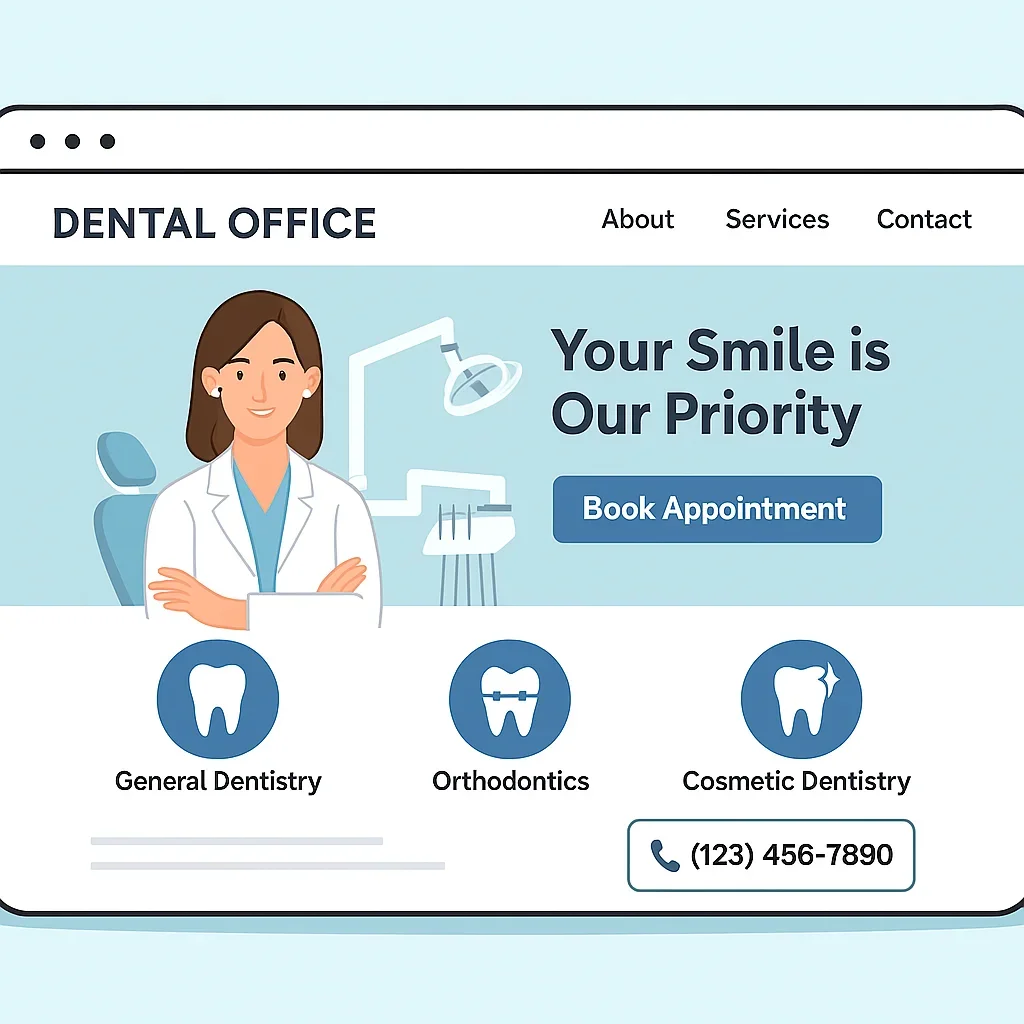
Cost Breakdown: Building and Maintaining a Dental Office Website
Creating a dental office website is an essential investment for any modern clinic, but many practices hesitate because they are unsure of the costs involved. The truth is that expenses can vary significantly depending on design complexity, features, and ongoing maintenance. Understanding the financial breakdown helps dental professionals allocate budgets wisely and avoid unnecessary overspending. In this section, we’ll explore the costs of building, hosting, optimizing, and maintaining a website that truly serves both patients and the dental practice.
Initial Development Costs
The first stage of a dental office website involves design and development. Clinics can choose between pre-made templates, custom-built designs, or hybrid approaches. The costs will depend on the desired features and level of customization.
Typical Website Development Options
- DIY Builders: Using platforms like Wix or Squarespace may cost $20–$50/month but limits advanced customization.
- Template-Based WordPress: Professional themes range from $50–$150, with additional setup costs of $500–$1,500 from freelancers.
- Custom Design: A tailor-made dental office website built by a specialized agency can range between $3,000 and $10,000+.
While custom solutions are more expensive upfront, they allow for branding flexibility and integration with features like patient portals or booking systems.
Domain and Hosting Fees
Every dental office website requires a domain name and hosting service. These are recurring annual or monthly costs but essential for keeping the site accessible to patients.
Common Domain and Hosting Costs
- Domain Name: Usually $10–$20/year
- Shared Hosting: Around $5–$15/month
- Managed WordPress Hosting: $25–$50/month
- Dedicated Hosting: $100+/month for high-traffic clinics
Choosing a reliable hosting provider ensures fast loading speeds and minimal downtime, which directly impact user experience and SEO performance.
Design and Branding Investments
A dental office website should reflect professionalism, trust, and patient comfort. Investing in high-quality visuals, graphics, and branding elements strengthens credibility.
Typical Branding Costs
- Custom logo design: $200–$1,000
- Professional photography: $300–$1,500 per session
- Stock imagery licenses: $100–$300 annually
Though optional, these visual investments enhance the overall look and feel, setting your website apart from competitors.
Essential Features and Integrations
The cost of a dental office website also depends on functional features that improve usability and patient engagement. Advanced integrations can significantly raise costs but offer long-term benefits.
Key Feature Cost Estimates
- Online appointment booking: $20–$100/month (depending on the platform)
- Patient portal integration: $1,000–$5,000 (one-time setup)
- Live chat functionality: $15–$50/month
- Secure payment gateways: $100–$500 setup + transaction fees
Each added feature enhances convenience for patients and supports clinic operations, justifying the investment.
SEO and Marketing Expenses
A beautifully designed dental office website is ineffective without proper visibility. SEO and digital marketing are ongoing expenses that ensure consistent traffic and patient inquiries.
Monthly SEO and Marketing Costs
- Basic SEO setup: $500–$1,000 one-time
- Ongoing SEO management: $500–$2,500/month
- Content creation (blogs, guides): $100–$300 per article
- PPC advertising: Flexible budgets, often $500–$2,000/month
Partnering with SEO experts or agencies ensures that your dental office website ranks higher in Google searches, making it easier for patients to find you.
Maintenance and Security Costs
Maintaining a dental office website involves regular updates, backups, and security measures. Neglecting maintenance can lead to downtime, data breaches, and lost patients.
Ongoing Maintenance Costs
- Software/plugin updates: $20–$100/month
- Website backups: $5–$15/month
- SSL certificates: Free to $150/year
- Security monitoring: $100–$500/year
These recurring costs protect sensitive patient data and ensure compliance with regulations like HIPAA, strengthening trust and credibility.
Total Cost Summary
When calculating the cost of a dental office website, it’s important to look at both upfront and ongoing investments. Below is a general breakdown:
Estimated Cost Ranges
- Basic Website: $500–$2,000 initial + $50–$100/month maintenance
- Intermediate Website: $3,000–$7,000 initial + $100–$300/month maintenance
- Advanced Website: $8,000–$15,000+ initial + $300–$600/month maintenance
The exact figure depends on your clinic’s goals, location, and patient volume. For example, a single-practice clinic may only need a $3,000 site, while a multi-location practice could justify a $15,000+ investment.
Maximizing Return on Investment (ROI)
While costs may seem high, a well-optimized dental office website quickly pays for itself. If a website generates just five new patients a month, the revenue from treatments such as cleanings, fillings, or implants can easily outweigh the expenses. Additionally, strong SEO and usability reduce marketing costs over time by generating steady organic traffic.
In conclusion, building and maintaining a dental office website involves a mix of upfront development, branding, features, SEO, and ongoing maintenance costs. While expenses vary, the long-term ROI is undeniable when executed strategically. By budgeting wisely and prioritizing high-impact features, dental practices can ensure their website becomes a valuable asset that consistently drives growth, improves patient engagement, and strengthens the clinic’s reputation. 💰