
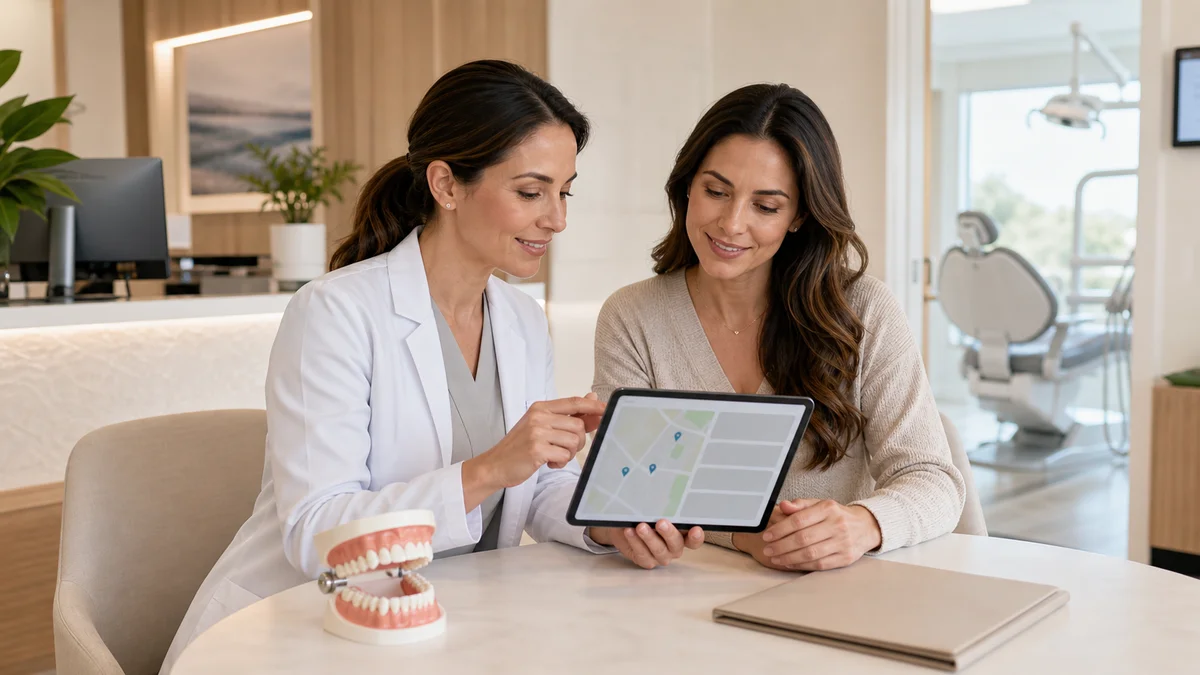
Quick answer: Compare dental offices nearby by more than distance. Verify the dentist’s license, services, emergency process, infection-control standards, accessibility, language support, insurance participation, written estimates, and follow-up arrangements. Confirm that the office can manage your likely needs or coordinate a specialist. Severe swelling, fever, uncontrolled bleeding, major trauma, or breathing or swallowing difficulty may require urgent assessment.
A search for dental offices nearby may return map pins, advertisements, urgent-care listings, corporate locations, specialists, teaching clinics, and offices that are not accepting new patients. The nearest address is not automatically the right dental home. A practical choice should fit the patient’s clinical needs, mobility, schedule, communication preferences, benefit plan, and ability to return for follow-up.
This guide provides a patient-safety framework for evaluating dental offices nearby. It does not diagnose symptoms, rank individual clinicians, guarantee appointment availability, or promise a particular treatment outcome or fee. Office hours, staff, insurer networks, services, and emergency arrangements can change. Confirm current information with the office, licensing authority, and benefit administrator before relying on an online listing.
Do not let comparison shopping delay urgent help. Rapidly increasing facial swelling, fever with dental symptoms, uncontrolled bleeding, serious injury, difficulty breathing or swallowing, or rapidly worsening illness can need prompt professional assessment. Call emergency services when appropriate. An emergency department may stabilize a dangerous condition but may not complete definitive dental treatment, so a dental follow-up plan remains important.
1. Define what you need before comparing dental offices nearby
Start with the purpose of the visit. A routine examination, a child’s preventive appointment, new tooth pain, a broken restoration, a denture problem, orthodontic consultation, implant assessment, or sedation need can lead to different office choices. A general practice may coordinate broad care but refer some procedures. A specialist may require a referral or new diagnostic appointment.
When calling dental offices nearby, describe symptoms rather than announcing a self-diagnosis. Say when the problem started, whether pain is constant or triggered, whether swelling or fever is present, and whether an injury occurred. The team can then explain the appropriate appointment category. A phone conversation cannot confirm the cause, and a promised procedure should not precede an examination.
Ask whether the office sees children, adults, patients with complex medical conditions, or people who require wheelchair access or communication accommodations. If anxiety, a strong gag reflex, sensory needs, or prior difficult experiences affect care, mention them before booking. The office should explain what support it can safely provide and whether another setting would be more appropriate.
- Routine care: examination, prevention, cleaning, risk assessment, and ongoing recalls.
- Urgent problem: pain, swelling, injury, broken tooth, or lost restoration.
- Comprehensive plan: multiple teeth, gum care, bite concerns, replacement of missing teeth, or staged treatment.
- Specialty need: endodontics, periodontics, pediatric dentistry, orthodontics, oral surgery, or prosthodontics.
- Additional support: accessibility, interpreter, sensory adaptation, medical coordination, or anxiety management.
2. Search dental offices nearby through verifiable sources
Search engines are useful for discovery, not final verification. The American Dental Association’s Find-a-Dentist tool allows searches by location and specialty for ADA members. Insurer directories can identify network listings, while community health-center and public-benefit directories can help people seeking particular access routes. A state dental board can confirm current licensure and available public disciplinary information.
For each result under dental offices nearby, open the practice’s own website and compare it with an authoritative directory. Confirm the physical address, phone number, dentist names, specialty claims, and current hours. Search listings can preserve an old location, former provider, or outdated “open now” status. Call before traveling, especially for a same-day need.
Online reviews reflect individual experiences and may help reveal practical themes, but they do not establish diagnosis quality, licensure, infection control, or suitability for your case. A high rating is not an outcome guarantee, and a single negative review may not show the full context. Give more weight to verifiable credentials, clear communication, written policies, and your direct consultation.
3. Verify licenses, roles, and specialty claims
Dentists, hygienists, and other regulated professionals practice under state law. Use the relevant state dental board’s official lookup to verify an active license and review the information the board makes public. Matching the clinician’s full name and location helps avoid confusing people with similar names. If the website uses a specialty title, confirm how that designation is recognized in the jurisdiction.
Results for dental offices nearby may also include dental school clinics or residency programs. Students and residents can provide care within structured supervision, but patients should understand who performs each step, who approves the plan, and who is responsible for follow-up. In any setting, ask for the treating professional’s name and role rather than assuming everyone wearing clinical clothing is a dentist.
Membership in a professional association may signal a voluntary ethical commitment, but it is not a substitute for state licensure. Conversely, an office does not need to buy a particular directory position to be legitimate. Use several indicators: active license, identifiable clinical leadership, transparent services, a real location, appropriate privacy practices, and a willingness to answer safety questions.
4. Match dental offices nearby to the required services
A website may display a long service list while the actual availability depends on the day, clinician, equipment, or case complexity. Ask who performs the procedure, how often it is offered, and when referral is likely. If a plan may require several stages, confirm that the office can provide continuity or coordinate specialists without losing records.
When evaluating dental offices nearby, distinguish general dentistry from specialty care. Root canal treatment may be offered by a general dentist or referred to an endodontist. Surgical extraction may be handled in-office or by an oral and maxillofacial surgeon. Gum disease, child behavior needs, complex prosthetics, or medically complicated care may call for additional expertise.
Technology names alone do not prove better care. Digital imaging, scanners, microscopes, cone-beam computed tomography, lasers, or same-day fabrication can be useful in selected cases, but each should have a clinical purpose. Ask how the information changes the decision, what alternatives exist, and whether the proposed test or device adds separate cost or radiation exposure.
5. Evaluate emergency access and after-hours plans
“Emergency dentist” can mean a reserved daytime slot, an on-call clinician, a call center, or only advice to visit another facility. Ask what symptoms the office evaluates, whether existing and new patients are treated differently, and what happens outside regular hours. Confirm whether the office can provide definitive treatment or only an examination and temporary stabilization.
For urgent searches of dental offices nearby, do not rely on a map label that says open. Call the verified number. Describe swelling, fever, trauma, bleeding, and medical conditions. If the office cannot safely see you, ask where it recommends going. Do not place aspirin or caustic substances on the gum, and do not take another person’s antibiotic or leftover prescription.
After urgent care, obtain a written summary of findings, treatment performed, medicines recommended or prescribed, and the next required step. Temporary fillings, drainage, or symptom relief may not complete treatment. Ask who is responsible for follow-up and what signs should trigger earlier reassessment.
6. Review infection prevention in dental offices nearby
The U.S. Centers for Disease Control and Prevention describes Standard Precautions as the minimum infection-prevention practices for all patient care. In dental settings, these include hand hygiene, appropriate personal protective equipment, respiratory hygiene, sharps safety, safe injection practices, sterile instruments and devices, and cleaning and disinfection of environmental surfaces.
Patients comparing dental offices nearby do not need to conduct a technical inspection, but reasonable questions are appropriate. Ask whether reusable instruments are heat sterilized according to validated processes, single-use devices are discarded after one patient, and treatment-room surfaces are cleaned or barrier-protected between patients. Staff should be able to explain policies without dismissing the question.
A spotless waiting room is not proof of clinical instrument processing, and an older building is not automatically unsafe. Focus on systems: training, dedicated responsibility, proper reprocessing workflow, hand hygiene, personal protective equipment, and written procedures. If you observe reuse of a single-use item, unsafe injection practice, or visibly contaminated equipment, pause and ask before treatment continues.
7. Accessibility, language, and communication
Distance is only one part of access. Confirm step-free entry, elevator availability, transfer support, restroom accessibility, parking, public transportation, and whether a support person can attend when appropriate. If the patient uses a wheelchair, ask whether treatment can occur in the chair or what transfer equipment and staff assistance are available.
For dental offices nearby, language access can be essential to informed consent. Ask whether a qualified interpreter is available, how it is arranged, and whether written instructions can be provided in the patient’s preferred language. A child should not be expected to interpret complex risks for an adult. Hearing, vision, cognitive, and sensory needs should be discussed before the visit.
Good communication includes listening to goals, explaining findings in plain language, presenting reasonable alternatives, and allowing questions. Consent is a process, not a signature obtained after treatment has effectively begun. A patient may request time to consider non-urgent options or seek a second opinion.
8. Insurance and network status at dental offices nearby
“We accept your insurance” can mean the office will submit a claim, not necessarily that the dentist is in-network. Verify network participation with both the office and the benefit administrator, using the exact plan name and dentist location. Networks can differ between plans issued by the same company, and a specialist at the same address may have a different contract.
When checking dental offices nearby, ask about deductible, coinsurance, annual maximum, waiting period, exclusions, frequency limits, missing-tooth rules, and prior authorization when applicable. A pre-treatment estimate is useful but may not guarantee final payment. Coverage decisions can change after the payer reviews eligibility, history, coding, and plan terms.
Medicaid adult dental benefits vary by state, and provider participation can change. Children enrolled in Medicaid and CHIP have specific dental-benefit protections, but families should still confirm the current provider and plan process. Use official state or federal resources rather than an unverified directory. If the listed office is not taking new patients, contact member services for assistance.
9. Written estimates and financial consent
A clinical recommendation and its payment arrangement should be understandable separately. Request an itemized written estimate with the proposed procedures, phases, likely laboratory charges, and which amounts are estimates. Ask what may change after additional findings. No office can guarantee an insurer’s final payment or promise that a complex plan will never need modification.
Price comparisons among dental offices nearby are meaningful only when services are equivalent. One quote may include diagnostics, temporary restoration, laboratory work, or follow-up; another may not. A crown, implant, denture, or aligner described by one marketing label can still differ in indication, material, design, number of visits, and included maintenance.
For membership plans, verify included services, renewal, cancellation, exclusions, and specialist discounts. For financing, review annual percentage rate, total repayment, deferred-interest terms, fees, and what happens if treatment changes or stops. Do not sign under artificial time pressure, while sedated, or before understanding the clinical alternatives.
10. Use a decision table for dental offices nearby
This comparison table turns a list of dental offices nearby into a patient-centered decision. Not every criterion has the same weight. Urgency and clinical capability may matter more than travel time; for long treatment, continuity and repeat travel can become decisive.
| Criterion | What to verify | Why it matters | Useful question |
|---|---|---|---|
| Clinical fit | Age group, general or specialty services, medical complexity | A convenient office may still need to refer the condition | Can you evaluate and complete the likely course of care? |
| Credentials | Active license, roles, specialty status, supervision | Clarifies who is responsible for diagnosis and treatment | Who will treat me and who reviews the plan? |
| Urgent access | Same-day triage, after-hours process, definitive care limits | Temporary relief may require prompt follow-up | What happens if symptoms worsen tonight? |
| Safety systems | Standard Precautions, sterilization, single-use items, surface cleaning | Reduces preventable infection risk | How are instruments processed between patients? |
| Access | Hours, travel, mobility, interpreter, sensory support | A plan is difficult to complete if visits are inaccessible | What accommodations can be arranged in advance? |
| Costs | Network, written estimate, exclusions, financing terms | Prevents comparison of incomplete or unlike quotes | Which charges are included and which may be added? |
| Continuity | Records, referrals, recalls, complications, provider changes | Many dental treatments require staged care and monitoring | Who coordinates follow-up if a specialist is involved? |
11. Prepare for consultations with dental offices nearby
A short preparation call can prevent a wasted trip. Confirm the appointment purpose, expected duration, forms, benefit information, and records to bring. Ask whether old radiographs can be transferred securely and whether the dentist will decide if new images are clinically necessary. More imaging is not automatically better; it should answer a diagnostic question.
When visiting dental offices nearby, bring an accurate medicine list, allergies, relevant diagnoses, prior dental concerns, and contact details for clinicians who manage important health conditions. Do not stop anticoagulants, osteoporosis medicines, diabetes medicines, or any prescription solely because a dental procedure is possible. Medication changes require coordinated professional advice.
During the consultation, ask what the examination found, what remains uncertain, which options are reasonable, and what happens without treatment. Discuss benefits, important risks, alternatives, timing, number of visits, and costs. Be cautious if a large irreversible plan is presented without examination, appropriate diagnostics, or room for questions.
- Who will perform each stage, and are specialists involved?
- What is urgent, what can be monitored, and what is elective?
- What alternatives preserve more natural tooth structure?
- Which outcomes are uncertain, and what are the main risks?
- How many visits are expected, and what can change that schedule?
- What is included in the written estimate and follow-up?
- What should I do if pain, swelling, bleeding, or a restoration problem occurs?
- How can I obtain records or a second opinion?
12. Continuity, records, and referrals
A dental home is valuable because the team can follow changes over time, maintain records, coordinate prevention, and respond when an urgent issue occurs. Still, patients may need specialists or move to a new office. Ask how referrals are made, whether the office communicates with the specialist, and who combines separate recommendations into one plan.
Continuity among dental offices nearby matters for multi-visit treatment. If a temporary crown, root canal, extraction site, implant, denture, or orthodontic appliance needs review, know which clinician is responsible. A referral should not create an unexplained gap. Request written instructions, relevant images, procedure notes, and medicine information.
Patients generally may request access to their records under applicable law and office policy, though copying or transfer processes can vary. Use secure methods for health information. A new dentist may still need an independent examination and may recommend different images or options based on current findings.
13. Red flags when screening dental offices nearby
No single marketing style proves poor care, but several warning signs deserve caution. These include inability to identify the treating dentist, unverifiable credentials, pressure to pay immediately, guaranteed outcomes, a universal plan offered without examination, refusal to provide written costs, or dismissal of questions about sterilization and follow-up.
For dental offices nearby, also be cautious about copied reviews, before-and-after images presented as typical guarantees, claims that one device makes diagnosis unnecessary, or financing offered before clinical alternatives are explained. A recommendation should be personalized, and cosmetic goals should not override disease control or patient consent.
If something feels unsafe, pause before irreversible treatment. Ask for clarification, request records, contact the appropriate licensing or consumer authority if necessary, and seek another qualified opinion. For an urgent condition, do not simply abandon care; arrange a safe handoff or immediate assessment elsewhere.
14. Local dental care and treatment abroad
Some patients compare dental offices nearby with planned care in another country. The comparison should include diagnosis, clinician qualifications, material and laboratory details, number of visits, travel, lodging, time away, records, complication management, and care after returning. A remote quote cannot replace a physical examination or guarantee that the provisional plan will remain unchanged.
The Redent Klinik English website explains available services and the international patient pathway. Initial records may help organize a consultation, but final decisions require an in-person clinical assessment and appropriate diagnostics. Patients should receive individualized alternatives, risks, stages, and written costs rather than a universal package promise.
Use the Redent Klinik English contact page to ask what records are useful, how many visits may be needed, and how follow-up is organized after travel. Send health information only through a verified channel. Keep a relationship with a local dentist because urgent hands-on care cannot be delivered across borders.
Frequently asked questions about dental offices nearby
How do I verify dental offices nearby are legitimate?
Confirm the office address and dentist’s full name, then use the official state dental board license lookup. Compare the practice website with authoritative directories and call the published number. Verify who will provide care, whether specialty claims are recognized, and how students or residents are supervised. Reviews alone do not verify licensure.
Which dental offices nearby accept my insurance?
Check both the insurer’s current directory and the office, using the exact plan name, dentist, and location. “Accepts insurance” may only mean the office submits claims; it may not be in-network. Ask about deductible, coinsurance, limits, authorization, and written estimates. A pre-treatment estimate is not a final payment guarantee.
Can dental offices nearby see me today?
Same-day capacity varies. Call and describe symptoms, swelling, fever, injury, bleeding, and relevant medical conditions. Ask whether the office offers definitive treatment or only triage. Severe swelling, uncontrolled bleeding, major trauma, or breathing or swallowing difficulty may require urgent medical assessment rather than waiting for a routine slot.
How can I compare prices at dental offices nearby?
Compare itemized plans after examination, not isolated marketing prices. Confirm diagnostics, procedure stages, material, laboratory work, temporary care, follow-up, and possible additions. Ask what insurance is expected to pay but understand that final coverage is determined by the benefit plan. Avoid fixed-price assumptions before diagnosis.
What infection-control questions can I ask dental offices nearby?
Ask how reusable instruments are sterilized, how single-use devices are handled, and how treatment areas are cleaned between patients. CDC Standard Precautions include hand hygiene, personal protective equipment, respiratory hygiene, sharps and injection safety, sterile instruments, and environmental cleaning. Staff should be able to explain their process clearly.
Do dental offices nearby have to provide accessibility support?
Requirements and reasonable arrangements depend on the setting and applicable law. Ask in advance about step-free entry, wheelchair transfer, restroom access, interpreter arrangements, hearing or vision communication, and sensory accommodations. The office should honestly explain what it can provide and coordinate another appropriate setting when needed.
Should I choose the closest of the dental offices nearby?
Proximity matters, especially for urgent and multi-visit care, but it is only one factor. Clinical capability, credentials, communication, accessibility, network status, safety systems, and continuity may outweigh a few minutes of travel. Choose the nearest office that can safely meet the need, not simply the nearest map pin.
Can dental offices nearby treat children and adults?
Some general offices see all ages, while others set age limits or refer children with specific behavior, medical, or treatment needs to pediatric dentists. Ask before booking. For a child, confirm caregiver policies, preventive approach, emergency process, benefit participation, and how the team supports age-appropriate communication.
Can I get a second opinion from dental offices nearby?
Yes, a second qualified opinion can be useful for non-urgent, complex, expensive, or irreversible care. Request relevant records and images, but expect the second dentist to perform an independent assessment. Different recommendations do not automatically mean misconduct; ask each clinician to explain diagnosis, uncertainty, alternatives, and consequences of delay.
What if dental offices nearby refer me to a specialist?
Ask why referral is recommended, how urgent it is, who sends records, and who remains responsible for other care. Verify the specialist’s license, network status, and written estimate separately. After treatment, ensure procedure notes and follow-up instructions return to the general dentist so care remains coordinated.
Conclusion: choose dental offices nearby for the whole care pathway
A good answer to dental offices nearby combines convenience with clinical fit, verifiable credentials, communication, infection prevention, transparent costs, and continuity. Begin with the type of care needed, use authoritative directories, confirm current details by phone, and obtain an examination before accepting a definitive treatment plan.
Distance matters, but the safest office is one that can explain findings, offer reasonable alternatives, coordinate specialists, provide written financial information, and respond when a plan changes. Evaluated this way, dental offices nearby becomes a search for a dependable dental home rather than a decision based only on a map ranking.
Official sources and further reading
- American Dental Association
- ADA MouthHealthy: How to choose a dentist
- U.S. Centers for Disease Control and Prevention: Standard Precautions in dental settings
- CDC: Sterilization and disinfection in dental settings
- U.S. Health Resources and Services Administration: Find a Health Center
- Centers for Medicare & Medicaid Services: Dental care benefits
- World Health Organization: Oral health fact sheet
Sources reviewed August 5, 2026. Licensure records, office staff, services, hours, networks, fees, and appointment availability can change. Confirm current details directly with the relevant office, licensing board, and benefit plan.