
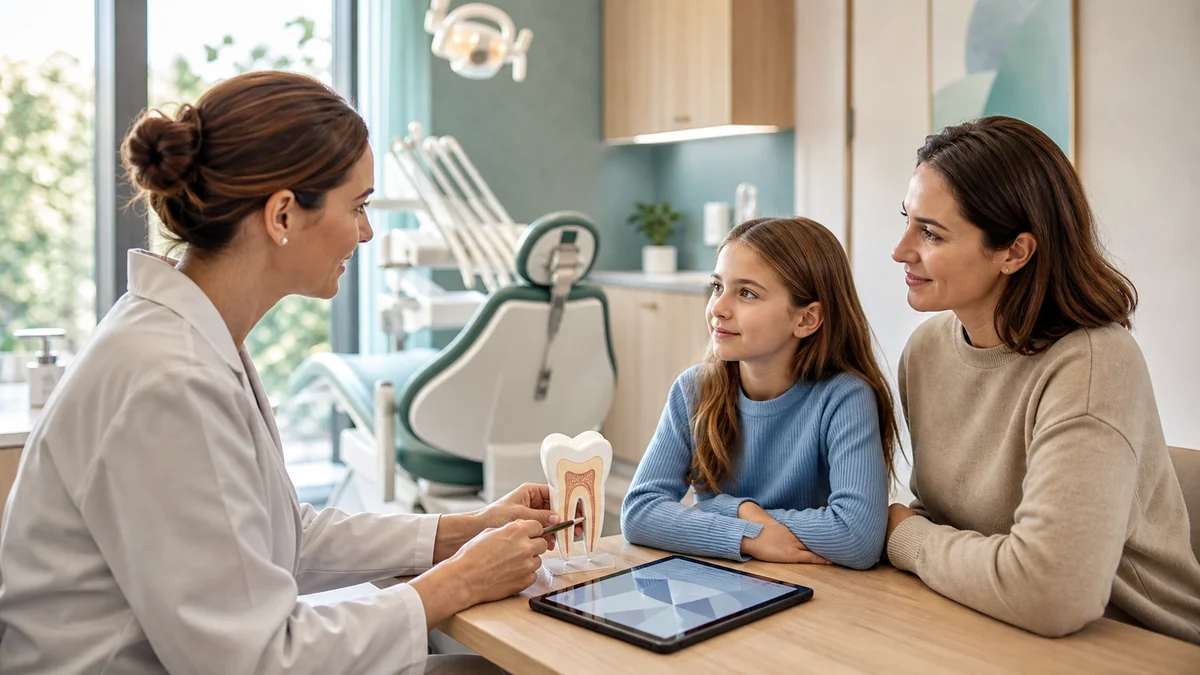
A useful search for a dentist for family near me goes beyond distance. Look for a practice that can care for the ages and needs in your household, explains prevention clearly, coordinates referrals, welcomes questions, publishes its emergency process, and gives written cost information. Confirm the fit in a first visit before making a long-term decision.
Typing dentist for family near me into a search bar is easy; deciding which result deserves your family’s trust takes more care. A nearby address can make regular visits realistic, but proximity cannot tell you whether a practice is comfortable with young children, an anxious adult, an older relative, or a person who needs accessibility adjustments. It also cannot show how the team handles urgent problems, infection prevention, referrals, records, or financial consent.
The most useful goal is not to find a supposedly perfect clinic. It is to identify a dependable dental home: an ongoing relationship in which care is accessible, coordinated, comprehensive within the team’s scope, and centered on the patient and family. That concept is especially well established in pediatric dentistry, but continuity can benefit people at every life stage. This guide turns a broad local search into a structured, safety-first decision.
Online information is only a starting point. It cannot diagnose anyone in your household or establish an individual treatment plan. Symptoms, medical history, dental development, medications, pregnancy, disability, anxiety, and previous treatment can all change what is appropriate. If someone has facial swelling that affects breathing or swallowing, uncontrolled bleeding, major facial trauma, or another potentially life-threatening problem, seek emergency medical help rather than waiting for a routine appointment.
What a family dental home should mean
A family-focused practice usually cares for more than one age group and emphasizes continuity. The exact scope varies. Some general dentists see children from an early age; others begin at a particular developmental stage or refer infants and complex pediatric cases to a pediatric dentist. Some provide many procedures in-house, while others coordinate with orthodontists, oral surgeons, endodontists, periodontists, prosthodontists, or hospital teams. A clear referral network is not a weakness. It is often a sign that the dentist recognizes the limits of the practice.
When evaluating a dentist for family near me, ask which ages are routinely treated and which services are available. More importantly, ask how the team decides when specialist input is appropriate. A trustworthy answer should be specific without promising that every need can be handled under one roof. The aim is coordinated care, not maximum procedure volume.
A strong dentist for family near me candidate generally offers:
- a prevention plan adapted to each person’s disease risk, age, ability, and home-care needs;
- a documented method for urgent advice and after-hours direction;
- respectful communication and consent before examination, imaging, or treatment;
- coordination with specialists and relevant medical professionals when necessary;
- accessible records and a practical process for transferring them;
- transparent information about likely fees, payment arrangements, and insurance administration; and
- reasonable adjustments for disability, sensory needs, language, or dental anxiety where possible.
No practice will match every family’s preferences. The useful question is whether its clinical scope, communication style, access arrangements, and safety systems fit the people who will actually receive care there.
Start the dentist for family near me search with household needs
Before comparing ratings, write a one-page household needs list. This prevents a polished website from distracting you from practical requirements. Include the ages of family members, preferred appointment windows, mobility or sensory needs, languages used for healthcare, insurance or payment constraints, and any known need for specialist coordination. Do not email detailed medical information through an unsecured contact form; ask the practice how it collects sensitive history.
For each person, think about the next twelve months rather than only today’s concern. An infant may need early prevention guidance and developmental monitoring. A school-age child may benefit from age-appropriate communication and assessment of eruption, bite, and caries risk. A teenager may need support with orthodontic hygiene, sports protection, or wisdom-tooth monitoring. Adults may need periodontal assessment, restorative review, pregnancy-informed care, or help with dry mouth. Older adults may have complex medication lists, dexterity limitations, exposed root surfaces, dentures, implants, or caregiver involvement.
Your dentist for family near me shortlist should reflect those different needs. One convenient clinic may be appropriate for most routine care while a child, medically complex adult, or person requiring sedation sees a specialist. Family care does not require every relative to follow an identical pathway.
Make access requirements concrete
“Accessible” can mean very different things. Ask about step-free entry, lift dimensions, parking, accessible toilets, transfer support, treatment-room space for a mobility device, quieter appointment times, visual or written communication, and whether a support person can attend. If a family member needs an interpreter, ask whether a professional language service is available and how it is arranged. A relative should not automatically be expected to interpret complex consent discussions.
Separate preferences from essentials
Place requirements in two columns. Essentials might include wheelchair access, experience with a specific age group, after-school appointments, or coordination with a medical team. Preferences might include décor, online booking, or having all appointments on one day. This distinction makes the dentist for family near me decision more consistent when no candidate checks every box.
Use location as a practical filter, not the final answer
Distance matters because preventive care is easier to maintain when travel is manageable. Yet the first map result is not necessarily the best fit. Compare real journey time at the hours you would attend, public transport reliability, parking, school or work routes, and the ability to reach the clinic when someone is in pain. A clinic slightly farther away may be more usable if it offers suitable hours and accessible entry.
When a search for dentist for family near me returns several branches or similarly named practices, verify the exact address and clinician location. Confirm whether the dentist you are considering routinely works at that branch. Ask whether appointments may be moved between sites and where urgent care is provided. Consistency is harder if every visit occurs with a different team, although a group practice can still provide continuity when records and handovers are well managed.
Check opening times by phone because directory listings can be outdated. Ask about early, late, or weekend availability only if those times are genuinely important. Also ask how far ahead routine visits are usually booked. No receptionist can guarantee future availability, but a transparent description of normal scheduling and cancellation procedures is useful.
Confirm age range, clinical scope, and referral pathways
The words “family dentist” are not a universal credential or a promise that every procedure is offered. Verify the dentist’s registration through the relevant professional regulator in the country where treatment will take place. Ask about the team’s experience with the ages and needs in your household, but avoid treating marketing labels as proof of competence.
A careful call to a dentist for family near me should clarify:
- the youngest age routinely seen and how early-childhood visits are approached;
- whether new patients can book preventive and problem-focused appointments;
- which imaging, hygiene, restorative, periodontal, endodontic, prosthetic, or orthodontic services are available;
- how suspected oral disease, unusual lesions, complex medical histories, or treatment complications are referred;
- whether the practice coordinates with pediatric dentists, oral surgeons, orthodontists, hospitals, and physicians;
- what forms of pain and anxiety support are available and when sedation referral is considered; and
- how reports, images, and follow-up responsibilities move between teams.
Be cautious if a dentist for family near me discourages reasonable second opinions, claims that specialist referrals are never needed, or guarantees a clinical result before an examination. Dentistry involves biological uncertainty. A responsible clinician explains likely benefits, material risks, alternatives, limitations, and what could change the plan.
A first-call checklist for a dentist for family near me
The first telephone or secure-message exchange with a dentist for family near me reveals how the practice handles ordinary questions. Staff do not need to diagnose symptoms remotely, and they should not. They should, however, explain registration, triage, scheduling, accessibility, records, fees, and urgent-care routes clearly.
Use a short script: “We are looking for ongoing care for a household with these age groups. Which ages do you routinely see? How do new-patient assessments work? What adjustments can you offer? How do patients get urgent advice? Can we receive a written estimate before treatment?” Make notes immediately. Asking the same core questions of each dentist for family near me candidate makes comparisons fairer.
Notice whether staff protect privacy. They may need basic information to triage safely, but they should offer an appropriate channel for medical and dental history. Also notice whether the answer distinguishes an initial assessment from guaranteed treatment. An ethical team cannot promise a particular procedure or final cost before adequate evaluation.
Decision table: compare practices on evidence, not stars alone
Reviews can describe communication and logistics, but they cannot verify clinical quality for your case. Extreme ratings may reflect expectations, billing disputes, or experiences that do not match your household. Use reviews to generate questions, then compare verifiable information. The table below can be copied into your notes for every dentist for family near me option.
| Decision factor | What to verify | Reassuring sign | Reason to ask more |
|---|---|---|---|
| Family fit | Ages, disability needs, anxiety support, language access | Specific explanation of scope and adjustments | “We treat everyone” without detail |
| Continuity | Usual clinician, handovers, record access | A named care team with documented handover | No clear ownership of follow-up |
| Prevention | Risk assessment, home-care coaching, recall rationale | Plans vary according to individual risk | One package or schedule for every patient |
| Urgent care | Same-day triage, after-hours instructions, escalation | Written route for urgent and emergency situations | Vague promise of permanent availability |
| Safety | Infection-prevention process and medical history review | Clear, calm answers consistent with standard precautions | Dismissive response to reasonable safety questions |
| Financial consent | Examination fee, estimate, alternatives, insurer process | Written, itemized information before non-urgent treatment | Pressure to pay immediately for an unclear plan |
| Referral network | When and where specialist care is arranged | Defined referral and follow-up responsibilities | Claims that referrals are never necessary |
You may score each factor from zero to two, but do not let arithmetic override a safety-critical need. A clinic that is convenient but inaccessible to one family member is not a workable shared dental home. Likewise, a low advertised fee does not compensate for unclear consent or absent urgent-care information.
A practical shortlist worksheet
Use this worksheet after the broad search but before booking. Write one factual answer beside each prompt for every dentist for family near me on your shortlist. “Unknown” is a useful answer because it tells you exactly what to verify.
- Record the exact address and realistic travel time for each dentist for family near me, including the journey at school or work rush hour.
- Confirm the age range routinely accepted by each dentist for family near me, rather than relying on the word “family” in a directory listing.
- Ask each dentist for family near me which household needs can be managed in the practice and which normally require referral.
- Verify the professional registration of the clinicians at each dentist for family near me through the regulator for the treatment country.
- Note whether each dentist for family near me can offer the physical, sensory, language, or communication adjustments your family actually requires.
- Write down the new-patient assessment process for each dentist for family near me, including what documents and history to bring.
- Compare how each dentist for family near me explains prevention, individual risk, recall planning, and imaging decisions.
- Save the opening-hours and after-hours instructions supplied by each dentist for family near me, then check whether the urgent pathway is understandable.
- Ask each dentist for family near me how written treatment options, consent information, and itemized estimates are provided.
- Check whether each dentist for family near me distinguishes its insurer administration from the insurer’s final coverage decision.
- Find out how each dentist for family near me transfers records, coordinates specialists, and assigns responsibility for follow-up.
- After an initial visit, note whether the dentist for family near me listened, explained uncertainty, welcomed questions, and avoided pressure.
The worksheet does not manufacture certainty. It makes the decision traceable and reduces the chance that one attractive feature will overshadow a safety or access problem. The strongest dentist for family near me choice is the one whose verified systems fit your household, not the one with the most ambitious slogan.
Expect prevention to be individual, not a family bundle
A good dentist for family near me makes prevention visible. The team should ask about brushing, fluoride exposure, diet frequency, tobacco or nicotine, alcohol, dry mouth, medications, previous disease, orthodontic appliances, sports, pregnancy, and barriers to home care. Recommendations should match clinical findings and risk rather than relying on a generic package.
If a dentist for family near me advertises one recall interval for everyone, ask how that schedule is individualized. The appropriate interval for examinations, professional cleaning, radiographs, fluoride measures, or periodontal maintenance can differ between relatives and can change over time. More frequent care is not automatically better, and a longer interval is not automatically neglectful. The rationale should be documented and explained.
Radiographs deserve the same individualized approach. Imaging can be valuable when it answers a clinical question, but it should not be treated as an automatic ritual. Ask why an image is recommended, what information it may add, and whether previous usable images can be obtained. The clinician should balance diagnostic benefit with radiation protection and the person’s age, development, symptoms, disease history, and examination findings.
Children need an age-appropriate dental home
The American Academy of Pediatric Dentistry describes a dental home as an ongoing relationship that is comprehensive, continuously accessible, coordinated, and family centered. Early contact supports prevention, development guidance, anticipatory advice, and a familiar place to seek help. It does not mean every child will cooperate immediately or that treatment will always be possible in a general practice.
When asking a dentist for family near me about children, listen for a developmentally appropriate approach. A calm team may use simple explanations, show safe instruments before use, allow pauses, involve the caregiver constructively, and build familiarity over time. The exact technique depends on age, development, anxiety, communication, and urgency. Restraint, sedation, and general anesthesia are distinct clinical matters that require careful indications, consent, trained teams, monitoring, and sometimes specialist or hospital care.
Ask what happens if a child cannot tolerate an examination or treatment. A trustworthy practice should describe options without blame: a shorter acclimatization visit, modified communication, another clinician, specialist referral, or a different setting. Avoid any promise that fear can be “fixed” in one appointment.
Questions for a baby’s or toddler’s first visit
Ask when the practice recommends establishing care, what parents should bring, how feeding and fluoride questions are discussed, and how the team assesses development and injury risk. If the practice does not see very young children, request the details of a pediatric referral pathway rather than postponing guidance indefinitely.
Questions for school-age children and teenagers
Ask about caries-risk assessment, sealant decision-making, sports mouthguards, orthodontic coordination, privacy for an adolescent where appropriate, and how consent evolves with maturity and local law. A dentist for family near me should speak to the young person respectfully rather than only about them.
Plan for anxiety, sensory needs, disability, and communication
Dental anxiety can affect children and adults, including people with previous trauma or a strong gag reflex. Before booking, describe only the information needed to arrange care and ask what support is available. Helpful adjustments may include a quieter time, extra explanation, a stop signal, shorter visits, gradual familiarization, a support person, reduced sensory stimulation, or referral for advanced anxiety management.
A capable dentist for family near me will not guarantee a pain-free or fear-free experience. The team should explain available comfort measures, their limits, and alternatives. Local anesthesia, behavioral support, conscious sedation, and general anesthesia are not interchangeable. Their suitability depends on the procedure, health history, anxiety level, age, cooperation, training, facilities, and applicable regulations.
For a person with a disability or neurodivergence, share communication preferences and known triggers in advance. Ask whether a pre-visit orientation, visual schedule, first appointment of the day, wheelchair-accessible treatment space, or caregiver participation is possible. If the practice cannot safely provide a needed adjustment, it should help identify an appropriate service and transfer relevant information with consent.
Look for visible infection-prevention habits
Dental settings should apply standard precautions to every patient. CDC guidance for dental settings includes hand hygiene, appropriate personal protective equipment, respiratory hygiene, sharps safety, safe injection practices, sterile instruments and devices, and cleaned and disinfected environmental surfaces. Patients are not expected to audit a sterilization system, but reasonable questions should receive clear answers.
At a first visit to a dentist for family near me, notice whether the clinical area appears orderly, hand hygiene occurs at appropriate times, single-use items are discarded, and reusable instruments arrive in a way consistent with sterilized storage. Protective barriers and room cleaning may occur between patients, so a snapshot is not a complete assessment. Ask the practice to explain its process if something concerns you rather than drawing a conclusion from décor alone.
Also expect the team to review medical history, allergies, medicines, previous reactions, and relevant changes. Infection prevention is only one part of safety; patient identification, medication checks, imaging justification, consent, record keeping, emergency preparedness, and follow-up all matter.
Know the urgent-care and after-hours pathway
“Emergency dentist” can mean telephone advice, an urgent clinic slot, referral to another service, or medical emergency escalation. Ask the practice to distinguish these routes before anyone needs them. Find out how registered patients make contact during opening hours, what message is available after hours, whether another provider covers the practice, and what information to have ready.
A reliable dentist for family near me should not promise that every urgent problem will be definitively treated immediately. Triage determines timing and setting. Severe facial swelling with breathing or swallowing difficulty, major trauma, uncontrolled bleeding, collapse, or signs of a serious systemic reaction may require emergency medical services. A knocked-out permanent tooth and significant dental trauma are time-sensitive; contact an emergency dental service promptly and follow professional instructions. Do not place an avulsed baby tooth back into the socket.
Keep the practice number, after-hours instructions, medication list, allergy information, and insurer contact details in one secure place. For children, know which adult can give consent if a parent or guardian is unavailable. Preparedness reduces confusion but does not replace clinical triage.
Compare costs without expecting a fixed universal price
Dental fees depend on the examination, diagnosis, procedure complexity, materials, laboratory work, imaging, clinician, location, and whether specialist care is required. An online number may be an example, a starting fee, or an incomplete package. Ask what is included and what could change. A treatment decision should not be made from price alone.
When speaking with a dentist for family near me, request the new-patient examination fee, the policy for radiographs, cancellation terms, payment timing, and how written estimates are provided. If you use insurance, ask whether the clinic submits claims, accepts assignment of benefits, or expects payment first. Verify coverage, waiting periods, annual limits, exclusions, and preauthorization directly with the insurer; a clinic estimate is not a guarantee of reimbursement.
Before non-urgent treatment, the clinician should explain the problem, reasonable options including no immediate treatment where clinically appropriate, material risks, likely benefits, limitations, expected maintenance, and costs. Ask for an itemized written plan and time to consider significant decisions. Treatment may need to change if new findings emerge, but the reason and financial implications should be discussed.
Use the first visit as a two-way assessment
The first appointment with a dentist for family near me should establish history, priorities, and baseline findings rather than function as a sales event. Bring medication and allergy details, relevant diagnoses, previous dental information, insurance documentation if used, and questions. Tell the team about pregnancy, implanted devices, bleeding disorders, immune conditions, previous complications, and anxiety. Do not stop prescribed medicines unless the prescribing clinician advises it.
During the appointment with a dentist for family near me, assess whether the dentist listens before proposing care, explains findings in understandable language, distinguishes urgent from elective needs, and invites questions. You should be able to ask why an examination, image, preventive measure, or procedure is recommended. Consent is a process, not a signature collected after the decision has effectively been made.
It is reasonable to begin with one family member or one assessment before transferring the whole household. After the visit, consider whether instructions were clear, privacy was respected, the environment met access needs, records were accurate, and follow-up responsibilities were defined. A respectful “not the right fit” is better than ignoring concerns for the sake of convenience.
Warning signs that deserve a pause
No single awkward interaction proves unsafe care, and misunderstandings can be clarified. However, repeated patterns matter. Pause and ask questions if a dentist for family near me candidate uses pressure, certainty, or secrecy in place of explanation.
- Guaranteed clinical outcomes or claims that a procedure is risk-free.
- A definitive diagnosis or treatment promise made only from a message or marketing photograph.
- Pressure to pay for extensive non-urgent treatment before options and findings are explained.
- Refusal to provide a written treatment plan or itemized estimate.
- Dismissal of allergies, medicines, pregnancy, disability needs, or previous adverse reactions.
- Discouragement of reasonable questions, records access, specialist referral, or a second opinion.
- No understandable route for urgent problems or post-treatment concerns.
- Privacy practices that expose another patient’s information.
If you have a concern about treatment already received, request the clinical explanation and records, seek an independent assessment when appropriate, and use the relevant clinic complaint process or professional regulator. A new dentist cannot reliably judge a past decision without records, context, and examination.
How to switch and preserve continuity
Families move, schedules change, clinicians leave, and needs become more complex. Changing to another dentist for family near me is not a failure. Ask the new clinic what records are useful, then authorize the previous practice to transfer them through a secure process. Materials may include clinical notes, radiographs, referral letters, laboratory information, medication history, periodontal records, and details of ongoing treatment.
When moving to a new dentist for family near me, do not assume an old plan will automatically continue. The new dentist for family near me remains responsible for an independent assessment and may interpret risks or options differently. Ask both practices who is responsible for urgent care and unfinished treatment during the transition. Retainers, temporary restorations, implants, dentures, active orthodontics, and recent surgery may need particularly clear handover.
For a child or dependent adult, explain the change in an age-appropriate and reassuring way. Bring communication tools or comfort items that have helped before. Continuity is supported by good records, but trust may still take time to rebuild.
A 21-point final checklist
Before registering the whole household, use these checks for each dentist for family near me candidate:
- Professional registration can be verified.
- The practice clearly states which ages it routinely treats.
- Its scope matches most foreseeable household needs.
- Specialist referral pathways are defined.
- Travel time is realistic at appointment hours.
- Opening times work often enough for your household.
- Physical access and reasonable adjustments are confirmed.
- Language and communication support are available where needed.
- New-patient assessment steps are clear.
- Prevention is tailored to individual risk.
- Imaging is based on clinical need.
- Children are approached in a developmentally appropriate way.
- Anxiety support and its limitations are explained.
- Standard infection-prevention processes are described confidently.
- Urgent and after-hours routes are written down.
- Medical history and medicines are reviewed.
- Consent includes benefits, risks, alternatives, and questions.
- Written estimates are available before non-urgent treatment.
- Insurance administration is distinguished from coverage guarantees.
- Records and privacy processes are understandable.
- The first visit feels respectful, unhurried enough, and free of pressure.
Mark any unanswered essential item and contact the practice once more. A dentist for family near me does not need to be flawless, but safety-critical uncertainty should be resolved before complex or irreversible care.
Frequently asked questions about choosing family dental care
How close should a dentist for family near me be?
There is no ideal distance. Choose a journey your household can manage for planned visits and urgent assessment, considering traffic, transport, parking, mobility, work, and school. A slightly longer trip may be worthwhile for needed accessibility or age-specific expertise. Confirm where urgent and specialist care would occur because it may be at another site.
Can one dentist safely treat every age in my family?
Sometimes one dentist for family near me can provide much of a household’s routine care, but scope varies. Infants, complex pediatric cases, advanced periodontal disease, difficult endodontics, surgery, orthodontics, significant medical complexity, or advanced anxiety support may require another clinician or setting. Good family care includes timely referral and clear coordination.
Should online ratings decide which dentist for family near me I choose?
No. Reviews may reveal patterns in access or communication, but they cannot establish clinical quality or suitability for your household. Verify registration, scope, accessibility, urgent-care arrangements, written cost information, and referral pathways. Use both positive and negative reviews as prompts for questions, not as diagnoses of the practice.
How often should everyone in the family have a checkup?
There is no single interval for every person. The dentist should recommend timing based on age, development, current findings, previous disease, periodontal status, home care, diet, medicines, dry mouth, and other risk factors. Ask what supports the interval and when it will be reviewed. Different relatives may appropriately have different schedules.
What should I ask about children’s appointments?
Ask which ages the practice sees, how first visits are structured, how caregivers participate, what happens if a child is distressed, and when pediatric referral is recommended. Also ask about prevention, dental development, trauma instructions, sports mouthguards, and orthodontic coordination when relevant. Avoid clinics that guarantee cooperation or a specific result.
How do I compare estimates from different practices?
Make sure each estimate is based on an adequate assessment and describes the same diagnosis, procedure scope, materials, laboratory work, imaging, provisional care, reviews, and maintenance. Ask what could change the plan. The lowest figure is not necessarily the lowest total cost, and insurer reimbursement remains subject to the policy.
Can I book the whole family together?
Many practices try to coordinate appointments, but availability, visit length, age, anxiety, and clinical need may make separate times safer or more comfortable. Ask whether a dentist for family near me offers linked bookings and how cancellations affect the group. For a new practice, starting with individual assessments can allow each person’s needs to be understood properly.
What if a family member needs a specialist?
Ask who selects the specialist, how records and images are transferred, whether the family can choose among qualified options, and who handles follow-up. Confirm which team provides urgent advice during the referral period. A dental home should coordinate care even when it does not deliver every procedure itself.
What if the first dentist for family near me does not feel right?
You can ask for clarification, seek a second opinion, or choose another practice. Request copies or secure transfer of records and clarify responsibility for temporary work, recent procedures, active treatment, and urgent needs. Do not interrupt time-sensitive care without discussing a safe transition with an appropriate clinician.
Where can I arrange an initial conversation?
You can learn about the clinic’s approach through the Redent Klinik English home page and use the Redent Klinik contact page to ask about age range, accessibility, appointment availability, records, and the current consultation process. A contact exchange can explain logistics, but an individual plan still requires appropriate clinical assessment.
Choose continuity with evidence and consent
The best result from a dentist for family near me search is not simply the shortest drive or the most polished profile. It is a practice that knows whom it can care for, recognizes when to refer, adapts prevention to individual risk, communicates urgent pathways, respects consent, and makes financial information understandable. Those features support a relationship that can remain useful as children grow and adult needs change.
Build a shortlist, make the same first-call checks, and treat the first visit as a two-way assessment. Keep safety and accessibility requirements non-negotiable while allowing preferences to remain flexible. If the chosen dentist for family near me provides clear explanations, coordinated follow-up, and respectful care, convenience becomes part of a stronger foundation: a reliable dental home.
Sources and further reading
- American Dental Association, MouthHealthy: How to Choose a Dentist
- American Academy of Pediatric Dentistry: Policy on the Dental Home
- US Centers for Disease Control and Prevention: Summary of Infection Prevention Practices in Dental Settings
- US Centers for Disease Control and Prevention: Standard Precautions
- World Health Organization: Oral health fact sheet
- American Dental Association