
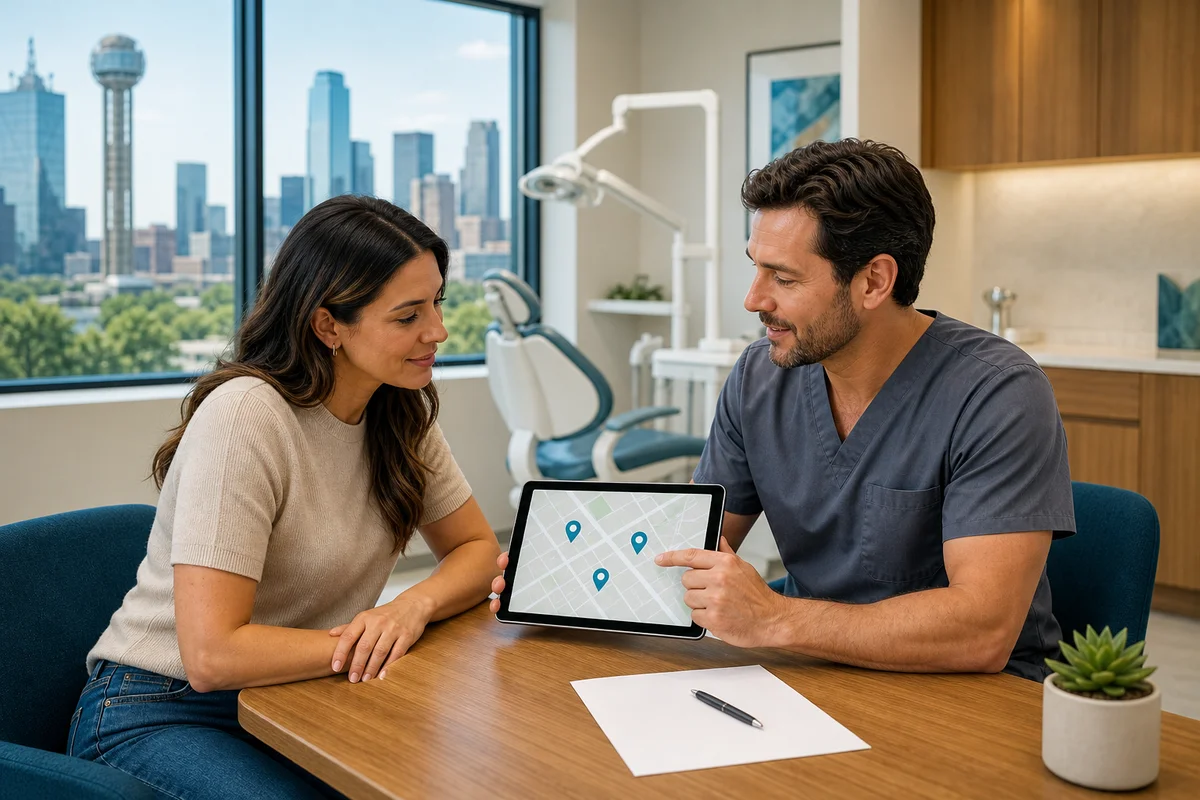
Quick answer: To choose a dentist in dallas tx, verify the individual clinician’s current Texas license, then compare clinical fit, location, hours, emergency access, communication, accessibility, insurance participation and written estimates. Use Texas and ADA directories as starting points, but confirm details directly with the practice. Online ratings cannot diagnose your condition or prove treatment quality.
Searching for a dentist in dallas tx can produce hundreds of map listings, advertisements and review profiles within seconds. That abundance does not make the decision simple. Dallas covers distinct neighborhoods and travel patterns, while the wider Dallas–Fort Worth area crosses city and county boundaries. A clinic that looks close by mileage may be difficult to reach at your appointment time, and a prominent listing does not itself verify a dentist’s license or suitability.
This guide provides a repeatable way to compare a dentist in dallas tx without ranking individual practices or promising a clinical result. It uses current information from the Texas State Board of Dental Examiners (TSBDE), Texas Department of State Health Services (DSHS), American Dental Association (ADA), federal sources and the World Health Organization. It is educational, not a diagnosis, referral or substitute for an examination.
1. Define why you need a dentist in dallas tx
Begin with the problem you need the practice to solve. Routine prevention, a child’s first visit, gum symptoms, a second opinion, a broken restoration and severe pain require different timing and expertise. Write down your main concern, duration, medical conditions, medicines, accessibility needs and preferred appointment times. If you do not know the specialty, a general dentist can often examine you and coordinate referral.
Your dentist in dallas tx search should distinguish urgent access from long-term fit. The practice able to assess pain today may not be the dental home you choose for years. Conversely, an excellent preventive-care match may lack same-day capacity. Ask what the office can evaluate now, which procedures it routinely provides and how it handles referrals. Do not assume that every service shown on a group website is available at every location.
2. Find a dentist in dallas tx through official directories
The ADA’s Find-a-Dentist directory offers a Dallas search for ADA member dentists and filters such as distance, specialty, language and accepted insurance. It can create a useful shortlist, but ADA membership is not the same as state licensure. The TSBDE public license search is the primary Texas source for verifying current license status and public board actions, and the Board states that its online verification data is updated daily.
For each dentist in dallas tx candidate, compare the full name and address across the official license search, the practice website and your insurer’s directory. Search engines may show old locations, duplicate profiles or paid placements. Call through a verified practice number and ask which clinician will actually see you. A clinic brand can employ multiple dentists whose schedules, credentials and areas of practice differ.
3. Verify the Texas license of the dentist in dallas tx
Open the TSBDE public search and enter the individual dentist’s identifying information. Review current status and any public actions the system displays. A framed certificate or profile badge is not a substitute for a live official record. If you do not understand a status or action, contact the Board rather than guessing. Names can be similar, so match the licensee carefully.
When choosing a dentist in dallas tx, verify the practitioner who will diagnose and treat you, not only the owner named in the website footer. Ask who supervises care if residents, students or different clinicians participate. If a specialist title is used, confirm how that title is recognized and whether the named specialist performs the procedure. Clear professional identity supports informed consent and continuity.
4. Match a general or specialist dentist in dallas tx to your need
General dentists provide examinations, prevention and many common treatments, and refer when appropriate. Pediatric dentists, periodontists, endodontists, oral and maxillofacial surgeons, orthodontists, prosthodontists and other recognized specialists focus on particular areas. Symptoms alone may not reveal which specialty you need: tooth pain can have several causes, and a remote description cannot establish a diagnosis reliably.
Use specialty filters in a dentist in dallas tx search when a need has already been identified, or ask a general dentist for an assessment. A responsible practice should examine you before recommending an irreversible or extensive procedure. Be cautious when a booking page appears to select a treatment before a clinician has reviewed your history, symptoms and relevant imaging.
5. Compare Dallas location by travel time, not ZIP code alone
Dallas traffic, construction, toll routes and cross-town travel can turn a short distance into a difficult routine. Check realistic travel at the time you would attend, including parking, public transit and building access. Neighborhood names may be used loosely in marketing, and nearby suburbs are not the same as the City of Dallas. Confirm the exact treatment address before booking.
A sustainable dentist in dallas tx choice should work for preventive visits and follow-up, not only the first appointment. Consider travel from home, work or school and who could drive you if a procedure requires an escort. Ask whether the same clinician works at multiple sites and whether your appointment could be moved. Practical access is part of continuity.
6. Confirm hours for a dentist in dallas tx
Evening or weekend availability may be helpful, but clarify what is actually offered. Is a dentist on site, is only the phone answered, or is the schedule reserved for established patients? Ask how messages are triaged after closing and where the practice sends patients when it cannot provide urgent care. “Open 24 hours” can mean a call center rather than a treatment facility.
For an urgent dentist in dallas tx search, describe symptoms accurately so the team can advise the right level of care. The ADA notes that dental emergencies should be assessed promptly; a knocked-out permanent tooth, for example, is time-sensitive. Life-threatening symptoms, severe facial trauma, uncontrolled bleeding or swelling that affects breathing or swallowing require emergency services rather than routine online booking.
7. Choose a dental home, not only a dentist in dallas tx
A dental home offers ongoing prevention, records, coordination and a trusted place to seek help. Ask how often the practice reviews medical history, medicines and allergies; how it determines recall intervals; and how it tracks gum health or decay risk. Regular care should be individualized rather than sold as the same package for every person.
When evaluating a dentist in dallas tx, ask how records and radiographs from previous dentists are obtained and when new imaging is needed. Existing images may remain useful, although new views can be clinically justified by symptoms, quality or elapsed time. The dentist should explain what a test will change. Continuity also means clear follow-up after a procedure and a process for referrals.
8. Judge communication during the first contact
A practice should listen to your goal, explain the purpose of the first appointment and acknowledge what cannot be decided by phone. Ask whether language interpretation is available and whether communication accommodations can be arranged. Family support can be valuable, but complex consent may be safer with a qualified interpreter when language is a barrier.
Your dentist in dallas tx should explain findings, options, expected benefits, material risks, reasonable alternatives and the likely consequences of waiting. You should have time to ask questions. A signature alone is not informed consent. Be cautious if the conversation relies on pressure, fear or guarantees instead of a clear diagnosis and a comparison of options.
9. Verify accessibility before choosing a dentist in dallas tx
Ask specific questions about parking, step-free entry, elevators, door width, accessible restrooms, transfer assistance, communication aids and sensory needs. The U.S. Department of Justice explains that health care providers are covered by federal accessibility requirements, but a generic accessibility symbol does not tell you whether a particular operatory or dental chair meets your needs.
For a mobility-sensitive dentist in dallas tx search, describe the equipment and assistance you use and ask the practice to confirm how it will provide access. Do not accept a vague “we should be fine” for an essential transfer or communication need. If anxiety, autism, hearing loss or visual impairment affects care, ask about quieter times, written instructions, stop signals or other reasonable supports.
10. Check insurance network status from both directions
A practice may say it “accepts” an insurance plan while being out of network, which can affect patient responsibility. Search your plan’s current provider directory, then call the insurer using the number on your card and confirm the dentist, address and date of service. CMS notes that provider directories are not always accurate and recommends contacting the insurer when status is unclear.
Before booking a dentist in dallas tx, ask whether the estimate assumes in-network fees, whether a referral or preauthorization is needed, and which services may not be covered. Insurance confirmation is not a guarantee of payment. Coverage depends on the plan, eligibility, limitations and the final service. Keep reference numbers or written messages from verification calls.
11. Request a written estimate before non-urgent treatment
Fees vary by diagnosis, procedure, materials, laboratory, sedation, insurance contract and complexity. A responsible estimate should identify the proposed services and what may change after examination or during treatment. Ask whether follow-up, temporary work, imaging, laboratory charges and emergency visits are included. If financing is offered, review the lender, interest, fees and cancellation terms separately.
We do not publish a fixed “average price” for a dentist in dallas tx because it could mislead patients about their individual care and coverage. Compare like with like only after you understand the diagnosis and scope. A low headline fee may omit necessary components, while a higher estimate may include them. Never let a short promotional deadline replace informed clinical decision-making.
- Confirm the examination and imaging charges.
- Ask for procedure codes or clear service descriptions when appropriate.
- Verify insurer network status and estimated patient responsibility.
- Separate professional, laboratory, material and sedation fees.
- Read financing terms without pressure from the treatment discussion.
- Ask how changes to the plan will be authorized and documented.
12. Use Texas resources when cost limits access
Texas DSHS maintains a Find a Dentist page describing lower-cost routes. It directs users to 2-1-1 Texas for local services and explains options connected with Texas Health Steps, Medicaid, CHIP, dental schools, dental hygiene schools and volunteer programs. Eligibility, treatment scope, availability and wait times vary, so contact the program before assuming it can meet your need.
For lower-cost dentist in dallas tx options, DSHS lists Texas A&M University School of Dentistry in Dallas among Texas dental schools. Student care is supervised by licensed clinical faculty, but appointment length and services may differ from private practice. Ask what the clinic can treat, what documentation is required, how urgent cases are handled and what charges apply.
13. Read reviews as experience reports, not diagnoses
Reviews can provide clues about scheduling, front-desk communication, accessibility and billing clarity. They cannot reliably show whether a diagnosis was correct or a procedure met the standard of care, because reviewers rarely have complete records or expert comparison. A high rating may also reflect marketing, selection effects or experiences unrelated to clinical outcomes.
Use reviews of a dentist in dallas tx to form questions. Look for detailed, recurring themes over time rather than a single emotional account. Ethical practice responses should protect patient privacy and avoid debating confidential details in public. Promises of permanent results, “painless for everyone” or universally perfect outcomes are reasons to ask for more realistic information.
14. Observe safety and organization at the office
Patients cannot inspect every technical standard, but they can notice whether the team confirms identity, health history, allergies and the planned procedure. Ask how reusable instruments are sterilized, how single-use products are managed and how concerns are escalated. Staff should perform hand hygiene and use protective equipment appropriate to the task. A stylish reception area alone does not establish clinical quality.
During a dentist in dallas tx visit, notice whether the dentist pauses for questions and documents relevant information. A safety-oriented team can explain its workflow without dismissing reasonable concerns. If you see a possible problem, ask calmly before drawing a conclusion. If a serious issue remains unresolved, you can postpone non-urgent care and seek advice from the appropriate regulator.
15. Ask how the practice handles complex or cosmetic plans
Large restorative, implant, orthodontic or cosmetic plans require diagnosis, alternatives, sequencing and maintenance. Ask which parts are necessary for health, which are preference-sensitive and which can be staged. Digital previews can help communication, but they are simulations rather than guarantees. The clinician should discuss limitations and what happens if biological or technical findings change.
For a major plan from a dentist in dallas tx, a second opinion can be reasonable when delay is clinically safe. Share existing records and imaging where appropriate so the second clinician can make an informed assessment. Different recommendations do not automatically prove misconduct; dentists may weigh risks and priorities differently. Ask each to explain the diagnosis, evidence, alternatives and consequences of waiting.
16. Protect records and personal information
Send identification, insurance details, health history and radiographs only through a channel the practice identifies as secure. Avoid transmitting unnecessary sensitive documents to an unverified email or messaging account. Ask how records are requested from a former dentist and how you can obtain copies. Keep your own treatment plans, estimates and aftercare instructions.
When contacting a dentist in dallas tx, verify the website domain and phone number before uploading data or paying a deposit. A copied logo does not prove identity. If a practice abruptly changes payment instructions, confirm by calling a known number. Suspected identity fraud belongs with law enforcement or consumer authorities; professional care complaints may fall within TSBDE jurisdiction, depending on the allegation.
17. Know the Texas complaint pathway
TSBDE accepts written complaints about matters within its jurisdiction, including allegations involving quality of care, sanitation, professional conduct, patient abandonment and unlicensed practice. The Board explains that it does not have jurisdiction over ordinary fee disputes. Its website provides the current complaint form and submission instructions. A poor interaction is not automatically a regulatory violation.
If a concern arises with a dentist in dallas tx, first seek clarification when it is safe and appropriate, and preserve records, estimates and communications. For an unresolved issue, use the regulator or other authority that has jurisdiction rather than relying on a public review to solve it. Urgent health needs should be treated promptly even while an administrative concern is documented.
18. Decision table for a dentist in dallas tx
Use the table to compare a short list consistently. Weight each factor according to your health, access and schedule rather than adding scores mechanically.
| Decision area | What to verify | Reassuring sign | Reason to ask more |
|---|---|---|---|
| License | Individual TSBDE status and public actions | Name and address match official record | Clinician identity or status is unclear |
| Clinical fit | Services, examination and referral process | Diagnosis comes before major treatment | Procedure selected by marketing page alone |
| Access | Travel time, hours and accommodations | Specific needs confirmed in advance | Generic promises without practical detail |
| Urgent care | After-hours triage and referral route | Clear instructions by severity | “24/7” is not defined |
| Costs | Network, estimate and financing terms | Written, itemized explanation | Pressure or unexplained exclusions |
| Communication | Options, risks, alternatives and consent | Questions welcomed in plain language | Guaranteed outcome or fear-based pressure |
A 10-step checklist for dentist in dallas tx
- Define whether your need is routine, urgent, specialist or access-related.
- Build a shortlist from official and professional directories.
- Verify each treating dentist in the TSBDE public search.
- Confirm the exact Dallas address, travel time and hours.
- Ask which services are provided and when referrals occur.
- Clarify after-hours instructions before you need them.
- Check insurance network status directly with the plan.
- Request an itemized estimate for non-urgent treatment.
- Use reviews to prepare questions, not judge diagnosis.
- Choose the team that supports safe, informed continuity.
Following this sequence makes a dentist in dallas tx search less dependent on ranking algorithms. It helps you document the facts that affect safety, access and long-term fit.
Frequently asked questions about dentist in dallas tx
How do I verify a dentist in dallas tx?
Use the Texas State Board of Dental Examiners public license search. Match the individual dentist’s name, status and other identifying information, and review public actions shown by the system. TSBDE describes the online search as a secure primary source that it maintains and updates daily. Ask the Board if you do not understand a record.
Where can I find an ADA dentist in Dallas?
ADA Find-a-Dentist has a Dallas page and filters for location, specialty, language and insurance. It lists ADA members, not every licensed dentist. Use it to create a shortlist, then verify Texas licensure separately through TSBDE and confirm current address, availability and network participation directly.
What should I ask before booking a dentist in dallas tx?
Ask who will examine you, whether the office handles your concern, what the first visit includes, expected charges, insurance network status, accessibility and after-hours instructions. Describe urgent symptoms honestly. For complex care, confirm that the first appointment is an evaluation and not a guaranteed procedure based only on a web form.
How can I find lower-cost dental care in Dallas?
Texas DSHS recommends starting with 2-1-1 Texas and describes programs associated with Medicaid, CHIP, Texas Health Steps, dental schools, hygiene schools and volunteer clinics. Texas A&M University School of Dentistry is in Dallas. Eligibility, services, prices and waiting times differ, so contact each program and explain your need.
Are online ratings enough to choose a dentist?
No. Ratings can suggest questions about scheduling, courtesy or billing, but they do not verify a license or establish clinical quality. Reviewers usually lack complete diagnostic records. Use several sources, check the official license, speak with the practice and assess whether the clinician explains findings and options after an examination.
When should I seek emergency help instead of a regular visit?
Call emergency services for severe facial trauma, uncontrolled bleeding or swelling that threatens breathing or swallowing. A knocked-out permanent tooth and rapidly worsening infection are time-sensitive and need prompt professional direction. If uncertain, describe symptoms to a qualified urgent-care service. Do not delay because you are comparing routine appointments online.
Can a dentist in dallas tx diagnose me over video?
Remote triage can identify urgency, collect history and guide the next step, but many conditions require an in-person examination and sometimes imaging. A video call should state its limits. Be cautious if extensive irreversible treatment is promised from photographs alone. Telehealth requirements and availability depend on the practice and applicable Texas rules.
Should I get a second opinion for expensive treatment?
A second opinion can be useful for extensive, irreversible or preference-sensitive care when waiting is clinically safe. Provide records and imaging where appropriate. Ask both clinicians to explain diagnosis, alternatives, risks and the consequences of delay. Do not postpone urgent infection, trauma or other time-sensitive care merely to collect multiple quotes.
Does Redent Klinik provide care in Dallas?
This article does not state that Redent Klinik operates a Dallas location. General information about its international dental approach is available on the Redent Klinik English website, and enquiries can be made through the English contact page. Travel-based care requires individualized clinical assessment and should not delay urgent local treatment.
Conclusion: choose a dentist in dallas tx with verified facts
The most prominent or closest listing is not automatically the best match. A sound choice begins with an active Texas license and adds clinical fit, realistic access, clear emergency arrangements, respectful communication, accessibility, coverage verification and written financial information. Official directories provide leads and facts; the examination establishes your individual needs.
Use dentist in dallas tx as the start of a documented decision, not a diagnosis. Keep urgent warning signs separate from routine comparison, ask precise questions and avoid guaranteed outcomes. The right dental home supports prevention, informed consent and continuity while referring appropriately when your needs exceed its scope.
Official sources for dentist in dallas tx
- Texas State Board of Dental Examiners — Public License Search: primary-source verification of current license status and public actions.
- American Dental Association — Find-a-Dentist in Dallas: ADA member directory with location and specialty filters.
- Texas Department of State Health Services — Find a Dentist: current Texas information on lower-cost care routes, 2-1-1 and dental schools.
- ADA MouthHealthy — Dental Emergencies: first steps for urgent dental injuries and symptoms.
- Centers for Medicare & Medicaid Services — Checking provider network status: official guidance on using directories and calling the insurer.
- U.S. Department of Justice — Access to Medical Care for People with Mobility Disabilities: federal accessibility guidance for healthcare settings.
- Texas State Board of Dental Examiners — How to Submit a Complaint: jurisdiction and current complaint procedure.
- American Dental Association: professional and patient oral-health resources.
- World Health Organization — Oral health fact sheet: global prevention and access context.
Licenses, directory entries, opening hours, insurance networks, program eligibility and emergency pathways can change. Recheck the current official source and contact the practice before relying on a listing. No clinic or clinician is ranked or endorsed here.