
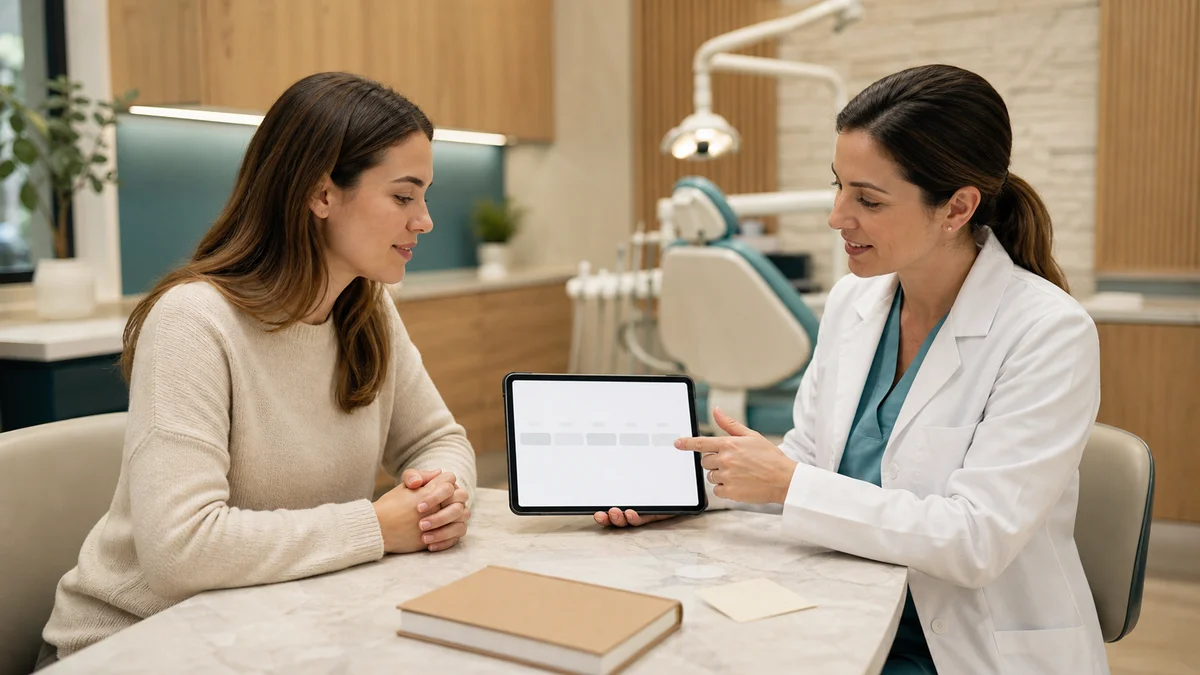
Quick answer: For a dentist near me appointment, first decide whether you need routine, urgent or emergency help. Tell the practice your symptoms, duration, swelling, bleeding, trauma, medical conditions and medicines; do not simply ask for the next free slot. Confirm the appointment purpose, clinician, likely fee, access adjustments and follow-up. Severe swelling affecting breathing, uncontrolled bleeding or serious facial injury needs emergency assessment.
A dentist near me appointment search can mean very different things. One person wants a routine check-up after moving home. Another has a broken filling but no significant pain. Someone else has facial swelling, trauma or bleeding that may require urgent triage. Search engines place all of these needs on one results page, but the correct timing, setting and clinician depend on symptoms and risk—not simply which calendar shows an opening.
The safest way to book a dentist near me appointment is to describe the problem accurately, let an appropriate dental service triage it and confirm what the visit is designed to do. An urgent appointment may focus on stabilising pain, infection, bleeding or injury and may not complete definitive treatment. A routine new-patient assessment may collect history and diagnostic information before any procedure is agreed. A cosmetic consultation should not bypass an oral-health examination when one is clinically needed.
This guide explains how to choose the right appointment type, what to say when booking, what information to prepare and how to evaluate costs, consent and follow-up. It is general education reviewed for patient safety and does not diagnose symptoms. Local access systems differ by country. The NHS examples apply to England unless stated otherwise; outside England, use the official dental and emergency pathway for your location.
Think of dentist near me appointment as a search request that still needs clinical context: location can find a door, but symptoms and health needs determine which door is appropriate.
1. Start your dentist near me appointment with the right category
Before calling, place your need in one of three broad categories: routine, urgent or emergency. This is not self-diagnosis. It is a way to communicate clearly so trained staff can select an appropriate pathway. If you are uncertain, tell the practice exactly what is happening and ask for triage rather than labelling the condition yourself.
A routine dentist near me appointment may be appropriate for a check-up, prevention, a stable concern without urgent symptoms, discussion of an elective goal or follow-up scheduled by your dentist. An urgent visit may be needed for persistent or severe pain, worsening swelling, recent extraction problems, trauma, or a broken restoration affecting comfort or function. An emergency pathway is intended for potentially life-threatening or serious injuries, not for getting routine care faster.
NHS guidance advises immediate emergency help for heavy bleeding that will not stop, serious injury to the face or jaw, or severe swelling of the mouth, lips, throat or neck with breathing difficulty. Loss of consciousness, vomiting or double vision after a head or facial injury also requires urgent medical assessment. Do not wait for an online dentist near me appointment confirmation in those circumstances.
2. Decision table: routine, urgent or emergency route
This table helps you prepare a call; it is not a substitute for clinical triage. Symptoms can change, and individual medical factors may alter urgency.
| Situation | Reasonable first route | Information to give | Important limitation |
|---|---|---|---|
| Check-up, prevention or stable concern | Routine dental appointment | Last visit, symptoms, goals and relevant history | Availability does not guarantee same-day treatment |
| Persistent pain, worsening swelling or broken restoration | Contact a dentist for urgent triage; in England, NHS 111 may advise | Onset, severity, swelling, fever, sleep or function impact | Urgent care may stabilise rather than finish treatment |
| Knocked-out or seriously injured tooth | Immediate dental triage | Time of injury, tooth type, bleeding, other injuries | Time can affect options; do not delay to compare reviews |
| Heavy uncontrolled bleeding or airway-threatening swelling | Emergency medical pathway | Breathing, swallowing, bleeding and general condition | A routine clinic calendar is not the right route |
| Elective whitening, veneers, aligners or implants | Assessment or consultation with appropriate clinician | Health goals, existing records and expectations | A remote price or cosmetic slot is not a diagnosis |
If your symptoms worsen while waiting, contact the service again. A dentist near me appointment assigned after yesterday’s description may no longer be appropriate today. Tell staff about new swelling, fever, bleeding, breathing difficulty, trauma or rapidly increasing pain. Do not assume the practice can see changes that you have not reported.
3. How to find a routine dentist near me appointment
Start with an official service directory where available, then contact the clinic directly to confirm current capacity. In England, the NHS “Find a dentist” service can search by town, city or postcode and indicate services such as routine, urgent or specialist care. NHS pages also warn that dental surgeries do not always have capacity for new NHS patients, so a listing is not a live appointment guarantee.
Some clinics provide NHS and private care. When requesting a dentist near me appointment, specify which type you are seeking. Ask whether the first visit is an NHS assessment, a private new-patient examination, a consultation for a named procedure, or an urgent slot. These are not interchangeable, and the booking label affects the time allowed, likely fee and what can reasonably be completed.
If an English practice cannot offer a routine NHS place, NHS guidance says you may need to join a waiting list, try another practice or consider private care. Your local integrated care board may provide access information. Scotland, Wales and Northern Ireland have their own official routes. A dentist near me appointment search should therefore use the health service for your UK nation, not assume one England-specific pathway applies everywhere.
- Check the clinic’s address and contact details in an independent directory.
- Confirm whether it is accepting the appointment type you want today.
- Ask if a waiting list is active and how updates are communicated.
- Verify the named dental professional on the relevant official register.
- Read current inspection information where the jurisdiction publishes it.
- Do not treat sponsored placement or star count as an access guarantee.
4. What to say when booking by phone or online
A useful booking message is concise but specific. State whether you are a new or existing patient, your main concern, when it began and whether it is getting worse. Mention pain that affects sleep or normal activity, swelling, fever, bleeding, trauma, a lost restoration, pregnancy, immune problems, anticoagulants or other important medical factors. Staff may ask more questions or arrange clinical triage.
For a dentist near me appointment, do not write only “toothache” if you can describe the pattern. Say which side or area hurts, whether pain is spontaneous or triggered, how long episodes last, whether there is swelling, and what self-care you have already used. Do not exaggerate symptoms to obtain an earlier slot and do not minimise them because you are worried about cost. Accurate triage protects you and other patients.
Online forms sometimes allow only a short message. Provide the essentials and a reliable callback number, then follow the clinic’s urgent instructions. Do not send sensitive health data to an unverified personal account. If the website says urgent requests are handled only by telephone, use that route. A submitted dentist near me appointment form is not confirmed until the service accepts it and gives you the date, time, location and instructions.
5. Confirm exactly what the appointment includes
The word “appointment” does not describe the clinical scope. A new-patient examination may include history, examination and appropriate records. An implant consultation may discuss suitability but require further imaging or referral. An urgent slot may provide examination, radiographs if indicated and treatment aimed at immediate stability. A hygiene appointment is not automatically a substitute for a dentist’s diagnosis.
Before accepting a dentist near me appointment, ask who you will see, how long is reserved and whether treatment is expected that day. Ask what happens if the examination identifies a different need. If you require a procedure under sedation, complex surgery or specialist assessment, confirm whether the first visit is only consultation and whether someone must accompany you later. Do not make travel, fasting or medicine changes without clinical instructions.
The confirmation for a dentist near me appointment should state the correct branch and arrival instructions, especially when one organisation operates several sites or sends urgent patients to a partner service.
Same-day care can be convenient, but it must still be based on valid consent. The General Dental Council says patients should receive relevant options and possible costs before treatment starts. Consent continues at each stage. If the plan or estimated cost changes during a dentist near me appointment, the change should be explained, agreed and documented rather than presented as an unavoidable surprise.
6. Prepare your health history and medicine list
Dental care is connected to general health. Prepare a current list of prescription medicines, over-the-counter products and relevant supplements, plus allergies and previous reactions. Note heart conditions, bleeding disorders, diabetes, immune suppression, pregnancy, kidney or liver disease, osteoporosis medicines, cancer treatment, previous radiotherapy to the head and neck, and any implanted devices your clinician should assess. This list does not decide treatment by itself.
Bring the medicine names, doses and schedule rather than saying “a blood thinner” or “a bone tablet” if you can avoid it. Do not stop anticoagulants, antiplatelets, steroids, osteoporosis medicines or any other prescribed treatment for a dentist near me appointment unless the responsible prescriber and dental clinician give appropriate instructions. Unsupervised changes can create serious risk.
Tell the clinic about fainting, panic attacks, difficult anaesthetic experiences, allergy concerns or previous complications. If you have an antibiotic prophylaxis plan from another clinician, bring the documentation; do not assume an antibiotic is needed for every medical condition or dental procedure. A well-prepared dentist near me appointment supports individual assessment without encouraging patients to self-prescribe.
7. Gather previous records without duplicating every test
Recent radiographs, scans, referral letters, treatment plans and details of restorations may help a new dentist understand prior care. Ask your previous practice how to request records securely. The new clinician decides whether existing images are adequate for the current question; having an image does not automatically make it current, diagnostic or the right type.
For a first dentist near me appointment, tell the clinic when and where recent radiographs were taken. The American Dental Association’s practice guidance advises asking whether recent images are available before new ones are made. Imaging should be selected for the patient and clinical need, not repeated solely because a package routinely includes it.
GDC standards expect complete and accurate records and secure handling of patient information. Photographs, radiographs, medical history, consent discussions, laboratory prescriptions and referrals may all form part of the record. Ask how to receive copies after your dentist near me appointment, particularly if care is staged, you travel between countries or another provider will manage follow-up.
8. Plan for anxiety, disability, language and sensory needs
Contact the practice before the visit if you need step-free access, transfer support, a hearing loop, an interpreter, a quiet waiting option, additional processing time, carer involvement, or adjustments for autism, dementia or a learning disability. “Accessible” on a profile may not describe the entrance, treatment room or communication support you personally require.
For dental anxiety, say what helps and what makes appointments difficult. NHS guidance notes that patients can tell the dental team they are anxious and can ask the clinician to stop or take a break. A dentist near me appointment may be booked for familiarisation or assessment before treatment if clinically and practically appropriate. Sedation is not the only support, and it is not suitable for everyone.
CQC’s patient guidance says a responsive practice considers different needs, makes adjustments where possible and provides an easy-to-use appointment system and emergency route. Ask whether interpretation is professional and confidential, especially for consent. A family member may provide support but may not be the best interpreter for complex options. The right dentist near me appointment must be usable, not merely geographically close.
9. Ask about costs before attending
Confirm the first appointment fee, what it generally covers, payment timing and cancellation policy. A consultation fee may not include radiographs, scans, cleaning or treatment. An advertised examination price may apply only to a defined group or appointment type. Do not assume that insurance, a membership plan or public coverage will pay until eligibility and provider participation are checked.
For an NHS dentist near me appointment in England, charges depend on the clinically necessary course of treatment and eligibility rules, not a clinic’s arbitrary price list. NHS guidance says the dental professional should tell you about costs before treatment. Clinically necessary NHS and private options must be distinguished, and mixed care should be reflected in the treatment plan. Avoid quoting an old charge from a search snippet because national fees can change.
For private care, request an estimate that identifies assessment, diagnostics, laboratory work, temporary care, review and maintenance. Ask what can change the estimate and what finance costs apply. A written figure is not a result guarantee. If a dentist near me appointment reveals a new diagnosis, you can ask for time to understand the revised scope, risks, alternatives and costs before non-urgent treatment begins.
10. What happens during a first dental examination?
The content depends on symptoms and history. NHS guidance describes examination of the mouth, teeth, lips and neck, with attention to decay, gum disease and mouth cancer signs. The dental professional may ask about pain or bleeding, oral hygiene, health, medicines, diet, smoking and alcohol. Radiographs may be needed when clinically justified. Not every patient requires the same tests.
At a thorough dentist near me appointment, your main concern should be heard before options are discussed. The clinician may examine teeth, gums, soft tissues, bite and existing restorations. They should explain important findings and uncertainty in understandable terms. A digital scan can record surfaces precisely but does not replace every clinical or radiographic assessment.
- Update your medical history, medicines and allergies.
- Describe symptoms, duration and any changes since booking.
- Explain previous dental experiences and current priorities.
- Ask why each test or image is recommended.
- Discuss options, likely benefits, material risks and maintenance.
- Clarify which care is urgent, preventive, restorative or elective.
- Request a written plan for significant or staged treatment.
A long list of technology does not prove quality, and a short routine review is not automatically inadequate. The relevant standard is proportionate, individual assessment. If the clinician needs a specialist opinion, additional records or disease control first, a responsible dentist near me appointment may end with a referral or plan rather than immediate treatment.
11. Understand urgent appointment limitations
Urgent dental care is designed to assess and manage the presenting problem within an appropriate time and setting. NHS England’s current unscheduled-care guidance distinguishes emergency, urgent and non-urgent unscheduled pathways. Clinical triage considers several factors; the label you choose on a form does not determine the final category.
An urgent dentist near me appointment may provide pain relief, drainage, a temporary restoration, management of bleeding, extraction, repair or referral depending on findings and clinician judgement. It may not include a comprehensive check-up or definitive restoration. Ask what follow-up is required and whether you must arrange it with your usual dentist. Do not interpret temporary care as a promise that the entire problem has been completed.
NHS England states that access to an available unscheduled appointment should not be denied solely because a patient lacks an NHS number, GP registration or permanent address. Actual capacity and local pathways still matter. If you are not registered with a practice, say so during triage. A dentist near me appointment for urgent stability does not necessarily create an ongoing routine-care place.
12. Children, carers and special-care referrals
When booking for a child, give the child’s age, symptoms, injury time, swelling, medical history and whether the tooth is primary or permanent if known. Do not attempt to reinsert a knocked-out baby tooth. Dental trauma can be time-sensitive, so seek prompt professional advice rather than waiting for a convenient routine slot.
A parent or person with parental responsibility may be involved in consent, but the child’s understanding, comfort and views also matter according to age and capacity. Tell the clinic about communication needs or previous distress. A child’s dentist near me appointment should not be booked under an adult profile or disguised as a simple check-up when there is trauma or swelling.
People with complex medical, physical, sensory, cognitive or behavioural needs may be treated in general practice with adjustments or referred to Special Care Dentistry. NHS guidance says a general practice can be the starting point and a dental professional may refer when specialised care is needed. Ask who coordinates records and how long the referral pathway may take. A referral is not a failure of the original dentist near me appointment; it can be the safest plan.
13. Cancellation, lateness and rescheduling
If you cannot attend, tell the practice as early as possible so the slot can be offered to someone else. Confirm the clinic’s policy when booking, including private deposits or cancellation fees. In England, NHS guidance says an NHS dental professional should not charge a fee for a missed NHS appointment, but repeated missed visits can affect continuation of a course and you may need to pay again for a new course in some circumstances.
For a dentist near me appointment, arrive early enough for forms, identity or eligibility checks and access needs. If you are late, the clinician may not be able to complete safe assessment or treatment within the remaining time. Ask whether the visit will be shortened, rebooked or charged under the applicable policy rather than assuming the team can run over.
Keep the dentist near me appointment contact number available on the day so you can report travel delays and receive the practice’s actual instruction rather than guessing.
Reschedule non-urgent care if the clinic advises this because of an infectious illness or another safety issue. For urgent symptoms, disclose the illness so staff can direct you appropriately; do not simply cancel without advice. Appointment policies should be applied transparently and consistently. Save confirmation messages for your dentist near me appointment, especially when travel or time off work is involved.
14. Online booking and remote consultation limits
Online booking is convenient for routine appointments, but symptom menus can oversimplify clinical need. Select the closest honest option and add detail. If no urgent category exists, call the clinic or official urgent pathway. A slot appearing online does not prove the clinician or equipment is suitable for your problem.
A remote dentist near me appointment may help collect history, review visible concerns, discuss broad options or plan an in-person visit. Photographs and video cannot reliably assess every cavity, crack, periodontal pocket, bite issue, root, bone condition or suspicious soft-tissue change. Remote advice should clearly state its limits and what signs require face-to-face or emergency care.
Be cautious if an online interaction jumps from selfies to a definitive irreversible treatment plan, fixed outcome promise or immediate finance agreement. Verify the clinician, clinic and privacy channel. Do not send passports, payment details or health records through an unverified link. A safe dentist near me appointment process protects personal information and leaves room for the clinical examination to change the plan.
15. Dental travel and appointment planning
“Near me” can also mean finding a clinic near a hotel or travel destination. Dental travel requires more planning because follow-up may occur in another country. Ask how many visits are needed, what happens if diagnostics change the plan, who manages complications after you return, and whether travel insurance excludes planned treatment. Do not schedule the return flight so tightly that there is no review margin.
For an international dentist near me appointment, confirm the clinic’s legal authorisation, treating dentist, language support, secure records, written costs and complaint route. A transfer or accommodation package is not evidence of clinical suitability. An online quote is provisional until examination. Avoid travelling with an untreated urgent infection merely because a later elective package seems cheaper.
You can review the care context on the Redent Clinic English homepage and send records or appointment questions through the Redent Clinic English contact page. A remote response can prepare a consultation but cannot determine diagnosis or guarantee treatment. Apply the same dentist near me appointment checklist whether the clinic is across town or abroad.
16. Twelve-step booking checklist
Use this compact sequence before a non-emergency dentist near me appointment:
- Write down the main symptom or goal and when it began.
- Check for emergency warning signs before searching routine calendars.
- Use an official service finder and verify the practice’s details.
- State whether you want NHS, private, urgent, routine or elective care.
- Describe pain, swelling, bleeding, trauma and functional impact accurately.
- Confirm the appointment purpose, clinician, duration and likely fee.
- Share access, language, anxiety or sensory adjustments early.
- Prepare health history, allergies and an exact medicine list.
- Ask whether recent records or images can be transferred securely.
- Clarify whether same-day treatment is possible or only assessment.
- Save confirmation, cancellation policy and after-hours instructions.
- Contact the service again if symptoms worsen before the visit.
This checklist improves communication but does not allow patients to assign their own urgency. The final pathway depends on triage and clinical judgement. A well-run dentist near me appointment system should be easy to use, responsive to different needs and clear about what it can and cannot provide, consistent with CQC’s public guidance.
Frequently asked questions about a dentist near me appointment
Can I book a dentist near me appointment without being registered?
You can contact a dental practice and ask, but capacity and local rules differ. In England, you do not register with a dentist in the same way as a GP, and practices may not accept new routine NHS patients. Urgent pathways may still be available through a dentist or NHS 111.
What information should I give for an urgent booking?
State when the problem began, pain severity, sleep or activity impact, swelling, fever, bleeding, trauma, broken dental work, medical conditions and medicines. Mention any breathing or swallowing difficulty immediately. Accurate details help triage; they do not guarantee a particular treatment or time.
Will treatment happen at my first appointment?
Not always. A routine first visit may focus on history, examination and diagnostics. An urgent visit may provide stabilising care, while complex or elective treatment often needs planning. Ask what the slot is designed for and do not assume a consultation fee includes treatment.
Can a dentist give me an exact price before examination?
The practice can explain appointment fees and general charges, but a personal treatment estimate may require examination and justified diagnostics. Ask what is included, what may change and whether NHS and private options are separated. Significant changes should be discussed and agreed before proceeding where possible.
Should I stop blood-thinning medicine before dental treatment?
Do not stop prescribed medicine on your own. Tell the clinic the exact medicine, dose, schedule and reason, and follow advice coordinated by the responsible clinicians. Unsupervised interruption can create serious risk. Booking staff may need a clinician to review the information before treatment.
What if I am very anxious about the dentist?
Tell the practice before attending and explain what helps. Ask about a longer assessment, a stop signal, breaks, familiarisation, communication support or referral. Sedation is not automatically required and is not suitable for everyone. You can ask the clinician to pause during an examination.
Can an online dentist near me appointment diagnose everything?
No. Remote history, photographs or video can support triage and planning but cannot reliably replace every clinical examination, test or image. The service should explain limits and arrange face-to-face or emergency care when needed. Be cautious of definitive irreversible plans based only on selfies.
What should I do if symptoms worsen before the appointment?
Contact the clinic or urgent pathway again and report the change. Severe swelling affecting breathing, heavy uncontrolled bleeding or serious facial injury needs emergency help. Do not rely on an appointment booked from an older symptom description if your condition has materially changed.
Final perspective: the right appointment is more important than the first slot
A dentist near me appointment search succeeds when it connects you with the right level of care, not merely the shortest waiting time. Routine, urgent and emergency pathways have different purposes. Clear symptom reporting, verified service details, prepared medical information and early access requests help the dental team triage safely and use appointment time well.
Before non-urgent treatment, understand the findings, options, material risks, costs and follow-up. Keep copies of written plans and records, and ask who is responsible at each stage. If the plan changes, valid consent should be renewed. The most patient-safe dentist near me appointment may end with prevention, monitoring, referral or another visit rather than immediate treatment—and that can be the correct outcome.
Sources and current official guidance
- NHS: How to find an NHS dentist
- NHS: Emergency and urgent dental appointments
- NHS: What happens at a dental visit
- NHS England: Unscheduled urgent and non-urgent dental care guidance
- General Dental Council: Valid consent at each treatment stage
- General Dental Council: Dental records and confidentiality
- Care Quality Commission: What patients should expect from a dental practice
- American Dental Association: Preparing for a patient’s dental visit
- World Health Organization: Oral health fact sheet