
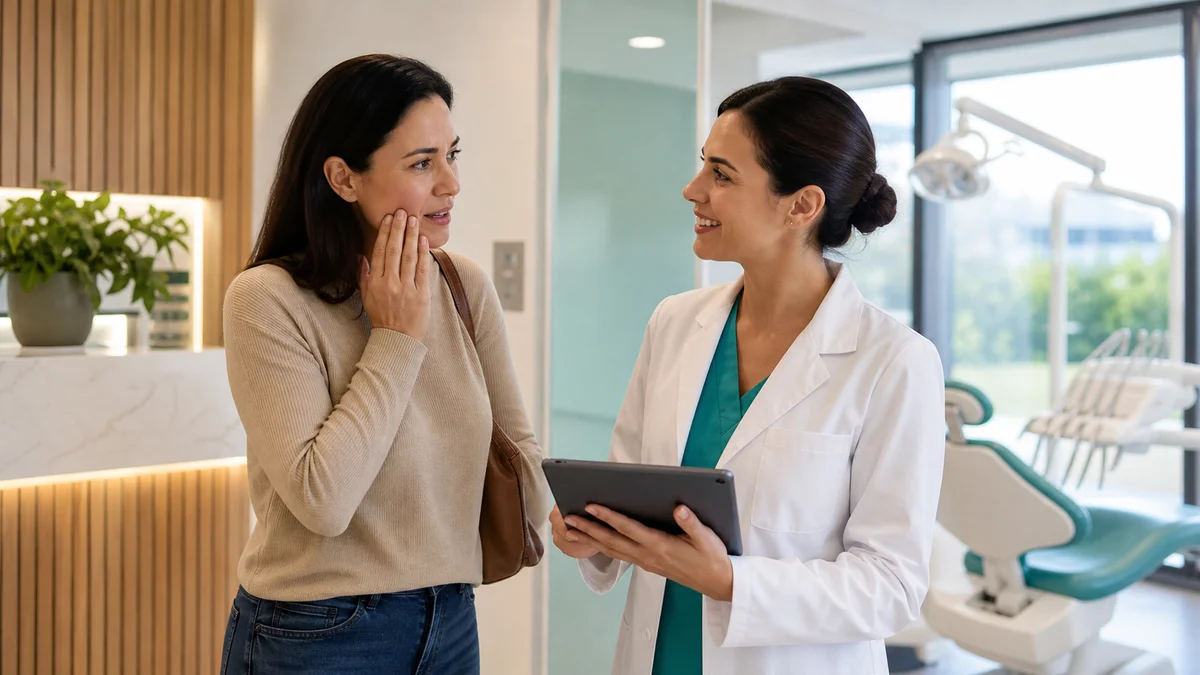
If you search dentist near me walk in welcome, call before travelling even when a clinic advertises walk-ins. Describe your symptoms, confirm today’s capacity, ask about examination fees and bring your medication and insurance details. Trouble breathing or swallowing, major facial trauma, or uncontrolled bleeding needs emergency medical assessment rather than routine walk-in care.
A sudden toothache, broken filling or swollen gum can turn an ordinary day into an urgent search for dentist near me walk in welcome. The wording usually means that a dental office is willing to assess people who do not already have a booked appointment. It does not necessarily mean immediate treatment, unlimited capacity, or a promise that every procedure can be completed during one visit. A responsible clinic first decides how urgent the problem is, whether dental care is the right setting and what can be done safely that day.
This guide explains what to ask, what to bring, which warning signs change the destination and how to compare same-day options without relying on a headline alone. It is educational and cannot diagnose the cause of pain. A dentist needs a history, examination and sometimes imaging before recommending treatment. If you want to understand Redent Klinik’s patient pathway before contacting the team, start with the Redent Klinik English information page.
What “dentist near me walk in welcome” really means
A walk-in dental service accepts unscheduled requests, but each practice sets its own operating model. Some keep protected urgent slots. Some ask callers to join a same-day cancellation list. Others accept arrivals only during limited hours or after telephone triage. A listing that says dentist near me walk in welcome may therefore describe access rather than a guaranteed chair time.
“Same day” also has several meanings. The office may offer an assessment and pain-focused intervention, complete a straightforward repair, or stabilise the problem and schedule definitive care later. Laboratory work, complex imaging, specialist procedures, medical clearance and healing cannot always be compressed into one appointment. Ask exactly what the clinic means by walk-in, urgent, emergency and same-day care.
- Walk-in accepted: the practice will consider an unscheduled arrival, subject to triage and capacity.
- Same-day appointment: the team has offered a defined time, although delays may still occur when more urgent cases arrive.
- Urgent dental visit: the appointment prioritises relief, assessment and prevention of deterioration.
- Emergency medical care: a hospital or emergency service manages threats to breathing, severe trauma, uncontrolled bleeding or serious systemic illness.
The safest response to a dentist near me walk in welcome result is a quick phone call. Confirm that the office is open, accepts new patients, can assess your age group and has the equipment or clinician likely to be needed. Location data and opening hours on directories may be outdated, so verify them with the practice.
Start a dentist near me walk in welcome search with triage
Triage is the process of deciding how quickly someone should be seen and in which setting. A receptionist may ask when the symptoms began, where the pain is, whether swelling is spreading, whether there is fever, whether an injury occurred and whether breathing or swallowing is affected. These questions do not replace a dental examination. They help the clinical team allocate limited same-day capacity safely.
Be specific when calling a dentist near me walk in welcome listing. “My tooth hurts” is less useful than explaining that pain started yesterday, wakes you at night, is triggered by biting and is accompanied by cheek swelling. Mention pregnancy, immune suppression, anticoagulant medicines, significant allergies and recent surgery. Do not minimise symptoms to obtain an appointment, and do not exaggerate them to move ahead in the queue.
The American Dental Association’s patient guidance says dental emergencies should be assessed by a dentist as soon as possible and notes that many practices reserve time for emergency patients. The NHS likewise advises contacting a dentist or urgent service for severe pain, swelling, trauma and other urgent dental problems. Local systems differ, so follow the emergency number and pathways where you are physically located.
When a hospital is safer than “dentist near me walk in welcome”
Some mouth and jaw problems exceed the scope of an ordinary walk-in dental office. Call the local emergency number or seek an emergency department when there is difficulty breathing or swallowing, rapidly increasing swelling involving the face or neck, uncontrolled bleeding, serious facial or jaw trauma, loss of consciousness, or other signs of a life-threatening condition. Do not wait in a dental reception if the airway may be at risk.
Fever with facial swelling, marked illness, confusion or rapidly worsening symptoms also warrants urgent escalation, particularly when a dentist cannot be reached. A suspected broken jaw needs immediate professional assessment. The right destination depends on the person’s condition and local services; telephone emergency dispatch or an urgent medical advice line can guide you when uncertain.
A search for dentist near me walk in welcome remains appropriate for many toothaches, lost restorations, chipped teeth, localised gum problems and dental appliance issues, but only after red flags are excluded. A hospital may help stabilise a serious emergency, yet definitive tooth treatment usually still requires a dental professional. Arrange dental follow-up when advised.
Problems a dentist near me walk in welcome team may assess
A walk-in dentist can evaluate many common complaints, but the treatment depends on diagnosis, available time and the patient’s medical needs. Tooth pain may arise from decay, a cracked tooth, gum inflammation, bite trauma, exposed dentine or several other causes. Swelling may be dental or non-dental. A loose crown can sometimes be reattached, but only if the tooth and restoration are suitable after inspection.
People commonly contact a dentist near me walk in welcome service about:
- toothache, temperature sensitivity or pain when biting;
- a chipped, fractured or knocked-out permanent tooth;
- a lost filling, crown, bridge component or temporary restoration;
- localised gum swelling, bleeding, soreness or a bad taste;
- a denture, retainer or aligner that has broken or is causing injury;
- pain or swelling after recent dental treatment;
- a sharp edge cutting the tongue or cheek; or
- concern about an object caught between teeth that cannot be removed gently.
For a knocked-out permanent tooth, official ADA and MedlinePlus guidance stresses acting promptly, handling the tooth by the crown rather than the root and keeping it moist. Do not scrub the root or let it dry. A baby tooth is managed differently and should not be replanted by a parent. Call a dentist immediately for case-specific instructions.
What happens during a dentist near me walk in welcome visit
The team will usually begin with registration, consent, a medical history and a focused account of the problem. The dentist then examines the mouth and may check the teeth, gums, bite, jaw movement and nearby tissues. Imaging is used only when clinically indicated and available. The goal is to identify likely causes, recognise danger signs and discuss reasonable options.
A dentist near me walk in welcome appointment may produce one of several outcomes: definitive treatment that day, temporary stabilisation, a prescription when clinically appropriate, referral to a specialist, or a planned return visit. Examples of stabilisation can include smoothing a sharp edge, placing a temporary material or adjusting an appliance. What is safe varies by diagnosis and individual risk.
Before any procedure, ask the dentist to explain the working diagnosis, proposed care, important alternatives, expected benefits, material risks and what may happen if treatment is deferred. You should also understand whether the intervention is temporary or definitive. Consent is a conversation, not merely a signature.
Why dentist near me walk in welcome access cannot guarantee completion
Walk-in access is valuable, but dentistry still depends on clinical sequencing. A tooth may need additional imaging, a specialist opinion or medical consultation. Swelling or limited mouth opening can affect what is possible. Some restorations require a dental laboratory. Complex extractions, sedation and treatment for medically vulnerable patients may need dedicated time and preparation.
When a dentist near me walk in welcome office recommends staged care, ask what today’s intervention is expected to accomplish, how long it is intended to last and what follow-up is required. Temporary relief should not be mistaken for complete treatment. Pain reduction also does not prove that infection or structural damage has resolved.
A careful clinic may decline a requested procedure if the examination does not support it or if the setting cannot provide it safely. That is not necessarily poor service. A clear referral and safety-net plan can be the most appropriate outcome of an urgent visit.
Call before travelling to a dentist near me walk in welcome result
Even if the listing says dentist near me walk in welcome, a brief call can prevent wasted time and improve triage. Clinics may reach capacity, change hours, assign different clinicians or have equipment temporarily unavailable. If no one answers, listen to the full voicemail because it may provide an after-hours number or emergency instructions.
Use this call script: “I am a new patient seeking an urgent visit today. My main symptom is ____. It began ____. I do/do not have swelling, fever, bleeding, trauma, or trouble breathing or swallowing. Do you accept walk-ins now, and what should I bring?” Answer follow-up questions honestly.
- Confirm the physical address, accessible entrance and current opening hours.
- Ask whether the practice treats adults, children or both.
- Describe any injury and ask whether time-sensitive instructions apply.
- Confirm language, mobility, sensory or anxiety accommodations.
- Ask what the examination and imaging process may include.
- Request the payment and insurance policy before arrival when practical.
- Ask whether someone should accompany you if sedation might be considered later.
What to bring to dentist near me walk in welcome care
Bring photo identification if locally required, your insurance information, a current medication list and details of allergies and important medical conditions. Include over-the-counter medicines, supplements and recent doses taken for the dental problem. If you have relevant radiographs, referral letters or treatment records, ask whether the practice can review them securely.
Bring a broken restoration, appliance or tooth fragment in a clean container. For a knocked-out permanent tooth, follow immediate professional first-aid instructions rather than waiting to organise paperwork. If the dentist near me walk in welcome practice requests forms, complete them accurately and disclose pregnancy or possible pregnancy before imaging or medication decisions.
Prepare a short timeline: when symptoms started, what makes them better or worse, whether sleep or eating is affected and whether the problem is changing. Also note the name and time of any medicine taken. This improves communication without attempting self-diagnosis.
How to assess a safe walk-in dental provider
Convenience matters, but safety and professional accountability matter more. Verify that the dentist and facility are appropriately licensed or authorised through the relevant regulator. Look for transparent contact information, consent processes, infection-control standards, privacy practices and a clear route for follow-up. Online reviews can reveal communication patterns, but they cannot verify clinical quality for your individual case.
A trustworthy dentist near me walk in welcome service should explain who will examine you, what the urgent fee covers and what care may need a later appointment. Be cautious when a provider promises a diagnosis or guaranteed result before examining you, pressures you to approve broad treatment immediately, refuses to itemise charges or will not explain alternatives.
Ask how records and radiographs will be shared if you return to your regular dentist. Continuity reduces duplicated imaging and helps the next clinician understand temporary materials, medicines and recommended follow-up. If you are considering Redent Klinik, use the official contact page to request current access information rather than relying on an unaffiliated directory.
Costs and insurance for dentist near me walk in welcome care
The cost of urgent dentistry varies with location, examination scope, imaging, diagnosis, materials, treatment complexity and whether the visit occurs outside ordinary hours. A headline fee may cover only the consultation. Ask separately about radiographs, temporary treatment, definitive treatment, laboratory work, prescriptions and follow-up. No article can provide a reliable fixed price for an unexamined problem.
When calling a dentist near me walk in welcome office, ask whether payment is due at the visit, which methods are accepted and whether the practice will submit an insurance claim. Verify network status and benefits directly with your insurer; a clinic accepting an insurance card does not necessarily mean it is in-network or that a particular procedure is covered. Deductibles, annual limits, waiting periods and clinical criteria can affect the patient share.
In the United States, CMS explains that uninsured or self-pay patients can usually request a written good faith estimate for scheduled care, though emergency care is treated differently and unanticipated care may not appear in an estimate. Rules vary by jurisdiction and situation. Ask for an itemised written plan whenever time permits and keep copies of estimates, consent documents, receipts and insurer communications.
Decision table for dentist near me walk in welcome options
| Situation | Likely first contact | What to confirm | Why it matters |
|---|---|---|---|
| Localised tooth pain without major swelling or systemic illness | Same-day or walk-in dental clinic | Current capacity, assessment scope, fee and follow-up | Dental examination can identify the cause and suitable care |
| Knocked-out permanent tooth or significant dental trauma | Call a dentist immediately; follow local trauma pathway | Immediate first aid, travel time and clinician capability | Time and correct tooth handling can affect options |
| Rapid facial or neck swelling, breathing or swallowing difficulty | Emergency medical service or emergency department | Local emergency instructions | Airway or spreading infection risk may require hospital resources |
| Broken appliance without pain or injury | Regular dentist, orthodontist or appropriate walk-in clinic | Repair capability and whether to bring the appliance | Not every urgent clinic repairs every device |
| Uninsured or self-pay scheduled visit | Clinic billing team and relevant official consumer resource | Written itemised estimate and payment terms | Clarifies expected scope while recognising estimates can change |
This table is a navigation aid, not a diagnosis. Symptoms can change quickly. If a dentist near me walk in welcome team redirects you to emergency medical care, follow that advice promptly.
Pain relief before a dentist near me walk in welcome appointment
Do not place aspirin or another tablet directly on a tooth or gum because it can injure tissue. Avoid using leftover antibiotics or someone else’s prescription. The ADA and CDC emphasise that antibiotics are not needed for most dental pain and localised swelling in otherwise healthy adults when definitive dental treatment is available; systemic involvement and individual risk can change the decision. Only a qualified clinician who has assessed you should prescribe for your situation.
Over-the-counter pain medicines may be unsuitable for some people because of allergies, pregnancy, kidney or liver disease, stomach ulcers, anticoagulants, interactions or other conditions. Follow the product label and seek pharmacist or medical advice when uncertain. Tell the dentist near me walk in welcome team exactly what you took and when.
Home measures should be temporary. Gentle oral hygiene, avoiding chewing on the affected side and a cold compress after trauma may help in some circumstances, but heat, sharp instruments and unverified remedies can worsen harm. Persistent or escalating symptoms require professional assessment.
Dentist near me walk in welcome care for children and vulnerable patients
Tell the clinic the patient’s age before travelling because not every urgent practice treats children. A knocked-out baby tooth is not managed like a permanent tooth. Children with facial trauma, heavy bleeding, altered consciousness or breathing difficulty need the appropriate emergency pathway. A parent or legal guardian may need to provide consent depending on local law and circumstances.
People who are pregnant, immunocompromised, medically complex, taking anticoagulants or receiving cancer therapy should disclose this during triage. It does not automatically prevent dental treatment, but it can change medication, imaging, bleeding and referral decisions. A dentist near me walk in welcome service may appropriately coordinate with another clinician.
Ask about wheelchair access, communication support, sensory accommodations and options for dental anxiety. If a patient needs sedation, the practice may schedule a separate visit because fasting, escort, monitoring and consent requirements cannot be improvised safely.
Aftercare following a dentist near me walk in welcome visit
Before leaving, obtain written instructions that explain what was done, what remains temporary, how to care for the area, what medicines were recommended and which warning signs require urgent help. Confirm who to call after hours and when the next appointment should occur. Ask for a receipt and an itemised treatment summary.
If the dentist near me walk in welcome clinic placed temporary material, do not assume it is intended to last indefinitely. Arrange definitive care within the recommended interval. If you return to a regular dentist, authorise secure transfer of relevant records and images. Tell that dentist how symptoms have changed since the urgent visit.
Seek prompt reassessment if pain or swelling is worsening, a restoration breaks, bleeding persists, a medicine causes a concerning reaction or new systemic symptoms develop. Breathing or swallowing difficulty and other life-threatening signs require emergency medical care.
Questions for a dentist near me walk in welcome consultation
Time pressure should not remove informed choice. When clinically possible, pause and ask what the dentist found, which options are reasonable today and which can wait. A useful dentist near me walk in welcome consultation should distinguish symptom control from definitive care.
- What is the working diagnosis, and is additional testing needed?
- Is the proposed treatment temporary, definitive or part of a staged plan?
- What benefits, material risks and alternatives should I understand?
- What will the visit cost, and what might be charged separately?
- What follow-up is required, and who provides it?
- Will I receive copies of records, images and prescriptions?
- Which symptoms mean I should call again or seek emergency medical help?
Frequently asked questions about dentist near me walk in welcome care
Does dentist near me walk in welcome mean no appointment is required?
It means the clinic may consider unscheduled patients, not that a chair is guaranteed. Capacity, opening hours, age limits and clinical scope can change. Call first, describe symptoms and ask whether to arrive immediately or accept a same-day time.
Will a walk-in dentist complete treatment on the first visit?
Sometimes, but not always. The dentist may provide definitive care, temporary stabilisation, a referral or a planned return visit. Diagnosis, medical risk, equipment, laboratory needs and appointment time determine what is safe.
Can dentist near me walk in welcome treat facial swelling?
A dentist can assess many dental swellings, but rapidly spreading facial or neck swelling, breathing or swallowing difficulty, severe systemic illness or other airway concerns require emergency medical assessment. Explain the location, speed of change and associated symptoms during triage.
Should I go to a hospital for ordinary toothache?
Most tooth causes need dental assessment, and a hospital may not provide definitive tooth treatment. However, serious trauma, uncontrolled bleeding, airway symptoms or severe systemic illness can require hospital resources. Use local urgent advice when uncertain.
Can I receive antibiotics without seeing a dentist?
Antibiotics are not a universal treatment for dental pain and can cause harm when unnecessary. Definitive dental care is prioritised for many conditions. A qualified clinician should assess whether antibiotics are indicated based on findings and individual risk.
How do I compare costs between walk-in clinics?
Compare the same scope: examination, imaging, temporary care, definitive procedure, materials and follow-up. Ask for an itemised written estimate when time permits, confirm insurance directly and remember that an estimate may change after examination.
What if the clinic is full when I arrive?
Ask whether the team can triage you, offer the next urgent slot or direct you to an appropriate alternative. If symptoms worsen or a red flag develops, do not remain in a routine queue; follow local emergency instructions.
What records should I request after dentist near me walk in welcome care?
Request an itemised receipt, treatment summary, medication information, relevant images and written aftercare. Confirm whether the intervention was temporary and when follow-up is due. These records support continuity with your regular dentist.
Conclusion: use dentist near me walk in welcome results safely
A search for dentist near me walk in welcome can connect you with timely dental assessment, but a directory label is only the beginning. Call first, describe symptoms accurately, screen for emergency warning signs, verify professional credentials and ask what the same-day visit can realistically include. Bring medical and insurance information, understand whether care is temporary and leave with a clear follow-up plan.
The safest clinic is not simply the closest one. It is the service that triages appropriately, communicates limits, obtains informed consent, provides transparent records and redirects serious conditions when necessary. If breathing, swallowing or uncontrolled bleeding is affected, prioritise emergency medical care over an online search.
Sources
- American Dental Association: Official Oral Health and Professional Resources
- American Dental Association, MouthHealthy: Dental Emergencies
- American Dental Association, MouthHealthy: How to Choose a Dentist
- Centers for Disease Control and Prevention: Treating Dental Pain and Swelling
- MedlinePlus, U.S. National Library of Medicine: Broken or Knocked-Out Tooth
- NHS: How to Find an Emergency or Urgent Dentist Appointment
- Centers for Medicare & Medicaid Services: Rights Without Insurance and Good Faith Estimates
- World Health Organization: Oral Health Fact Sheet