
Quick answer: A dentist that do dental implants near me search should identify who diagnoses, places, and restores the implant—not simply who advertises it. Verify the treating dentist’s license and relevant training, request an examination and individualized plan, compare alternatives, risks, stages, device records, aftercare, and written estimates, and seek another opinion when recommendations differ or pressure replaces informed consent.
People typing dentist that do dental implants near me often want a fast shortlist, but proximity is only the beginning. An implant is a surgically placed medical device that supports a crown, bridge, or denture. The plan may involve diagnosis, gum and bone assessment, surgery, laboratory work, a temporary restoration, healing, the final prosthesis, and long-term maintenance. Those stages may be handled by one dentist or a coordinated team.
A trustworthy dentist that do dental implants near me result will not guarantee candidacy, a fixed timeline, or a lifelong outcome before examining you. The U.S. Food and Drug Administration advises patients to discuss potential benefits and risks, overall health, healing, and the implant system with their dental provider. Your needs, anatomy, medical history, oral hygiene, disease control, and preferences shape the decision.
This dentist that do dental implants near me guide helps adults compare local implant providers without inventing rankings, prices, or success statistics. It is educational, cannot diagnose a missing-tooth problem, and does not replace an examination. Provider availability, scope, credentials, fees, insurance rules, and laws change, so verify current details through the relevant official sources and the individual clinic before consenting.
What the dentist that do dental implants near me search should uncover
Treat dentist that do dental implants near me as a search phrase, not proof of competence. You need to know who will evaluate the site, whether the existing tooth is truly non-restorable, which replacement options are reasonable, who will place the implant, who will design and fit the restoration, and who will manage complications. A practice name or advertising badge does not answer those questions.
When calling a dentist that do dental implants near me office, ask for the names and roles of every treating clinician. Some general dentists perform both surgery and restoration. Other cases involve a periodontist or oral and maxillofacial surgeon for surgical care and a general dentist or prosthodontist for the prosthesis. Coordination matters because implant position must support a cleansable, functional final tooth.
In a dentist that do dental implants near me comparison, do not assume that “implant,” “implant crown,” “abutment,” “full arch,” “same-day teeth,” or “all-inclusive” describes the same scope everywhere. Ask the office to translate marketing language into clinical components and named providers. The most useful local result is the one that explains responsibility across the entire plan, not merely the first appointment.
Begin with diagnosis and alternatives, not an advertised procedure
For a dentist that do dental implants near me search, remember that a missing tooth does not automatically make an implant the only appropriate choice. Depending on the clinical findings, options may include monitoring a space, a removable partial denture, a conventional bridge, a resin-bonded bridge, an implant-supported restoration, orthodontic space management, or another individualized approach. Each option has different effects on adjacent teeth, hygiene, function, time, surgery, maintenance, and cost.
A careful dentist that do dental implants near me consultation should also confirm whether a painful or damaged tooth might be treated rather than removed. The clinician should explain the diagnosis, prognosis, reasonable alternatives, expected benefits, material risks, and consequences of delaying or declining care. Seeking an implant quote before confirming the diagnosis can turn a complex health decision into an incomplete shopping comparison.
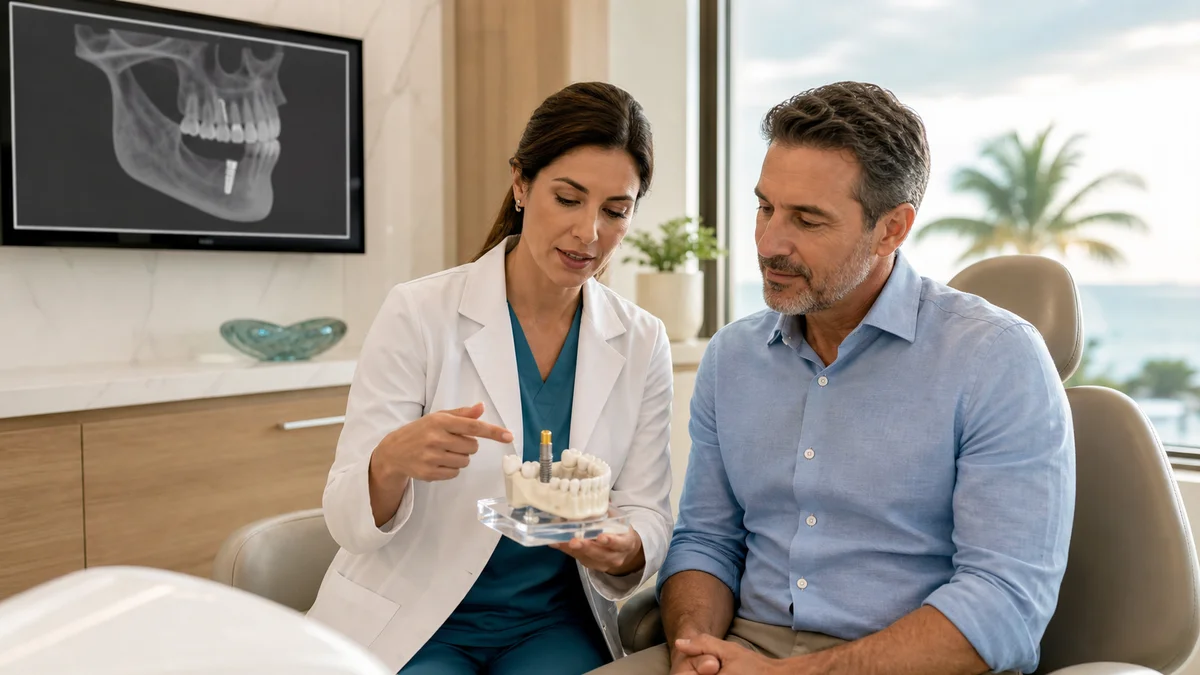
During a dentist that do dental implants near me consultation, ask the dentist to show you the relevant findings in plain language. You should understand which tooth or site is involved, whether active decay or gum disease is present, what supports the proposed restoration, and why each diagnostic image or test is necessary. Informed consent is a conversation and process, not a signature added after the financial decision.
Who can place and restore a dental implant?
A dentist that do dental implants near me search can surface clinicians whose education, practice focus, postgraduate training, supervision arrangements, and case experience vary. The American Dental Association’s National Commission recognizes twelve dental specialties, including periodontics, prosthodontics, and oral and maxillofacial surgery. “Implant dentistry” itself is not listed as a separately recognized dental specialty by that commission, so read credential claims precisely.
A dentist that do dental implants near me office may offer care through a general dentist, a specialist, or a team. The title alone cannot determine who is right for your specific case. Ask what formal education is relevant to the planned procedure, how often the clinician performs comparable cases, what conditions prompt referral, how emergencies are covered, and whether the same team will remain available for restoration and maintenance.
When screening dentist that do dental implants near me results, connect experience questions to your situation: a single healed molar site differs from an immediate implant after extraction, a front-tooth aesthetic site, a grafted site, or a full-arch reconstruction. No responsible clinician can use experience to promise your result. The goal is to understand the match between scope, training, and support.
Verify the license and the individual treating clinician
For any dentist that do dental implants near me candidate, verify the individual dentist through the licensing board for the state where care will occur before booking surgery. In Florida, the Florida Board of Dentistry provides a public “Verify a License” route and licensing information. Search the clinician’s full legal name and match the result to the practice location. A company name, social profile, or directory listing is not a substitute.
For a Florida dentist that do dental implants near me result, confirm current license status and review the public information available through the official system. If a practice says an outside specialist visits periodically, verify that person too. Ask who owns each treatment decision, who signs prescriptions, and whom you should contact if symptoms develop when the visiting provider is away.
After a dentist that do dental implants near me license check, remember that licensure is a minimum screen, not a quality guarantee or prediction of outcome. Public records require context, and a similar name can belong to another person. If the record is unclear, contact the board through its official channel rather than relying on screenshots, review-site comments, or an unrelated third party.
Expect a complete clinical and medical assessment
At a dentist that do dental implants near me consultation, disclose the factors the FDA says can affect candidacy, healing, and longevity. Tell the clinician about diagnosed conditions, past surgeries, allergies, current medicines and supplements, tobacco or nicotine use, pregnancy, bleeding history, previous radiation treatment, and earlier implant complications. Do not change prescribed medicine without appropriate guidance.
A dentist that do dental implants near me evaluation normally considers the teeth, gums, bite, available space, bone and soft tissues, hygiene access, and the restoration that will sit on the implant. Imaging should be selected for a clinical reason. Ask what question each image answers, how the result changes the plan, and whether earlier records can prevent unnecessary duplication.
In a dentist that do dental implants near me case, active dental or periodontal disease may need attention before or alongside implant treatment. The final decision may require communication with a physician or another dental professional when medical conditions or medicines affect surgery or healing. A request for medical input does not automatically rule out an implant; it means risk should be evaluated in context.
Understand dental implant benefits, limits, and risks
Any dentist that do dental implants near me plan should reflect the FDA explanation that implants can support crowns, bridges, or dentures and may restore chewing and appearance while helping preserve surrounding structures. Benefits depend on the diagnosis and a functioning restoration. An implant is not a natural tooth, does not eliminate disease risk, and requires ongoing care. “Permanent” is not a promise that repair or replacement will never be needed.
Every dentist that do dental implants near me plan should include a patient-specific risk discussion. FDA-listed risks include injury to adjacent teeth or tissues, sinus perforation, jawbone injury, altered bite, screw loosening, infection, delayed healing, difficulty cleaning, implant loosening or loss, and numbness related to nerve injury. Individual likelihood and management cannot be estimated from a web page.
For dentist that do dental implants near me candidates, the FDA also notes that smoking may affect healing and long-term success, and that uncontrolled diabetes may make systemic infection more likely. These statements support honest risk assessment, not automatic refusal or online self-diagnosis. Ask how modifiable risks can be addressed, what findings would change the plan, and which warning signs require urgent review.
Map every component of the implant plan
An implant treatment plan can include more than a titanium fixture. Ask the dentist that do dental implants near me team to identify each expected component and whether it is included, optional, conditional, or billed elsewhere. A clear map can include:
- Consultation, examination, periodontal assessment, diagnostic records, and imaging.
- Tooth removal, socket management, infection control, and temporary replacement if needed.
- Bone augmentation, membrane, sinus-related procedure, or soft-tissue treatment when indicated.
- Implant body, cover screw or healing component, abutment, fixation screw, and final restoration.
- Anesthesia or sedation, monitoring, medications, laboratory work, and facility charges.
- Follow-up visits, restoration adjustments, hygiene instruction, maintenance, and complication care.
In a dentist that do dental implants near me proposal, ask which steps are certain now and which depend on findings during treatment or healing. A contingency is not necessarily a hidden charge, but it should be explained with the reason, decision point, likely alternatives, and financial process. If multiple offices participate, request a coordinated sequence and a named contact at each location.
Decision table for comparing local implant providers
Use this table after obtaining a diagnosis. It does not rank clinics or determine suitability. A dentist that do dental implants near me comparison is safer when the same clinical scope is evaluated across providers.
| Decision area | Evidence to request | Useful question | Warning sign |
|---|---|---|---|
| Provider identity | Full name, active state license, role in care | Who places the implant and who restores it? | Staff will not name the treating clinician |
| Diagnosis | Findings, images, prognosis, alternatives | Why is this tooth or space suited to this plan? | Extraction or surgery promised from an online photo |
| Training and scope | Relevant formal training and case-specific experience | What findings would make you refer this case? | Credentials described with vague or misleading titles |
| Treatment design | Surgical and restorative sequence | How does the planned implant position support the final tooth? | Surgery discussed without a restorative plan |
| Risk management | Personal risk discussion and contingency plan | What complications are most relevant to me? | “Zero risk” or guaranteed lifetime result |
| Fees | Itemized written estimate from each provider | Which parts, visits, and possible additions are excluded? | A deposit demanded before the scope is explained |
| Continuity | After-hours route and maintenance schedule | Who manages pain, loosening, or restoration problems? | No named follow-up provider |
Questions for the implant consultation
Bring a written list so urgency or sales pressure does not erase important details. Ask the dentist that do dental implants near me provider questions that connect treatment, responsibility, and maintenance:
- What is the diagnosis, and what reasonable non-implant alternatives should I consider?
- Which clinician performs each surgical and restorative step?
- What records or images are needed, and why?
- What health, periodontal, hygiene, tobacco, or bite factors affect this plan?
- Is grafting expected, possible, or unlikely, and when will that decision be made?
- Will I have a temporary tooth, and what are its functional limits?
- What implant system, components, and laboratory will be used?
- What symptoms are expected, and which require urgent contact?
- How will the implant and restoration be cleaned and monitored?
- What does the written estimate exclude, and who may bill separately?
A useful dentist that do dental implants near me discussion acknowledges uncertainty where it exists. The clinician should distinguish common postoperative experiences from complications, describe choices without shaming, and allow time for questions. If you do not understand a term, ask for plain language or a diagram. You may request copies of your plan and records according to applicable policies and law.
Request a written estimate before planned care
A headline price cannot show whether examination, imaging, extraction, grafting, implant placement, the abutment, provisional restoration, final crown, anesthesia, laboratory work, or follow-up is included. For any dentist that do dental implants near me quote, insist on a written, itemized scope and connect each charge to the treatment stage.
For planned dentist that do dental implants near me care, the Centers for Medicare & Medicaid Services states that people who do not have or do not use insurance are usually entitled to a good faith estimate when they request one or schedule care at least three business days in advance. Emergency care is handled differently. CMS says a federal dispute process may be available when a provider’s bill is at least $400 above that provider’s estimate.
After a dentist that do dental implants near me estimate request, tell every participating provider or facility that you are uninsured or self-pay and ask each one for its document. Save estimates, the treatment plan, financing terms, receipts, and final bills. A good faith estimate cannot guarantee that unanticipated clinically necessary care will never arise, but it creates a written baseline for comparison.
Compare equivalent implant scopes, not headline totals
Two dentist that do dental implants near me proposals are comparable only when they address the same diagnosis and components. One plan may include only the implant body; another may include the abutment and crown. One may expect grafting; another may propose an alternative site or restoration. Differences can be clinically legitimate, but they should be explained.
In a dentist that do dental implants near me scope comparison, ask each clinician to label services as included, excluded, conditional, or handled elsewhere. Confirm whether the estimate covers temporary teeth, a failed provisional, laboratory remakes, maintenance, imaging, anesthesia, and postoperative visits. Understand refund and cancellation rules before making a deposit, especially when custom components or laboratory work are ordered.
When dentist that do dental implants near me financing is offered, review the credit contract separately from treatment consent. The Consumer Financial Protection Bureau warns that medical credit cards and payment plans may use deferred interest, fees, credit checks, and terms that increase repayment. Ask about assistance or an office arrangement, calculate total repayment, and never rely solely on “zero interest” advertising.
Be cautious with “same-day” and “teeth in a day” promises
A dentist that do dental implants near me result may advertise “same day,” while the ADA’s patient information describes placement, healing through osseointegration, and restoration. It notes that some patients may have implants and replacement teeth placed in one visit, while others wait months before teeth are attached. The phrase can therefore describe different combinations of extraction, implant placement, and temporary restoration.
A responsible dentist that do dental implants near me discussion should state what is placed that day, whether the visible tooth is temporary or final, what forces it can tolerate, and what findings could change the plan. Immediate placement or loading is not appropriate for everyone, and a preoperative promise should contain clear clinical conditions.
With a dentist that do dental implants near me same-day plan, ask about diet, cleaning, review visits, temporary-restoration fracture or loosening, and the backup if primary stability or another required condition is not achieved. A longer timeline is not automatically inferior; a shorter timeline is not automatically unsafe. The appropriate sequence depends on individualized findings.
Clarify grafting, sinus procedures, and temporary teeth
Bone and soft-tissue procedures may be recommended to create a suitable foundation or improve cleanability and appearance. A dentist that do dental implants near me plan should explain the defect or limitation, the purpose of the proposed procedure, material choices, alternatives, added risks, healing sequence, and whether the implant is planned at the same or a later visit.
For a dentist that do dental implants near me quote, do not treat “bone graft included” as a complete description. Ask where material comes from, what quantity or technique is anticipated, what findings might change it, and who manages complications. The same applies to sinus-related procedures. These decisions require imaging and examination; online price menus cannot determine anatomical suitability.
During a dentist that do dental implants near me healing plan, ask what temporary solution is available and what it can safely do if appearance or chewing is important. A removable appliance, bonded temporary, implant-supported provisional, or no temporary may be considered in different situations. Obtain written cleaning and use limits rather than assuming the temporary functions like a final restoration.
Review anesthesia, sedation, and surgical safeguards
At a dentist that do dental implants near me consultation, remember that local anesthesia, minimal sedation, moderate sedation, deep sedation, and general anesthesia are not interchangeable. If sedation is proposed, ask who administers and monitors it, what credentials and permits apply, what preoperative instructions are required, and whether an escort is necessary. Disclose medicines, sleep apnea, allergies, and prior reactions accurately.
The dentist that do dental implants near me office should provide instructions appropriate to the planned level of care. Do not fast, take extra medication, or stop a prescribed medicine based only on generic internet advice. Ask whom to call if illness develops before the appointment and what happens if transport or escort arrangements fail.
Sterility, emergency readiness, patient monitoring, and a clear transfer route matter, but patients cannot audit every clinical process. Focus on concrete questions and official credential checks. Vague reassurance is less useful than a named clinician, defined anesthesia plan, written preparation instructions, and accessible postoperative contact.
Keep the implant brand, model, and treatment records
The FDA recommends asking which brand and model of implant system is used and keeping that information. Request a record of the implant body and relevant components, placement date, site, treating clinicians, and restoration. Store it with radiographs, operative notes, and laboratory information you receive.
A dentist that do dental implants near me provider should be able to explain how records are supplied and transferred. Device information can help future clinicians identify compatible components if a screw, abutment, or restoration needs attention. It does not remove the need for a clinical assessment, and it should not be confused with a guarantee.
Tell future dental and medical imaging professionals that you have dental implants. The FDA notes that implants can distort or interfere with some MRI or X-ray images, although it reports no known adverse events from MRI or X-ray procedures with dental implants. Follow the imaging team’s instructions and provide device details when requested.
Plan maintenance before implant placement
Implants require plaque control and professional monitoring. The American Academy of Periodontology explains that peri-implant diseases affect tissues around implants and that signs can include red or tender gums or bleeding during brushing. Previous periodontal disease, poor plaque control, smoking, and diabetes are listed as risk factors. An implant cannot decay, but surrounding tissues can become inflamed and lose support.
Ask the dentist that do dental implants near me team to demonstrate cleaning around the planned restoration and explain which tools fit its shape. A full-arch bridge, single crown, and implant-retained overdenture require different access. Confirm recall intervals, who performs maintenance, how baseline measurements or images are used, and when the restoration must be removed for service.
Maintenance cost and accessibility belong in the original decision. If you cannot clean under a design or cannot return to the placing office, discuss alternatives before surgery. Long-term care should include natural teeth, gums, bite, and general oral health—not only the implant.
Know the warning signs after implant treatment
Follow the treating clinician’s written instructions because normal recovery and risk vary by procedure. Contact the office promptly for symptoms it identifies as concerning. The FDA specifically advises telling a dental provider right away if an implant feels loose or painful. Worsening swelling, persistent bleeding, fever, drainage, altered sensation, trauma, or a changing bite also deserves professional triage.
A dentist that do dental implants near me office should give you a daytime and after-hours route before treatment. Ask who covers weekends and what to do if the surgeon and restoring dentist work at different locations. Difficulty breathing, uncontrolled heavy bleeding, severe facial or neck swelling, or another potentially life-threatening problem requires emergency medical care rather than waiting for an ordinary office reply.
Do not tighten components yourself, glue a loose restoration, take leftover antibiotics, or use another person’s medicine. Preserve any detached component in a clean container and call the treating team. Early assessment may protect tissues or parts, but no website can determine the cause of a symptom.
Red flags in local dental implant advertising
High treatment costs and missing teeth can make certainty appealing. Pause when a dentist that do dental implants near me advertisement or sales call uses any of these patterns:
- A diagnosis, candidacy decision, or fixed surgical plan based only on a photo or brief form.
- A guaranteed result, guaranteed lifetime device, or claim that complications cannot occur.
- A price that hides whether the implant, abutment, crown, graft, anesthesia, and follow-up are included.
- Pressure to finance immediately before meeting the treating clinician.
- Refusal to name the surgeon, restoring dentist, implant system, or laboratory responsibility.
- Credential language that implies a recognized specialty without clear supporting information.
- Before-and-after images presented as a prediction of your outcome.
- No written aftercare, maintenance, complication, or transfer plan.
Reviews may reveal communication patterns, but they do not verify licensure, diagnosis, sterility, or suitability. Paid placement in a search result is advertising, not independent clinical ranking. Verify critical facts through official records, written documents, and a direct conversation with the actual treating clinician.
When a second opinion adds value
Consider another opinion when extraction is irreversible, multiple implants or full-arch treatment is proposed, grafting recommendations differ, a major medical factor is involved, the aesthetic risk is high, or you do not understand the alternatives. A second opinion is also reasonable when one plan promises certainty and another describes important limitations.
Send the second dentist that do dental implants near me provider the same relevant records when possible. Ask both clinicians to explain why their diagnosis, implant number or position, graft plan, timeline, and restoration differ. Different plans are not automatically evidence that one is wrong; priorities, techniques, and risk tolerances can vary.
A useful second opinion is independent and complete, not a quick attempt to beat a price. Compare clinical reasoning first, then written scope and cost. If urgent disease or infection needs management, ask how to address immediate risk while you evaluate definitive options.
Local care versus treatment travel
Local access can simplify urgent review, staged visits, restoration adjustments, and maintenance. Travel may broaden options but adds coordination, transport, accommodation, recovery, and follow-up questions. Compare total care pathways rather than procedure prices. Confirm who will handle a loose temporary, infection concern, component issue, or laboratory remake after you return home.
If you are comparing a local dentist that do dental implants near me plan with treatment in Istanbul, review the Redent Klinik English patient information and use the official contact page to request an individualized assessment. Remote information can organize records and questions, but final candidacy and treatment require appropriate clinical evaluation.
Ask any travel provider for named clinicians, credentials, device information, staged visit requirements, provisional limits, complication policies, and a written handoff plan. Build buffer time into travel and do not assume you can safely fly or resume work immediately. The treating team must give advice based on the actual procedure and your health.
15-step checklist before accepting an implant plan
- Confirm the diagnosis and whether the tooth can reasonably be treated.
- Discuss implant and non-implant alternatives.
- Name every clinician involved in surgery and restoration.
- Verify each treating dentist through the official licensing authority.
- Ask about case-relevant education, experience, and referral thresholds.
- Share complete medical, dental, medicine, allergy, and tobacco information.
- Understand why each image and diagnostic record is needed.
- Review patient-specific benefits, limitations, and risks.
- Map extraction, grafting, implant, temporary, abutment, and final restoration stages.
- Clarify anesthesia, sedation, monitoring, escort, and emergency arrangements.
- Request an itemized written estimate from every billing provider.
- Read financing, deposit, refund, remake, and cancellation terms separately.
- Record the implant brand, model, site, and placement date.
- Plan hygiene, monitoring, maintenance costs, and after-hours contact.
- Seek another opinion when the plan, credentials, risks, or pressure feel unclear.
Use the checklist as a conversation aid, not a scoring system. The best dentist that do dental implants near me choice is not necessarily the closest, fastest, or most expensive. It is the provider or team that can justify the plan, identify uncertainty, document responsibilities, support informed consent, and remain available for appropriate follow-up.
Frequently asked questions
How do I find a dentist that do dental implants near me?
Start with the official state license lookup, then call practices directly and ask who diagnoses, places, and restores implants. Verify every treating clinician, not only the business. Request a consultation that covers alternatives, individualized risks, treatment stages, device records, maintenance, and an itemized written estimate. Search proximity is useful for follow-up, but it does not establish suitability or quality.
Does a general dentist place dental implants?
Some general dentists provide implant surgery and restoration; others restore implants placed by a periodontist or oral and maxillofacial surgeon, and some cases involve a prosthodontist. Training and scope vary. Ask who performs each stage, what education and comparable experience are relevant, when the clinician refers, and how the team coordinates the final restoration. A title alone cannot choose the right provider for you.
Is implant dentistry a recognized dental specialty?
The ADA’s National Commission lists twelve recognized dental specialties, and “implant dentistry” is not presented as a separate recognized specialty on that list. Periodontics, prosthodontics, and oral and maxillofacial surgery are among recognized specialties that may participate in implant care. Read credential claims carefully and verify specialty status through the relevant official body and licensing jurisdiction.
Can I receive a dental implant and tooth on the same day?
Some patients may receive an implant and a temporary replacement tooth in one visit, while others require healing before a tooth is attached. The ADA describes both pathways. Anatomy, infection, bone, stability, bite, health, and the planned restoration affect timing. Ask exactly what “same day” means, whether the tooth is temporary, its limits, and the backup plan if conditions are unsuitable.
How can I compare dental implant estimates?
Compare the same diagnosis and scope. Check whether each proposal includes examination, imaging, extraction, grafting, implant body, abutment, temporary, final crown or bridge, anesthesia, laboratory work, follow-up, maintenance, and conditional services. Ask every provider expected to bill for a written estimate. A lower headline number is not a saving when essential stages are excluded.
What implant information should I keep?
Keep the implant manufacturer, brand or system, model and component details available to you, site, placement date, treating clinicians, operative and restorative records, relevant images, and laboratory documentation. The FDA specifically recommends asking for the brand and model. These records may help future clinicians identify compatible parts and understand earlier treatment, although a new examination may still be necessary.
Do dental implants require maintenance?
Yes. Follow individualized cleaning instructions and attend professional monitoring. The FDA recommends regular cleaning and visits, and the American Academy of Periodontology describes inflammatory diseases that can affect tissues around implants. Ask how to clean under your specific restoration, which symptoms to report, who provides maintenance, what records form the baseline, and how often review is appropriate for your risks.
When should I seek help for an implant problem?
Contact your dental provider promptly if the implant or restoration feels loose, becomes painful, or develops other warning signs in your written instructions. Worsening swelling, fever, drainage, persistent bleeding, altered sensation, trauma, or a changing bite warrants triage. Breathing difficulty, severe spreading swelling, uncontrolled heavy bleeding, or another life-threatening concern requires emergency medical care.
Final perspective on choosing an implant provider
A search for dentist that do dental implants near me should end with verified people, a defensible diagnosis, and a complete care pathway. The plan should connect surgery to the final restoration, present reasonable alternatives, state patient-specific uncertainty, and define follow-up. No advertisement can replace those elements.
Take time to read the treatment plan, consent information, estimates, and credit terms. Keep your device and clinical records. Ask for another opinion when the recommendation is extensive or unclear. A safe decision respects both oral health and financial reality without turning uncertainty into a promise.
Sources and official patient resources
- U.S. FDA: Dental Implants—What You Should Know
- American Dental Association MouthHealthy: Implants
- National Commission: Recognized Dental Specialties
- Florida Board of Dentistry: Licensing and Verify a License
- American Academy of Periodontology: Peri-Implant Diseases
- CMS: Good Faith Estimates for Uninsured or Self-Pay Patients
- Consumer Financial Protection Bureau: Medical Credit and Payment Plans
- American Dental Association
- World Health Organization: Oral Health