
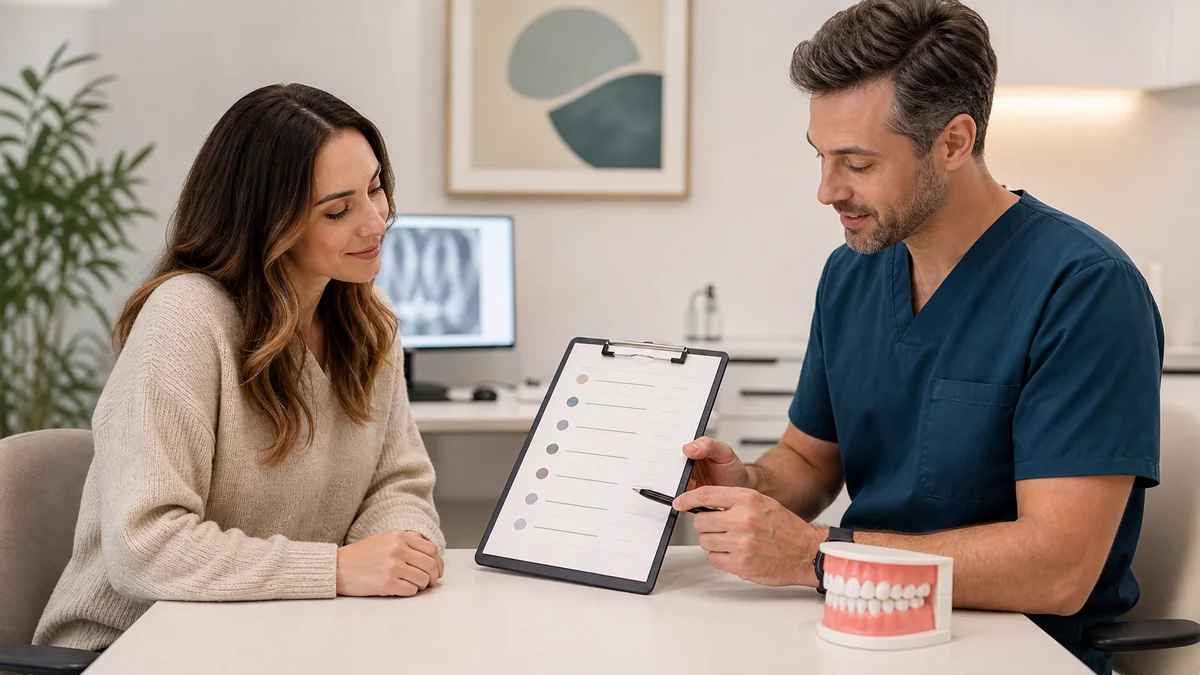
Quick answer: To find a dentist without insurance near me, compare licensed local offices, HRSA-supported health centers, and supervised dental school clinics. Ask for the examination fee, likely imaging, an itemized self-pay estimate, sliding-fee rules, and payment terms. Trouble breathing, spreading facial swelling, uncontrolled bleeding, or major trauma needs emergency help rather than price shopping.
Typing dentist without insurance near me into a search bar usually means that two questions have become urgent at the same time: where can you be examined, and how can you make the cost understandable? The safest answer is not automatically the clinic with the lowest advertisement. It is a properly licensed service that can assess what is happening, explain what must be treated first, show what may wait, and give you written financial information before non-emergency treatment.
This guide uses the United States as its main context because self-pay dental access, Medicaid benefits, community health centers, and Marketplace dental coverage differ by state. It does not diagnose a tooth, prescribe medication, promise eligibility, or quote a universal fee. A dentist without insurance near me search should lead to an examination and an informed choice, not a do-it-yourself diagnosis based on symptoms alone.
Location matters, but distance is only one part of “near me.” Opening hours, an urgent referral pathway, accessibility, language support, the scope of services, and a written estimate may matter just as much. Use the steps below to turn a broad dentist without insurance near me result into a short, verifiable list that fits your clinical needs and your budget.
What a dentist without insurance near me search should find
A useful dentist without insurance near me result should answer more than “Does this office accept self-pay patients?” Start by confirming the street address and whether the listing belongs to the clinic itself. Then ask what type of appointment is available: a comprehensive new-patient visit, a limited urgent examination, preventive care, or a consultation for a known treatment. These appointments are not interchangeable, and the records or imaging needed may differ.
Call the office directly when symptoms are active. Describe the problem briefly without trying to name the diagnosis: where it is, when it started, whether swelling or fever is present, whether a tooth was injured, and whether swallowing or breathing feels different. Staff can explain the clinic’s triage process, but only an appropriate clinician can diagnose the cause. If the clinic cannot provide the needed service, ask where it refers self-pay patients.
- Confirm that the clinic sees uninsured or self-pay patients and is accepting appointments.
- Ask whether the quoted visit is comprehensive or limited to the urgent problem.
- Request the examination charge and how necessary X-rays or scans are priced.
- Ask when you will receive an itemized treatment plan and whether alternatives will be discussed.
- Verify cancellation, deposit, financing, interpreter, accessibility, and after-hours policies.
- Check the dentist’s current license through the relevant state dental board.
Do not send health or payment details through an unverified directory message. A legitimate dentist without insurance near me listing should connect you to a clinic that can identify itself, explain privacy-safe contact options, and state who will provide the care.
Emergency warning signs come before a dentist without insurance near me comparison
Cost research should pause when there may be a threat to breathing, circulation, vision, or consciousness. MedlinePlus lists difficulty breathing, sudden severe pain, facial or tongue swelling, and uncontrolled bleeding among warning signs that may require emergency help. Call 911 for a life-threatening emergency. Swelling that is spreading toward the eye or neck, confusion, collapse, major facial trauma, or bleeding that will not stop should not wait while you compare a dentist without insurance near me.
Severe tooth pain, a broken tooth, a lost filling, a localized swelling, or pain after trauma can still require prompt dental attention even when there is no airway problem. Ask for urgent triage and tell staff about fever, malaise, pregnancy, immune conditions, blood thinners, allergies, and current medicines. The urgency and safest setting depend on the whole clinical picture.
Antibiotics are not a substitute for definitive dental treatment. The American Dental Association’s evidence-based guidance says that most pulpal and periapical pain and swelling should be managed by prioritizing dental procedures when appropriate, with antibiotics reserved for defined circumstances such as systemic involvement. Never use leftover or someone else’s antibiotics. The clinician assessing you decides whether a medicine is indicated.
If symptoms are stable enough for outpatient care, tell each dentist without insurance near me candidate that you are paying directly and need an urgent-care estimate. A hospital emergency department may stabilize a serious problem but may not provide definitive treatment of the tooth, so ask what dental follow-up is required.
A decision table for every dentist without insurance near me candidate
Use the same questions for every dentist without insurance near me option. A consistent comparison prevents a low headline fee from hiding missing services, and it makes it easier to distinguish a real treatment plan from a sales offer.
| Decision point | What to ask | A reassuring answer | Reason to pause |
|---|---|---|---|
| Urgency | How are pain, swelling, trauma, or bleeding triaged? | Clear screening and an emergency referral pathway | Symptoms are dismissed without questions |
| Credentials | Who will examine and treat me? | Named licensed professionals and supervised trainees where relevant | The provider’s identity or role is unclear |
| Visit scope | Is this a comprehensive or problem-focused examination? | The scope and limitations are explained | A consultation is presented as complete treatment |
| Diagnostics | Which images may be needed and why? | Need is decided clinically and costs are itemized | A package is required without explanation |
| Treatment choices | What are the reasonable options, benefits, risks, and timing? | Alternatives, including no immediate elective treatment, are discussed | Only the most extensive option is mentioned |
| Self-pay estimate | Can I receive an itemized written estimate? | Professional, laboratory, imaging, follow-up, and medication items are separated | Only a verbal total or guaranteed final bill is offered |
| Discount rules | Is there a self-pay or prompt-payment policy? | Terms and exclusions are written before payment | Urgency is used to pressure immediate payment |
| Payment plan | Who provides it, and what are all terms? | Interest, fees, schedule, and late-payment effects are disclosed | Financing is described as “free” without documents |
| Continuity | Who handles complications and follow-up? | A named contact, schedule, and after-hours plan | No one is responsible after payment |
Save notes from each call. The strongest dentist without insurance near me choice is usually the one that combines appropriate timing, transparent clinical reasoning, a comprehensible estimate, and reliable follow-up—not necessarily the closest office or lowest starting fee.
How self-pay estimates work without dental insurance
A dental estimate is based on the information available at that moment. The final plan can change after an examination, imaging, removal of an old restoration, or a specialist opinion. This is not automatically a sign of poor practice; the important point is whether the dentist without insurance near me candidate explains uncertainty, obtains consent for changes, and updates the written estimate.
Ask what the first visit includes and what it does not. Depending on the situation, cost may be affected by the type of examination, necessary radiographs, the tooth and surfaces involved, complexity, materials, laboratory work, sedation, specialist involvement, follow-up, geographic location, and whether care is urgent. There is no safe universal fee that applies to every patient or every clinic.
An itemized plan can help you separate three layers: immediate measures to control risk or pain, definitive treatment of the underlying dental problem, and elective improvements that may be scheduled later. Ask what could happen if each part is delayed. When time safely allows, you may seek a second opinion and give the second clinician relevant records. Do not delay care solely to collect estimates if a dentist warns that deterioration is likely.
- Request the procedure name and tooth location in plain language.
- Ask whether laboratory, imaging, anesthesia, temporary work, and follow-up are included.
- Confirm how long the estimate is valid and what could change it.
- Ask whether records can be transferred and whether a release or duplication charge applies.
- Keep receipts, consent forms, finance documents, and after-care instructions together.
A trustworthy dentist without insurance near me conversation should make the trade-offs clearer without promising a precise biological outcome. Treatment success depends on diagnosis, anatomy, healing, home care, smoking or vaping, general health, follow-up, and other individual factors.
Community health centers for a dentist without insurance near me
Health Resources and Services Administration-supported health centers are a practical starting point. HRSA states that anyone may use a community health center, whether or not they have insurance, and that charges may be adjusted through a sliding scale. Health centers can provide dental services directly or arrange access through their local network. Availability and the range of treatment vary by location.
Use the official HRSA Find a Health Center locator rather than an advertisement that merely uses the words “community clinic.” When you call, ask whether the site provides adult dentistry, pediatric dentistry, urgent visits, preventive services, restorative care, or referrals. Confirm the documents used for sliding-fee eligibility. HRSA’s compliance guidance says sliding-fee programs use income and family size, and a health center may have a fee schedule specifically for dental care.
A community health center may have a waiting list, limited treatment scope, or separate dental intake. If the first site cannot help, ask it to identify another local center. Include these centers in your dentist without insurance near me list, but do not assume that “federally supported” means every service is free. Ask what you may owe before the visit and again after the treatment plan is made.
Dental schools and hygiene programs near you
The National Institute of Dental and Craniofacial Research explains that dental schools often operate clinics where students provide care under experienced, licensed supervision, commonly at reduced cost. Dental hygiene schools may offer supervised preventive services. These settings can be valuable when a standard dentist without insurance near me result is unaffordable, but they require the same careful questions about scope, scheduling, and follow-up.
Teaching appointments can take longer because each stage may be checked. Not every school accepts every case, and complex care may require a graduate specialty clinic or outside referral. Ask whether the first appointment is screening only, whether treatment will occur on another day, how urgent problems are handled, and who is responsible between appointments.
Use the school’s official website and call its patient clinic, not an unofficial “grant” page. NIDCR warns that it does not provide treatment, referrals, financial aid, or grants for dental implants. A claim that a government research institute will pay for elective dental work is a red flag. A genuine dentist without insurance near me pathway should not require a fee merely to reveal a public clinic address.
Medicaid, CHIP, and state dental benefits
Eligibility and dental benefits are separate questions. The federal Medicaid website says states must provide dental services for eligible children as part of the Early and Periodic Screening, Diagnostic and Treatment benefit. Adult dental benefits are optional for states, and there is no federal minimum adult benefit. That means an adult who qualifies for Medicaid must still check the current dental coverage, network, limits, prior authorization, and participating providers in that state.
Start with your state Medicaid agency or the member number on an enrollment document. Verify benefits with the plan and then confirm participation directly with the clinic. Online directories can lag behind network changes. When calling a dentist without insurance near me, state whether coverage is active, pending, or absent; do not assume a claim can be submitted retroactively.
For a child, ask the state program about Medicaid or the Children’s Health Insurance Program and use the program’s official provider search. For an adult, ask which services are covered, whether the benefit is emergency-only or broader, and whether referrals or authorizations are required. Never postpone emergency help while waiting for a benefits answer.
Marketplace dental plans and discount plans are not immediate care
HealthCare.gov explains that adult dental coverage is not an essential health benefit. Marketplace dental coverage may be included in a health plan or offered as a separate dental plan; on the federal Marketplace, a stand-alone dental plan is purchased with a health plan. Separate adult dental plans may also have waiting periods. Buying a plan after pain begins therefore may not cover the care you need now.
Insurance, a dental discount plan, a membership plan, and financing are different products. Insurance defines covered benefits, networks, cost sharing, exclusions, and annual limits. A discount plan generally offers contracted reductions at participating clinics but is not insurance. An in-office membership plan may apply only at that practice. Financing is credit that must be repaid.
Before replacing a self-pay dentist without insurance near me search with a new product, read the effective date, waiting period, provider network, covered procedures, exclusions, cancellation terms, renewal terms, and total cost. Confirm in writing that the exact clinic participates. Do not rely on a marketing agent’s verbal assurance that treatment “will be covered.”
Payment plans, financing, and staged treatment
Some clinics accept installments, third-party healthcare credit, or deposits followed by scheduled payments. Approval is not guaranteed, and financing can add interest or fees. Ask whether the lender or the clinic owns the agreement, whether a credit check occurs, the annual percentage rate, total repayment, late charges, deferred-interest conditions, refund rules, and what happens if the treatment plan changes.
Staged treatment is a clinical decision, not simply a billing tool. Ask the dentist to identify what is urgent, what is definitive, what is preventive, and what may reasonably be deferred. A dentist without insurance near me should not split a procedure in a way that compromises safety merely to create smaller payments. Conversely, a thoughtful sequence may let you address active disease first and plan elective work later.
Be cautious with high-pressure applications completed before you see an itemized plan. Take time to read credit documents when the situation is not urgent. If you do not understand a term, ask for it in writing and consider independent financial guidance. Dental staff can explain their office policy, but they should not guarantee that a financing product suits your personal finances.
How to check quality, credentials, and privacy
Look up the dentist through the state dental board and review whether the license is current. If a dental school or residency clinic is involved, ask how supervision works. Confirm who will perform each procedure and who you contact after hours. A verified dentist without insurance near me option should welcome reasonable questions about provider roles and informed consent.
Reviews may reveal patterns in communication or scheduling, but they cannot establish clinical quality for your case. Be wary of anonymous before-and-after images, guaranteed results, stock testimonials, or claims that one treatment is right for everyone. Diagnosis should follow an examination and relevant records—not a sales call or a photograph alone.
Protect personal information. Use the clinic’s stated secure channel for medical histories, images, identification, or financial data. Ask how telehealth or photo triage is documented and what it can and cannot determine. Never send a card number, Social Security number, or health record to an unverified directory account that appears in a dentist without insurance near me search.
Considering dental care away from home
Travel can expand the range of clinics, but it also changes the follow-up plan. International or long-distance care should be considered only after the diagnosis, treatment alternatives, clinician credentials, total itinerary, materials, laboratory arrangements, healing time, and complication pathway are clear. Urgent swelling, trauma, or uncontrolled pain should first be assessed locally rather than postponed for a flight.
For background on treatment planning and clinic standards, you can review the Redent Klinik English information hub. If you want to ask how records are reviewed, what an in-person examination may change, or how follow-up is organized, use the Redent Klinik contact page. These links are not a substitute for a local dentist without insurance near me when emergency or hands-on care is needed.
Ask any travel clinic for a written plan before booking transport. Clarify how many visits may be needed, who pays if extra treatment is clinically necessary, how records are shared with your home dentist, and who can help after you return. No ethical provider can guarantee that complications will never occur.
Scams and red flags in low-cost dental searches
Financial stress can make “free treatment” or “government implant grant” advertisements appealing. Verify the organization through an official government, university, professional association, or clinic website. NIDCR specifically says it does not provide dental care, financial assistance, referrals, or implant grants. A genuine assistance program should state its sponsor, eligibility, covered service, clinic, privacy policy, and costs.
- Avoid anyone who charges only to disclose publicly available clinic listings.
- Pause if a diagnosis or guaranteed outcome is offered without an examination.
- Do not accept pressure to pay the entire plan before risks and alternatives are explained.
- Question “one price for everyone” claims that ignore diagnosis, materials, or complexity.
- Verify surprise calls, messages, QR codes, payment links, and requests for identity documents.
- Report suspected fraud through the relevant state regulator or consumer protection authority.
A reliable dentist without insurance near me does not need to hide the provider’s identity, the clinic’s address, the scope of the first visit, or the written payment terms.
Frequently asked questions about dentist without insurance near me options
Can a dentist without insurance near me see me for an emergency?
Many offices accept direct payment for urgent examinations, but availability and treatment scope vary. Call and describe symptoms, ask how triage works, and request the likely initial charges. Call 911 for breathing difficulty, spreading swelling that threatens the airway or eye, uncontrolled bleeding, collapse, or major trauma. An urgent dental appointment is not a substitute for emergency services when life may be at risk.
Is a dentist without insurance near me required to offer a discount?
No universal rule requires every private office to discount self-pay care. Some have written prompt-payment or membership policies, while HRSA-supported health centers may use sliding-fee schedules based on income and family size. Ask about eligibility and exclusions before the visit. A discount does not by itself show that the proposed treatment is necessary or appropriate.
How do I compare estimates from a dentist without insurance near me?
Compare the same scope: examination type, required images, tooth and procedure, materials, laboratory work, temporary care, anesthesia, follow-up, and possible changes. Give each dentist relevant records. A second opinion may recommend a different plan because clinical judgments can differ; ask each clinician to explain the reasons, risks, alternatives, and consequences of delay.
Will a community health center act as my dentist without insurance near me?
Possibly. HRSA health centers can serve patients with or without insurance and may use a sliding fee, but not every location offers the same dental services. Search the official locator, call the dental program, and confirm availability, intake rules, documents, fees, and referral options. Do not assume every treatment is free.
Are dental school clinics safe for uninsured patients?
Dental school care is provided by students under licensed supervision, and graduate clinics may involve dentists receiving specialty training. Safety still depends on appropriate screening, consent, supervision, records, and follow-up. Appointments may take longer and not every case is accepted. Ask who is responsible at each stage and what happens if urgent care is needed between visits.
Can I buy dental insurance after finding a dentist without insurance near me?
You can review available plans during an applicable enrollment opportunity, but new coverage may not solve an existing urgent need. Networks, effective dates, waiting periods, exclusions, annual limits, and cost sharing apply. HealthCare.gov notes that separate adult dental plans may have waiting periods. Read official plan documents and verify the clinic’s participation.
Should I choose the lowest quote from a dentist without insurance near me?
Not on price alone. A headline quote may describe a different examination, material, or treatment scope. Compare credentials, diagnosis, alternatives, written estimates, consent, continuity, and complication planning. The least expensive option can be reasonable, but only when you understand what is included and a clinician has found it appropriate for your case.
Can antibiotics replace treatment from a dentist without insurance near me?
Usually not. ADA guidance emphasizes definitive dental treatment for most pulpal and periapical pain and swelling, with antibiotics used in selected situations such as systemic involvement. Antibiotics do not repair decay, drain every infection, or restore a broken tooth. Seek clinical assessment and never take leftover, borrowed, or unprescribed medicine.
What should I bring to a dentist without insurance near me appointment?
Bring identification requested by the clinic, a medicine and allergy list, relevant health conditions, prior dental records or images if available, and any sliding-fee documents the facility asks for. Bring written questions and a payment method only after confirming policy. Tell the team about pregnancy, immune conditions, anticoagulants, and previous reactions to dental treatment or medicines.
What if no dentist without insurance near me has an opening?
Ask each office for its cancellation list, urgent referral pathway, and nearby alternatives. Search the official HRSA locator, contact dental school clinics, consult the state or local health department, and call 2-1-1 where available for community resources. If symptoms worsen or emergency warning signs appear, escalate to the appropriate urgent or emergency service instead of waiting.
A practical call script and final checklist
You can say: “I am paying without dental insurance. I have had [brief symptom] since [time]. I do or do not have swelling, fever, trauma, bleeding, or trouble breathing or swallowing. What type of appointment do I need, what does the first visit include, and can you give me the likely examination and imaging charges before I arrive?” This gives a dentist without insurance near me office useful information without assuming a diagnosis.
Before committing to non-emergency treatment, confirm the provider, diagnosis, options, risks, expected stages, itemized estimate, payment terms, records policy, and follow-up contact. If something changes, ask for an updated explanation and consent discussion. Keep your documents and record whom you spoke with.
The best outcome of a dentist without insurance near me search is not a promise of cheap or perfect care. It is timely access to a qualified clinician, a plan proportionate to your needs, financial terms you understand, and a safe route for questions or complications. That combination protects both oral health and decision quality.
Keep your dentist without insurance near me notes current because schedules, benefit participation, and clinic policies can change. Reconfirm the appointment, provider, estimate, and payment method directly with the clinic. If a dentist without insurance near me result conflicts with an official program directory, use the official source and call the facility before traveling. Repeating this final dentist without insurance near me check can prevent delays and unexpected financial assumptions.
Sources and official tools
- National Institute of Dental and Craniofacial Research — Finding Dental Care
- Health Resources and Services Administration — Affordable care and eligibility
- HRSA Health Center Program Compliance Manual — Sliding Fee Discount Program
- HRSA — Find a Health Center
- Medicaid.gov — Dental Care
- HealthCare.gov — Dental coverage in the Marketplace
- MedlinePlus Medical Encyclopedia — Recognizing medical emergencies
- American Dental Association
- American Dental Association — Antibiotics for Dental Pain and Swelling
- World Health Organization — Oral health fact sheet