
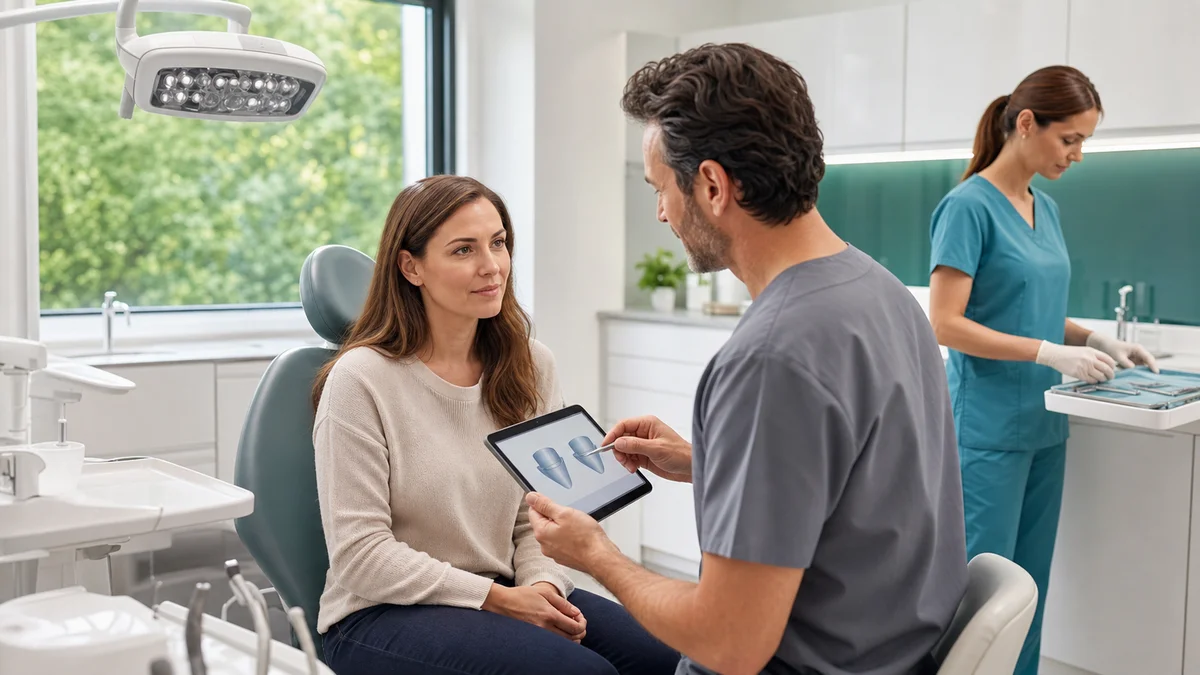
A safe dentistry dental clinic should verify clinician credentials, examine before recommending treatment, explain alternatives and risks, obtain informed consent, follow documented infection controls, protect records and provide a written plan with follow-up. Reviews and décor can inform comfort, but neither replaces clinical evidence, transparent communication or an independently verifiable professional licence.
The search phrase dentistry dental clinic can lead to hundreds of choices, from small general practices to multidisciplinary centres. A polished website may show services and amenities, but it cannot prove that a treatment is necessary, suitable or safely delivered. The best decision uses verifiable credentials, a proper examination, understandable consent and a care plan that respects both oral health and personal priorities.
This guide turns a broad dentistry dental clinic search into 19 patient-safety checks. It does not rank clinics, promise outcomes or diagnose a dental problem. Licensing systems, advertising rules, insurance arrangements and emergency pathways differ by country, so confirm local requirements with the competent dental regulator and your insurer. The practical principles below—safe care, evidence, consent, hygiene and continuity—remain useful across jurisdictions.
Do not delay urgent assessment while comparing websites. Facial swelling with difficulty breathing or swallowing, uncontrolled bleeding, severe trauma, spreading infection signs, fever with worsening swelling, or rapidly deteriorating symptoms can require emergency care. For persistent pain, a broken tooth, swelling, pus, numbness or a loose adult tooth, contact a dental professional promptly.
What a dentistry dental clinic should actually provide
A clinic is more than a room with a dental chair. It is a system for assessment, diagnosis, prevention, treatment, sterilization, records, referrals and follow-up. General dentists often manage routine examinations, prevention, fillings, gum care and many restorative needs. Specialists complete additional recognized training in areas such as orthodontics, periodontics, endodontics, paediatric dentistry or oral surgery, depending on the jurisdiction.
A responsible dentistry dental clinic should identify who will examine and treat you, what that professional is qualified to do, and when referral is appropriate. A large centre is not automatically safer than a small practice, and a specialist label should be independently verifiable. The central question is whether the team can meet your needs within its competence and coordinate care when it cannot.
- A named clinician with a current, independently verifiable registration or licence.
- An examination and diagnosis before irreversible treatment is proposed.
- A clear explanation of reasonable options, including no treatment or monitoring when appropriate.
- Documented infection prevention, medical-history review and emergency procedures.
- Accessible records, written plans, transparent estimates and defined follow-up.
Check 1: Verify the dentist and the legal clinic identity
Start with names, not marketing titles. Ask for the treating dentist’s full name and professional registration number, then verify the current status through the official register for the country or region where care will occur. Confirm the legal clinic name, physical address and a working way to contact the practice after treatment. Screenshots supplied by a salesperson are not equivalent to checking the regulator’s live register yourself.
A dentistry dental clinic may employ general dentists, specialists, hygienists, therapists, nurses or technicians whose scopes differ. Ask who performs each stage and who remains clinically responsible. If a website uses “specialist,” “surgeon” or another protected title, verify it rather than assuming that experience alone confers the title. Legitimate teams should answer this without pressure or evasiveness.
Check 2: Match the clinic’s competence to your actual need
A routine check-up and a complex full-mouth reconstruction require different planning resources. List your main concern, medical conditions, medicines, allergies, previous dental experiences and any current imaging. Ask whether the proposed clinician routinely manages comparable complexity and what findings would trigger referral. The answer should describe a process, not guarantee a result.
The right dentistry dental clinic recognizes limits. Complex periodontal disease, difficult root-canal anatomy, impacted teeth, significant medical risk or unusual oral lesions may benefit from a specialist or hospital service. Referral is not a weakness; it can be a sign of responsible scope management. Be cautious when one provider claims to be the ideal expert for every possible procedure.
Check 3: Expect an examination before a definitive plan
The NHS describes a dental appointment as an assessment of the mouth, teeth, lips and neck, alongside questions about symptoms, home care, general health, medicines, diet, smoking and alcohol. The exact components vary by need and jurisdiction, but a clinician should gather enough information to reach and explain a working diagnosis before proposing irreversible care.
A safe dentistry dental clinic does not finalize an implant, veneer, extraction or aligner plan from a social-media photo alone. Remote information may support initial triage or an estimate, yet dimensions, bite, gum health, decay, endodontic status and medical risks can change the plan after examination. Any pre-visit quote should be presented as provisional when key clinical data are missing.
Check 4: Ask why imaging is needed
Dental X-rays and three-dimensional scans can provide important information, but they should be clinically justified and tailored to the question being investigated. Ask what the image is expected to show, whether a recent suitable image can be reviewed, and how exposure is optimized. More imaging is not automatically more thorough, and refusing every image can also limit safe diagnosis.
The dentistry dental clinic should connect each image to history and examination findings. Images do not replace a clinical examination, and impressive software simulations are not proof of the final outcome. If a plan depends on a scan, ask the clinician to show the relevant anatomy in plain language and explain any uncertainty.
Check 5: Look for diagnosis-first communication
Before discussing brands or materials, the clinician should explain the problem: what was found, how certain the diagnosis is, what may happen without intervention and which goals matter. Symptoms can have multiple causes. Pain, for example, may arise from decay, pulp inflammation, cracks, gum disease, bite overload or non-dental conditions; a single product should not be sold as the answer before evaluation.
A trustworthy dentistry dental clinic separates diagnosis from sales. You should be able to ask what evidence supports the recommendation, whether monitoring is reasonable, and which less invasive option exists. A treatment’s popularity, price or cosmetic appeal does not establish medical necessity.
Check 6: Confirm informed consent is a conversation
Consent is not merely a signature collected at reception. It requires a decision-making conversation in language you understand, with an opportunity to ask questions and time to consider elective care. The clinician should discuss the nature and purpose of treatment, material risks, expected limitations, reasonable alternatives and what may happen if treatment is postponed or declined.
At a patient-centred dentistry dental clinic, consent can be revisited when findings or plans change. Sedation, surgery, implants, orthodontics, extensive tooth preparation and complex rehabilitation need procedure-specific discussion. No ethical consent form turns uncertainty into a guarantee. Ask for a copy of the plan and consent information before an elective commitment.
Check 7: Compare benefits, limitations and alternatives
Every intervention has trade-offs. A crown can strengthen a compromised tooth but requires preparation; an implant avoids cutting adjacent teeth but involves surgery and maintenance; a bridge may be appropriate in a different anatomical or financial context. The comparison must be based on your examination, not a universal “best” label.
The dentistry dental clinic should include preventive, restorative and referral options when relevant. Ask whether a reversible or tooth-preserving step can meet the goal, how long each option is expected to function without promising a fixed lifespan, and what maintenance or replacement could involve. If the explanation presents only the most expensive choice, seek clarification or a second opinion.
Check 8: Review infection prevention beyond visible cleanliness
A spotless waiting room does not reveal instrument processing. CDC Standard Precautions for dental settings include hand hygiene, appropriate personal protective equipment, respiratory hygiene, sharps safety, safe injection practices, sterile instruments and devices, and cleaning and disinfection of environmental surfaces. These minimum practices apply regardless of whether infection is known or suspected.
Ask the dentistry dental clinic how reusable instruments are cleaned, packaged, sterilized, stored and traced, and how single-use items are handled. The team should be able to explain its infection-prevention coordinator or responsibility structure without disclosing confidential staff information. Barrier protection and gloves are only parts of a complete system; gloves do not replace hand hygiene.
Check 9: Observe practical safety signals
Patients cannot audit an entire sterilization programme, but they can notice whether the team opens packaged instruments appropriately, changes gloves between tasks, manages clean and contaminated zones, and responds seriously to questions. Waterline care, surface disinfection, sharps disposal and maintenance records belong to the clinic’s system even when not visible during a short visit.
A safe dentistry dental clinic should not shame a patient for asking about infection control. A rehearsed slogan is less useful than a calm description of protocols, training and accountability. If you see obvious cross-contamination or an unsafe practice, pause elective care and ask for clarification.
Check 10: Insist on medical-history and medication review
Dental treatment interacts with general health. Anticoagulants, antiresorptive medicines, allergies, diabetes, pregnancy, heart conditions, immune suppression, previous radiotherapy, sleep apnoea and many other factors can affect planning. Give an accurate medicine list, including non-prescription products and supplements, and update it when anything changes.
The dentistry dental clinic should ask relevant questions and coordinate with medical professionals when indicated. Do not stop a prescribed medicine simply because a non-prescribing person tells you to do so. Any alteration should involve the appropriate prescriber and a risk-based clinical plan.
Check 11: Demand a transparent written estimate
Prices depend on diagnosis, complexity, materials, laboratory work, clinician involvement, location, insurance terms and follow-up. A legitimate estimate should identify what is included, what is optional, what could change after new findings, and when payments are due. It should distinguish professional fees, laboratory components, imaging, sedation, temporary work, maintenance and possible additional procedures where relevant.
A dentistry dental clinic should not advertise a teaser price and reveal essential components only after a deposit. At the same time, no responsible clinician can promise that an estimate will never change if hidden disease or complications are discovered. Ask how changes are authorized and whether you receive an updated written plan before additional elective work.
Check 12: Use a decision table to compare clinics
Use the same questions for each candidate so décor and first impressions do not dominate. The table is a screening tool, not a substitute for a consultation or regulator check.
| Decision area | Reassuring evidence | Reason to clarify or pause | Action |
|---|---|---|---|
| Credentials | Named clinician and current official registration | Protected titles without verifiable details | Check the competent regulator directly |
| Assessment | History, examination, diagnosis and justified imaging | Irreversible plan finalized from photos alone | Request an in-person assessment or second opinion |
| Consent | Benefits, risks, limitations and alternatives explained | Guarantees, pressure or same-day expiry claims | Take time before elective treatment |
| Infection control | Clear Standard Precautions and instrument process | Evasive response or visible cross-contamination | Pause and ask for the protocol |
| Costs | Itemized estimate and change-authorization process | Unclear exclusions or large irreversible pressure deposit | Get the complete plan in writing |
| Aftercare | Named contact, review schedule and complication pathway | No responsibility after the procedure or trip | Clarify continuity before starting |
The strongest dentistry dental clinic candidate should perform consistently across the rows. One attractive feature does not cancel a major safety gap. Where uncertainty remains, delay non-urgent irreversible care until you understand the plan.
Check 13: Test the clinic’s emergency and complication pathway
Ask who answers after-hours concerns, what symptoms require an urgent return, where you should go if the clinic is closed and how complications are documented. A recorded phone message alone may not be sufficient for complex surgical care. If you live far away or travel for treatment, define who will provide hands-on assessment after you return home.
A prepared dentistry dental clinic explains likely post-treatment sensations separately from warning signs. It should give written instructions for medicines, bleeding, swelling, diet and hygiene where relevant. No aftercare document can predict every complication, but it should make the escalation route clear.
Check 14: Protect records, images and privacy
Dental records may include health histories, photographs, scans, diagnoses, consent notes, prescriptions and financial information. Ask how the clinic protects access, who can view the data, how long records are retained under local rules, and how you can obtain a copy. Marketing consent should be separate from clinical consent.
The dentistry dental clinic should not post identifiable before-and-after images without valid permission. Messaging apps and cloud portals can be convenient, but convenience does not remove privacy duties. Avoid sending sensitive information to an unverified account, and ask how data are transferred if another clinician needs to continue care.
Check 15: Assess accessibility, language and anxiety support
Safe consent depends on communication. Tell the clinic about mobility, hearing, vision, sensory, cognitive or communication needs before the visit. Ask whether the building and treatment room are accessible, whether an appropriate interpreter can be arranged, and whether written material is available in a language and format you understand.
A considerate dentistry dental clinic also takes dental anxiety seriously. The NHS advises patients to tell the dental professional when they are anxious and notes that patients can ask to stop or take a break during a check-up. Discuss a stop signal, pacing, local anaesthesia and, when indicated, properly assessed sedation rather than relying on vague promises of “pain-free” dentistry.
Check 16: Expect prevention and risk-based recall
Good dentistry does not begin and end with procedures. WHO identifies tooth decay, periodontal disease, tooth loss and oral cancer among major oral conditions and emphasizes prevention, fluoride exposure and access to care. Your plan may include toothbrushing, interdental cleaning, diet, tobacco and alcohol advice, fluoride, gum maintenance and management of dry mouth, based on risk.
A preventive dentistry dental clinic does not automatically schedule everyone at the same interval. The NHS notes that check-up timing can vary according to oral health and future risk. Your dentist should explain why the suggested recall interval fits current findings and change it when risk changes.
Check 17: Read reviews with the right limits
Reviews can reveal patterns in communication, scheduling and accessibility, but they cannot independently prove diagnosis quality, sterilization or long-term outcomes. Positive reviews may be selected, incentivized or focused on hospitality; negative reviews may omit clinical context. Use reviews to generate questions, not to self-diagnose which treatment you need.
When evaluating a dentistry dental clinic, give more weight to verifiable credentials, a transparent plan and your consultation experience. Before-and-after images are also limited: lighting, angle, editing, case selection and biological differences can make comparisons misleading. Your result cannot be guaranteed from another patient’s photograph.
Check 18: Plan a second opinion for major irreversible care
A second opinion is reasonable when a plan is extensive, irreversible, unexpectedly urgent, substantially different from previous advice or difficult to understand. Request copies of relevant records and imaging. The second clinician may agree, disagree or identify another option; disagreement does not automatically prove misconduct because evidence and preferences can support more than one defensible plan.
The first dentistry dental clinic should not punish questions or block lawful access to records. Ask each clinician to explain diagnosis, assumptions, alternative sequences, uncertainty and maintenance. Compare the reasoning, not only the total price.
Check 19: Confirm continuity before treatment begins
Restorations, implants, orthodontic appliances and gum treatment need maintenance. Before starting, ask who reviews healing, what routine maintenance is expected, how replacements or repairs are handled and what happens if the treating dentist leaves. If care spans countries, confirm whether a local clinician has agreed to provide follow-up rather than assuming any dentist will take responsibility.
A continuity-focused dentistry dental clinic provides records, device or material information where appropriate, and a clear review schedule. Warranties, if offered, should be read carefully: biological outcomes cannot be guaranteed, and conditions may depend on hygiene, attendance, smoking, bruxism or other factors. A warranty is not a substitute for clinical aftercare.
How to prepare for a dentistry dental clinic consultation
Preparation improves the value of a first visit. Write down symptoms, when they began, triggers, previous treatment and your main goal. Bring an up-to-date health and medicine list, allergies, relevant records and insurance information. If you have recent imaging, ask whether it is suitable rather than assuming a new scan is necessary.
- Verify the clinician and dentistry dental clinic through official sources.
- List your three most important questions and any anxiety or access needs.
- Ask for the diagnosis, evidence, options, limitations and no-treatment alternative.
- Request an itemized written plan, provisional timeline and follow-up pathway.
- Take time to review elective irreversible care and seek a second opinion when useful.
At Redent Klinik, patient-centred planning begins with assessment rather than a guaranteed package. You can explore our approach on the Redent Klinik English homepage or use the Redent Klinik contact page to request a consultation. Suitability and scope can only be confirmed after appropriate clinical evaluation.
Frequently asked questions about a dentistry dental clinic
How can I verify a dentistry dental clinic?
Identify the legal clinic name, address, treating dentist and registration number. Check the dentist’s current status in the official professional register for the place where treatment occurs, and confirm any specialist title. Do not rely only on badges, screenshots, social profiles or a salesperson’s assurance.
Does a modern dentistry dental clinic guarantee safer care?
No. Modern equipment can support diagnosis or treatment, but safety depends on trained people, justified use, maintenance, infection control, diagnosis, consent and follow-up. An older-looking practice can provide excellent care, while a luxurious facility can still communicate poorly. Assess the complete clinical system.
Should a dentistry dental clinic give a price before examination?
It may provide a general range or provisional estimate, but definitive costs can depend on examination, imaging, diagnosis, materials and complexity. Ask what is included and what may change. Be cautious if an irreversible plan and fixed total are presented from photos alone without clear clinical limitations.
What infection-control questions should I ask?
Ask how reusable instruments are cleaned, packaged, sterilized, stored and traced; how single-use items are managed; and who coordinates infection prevention. CDC Standard Precautions also cover hand hygiene, protective equipment, respiratory hygiene, sharps, injections and environmental surfaces. The team should answer calmly and specifically.
Can I ask a dentistry dental clinic for my records?
Access rights and processes vary by jurisdiction, but patients can commonly request copies subject to local law and reasonable identity checks. Ask about notes, radiographs, scans, photographs, prescriptions and the treatment plan. Obtain records early if another clinician will provide a second opinion or follow-up.
When is a second opinion useful?
Consider one for extensive, expensive or irreversible treatment; an unexpected extraction; conflicting recommendations; pressure to decide immediately; or a plan you do not understand. A second opinion may confirm the first plan. Ask both clinicians to explain evidence, uncertainty, alternatives and maintenance.
How often should I visit a dentistry dental clinic?
There is no single safe interval for everyone. Recall should reflect current oral health and future risk. The NHS notes that intervals can vary, with some people needing more frequent review than others. Follow the individualized interval explained by your dentist and return sooner if symptoms develop.
What if I am afraid of dental treatment?
Tell the team before the visit. Ask for a stop signal, plain-language explanations, breaks and staged care. Some patients benefit from behavioural support or appropriately assessed sedation. “Pain-free” advertising is not a guarantee; anaesthesia, anxiety management and realistic expectations should be discussed clinically.
Is the largest dentistry dental clinic automatically best?
No. Size may offer multiple services and extended hours, while a smaller practice may provide strong continuity. Evaluate the named clinician, competence, referral network, infection controls, communication, records and aftercare. The structure should fit your needs rather than serve as a quality shortcut.
Which dentistry dental clinic warning signs matter most?
Pause for unverifiable credentials, guaranteed biological outcomes, a definitive irreversible plan without examination, pressure deposits, vague infection-control answers, hidden exclusions, refusal to explain alternatives, or no aftercare pathway. One concern may have an explanation; several unresolved concerns justify postponing elective treatment.
A final dentistry dental clinic checklist
Use this final list before committing to treatment. A safe dentistry dental clinic may not be able to remove every uncertainty, but it should name uncertainty honestly and show how risk is managed.
- Clinician identity, licence and specialist status independently verified.
- Relevant history, examination and clinically justified imaging completed.
- Diagnosis, benefits, risks, alternatives and no-treatment option understood.
- Consent obtained without pressure and revisited if the plan changes.
- CDC-aligned Standard Precautions and instrument processing explained.
- Written estimate identifies inclusions, exclusions and change approval.
- Emergency contact, follow-up, maintenance and records transfer defined.
- Access, language, anxiety, medical conditions and medicines accommodated.
The phrase dentistry dental clinic may begin as a search query, but safe selection ends with evidence and a two-way clinical conversation. The strongest dentistry dental clinic choice is the one that makes its people, reasoning, safeguards and follow-up understandable. Verify people, understand the diagnosis, compare reasonable options, inspect the care system and protect continuity. Those steps are more dependable than rankings, guarantees or aesthetics alone.
Official evidence and patient-safety sources
- American Dental Association official website
- American Dental Association: Seeing the Dentist
- US Centers for Disease Control and Prevention: Dental Infection Prevention and Control
- US Centers for Disease Control and Prevention: Standard Precautions in Dental Settings
- NHS: Dental check-ups
- NHS: What happens when you visit the dentist
- World Health Organization: Oral health fact sheet