
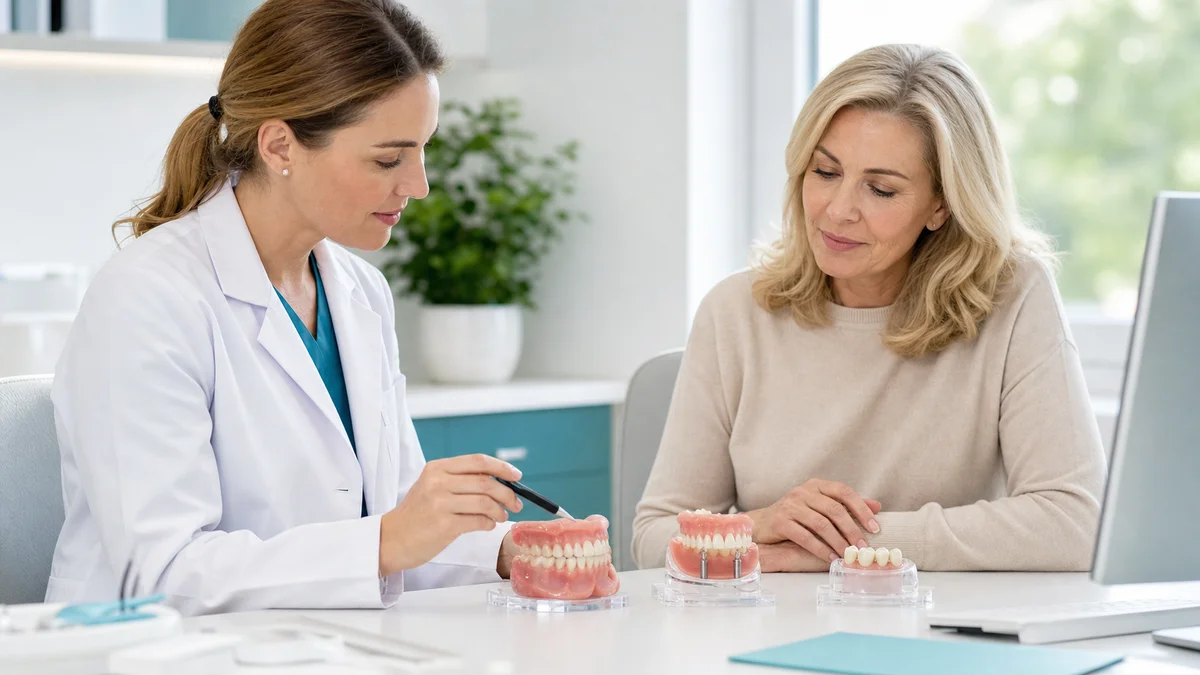
Typing dentures best option into a search bar sounds like a request for one winning appliance. In practice, the safest answer is more personal. A removable full denture, a partial denture, an implant-retained overdenture, a fixed implant restoration, a bridge or an implant crown can each be appropriate in different circumstances. The best choice is the one that fits the number and position of missing teeth, the condition of the remaining teeth and gums, the available bone, your general health, your ability to clean the restoration, your priorities and a realistic maintenance plan.
Quick answer: There is no single best denture for everyone. A conventional denture may be suitable when surgery is unwanted or inappropriate; a partial denture can preserve useful teeth; an implant overdenture may improve stability; and a fixed option can feel secure but needs sufficient anatomy, meticulous cleaning and ongoing maintenance.
This guide turns the dentures best option question into a structured conversation with a dentist. It explains what each design can and cannot do, how clinicians assess suitability, and why a lower initial price does not always equal a lower lifetime burden. It is general education, not a diagnosis. Pain, swelling, bleeding, a persistent sore area, a loose implant or a denture that suddenly stops fitting deserves professional assessment.
1. Dentures best option starts with the problem being solved
“Dentures” can mean several different restorations. A complete denture replaces all teeth in an upper or lower arch. A partial denture replaces some teeth and usually gains support or retention from the remaining teeth and oral tissues. An overdenture is removable but attaches to implants or, in selected cases, prepared tooth roots. A fixed full-arch restoration is supported by implants and is removed only by a dental professional. When only one or a few teeth are absent, a conventional bridge or an individual implant crown may be more relevant than a denture.
The first dentures best option checkpoint is therefore not material or brand. It is the clinical problem: what is missing, what remains healthy, what must be protected and what functions need to improve. Two people of the same age can receive very different recommendations because their bone, bite, saliva, hand skills and expectations differ.
- Extent: one tooth, several teeth or an entire arch.
- Support: remaining teeth, gum-bearing tissues, implants or a combination.
- Priority: stability, appearance, speech, chewing, removability, simpler care or avoiding surgery.
- Constraints: health conditions, healing capacity, anatomy, time, travel, budget and maintenance access.
2. Dentures best option may be keeping repairable teeth
Before comparing appliances, a dentist should decide whether remaining teeth are predictable enough to keep. A tooth with useful bone support and a restorable structure can sometimes help a partial denture, preserve sensation and reduce the size of a replacement. Conversely, retaining a tooth with uncontrolled infection, severe mobility or an unmanageable fracture can undermine the entire plan. Extraction is irreversible, so the reasoning should be explained clearly.
For the dentures best option decision, “save every tooth” and “remove everything” are both oversimplifications. The examination may include gum measurements, decay assessment, vitality tests, radiographs and a review of how the upper and lower teeth meet. A staged plan can sometimes stabilise gum disease or decay first, then reassess which teeth are dependable. Ask what evidence supports each tooth’s prognosis and how the plan changes if that tooth later fails.
3. Dentures best option for a completely toothless arch
A conventional complete denture rests mainly on the gum-covered ridge and is removable for cleaning. It avoids implant surgery and can replace the visible teeth and some lost soft-tissue volume. Upper complete dentures may gain useful suction when anatomy and fit allow. Lower complete dentures are often more challenging because the tongue, cheeks and smaller supporting area can move the appliance. Ridge shrinkage over time can also reduce stability.
A conventional complete denture can still be the dentures best option when surgery is not desired, healing risk is unacceptable, anatomy limits implant treatment or a simpler removable solution matches the person’s priorities. “Conventional” does not mean effortless. Successful use requires realistic expectations, careful impressions and bite records, adjustment visits, cleaning, night-time removal unless a clinician advises otherwise, and periodic reassessment as tissues change.
Adhesive may improve confidence for some well-made dentures, but it should not be used to disguise a chronically poor fit or pain. A sudden change in fit can result from wear, tooth movement, tissue change or disease. The solution may be adjustment, relining, remaking or treatment of the underlying problem—not simply adding more adhesive.
4. Dentures best option when several natural teeth remain
A removable partial denture fills spaces while the person keeps selected natural teeth. The design may use clasps, rests and guide surfaces to control movement. An acrylic partial is often easier to modify if more teeth are expected to be lost and may be useful as an interim restoration. A cast metal framework is usually thinner and more rigid, which can improve comfort and load distribution when the supporting teeth and design are suitable. Some flexible materials provide clasp aesthetics but may be harder to reline, repair or control in certain cases.
The dentures best option is not automatically the least visible clasp. A clasp that looks discreet but overloads a weak tooth is a poor trade. The dentist and technician need to plan where the denture rests, how it resists rotation and how food traps can be minimised. Sometimes small contour changes or surveyed crowns are proposed to improve the path of insertion. You should understand whether those procedures are essential, elective or avoidable with another design.
5. Dentures best option after recent extractions
An immediate denture is made before teeth are removed and inserted soon after extraction. Its main advantage is that the patient does not have to spend the early healing period without front teeth. It can also help shape expectations about appearance. Its limitation is biological change: gums and bone remodel after extraction, so the fit can change quickly. Adjustments, a temporary lining and eventually a reline or replacement may be needed.
When evaluating dentures best option after extractions, separate the temporary transition from the definitive restoration. An immediate denture may be the bridge between diseased teeth and a later conventional denture, overdenture or fixed implant restoration. The treatment estimate should state what is included: extractions, temporary denture, follow-up adjustments, relines and the final prosthesis. That prevents a low headline figure from hiding predictable later stages.
6. Dentures best option with implant retention
An implant-retained overdenture remains removable, but attachments connect it to implants for added retention. This can substantially reduce movement, particularly in the lower arch. The wearer can take it out to clean the denture and the implant attachments. The denture may still receive some support from the gum, depending on design. Attachment inserts wear and may need replacement; the denture and implants still require professional reviews.
For many people struggling with a loose lower complete denture, an overdenture becomes a strong dentures best option candidate. International Team for Implantology consensus reviews report better patient-reported outcomes for implant overdentures than conventional complete dentures, while also stressing that anatomy, opposing teeth, maintenance, cost and dexterity matter. Implant number and attachment design are clinical decisions, not a universal package.
Implants do not remove the need for hygiene. Plaque-related inflammation can develop around implants, and smoking, uncontrolled disease, previous gum disease and irregular maintenance may increase risk. Treatment can require imaging, surgery, healing time and sometimes bone augmentation. A responsible recommendation includes both expected benefits and the possibility that an implant is not advisable.
7. Dentures best option as a fixed full-arch restoration
A fixed implant-supported full-arch restoration is secured to implants and normally removed only by a clinician. Many patients value its stability and the feeling that the teeth remain in place. It may reduce the bulk needed for some removable designs, but adequate restorative space, implant distribution, bite control and cleanable contours are essential. The prosthesis can be acrylic-composite, metal-composite, ceramic or another system, each with different repair and wear characteristics.
A fixed restoration is not automatically the dentures best option merely because it is fixed. It can be more demanding to clean beneath, and it may cost more to make, maintain and repair. The ITI notes that patient-reported outcomes alone do not decide between fixed and removable full-arch treatment. Lip support, speech, smile line, jaw relationship, dexterity and the ability to attend maintenance visits may make a removable overdenture more appropriate.
Ask to see where brushes or irrigating aids must pass, what happens if a tooth or veneering material chips, and whether the design can be repaired locally. A plan that looks attractive on the day of fitting but cannot be cleaned or serviced is not patient-centred.
8. Dentures best option when a bridge or implant crown is possible
When only one or a short span of teeth is missing, a removable denture is only one option. A tooth-supported bridge can provide fixed replacement by using adjacent teeth, but those teeth usually need preparation and must be healthy enough to carry the load. An implant crown can replace a tooth without preparing its neighbours, although it involves surgery and adequate bone and tissue. In some situations, leaving a space is acceptable if function, stability and appearance are not compromised.
The dentures best option comparison should include these non-denture alternatives rather than presenting a removable appliance as the only route. A bridge may suit someone who wants a fixed result and has heavily restored adjacent teeth. An implant may be attractive when neighbours are untouched, yet risk, time and hygiene remain important. A partial denture may be more adaptable when several spaces exist or future tooth loss is likely.
9. Dentures best option comparison table
The table offers a conversation framework, not a prescription. “Best” depends on the balance between support, biological cost, cleaning and maintenance. The dentures best option should only be selected after examination and, where relevant, imaging.
| Option | Often considered when | Potential strengths | Important trade-offs |
|---|---|---|---|
| Conventional complete denture | All teeth in an arch are missing and a non-surgical removable route is preferred | Replaces teeth and some tissue volume; removable for cleaning; no implant surgery | Movement and adaptation; ridge changes; periodic reline or remake |
| Acrylic partial denture | Several teeth are missing, especially during transition or when modification may be needed | Usually adaptable and repairable | Can be bulkier; movement and load control depend heavily on design |
| Metal-framework partial denture | Healthy supporting teeth permit a planned definitive removable design | Rigid, often thinner, controlled support and retention | Needs precise planning; clasps may show; future modification can be complex |
| Implant overdenture | More retention is wanted but removability for cleaning remains valuable | Improved stability; easier access for cleaning than many fixed full-arch designs | Surgery, attachment wear, implant maintenance and sufficient anatomy |
| Fixed implant full arch | Fixed stability is a high priority and anatomy, health and hygiene are favourable | Secure feel and strong function for suitable patients | Higher complexity; cleaning beneath; repair and long-term service costs |
| Bridge or implant crown | One or a short span of teeth is missing | Fixed replacement without a removable plate | Tooth preparation or surgery; not suitable for every span or tissue condition |
10. Dentures best option depends on bone, gums and saliva
Oral anatomy influences support and retention. A broad, firm ridge may support a conventional denture better than a narrow, mobile or severely resorbed ridge. The depth of the vestibule, muscle attachments, palate shape and tongue movement matter. Bone quantity and quality affect whether implants are possible and whether grafting might be discussed. Healthy-looking gums do not replace imaging when critical anatomy or implant dimensions must be assessed.
Saliva also affects the dentures best option outcome. A thin film can help retention and comfort, while dry mouth can increase friction, soreness, decay risk around remaining teeth and difficulty swallowing. Dryness may relate to medication, systemic conditions or head-and-neck treatment. The answer is not necessarily stronger adhesive; it may require medical and dental review, hydration strategies, saliva substitutes, fluoride prevention and a design that minimises trauma.
11. Dentures best option depends on health and healing
A full medical history matters most when surgery, extraction or complex healing is involved. Diabetes control, medications that affect bleeding or bone, immune status, previous radiotherapy, smoking and cardiovascular conditions can change timing or risk. This does not mean a diagnosis automatically excludes implants. It means the dental team may need information from the treating physician, modified precautions or a non-surgical alternative.
For a safe dentures best option recommendation, disclose prescribed drugs, non-prescription products, allergies, tobacco and nicotine use, and previous problems with local anaesthetic or healing. Do not stop anticoagulants, osteoporosis medication or other treatment on your own. The relevant clinicians should coordinate changes when changes are actually indicated.
12. Dentures best option must be cleanable every day
Daily care is part of the treatment, not an optional extra. Removable dentures should generally be cleaned away from the mouth with a suitable brush and cleanser, handled over a soft surface or water-filled basin, and removed at night unless the dentist provides a different instruction. Remaining teeth, gums and tongue also need cleaning. Very hot water can distort some materials, and abrasive household products may scratch them.
The dentures best option can change if arthritis, tremor, visual impairment or cognitive change makes cleaning difficult. Large, easy-to-grip brush handles, an electric brush, a simpler attachment or a removable design may help. A fixed full-arch restoration can be excellent but is a poor match if the person or caregiver cannot clean beneath it. Caregivers should receive practical instructions and know which components are removable.
- Demonstrate removal and insertion before accepting the final appliance.
- Show exactly where plaque collects and which brush, floss threader or interdental aid fits.
- Confirm whether the denture should be stored dry or in liquid according to its material and clinician advice.
- Schedule reviews for soft tissues, remaining teeth, attachments, implants and bite—not just the visible denture teeth.
13. Dentures best option includes speech and appearance
Tooth position changes facial support, smile, lip movement and certain sounds. The whitest or straightest teeth are not always the most natural-looking choice. A trial stage can allow assessment of tooth display, midline, lip support and speech before final processing. With immediate dentures, some choices must be estimated before extraction, so photographs or information about the previous teeth can help.
Discussing the dentures best option means stating what you value without asking for a guaranteed imitation of a photograph. Bring examples of smiles you like, but expect the dental team to adapt shape and position to anatomy and function. A very bulky flange may improve lip support yet affect comfort or speech; reducing it may reveal tissue deficiency. These are design balances, not proof of poor workmanship.
14. Dentures best option is a lifetime-cost decision
Prices vary with diagnosis, materials, laboratory work, surgery, imaging, temporary restorations and local professional fees. A responsible clinic should provide an individual written estimate after assessment rather than promising one fixed universal price. Compare like with like: a quote for an acrylic temporary partial is not equivalent to a definitive metal framework, and an implant overdenture quote may or may not include attachments, relines or future replacement parts.
The lower upfront price may still be the dentures best option when it safely meets priorities and future care is understood. Equally, a more expensive fixed plan is not automatically more durable. Denture teeth wear, bases fracture, attachments lose retention, screws loosen, ceramic can chip and oral tissues change. Ask for likely service items, review intervals, warranty limits and who provides urgent repairs if you live or travel far from the clinic.
15. Dentures best option requires an adaptation plan
New dentures often feel unfamiliar. Saliva may increase temporarily, speech can change, and chewing usually improves gradually. Start with manageable bites, chew on both sides when appropriate and practise difficult words. Localised pressure spots can occur, but persistent pain is not something to “tough out.” Keep the denture available for the appointment so the dentist can identify the precise contact area; avoid repeatedly filing it yourself.
A good dentures best option pathway sets expectations for review. Immediate dentures need closer monitoring during healing. New complete dentures may need adjustments as muscles learn to control them. Implant restorations need soft-tissue and component reviews. Adaptation varies, and no ethical clinician should promise a painless process, identical chewing to natural teeth or a guaranteed lifespan.
16. Dentures best option and warning signs
Routine review matters even when no natural teeth remain because the mouth and appliance can change. Seek dental advice for repeated ulcers, bleeding, swelling, a persistent red or white patch, numbness, a new lump, bad taste, sudden looseness, clicking, fracture or an implant component that moves. A sore area that does not settle after removing the denture should not be ignored.
The dentures best option is never an appliance that masks unexplained symptoms. Remove a painful removable denture when safe to do so and contact a dentist, but follow professional advice about wearing it before an adjustment appointment. Facial swelling with breathing or swallowing difficulty, uncontrolled bleeding or severe systemic symptoms may require urgent medical care.
17. Dentures best option consultation checklist
A useful consultation should end with reasons, alternatives and a sequence—not only a product name. If several routes are clinically reasonable, ask the clinician to compare what each one means for surgery, removability, cleaning, appearance, repair and cost. If only one route is recommended, ask why the others are unsafe or unlikely to meet your goals.
Use this dentures best option checklist:
- Which teeth can predictably remain, and what evidence supports that judgement?
- Is the proposed appliance temporary, transitional or definitive?
- Where will it gain support and retention, and what movement should I expect?
- Would an implant overdenture, fixed bridge, implant crown or no replacement be reasonable?
- What medical or anatomical factors change surgery and healing risk?
- Can I remove, insert and clean it with my current dexterity?
- Which adjustments, relines, attachment changes and reviews are included?
- What signs mean I should contact the clinic urgently?
18. Dentures best option planning at Redent Klinik
At Redent Klinik, a treatment discussion can compare removable and fixed possibilities after an examination rather than treating one technique as universally superior. Bring a medication list, previous dental records if available, any current denture and a note of the difficulties you want solved. Photos of an earlier natural smile may help with appearance planning, but they do not replace clinical measurements.
If you want to explore your dentures best option, use the English contact page to request an assessment. A remote conversation may help organise records and explain the process, but definitive suitability, especially for implants or extractions, requires appropriate in-person examination and imaging. A personalised plan should describe alternatives, limitations and maintenance before consent.
19. Dentures best option frequently asked questions
Are implant dentures always the dentures best option?
No. Implant retention can improve stability and patient-reported outcomes, particularly for a difficult lower complete denture, but it involves surgery, sufficient anatomy, hygiene and maintenance. A conventional denture may be safer or more aligned with a person’s wishes. Some people value a removable overdenture because it is easier to clean than a fixed full-arch restoration.
Which denture material lasts the longest?
There is no single material that wins independently of design and care. A rigid metal partial framework may distribute forces well, while acrylic is often easier to repair or add teeth to. Flexible materials have selected uses but can be harder to adjust or reline. For the dentures best option, support, fit, bite and maintenance matter at least as much as the material label.
Can I sleep in my dentures?
Many patients are advised to remove removable dentures at night to rest tissues and clean both the appliance and mouth. Individual instructions may differ after surgery or for a specific condition. Follow the treating dentist’s advice. Regular overnight wear without cleaning may contribute to inflammation and infection risk.
Will a new denture let me eat everything immediately?
No result should be guaranteed. Most people need an adaptation period, beginning with manageable foods and practising balanced chewing. Implant retention can improve function in suitable patients, but restorations still have limits. Hard or sticky foods can damage components. Persistent pain, instability or an altered bite needs review rather than repeated self-adjustment.
Is denture adhesive a solution for a loose denture?
Adhesive can sometimes improve confidence and retention when used correctly with a suitable denture. It cannot correct a worn, fractured or poorly fitting base, uncontrolled ridge change or disease. If you need increasing amounts, arrange an assessment. The dentures best option may be adjustment, reline, remake or a different support strategy.
How many implants are needed for an overdenture?
The answer depends on the arch, bone, opposing teeth, attachment design and treatment goal. ITI consensus reports strong patient-reported outcomes for a two-implant lower overdenture in appropriate cases, but this is not a prescription for every patient. The upper arch and complex anatomy may require a different configuration. Imaging and restorative planning must come before a number.
Can old dentures be relined instead of replaced?
Relining can improve the tissue fit when the denture’s tooth position, bite, base integrity and appearance remain acceptable. It will not correct every problem. A heavily worn bite, repeated fracture, poor tooth position or major design limitation may make replacement more predictable. The clinician should explain what a reline can realistically change.
How often should dentures and implants be checked?
Review intervals should reflect oral health, remaining teeth, implant history, smoking, dexterity and appliance condition. People with higher risk may need closer monitoring. Even complete denture wearers benefit from oral soft-tissue checks. Ask for an individual recall schedule rather than assuming that having no natural teeth means no dental visits.
What is the dentures best option if I have a dry mouth?
Dry mouth can reduce comfort and retention, so the cause and prevention needs should be assessed first. Medication review with the appropriate prescriber, fluoride protection for remaining teeth, hydration guidance and saliva-support measures may help. Appliance design should minimise friction and be easy to clean. Do not change prescribed medicine without medical advice.
20. Dentures best option: the final decision
The most reliable answer to dentures best option is a defensible clinical match, not a universal ranking. Conventional complete dentures avoid implant surgery. Partial dentures can preserve and use suitable teeth. Implant overdentures can improve retention while remaining removable. Fixed implant restorations can provide strong stability but demand anatomy, cleaning and long-term service. Bridges and implant crowns may be better for shorter spaces.
Choose the plan whose benefits, limitations, alternatives and maintenance you can explain back in your own words. Ask for a written sequence and cost breakdown, and allow time for questions before irreversible treatment. A second opinion is reasonable when recommendations differ sharply or the plan involves extensive extraction or surgery.
Evidence and patient-information sources
- NHS: Dentures — complete and partial dentures, adaptation, cleaning and when to seek review.
- NHS: Dental treatments — dentures, bridges and implant-supported replacements.
- American Dental Association and its denture care topic — types, cleaning, adhesive and professional review.
- World Health Organization oral health fact sheet — broader prevention and oral-health context.
- ITI consensus: implant-supported fixed dentures and overdentures — patient-reported outcomes and selection factors.
- ITI consensus: removable versus fixed implant prostheses — why outcomes, anatomy, hygiene and patient priorities all matter.