
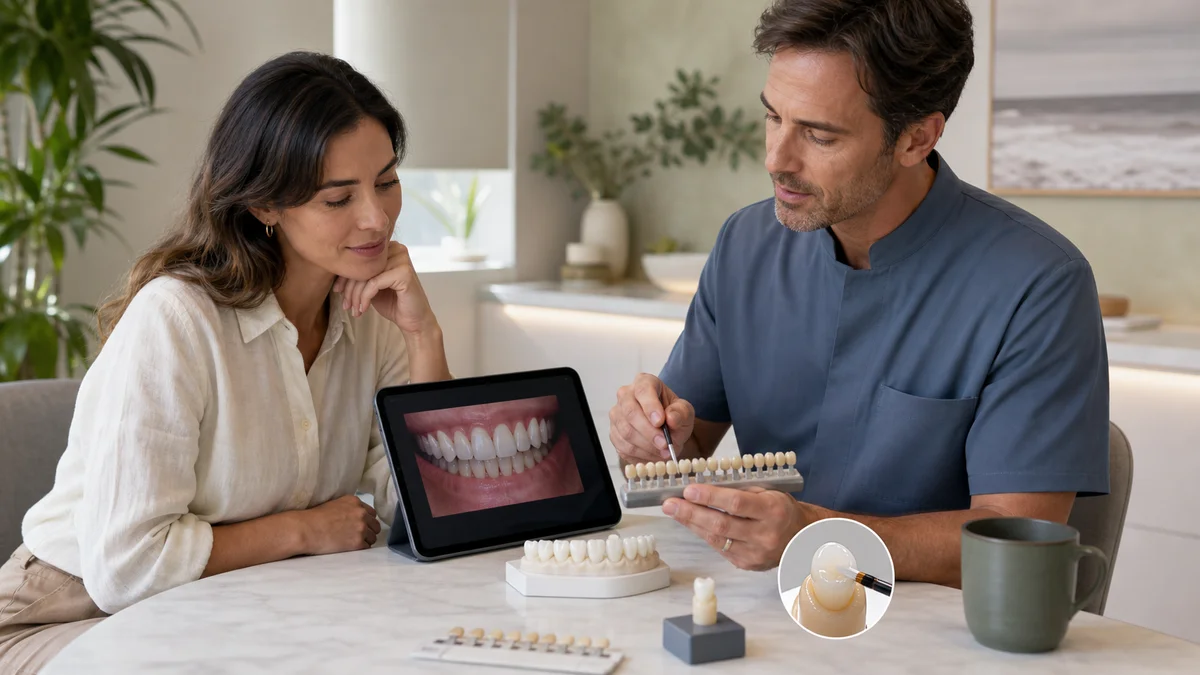
Quick answer: A safe quote for direct composite veneers depends on the number and condition of teeth, design complexity, shade layering, bite assessment, preparation, polishing and included reviews. Ask whether repairs, whitening, gum treatment or a protective appliance are separate. Composite can require less enamel removal and may be easier to repair than porcelain, but it generally stains and wears more readily.
When people search direct composite veneers price, they often see a per-tooth figure without a shared definition of “veneer.” One clinic may describe a small additive edge repair; another may mean full facial coverage with layered shades, detailed contouring and bite adjustment. A quote can also exclude examination, radiographs, whitening, mock-ups, gum treatment, polishing visits or a night guard. Those are not interchangeable plans.
A direct composite veneer is made chairside by bonding tooth-coloured resin to the visible surface of a tooth and sculpting it in the mouth. It differs from a laboratory-made ceramic veneer, which is manufactured outside the mouth and later bonded to the tooth. The American Dental Association’s consumer information notes that composite veneers may require less enamel removal and fewer visits and can be easier to repair, but they are generally less resistant to staining and wear than porcelain.
This guide turns direct composite veneers price into an itemised clinical and financial comparison. It gives no fixed fee, does not determine suitability and does not promise a particular smile or lifespan. It is prepared for review by Dentist Esma Çevrük Çakır and is based on current professional, regulatory and government information checked on 2 August 2026.
1. direct composite veneers price: Why a per-tooth number is not enough
The visible result reflects far more than the amount of resin used. Time is spent diagnosing the concern, planning proportions, selecting shades, controlling moisture, applying adhesive, layering and curing composite, creating surface texture, polishing margins and checking the bite. Two teeth with similar size can require very different work if one has an old restoration, dark substrate, fracture, rotation, gum asymmetry or heavy bite contact.
For direct composite veneers price, a useful estimate should say how many teeth are included and what is being done to each tooth. “Composite bonding,” “edge bonding,” “composite build-up” and “direct composite veneer” are sometimes used loosely in marketing. Ask the dentist to identify whether coverage is limited to an edge, a corner, selected surfaces or most of the front surface.
- Small additive repair: replaces a chip or refines an edge without covering the whole front surface.
- Contour bonding: changes limited shape, spacing or symmetry.
- Direct composite veneer: layers resin across much of the facial surface to alter shape, shade or both.
- Replacement work: removes or repairs existing composite and rebuilds the surface.
- Complex rehabilitation: coordinates several teeth, the bite, gum levels and other restorations.
Without this scope, one direct composite veneers price cannot be compared with another fairly. The lowest headline may describe the smallest intervention rather than the same completed treatment.
A shared definition is therefore the first safeguard in every direct composite veneers price comparison.
2. Examination before cosmetic bonding protects the tooth
Veneers should not be placed over untreated decay or active gum disease. The ADA advises that oral health problems should be addressed first because covering an unhealthy tooth can worsen an existing problem. The dentist also needs to evaluate cracks, old fillings, enamel availability, sensitivity, tooth position and the bite.
A clinically responsible direct composite veneers price pathway starts with diagnosis rather than a social-media photograph. Some concerns may be treated more conservatively with whitening, orthodontics, minor reshaping, a small repair or no treatment. Others may require a restoration for health as well as appearance. Consent is meaningful only when alternatives and the option of declining cosmetic treatment are clear.
What the dentist should assess
- decay, cracks, erosion, wear and existing restorations;
- gum inflammation, recession, tooth length and visible margins;
- enamel available for predictable bonding;
- clenching, grinding, deep overbite and edge-to-edge contacts;
- tooth colour, translucency and the source of dark areas;
- spacing, crowding, tooth position and smile proportions;
- expectations, maintenance capacity and tolerance for future repair.
The examination explains why direct composite veneers price may include diagnostic records or preparatory care. Those items should be justified, not automatically bundled into every case.
Diagnosis gives the final direct composite veneers price clinical context rather than promotional context.
3. The eight components of an itemised quote
A written plan should separate known treatment from optional or conditional items. The UK Competition and Markets Authority advises patients to obtain a written treatment plan before care begins and to receive an updated plan if treatment or estimated costs change. The General Dental Council likewise requires clear cost information and a realistic estimate in a written plan.
1. Consultation and records
This may include a dental examination, photographs, radiographs when clinically indicated, digital scans or impressions, and assessment of the bite. Ask whether the first consultation is included in the advertised direct composite veneers price or charged separately.
2. Design and trial stage
Simple repairs may need no separate mock-up. Multi-tooth changes may benefit from a wax-up, digital preview or temporary trial. These tools help discuss length and shape but cannot guarantee that a simulation will match biology, materials and live facial movement exactly. Confirm whether design revisions are included.
3. Existing composite removal or repair
Replacing old bonding can take additional time because material must be distinguished from natural tooth and removed conservatively. The dentist must also decide whether the underlying tooth is healthy and whether the new bond has a sound surface. A first-time veneer and a complex replacement should not be assumed to carry the same direct composite veneers price.
4. Isolation and adhesive steps
Composite bonding is technique-sensitive. Moisture control, tooth cleaning, conditioning, adhesive application and adequate light curing influence the restoration. The ADA describes resin composite as a mixture of polymer resin matrix and inorganic filler; the material is applied and polymerised rather than simply “painted” on.
5. Shade selection and layering
A single opaque shade may not mimic enamel, dentine and translucency in a visible area. Complex shade masking or natural characterisation can require several materials and more chair time. The number of layers alone is not a quality score, but the plan should explain whether a simple monochromatic repair or a detailed aesthetic build-up is proposed.
6. Contouring, texture and polishing
The dentist shapes contact points, embrasures, line angles and the surface, then polishes the composite and margins. Finishing affects how the veneers feel, clean and reflect light. Ask whether a separate refinement or re-polishing visit is included in direct composite veneers price.
7. Bite adjustment
New length or contour must be checked in normal closure and movements. Heavy contact can increase chipping risk. If clenching or grinding is suspected, the dentist may discuss a protective appliance, but it should be listed as a separate recommendation rather than silently added.
8. Follow-up, repairs and maintenance
Ask which early review is included, how polishing is scheduled and how a chip, stain or open margin is assessed. A repair policy is not the same as a biological guarantee. Written terms should distinguish material adjustment, accidental damage, wear, new decay and changes in the natural teeth.
These eight layers give direct composite veneers price a clear scope. The completed quote should state the number of teeth, clinical assumptions, payment timing and foreseeable items outside the total.
Keep that itemisation with the accepted direct composite veneers price and any later written revisions.
4. Decision table: compare direct composite quotes on equal terms
| Quote line | What to verify | Why it changes value | Question to ask |
|---|---|---|---|
| Number and surfaces of teeth | Edge repair, partial coverage or full facial veneer | “Per tooth” can describe different amounts of work | What exactly will be added to each tooth? |
| Records and planning | Examination, photos, scans, radiographs and mock-up | Some headlines exclude the diagnostic stage | Which records are included and clinically necessary? |
| Preparation | Additive plan or enamel/tooth reduction | Irreversibility and future treatment differ | Will any natural tooth be removed, and why? |
| Material and layering | Composite system, shade strategy and masking needs | Complex colour correction takes more time | Is the aim shape change, colour change or both? |
| Finishing | Contouring, bite check, polishing and refinement | A rough or bulky result is not a completed veneer | Is the review and final polish included? |
| Preparatory treatment | Whitening, gum care, decay treatment or orthodontics | These may be separate and alter sequencing | What must be completed before bonding? |
| Aftercare | Maintenance, repair terms and protective appliance | Long-term costs are not visible in the initial figure | What is included if a veneer chips or stains? |
Apply this table to every direct composite veneers price proposal. A cheaper edge repair should not be placed beside a full-coverage, multi-shade veneer and treated as the same product.
Equal columns make each direct composite veneers price easier to assess without relying on package names.
5. Direct composite versus porcelain: price follows a different workflow
Direct composite is shaped in the mouth and may often be completed in fewer visits. Porcelain veneers are indirect restorations, usually involving scans or impressions, laboratory manufacture, a fitting stage and bonding. ADA materials guidance distinguishes direct restorations made in the mouth from indirect restorations made outside it. The workflows, materials, repair options and preparation can differ substantially.
The ADA’s MouthHealthy page says composite veneers may need less enamel removal and are easier to fix if damaged, while porcelain tends to be stronger, longer-lasting and more stain-resistant. These are general comparisons, not promises for a particular patient. A direct composite veneers price discussion should therefore include durability expectations and maintenance, not imply that lower initial cost automatically wins.
Material choice should follow the diagnosis before the direct composite veneers price is treated as decisive.
When a composite option may be attractive
Composite may be considered for conservative shape changes, small gaps, chipped edges, developmental size differences or a repairable aesthetic trial. It can be useful when adding material is possible without extensive tooth reduction. Suitability depends on enamel, bite, tooth position, colour and expectations.
When direct composite may have limitations
Severe colour masking, large positional changes, limited enamel, heavy grinding, deep bite or very high resistance-to-stain expectations may complicate the plan. Composite can wear, stain, chip or lose polish. Those limitations do not make it “bad”; they define the maintenance trade-off behind direct composite veneers price.
6. Additive does not always mean fully reversible
Some direct composite work can be mostly or entirely additive, with little or no tooth removal. Other cases need reshaping, roughening, removal of old material or reduction to avoid excessive bulk. The exact preparation should be explained tooth by tooth. Even when no drilling is planned, adhesive treatment and future maintenance mean the decision should not be marketed as consequence-free.
The ADA cautions that veneer treatment may be irreversible when enamel is removed. For direct composite veneers price, ask the dentist to document what natural tissue will be changed, whether the plan remains in enamel and what may be required if the composite is later removed or replaced.
Conservation is part of the value represented by direct composite veneers price, even though it is not a visible invoice material.
Why “no-prep” is a diagnosis, not a product label
A no-preparation approach can create excessive thickness or affect cleaning if the tooth position and planned contour do not allow space. Conversely, unnecessary removal sacrifices healthy tissue. The right balance is site-specific and should follow a three-dimensional design, not a universal advertising claim.
7. Tooth count, symmetry and the smile zone
More teeth generally require more clinical time and material, but treatment should not be sold in preset multiples without aesthetic and functional reasoning. Sometimes one chipped tooth can be matched conservatively. Sometimes treating an uneven number creates a visible transition. The smile line, tooth display, natural asymmetry and existing restorations all matter.
A thoughtful direct composite veneers price plan explains why a certain number of teeth is proposed. It should not pressure a patient to cover healthy teeth simply to qualify for a package. Ask whether a mock-up can show the boundary between treated and untreated teeth before committing.
Tooth count should be justified clinically before it multiplies direct composite veneers price.
8. Whitening, shade timing and colour limitations
Composite does not whiten predictably after placement in the way natural teeth may respond to bleaching. If whitening is desired, it is often discussed before final shade selection, with time allowed for the colour to stabilise. Existing fillings, crowns and veneers also may not change colour. The sequence affects both result and total cost.
When reviewing direct composite veneers price, ask whether whitening is recommended, optional or unnecessary; whether it is included; and how long the dentist intends to wait before bonding. Whitening has its own suitability and sensitivity considerations. It should not be bundled without consent.
Can composite hide every dark tooth?
No material can guarantee invisible masking in every situation. A dark substrate may require opaque layers, additional thickness or a different restorative strategy. Excessively opaque composite can look flat, while excessive thickness can affect contour. A dark single tooth may also require diagnosis before cosmetic coverage.
9. Gum contour, margins and cleanability
Healthy gums frame the restoration. Active inflammation, recession or uneven levels can influence timing and design. Composite margins should be accessible for cleaning and polished to reduce plaque retention. Adding bulk near the gum can make hygiene difficult and may irritate tissue.
A complete direct composite veneers price estimate should identify whether periodontal cleaning, gum treatment or contouring is proposed separately. It should also explain why. Gum procedures are not a routine requirement for every cosmetic case, and cosmetic contouring is not a substitute for treating disease.
Healthy, cleanable margins matter more than minimising the initial direct composite veneers price.
10. Repairs, staining and the lifetime cost
The ADA notes that composite veneers are easier to repair than porcelain but are not as resistant to staining or wear. UCLH patient information similarly describes direct composite as relatively easy to repair or repolish. That repairability is valuable, but it does not mean every repair is free or that repeated work never affects the tooth.
Long-term direct composite veneers price should account for reviews, professional polishing, local repairs and eventual replacement. Diet, smoking, oral hygiene, bite, grinding, material thickness and the size of the restoration may influence maintenance. No ethical article can assign one lifespan to everyone.
A maintenance forecast makes direct composite veneers price more realistic over time.
What a written repair policy should clarify
- which early adjustments or polish visits are included;
- how accidental fracture differs from a material defect;
- whether a local repair is possible or full replacement is needed;
- what maintenance frequency is recommended;
- whether a protective appliance is required for warranty terms;
- what happens if new decay, gum recession or tooth movement changes the margin.
Read these terms before accepting direct composite veneers price, not after a chip occurs.
11. Insurance, public coverage and financing
Veneers are usually considered cosmetic, and the ADA notes they may not be covered by insurance unless deemed medically necessary. Policy rules vary by country and plan. An insurer may classify a direct composite veneer differently from a restoration placed because of fracture or decay, but the dentist must code the actual diagnosis and service rather than relabel cosmetic work.
For direct composite veneers price, send the itemised plan to the insurer and request a written benefit estimate. Confirm deductibles, waiting periods, annual maximums, exclusions, pre-authorisation and network rules. A benefit estimate is not a guarantee of payment if eligibility or policy terms change.
Questions before using a payment plan
- What is the total payable, including mandatory fees and interest?
- Is the credit provided by the clinic or a separate finance company?
- What happens if treatment changes, stops or is refunded?
- Are missed-payment fees or early-repayment rules clearly stated?
- Can you compare the credit agreement independently before treatment?
Financing can spread payments but does not reduce the clinical need for informed consent. Do not let a same-day approval deadline replace comparison of direct composite veneers price and alternatives.
12. Licensed care and social-media “veneer technicians”
The ADA warns that unlicensed veneer services can expose people to infection, nerve damage and treatment over unhealthy teeth. Dental procedures that alter teeth should be provided by appropriately licensed or registered dental professionals. In the UK, the General Dental Council describes offering dental treatment while unregistered as illegal practice.
A very low direct composite veneers price from an unverified provider is not a comparable quote. Check the professional register for the country where care will occur. Ask who examines the teeth, who provides the bonding, who manages complications and whether the premises and infection-control arrangements are regulated.
Registration and accountability belong beside direct composite veneers price in every shortlist.
Red flags in a veneer offer
- no dental examination before payment or placement;
- no check for decay, gum disease, cracks or bite problems;
- guaranteed “perfect” or permanent results;
- unclear identity, registration or role of the provider;
- one material and one shape offered to every patient;
- no written treatment plan, consent process or emergency contact;
- pressure to cover many teeth because a discount expires.
These warnings are more important than any promotional direct composite veneers price.
13. Questions to ask before accepting the quote
The CMA’s 2026 consumer guidance recommends checking prices, comparing options and holding a written treatment plan before treatment starts. Use the same questions at each consultation so scope is comparable.
- What diagnosis and aesthetic concern are we treating?
- Could whitening, orthodontics, a small repair or no treatment meet the goal?
- How many teeth are proposed, and why that number?
- Is each service edge bonding, partial coverage or a full direct veneer?
- Will any enamel or tooth structure be removed?
- Are examination, photographs, scans, mock-up and radiographs included?
- Does the plan include removal of old composite?
- How will shade, opacity, texture and symmetry be designed?
- Are bite checks, refinement and the final polish included?
- Is whitening, gum treatment or a protective appliance separate?
- What maintenance and repair should I reasonably expect?
- What could change the estimate, and will I receive an updated plan?
- Who provides urgent care if I have pain, a sharp edge or a fracture?
This checklist transforms direct composite veneers price from a sales number into clinical and financial consent. If answers are unclear, pause before irreversible work.
Clear answers let direct composite veneers price be evaluated without surrendering time for a second opinion.
Frequently asked questions about direct composite veneers price
How much do direct composite veneers cost per tooth?
There is no safe universal fee. Scope can range from a small edge repair to full facial layering with complex shade masking and bite adjustment. Location, clinician time, replacement of old work, records and aftercare also vary. Ask for an examined, written and itemised direct composite veneers price.
Why are some composite veneer quotes much cheaper?
They may describe less coverage, fewer planning records, a simpler shade, no mock-up or no included review. Price alone cannot establish quality, and higher cost cannot guarantee it. Compare the number of teeth, preparation, finishing, maintenance and provider registration on equal terms.
Are direct composite veneers cheaper than porcelain?
Direct composite commonly involves no laboratory veneer and may require fewer visits, so its initial fee may be lower. Porcelain has a different laboratory and bonding workflow and tends to resist stain and wear better. Compare preparation, repairability, maintenance and long-term goals rather than initial price alone.
Can direct composite veneers be done without drilling?
Sometimes treatment is additive with little or no removal, but not every tooth position allows a healthy contour without preparation. Old composite may need removal, and small adjustments may be recommended. The dentist should document what will change before consent.
How long do composite veneers last?
No single lifespan applies to every patient. Size, bite, grinding, oral hygiene, diet, smoking, material and maintenance influence wear, staining and chipping. Ask about review and repair rather than accepting a guaranteed number of years as the basis for direct composite veneers price.
Can a chipped composite veneer be repaired?
Often a local repair is possible, which is one advantage of direct composite, but feasibility depends on fracture location, remaining bond, bite and condition of the tooth. Some failures require replacement. Ask how repair fees and review appointments are handled.
Do composite veneers stain?
They can lose surface polish or stain over time more readily than porcelain. Smoking and strongly coloured foods or drinks may contribute, but individual change varies. Professional repolishing may help some surface changes; it cannot correct every shade mismatch or underlying problem.
Should I whiten before composite veneers?
If whitening is desired and clinically suitable, it is usually discussed before final shade matching because composite itself will not predictably whiten later. The dentist may allow colour to stabilise before bonding. Whitening is a separate procedure with its own risks and fee.
Will insurance cover direct composite veneers?
Purely cosmetic veneers are frequently excluded. A restoration for fracture or disease may be assessed differently, but coverage depends on the policy, diagnosis and submitted service. Obtain a written insurer estimate; do not assume a quoted percentage applies to cosmetic direct composite veneers price.
Do I need veneers on every front tooth?
No preset number suits everyone. The visible smile zone, transition to untreated teeth, existing restorations and goal affect planning. Treating extra healthy teeth solely to enter a package should be questioned. A mock-up may help evaluate a conservative boundary.
Are direct composite veneers reversible?
Not reliably in every case. Some additive composite may be removed conservatively, but preparation, adhesive treatment, underlying stains, repairs and later replacement can create ongoing treatment needs. Ask what tooth structure will be changed and what removal would involve.
What if I grind my teeth?
Grinding or heavy bite contacts can increase concern for chipping and wear. The dentist should assess the bite and discuss whether shape, material, orthodontics or a protective appliance changes the plan. A night guard may reduce some risk but cannot guarantee veneers will not fail.
Conclusion: value comes from scope, conservation and follow-up
The clearest direct composite veneers price is a written plan produced after examination. It defines each tooth, coverage, preparation, design, material layering, finishing, bite adjustment, included reviews and conditional items. It also explains alternatives, future repairs and the process if the plan or estimate changes.
Composite can be conservative and repairable in suitable cases, but it is not maintenance-free and cannot guarantee a particular shade, symmetry or lifespan. Verify the provider’s registration, treat disease first, understand any enamel removal and compare equivalent scopes. For an individual assessment, use the Redent Klinik contact page; the Redent Klinik English homepage explains the clinic’s broader approach. Online information cannot replace an examination.
Sources and further reading
- American Dental Association MouthHealthy: Veneers, composite and porcelain comparisons, risks and licensed care
- American Dental Association: Materials for direct restorations
- American Dental Association: Official portal
- NHS: Dental treatments, including veneers
- University College London Hospitals: Direct composite reshaping and repairability
- UK Competition and Markets Authority: Choosing and paying for dental care
- General Dental Council: Written treatment plans and cost communication
- General Dental Council: Illegal and unregistered dental practice
- World Health Organization: Oral health fact sheet
Sources checked 2 August 2026. This educational article does not replace individual diagnosis, a written treatment plan or policy-specific insurance confirmation.