
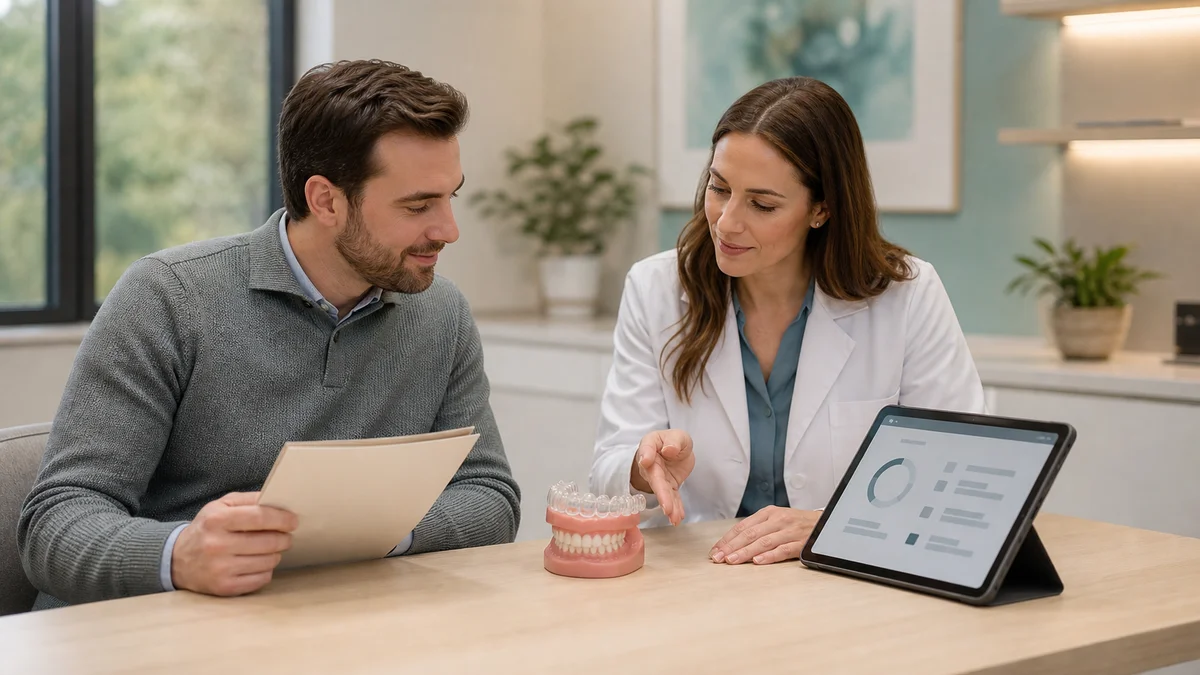
Does FSA cover Invisalign treatment? In many U.S. health flexible spending arrangements, professionally prescribed orthodontic treatment can be reimbursable as a qualified dental expense. The current FSAFEDS eligible-expense tool explicitly lists Invisalign and other clear dental aligners as eligible with a detailed receipt. That is useful evidence, but it is not a universal approval for every employer plan, payment schedule, patient, or clear-aligner purchase.
The final answer depends on the plan document, the reason for treatment, the person receiving care, when the expense is considered incurred, other reimbursement, and the documentation submitted. Clinical suitability is a separate question: an FSA eligibility listing does not replace an examination, individualized diagnosis, treatment plan, or monitoring by a licensed dentist or orthodontist.
Quick answer: does FSA cover Invisalign? Often yes when clear-aligner treatment is a qualified orthodontic expense for an eligible participant, spouse, or dependent and the claim follows the employer plan’s rules. Confirm coverage before paying, coordinate dental insurance first, obtain an itemized receipt and orthodontic contract, and verify how the plan treats down payments, monthly installments, retainers, and prepaid care.
does fsa cover invisalign: the short rule and its limits
IRS Publication 502 says dental treatment for the prevention or alleviation of dental disease can include braces, along with examinations, X-rays, fillings, extractions, and other dental care. IRS Publication 969 says a health FSA reimburses qualified medical expenses specified by the employer plan that would generally qualify for the medical and dental expense deduction. Together, those rules support orthodontia as a common eligible category.
However, the question does FSA cover Invisalign cannot be answered from IRS language alone. The employer’s summary plan description and administrator control how a claim is substantiated and when a long orthodontic course becomes reimbursable. A general-purpose health FSA, a limited-purpose dental and vision FSA, an HSA, and an HRA are different arrangements. Ask the administrator about the exact account on the benefits portal.
- Confirm that the account is a health FSA or limited-purpose health FSA, not a dependent-care FSA.
- Check whether the patient is an eligible participant, spouse, or tax dependent under the plan.
- Verify that the treatment is qualified orthodontic care rather than a cosmetic-only purchase.
- Determine the plan’s rule for the service date, payment date, and prepaid orthodontia.
- Subtract amounts paid or expected from dental insurance or another health plan.
- Collect the treatment plan, itemized receipt, proof of payment, and explanation of benefits when relevant.
does fsa cover invisalign because it is a brand?
Invisalign is a brand of sequential clear aligners. An FSA generally evaluates the underlying medical or dental expense, not the marketing name alone. A different professionally managed aligner system may be treated similarly if it meets the plan’s definition of qualified orthodontia and the claim documentation is sufficient. Conversely, a familiar brand name does not override an exclusion or missing documentation.
This distinction improves the answer to does FSA cover Invisalign. Ask the administrator about “orthodontic treatment with clear aligners,” then identify the provider, patient, service, payment arrangement, and expected insurance benefit. Do not assume that reimbursement approval means a particular product is clinically appropriate. Benefit administrators review claims; dentists and orthodontists assess oral health and treatment suitability.
does fsa cover invisalign: 12-point decision table
Use the following table before relying on FSA funds. It is an organizing tool, not tax, legal, insurance, or clinical advice. The authoritative answer comes from the current plan and an individualized dental assessment.
| Check | What generally supports reimbursement | What can delay or prevent reimbursement | Best next step |
|---|---|---|---|
| 1. Account type | Health FSA or a limited-purpose FSA that covers dental expenses | Dependent-care FSA or another account selected by mistake | Read the account name and summary plan description |
| 2. Eligible patient | Participant, spouse, or eligible dependent under the plan and tax rules | Person outside the plan’s eligibility definition | Ask the administrator before treatment |
| 3. Purpose | Qualified orthodontic treatment to prevent, treat, or alleviate a dental condition | Service considered solely cosmetic under applicable rules | Keep the clinician’s diagnosis and treatment rationale |
| 4. Provider and supervision | Documented care prescribed and monitored by a licensed dental professional | Unclear provider, unsupervised purchase, or missing treatment record | Verify clinical responsibility and licensing |
| 5. Treatment start | Active treatment has begun under the plan’s rule | Payment for future care before the plan regards the expense as incurred | Ask for the exact eligible date in writing |
| 6. Down payment | Itemized orthodontic down payment after treatment begins, if allowed | Generic deposit without service detail | Obtain an orthodontic contract and paid receipt |
| 7. Monthly installment | Payment within the benefit period supported by a ledger or statement | Balance-forward statement without patient, provider, or service details | Submit the monthly itemized record required by the plan |
| 8. Lump-sum prepayment | Allowed under the plan’s orthodontia rule with contract and proof | General future-expense rule or plan restriction on advance reimbursement | Get administrator confirmation before prepaying |
| 9. Dental insurance | Claim reflects only the patient’s final unreimbursed responsibility | Attempt to reimburse an amount paid by insurance or another plan | Include the explanation of benefits or coverage estimate |
| 10. Documentation | Patient, provider, date, service, amount, and proof of payment are clear | Credit-card slip, canceled check, estimate, or vague receipt alone | Request a detailed receipt and complete treatment plan |
| 11. Plan-year balance | Election and available reimbursement cover the approved claim | Insufficient election, forfeited funds, or missed run-out deadline | Check the portal balance, deadlines, carryover, or grace period |
| 12. Related items | Clinically required records, refinements, or retainers documented as qualified care | Cosmetic add-ons, whitening, replacement caused by misuse, or unclear bundling | Ask the plan to evaluate each line item separately |
does fsa cover invisalign under the 2026 contribution limits?
For plan years beginning in 2026, the IRS says the limit on voluntary employee salary-reduction contributions to a health FSA is $3,400. If a cafeteria plan permits carryover, the indexed maximum carryover is $680. An employer plan can set a lower election or carryover amount, and employer contributions can affect the available balance. The federal maximum is not a promise that the full orthodontic cost will fit in one election.
When planning around does FSA cover Invisalign, use the limit for the correct plan year rather than an old benefits article. Also separate “annual election” from “available reimbursement.” IRS Publication 969 explains that a participant may generally access the maximum elected health FSA reimbursement during the coverage period even before the same amount has been withheld from pay, subject to qualified-expense and plan rules.
does fsa cover invisalign across carryover and grace periods?
Health FSAs are generally use-it-or-lose-it arrangements. A plan may offer either a grace period of up to two and a half months or a carryover, but it is not required to offer either. A plan with a carryover cannot also provide a health FSA grace period for the same plan year. The current plan controls the actual design and any lower carryover limit.
A run-out period is different: it is time after the plan year to submit claims for eligible expenses incurred during the applicable coverage period. It does not usually create extra time to incur a new expense. For does FSA cover Invisalign, write down four dates: coverage start, treatment or payment date recognized by the plan, plan-year end, and claim-submission deadline. Do not schedule or prepay treatment only to prevent forfeiture without confirming clinical need and the reimbursement rule.
does fsa cover invisalign if treatment is cosmetic?
IRS Publication 502 generally excludes procedures directed only at improving appearance when they do not meaningfully promote proper body function or prevent or treat illness or disease. Orthodontics may address crowding, spacing, bite relationships, function, or other clinically assessed conditions, but an online desire for a straighter smile does not establish that a specific claim qualifies.
Therefore, does FSA cover Invisalign when the aim is cosmetic is a fact- and plan-specific question. The plan may request a treatment statement or additional evidence. A letter of medical necessity is not automatically required for every orthodontic claim, and it does not force approval. Ask the administrator which document is needed, then have the treating professional describe the actual diagnosis and plan without exaggeration.
does fsa cover invisalign in general and limited-purpose accounts?
A general-purpose health FSA can reimburse a broad range of eligible medical, dental, and vision expenses under its plan. A limited-purpose health FSA is commonly paired with HSA eligibility and is typically restricted to qualifying dental and vision expenses before the high-deductible health plan deductible is met, although plan designs can vary. FSAFEDS identifies orthodontia as eligible under its limited-expense health care FSA.
If someone asks does FSA cover Invisalign while also contributing to an HSA, account coordination matters. A general-purpose health FSA can affect HSA contribution eligibility, while a properly limited-purpose arrangement may be compatible. Do not change elections or claim categories based on a clinic’s assumption. Review the employer plan and, if needed, obtain advice from the benefits administrator or a qualified tax professional.
does fsa cover invisalign after dental insurance pays?
An FSA can generally reimburse the eligible out-of-pocket amount that remains after dental insurance or another health plan, not the same expense twice. Orthodontic insurance may use a lifetime maximum, waiting period, age rule, network rule, or staged benefit. A pre-treatment estimate can help, but it is not always a guarantee of final claim payment.
For a precise does FSA cover Invisalign calculation, obtain the orthodontic contract and the insurer’s estimate or explanation of benefits. Separate the total contracted charge, negotiated adjustment, expected insurance payment, initial fee, installment schedule, and patient responsibility. If insurance later pays more than expected, ask the FSA administrator how to correct an over-reimbursement rather than keeping duplicate tax-free payment.
- Confirm whether clear aligners and conventional braces share the same orthodontic benefit.
- Ask whether the insurer requires preauthorization or a pre-treatment estimate.
- Check whether coverage is a percentage, fixed allowance, or lifetime maximum.
- Identify age, dependent, waiting-period, network, and treatment-in-progress rules.
- Verify how benefits are paid when employment or insurance changes during treatment.
- Submit only the final eligible amount that has not been paid elsewhere.
does fsa cover invisalign with a detailed receipt?
IRS Publication 969 says an FSA generally needs an independent third-party statement showing that a medical expense was incurred and stating the amount, plus confirmation that the expense was not paid or reimbursed under another health plan. A debit-card swipe does not always complete substantiation. The administrator may later ask for records even when the transaction initially processes.
For does FSA cover Invisalign, a strong documentation package commonly includes the patient and provider names, treatment description, service or treatment-start date, total contracted charge, down payment, installment amount and due date, anticipated treatment length, insurance estimate or explanation of benefits, itemized receipt, and proof of payment. Redact unrelated account information when the plan permits, but do not alter clinical or payment facts.
does fsa cover invisalign down payments and monthly payments?
Orthodontic treatment is unusual because it extends across months or years and payment may not track each visit. Some plans reimburse periodic payments as they are made; some have a special orthodontia method; some permit eligible prepaid orthodontia with defined documentation. FSAFEDS, for example, publishes specific pathways for initial fees, scheduled payments, and prepaid orthodontia. Its rules illustrate possibilities but do not govern every private employer FSA.
Before choosing a payment method for does FSA cover Invisalign, ask the administrator to identify the permissible claim method and eligible date. A provider’s discount for paying in full can be outweighed by an FSA denial, loss of consumer leverage, or financing cost. The clinic should explain what happens to unearned fees if treatment is canceled, transferred, shortened, or changed.
does fsa cover invisalign retainers, refinements, and records?
Initial examinations, clinically selected imaging, photographs, scans, impressions, treatment planning, aligners, attachments, refinements, and retainers may be included in one orthodontic contract or billed separately. Whether each item is reimbursable depends on its clinical purpose, timing, and plan documentation. Replacement aligners or retainers caused by loss or damage may be handled differently from the original prescribed appliance.
The most reliable answer to does FSA cover Invisalign related items is an itemized review. Ask the clinic which records and retainers are essential, what is included, and what could incur another fee. Ask the administrator whether bundled charges are acceptable or whether separate service lines are required. Teeth whitening and other cosmetic add-ons should not be folded into the orthodontic claim.
does fsa cover invisalign when clinical eligibility is uncertain?
An FSA administrator can approve a category without determining that clear aligners are safe or suitable for a particular mouth. Orthodontic tooth movement should follow an examination of the teeth, gums, bite, jaw relationships, and relevant health history. Imaging should be selected by professional judgment when its clinical benefit outweighs risk; a scan or selfie cannot reveal every condition below the gums.
Even when does FSA cover Invisalign is answered yes, treatment may require managing decay, gum inflammation, impacted teeth, root concerns, or other findings first. Some movements are more predictable with a different appliance or a combined plan. No dentist can guarantee a precise timeline, perfect tracking, absence of refinements, or permanent alignment. Retainer use and follow-up remain important after active treatment.
direct-to-consumer aligners and the FSAFEDS listing
The FSAFEDS expense search currently lists Invisalign and other clear dental aligners, including self-service mail-order products, as eligible with a detailed receipt. That statement concerns reimbursement within the federal program; it is not a safety endorsement of mail-order treatment, and it does not bind another employer plan. The American Dental Association has separately expressed patient-safety concerns about direct-to-consumer dental services without adequate dentist involvement.
Do not let a favorable does FSA cover Invisalign search result replace clinical due diligence. Identify the licensed dentist responsible for diagnosis, prescription, monitoring, refinements, emergencies, and retention. Ask how gum health, roots, impacted teeth, and bite are assessed and how in-person care is arranged. A device being an eligible expense or lawfully marketed product does not mean it is appropriate for every patient.
does fsa cover invisalign paid with a medical credit card?
An FSA uses elected pre-tax funds under an employer benefit plan. A medical credit card or third-party payment plan is borrowing. Paying an orthodontic bill with credit does not automatically make the underlying charge eligible, and FSA reimbursement does not eliminate the debt. The Consumer Financial Protection Bureau warns that some medical financing uses deferred interest that can become expensive if terms are not met.
When planning does FSA cover Invisalign, compare the cash contract, insurance estimate, FSA amount, financing total, annual percentage rate, promotional deadline, late fees, and refund rules. A low monthly payment is not the treatment price. Do not open credit during a rushed consultation without understanding when interest starts and whether the provider receives the full amount before treatment is completed.
what to do if an Invisalign FSA claim is denied
A denial does not always mean the category is permanently ineligible. It may identify a missing service date, inadequate receipt, uncoordinated insurance benefit, ineligible patient, future expense, or unclear treatment description. Read the explanation rather than resubmitting the same document repeatedly. Ask the administrator what evidence or appeal route the plan permits and note the deadline.
For a denied does FSA cover Invisalign claim, compare the response with the plan document and the facts. Request a corrected itemized receipt or contract from the provider if information is genuinely incomplete. Do not ask a clinic to change dates, disguise a cosmetic service, or state medical necessity that was not clinically established. For a substantive tax or plan dispute, consult the administrator or an appropriately qualified adviser.
does fsa cover invisalign after an employment change?
FSA coverage can end or change when employment ends, leave begins, eligibility changes, or a new plan year starts. Continuation rights and deadlines depend on the plan and circumstances. Orthodontic treatment may continue even when the account or dental insurance does not. Before changing jobs, check the last eligible expense date, claim run-out period, treatment-in-progress rules, and any available continuation information.
A job transition makes does FSA cover Invisalign more time-sensitive, but it does not justify unnecessary prepayment. Ask whether the existing claim method can be completed while covered and how a transfer to another orthodontist affects the contract. Keep copies of clinical records, payment ledgers, insurance statements, prior FSA approvals, and retainer or refinement terms.
does fsa cover invisalign within your annual election?
Start with the provider’s written treatment estimate, then subtract reasonably expected insurance payment and any other reimbursement. Add only qualified out-of-pocket health expenses expected during the same plan year. Leave room for uncertainty in treatment timing and other medical needs. Because unused health FSA funds may be forfeited beyond any permitted carryover or grace period, over-electing can be costly.
The answer to does FSA cover Invisalign should therefore be converted into a calendar, not just a yes. Map the initial evaluation, treatment start, down payment, installments, insurance payments, plan-year boundary, eligible claim dates, and run-out deadline. Use current election limits and the employer’s actual plan. Do not treat projected refinements or replacement appliances as certain unless the contract and plan explain them.
does fsa cover invisalign treatment outside the United States?
Some U.S. plans may reimburse qualified medical or dental expenses paid to an overseas provider, but administrators can require detailed documentation and currency conversion. Coverage, card acceptance, provider licensing, language, tax identification, and receipt standards vary. Dental insurance may apply different network or territorial rules. Verify before traveling or paying.
For international planning around does FSA cover Invisalign, request an English itemized estimate, provider details, service dates, payment records, and a clear refund and follow-up policy. Redent Klinik’s English dental information offers an orientation to available services, while the international patient contact page can explain which records are needed for an individualized review. Neither a remote quote nor an FSA answer establishes clinical suitability.
does fsa cover invisalign: prepayment checklist
Complete these steps before signing a financing agreement or making an irreversible orthodontic payment:
- Obtain an in-person or otherwise clinically appropriate examination by a licensed dentist or orthodontist.
- Ask what diagnosis and treatment objectives support clear aligners rather than another option.
- Request the total contracted fee and a list of included records, aligners, refinements, retainers, and visits.
- Obtain the dental insurer’s current estimate and note that it may not guarantee payment.
- Confirm the exact FSA account, eligible patient, claim method, and orthodontia timing rule.
- Ask whether a detailed receipt, contract, ledger, explanation of benefits, or other document is required.
- Check the 2026 election, available balance, carryover or grace-period design, and run-out deadline.
- Separate cosmetic add-ons and amounts reimbursed by another source.
- Review cancellation, transfer, refund, lost-aligner, refinement, and retainer policies.
- Save the administrator’s written response and every clinical and payment record.
frequently asked questions about does fsa cover invisalign
Does FSA cover Invisalign in 2026?
Often, yes, when the treatment is qualified orthodontia for an eligible person and the claim meets the employer plan’s rules. FSAFEDS explicitly lists Invisalign and other clear aligners as eligible with a detailed receipt. Another employer plan may apply different timing or substantiation. The 2026 federal employee salary-reduction limit is $3,400, but a plan can set a lower election.
Do I need a letter of medical necessity?
Not necessarily. Many orthodontic claims are supported by a treatment plan, contract, detailed receipt, and insurance information. A plan may request additional clinical documentation when eligibility is unclear or the service appears cosmetic. Ask the administrator exactly what is required. A letter cannot transform a cosmetic-only or otherwise excluded expense into an eligible one.
Can I use the entire elected FSA amount before payroll deductions finish?
IRS Publication 969 explains that the maximum elected health FSA reimbursement is generally available during the coverage period even before the full amount has been credited through payroll. The expense must still be qualified, incurred under the plan’s rule, properly substantiated, and within the coverage period. Dependent-care FSAs work differently, so confirm the account type.
Does FSA cover Invisalign down payments?
Many plans have an orthodontia method for an initial fee after treatment begins, but the documentation and eligible date vary. FSAFEDS describes reimbursement of an initial fee with a completed claim and itemized proof. Do not assume that its method controls a private plan. Obtain written confirmation before paying a large deposit or future-care amount.
Can I prepay the full Invisalign contract with an FSA?
Possibly under a plan’s special orthodontia rule, but not universally. IRS guidance generally bars advance reimbursement of future projected expenses, while FSAFEDS publishes a specific prepaid-orthodontia approach. The administrator must explain how its plan treats a lump sum, when treatment must begin, what documents are required, and how insurance is subtracted.
Does a limited-purpose FSA cover clear aligners?
It often can because limited-purpose FSAs commonly cover eligible dental and vision expenses. FSAFEDS includes orthodontia within its limited-expense account. Plan terms vary, especially regarding HSA coordination and post-deductible benefits. Confirm the exact account and expense rather than relying on a general benefits chart.
Can I use an FSA for my spouse or child’s Invisalign?
A health FSA can generally reimburse qualified expenses for the participant, spouse, and eligible dependents under applicable tax and plan definitions. Relationship and age rules can be nuanced, and a plan may request dependent information. Verify eligibility before treatment, especially for an adult child or a person who is not claimed in the expected way for tax purposes.
Does FSA cover Invisalign retainers after treatment?
Prescribed retainers used to maintain an orthodontic result may be treated as qualified dental care, but the administrator decides the claim under the plan. Ask whether the original contract includes retainers, whether replacement retainers are handled differently, and which service date and receipt are required. Do not combine teeth whitening or cosmetic accessories with the retainer claim.
Can I use both dental insurance and an FSA?
Yes, but not for duplicate reimbursement. Dental insurance usually pays first or provides an estimate, and the FSA may reimburse the remaining eligible patient responsibility. Keep the explanation of benefits. If insurance later changes its payment, contact the administrator about correcting the FSA claim.
Does FSA approval mean Invisalign is safe for me?
No. Financial eligibility and clinical suitability are separate. Safe planning requires evaluation of the teeth, gums, bite, roots, jaw relationships, and relevant health history, with imaging selected when clinically justified. Treatment also needs monitoring and a retention plan. A claim approval is not a diagnosis, safety certification, or result guarantee.
does fsa cover invisalign: the bottom line
So, does FSA cover Invisalign? It commonly can when clear-aligner therapy is qualified orthodontic care for an eligible person, insurance and other reimbursement are coordinated, and the claim follows the plan’s timing and documentation rules. FSAFEDS provides a strong concrete example, but every employee should verify the current employer plan rather than assuming identical treatment of down payments or prepayment.
Start with clinical assessment, then build the financial plan around the written orthodontic contract, insurance estimate, 2026 FSA rules, and claim deadlines. Keep cosmetic add-ons separate, avoid duplicate reimbursement, and do not let expiring funds push you into rushed or unsupervised tooth movement. This article is educational and does not replace advice from the plan administrator, tax adviser, dentist, or orthodontist.
Sources and official guidance
- Internal Revenue Service — Publication 502, Medical and Dental Expenses
- Internal Revenue Service — Publication 969, Health Savings Accounts and Other Tax-Favored Health Plans
- Internal Revenue Service — 2026 tax inflation adjustments
- FSAFEDS — Eligible Health Care FSA expenses: clear aligners
- FSAFEDS — Orthodontia Quick Reference Guide
- U.S. Office of Personnel Management — Orthodontia FSA FAQ
- U.S. Food and Drug Administration — Braces and clear aligners
- American Dental Association
- American Dental Association — Direct-to-consumer dental services policy
- Consumer Financial Protection Bureau — Medical credit cards and payment plans
- World Health Organization — Oral health fact sheet