
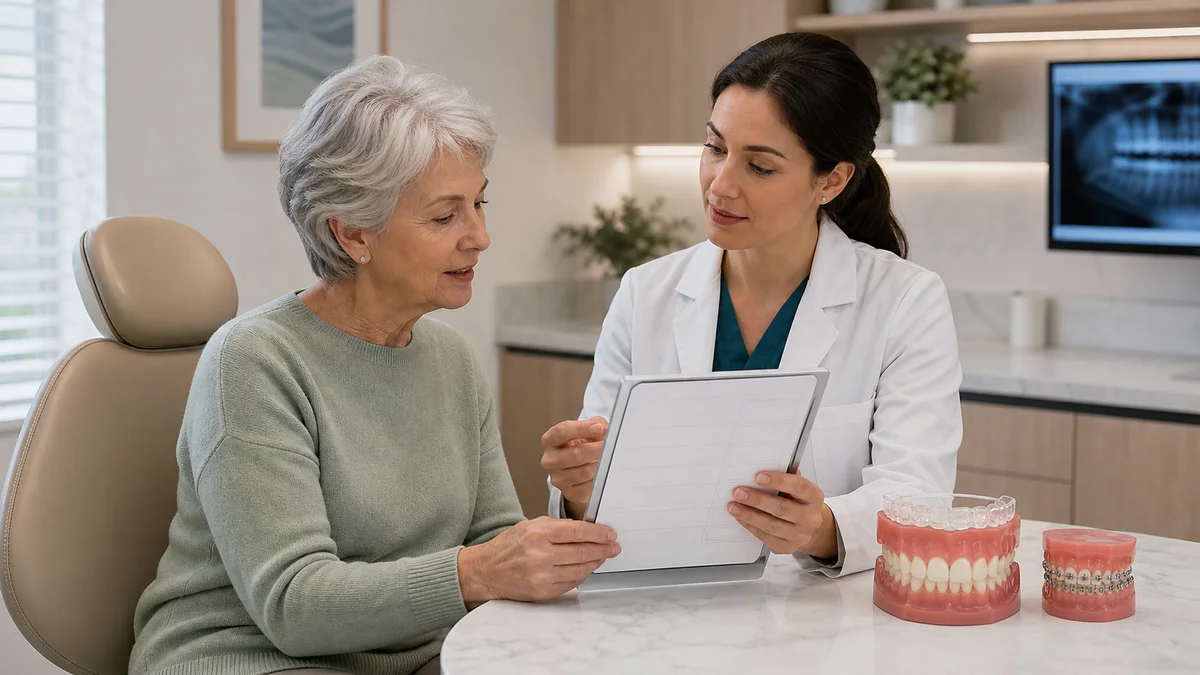
Does Medicare cover orthodontics in 2026? For most people with Original Medicare, the practical answer is no: routine dental care is generally excluded, and braces or clear aligners used to correct tooth alignment are not a standard Part A or Part B benefit. Medicare.gov says that, in most cases, Medicare does not cover dental services such as routine cleanings, fillings and other ordinary dental care. Orthodontic treatment usually falls on the noncovered side of that rule.
There are two reasons the answer still deserves careful checking. First, some Medicare Advantage plans offer supplemental dental benefits beyond Original Medicare, and each plan sets its own covered services, network, authorization rules, limits and member costs. Second, Original Medicare can pay for certain dental services that are inextricably linked to the clinical success of specified Medicare-covered medical treatment. That is a narrow medical link—not a general orthodontic benefit—and it does not automatically make braces or aligners payable.
When asking does Medicare cover orthodontics, identify your exact coverage pathway before requesting a quote. “Medicare” may mean Original Medicare, a particular Medicare Advantage plan, Medicare plus employer or union dental coverage, or Medicare combined with Medicaid. The controlling document and payer can be different in each case.
This guide explains the 2026 framework, the records to request and how to obtain a written coverage decision. It does not promise payment, interpret a specific contract as legal advice or decide whether orthodontic treatment is clinically necessary. Diagnosis requires an examination and appropriate records. The content is evidence-informed, prioritizes patient safety and is prepared for clinical review by Dentist Esma Çevrük Çakır.
Quick answer: does Medicare cover orthodontics? Original Medicare generally does not cover routine braces or clear aligners. A Medicare Advantage plan may offer dental benefits, but orthodontic inclusion, eligibility, networks, age rules, prior authorization, limits and cost sharing vary. Rare medical circumstances require a case-specific coverage review. Check the current Evidence of Coverage and request a written decision before treatment.
Does Medicare cover orthodontics under Original Medicare?
Original Medicare consists of Part A hospital insurance and Part B medical insurance. Federal law generally excludes payment for services connected with the care, treatment, filling, removal or replacement of teeth or the structures directly supporting teeth. CMS describes this as the dental services coverage exclusion. Routine orthodontic treatment intended to move teeth or correct malocclusion generally does not become a Part B dental benefit simply because a dentist or orthodontist considers it beneficial.
For someone asking does Medicare cover orthodontics under Original Medicare, distinguish medical necessity from Medicare coverage. A service can be clinically appropriate yet excluded by statute. Conversely, a service that occurs in a hospital is not automatically covered as orthodontics. Medicare may cover certain inpatient hospital services associated with dental care when hospitalization is required because of the patient’s underlying condition or the severity of the procedure, while the dental or orthodontic professional services can still face the exclusion.
Do not rely on a provider saying only that they “accept Medicare.” Participation tells you how a provider handles covered Medicare services; it does not turn a normally excluded orthodontic service into a covered one. Ask which exact service, code, coverage provision and payer the provider expects to bill.
Under Original Medicare, does Medicare cover orthodontics should therefore be answered from the statutory benefit rules, not from the clinic’s enrollment status.
2026 decision table: which coverage pathway applies?
This table routes does Medicare cover orthodontics to the correct source. It is a starting point, not an approval.
| Your coverage | Typical orthodontic position | Document to check | Best next action |
|---|---|---|---|
| Original Medicare Part A and Part B | Routine braces and clear aligners are generally not covered dental services | Medicare.gov dental coverage page and any written claim notice | Ask whether a specific statutory medical-link exception is claimed and request cost information |
| Medicare Advantage (Part C) | May include supplemental dental benefits, but orthodontics may be excluded or tightly limited | Current Evidence of Coverage, Summary of Benefits and provider directory | Request a pre-service organization determination and verify the orthodontist’s network status |
| Original Medicare plus employer, union or retiree dental plan | The separate dental plan may have its own orthodontic benefit | Dental certificate, schedule, exclusions and coordination rules | Ask the dental payer for a code-level predetermination |
| Medicare plus Medicaid | Medicaid dental rules vary by state, eligibility group and age; adult orthodontics is often restricted | State Medicaid member handbook and managed-care contract | Confirm eligibility, medical-necessity criteria, referral and prior authorization |
| Medigap with Original Medicare | Medigap generally helps with cost sharing for Medicare-covered services; it does not create a routine orthodontic benefit | Medigap policy and any separate discount or ancillary terms | Ask whether any dental offering is insurance, a discount arrangement or a separate rider |
| PACE or another coordinated program | Benefits and authorization follow the program’s individual care plan and rules | Membership materials and care-team decision | Ask the program directly before outside orthodontic care |
The table shows why does Medicare cover orthodontics is incomplete without the name of the plan that will receive the claim.
The narrow exception for dental services linked to covered medical care
CMS states that the dental exclusion does not apply when dental services are “inextricably linked to” and substantially related and integral to the clinical success of certain Medicare-covered procedures or services. Medicare.gov gives examples such as oral evaluation and necessary dental treatment connected with heart-valve replacement, organ or bone-marrow transplant, certain cancer treatment and dialysis for end-stage renal disease.
This expanded dental framework does not mean the answer to does Medicare cover orthodontics changed to yes for routine tooth straightening. The listed scenarios focus on dental examination, elimination of oral infection and treatment of oral complications related to covered medical care. Orthodontic movement is not automatically included. The medical and dental providers must coordinate, document the link and satisfy the applicable Medicare requirements.
If an orthodontist proposes an appliance as part of a medically complex pathway—such as care coordinated with covered jaw surgery—ask the medical surgeon and orthodontist to identify each service separately. A covered medical operation does not guarantee coverage for pre-surgical or post-surgical orthodontics. Request the codes, providers, settings, medical rationale and written payer determination before committing to elective expenses.
In other words, does Medicare cover orthodontics remains a service-by-service question even when related medical care is covered.
Medicare Advantage: possible dental benefits, plan-specific rules
Medicare Advantage plans must cover almost all medically necessary services that Original Medicare covers and may add supplemental benefits, including dental services. “May” is crucial. Plans differ by county, contract and year. A plan offering preventive cleanings may exclude braces, aligners and retainers. Another may list an orthodontic allowance only for a narrow eligibility group or specified condition.
For does Medicare cover orthodontics in a Medicare Advantage plan, read the current Evidence of Coverage rather than a marketing postcard or last year’s benefits. Medicare.gov explains that the Evidence of Coverage describes what the plan covers and what the member pays. Search the dental section for terms such as orthodontics, braces, clear aligners, malocclusion, retainers, exclusions, prior authorization, network, maximum and medically necessary.
Check all of these details:
- whether orthodontic treatment is explicitly included or excluded;
- whether the benefit is limited by age, diagnosis or severity criteria;
- whether a referral, pre-treatment estimate or prior authorization is required;
- whether only contracted dental providers can deliver the benefit;
- whether the individual orthodontist and service location are in network;
- which procedure codes, appliances and treatment stages are eligible;
- whether there is a lifetime, annual or supplemental dental maximum;
- what deductible, copayment or coinsurance applies;
- whether replacement retainers, repairs or refinements are separate; and
- how coverage changes if treatment crosses into a new plan year.
Benefits can change annually. An orthodontic approval issued under one contract year may have conditions for continued payment. Keep the authorization, treatment schedule and every Evidence of Coverage that applies during multi-year care.
For Medicare Advantage members, revisit does Medicare cover orthodontics whenever the plan year, provider network or proposed treatment changes.
How to verify whether your plan covers braces or aligners
A customer-service representative’s verbal explanation is useful, but high-cost treatment deserves a written trail. Use this sequence when the question is does Medicare cover orthodontics:
- Write down the exact plan name, contract number, member ID and coverage year.
- Confirm whether you have Original Medicare or Medicare Advantage; show the correct plan card.
- Obtain a dated orthodontic evaluation and itemized proposed treatment plan.
- Request procedure codes, appliance type, treatment phases, estimated dates and provider charges.
- Check the Evidence of Coverage, Summary of Benefits, Annual Notice of Change and dental rider.
- Call the plan and ask whether each proposed code is covered, excluded or subject to criteria.
- Verify the named orthodontist and each service address in the current network.
- Ask whether prior authorization or an organization determination is required.
- Request the answer in writing, including the expected member responsibility.
- Ask how staged payments are handled if enrollment or benefits change.
- Keep call reference numbers, letters, portal messages, estimates and clinical records.
Do not start irreversible or expensive elective treatment solely because a portal shows a generic dental maximum. The maximum is not proof that orthodontic codes qualify. Confirm the service category first.
A generic benefit balance cannot resolve does Medicare cover orthodontics; the plan must evaluate the actual codes and eligibility rules.
Organization determinations and prior authorization
Medicare.gov calls a Medicare Advantage coverage decision an “organization determination.” A member has the right to ask the plan, orally or in writing, whether it will cover a service. For someone asking does Medicare cover orthodontics, a pre-service organization determination is stronger than an informal benefits quote because it creates a formal decision and appeal route.
Prior authorization is not the same as a guarantee of every final payment. Approval may depend on continued enrollment, network use, service dates, approved codes, clinical documentation and plan limits. The treatment delivered must match the authorized plan. If the orthodontist changes the appliance, adds procedures or extends treatment, ask whether a new request is required.
If the plan denies the request, read the written notice. It should explain the reason and the appeal instructions. Medicare’s current appeals guidance says members generally have 65 days from the initial denial notice to request a Medicare Advantage reconsideration, although the notice and current rules control your case. Do not rely on a blog for a deadline; use the letter you received.
The written organization determination turns does Medicare cover orthodontics from a customer-service conversation into a decision with documented rights.
What an itemized orthodontic estimate should show
Coverage and clinical consent are easier to understand when the quote is itemized. Ask for the comprehensive treatment fee and its components, including records, appliances, attachments or brackets, planned adjustments, refinements, emergency visits, retainers and follow-up. Clarify which services are included, excluded or charged separately.
When evaluating does Medicare cover orthodontics, match each clinic line to a payer response. A plan might process diagnostic records differently from active treatment or retention. It might cover a medical imaging service under one benefit while excluding the dental appliance. Never assume payment for one line makes the entire package covered.
The estimate should identify:
- procedure description and code where applicable;
- treating provider and service location;
- tooth, arch or treatment phase when relevant;
- clinic charge and any contracted allowance;
- estimated plan payment and patient share;
- benefit maximum already used or remaining;
- deposit, installment and cancellation terms;
- what happens if treatment stops, transfers or takes longer; and
- how long the financial estimate is valid.
An estimate is not a result guarantee. Tooth movement, tissue health, attendance, appliance wear and biological response can affect the clinical course. Financial consent should state how plan changes or added care are handled.
Keep the payer response beside the clinic estimate so does Medicare cover orthodontics can be reconciled line by line rather than as one package total.
Medigap, Part D and other coverage do not mean the same thing
Medigap supplements Original Medicare by helping pay certain deductibles, coinsurance and other gaps for services Medicare covers. It generally does not transform excluded routine orthodontics into a Medicare-covered service. Some companies market separate dental discount programs or ancillary products alongside Medigap, but those are not necessarily the Medigap benefit itself.
Part D covers eligible prescription drugs, not braces, clear aligners or routine orthodontic professional fees. A medicine associated with a covered medical condition follows drug-plan rules; that does not change the answer to does Medicare cover orthodontics.
Employer, union, retiree, veterans or private dental coverage may be relevant. Ask which payer is primary, which is secondary and whether the orthodontic office will submit to both. Medicare.gov advises people with multiple forms of insurance to understand coordination of benefits. A secondary plan cannot be assumed to pay a service merely because Medicare denied it.
With multiple payers, answer does Medicare cover orthodontics separately for each contract and then apply coordination rules.
Medicare and Medicaid dual eligibility
People enrolled in both Medicare and Medicaid may have dental coverage through a state Medicaid program or managed-care plan. Medicaid rules vary significantly by state, age, eligibility category and clinical criteria. Adult orthodontics may be excluded, limited to severe medically necessary conditions or require extensive prior authorization.
For a dual-eligible member asking does Medicare cover orthodontics, the more useful next question may be whether the state Medicaid benefit or another dental plan covers the proposed codes. Obtain the current member handbook and contact the managed-care plan. Confirm that the orthodontist is enrolled with the correct program before treatment.
Do not assume that disability status alone creates an orthodontic benefit. Medicare eligibility based on disability does not remove the general dental exclusion. A separate Medicaid or employer benefit may help, but its own rules govern.
Dual eligibility changes the payer search, but it does not by itself make does Medicare cover orthodontics an automatic yes.
Orthodontics associated with jaw surgery or congenital conditions
Orthognathic surgery can involve coordinated medical, surgical and orthodontic care. Medicare may evaluate a medically necessary covered surgical service under medical rules, while preoperative and postoperative orthodontic treatment remains a distinct set of services. Coverage for one component does not automatically extend to every provider or appliance.
In this context, does Medicare cover orthodontics requires a coordinated written plan from the surgeon, orthodontist and payer. Ask:
- Which diagnosis supports the medical procedure?
- Which services are dental, orthodontic, surgical, imaging, anesthesia or facility charges?
- Which payer and benefit category will receive each code?
- Is orthodontic preparation considered excluded, supplemental or integral in this specific case?
- What documentation and prior decision are required before treatment?
- What is the cost if the medical service is approved but orthodontics is not?
Complexity makes written decisions more important, not less. A provider’s expectation is not a payer determination. Seek a second clinical opinion if the treatment rationale or alternatives remain unclear.
Before a coordinated surgical case begins, resolve does Medicare cover orthodontics for every preoperative and postoperative stage that can be identified.
Adult orthodontics, cosmetic language and medical necessity
Orthodontic treatment can aim to improve function, hygiene access, bite relationships or preparation for other care, as well as appearance. Describing treatment as functional does not by itself overcome a Medicare exclusion. The payer applies the law and contract to the submitted codes and documentation.
A common misunderstanding around does Medicare cover orthodontics is that the word “medically necessary” guarantees payment. Medical necessity is important, but it operates within benefit categories and exclusions. Ask for the plan’s exact criteria and a formal pre-service decision. Avoid asking the clinic to change truthful coding or diagnosis wording merely to seek coverage.
Similarly, “cosmetic” should not be used casually to dismiss a legitimate clinical concern. The orthodontist should explain diagnosis, risks, alternatives and likely functional goals. The insurer decides coverage separately. Clinical consent and benefit eligibility are related but different questions.
The best answer to does Medicare cover orthodontics respects both sides: a legitimate clinical indication and the payer’s separate benefit decision.
What to do if coverage is denied
First identify whether you received an informal benefits answer, a prior-authorization denial, an organization determination, a Medicare Summary Notice or an explanation of benefits. The appeal path depends on the payer and document. Read the reason: exclusion, missing information, network status, lack of authorization, unmet criteria or coding can require different responses.
If a Medicare Advantage plan denies the service, Medicare.gov says the initial appeal is a reconsideration. Include the clinical records and provider explanation that address the stated reason. If your health could be seriously harmed by waiting for the standard decision, current Medicare rules allow a request for an expedited process when the applicable criteria are met. Follow the denial notice rather than inventing urgency.
For Original Medicare, an Advance Beneficiary Notice may warn that Medicare is expected not to pay, but Medicare.gov emphasizes that an ABN is not an official denial. If a claim is submitted and denied, formal appeal rights may apply. Statutorily excluded dental services can involve different notice requirements, so ask the provider and Medicare how your exact service will be handled.
Do not let an appeal delay treatment that a qualified clinician says is urgent for infection, trauma, airway or other immediate safety. Orthodontic alignment is often planned care, but dental emergencies can arise during evaluation. Separate emergency stabilization from the elective orthodontic coverage dispute.
An appeal may revisit does Medicare cover orthodontics, but it should never be presented as a payment guarantee.
Patient-safety and financial red flags
Pause before paying if a clinic, broker or salesperson:
- guarantees Medicare approval before reviewing your exact plan and codes;
- claims that hospitalization automatically covers braces or aligners;
- uses a Medicare logo, government seal or official-looking card without authorization;
- asks you to misstate symptoms, diagnoses or dates to obtain payment;
- will not provide an itemized plan, provider identity or refund terms;
- pressures you to finance nonurgent care immediately;
- requests your Medicare number through an insecure channel without a clear need; or
- discourages you from contacting the plan directly or seeking a second opinion.
Protect your Medicare number and health information. Medicare and plan representatives can explain benefits without requiring a clinic to guarantee payment. For general dental information, visit Redent Klinik in English; for a consultation pathway, use the Redent Klinik contact page.
Anyone who answers does Medicare cover orthodontics with an unconditional promise before seeing the plan and codes deserves additional scrutiny.
Frequently asked questions: does Medicare cover orthodontics?
Does Medicare cover orthodontics for adults over 65?
Age alone does not create an Original Medicare orthodontic benefit. Routine braces and clear aligners are generally not covered. A Medicare Advantage, Medicaid, employer, union or separate dental plan may have different rules. Verify the current plan and obtain a written pre-service decision.
Does Medicare cover orthodontics if it is medically necessary?
Not automatically. A service can be clinically necessary yet fall within the dental exclusion. Original Medicare covers certain dental services inextricably linked to specified covered medical treatment, but routine orthodontic movement is not broadly added. The payer must evaluate the exact services and documentation.
Does Medicare Advantage cover braces or clear aligners?
Some plans offer supplemental dental benefits, but orthodontic coverage is plan-specific and may be excluded or limited. For does Medicare cover orthodontics under Part C, read the Evidence of Coverage for the current year, confirm the provider network and codes, and request an organization determination before treatment.
Does Medicare cover orthodontics before jaw surgery?
Coverage of a medically necessary surgical service does not guarantee payment for pre-surgical or post-surgical orthodontics. Ask the surgeon and orthodontist to itemize every component and request written payer decisions for each benefit category before the care sequence begins.
Does Medicare cover retainers?
Original Medicare generally does not cover routine orthodontic retainers. A supplemental dental plan may define retention as part of an approved orthodontic case or charge it separately. Retention should be included when asking does Medicare cover orthodontics. Check replacement limits, network rules and whether retainers remain covered after active treatment ends.
Does Medicare cover orthodontics for a person with a disability?
Medicare eligibility based on disability does not by itself remove the dental exclusion. In this situation, does Medicare cover orthodontics still depends on the same Original Medicare rules or the person’s specific supplemental plan. The person may also qualify for Medicaid or another dental benefit with separate criteria. Review every payer and request reasonable communication or access accommodations during clinical care.
Can Medigap pay for orthodontics Medicare excludes?
Medigap generally helps with cost sharing for covered Original Medicare services; it does not normally create coverage for excluded routine orthodontics. Therefore, does Medicare cover orthodontics cannot be answered yes merely because a Medigap card is present. A company may sell a separate dental product or discount program, so verify which contract applies and whether it is insurance.
How can I get a definite answer before starting treatment?
Obtain an itemized clinical plan with codes, providers, locations and dates. Check your Evidence of Coverage, then ask the payer for the appropriate written pre-service decision. For Medicare Advantage, this may be an organization determination. That is the strongest way to resolve does Medicare cover orthodontics before treatment. Keep the decision and verify any conditions before each stage.
Can I appeal if the plan says no?
Formal coverage denials generally include appeal rights, but the process depends on Original Medicare, Medicare Advantage, Medicaid or another dental plan. An appeal asks the payer to reconsider does Medicare cover orthodontics under the governing rules. Follow the denial notice and current deadline. Include relevant clinical records and address the stated reason rather than resubmitting an unchanged request.
Conclusion: coverage depends on the exact payer and written decision
The most accurate answer to does Medicare cover orthodontics is that Original Medicare generally does not cover routine braces or clear aligners. Narrow dental coverage connected to specified Medicare-covered medical treatment should not be mistaken for a broad orthodontic benefit. Medicare Advantage and other coverage can add dental services, but their contracts and conditions vary.
Identify the payer, read the current Evidence of Coverage, obtain an itemized orthodontic plan and request a written pre-service determination. Verify network, authorization, maximums, cost sharing and multi-year rules. Keep clinical necessity separate from benefit eligibility, and never accept a payment guarantee from someone who has not reviewed the actual contract and codes. That disciplined process is the safest way to resolve does Medicare cover orthodontics for your situation.
Official sources and further reading
- Medicare.gov: dental service coverage – current 2026 consumer guidance on the general dental exclusion and specified medical-treatment links.
- Centers for Medicare & Medicaid Services: Medicare dental coverage – official provider framework for inpatient dental services and services integral to covered medical care.
- Medicare.gov: Evidence of Coverage – explanation of the annual plan document describing benefits and member costs.
- Medicare.gov: appeals in Medicare health plans – organization determinations and current Medicare Advantage appeal process.
- American Dental Association – professional dental and oral-health information.
- World Health Organization: oral health fact sheet – evidence-based global context on oral disease and prevention.
Official sources were reviewed on August 4, 2026. Medicare, Medicaid and private-plan benefits can change. Your current coverage documents and formal payer decision control your case.