
Quick answer: A search for a friendly dentist near me should go beyond smiles and review scores. Shortlist licensed practices that communicate clearly, welcome questions, discuss anxiety and accessibility, explain options and costs, use appropriate infection-prevention procedures, and respect consent. Call before booking, then judge whether the first visit feels calm, unhurried, transparent and clinically thorough.
Typing friendly dentist near me into a search box is often less about distance than trust. You may want a clinician who listens after a difficult experience, explains an unfamiliar procedure, supports a nervous child, accommodates a disability, or avoids judgment about how long it has been since your last appointment. Those are reasonable needs, but “friendly” is not a regulated clinical credential and cannot be verified from a photograph alone.
The most useful approach in a friendly dentist near me search is to translate friendliness into observable behavior. Does the team ask what would make the visit easier? Do they explain what they are doing before touching you? Can you pause? Are reasonable alternatives presented without pressure? Are costs and benefit limitations discussed before treatment? Does the dentist take an appropriate history and examine the problem instead of promising a result from a message or photograph?
This guide turns friendly dentist near me into a patient-safety checklist. It combines practical access questions with principles supported by official American Dental Association, CDC and NHS resources. It cannot recommend a particular practice, confirm that a dentist is suitable for you, or replace an examination. It can help you build a shortlist, prepare a first call and recognize when warmth is supported by professional care.
What should “friendly” mean in dental care?
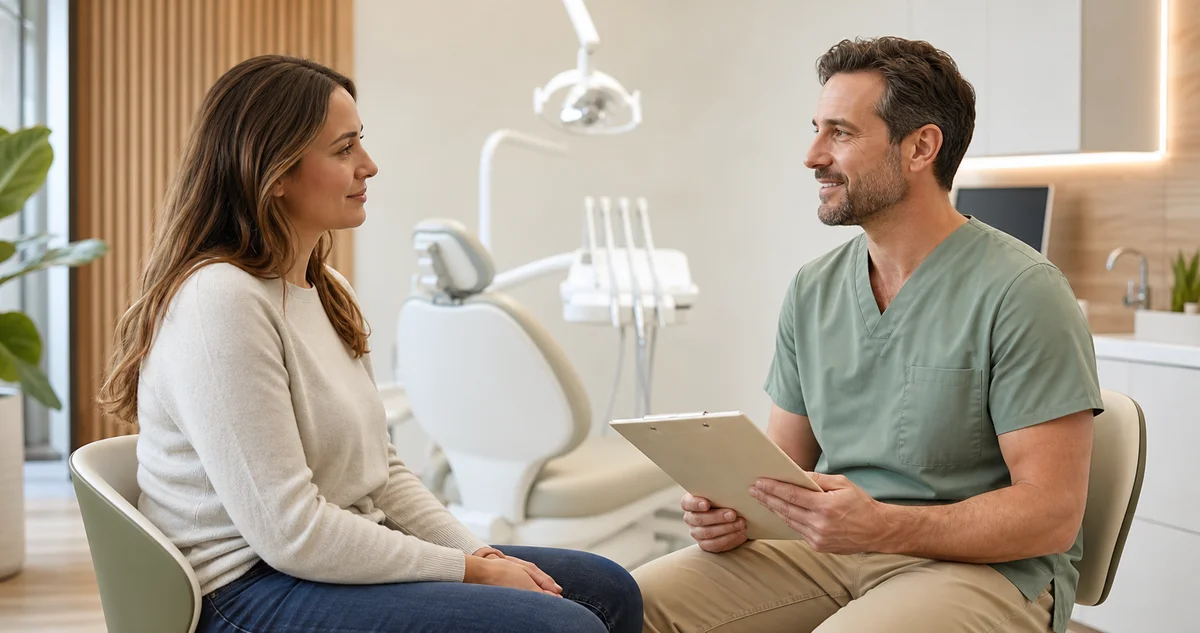
For a friendly dentist near me, kindness should be more than an upbeat reception. A patient-centered team listens without shaming, uses language you understand, checks consent, protects privacy, responds to discomfort, and accepts questions. The dentist should distinguish what is urgent from what can wait, explain uncertainty, and involve you in decisions rather than presenting one option as inevitable.
The ADA’s patient-autonomy principle says patients should be meaningfully involved in treatment decisions and should receive information about proposed treatment and reasonable alternatives. NHS England’s dental anxiety guidance emphasizes assessment, rapport, enhanced control and individualized management. These ideas turn a vague personality preference into actions you can observe during a call or consultation.
- Respect: no scolding, stereotyping, ridicule or dismissal of pain and fear.
- Clarity: plain-language explanations, time for questions and a written plan when treatment is complex.
- Control: permission before examination, an agreed pause signal and an opportunity to decline or defer.
- Safety: a proper history, diagnosis, infection prevention and referral when a need is outside the dentist’s scope.
- Transparency: realistic benefits and risks, alternatives, limitations, estimated costs and no result guarantee.
When judging a friendly dentist near me, a pleasant tone cannot compensate for rushed diagnosis, opaque fees or coercive treatment. Conversely, a quiet or formal clinician may still be an excellent communicator who respects your needs. Your goal is not to rank personalities; it is to find a working relationship in which you can obtain safe care and participate confidently.
1. Build a practical friendly dentist near me shortlist
Start the friendly dentist near me search with logistics that make continuing care realistic. Record the distance from home or work, public transport, parking, step-free access, opening hours, emergency arrangements, languages, interpreter process, accepted age groups and whether the practice is accepting new patients. If you use dental benefits, check the insurer’s current directory and confirm participation with the office.
The ADA’s consumer guidance recommends considering location, hours, network participation, communication needs and referrals from trusted sources. Its Find-a-Dentist tool can help locate ADA member dentists in the United States, while local dental societies, health departments and dental schools may offer additional routes. In other countries, use the relevant official regulator or professional register.
Online maps help discover a friendly dentist near me, but they are not proof of licensure, specialty, safety or quality. Sponsored placement means an advertiser paid for visibility; it does not establish that the practice is the best match. Create a shortlist of two or three plausible offices, then verify them through official and direct channels.
2. Verify the dentist, practice and requested service
Before choosing a friendly dentist near me, confirm the dentist’s registration or license through the relevant dental board or professional regulator. Check whether any specialty title is recognized in that jurisdiction. A general dentist can provide a broad range of care, but complex surgery, sedation, orthodontics, pediatric needs or medically complicated treatment may require additional training or referral.
For each friendly dentist near me candidate, ask who will actually examine and treat you. A practice brand can include several clinicians with different schedules and scopes. If continuity matters, ask whether you can see the same dentist for planned visits. If the office promotes sedation, implants or another advanced service, ask who provides it, where it occurs, how emergencies are managed and whether referral is available when the case exceeds that clinician’s scope.
Do not expect a friendly dentist near me or the staff to diagnose through a phone call. They can describe services and appointment pathways, but a definitive treatment recommendation usually requires history, examination and appropriate diagnostic records. A promise that every patient is suitable for a procedure, or that one treatment will certainly last for life, is not a sign of patient-centered care.
3. Use the first call as a communication test
A brief call can reveal whether a friendly dentist near me is prepared for your needs. You do not need to disclose every private detail to reception. Explain the accommodation or concern relevant to booking, then ask how the team handles it. Note whether staff answer within their role, seek clarification and offer a realistic next step instead of minimizing the issue.
- “I feel anxious about dental visits. Can the first appointment focus on discussion and assessment?”
- “Can the dentist agree a hand signal so I can pause during the examination?”
- “I need step-free access, extra transfer time or another accommodation. How is that arranged?”
- “Which languages are spoken, and how do you arrange qualified interpretation?”
- “Can I receive a written treatment plan and estimate before non-urgent work?”
- “What happens if I develop pain or swelling outside normal hours?”
- “Are you participating in my exact dental plan, and which parts must I verify with the insurer?”
During a friendly dentist near me call, a receptionist may need to consult the dentist and call back; that is often more responsible than improvising a clinical answer. Be cautious if the practice pressures you to prepay extensive treatment before an examination, refuses to explain cancellation or refund terms, or guarantees pain-free treatment and permanent results.
4. Find a friendly dentist near me for dental anxiety
When anxiety drives the friendly dentist near me search, tell the office before the visit. You might name a specific trigger such as injections, sounds, loss of control, gagging, previous pain, embarrassment or not being believed. NHS England guidance recognizes that anxiety varies by person and procedure; it supports assessment of triggers and an individualized approach.
Low-intensity support can include rapport building, a calm explanation, agreed stop signals, shorter or staged visits, extra time and attention to the clinical environment. NHS England specifically describes enhancing control and notes that a raised-hand stop signal can communicate increasing anxiety. These strategies are not childish; they are practical tools that help a patient and team work safely.
Some people seeking a friendly dentist near me need more than reassurance. Behavioral approaches, including cognitive behavioral therapy in appropriate services, and conscious sedation may be considered after individual assessment. Sedation is not a universal shortcut and does not replace local anesthesia, informed consent or risk evaluation. The simplest safe method likely to be effective should be considered by qualified professionals for the particular patient and procedure.
A supportive friendly dentist near me will not promise “zero anxiety.” The team should ask what happened previously, what has helped, what treatment is urgent and whether referral is appropriate. If fear has led to years of avoidance, you can request a discussion-first visit and decide in advance whether any examination will occur.
5. Assess listening, consent and shared decisions
During the first appointment, a friendly dentist near me should ask about your main concern, symptoms, dental history, medical conditions, medications, allergies and relevant preferences. The examination should be explained. You should have an opportunity to ask what information a radiograph or test would add and what its limitations are.
At a friendly dentist near me, consent should be a continuing conversation, not a signature that removes your right to ask or stop. ADA guidance describes informed consent as a process that covers the proposed treatment, reasonable alternatives, expected benefits, material risks and the consequences of no treatment. Requirements vary by jurisdiction, but respectful explanation and voluntary participation are core patient-safety principles.
Ask the dentist to show you the finding on an image or diagram when useful, distinguish diagnosis from cosmetic preference and identify what needs prompt action. If the plan is complex, request it in writing. A considerate dentist can give a professional recommendation while acknowledging uncertainty and your values.
Watch how disagreement is handled. It is acceptable for a dentist to explain why a requested procedure is unsafe or unsupported. It is also acceptable for you to seek a second opinion. Pressure, humiliation, fear-based selling or refusal to release records according to applicable rules are not evidence of a healthy partnership.
6. Match accessibility, language and sensory needs
“Near” is useful only if the friendly dentist near me is accessible to you. Ask about entrances, elevators, treatment-room space, transfer assistance, accessible toilets, seating, support people and communication methods. Do not assume a website accessibility icon describes the physical building. Request specific details and explain what safe accommodation means for you.
For hearing, vision, cognitive, developmental or sensory needs, discuss preferred communication, lighting, noise, appointment timing, extra processing time and whether a familiar support person can attend. A qualified interpreter may be more appropriate than relying on a child or untrained relative for clinical consent. The practice should also protect privacy when arranging assistance.
When a friendly dentist near me receives an accommodation request, the response may require planning, equipment or referral, and not every office can safely provide every service. A respectful response explains the limitation and helps identify an appropriate pathway. A dismissive “we treat everyone exactly the same” can overlook the adjustments needed for equitable care.
7. Look for prevention and diagnosis before sales
A high-quality friendly dentist near me should begin with your health and goals, not a preselected package. Appropriate care may include prevention, disease control, monitoring and discussion of several restorative or cosmetic options. The dentist should explain why a recommendation fits the findings and whether delaying it changes risk.
Be cautious when a consultation focuses on discounts, dramatic before-and-after images or financing before the clinician has taken a history and examined you. Photographs do not show every complication, patient circumstances vary and no ethical practice can guarantee a biological result. A second opinion is particularly reasonable for irreversible, extensive or costly plans.
A plan from a friendly dentist near me should separate urgent disease management from elective enhancement. Pain relief or infection control may need prompt attention, while whitening or broader smile design can usually wait for informed consideration. If you feel rushed, ask for the records and written proposal, then take time to compare.
8. Check fees, benefits and written estimates
The word “friendly” in friendly dentist near me should include financial clarity. Before non-urgent treatment, ask for an itemized estimate with procedure descriptions, stages, anticipated provider charges and what is not included. Confirm whether diagnostic work, laboratory services, sedation, temporaries, maintenance or complication care are separate.
Insurance network status does not guarantee that every service is covered. Verify the exact dentist, location, procedure codes, authorization requirements, deductibles, waiting periods, frequency limits and remaining benefit with the plan. A dental office may help estimate benefits, but the contract and claim decision belong to the insurer or program.
Fees vary by diagnosis, complexity, materials, location and professional time. A website price may be an example rather than a personalized quote. Read deposits, cancellation terms, financing, interest and refund conditions before paying. Do not let a limited-time message replace clinical comparison.
9. Observe infection prevention without demanding a performance
A friendly dentist near me must also maintain safe systems. CDC guidance describes Standard Precautions as minimum infection-prevention practices for all patient care. They include hand hygiene, appropriate personal protective equipment, respiratory hygiene, sharps safety, safe injections, sterile instruments and clean environmental surfaces.
Patients will not see the entire reprocessing system from the chair, and an instrument pouch alone cannot prove every process. You can ask how reusable instruments and dental handpieces are cleaned, packaged, sterilized and monitored; how treatment surfaces are protected or disinfected; and whom to contact with a safety concern. Staff should be able to give a calm, credible explanation.
Visible clutter does not automatically prove unsafe care, just as a luxurious lobby does not prove safe care. Focus on professional behavior: hand hygiene at appropriate times, new gloves for patient care, protected or cleaned surfaces, correctly handled sharps and a team that takes questions seriously.
10. Read reviews without letting them make the diagnosis
Reviews can help a friendly dentist near me search by revealing repeated themes about scheduling, communication, accessibility or billing. They cannot establish whether a diagnosis was correct, because reviewers rarely have complete clinical records and privacy rules limit how practices can respond.
Read a range of recent and older comments. Look for patterns rather than one very positive or negative story. Consider whether the practice responds professionally without exposing private information. Perfect ratings, generic language and sudden clusters of posts should be treated cautiously, but they do not prove manipulation on their own.
Use reviews to create questions about a friendly dentist near me. If several people mention long waits, ask about scheduling. If cost communication varies, request a written estimate. If anxiety support is praised, ask what specific steps are available. Then base your decision on verified credentials, direct communication and your own first appointment.
11. Use a decision table after the first contact
After contacting each friendly dentist near me candidate, compare the same evidence. Avoid scoring charisma alone. A simple table makes tradeoffs visible and helps prevent one advertisement or review from dominating the choice.
| Decision area | Reassuring evidence | Question or caution |
|---|---|---|
| Credentials and scope | Official registration can be verified; provider and role are clear | Who will treat me, and when would you refer? |
| Communication | Questions are welcomed; explanations use understandable language | Can I receive the plan and alternatives in writing? |
| Anxiety support | Triggers are assessed; pause signal and staged options are discussed | What happens if I need to stop or cannot continue? |
| Accessibility | Specific accommodations are confirmed before arrival | Is the treatment room—not only the entrance—accessible? |
| Clinical process | History and examination precede definitive recommendations | What finding supports this option, and what can wait? |
| Costs and benefits | Itemized estimate and financial terms are available | Which items are estimates, excluded or billed separately? |
| Infection prevention | Team explains standard systems confidently and consistently | How are reusable instruments and handpieces processed? |
| Urgent support | Clear in-hours and out-of-hours instructions | Whom do I contact for worsening pain or swelling? |
No office will be perfect in every convenience category. Decide which factors are essential for safety and access, which are preferences, and which can be solved through planning. If the clinical relationship feels unsafe or coercive, a shorter journey is not enough reason to stay.
12. Plan the first visit and judge the follow-through
For the first friendly dentist near me appointment, bring an updated medication and allergy list, relevant diagnoses, benefit information, previous records if available and your top questions. Note the timeline and triggers of symptoms. If anxiety is prominent, write down what you want the team to know so you do not have to remember everything under stress.
Ask what the visit will include and whether treatment is expected that day. A first visit may involve discussion, examination, radiographs when justified and planning. Emergency appointments may focus on stabilizing the immediate problem. You can ask to pause and clarify before a procedure, although a dentist may explain that some requested limitation makes safe diagnosis or treatment impossible.
Afterward, ask yourself whether the team did what it said it would do. Were your concerns recorded? Did the dentist explain findings and alternatives? Was the written estimate consistent with the conversation? Did you feel able to say no? A warm greeting matters, but reliable follow-through is the stronger sign.
Comparing local care with treatment while traveling
A search for a friendly dentist near me may show clinics outside your ordinary area, especially when a map uses your travel location. Planned treatment abroad requires additional questions about licensing, records, language, consent, number of visits, healing intervals, maintenance, emergency care after returning home and whether insurance applies.
If you are specifically considering care in Istanbul, you can read about Redent Klinik’s general approach on its English homepage and use the English contact page to request preliminary information. A remote exchange cannot diagnose you, establish suitability, guarantee an outcome or replace an in-person examination.
Compare complete pathways rather than headline treatment prices. Include diagnostics, staged procedures, temporary work, travel, accommodation, time away, follow-up, maintenance and the plan for complications. Urgent pain, swelling or trauma should be assessed promptly where you are; do not delay necessary local care while arranging elective travel.
Frequently asked questions about a friendly dentist near me
How can I tell if a friendly dentist near me is good with anxious patients?
Ask what happens before and during the appointment. Useful answers may include discussing triggers, a calm assessment, a pause signal, step-by-step explanations, staged visits and referral when more support is needed. No team can promise that you will feel no anxiety. Judge whether the response is individualized and whether your control is respected.
Should I choose the closest friendly dentist near me?
Distance affects attendance, but it is only one factor. Compare verified credentials, scope, communication, accessibility, hours, emergency arrangements, network status and continuity. A slightly longer journey may be worthwhile for essential accommodations, while a distant practice may be impractical for multi-visit treatment. Choose a sustainable balance.
Can I meet a friendly dentist near me before treatment?
Many practices offer an assessment or consultation, although format and fees vary. Ask whether the visit can begin with discussion and what examination or imaging may be recommended. Meeting does not oblige you to accept treatment. For an urgent problem, the dentist may prioritize diagnosis and stabilization while still obtaining consent.
Is sedation the best solution for dental fear?
Not automatically. Appropriate support depends on anxiety severity, triggers, medical history, procedure and available expertise. Behavioral strategies, staged care, local anesthesia, conscious sedation or specialist referral may be considered. Sedation has risks and requirements and should follow qualified assessment; it does not replace communication or permission.
Can a friendly dentist near me guarantee painless treatment?
No responsible clinician can guarantee a completely painless experience or a particular result. The team can discuss local anesthesia, comfort measures, anxiety support and what to do if you feel pain. Be cautious with absolute promises. Your response, anatomy, condition and procedure all influence the experience.
What if the dentist recommends extensive treatment immediately?
Ask which findings support each item, what is urgent, what can be monitored, the alternatives and the consequence of waiting. Request radiographs, records and an itemized plan. Unless delay presents a meaningful risk, you can seek a second opinion before irreversible or expensive treatment. Do not ignore acute infection or emergency symptoms.
How should a practice discuss fees?
Expect a personalized, itemized estimate for planned care and an explanation of what may change. Confirm insurance independently and read deposits, finance and cancellation terms. A quotation is not a biological outcome guarantee, and benefit estimates are not final claim decisions. Ask before treatment if any line is unclear.
What are red flags when searching for a friendly dentist near me?
Warning signs include guaranteed results, diagnosis without adequate assessment, unexplained pressure to prepay, refusal to discuss alternatives, humiliation, disregard for consent, vague provider identity or implausible claims about credentials. One awkward interaction is not proof of misconduct, but you can pause, document concerns, verify with the regulator and seek another opinion.
When is a dental problem urgent?
Promptly contact a dentist for persistent pain, swelling, fever, drainage, trauma or a broken tooth. Breathing or swallowing difficulty, rapidly spreading facial or neck swelling, severe uncontrolled bleeding or major facial trauma can require emergency medical services or an emergency department. A web search should not delay urgent assessment.
Final checklist for choosing with confidence
The best answer to friendly dentist near me is a verified relationship, not a search ranking. Start with practical access, confirm credentials and scope, test communication, disclose relevant anxiety or accommodation needs and request transparent clinical and financial information. Then use the first visit to see whether the practice follows through.
Kindness and clinical quality should reinforce each other. Look for respect, consent, appropriate assessment, evidence-informed recommendations, clear limitations, infection-prevention systems and referral when needed. You do not need to tolerate shame or pressure, and you also should not expect a responsible dentist to promise certainty where biology and diagnosis are individual.
Once you find a friendly dentist near me who meets these standards, keep the relationship useful: share changes in health and medication, attend agreed reviews, follow home-care advice, ask questions early and report new symptoms. A dental home works best as an ongoing partnership rather than a one-time purchase.
Official sources and review date
This patient guide was prepared for clinical review on August 21, 2026. Professional guidance, local licensing rules and service availability can change; verify information for your jurisdiction and appointment date.
- MouthHealthy by the American Dental Association — How to choose a dentist
- American Dental Association — Find-a-Dentist
- American Dental Association — Patient autonomy and involvement
- NHS England — Clinical standards for dental anxiety management
- NHS inform — Coping with a fear of the dentist
- U.S. Centers for Disease Control and Prevention — Standard Precautions in dental settings
- U.S. Centers for Disease Control and Prevention — Dental infection prevention and control
- World Health Organization — Oral health fact sheet