
Losing all or most of your teeth can have a major impact on your health, appearance, confidence, and quality of life. Many people who experience severe tooth loss begin searching for affordable treatment options and often wonder whether full mouth dental implants with medicaid are available. Because dental implant treatment is one of the most effective solutions for replacing missing teeth, understanding Medicaid coverage can help patients make informed decisions about their oral health.
Full mouth dental implants with medicaid refers to situations where Medicaid may partially or fully assist eligible patients in obtaining implant-supported restorations to replace an entire upper arch, lower arch, or both. However, coverage rules vary significantly from state to state, making it important for patients to understand what Medicaid does and does not cover.
Unlike traditional dentures, full mouth dental implants are designed to provide a permanent or long-term solution for extensive tooth loss. The treatment typically involves placing several titanium implant posts into the jawbone, which act as artificial tooth roots. These implants support a fixed bridge or full arch prosthesis that looks, feels, and functions similarly to natural teeth.
Many individuals researching full mouth dental implants with medicaid are surprised to learn that Medicaid dental benefits are not standardized across the United States. Each state administers its own Medicaid program and determines which dental services are covered for adults. While children generally receive broader dental benefits, adult dental coverage can range from comprehensive services to emergency-only treatment.
One of the main reasons patients seek full mouth dental implants with medicaid is the high cost associated with implant treatment. Full arch implant rehabilitation may cost thousands of dollars depending on the complexity of the case, the number of implants required, bone grafting needs, and the type of restoration selected. For individuals living on limited incomes, Medicaid coverage can potentially make treatment more accessible.
When discussing full mouth dental implants with medicaid, it is important to understand that dental implants are often classified as elective or non-essential procedures by many insurance programs. Medicaid frequently prioritizes treatments considered medically necessary, such as extractions, pain management, infection control, and preventive care. As a result, implant coverage may be limited unless a strong medical necessity can be demonstrated.
Patients exploring full mouth dental implants with medicaid should also understand the distinction between complete implant-supported restorations and conventional dentures. Traditional dentures are removable appliances that rest on the gums, while implant-supported teeth are anchored directly to implants placed in the jawbone. This stability provides significant advantages, including improved chewing ability, speech clarity, comfort, and confidence.
Another reason interest in full mouth dental implants with medicaid continues to grow is the increasing awareness of long-term oral health benefits. Dental implants help preserve jawbone density by stimulating the bone during chewing. Without this stimulation, the jawbone gradually deteriorates after tooth loss. Bone loss can lead to facial collapse, changes in appearance, and difficulties wearing conventional dentures.
For many patients, obtaining full mouth dental implants with medicaid is not simply about aesthetics. It can also improve nutrition and overall health. Individuals with missing teeth often struggle to eat nutritious foods such as fruits, vegetables, nuts, and lean proteins. Implant-supported teeth can restore chewing efficiency and support a healthier diet.
There are several implant treatment approaches that may be discussed when evaluating full mouth dental implants with medicaid. Common options include:
- All-on-4 dental implants
- All-on-6 dental implants
- Fixed implant-supported bridges
- Implant-retained overdentures
- Full arch rehabilitation procedures
These solutions are often grouped under terms such as “full arch dental implants,” “implant-supported dentures,” and “complete mouth restoration.” Understanding these related terms can help patients communicate more effectively with dental providers and Medicaid representatives.
Patients interested in full mouth dental implants with medicaid should begin by reviewing their state’s Medicaid dental policies. Some states may offer expanded dental benefits, while others provide only limited services. In certain cases, implant treatment may be approved if it is deemed medically necessary due to trauma, congenital conditions, severe functional impairment, or other documented health concerns.
Consulting with a qualified implant dentist is an essential step. During the evaluation process, the dentist can assess bone levels, oral health status, and treatment eligibility. They may also help determine whether full mouth dental implants with medicaid could potentially be covered under specific circumstances.
Patients seeking additional professional guidance regarding advanced tooth replacement options may also benefit from reviewing educational resources provided by the American Dental Association. Reliable information can help individuals understand treatment expectations, risks, benefits, and maintenance requirements.
For those considering treatment internationally or exploring comprehensive consultation options, the Redent Klinik Contact Page can provide further information regarding implant dentistry and full-mouth rehabilitation solutions.
Ultimately, understanding full mouth dental implants with medicaid begins with recognizing that coverage depends on state-specific rules, medical necessity criteria, and individual patient circumstances. While Medicaid may not universally cover implant treatment, there are situations where benefits, alternative funding programs, or supplemental resources can help patients access life-changing dental care. In the following sections, we will explore coverage details, eligibility requirements, state-by-state considerations, costs, and practical strategies for obtaining the treatment you need.
What Are Full Mouth Dental Implants With Medicaid?
Many people searching for full mouth dental implants with medicaid are facing significant tooth loss and looking for an affordable way to restore their smile. Understanding exactly what this term means is the first step toward making informed treatment decisions. While dental implants are widely recognized as one of the most advanced tooth replacement solutions available today, Medicaid coverage for these treatments can be complex and varies significantly depending on where a patient lives.
At its core, full mouth dental implants with medicaid refers to situations in which Medicaid may help cover some or all of the costs associated with replacing an entire upper arch, lower arch, or both arches using dental implants. These implant-supported restorations are designed to restore appearance, oral function, chewing efficiency, and confidence for individuals who have lost most or all of their natural teeth.
Understanding Full Mouth Dental Implant Treatment
Full mouth dental implant treatment involves replacing all missing teeth using strategically placed titanium implants that integrate with the jawbone. These implants act as artificial tooth roots and support fixed or removable prosthetic teeth.
When patients investigate full mouth dental implants with medicaid, they are usually referring to one of several common treatment options:
- All-on-4 implant systems
- All-on-6 implant systems
- Full arch implant-supported bridges
- Implant-retained overdentures
- Complete mouth reconstruction with implants
Unlike traditional dentures, implant-supported restorations provide greater stability and comfort. They do not shift while eating or speaking, which can significantly improve daily life.
Why Patients Seek Full Mouth Dental Implants With Medicaid
One of the primary reasons people search for full mouth dental implants with medicaid is affordability. Dental implants are often considered the gold standard for tooth replacement, but they can be expensive. A full-mouth restoration may cost tens of thousands of dollars depending on the patient’s needs, surgical complexity, and restoration type.
For individuals with limited financial resources, Medicaid may represent the only realistic pathway toward receiving advanced dental treatment. This is especially true for seniors, disabled individuals, and low-income adults who rely on government-sponsored healthcare programs.
In many cases, patients are not simply looking for cosmetic improvements. They are seeking relief from challenges such as:
- Difficulty chewing food
- Poor nutrition due to missing teeth
- Speech problems
- Jawbone deterioration
- Pain caused by unstable dentures
- Reduced self-confidence
As a result, interest in full mouth dental implants with medicaid continues to grow each year.
How Dental Implants Differ From Traditional Dentures
Many people assume dentures and implants provide the same benefits, but there are important differences.
Traditional Dentures
- Rest directly on the gums
- Can move during eating or speaking
- May require adhesives
- Do not prevent bone loss
- Require periodic adjustments
Implant-Supported Restorations
- Anchored directly to implants
- Provide excellent stability
- Allow stronger biting force
- Help preserve jawbone density
- Feel more similar to natural teeth
Because of these advantages, patients often prioritize full mouth dental implants with medicaid when exploring long-term tooth replacement options.
Who May Need Full Mouth Dental Implants?
Not everyone requires complete arch replacement. However, certain groups commonly benefit from implant-supported full-mouth rehabilitation.
Potential candidates include:
- Individuals missing all teeth in one or both arches
- Patients with severe tooth decay
- People with advanced periodontal disease
- Long-term denture wearers experiencing bone loss
- Patients with traumatic dental injuries
- Individuals whose remaining teeth cannot be saved
For these patients, full mouth dental implants with medicaid may represent a life-changing treatment opportunity if coverage can be obtained.
The Role of Medical Necessity
A critical concept when discussing full mouth dental implants with medicaid is medical necessity. Medicaid programs frequently distinguish between procedures considered medically necessary and those considered elective.
Dental implants are often categorized as elective because traditional dentures may be viewed as an acceptable alternative. However, exceptions sometimes exist when implants are required to address serious functional or medical concerns.
Examples may include:
- Severe facial trauma
- Congenital oral defects
- Cancer-related jaw reconstruction
- Significant functional impairment
- Documented inability to wear conventional dentures
In these circumstances, approval for full mouth dental implants with medicaid may be more likely, although requirements differ by state.
Benefits Beyond Appearance
While many people associate implants with cosmetic improvements, the benefits extend far beyond aesthetics. Patients who successfully receive full mouth dental implants with medicaid may experience substantial improvements in overall health and daily function.
Potential benefits include:
- Improved chewing efficiency 🍎
- Enhanced speech clarity 🗣️
- Greater comfort compared to dentures 😊
- Better facial support and appearance 😁
- Preservation of jawbone structure 🦷
- Increased confidence in social situations 💬
These advantages explain why so many patients continue researching full mouth dental implants with medicaid despite coverage challenges.
What Patients Should Know Before Proceeding
Anyone considering full mouth dental implants with medicaid should begin with a comprehensive dental evaluation. A qualified implant dentist can assess oral health, bone volume, and treatment eligibility. Patients should also contact their state Medicaid office to verify current dental benefits and determine whether implant-related services are covered.
Because policies change periodically, it is important not to assume that coverage rules remain the same from year to year. Documentation, referrals, prior authorization requirements, and proof of medical necessity may all influence whether full mouth dental implants with medicaid becomes a realistic treatment option.
Ultimately, full mouth dental implants represent one of the most effective solutions for complete tooth loss. Understanding how Medicaid interacts with implant treatment provides the foundation needed to explore coverage opportunities, alternative financing options, and long-term oral health solutions.
Does Medicaid Cover Full Mouth Dental Implants?
One of the most common questions patients ask when researching full mouth dental implants with medicaid is whether Medicaid actually covers implant treatment. Unfortunately, there is no simple nationwide answer. Medicaid is a joint federal and state healthcare program, which means each state has significant flexibility in determining what dental services are covered for adult beneficiaries.
As a result, coverage for full mouth dental implants with medicaid can vary dramatically depending on where a patient lives. Some states offer comprehensive adult dental benefits that may include implant-related procedures under specific circumstances, while others provide only emergency dental care and exclude implants entirely.
Understanding how Medicaid evaluates implant treatment is essential for anyone considering full mouth dental implants with medicaid. Coverage often depends on medical necessity, state regulations, patient eligibility, and the availability of alternative treatments.
Why Medicaid Coverage Varies by State
Although Medicaid receives federal funding, states administer their own programs. Federal law requires comprehensive dental coverage for eligible children, but adult dental benefits are largely optional. This creates significant differences between states.
For example, one state may provide extensive dental services including oral surgery and prosthetic rehabilitation, while another may limit benefits to emergency tooth extractions and infection treatment only.
This variation directly impacts access to full mouth dental implants with medicaid. Patients in states with expanded dental programs generally have a greater chance of obtaining coverage for implant-related services than patients in states with limited adult dental benefits.
Are Dental Implants Considered Medically Necessary?
One of the biggest factors affecting approval for full mouth dental implants with medicaid is whether the treatment is classified as medically necessary.
In many cases, Medicaid views traditional dentures as a less expensive alternative to implants. Because dentures can restore basic oral function, implant treatment may be categorized as elective rather than essential.
However, certain situations may strengthen a patient’s case for full mouth dental implants with medicaid approval.
Examples of Potential Medical Necessity
- Severe facial trauma resulting in tooth loss
- Jaw reconstruction following cancer treatment
- Congenital craniofacial abnormalities
- Severe bone loss preventing denture stability
- Documented inability to function with traditional dentures
- Major oral defects affecting speech and nutrition
When these circumstances exist, dental providers may submit documentation supporting the medical necessity of full mouth dental implants with medicaid. Approval is never guaranteed, but detailed clinical evidence can improve the likelihood of a favorable decision.
Services That Medicaid May Cover
Even when Medicaid does not fully cover implants, certain related procedures may still qualify for reimbursement.
Depending on the state, Medicaid may provide benefits for:
- Dental examinations
- Diagnostic X-rays
- Tooth extractions
- Treatment planning
- Oral surgery procedures
- Denture fabrication
- Bone preservation treatments
- Certain prosthetic services
For some patients pursuing full mouth dental implants with medicaid, partial coverage of these services can significantly reduce overall treatment expenses.
Situations Where Coverage Is Less Likely
While some exceptions exist, there are several circumstances where approval for full mouth dental implants with medicaid may be difficult to obtain.
Common Reasons for Denial
- The treatment is considered cosmetic rather than functional.
- A lower-cost alternative is available.
- Medical necessity cannot be demonstrated.
- The state Medicaid program excludes implant procedures.
- Required documentation is incomplete.
- Prior authorization requirements were not met.
Patients should understand that denial does not always mean the end of the process. Appeals may be possible when additional evidence is available to support the need for full mouth dental implants with medicaid.
How Prior Authorization Works
Many Medicaid programs require prior authorization before approving extensive dental procedures. Prior authorization is a formal review process used to determine whether treatment meets coverage criteria.
For full mouth dental implants with medicaid, a dentist may need to submit:
- Clinical examination findings
- Radiographs and CBCT scans
- Medical history documentation
- Treatment plans
- Letters supporting medical necessity
- Evidence that alternative treatments are inadequate
The review process can take several weeks or even months depending on the state and complexity of the case.
Can Children Receive Implant Coverage Through Medicaid?
In certain circumstances, younger patients may have greater access to implant-related benefits. Federal Medicaid regulations require states to provide comprehensive services for eligible children through the Early and Periodic Screening, Diagnostic and Treatment (EPSDT) program.
Although pediatric implant cases are uncommon, medically necessary implant procedures may sometimes qualify under these expanded benefits.
However, most searches for full mouth dental implants with medicaid involve adults seeking complete arch rehabilitation, where coverage rules tend to be more restrictive.
What Patients Should Do Before Applying
Anyone considering full mouth dental implants with medicaid should take several important steps before beginning treatment:
- Verify current dental benefits through the state Medicaid office.
- Choose a provider experienced with Medicaid authorization procedures.
- Request a comprehensive dental evaluation.
- Gather medical records supporting treatment necessity.
- Understand appeal rights if coverage is denied.
- Explore alternative financing options if needed.
Being proactive can improve the chances of successfully navigating the approval process.
The Reality of Medicaid Implant Coverage
The reality is that full mouth dental implants with medicaid are not routinely covered in every state. Nevertheless, coverage is not impossible. Some patients obtain approval through medical necessity exceptions, specialized state programs, or comprehensive adult dental benefit packages.
Patients should avoid assuming automatic denial or automatic approval. Every Medicaid program operates differently, and eligibility depends on multiple factors. Working closely with experienced dental professionals and thoroughly documenting functional limitations can sometimes open opportunities that patients did not initially realize were available.
For individuals struggling with extensive tooth loss, researching full mouth dental implants with medicaid remains worthwhile. Even when full coverage is unavailable, partial benefits, alternative assistance programs, and carefully structured treatment plans may help make advanced dental rehabilitation more attainable and affordable.
Eligibility Requirements for Full Mouth Dental Implants With Medicaid
Understanding eligibility requirements is one of the most important steps for patients researching full mouth dental implants with medicaid. While many individuals assume that qualifying for Medicaid automatically guarantees dental implant coverage, the reality is much more complex. Eligibility for Medicaid itself and eligibility for implant-related benefits are often two separate matters.
Patients seeking full mouth dental implants with medicaid must typically satisfy both financial requirements and treatment-specific criteria established by their state’s Medicaid program. Because every state manages its own dental benefits, the exact rules vary considerably across the country.
Knowing what factors influence approval can help patients prepare stronger applications and better understand their potential treatment options.
Basic Medicaid Eligibility Requirements
Before Medicaid can consider coverage for full mouth dental implants with medicaid, an individual must first qualify for Medicaid benefits. Eligibility is generally determined using factors such as income, household size, disability status, age, and specific state regulations.
Although requirements vary, Medicaid commonly serves:
- Low-income adults
- Children and adolescents
- Pregnant women
- Seniors
- Individuals with disabilities
- Certain medically vulnerable populations
Even after obtaining Medicaid coverage, patients must still determine whether their state’s dental benefits include any pathway toward full mouth dental implants with medicaid.
Dental Eligibility Versus Financial Eligibility
Many patients misunderstand the difference between Medicaid enrollment and dental treatment approval.
Financial eligibility determines whether a person can participate in Medicaid. Dental eligibility determines whether a specific procedure qualifies for reimbursement.
This distinction is especially important when discussing full mouth dental implants with medicaid. A patient may be fully enrolled in Medicaid yet still face restrictions regarding implant coverage.
In many states, implant procedures undergo additional review because they are considered advanced restorative treatments. Approval often requires extensive documentation proving that the treatment is necessary rather than elective.
Medical Necessity Requirements
One of the most significant factors affecting access to full mouth dental implants with medicaid is medical necessity. Medicaid programs frequently prioritize procedures that directly address health concerns, functional limitations, or serious oral conditions.
Medical necessity generally means that the treatment is essential for maintaining or restoring health and that reasonable alternatives are inadequate.
Situations That May Support Medical Necessity
- Severe chewing dysfunction
- Extensive facial trauma
- Jaw defects caused by disease
- Congenital oral abnormalities
- Cancer-related oral reconstruction
- Failure of conventional dentures
- Significant nutritional impairment due to tooth loss
When evaluating requests for full mouth dental implants with medicaid, reviewers often examine whether the patient’s condition substantially interferes with normal daily activities.
Oral Health Evaluation Requirements
Patients pursuing full mouth dental implants with medicaid typically undergo a comprehensive oral examination before treatment recommendations can be submitted.
Dental professionals assess multiple factors including:
- Remaining teeth condition
- Gum health status
- Jawbone density
- Occlusion and bite function
- Evidence of oral disease
- Overall treatment prognosis
The findings from this examination help determine whether implant-supported rehabilitation is clinically appropriate.
Importance of Diagnostic Imaging
Advanced imaging often plays a critical role in evaluating candidates for full mouth dental implants with medicaid. Dentists may request:
- Panoramic X-rays
- Cone Beam CT (CBCT) scans
- Full-mouth radiographic series
- Bone density assessments
These images help document oral conditions and provide evidence supporting treatment recommendations.
Documentation Requirements
Proper documentation is frequently one of the most important components of obtaining approval for full mouth dental implants with medicaid.
State Medicaid agencies and managed care organizations often require detailed records before authorizing major dental procedures.
Common documentation requirements may include:
- Clinical examination reports
- Dental charting records
- Radiographic evidence
- Treatment plans
- Photographs
- Medical history summaries
- Specialist evaluations
- Letters of medical necessity
Incomplete documentation is a common reason why requests involving full mouth dental implants with medicaid are delayed or denied.
Age and Disability Considerations
Certain Medicaid populations may have additional pathways to treatment approval. Individuals with qualifying disabilities sometimes receive enhanced healthcare benefits depending on state policies.
Similarly, patients whose oral conditions are connected to disabilities may have stronger cases when requesting full mouth dental implants with medicaid.
For example, severe functional limitations that interfere with eating, speaking, or maintaining nutrition may receive closer review than purely cosmetic concerns.
When Dentures Are Considered an Alternative
A major challenge for many applicants seeking full mouth dental implants with medicaid is demonstrating why conventional dentures are not an adequate solution.
Because dentures are typically less expensive than implants, Medicaid programs may require evidence showing that traditional prosthetic treatment cannot reasonably address the patient’s needs.
Examples of Supporting Circumstances
- Chronic denture instability
- Severe jawbone resorption
- Persistent oral pain from dentures
- Repeated denture treatment failures
- Documented inability to wear dentures
These factors may strengthen requests involving full mouth dental implants with medicaid, particularly when supported by objective clinical findings.
Provider Participation Requirements
Another often-overlooked eligibility factor involves provider participation. Not every dentist accepts Medicaid, and even fewer providers offer advanced implant services through Medicaid programs.
Patients interested in full mouth dental implants with medicaid should verify that both the dentist and any surgical specialists involved participate in their Medicaid network.
Working with experienced providers familiar with authorization procedures can significantly improve the application process.
Steps to Improve Eligibility Chances
Although approval is never guaranteed, patients can take practical steps to strengthen their chances of receiving authorization for full mouth dental implants with medicaid.
- Schedule a comprehensive implant consultation.
- Gather all relevant medical records.
- Obtain detailed diagnostic imaging.
- Request a formal letter of medical necessity.
- Document functional limitations.
- Follow all Medicaid prior authorization procedures.
- Submit complete supporting documentation.
- Appeal denials when appropriate.
Understanding the Approval Process
The approval process for full mouth dental implants with medicaid often involves multiple layers of review. Financial eligibility, clinical necessity, provider participation, diagnostic evidence, and state-specific regulations all influence the final decision.
Patients should understand that obtaining approval may require persistence and thorough preparation. While many Medicaid programs maintain strict standards regarding implant coverage, individuals with significant functional impairments, documented medical necessity, and comprehensive supporting records may have a stronger opportunity to access treatment.
Ultimately, understanding eligibility requirements helps patients navigate the complex path toward full mouth dental implants with medicaid and prepares them for the next step of exploring state-specific coverage options and approval criteria.
Alternative Options When Medicaid Does Not Cover Dental Implants
Many patients researching full mouth dental implants with medicaid eventually discover that implant coverage is either unavailable in their state or limited to very specific circumstances. While this can be disappointing, it does not mean that restoring a healthy, functional smile is impossible. In fact, there are several alternative pathways that can help patients access treatment even when full mouth dental implants with medicaid are not directly covered.
Understanding these alternatives is important because implant treatment can significantly improve oral health, chewing ability, speech, confidence, and overall quality of life. Patients who are denied approval for full mouth dental implants with medicaid should explore all available options before abandoning treatment plans.
Why Medicaid May Not Cover Dental Implants
Before exploring alternatives, it is helpful to understand why full mouth dental implants with medicaid may not be approved.
Most Medicaid programs focus on medically necessary treatments. Since conventional dentures can often restore basic function at a lower cost, implant-supported restorations are frequently classified as elective procedures. Even when a patient would clearly benefit from implants, budget limitations and state-specific regulations may restrict coverage.
This is why many patients who initially search for full mouth dental implants with medicaid begin evaluating other financial assistance opportunities after receiving a denial.
Traditional Complete Dentures
One of the most common alternatives to full mouth dental implants with medicaid is conventional full dentures.
Advantages of Traditional Dentures
- Widely covered by many Medicaid programs
- Lower treatment cost
- Non-surgical solution
- Shorter treatment timeline
- Can restore basic chewing and appearance
Although dentures do not offer the stability of implants, they remain a practical solution for many patients. Individuals who cannot obtain full mouth dental implants with medicaid may find that modern dentures provide satisfactory function while they explore future treatment options.
Limitations of Traditional Dentures
- Can become loose over time
- Do not prevent jawbone loss
- May require adhesives
- Can affect speech initially
- Require periodic adjustments
Despite these limitations, dentures continue to serve as an important alternative when full mouth dental implants with medicaid are unavailable.
Dental Schools and University Clinics
Another valuable option for patients seeking affordable alternatives to full mouth dental implants with medicaid is treatment through accredited dental schools.
Dental schools often provide reduced-cost services because procedures are performed by dental students under the supervision of experienced faculty members and specialists.
Services may include:
- Implant consultations
- Diagnostic imaging
- Oral surgery procedures
- Implant placement
- Prosthetic restorations
For patients unable to obtain full mouth dental implants with medicaid, university programs may reduce treatment expenses substantially.
Dental Grant Programs
Certain nonprofit organizations and charitable foundations offer assistance programs designed to improve access to dental care.
While these programs are often competitive, they may help individuals who were unable to secure full mouth dental implants with medicaid.
Potential Sources of Assistance
- Community health organizations
- Dental charity foundations
- Local nonprofit healthcare groups
- Veterans assistance programs
- Religious or community outreach programs
Availability varies significantly by location, but these resources can sometimes bridge the financial gap when full mouth dental implants with medicaid are not approved.
Payment Plans Through Dental Providers
Many dental clinics understand that full-mouth rehabilitation can represent a significant financial commitment. As a result, some providers offer payment plans that spread treatment costs over time.
Patients who cannot obtain full mouth dental implants with medicaid may find monthly financing arrangements more manageable than paying the entire treatment cost upfront.
Benefits of Dental Financing
- Predictable monthly payments
- Immediate treatment access
- Flexible repayment schedules
- Potential promotional financing options
Before entering a financing agreement, patients should carefully review all terms and understand the total repayment amount.
Implant-Retained Overdentures
For some patients, implant-retained overdentures represent a more affordable alternative to complete fixed implant rehabilitation.
Instead of requiring numerous implants throughout the arch, overdentures often utilize fewer implants while still providing improved stability compared to traditional dentures.
This option can sometimes reduce overall treatment costs significantly.
Patients who initially searched for full mouth dental implants with medicaid may discover that implant-retained overdentures offer a balance between affordability and functionality.
Medical Credit Programs
Healthcare financing companies frequently provide credit specifically designed for medical and dental treatments.
When full mouth dental implants with medicaid are not covered, these programs may help qualified patients access treatment sooner.
Potential benefits include:
- Extended payment terms
- Fixed monthly installments
- Flexible financing structures
- Immediate treatment availability
However, patients should compare financing options carefully and understand any interest rates or fees that may apply.
International Dental Tourism
Some individuals explore dental tourism when seeking alternatives to full mouth dental implants with medicaid. In certain countries, implant treatment may be available at substantially lower costs while maintaining high professional standards.
Dental tourism requires careful research, including:
- Provider qualifications
- Clinic accreditation
- Treatment warranties
- Follow-up care planning
- Travel expenses
Patients should always prioritize quality and safety rather than focusing solely on cost.
Community Health Centers
Federally funded community health centers may offer reduced-cost dental services based on income. Although these facilities may not routinely provide extensive implant treatment, they can often assist with examinations, extractions, dentures, and referrals.
For patients unable to access full mouth dental implants with medicaid, community clinics can serve as an important starting point for treatment planning.
Appealing a Medicaid Denial
Many patients do not realize that a Medicaid denial is not always final.
If coverage for full mouth dental implants with medicaid is denied, patients may have the right to appeal the decision. Additional documentation, specialist opinions, or stronger evidence of medical necessity can sometimes influence the outcome.
Helpful Appeal Documentation
- Updated radiographs
- Medical specialist reports
- Nutritional assessments
- Functional limitation evidence
- Detailed letters of medical necessity
Appeals require patience, but they can occasionally result in successful authorization.
Combining Multiple Financial Resources
In many situations, the most realistic solution involves combining several resources rather than relying solely on full mouth dental implants with medicaid.
Patients may use a combination of:
- Partial Medicaid benefits
- Dental grants
- Payment plans
- Personal savings
- Healthcare financing
- Reduced-cost university clinics
This strategy can make advanced treatment more accessible than many patients initially expect.
Finding the Best Path Forward
Although obtaining full mouth dental implants with medicaid can be challenging, a lack of direct coverage does not mean patients must give up on restoring their smile. Numerous alternatives exist, ranging from traditional dentures and implant-retained overdentures to financing programs, charitable assistance, dental schools, and appeal opportunities.
The key is to remain proactive, seek professional guidance, and explore every available option. With careful planning and the right support, many individuals who are unable to receive direct approval for full mouth dental implants with medicaid can still find an effective and affordable path toward improved oral health and renewed confidence.
How Much Do Full Mouth Dental Implants Cost Without Medicaid?
One of the biggest concerns for patients researching full mouth dental implants with medicaid is the cost of treatment when Medicaid coverage is unavailable. Dental implants are widely considered the most advanced and long-lasting solution for replacing missing teeth, but they also represent a significant financial investment. Understanding the actual costs involved helps patients plan realistically and explore available alternatives if full mouth dental implants with medicaid are not approved.
The total price of full-mouth implant rehabilitation varies considerably based on individual needs, geographic location, provider expertise, surgical complexity, and the type of restoration selected. Because every patient’s oral health situation is unique, there is no universal cost that applies to everyone seeking full mouth dental implants with medicaid alternatives.
Average Cost of Full Mouth Dental Implants
When discussing treatment costs, it is important to understand that full-mouth rehabilitation often involves multiple procedures rather than a single service.
In the United States, patients who cannot obtain full mouth dental implants with medicaid may encounter average treatment costs within the following ranges:
| Treatment Type | Estimated Cost Range |
|---|---|
| Single Dental Implant | $3,000 – $6,000 |
| Implant-Supported Overdenture | $8,000 – $25,000 per arch |
| All-on-4 Implants | $15,000 – $35,000 per arch |
| All-on-6 Implants | $20,000 – $40,000 per arch |
| Full Mouth Rehabilitation (Upper & Lower) | $30,000 – $80,000+ |
These figures are estimates and can vary substantially. However, they help explain why so many individuals search for full mouth dental implants with medicaid before committing to treatment.
Factors That Influence Cost
The final cost of treatment depends on several variables. Two patients seeking similar implant procedures may receive very different treatment estimates based on their oral health conditions.
Number of Implants Required
The number of implants placed directly affects treatment expenses. Some patients may qualify for an All-on-4 system, while others require six or more implants per arch for optimal support.
Individuals who cannot obtain full mouth dental implants with medicaid should understand that additional implants generally increase surgical and restorative costs.
Bone Grafting Procedures
Many patients experiencing long-term tooth loss suffer from jawbone deterioration. If insufficient bone exists to support implants, bone grafting may be required.
Additional procedures may include:
- Bone grafting
- Sinus augmentation
- Ridge preservation
- Soft tissue grafting
These treatments can add several thousand dollars to the overall cost when full mouth dental implants with medicaid are not available.
Type of Final Restoration
The materials used for the final prosthetic teeth also influence pricing.
Common options include:
- Acrylic hybrid prostheses
- Porcelain restorations
- Zirconia full-arch bridges
- Titanium-supported prosthetics
Premium materials generally provide greater durability and aesthetics but increase total treatment costs.
What Is Included in Full Mouth Implant Costs?
Many patients mistakenly assume implant pricing only covers the implants themselves. In reality, comprehensive treatment plans often include multiple services.
Typical Components of Treatment
- Initial consultation
- Comprehensive examination
- Diagnostic imaging
- Treatment planning
- Extractions if needed
- Implant surgery
- Temporary restorations
- Permanent prosthetic teeth
- Follow-up appointments
Patients who are unable to secure full mouth dental implants with medicaid should carefully review treatment estimates to understand which services are included.
Why Full Mouth Dental Implants Are Expensive
The high cost associated with full-mouth implant treatment often surprises patients. However, several factors contribute to the investment.
Implant treatment requires:
- Advanced surgical training
- Specialized technology
- High-quality implant materials
- Precision laboratory fabrication
- Extensive treatment planning
- Long-term maintenance support
These factors help explain why full mouth dental implants with medicaid are frequently sought after by patients hoping to reduce treatment expenses.
Cost Comparison: Implants vs Dentures
Patients denied approval for full mouth dental implants with medicaid often compare implant costs with traditional dentures.
| Feature | Traditional Dentures | Implant-Supported Teeth |
|---|---|---|
| Initial Cost | Lower | Higher |
| Stability | Moderate | Excellent |
| Bone Preservation | No | Yes |
| Longevity | Requires Replacements | Long-Term Solution |
| Chewing Efficiency | Limited | Superior |
Although implants require a greater upfront investment, many patients view them as a long-term solution with substantial functional benefits.
Ways to Reduce Treatment Costs
Patients who cannot access full mouth dental implants with medicaid still have several strategies for reducing overall expenses.
Potential Cost-Saving Approaches
- Dental school treatment programs
- University teaching clinics
- Community assistance programs
- Healthcare financing plans
- Implant-retained overdentures
- Treatment completed in phases
- Promotional implant programs
Combining these options may make treatment significantly more affordable.
Are Full Mouth Dental Implants Worth the Cost?
Many patients who initially seek full mouth dental implants with medicaid ultimately ask whether implant treatment is worth the investment.
For many individuals, the answer is yes. Implant-supported restorations provide:
- Improved chewing ability
- Enhanced confidence
- Better speech clarity
- Greater comfort
- Jawbone preservation
- Long-term durability
- Natural appearance
These benefits often lead patients to view implants as a long-term investment in overall health and quality of life.
Planning for Treatment Financially
Patients researching full mouth dental implants with medicaid should approach treatment planning with realistic expectations. Costs can vary widely, and obtaining multiple consultations is often beneficial.
Understanding the factors that influence pricing allows patients to compare options more effectively and identify solutions that fit their financial circumstances.
While treatment costs may initially seem overwhelming, many patients successfully achieve full-mouth restoration through a combination of financing, phased treatment, reduced-cost programs, and careful planning. Even when full mouth dental implants with medicaid are unavailable, there are often practical pathways that can make this life-changing treatment more accessible and attainable.
Benefits of Choosing Full Mouth Dental Implants for Complete Tooth Loss
For individuals suffering from extensive tooth loss, restoring oral function and confidence is often a top priority. This is one of the primary reasons so many people research full mouth dental implants with medicaid. While coverage concerns are important, understanding the actual benefits of implant treatment is equally essential. Full-mouth implant rehabilitation offers advantages that go far beyond simply replacing missing teeth.
Patients considering full mouth dental implants with medicaid are often searching for a long-term solution that improves their ability to eat, speak, smile, and maintain overall oral health. Compared with conventional dentures, implant-supported restorations can provide significantly greater stability, comfort, and functionality.
Whether treatment is obtained through Medicaid, private financing, or alternative assistance programs, understanding the benefits of full-mouth implants helps patients determine whether this investment aligns with their long-term health goals.
Restoration of Natural Chewing Function
One of the most significant benefits associated with full mouth dental implants with medicaid is the restoration of chewing ability.
Missing teeth can make it difficult to consume many nutritious foods. Patients often avoid foods that require substantial chewing, such as:
- Fresh fruits
- Raw vegetables
- Lean meats
- Nuts and seeds
- Whole grains
As a result, nutritional deficiencies may develop over time. Full-mouth implant-supported restorations help restore biting strength and allow patients to enjoy a wider variety of foods.
Improved Dietary Choices
Patients who successfully receive full mouth dental implants with medicaid frequently report being able to return to a more balanced and enjoyable diet. Improved chewing efficiency can support better digestion, nutritional intake, and overall health.
Enhanced Speech and Communication
Missing teeth and unstable dentures can interfere with speech clarity. Certain sounds require precise tongue and tooth positioning. When teeth are absent, pronunciation may become more difficult.
Many patients pursuing full mouth dental implants with medicaid hope to regain clear and confident communication.
Because implant-supported teeth remain securely anchored in place, they often provide superior speech stability compared to removable dentures.
Reduced Denture Movement During Speech
One common complaint among denture wearers is movement while talking. Implant-supported restorations minimize this issue, helping patients speak naturally and comfortably in social and professional situations.
Greater Stability and Comfort
Unlike traditional dentures that rest directly on the gums, implant-supported restorations are anchored to titanium implants placed within the jawbone.
This structural support creates exceptional stability. Patients researching full mouth dental implants with medicaid are often attracted to the idea of having teeth that feel secure throughout daily activities.
Benefits of improved stability include:
- Reduced irritation
- Less movement during eating
- Increased comfort
- Improved confidence
- Better chewing performance
For many individuals, stability alone justifies pursuing full mouth dental implants with medicaid whenever possible.
Preservation of Jawbone Health
One of the most important biological advantages of dental implants involves bone preservation.
After tooth loss, the jawbone gradually begins to shrink due to a lack of stimulation. This process, known as bone resorption, can continue for years.
Patients considering full mouth dental implants with medicaid should understand that implants function similarly to natural tooth roots. During chewing, they stimulate the surrounding bone and help reduce bone loss.
Long-Term Facial Support
Bone preservation contributes to maintaining facial structure. Severe bone loss can cause the lower face to appear collapsed or prematurely aged.
By supporting the jawbone, full mouth dental implants with medicaid may help preserve a more youthful facial appearance over time.
Improved Confidence and Self-Esteem
The emotional impact of tooth loss is often underestimated. Missing teeth can affect self-image, social interactions, and overall confidence.
Many individuals who seek full mouth dental implants with medicaid report avoiding photographs, smiling less frequently, or feeling uncomfortable in social settings.
Implant-supported restorations can dramatically improve self-confidence by creating a natural-looking smile that feels secure and functional.
Psychological Benefits
- Improved self-image
- Greater willingness to smile
- Enhanced social comfort
- Reduced embarrassment
- Better overall quality of life
These emotional benefits can be just as meaningful as the physical improvements provided by full mouth dental implants with medicaid.
Long-Term Durability
Another advantage of implant-supported treatment is durability. While no dental restoration lasts forever, dental implants are designed to function for many years when properly maintained.
Patients researching full mouth dental implants with medicaid often view implants as a long-term investment rather than a temporary solution.
Proper maintenance may include:
- Routine dental visits
- Professional cleanings
- Excellent oral hygiene
- Smoking cessation when possible
- Regular implant evaluations
With appropriate care, implants can provide decades of service.
Reduced Dependence on Denture Adhesives
Many denture wearers rely on adhesives to improve stability. While adhesives can help, they may also create inconvenience and ongoing expenses.
Patients pursuing full mouth dental implants with medicaid often appreciate the possibility of reducing or eliminating the need for denture adhesives altogether.
This can simplify daily routines and improve comfort throughout the day.
Improved Overall Oral Function
Full-mouth implant rehabilitation does more than replace missing teeth. It restores a complex system responsible for chewing, speaking, facial support, and overall oral health.
Individuals who successfully obtain full mouth dental implants with medicaid frequently experience improvements across multiple aspects of daily life.
Functional benefits may include:
- Stronger bite force
- More efficient chewing
- Enhanced speech
- Greater comfort
- Improved oral stability
- Better quality of life
Benefits Compared to Traditional Dentures
When comparing treatment options, many patients evaluate implants against conventional dentures.
| Feature | Traditional Dentures | Implant-Supported Teeth |
|---|---|---|
| Stability | Moderate | Excellent |
| Bone Preservation | No | Yes |
| Chewing Efficiency | Limited | Superior |
| Speech Stability | Variable | Excellent |
| Comfort | May Require Adjustments | Typically Higher |
These differences explain why many patients actively pursue full mouth dental implants with medicaid whenever coverage opportunities exist.
A Life-Changing Solution for Tooth Loss
For individuals experiencing complete tooth loss, implant-supported treatment can offer transformative benefits. From improved nutrition and oral function to enhanced confidence and long-term jawbone preservation, the advantages extend well beyond appearance.
Although obtaining full mouth dental implants with medicaid may involve navigating complex eligibility requirements and coverage limitations, the potential rewards can be substantial. For many patients, full-mouth implant rehabilitation represents not only a dental treatment but also a meaningful investment in health, comfort, and quality of life for years to come.
Frequently Asked Questions About Full Mouth Dental Implants With Medicaid
Patients researching full mouth dental implants with medicaid often have many questions about coverage, eligibility, costs, treatment timelines, and alternatives. Because Medicaid dental benefits vary from state to state, finding clear answers can sometimes be difficult. This section addresses some of the most frequently asked questions to help patients better understand their options and make informed decisions regarding tooth replacement treatment.
Whether you are just beginning your research or actively pursuing approval for full mouth dental implants with medicaid, the information below can help clarify common concerns.
Can Medicaid Pay for Full Mouth Dental Implants?
One of the most common questions regarding full mouth dental implants with medicaid is whether Medicaid will pay for the entire treatment.
The answer depends largely on the state in which you live. Medicaid programs have significant flexibility in determining adult dental benefits. Some states offer broader dental coverage than others, and certain programs may approve implant treatment when medical necessity can be demonstrated.
However, many states do not routinely cover full-mouth implant rehabilitation for adults. Patients should always verify benefits directly through their state’s Medicaid program before making treatment decisions.
Key Takeaway
Coverage for full mouth dental implants with medicaid is possible in some situations, but it is not universally available nationwide.
What Does “Medical Necessity” Mean?
Medical necessity is a term frequently encountered when discussing full mouth dental implants with medicaid.
In general, medically necessary treatment is care required to restore health, function, or quality of life when less expensive alternatives are inadequate.
Examples that may strengthen medical necessity claims include:
- Severe facial trauma
- Jaw reconstruction following cancer treatment
- Congenital oral abnormalities
- Documented inability to wear dentures
- Significant nutritional impairment
- Major functional limitations
Each Medicaid program evaluates these factors according to its own guidelines.
How Long Does Approval Take?
The timeline for obtaining approval for full mouth dental implants with medicaid varies considerably.
Several factors influence processing times:
- State-specific review procedures
- Completeness of documentation
- Need for specialist evaluations
- Prior authorization requirements
- Appeals processes
Some requests may be reviewed within a few weeks, while more complex cases can take several months. Patients should remain patient and ensure all required documents are submitted promptly.
Helpful Tip
Working with a provider experienced in Medicaid authorization procedures may help streamline the approval process for full mouth dental implants with medicaid.
Can Dentures Be Covered If Implants Are Denied?
Yes. In many states, traditional dentures are more commonly covered than implant-supported restorations.
Patients denied approval for full mouth dental implants with medicaid may still qualify for:
- Complete dentures
- Partial dentures
- Denture repairs
- Denture relines
- Tooth extractions
While dentures do not provide the same level of stability as implants, they can restore basic oral function and appearance.
Are Implant-Supported Dentures Easier to Obtain Coverage For?
In some cases, implant-retained overdentures may be considered differently from fully fixed implant restorations.
Patients researching full mouth dental implants with medicaid should discuss all available treatment options with their dentist. Depending on the state program and clinical circumstances, less extensive implant-supported solutions may occasionally be easier to justify than complete fixed implant rehabilitation.
Coverage policies vary widely, so individualized evaluation is essential.
What If My Medicaid Application Is Denied?
A denial does not always mean treatment is permanently unavailable.
Patients seeking full mouth dental implants with medicaid may have the right to appeal an adverse decision.
Appeal Documentation May Include
- Additional radiographs
- Specialist opinions
- Updated treatment plans
- Medical necessity letters
- Nutritional assessments
- Functional impairment evidence
Submitting stronger supporting documentation can sometimes improve the chances of approval during the appeals process.
Can Seniors Receive Implant Coverage Through Medicaid?
Many seniors search for full mouth dental implants with medicaid because tooth loss becomes increasingly common with age.
Eligibility depends on:
- State Medicaid regulations
- Income qualifications
- Medical necessity criteria
- Available adult dental benefits
Seniors who qualify for Medicaid should review their specific dental coverage provisions and consult experienced providers regarding treatment options.
How Successful Are Full Mouth Dental Implants?
Dental implants have demonstrated high long-term success rates when properly planned and maintained.
Patients considering full mouth dental implants with medicaid often choose implants because they offer:
- Excellent stability
- Improved chewing ability
- Natural appearance
- Jawbone preservation
- Long-term durability
Success depends on multiple factors, including oral hygiene, bone quality, smoking status, medical health, and regular professional care.
Are There Risks Associated With Implant Treatment?
Like any surgical procedure, dental implant treatment carries certain risks.
Potential complications may include:
- Infection
- Implant failure
- Delayed healing
- Nerve injury
- Sinus complications
- Peri-implant disease
Fortunately, serious complications are relatively uncommon when treatment is performed by qualified professionals and patients follow postoperative instructions carefully.
Individuals pursuing full mouth dental implants with medicaid should discuss risks and benefits thoroughly during consultation appointments.
Can Smoking Affect Eligibility or Outcomes?
Smoking is an important consideration for implant candidates.
Tobacco use may:
- Reduce healing capacity
- Increase implant failure risk
- Complicate surgical recovery
- Increase infection rates
Patients considering full mouth dental implants with medicaid are often encouraged to quit smoking before treatment to improve long-term success rates.
How Can I Improve My Chances of Approval?
Patients frequently ask how they can strengthen applications for full mouth dental implants with medicaid.
Helpful strategies include:
- Obtaining comprehensive diagnostic evaluations.
- Working with experienced implant providers.
- Documenting functional limitations.
- Submitting complete medical records.
- Following all prior authorization requirements.
- Providing evidence of medical necessity.
- Appealing denials when appropriate.
Careful preparation often improves the overall review process.
Final Thoughts
The topic of full mouth dental implants with medicaid can be complex because coverage rules differ significantly across states and patient circumstances. Understanding eligibility requirements, approval procedures, treatment alternatives, costs, and potential benefits allows patients to approach the process with realistic expectations.
While obtaining approval for full mouth dental implants with medicaid may require persistence, documentation, and professional guidance, many individuals successfully navigate the process or discover alternative pathways toward treatment. The most important step is gathering accurate information, consulting qualified providers, and exploring every available option for restoring oral health, function, and confidence.
The Application Process for Medicaid Dental Implant Coverage
For many patients, understanding the application process is one of the most confusing aspects of pursuing full mouth dental implants with medicaid. Even when a state Medicaid program offers some form of implant-related coverage, approval is rarely automatic. Patients often need to complete multiple steps, provide extensive documentation, and demonstrate that treatment is medically necessary.
Because every state administers Medicaid differently, specific requirements can vary. However, most requests involving full mouth dental implants with medicaid follow a similar pathway that includes eligibility verification, clinical evaluation, prior authorization, and case review.
Learning how this process works can help patients avoid unnecessary delays and improve their chances of obtaining approval.
Step 1: Verify Medicaid Dental Benefits
The first step in pursuing full mouth dental implants with medicaid is confirming exactly what dental benefits are available through your state’s Medicaid program.
Many patients assume they have implant coverage simply because they have Medicaid. Unfortunately, this is not always the case. Some states provide comprehensive adult dental benefits, while others offer only emergency dental services.
Questions to Ask Medicaid
- Are dental implants covered under my plan?
- Are there age restrictions?
- Is prior authorization required?
- What documentation must be submitted?
- Are there participating implant providers?
- What services are excluded?
Obtaining clear answers early in the process can save significant time when pursuing full mouth dental implants with medicaid.
Step 2: Schedule a Comprehensive Dental Evaluation
Once benefits have been verified, patients should schedule a consultation with a qualified implant dentist.
This evaluation is essential because Medicaid reviewers generally require objective clinical evidence before approving full mouth dental implants with medicaid.
During the appointment, the dental provider will assess:
- Number of missing teeth
- Condition of remaining teeth
- Gum health
- Jawbone quality
- Bite function
- Overall oral health status
The examination forms the foundation of the treatment recommendation and authorization request.
Step 3: Complete Diagnostic Imaging
Diagnostic imaging is a critical component of the approval process for full mouth dental implants with medicaid.
Medicaid reviewers typically require detailed imaging that demonstrates the patient’s oral condition and supports the proposed treatment plan.
Common Imaging Requirements
- Panoramic X-rays
- Cone Beam CT (CBCT) scans
- Periapical radiographs
- Full-mouth radiographic series
These records help establish whether implant treatment is appropriate and whether alternative solutions may be insufficient.
Step 4: Establish Medical Necessity
One of the most important stages in obtaining full mouth dental implants with medicaid involves demonstrating medical necessity.
Because implants are often considered elective procedures, patients must frequently provide evidence showing that implant-supported treatment is necessary to restore essential oral function.
Medical necessity may be supported by:
- Severe chewing difficulties
- Nutritional problems caused by tooth loss
- Traumatic facial injuries
- Cancer-related oral reconstruction
- Failure of traditional dentures
- Significant functional impairment
The stronger the evidence, the stronger the case for full mouth dental implants with medicaid.
Step 5: Prepare Supporting Documentation
Documentation is often the deciding factor in whether a request for full mouth dental implants with medicaid receives approval.
Comprehensive records help reviewers understand the patient’s condition and evaluate treatment necessity.
Typical Documentation Package
- Clinical examination notes
- Dental charts
- Radiographs and scans
- Treatment plans
- Photographs
- Medical records
- Specialist reports
- Letters of medical necessity
Incomplete documentation is one of the most common reasons applications are delayed or denied.
Step 6: Submit Prior Authorization
Most Medicaid programs require prior authorization before approving major dental procedures.
Prior authorization is essentially a formal review process during which Medicaid evaluates whether full mouth dental implants with medicaid meet coverage requirements.
The dental office usually submits the authorization request on behalf of the patient.
Reviewers examine:
- Eligibility status
- Clinical findings
- Medical necessity
- Coverage guidelines
- Available alternatives
Approval timelines vary significantly depending on the state and complexity of the case.
Step 7: Respond to Additional Information Requests
In some cases, Medicaid may request additional documentation before making a final decision regarding full mouth dental implants with medicaid.
Examples include:
- Additional imaging
- Updated treatment plans
- Medical specialist evaluations
- Nutritional assessments
- Functional limitation reports
Responding quickly to these requests can help prevent unnecessary delays.
Step 8: Receive Approval or Denial
After reviewing all submitted materials, Medicaid will issue a determination.
If Approved
- Treatment planning can proceed.
- Covered services are authorized.
- Scheduling can begin.
- Patients receive benefit information.
If Denied
- The denial reason is provided.
- Appeal rights are explained.
- Additional evidence may be submitted.
- Alternative treatment options may be discussed.
A denial does not necessarily mean that full mouth dental implants with medicaid are permanently unavailable.
Step 9: Appeal the Decision if Necessary
Many patients are unaware that Medicaid denials can often be appealed.
If a request for full mouth dental implants with medicaid is rejected, additional documentation may strengthen the case.
Appeals commonly include:
- Updated clinical evidence
- Additional specialist opinions
- Expanded medical necessity documentation
- Functional impairment records
- New radiographic findings
Some patients obtain approval after submitting stronger supporting evidence during the appeals process.
Common Mistakes That Delay Approval
Patients and providers should avoid several common errors when applying for full mouth dental implants with medicaid.
- Submitting incomplete records
- Missing authorization deadlines
- Providing insufficient medical necessity evidence
- Using non-participating providers
- Failing to respond to review requests
- Assuming coverage without verification
Careful preparation can significantly improve the efficiency of the application process.
Final Thoughts on the Application Process
The path toward obtaining full mouth dental implants with medicaid often requires patience, organization, and persistence. While approval is not guaranteed, patients who understand the process and provide strong clinical documentation are generally in a better position to navigate Medicaid requirements successfully.
From verifying benefits and completing diagnostic evaluations to demonstrating medical necessity and appealing denials when appropriate, each step plays an important role. By working closely with experienced dental professionals and understanding the requirements in advance, patients can maximize their chances of obtaining approval for full mouth dental implants with medicaid and moving forward with life-changing restorative treatment.
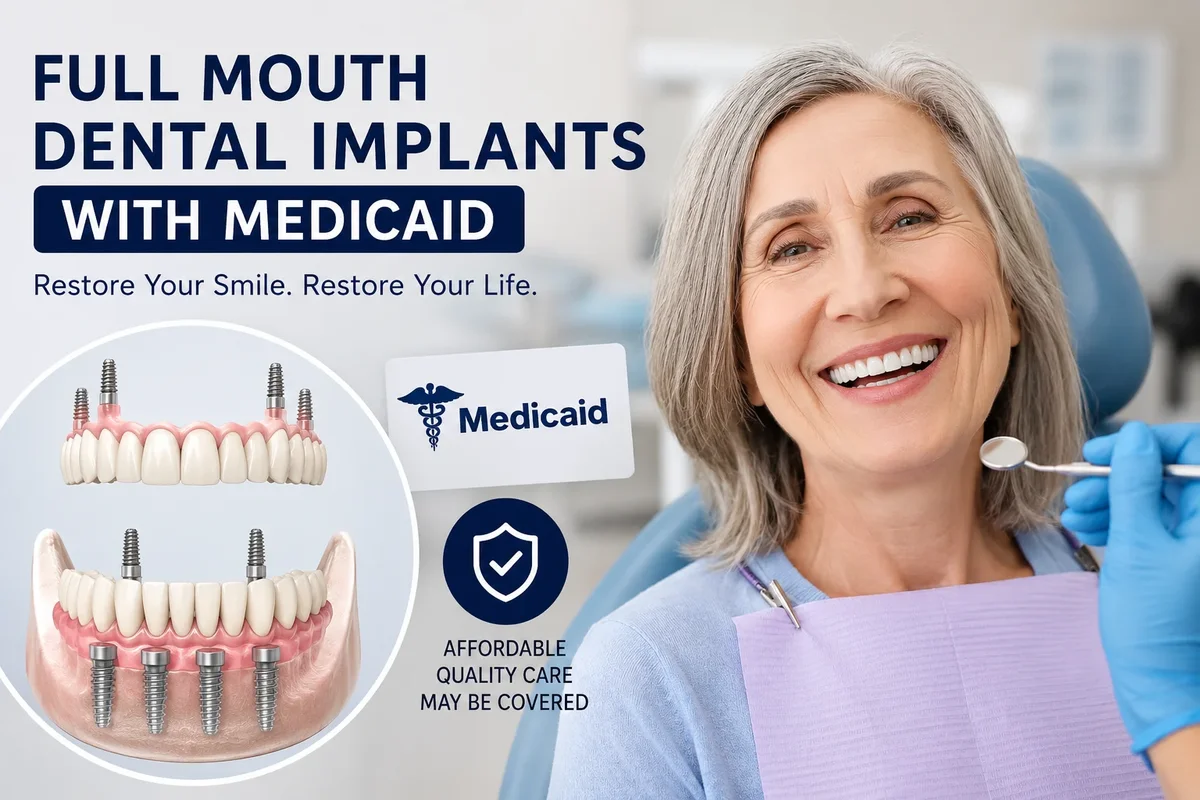
States That May Offer Coverage for Full Mouth Dental Implants
One of the most important factors affecting access to full mouth dental implants with medicaid is the state in which a patient lives. Unlike many federal healthcare programs that operate under uniform nationwide standards, Medicaid allows states considerable flexibility in determining adult dental benefits. As a result, opportunities for obtaining full mouth dental implants with medicaid vary significantly across the United States.
Many patients become frustrated when reading conflicting information online about full mouth dental implants with medicaid. In most cases, these differences occur because one person’s experience may come from a state with broader dental benefits, while another patient’s experience may come from a state that provides only emergency dental care.
Understanding how state Medicaid programs differ can help patients identify potential coverage opportunities and avoid misunderstandings during the treatment planning process.
Why State Medicaid Programs Differ
Although Medicaid receives federal funding, states administer their own programs and determine many aspects of adult dental coverage.
Each state decides:
- Which dental services are covered
- Who qualifies for benefits
- What procedures require authorization
- Whether implant treatment may be approved
- How medical necessity is evaluated
- Which providers participate in the program
This flexibility explains why full mouth dental implants with medicaid may be more accessible in some locations than others.
States With More Comprehensive Adult Dental Benefits
Historically, several states have offered broader adult dental coverage compared with many other Medicaid programs. While coverage policies change periodically, states with more comprehensive dental benefits may provide greater opportunities for patients pursuing full mouth dental implants with medicaid.
Examples of states that have often maintained relatively extensive adult dental programs include:
- California
- New York
- Massachusetts
- Washington
- Oregon
- Minnesota
- Colorado
- Connecticut
It is important to understand that comprehensive dental benefits do not automatically mean full implant coverage. However, patients seeking full mouth dental implants with medicaid may encounter more potential pathways in states that invest heavily in adult oral healthcare.
Important Note
Medicaid regulations change frequently. Patients should always verify current coverage directly with their state’s Medicaid agency rather than relying solely on older online information.
States That May Approve Implants for Medical Necessity
Even in states where implant coverage is not routinely available, exceptions may sometimes be granted when strong medical necessity exists.
Situations that may support approval for full mouth dental implants with medicaid include:
- Severe facial trauma
- Cancer-related jaw reconstruction
- Congenital craniofacial disorders
- Severe functional impairment
- Documented inability to wear dentures
- Major oral defects affecting nutrition
Because each Medicaid program uses different review criteria, approval decisions are typically made on a case-by-case basis.
How Managed Care Plans Affect Coverage
In many states, Medicaid services are administered through managed care organizations rather than directly by the state government.
This can create additional complexity when evaluating full mouth dental implants with medicaid.
Managed care plans may have:
- Different provider networks
- Unique authorization procedures
- Additional documentation requirements
- Specialized review panels
- Specific appeal processes
Patients should review not only state Medicaid rules but also the policies of their specific managed care plan.
States With Limited Adult Dental Benefits
Some Medicaid programs provide only minimal adult dental coverage. In these states, obtaining approval for full mouth dental implants with medicaid may be significantly more challenging.
Limited-benefit programs often focus on:
- Emergency dental treatment
- Pain management
- Infection control
- Extractions
- Basic preventive services
When implant coverage is unavailable, patients may need to explore alternative options such as dental schools, financing plans, charitable assistance programs, or implant-retained overdentures.
How to Check Your State’s Coverage
Patients interested in full mouth dental implants with medicaid should never assume that information from another state applies to their situation.
The most reliable approach is to verify benefits directly through official Medicaid resources.
Recommended Steps
- Contact your state Medicaid office.
- Review official Medicaid dental benefit documents.
- Speak with participating dental providers.
- Ask about implant-specific authorization requirements.
- Confirm current coverage policies.
- Request written information whenever possible.
These steps can help patients obtain accurate information regarding full mouth dental implants with medicaid in their specific location.
The Importance of Provider Experience
Even when coverage opportunities exist, success often depends on working with providers who understand Medicaid procedures.
Experienced providers can assist patients seeking full mouth dental implants with medicaid by:
- Preparing documentation
- Submitting prior authorizations
- Gathering diagnostic evidence
- Writing medical necessity reports
- Managing appeals when needed
This expertise can make a substantial difference in navigating complex approval requirements.
Can Coverage Change Over Time?
Yes. Medicaid dental benefits frequently change due to legislative updates, state budgets, healthcare reforms, and policy revisions.
Patients who were previously denied full mouth dental implants with medicaid should not assume they will always remain ineligible. Coverage criteria, authorization pathways, and benefit structures can evolve over time.
Periodic reevaluation of available benefits may reveal new opportunities that were not previously available.
State Coverage Is Only One Piece of the Puzzle
While state policies play a major role, approval for full mouth dental implants with medicaid also depends on factors such as medical necessity, oral health status, provider participation, and documentation quality.
Two patients living in the same state may receive different outcomes based on their individual circumstances and supporting evidence.
Final Thoughts
State Medicaid policies are one of the most important factors influencing access to full mouth dental implants with medicaid. Some states offer broader adult dental benefits and may provide pathways to implant coverage under specific circumstances, while others maintain more restrictive programs.
Because regulations change regularly, patients should always verify current benefits directly through official Medicaid resources and consult experienced providers who understand authorization procedures. By researching state-specific rules, documenting medical necessity, and exploring all available options, patients can maximize their chances of obtaining full mouth dental implants with medicaid and moving closer to a stable, functional, and confident smile.